


INTRODUCTION
We live in polarized times. Partisans dislike and distrust members of the opposing party—both leaders and the rank and file—to an unprecedented degree (Iyengar et al. Reference Iyengar, Lelkes, Levendusky, Malhotra and Westwood2019). This phenomenon of affective polarization raises important questions about the origins and development of partisan attitudes, especially because studies of socialization document that children acquire their partisan identity at an early age primarily through parental transmission (Hyman Reference Hyman1959; Jennings and Niemi Reference Jennings and Niemi1981; Sears Reference Sears, Greenstein and Polsby1975). If parents are polarized, we would expect the same of children. However, early studies of socialization (most conducted before 1980), documented the acquisition of a partisan identity that was unaccompanied by in-group favoritism. Instead, children on both sides of the party divide expressed idealized evaluations of political leaders (Kinder and Sears Reference Kinder, Sears, Lindzey and Aronson1985).
Our goal is to update the earlier socialization research in order to establish the timeline under which polarization takes hold. We also seek to follow up on earlier research demonstrating the powerful role of parents as socialization agents. Our findings derive from a national sample of children between the ages of 11 and 17 and a parallel sample of their parents. This study serves as a partial replication of a well-cited 1980 socialization study (Sears and Valentino Reference Sears and Valentino1997), which we use as a temporal baseline. By comparing attitudes toward the same party labels over time, we are able to show how the development of childhood attitudes (and parent–offspring correspondence) has evolved over the past 40 years.
We find that adolescents who identify as Republican or Democrat have become just as polarized as adults. The increased level of polarization in the youth sample occurs not because partisans became more positive in their evaluations of their own party but primarily because their distrust of the opposing party increased dramatically.
We begin by summarizing the vast literature on childhood socialization, paying particular attention to childhood evaluations of political leaders and the gradual transition from blanket positivity to evaluations grounded in partisan affiliation. We then describe the two surveys used to shed light on changes in the level of preadult and adult polarization between 1980 and 2019. After presenting our results, we conclude by discussing the implications of our findings for the development of political attitudes in childhood and adolescence and, more generally, for the state of contemporary American politics.
REVISITING SOCIALIZATION RESEARCH
Socialization research dates back to the 1960s, with multiple studies documenting three main findings. First, young children view governmental figures much more favorably than adults (Greenstein Reference Greenstein1960; Hess and Torney Reference Hess and Torney1967; Sears Reference Sears, Greenstein and Polsby1975). Second, children acquire their partisan identity at an early age, typically through parental transmission (Hyman Reference Hyman1959). Third, in comparison with adults, partisan affiliation only weakly conditions evaluations of political leaders (Greenstein Reference Greenstein1960; Hess and Torney Reference Hess and Torney1967). Taken together, these findings indicated that polarization would not apply to children’s evaluations of political leaders.
As children age, their sense of party identification becomes more cognitively grounded and thus more likely to condition evaluations of political leaders and groups (Kinder and Sears Reference Kinder, Sears, Lindzey and Aronson1985; Sears and Whitney Reference Sears and Whitney1973). However, despite this growth in partisan attitudes, adolescents still expressed substantially more trust in government than did their parents (Jennings and Niemi Reference Jennings and Niemi1981, 96).
Socialization researchers attributed the absence of partisan divisions in children’s political views to several factors. First, young children personalized government in terms of salient political leaders such as the president (Greenstein Reference Greenstein1960), giving rise to the “person positivity” bias (Sears Reference Sears1983) by which individuals come to be viewed more favorably than the groups or categories they represent. Second, young children’s complete dependence on adults creates psychological pressures to view adult political leaders as benevolent (Dawson, Prewitt, and Dawson Reference Dawson, Prewitt and Dawson1977, 70). As children age and become more self-sufficient, these anxiety-related concerns abate and views of political authority become less idealized. Third, children’s sense of partisan identity reflects only a limited understanding of the groups and interests represented by the parties. In keeping with social learning theory (Bandura Reference Bandura1977), young children may simply mimic the political affiliations of their parents—observable on a regular basis—without developing the concomitant feelings of in-group favoritism.Footnote 1
Although the socialization process includes gradual age-related increases in partisan attitudes, contextual effects can also come into play. In the aftermath of the Watergate scandal, children’s evaluations of political leaders became less idealized (Hershey and Hill Reference Hershey and Hill1975). In their Wisconsin study, Sears and Valentino (Reference Sears and Valentino1997) found that exposure to the 1980 presidential campaign caused children to make more partisan evaluations (also, see Patterson et al. Reference Patterson, Bigler, Pahlke, Brown, Amy Roberson Hayes and Nelson2019). However, although the campaign did make partisanship more salient for children, the difference in polarization between children and adults remained substantial at all stages of the campaign, with adults showing greater polarization.
If short-term forces contribute to socialization, then we might also expect children to respond to intensified polarization. Today, party cues constrain matters of social and interpersonal relations (Iyengar et al. Reference Iyengar, Lelkes, Levendusky, Malhotra and Westwood2019). Surveys show that partisans have few friends from the opposing side (Pew Research Center 2017) and their online social networks are no less homogeneous (Bakshy, Messing, and Adamic Reference Bakshy, Messing and Adamic2015). Polarization has contributed to strengthened spousal partisan agreement from around 60% of couples in the mid-1960s (Jennings and Niemi Reference Jennings and Niemi1968; Reference Jennings and Niemi1981) to near 85 percent today (Iyengar, Konitzer, and Tedin Reference Iyengar, Konitzer and Tedin2018). In short, polarization has caused partisanship to become a much more salient social identity, resulting in strengthened parent–offspring agreement (Iyengar, Konitzer, and Tedin Reference Iyengar, Konitzer and Tedin2018).
As we noted at the outset, the evidence bearing on preadult evaluations of political leaders derives almost entirely from studies carried out before the onset of intensified party polarization. We know of only three studies of preadult attitudes fielded over the past two decades in the United States. In 2000, researchers surveyed 4th–8th grade students in one American city. As expected, children’s attitudes were less positive than comparable attitudes from the 1960s (Carter and Teten Reference Carter and Teten2002). However, this study did not assess partisan differences in children’s attitudes. The second study—a national online survey of children and their parents conducted in 2015 (Iyengar, Konitzer, and Tedin Reference Iyengar, Konitzer and Tedin2018)—documented dramatic postpolarization increases in both intergenerational and spousal agreement on party identification. Finally, researchers interviewed a sample of 500 grade school children in 2017 and 2018 (Oxley et al. Reference Oxley, Holman, Greenlee, Bos and Lay2020). They too found evidence of declining positivity, but they do not analyze partisan affiliation in the paper. Our study builds on these works by examining when in the life cycle partisan polarization occurs in the evaluations of politicians.
In summary, classic studies of political socialization suggest that polarized evaluations of political institutions and leaders occurs postchildhood. However, as indicated by the more recent research, children do respond to changes in the political environment. Given the charged contemporary political environment of today, we anticipate that the gap between adult and preadult polarization may be closing.
DATA
To compare adolescents across time, we employ a repeated cross-sections design using data from two surveys that asked similar questions in 1980 and 2019. Our “prepolarization” data is based on a well-known statewide telephone survey of Wisconsin families (Sears and Valentino Reference Sears and Valentino1997; Sears, Dennis, and Chaffee Reference Sears, Dennis and Chaffee2015). The sample consisted of Wisconsin households with children between the ages of 10 and 17. For each preadult respondent completing the survey, the researchers also interviewed one of their parents (selected randomly). Our “postpolarization” dataset is a 2019 national online survey of children between the ages of 11 and 17 whose parents are members of the YouGov online panel.Footnote 2 We document the details of each dataset in online appendix A.Footnote 3
Both surveys included questions probing trust in the major political parties. The questions appeared in identical format: “How often do you think you can trust X to do what is right?” Responses were coded on a five-point scale, with 5 denoting the highest level of trust and 1 the lowest level of trust.Footnote 4
RESULTS
We turn now to the results of our data analysis. First, after contextualizing adolescent party identification, we show that adults and adolescents have become similarly polarized in their evaluations of the parties since 1980. Second, we show that parents and their children agree on party identification far more in 2019 than they did in 1980, and that agreement on party identification is a strong predictor of adolescent polarization.
Partisan Identification
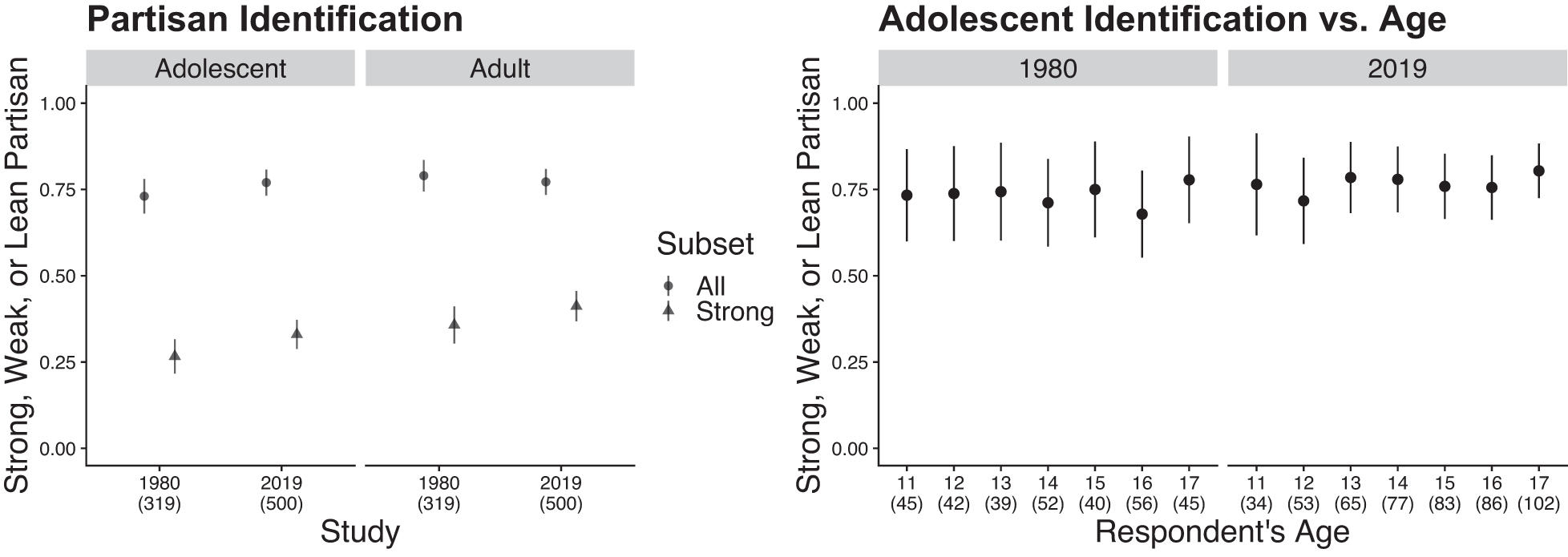
To place our full results in context, Figure 1 plots the rate at which adolescents and adults self-identify with either the Democratic or Republican party. The left panel of the figure shows the percentage of the sample expressing a partisan identity (strong, weak, or leaning) and also the subsets classified as strong partisan.Footnote 5 Even in 1980, nearly as many adolescents as adults expressed a partisan identity. Figure 1 does show that strong partisanship is 9 percentage points higher among adults than among adolescents (p < 0.01). However, we find no evidence that the magnitude of the adult–adolescent gap has changed over time (see Table C.1 in the online appendix). These results imply that any changes to the adolescent–parent gap in partisan trust cannot be attributed merely to heightened levels of partisan identity among adolescents in 2019. It also appears (from the flat line in the panel to the right) that adolescent partisan identification is well established by age 11 in both periods.
Partisan Identification
Note: Share of adolescent and adult respondents classified as strong, weak, or leaning partisan in each study. Numbers in parentheses correspond to the number of respondents in that study’s age group.

Polarized Evaluations of the Political Parties
We first examine partisan differences in the trustworthiness of the political parties. If adolescent partisans remain much more trusting than adults toward the opposition party, then we might conclude that they have not yet begun to internalize adult levels of partisan animosity. Alternatively, adult-like levels of adolescent polarization would suggest that adolescents have already been sufficiently socialized to acquire in-party favoritism and out-party animus.
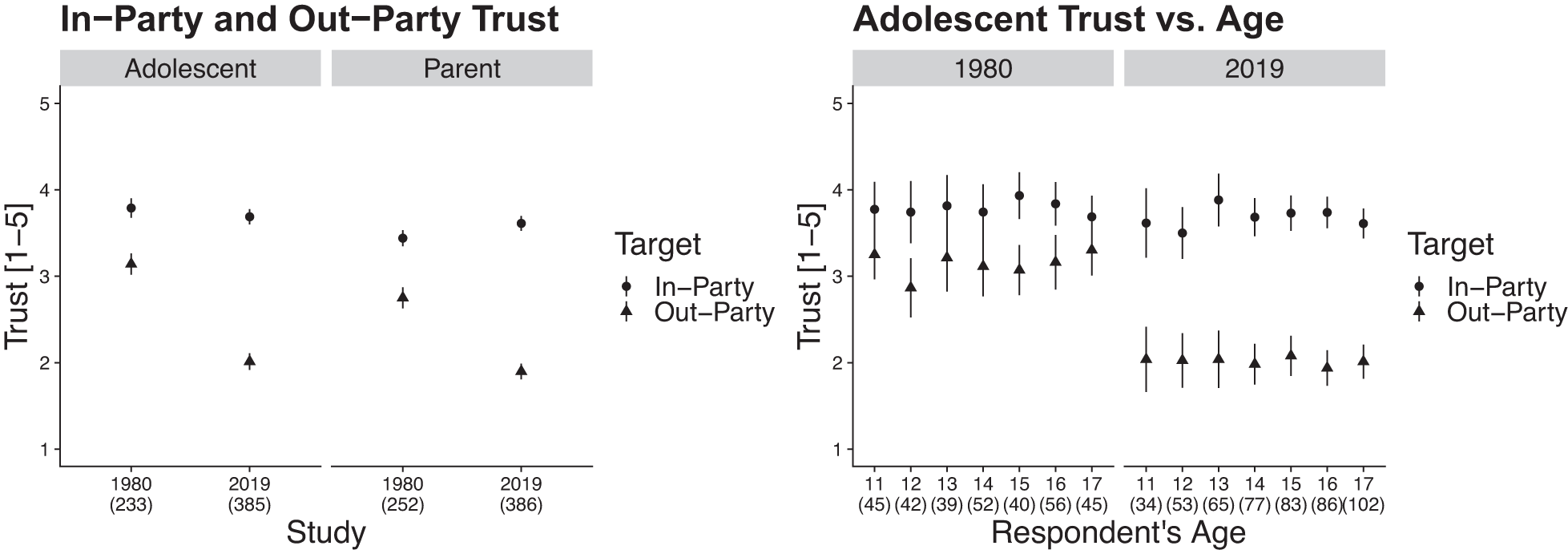
Figure 2 plots the average level of in-party and out-party trust among partisan adolescents and partisan adults (left panel) and among adolescents across age (right panel). Consistent with the earlier literature, the average adolescent in the 1980 sample was more trusting of the parties than their parents were, by 0.35 for the in-party and by 0.39 out-party. By 2019, however, the gap between adolescents and adults had shrunk considerably, to 0.08 and 0.11, respectively.
In-Party and Out-Party Trust over Time
Note: Numbers in parentheses correspond to the number of respondents in that study’s age group.

Second, both adolescents and adults provide much more negative evaluations of the out-party in 2019. In 1980, the average adolescent gave the out-party a trust score of 3.14, which is a little higher than an average response of trusting the out-party “about half of the time.” By 2019, the average adolescent gave the out-party a much lower trust score of 2.01—that is, an average response of “not very often.” We show these differences are robust to controlling for parental age, political interest, and ethnicity in Table C.2 in the online appendix. More broadly, the results accord with the significant increase in out-party animus over the past four decades documented by national surveys and multiple indicators of partisan affect (Iyengar et al. Reference Iyengar, Lelkes, Levendusky, Malhotra and Westwood2019).
Third and finally, we find that this pattern of increased polarization appears largely constant across adolescent age groups at both points. The right panel of Figure 2 shows that, for both in-party and out-party trust, the age-related slope is flat. Contrary to the earlier literature showing gradual age-related increases in partisan attitudes, these results show polarization occurring at an early age with minimal changes thereafter.
Robustness of the Trust Measure
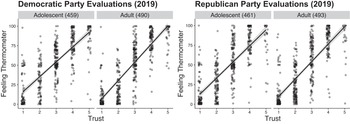
Most studies of affective polarization rely on feeling thermometer ratings of the parties and candidates for office, raising questions over the construct validity of our trust indicators. Fortunately, the 2019 survey included the standard feeling thermometer question for both parties. Figure 3 shows that there is a strong convergence between the thermometer and trust scores in both the adolescent and adult samples. The lowest trust–thermometer correlation coefficient is 0.75. Therefore, we can be confident that the trust measure is tapping into partisan affect.
Measuring Partisan Affect
Note: The standard feeling thermometer measure plotted against the trust score used in this study. Points are “jittered” horizontally by 0.1 for visual clarity.

Household Influence
Having documented the significant increase in polarization among youth, we turn next to explore possible sources of childhood attitudes. As noted at the outset, there is a vast literature on “agents” of socialization (Dawson, Prewitt, and Dawson Reference Dawson, Prewitt and Dawson1977; Jennings and Niemi Reference Jennings and Niemi1981; Ojeda and Hatemi Reference Ojeda and Hatemi2015; Tedin Reference Tedin1974), showing that parental influence is the primary source of partisan attitudes.Footnote 6 Below, we explore whether polarization might have strengthened the role of parents in the development of partisan attitudes.
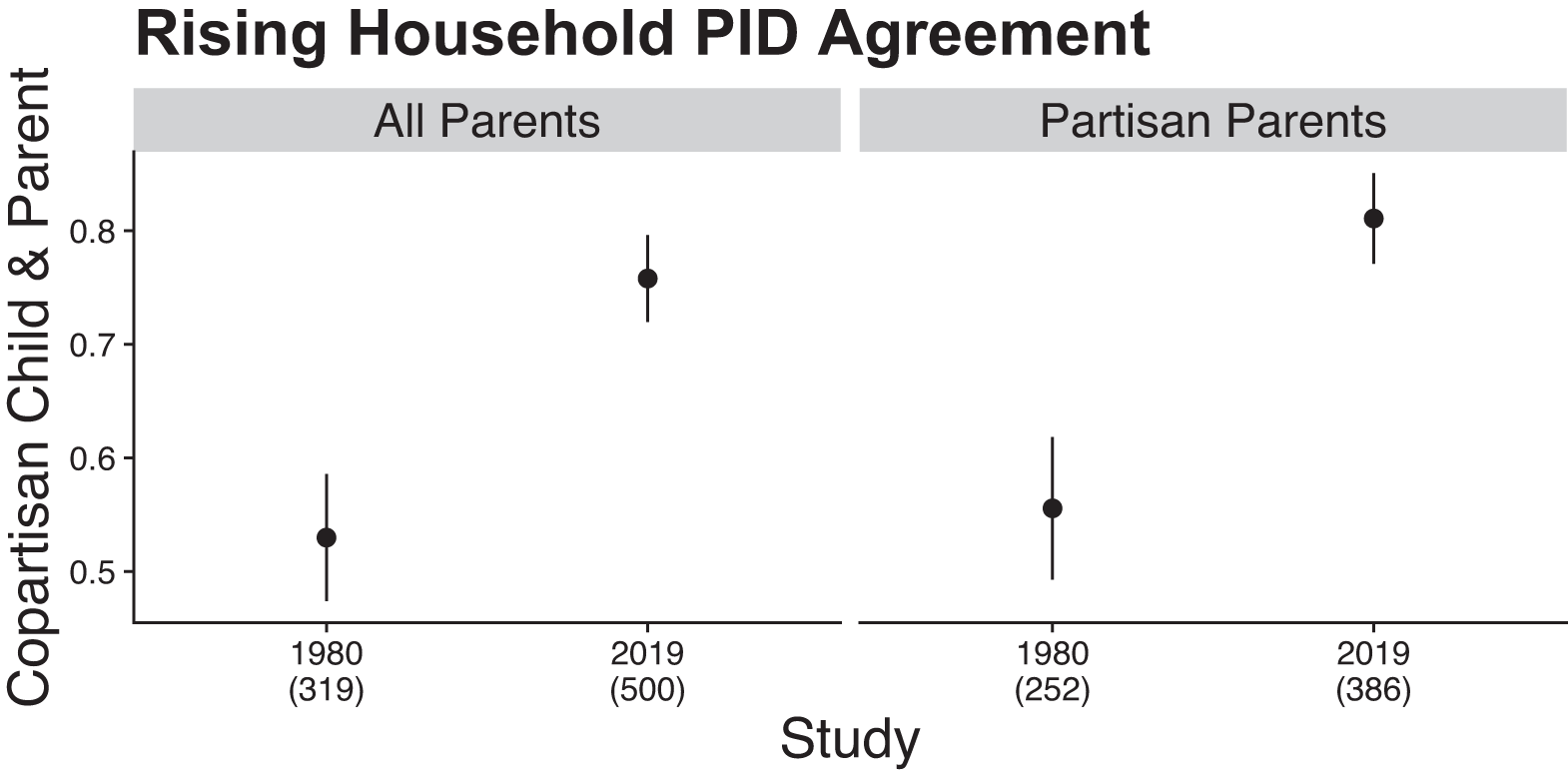
Figure 4 shows the level of parent–offspring agreement on partisan identity and how the level of agreement has increased over time. In 1980, the average level of intergenerational agreement for children with Democrat or Republican parents was 56%. By 2019, that number had increased to around 81%.
Child–Parent Copartisanship over Time

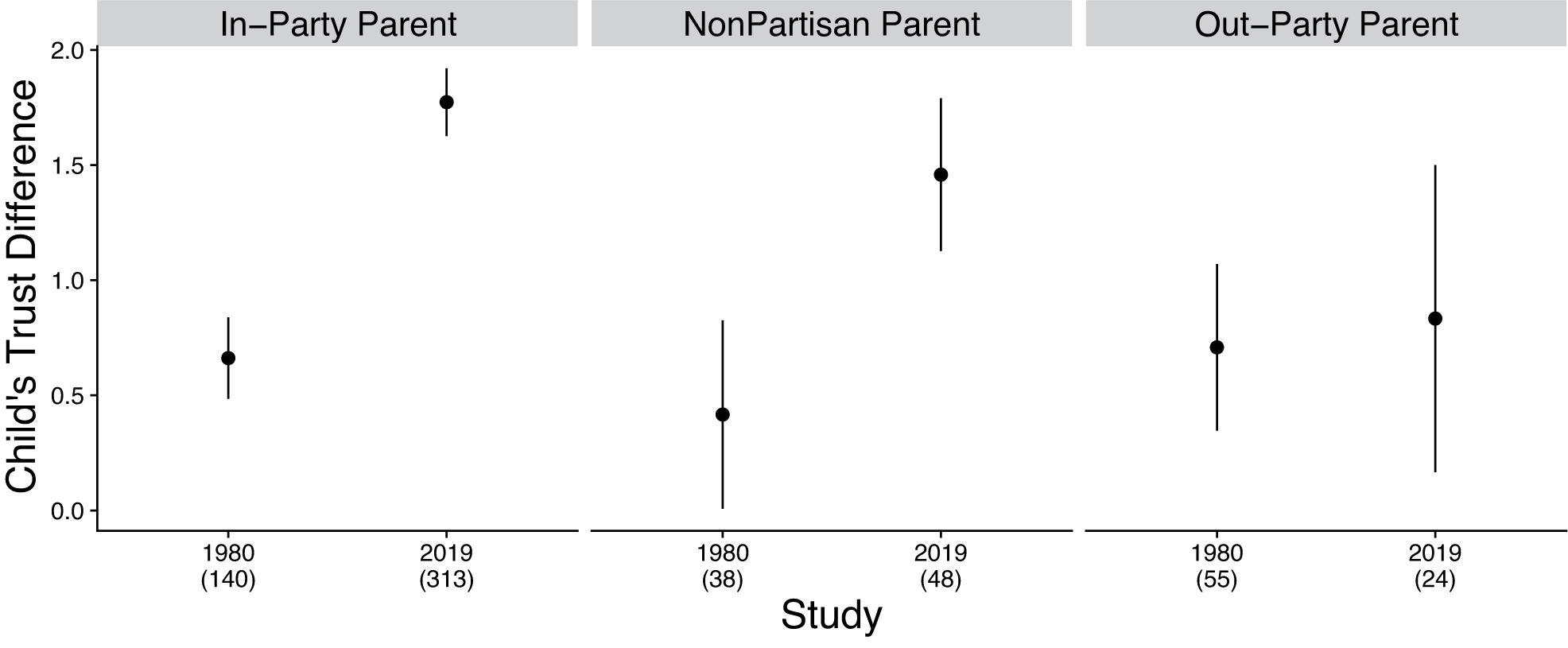
We can also exploit differences in the level of parent–offspring agreement to examine whether agreement conditions trust in the parties. Figure 5 shows how parent–offspring agreement on party identification predicts polarization of party trust (defined as the difference between in-party and out-party trust). In 1980, children who adopted or rejected the parent’s affiliation expressed similar levels of in-party and out-party trust. In 2019, however, the trust difference score is elevated among offspring who report the same party affiliation as their parents.
Child Polarization Depends on Child-Parent Copartisanship
Note: Outcome is in-party minus out-party trust scores. Higher values indicate that the child trusts their party more than the other party.

To the degree familial agreement is a proxy for parental influence, these results suggest that parental socialization is increasing hostility across the party divide.
The elevated level of parent–offspring agreement suggests that the most likely explanation for heightened adolescent polarization is parental influence. In the case of parent–offspring disagreement, not only is there a break with parental attitudes; partisanship does not necessarily elicit out-party animus. This is most likely because children in these households, by definition, have close personal relations with a member of the opposite party.
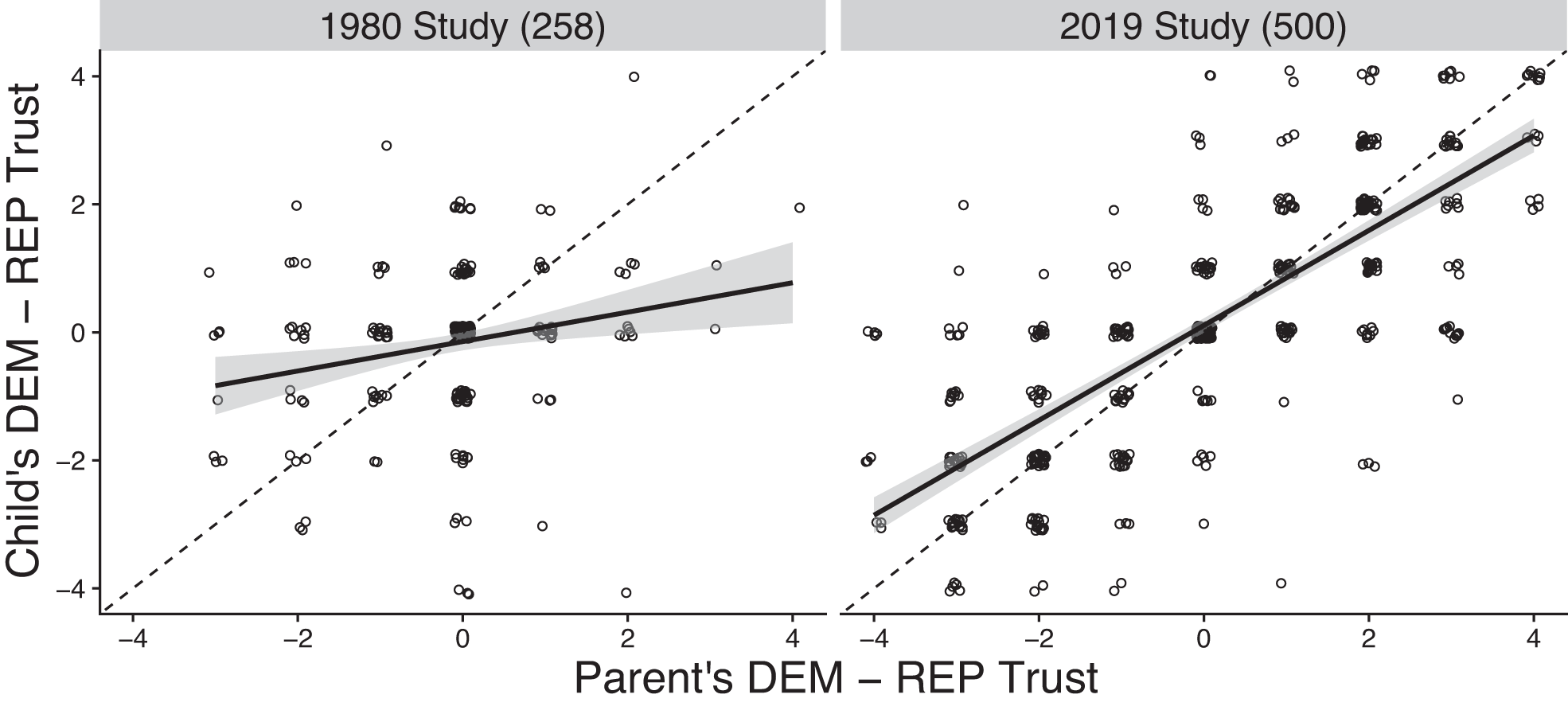
We can further test for strengthened parental transmission of partisan sentiments by regressing the offspring’s net trust score on the parent’s score at both points. A slope of 0 would indicate that parent net trust does not help predict child net trust, whereas a slope of 1 would indicate that children inherit their parent’s net trust. As shown in Figure 6, the slope for parental influence is much steeper in 2019. In 1980, the regression coefficient is only 0.23 (0.08); by 2019, it is 0.74 (0.03).
Parent Trust Increasingly Correlates with Adolescent Trust
Note: The difference between trust in the Democratic Party (1–5) and trust in the Republican Party (1–5) for children versus their parents over time. The dashed line corresponds to perfect child–parent agreement. Confidence intervals are based on robust standard errors (HC2). Formal estimates are available in Table C.3 in the online appendix.

Although Figure 5 and Figure 6 point to the significant influence of parents as sources of children’s partisan trust, we acknowledge that children may also be subject to other influences. For instance, the multiple controversies surrounding the Trump presidency may have prompted children to more frequently engage in political conversations with friends and peers.Footnote 7 Alternatively, the greater degree of polarization expressed by children in same-party households may reflect the direct effects of residence in politically homogeneous neighborhoods where partisan sentiments are more polarized.
To recap, our analysis reveals several important descriptive facts. Adolescents develop partisan attachments at a young age. However, in the era of polarization, those partisan attachments are now associated with in-party favoritism and out-party animus, thus matching adult attitudes. Strengthened parent–offspring agreement on partisan attitudes is one possible explanation for the increased level of childhood polarization. Parental polarization is now a much stronger predictor of offspring polarization.
CONCLUSION
We have shown that the onset of partisan polarization occurs early in the life cycle. Today, high levels of in-group favoritism and out-group distrust are in place well before early adulthood. In fact, the absence of age differences in our 2019 results suggests that the learning curve for polarization plateaus by the age of 11. This is very unlike the developmental pattern that held in the 1970s and 1980s, when early childhood was characterized by blanket positivity toward political leaders and partisanship gradually intruded into the political attitudes of adolescents before peaking in adulthood.
When we considered the antecedents of children’s trust in the parties, our findings confirm the earlier literature documenting the primacy of the family as an agent of socialization (Jennings and Niemi Reference Jennings and Niemi1968; Jennings, Stoker, and Bowers Reference Jennings, Stoker and Bowers2009; Tedin Reference Tedin1974). Polarized parents seem to transmit not only their partisanship but also their animus toward opponents. It is striking that the least-polarized youth respondents in 2019 are those who have not adopted their parental partisan loyalty.
In closing, our findings have important implications for the study of political socialization. Fifty years ago, political socialization was thought to play a stabilizing role important to the perpetuation of democratic norms and institutions. In particular, children’s adoption of uncritical attitudes toward political leaders helped to legitimize the entire democratic regime. Indeed, researchers cited this “functional” role of socialization in justifying the study of political attitudes in childhood (Kinder and Sears Reference Kinder, Sears, Lindzey and Aronson1985; van Deth, Abendschön, and Vollmar Reference van Deth, Abendschön and Vollmar2011).
In the current era, it seems questionable whether the early acquisition of out-party animus fosters democratic norms and civic attitudes. Extreme polarization is now associated with rampant misinformation (Peterson and Iyengar Reference Peterson and Iyengar2021) and, as indicated by the events that occurred in the aftermath of the 2020 election, with willingness to reject the outcome of free and fair electoral procedures. The question for future research is how to transmit party attachments, as occurred in the prepolarization era, without the accompanying distrust and disdain for political opponents.
Supplementary Materials
To view supplementary material for this article, please visit http://doi.org/10.1017/S000305542200048X.
DATA AVAILABILITY STATEMENT
Research documentation and data that support the findings of this study are openly available at the American Political Science Review Dataverse: https://doi.org/10.7910/DVN/TMJWIA (Tyler and Iyengar Reference Tyler and Shanto2022). Replication code for this article has been published in Code Ocean, a computational reproducibility platform that enables users to run the code, and can be viewed interactively at: https://doi.org/10.24433/CO.4103928.v1 (Tyler Reference Tyler2022).
FUNDING STATEMENT
This research was funded by Shanto Iyengar’s university research account.
ACKNOWLEDGMENTS
We are greatly indebted to Masha Krupenkin for helping us acquire our data. We would also like to thank four anonymous reviewers, Laura Stoker, Nicholas Valentino, Justin Grimmer, and seminar participants at the Stanford Democracy and Polarization Lab for their invaluable comments. All errors are entirely our own.
CONFLICT OF INTEREST
The authors declare no ethical issues or conflicts of interest in this research.
ETHICAL STANDARDS
The authors declare the original human subjects research in this article was reviewed and approved by the Stanford University IRB under the title “Youth-Parent Socialization Survey” (eProtocol 47566) with approval documentation provided at the American Political Science Review Dataverse: https://doi.org/10.7910/DVN/TMJWIA (Tyler and Iyengar Reference Tyler and Shanto2022). The authors affirm that this article adheres to the APSA’s Principles and Guidance on Human Subject Research.




Comments
No Comments have been published for this article.