INTRODUCTION
Since the 1970s, rising temperatures in the Mediterranean have led to an expansion in habitats suitable for warm-water species, facilitating their settlement at an unexpectedly rapid rate (Vargas-Yáñez et al., Reference Vargas-Yáñez, García, Salat, García-Martínez, Pascual and Moya2008, Reference Vargas-Yáñez, Moya, García-Martínez, Tel, Zunino, Plaza, Salat, Pascual, López-Jurado and Serra2010; Raitsos et al., Reference Raitsos, Beaugrand, Georgopoulos, Zenetos, Pancucci-Papadopoulou, Theocharis and Papathanassiou2010). Trends of increasing abundance and northward expansion have been recorded for warm-water fish taxa, such as the Carangidae and Sphyraenidae families, meanwhile other Mediterranean species, such as the Scombridae and Cupleidae families, have declined in abundance (Azzurro et al., Reference Azzurro, Moschella and Maynou2011). Several species of the Carangidae family presently support a diverse array of economically important fisheries in tropical and subtropical waters worldwide.
There are several carangid species in the temperate areas within the north-western region of the Mediterranean basin (the Gulf of Lyon and surrounding coastal areas), such as the leer fish Lichia amia, the pilot fish Naucrates ductor, the greater amberjack Seriola dumerili, the Mediterranean horse mackerel Trachurus mediterraneus, the blue jack mackerel Trachurus picturatus, and the Atlantic horse mackerel Trachurus trachurus. However, during the last decade a previously unusual warm-water carangid species, the pompano Trachinotus ovatus has become more frequent in the Gulf of Roses and adjacent waters (southern Gulf of Lyon) (Lloret et al., Reference Lloret, Sabatés, Muñoz, Demestre, Solé, Font, Casadevall, Martín and Gómez2015). Unfortunately, accurate records of the abundance of this species within the area are virtually non-existent because up to now the pompano has been caught unintentionally while fishing for other target species, and is considered as a by-catch species among the area's fishing community.
Of the 20 species from the genus Trachinotus described worldwide, only T. ovatus inhabits the Mediterranean Sea although its distribution extends north and south of the Eastern Atlantic coasts, from Scandinavian and British waters to the Bay of Biscay and as far south as Angola (Smith-Vaniz, Reference Smith-Vaniz, Whitehead, Bauchot, Hureau, Nielsen and Tortonese1986; Froese & Pauly, Reference Froese and Pauly2013). The pompano is a pelagic coastal and schooling species that is found primarily in brackish environments (especially young) and, as adults, are moderately common in shallow water in areas of surge, over sand or muddy bottoms, where they are commonly caught commercially with trawl nets, purse seines, traps, and hook-and-lines (Smith-Vaniz, Reference Smith-Vaniz, Whitehead, Bauchot, Hureau, Nielsen and Tortonese1986; Schneider, Reference Schneider1990). Scientific information on pompano biology is considerably sparse. Its reproductive biology has been investigated in just one scientific publication which explored the biochemical aspects of reproduction in female pompano in Egyptian waters (Assem et al., Reference Assem, El-Serafy, El-Garabawy, El-Absawy and Kaldus2005). There is a preliminary study into feeding, growth, food conversion efficiency and feeding behaviour of wild-caught pompano reared in captivity in Croatian coastal waters (Tutman et al., Reference Tutman, Glavić, Kožul, Skaramuca and Glamuzina2004). The diet and diel feeding activity of juvenile pompanos from the south-eastern Adriatic Sea has been examined (Batistić et al., Reference Batistić, Tutman, Bojanić, Skaramuca, Kožul, Glavić and Bartulović2005). The length-weight relationships of this species have also been estimated for specimens reared in floating sea cages in the South China Sea (Guo et al., Reference Guo, Ma, Jiang, Zhang, Zhang and Li2014) as well as for wild populations from the Azores Islands (Morato et al., Reference Morato, Afonso, Lourinho, Barreiros, Santos and Nash2001) and from the western Mediterranean (Morey et al., Reference Morey, Moranta, Massutí, Grau, Linde, Riera and Morales-Nin2003). However, research into other reproductive traits that may indicate the breeding season, sexual maturity and spawning in both sexes of this species is virtually non-existent for the NW Mediterranean or elsewhere in its distribution range.
Clime-driven changes in the abundance and distribution of fish can lead to readjustments in ecosystems and alterations in the way they function which have been well documented (Francour et al., Reference Francour, Boudouresque, Harmelin, Harmelin-Vivien and Quignard1994; Perry et al., Reference Perry, Low, Ellis and Reynolds2005; Coll et al., Reference Coll, Piroddi, Steenbeek, Kaschner, Ben Rais Lasram, Aguzzi, Ballesteros, Bianchi, Corbera, Dailianis, Danovaro, Estrada, Froglia, Galil, Gasol, Gertwagen, Gil, Guilhaumon, Kesner-Reyes, Kitsos, Koukouras, Lampadariou, Laxamana, López-Fé de la Cuadra, Lotze, Martin, Mouillot, Oro, Raicevich, Rius-Barile, Saiz-Salinas, San Vicente, Somot, Templado, Turon, Vafidis, Villanueva and Voultsiadou2010). But it has also been pointed out that we need a better understanding of the physiological and behavioural response of fish to climate change since such impacts might vary across the different stages of the life cycle (Petitgas et al., Reference Petitgas, Rijnsdorp, Dickey-Collas, Engelhard, Peck, Pinnegar, Drinkwater, Huret and Nash2013); thus, the more knowledge we have of the life cycles of various species, the better our understanding of the impacts of climate change on fish populations will be. Consequently, the overall aim of this study was to explore the reproductive traits of Trachinotus ovatus and our results are discussed in relation to the expansion and establishment of this species in the colder waters of the NW Mediterranean. In addition, temporal variations in sea surface temperatures (SSTs) within the study area were also analysed in order to investigate whether we could explain if its seasonal arrival and/or reproductive traits are triggered by the physical conditions of the coastal waters off the NW Mediterranean.
MATERIALS AND METHODS
Study area and sample collection
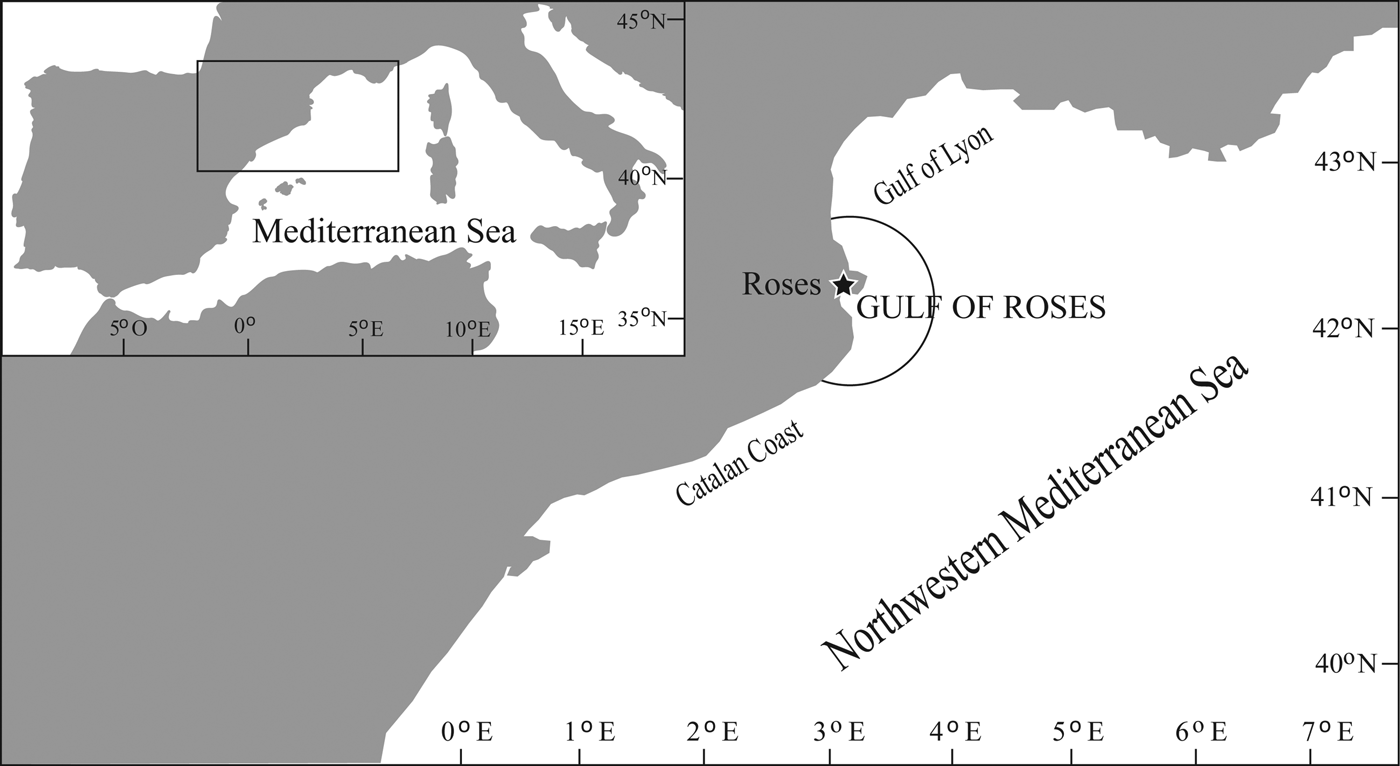
Pompano specimens were collected monthly from fishermen (coastal purse seiners) at the Port of Roses (Figure 1), from July 2010 to September 2012, shortly after landing. It should be noted that fishermen were asked for the approximate location and depth where the specimens were caught in order to be sure that the origin of the samples was within the coastal waters of the study area. In addition, data on sea surface temperatures (SST, in °C) were retrieved from the International Comprehensive Ocean-Atmosphere Data Set (ICOADS) for the study period 2010–2012 in the north-western Mediterranean (ds540.0-Release 2.5) (Woodruff et al., Reference Woodruff, Worley, Lubker, Ji, Eric Freeman, Berry, Brohan, Kent, Reynolds, Smith and Wilkinson2011). The data comprised individual daily mean SST observations for 1° latitude × 1° longitude units in surrounding waters off the Gulf of Roses (42.0–43.0°N and 3.0–4.0°E) (Figure 1). Then, the mean monthly values of SSTs were calculated by averaging daily SSTs.
Map of the north-western Mediterranean basin showing the study area (Gulf of Roses and adjacent waters) and the location of the fishing port of Roses.

Fish size distribution
Once in the laboratory, all specimens were measured and weighed using the total length (TL) to the nearest 0.5 cm and total weight (TW) to the nearest 1 mg. Then, all samples were dissected and eviscerated, and the somatic or eviscerated body weight (SW) and the gonad weight (GW) were obtained to the nearest 1 mg. The length-weight relationship (LWR) was estimated using the curvilinear formula SW = a·TL b (LeCren, Reference LeCren1951), where SW is the somatic body weight of the fish and TL is the total length of the fish. The gonads were fixed in 4% buffered formaldehyde for further histological processing and fecundity estimation.
Gonadal development, spawning season and size at 50% maturity
The gonadosomatic index (GSI) was calculated for each individual based on SW in order to avoid possible variations arising from differences in the contents of the digestive tract with the following formula: GSI = 100 × (GW/SW), where GW and SW represent gonad and somatic weights, respectively. Although the sex and reproductive status of specimens were first macroscopically determined, a histological analysis was also performed in order to provide a more accurate analysis of the reproductive characteristics of the pompano. Thus, a histological study of the gonads of every single individual was carried out in order to determine the phases of development of their germ cells. Central portions (transverse sections) of the fixed gonads were dehydrated and embedded in paraffin, sectioned at between 3–8 µm, depending on their state of gonadal development because the early phases required thinner sections in order to facilitate the identification of their germ cells, and then stained with haematoxylin-eosin. The maturity phases of the gonads were classified in line with Brown-Peterson et al. (Reference Brown-Peterson, Wyanski, Saborido-Rey, Macewicz and Lowerre-Barbieri2011) as immature (IMM), developing (DEV), spawning capable (SC), regressing (RGS) and regenerating (RGN). The histological photomicrographs of the gonads of T. ovatus are shown in Figure 2. It should be noticed that ovarian wall thickness was a key factor in distinguishing between immature and regenerating phases in T. ovatus, since a thin ovarian wall was observed in immature specimens whereas a thick ovarian wall (along with atretic oocytes) was observed at specimens in the regenerating phase.
Photomicrographs of ovaries and testis of the T. ovatus showing the reproductive phases considered in this study: (A) immature, (B) developing, (C) spawning capable, (D) regressing and (E) regenerating. Oocyte developmental phases are also shown as PG, primary growth; CA, cortical alveoli; Vtg1, early vitellogenic; Vtg2, mid-vitellogenic; Vtg3, advanced vitellogenic; AT, atretic; POF, post-ovulatory follicles; OW, ovarian wall. Germinal developmental phases are also shown as Sg1, primary spermatogonia; Sg2, secondary spermatogonia; Sc, spermatocyte; St, spermatid; Sz, spermatozoa; Rsz, residual spermatozoa, and Lu, lumen.

Size at 50% maturity (L50) was estimated in order to define sexual maturity as a function of body length (length at which 50% of the individuals were mature) and was estimated separately for females and males. To predict the probability that an individual was mature based on its length binary maturity observations (0 = immature, 1 = mature) and length (TL) were fitted to binary logistic models to construct maturity ogives (maturity-at-length probability plots) based on logistic equations.
Oocyte size-frequency distribution and fecundity estimates
The presence of hydrated oocytes and post-ovulatory follicles (POFs) was histologically determined in order to select suitable specimens for the analyses of the oocyte size-frequency distributions and the estimates of the batch fecundity (defined as the number of eggs spawned per batch). Firstly, batch fecundity (BF) was estimated for each specimen in the spawning capable (SC) phase and without POFs – using the gravimetric method combined with image analysis as explained by Murua et al. (Reference Murua, Kraus, Saborido-Rey, Witthames, Thorsen and Junquera2003). With this aim, subsamples of about 150 mg were taken from the ovary; oocytes were separated from connective tissue using a washing process (Lowerre-Barbieri & Barbieri, Reference Lowerre-Barbieri and Barbieri1993) and sorted by size through several sieves (from 1000 to 100 µm), which facilitated the subsequent work of counting and measuring oocytes using a computer-aided image analysis system (Image-Pro Plus 5.1). It is worth mentioning that subsamples were taken from sections of the middle part of the ovary since there were no significant differences in the number of most advanced oocytes per gram among the anterior, middle and posterior parts of the ovary of 10 specimens that were in the latest developmental phases (ANOVA, F 2,29 = 2.21, P = 0.128). Then, batch fecundity was estimated according to Hunter et al. (Reference Hunter, Lo and Leong1985) as BF = GW × (Y/Sw), where GW is the gonad weight after fixation, Y is the number of hydrated oocytes in a weighted subsample of ovarian tissue and Sw is the subsample weight. The relationship between BF and size (TL) was estimated by fitting power functions. The relative batch fecundity (RBF) was also calculated as batch fecundity per gram of somatic weight of the fish.
Secondly, the oocyte size-frequency distributions were analysed by exploring the size range for each oocyte developmental stage in order to define the oocyte recruitment pattern whether synchronous, group-synchronous or asynchronous (Murua & Saborido-Rey, Reference Murua and Saborido-Rey2003). Thus, the mean diameter of 150 oocytes from each gonadal development phase (50 oocytes per sampling year) of ‘standard’ 35.0 cm TL females (in order to avoid any maternal size effect on estimates) were measured from the histological sections as the average of major and minor axes using the previously mentioned computer-aided image analysis system. Due to their irregular shape in histological transverse sections, the mean diameter of the hydrated oocytes was estimated differently: those largest oocytes previously separated through sieves were separated and then measured using the computer-aided image analysis system.
Egg quality and follicular atresia estimates
The dry weight of hydrated oocytes were used to estimate the quality of the eggs (hydrated oocytes), hence an approximation of the potential reproductive success (Brooks et al., Reference Brooks, Tyler and Sumpter1997). First, hydrated oocytes were previously separated through sieves and then by adding glycerine, which makes them translucent under transmitted light, they were more easily differentiated and separated from those oocytes not yet hydrated. Once the eggs were selected, the mean dry weights (in mg per egg) were estimated by drying (for 24 h at 110°C) two replicates per sample of the eggs from a total of 20 actively spawning females (with hydrated oocytes) per sampling year.
The numbers of normal and α-stage atretic vitellogenic oocytes (Hunter & Macewicz, Reference Hunter and Macewicz1985) were counted at three different focal planes of different histological slides of each specimen in order to estimate the prevalence of follicular atresia, Pa (percentage of sexually mature females that have α-atretic vitellogenic oocytes in relation to total number of females) as well as the relative intensity of atresia, RIa (percentage of α-atretic vitellogenic oocytes in relation to the total number of normal and atretic vitellogenic oocytes in an individual fish) (Kurita et al., Reference Kurita, Meier and Kjesbu2003; Witthames et al., Reference Witthames, Thorsen, Murua, Saborido-Rey, Greenwood, Domínguez-Petit, Korta and Kjesbu2009; Kjesbu et al., Reference Kjesbu, Fonn, Gonzáles and Nilsen2010a).
Statistical analysis
Pairwise comparison analyses of covariance were applied between regression parameters (slopes and intercepts) of the resulting linear regression models of the length-weight relationships (LWR) of each sex (Cone, Reference Cone1989) in order to look for LWR differences between sexes.
Generalized linear models (GLMs) (McCullagh & Nelder, Reference McCullagh and Nelder1989) were used to investigate the variation in GSI with sex, phase of maturity and size. GLMs were fitted to GSI as response variables and using sex and maturity as categorical predictor variables and size as continuous predictor variable. All predictors and their first-order interactions were initially included in the GLM. Analysis of deviance to evaluate the significance (F-test) of the factors in the model was performed by a stepwise procedure, and the most appropriate error models were chosen on the basis of residual plots. The GLMs incorporating the sex, maturity and size as predictor variables accounted significantly for 55.8% of the variability in GSI (ANOVA, F 10,225 = 24.97, P < 0.0.001). Therefore, the GLM approach was used to standardize GSI data for the effects of sex, maturity and size by estimating the adjusted means of GSI for the variation of the covariables.
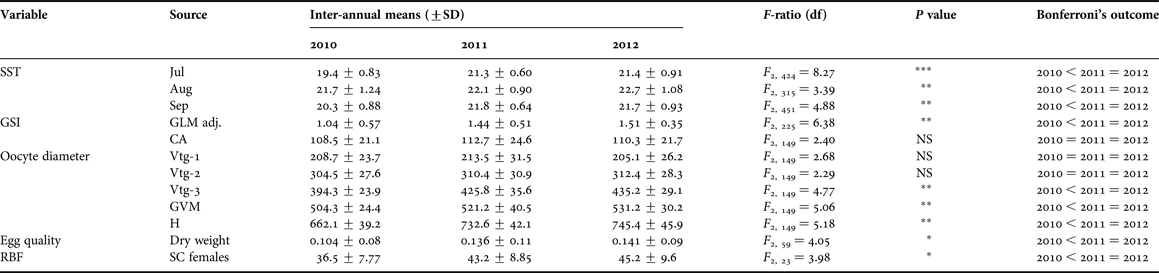
Since the mean monthly SSTs recorded during the summer months (July, August, September) in the 2010 sample were significantly lower (P < 0.05) than those observed in 2011 or 2012 (Table 1), ANOVA models were also used to find out whether, on average, the GSI (adjusted GLM data), the oocyte diameter (per developmental stage), the egg quality (hydrated dry weight), and the relative batch fecundity (RBF) were statistically different among sampling years. Then, if the ANOVA indicated significant differences, Bonferroni's multiple tests were applied for post hoc comparisons of significant effects (Sokal & Rohlf, Reference Sokal and Rohlf1995). It should be noticed that a P value of α = 0.05 or less was considered to be statistically significant, and prior to the ANOVAs, for all the aforementioned variables, the Shapiro–Wilk test was used to test the assumptions of normality and Levene's test was used to test the homogeneity of variances (Zar, Reference Zar1996).
Summary of the mean values (±SD) for specimens of T. ovatus and ANOVA tests evaluating the effect of the inter-annual variation on the following parameters: the monthly sea surface temperatures (SST, in °C), the gonadosomatic index (GSI), the oocyte diameter (μm, for each developmental stage), the egg quality (dry weight of hydrated oocytes in mg per egg), the relative batch fecundity (RBF, eggs per gram of body mass).

*Indicates P < 0.05, **indicates P < 0.01; ***indicates P < 0.001, and NS indicates no significant difference.
RESULTS
Size distribution and size at 50% maturity
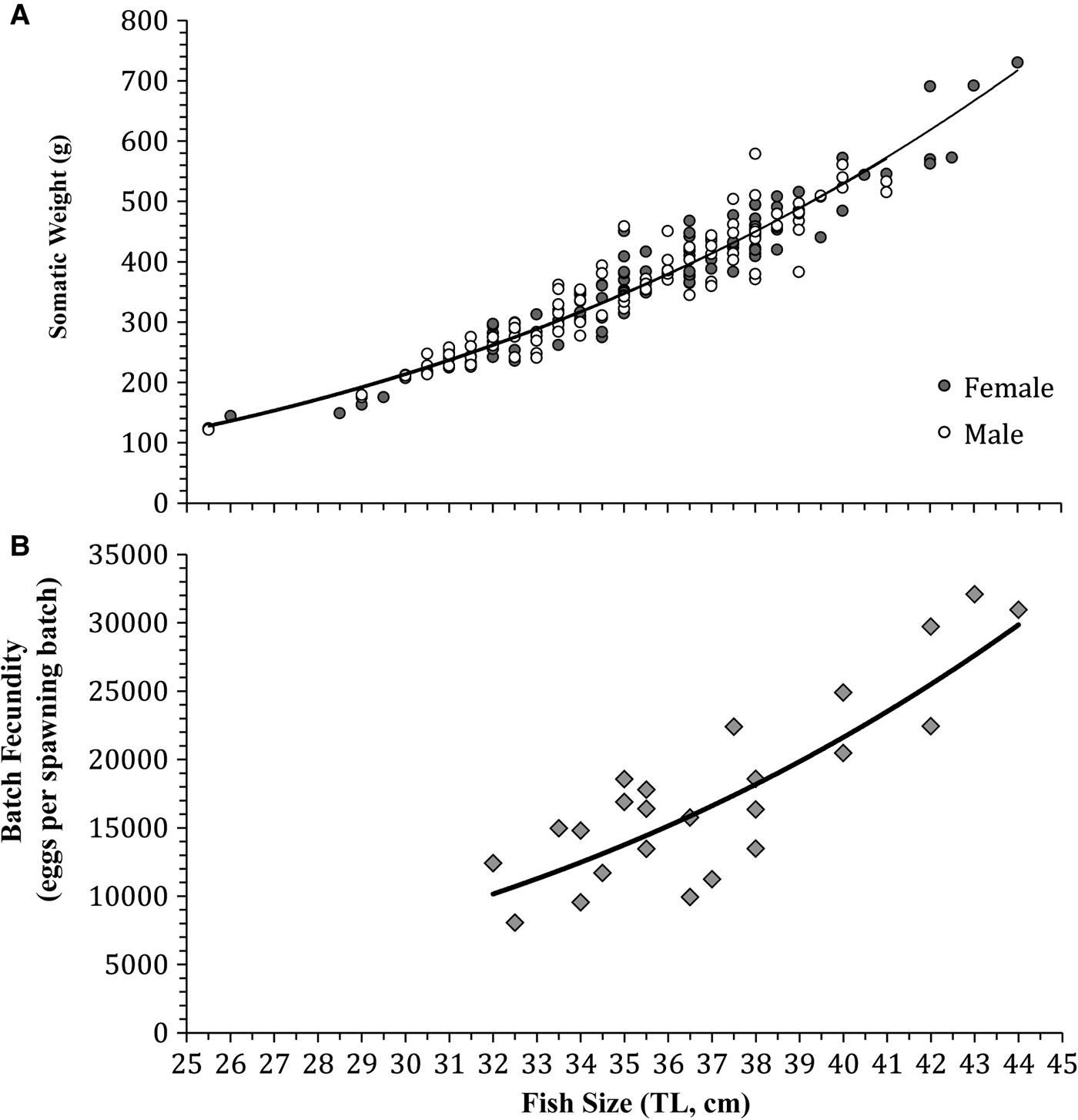
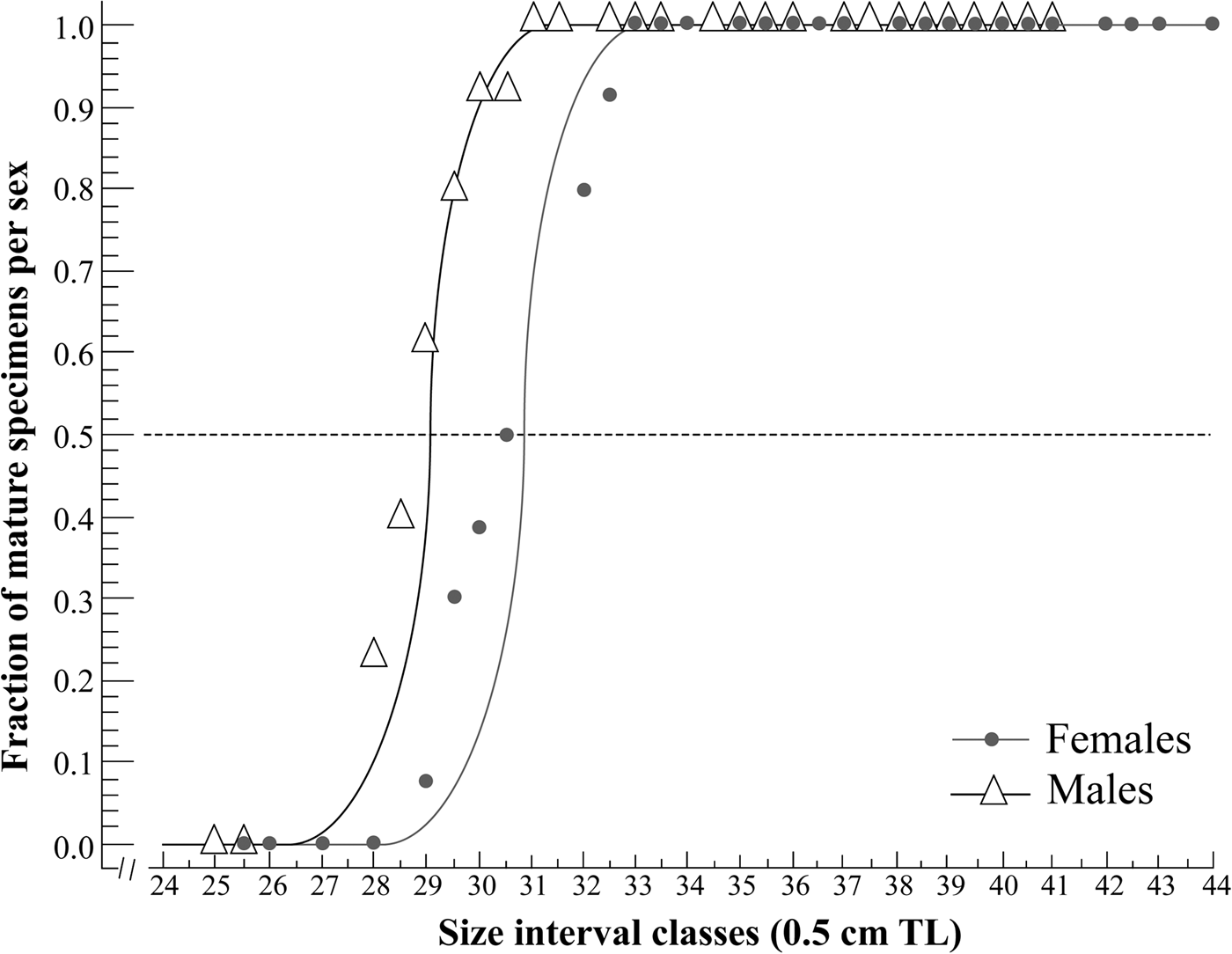
Of the 226 pompano specimens collected during the study, a total of 118 were identified as females and 108 as males. The length-frequency distributions were similar for both sexes, ranging from 25.0 to 44.0 cm, and the length-weight relationships (LWR) were accurately fitted to curvilinear regression models (Figure 3A) separately for males (SW = 0.0053·TL3.1201, r 2 = 0.919) as well as for females (SW = 0.0043·TL3.1805, r 2 = 0.935), with any significant difference, at α = 0.01, between sexes in both regression parameters: slopes (ANOVA, F 1,3 = 4.416, P = 0.1264) and intercepts (ANOVA, F 1,3 = 3.355, P = 0.1644). On the other hand, the size at 50% maturity (L50) was estimated at 30.9 (±2.7) cm TL for females and 29.1 (±1.8) cm TL for males, and no immature individuals were found with TLs greater than 33.0 cm (Figure 4).
Fitted regression models based on (A) length-weight relationships for males (SW = 0.0053·TL3.1201, r 2 = 0.919, N = 108) as well as for females (SW = 0.0043·TL3.1805, r 2 = 0.935, N = 118), and (B) the relationship of the batch fecundity to fish length for females (BF = 0.0822·TL3.3833, r 2 = 0.6475, N = 24), of T. ovatus.

Logistic curves of relative frequency of reproductive females (N = 118) and males (N = 108) of T. ovatus as function of size class (total length). The size at 50% maturity (L50) was estimated at 30.5 (±2.1) cm TL for females and 28.7 (±1.5) cm TL for males.

Gonadal development and spawning season
Similar gonadal development patterns were observed in both sexes: the developing phases were observed mainly from May to early July followed by spawning activity until September, when subsequently the spawning activity ceased and the regressing and regenerating phases became more evident. With regard to the time of the year, it was found that the GSI of both sexes peaked during the summer months (July and August). This was later confirmed by similar trends in maturity phases (expressed in frequency of occurrence) found throughout the year (Figure 5). The inter-annual analysis of the pompano's reproductive investment (GSI) showed statistically lower mean values in specimens sampled in the year 2010 compared with those sampled in 2011 and 2012 (Table 1). Moreover, the occurrence of spawning (inferred with both the GSI peaks and the increased frequency of spawning capable specimens) was observed to differ between years: spawning did not start until August in 2010 whereas in 2011 and 2012, spawning started in July (Figure 5). Furthermore, it was also noticeable that actively spawning specimens began to appear at similar SSTs: at between 21.3 and 23.3°C in 2010 and between 21.1 and 23.1°C in 2011 and 2012. In other words, although spawning activity began a month earlier in 2011 and 2012 compared with 2010, in all 3 years it began when SSTs had attained similar values (≈21.0°C).
Monthly gonadal development phases frequency (per cent abundance), mean (±SD) monthly variation in the gonadosomatic index (GSI) for males and females of T. ovatus, and mean (±SD) monthly sea surface temperatures (SSTs) during the study period (2010–2012). Development phases: regenerating (RGN), developing (DEV), spawning capable (SC) and regressing (RGS). Sample number (N) per month is also given above bars.

Oocyte development and fecundity
The range of oocytes diameters at different stages of development were as follows: cortical alveoli (CA, 75–150 µm), early vitellogenesis (Vtg-1, 150–250 µm), mid vitellogenesis (Vtg-2, 250–350 µm), advanced vitellogenesis (Vtg-3, 350–450 µm), germinal vesicle migration (GVM, 450–550 µm) and hydration (H, 550–800 µm). No significant difference (P > 0.01) was found in the inter-annual variation of oocyte diameters at early stages of development, i.e. CA, Vtg-1 and Vtg-2. However, significantly smaller (P < 0.01) oocyte diameters in the later stages of development (Vtg-3, GVM and H) were observed in specimens sampled in 2010 compared with those sampled in 2011 and 2012 (Table 1).
Oocyte development in T. ovatus was considered to be asynchronous, since oocytes at different stages of development were simultaneously present in the ovary. Moreover, the variation in the stage-specific oocyte size-frequency distribution during the reproductive cycle indicated a lack of hiatus separating the primary growth oocytes (<75 µm) from the reservoir of secondary growth oocytes (<75 µm) (Figure 6A–F). These oocyte size-frequency distributions showed a continuous size-frequency development of oocytes, except for ovaries at the onset of spawning which, as with all the secondary growth stages, had a separate mode of the most advanced oocytes (>350 µm) (Figure 6C–E). That is to say that just before ovulation most advanced oocytes did outgrow the standing stock of vitellogenic oocytes and a separate mode of mature hydrated oocytes developed for ovulation.
Oocyte size-frequency distributions (per cent abundance per 25 µm diameter class) of ‘standard’ 35.0 cm TL females of Trachinotus ovatus through subsequent gonadal development phases: (A) early developing, (B) developing, (C) advanced developing, (D) spawning capable, (E) actively spawning and (F) regressing. Each distribution corresponds to an individual fish. The range of oocytes diameters at different stages of development is also illustrated as follows: primary growth (PG, 50–75 µm), cortical alveoli (CA, 75–150 µm), early vitellogenesis (Vtg-1, 150–250 µm), mid vitellogenesis (Vtg-2, 250–350 µm), advanced vitellogenesis (Vtg-3, 350–450 µm), germinal vesicle migration (GVM, 450–550 µm) and hydration (H, 550–800 µm).

Twenty-four females met the histological criteria (actively spawning with hydrated oocytes and without POFs) for fecundity analysis. The batch fecundity (BF) ranged from 8070 to 32 080 eggs per spawning batch in fish ranging from 32.0 to 44.0 cm TL, and the relationship between BF and TL was fitted to the following exponential regression model BF = 0.0822 TL3.3833 (r 2 = 0.6475, N = 24) (Figure 3B). The mean BF (±SD) was estimated at 17 620 (±6649) eggs per spawning batch. Meanwhile, the overall mean relative batch fecundity (RBF) was estimated at 40.5 (±8.9) eggs per gram of body mass for this species, and any size effect was observed between RBF and TL (P > 0.05). However, it should be noticed that significant inter-annual differences were found in the RBF (ANOVA, F 2,23 = 3.98, P = 0.0328), being significantly lower during 2010 than during 2011 and 2012 (Table 1).
Egg quality and follicular atresia
As a measure of egg quality, the mean dry weight of hydrated oocytes (showing also any significant size effect) estimated from specimens caught in 2010 was 0.104 (±0.08) mg per egg which was significantly lighter (ANOVA, F 2,59 = 4.05, P = 0.0225) than that of specimens collected in 2011 (0.136 ± 0.11) and in 2012 (0.141 ± 0.09) (Table 1). Signs of α-atresia were observed only during the regressing gonadal development phase, and the prevalence of atresia (Pa) was estimated at 22.2% (N = 6) in relation to total number of mature females (N = 27). The mean intensity of atresia (Ria) in these individuals was estimated at 96.8 ± 2.3% of their vitellogenic oocytes in α-atretic state.
DISCUSSION
This is the first time that the main reproductive traits of this warm-water species have been described. The oocyte size-frequency distributions indicated an asynchronous oocyte recruitment pattern as oocytes at different stages of development were simultaneously present, whereas according to Murua & Saborido-Rey (Reference Murua and Saborido-Rey2003) the following features suggest multiple batch spawning and an indeterminate nature of the fecundity of this species: (1) continuous size-frequency development of oocytes (in which case only during spawning did the secondary growth stages have a separate mode of the most advanced oocytes), (2) the presence of recent POFs along with oocytes in the final phases of gonadal development, (3) the massive atresia in post-spawning individuals (i.e. in the regressing phase of gonadal development). Moreover, the presence of atresia in the gonads of the females only at the end of the spawning season even though not all vitellogenic oocytes are fully developed, indicates that there is a need to eliminate the underdeveloped non-ovulated oocytes, which is done through atresia, as shown by the sudden and marked increase in the relative intensity of atresia detected in the ovaries at the end of the spawning season. On the other hand, the indeterminate fecundity and its batch spawning nature of T. ovatus, whose eggs are recruited and ovulated from the population of yolked oocytes in several batches during the spawning season, makes it quite difficult to estimate more accurately the annual egg production, which in turn is an essential component of the reproductive biology of multiple spawning fishes and can have important implications for the management of fish populations (Ganias et al., Reference Ganias, Murua, Claramunt, Dominguez-Petit, Gonçalves, Juanes, Keneddy, Klibansky, Korta, Kurita, Lowerre-Barbieri, Macchi, Matsuyama, Medina, Nunes, Plaza, Rideout, Somarakis, Thorsen, Uriarte, Yoneda, Domínguez-Petit, Murua, Saborido-Rey and Trippel2015).
Although specimens of T. ovatus were not caught throughout the year due to its absence within the study area during the coldest months, the overall data indicate that this species has a short spawning season (lasting no more than 2 months) restricted to the warmest period of the year (July–August). Other species of carangids also present a short and well-defined spawning period during the spring and summer months, e.g. the giant trevally Caranx ignobilis and bluefin trevally Caranx melampygus in Hawaii (Sudekum et al., Reference Sudekum, Parrish, Radtke and Ralston1991), the horse mackerel Trachurus trachurus in Greece (Karlou-Riga & Economidis, Reference Karlou-Riga and Economidis1997), the permit Trachinotus falcatus in Florida (Crabtree et al., Reference Crabtree, Hood and Snodgrass2002), the short-fin pompano Trachinotus teraia in the Ivory Coast (Sylla et al., Reference Sylla, Atse and Kouassi2009) and the plata pompano Trachinotus marginatus in southern Brazil (Lemos et al., Reference Lemos, Varela Junior, Velasco and Vieira2011). In fact our study indicated that this warm-water species has a narrower spawning season in the northern Catalan Sea (centring on the warmest months of the year) than it has in warmer areas of the Mediterranean such as Egyptian waters where its spawning season ranged from mid-August to mid-October (Assem et al., Reference Assem, El-Serafy, El-Garabawy, El-Absawy and Kaldus2005).
As stated previously, inter-annual variations in some reproductive traits, such as the mean diameters of the oocytes, the relative batch fecundity or the mean dry weight of hydrated oocytes, were observed for the pompano in this study. In addition to this, since the maternal size effect on these reproductive traits was disregarded in our data we believe that those sea water temperature inter-annual variations could at least explain those variations in its reproductive features. Similar seasonal or inter-annual variations in batch fecundity and egg-size have been reported for other fish species, e.g. the Atlantic silverside Menidia menidia (Conover, Reference Conover1985), the pacific jack mackerel Trachurus symmetricus (Lisovenko & Andrianov, Reference Lisovenko and Andrianov1991), the bright-eye darters Etheostoma lynceum (Heins et al., Reference Heins, Baker and Guill2004) and the European hake Merluccius merluccius (Murua et al., Reference Murua, Lucio, Santurtún and Motos2006). Furthermore, differences in egg quantity and quality have been attributed to different temperature conditions in the spawning habitats for other species, e.g. the anchoveta Engraulis ringens off the Chilean coast (Castro et al., Reference Castro, Claramunt, Krautz, Llanos-Rivera and Moreno2009; Leal et al., Reference Leal, Castro and Claramunt2009). Thus, water temperature appears to be related to different patterns of seasonal, inter-annual or latitudinal changes in egg quantity and quality in fish populations (Conover, Reference Conover1985; Tanasichuk & Ware, Reference Tanasichuk and Ware1987; Heins et al., Reference Heins, Baker and Guill2004; Murua et al., Reference Murua, Lucio, Santurtún and Motos2006; Castro et al., Reference Castro, Claramunt, Krautz, Llanos-Rivera and Moreno2009; Leal et al., Reference Leal, Castro and Claramunt2009).
Along with potential temperature effects, food availability for adults may also play a role in determining differences in oocyte number and size, and it might also explain the variability, whether spatial or temporally, in egg traits of a given fish species (Beacham & Murray, Reference Beacham and Murray1993). In this sense the assessment of the energetic content and relative concentrations of different biochemical components (amount of lipid or protein) in the eggs would provide a complementary insight into the environmental-related variations of the egg quality (Pickova et al., Reference Pickova, Dutta, Larson and Kiessling1997; Rainuzzo et al., Reference Rainuzzo, Reitan and Olsen1997; Riveiro et al., Reference Riveiro, Guisande, Lloves, Maneiro and Cabanas2000, Reference Riveiro, Guisande, Maneiro and Vergara2004; Castro et al., Reference Castro, Claramunt, Krautz, Llanos-Rivera and Moreno2009). In fact, Assem et al. (Reference Assem, El-Serafy, El-Garabawy, El-Absawy and Kaldus2005) have found in female specimens of T. ovatus from the Egyptian waters off the Mediterranean that the total protein content in ovaries varied according to different maturity phases, recording maximum value at immature ovaries and minimum at spawning and spent (regressing) ovaries; whereas the total lipid contents of ovaries reached their minimal values at immature phase, and their maximum recorded value was at the nearly ripe (late developing) gonad. Unfortunately, in the present study these latter kinds of analyses were not carried out to determine if the nutritional content was the same or not across years, however we do recognize that this kind of study is also very important since differing diets could change the nutritional content and might give us an idea of the temporal changes in egg quality and size.
Several studies have previously shown that sea temperature may influence the timing of various life processes in fish such as, for example, their spawning date (Kjesbu et al., Reference Kjesbu, Righton, Krüger-Johnsen, Thorsen, Michalsen, Fonn and Witthames2010b; Morgan et al., Reference Morgan, Wright and Rideout2013). In this case, the effects of temperature depend on when, in the annual thermal cycle, spawning normally occurs, with increasing spring temperatures being required to trigger gonadal development in species that spawn in spring and early summer, while falling temperatures stimulate reproduction in autumn-spawning species (Pankhurst & Munday, Reference Pankhurst and Munday2011). In our study of the pompano, the inter-annual variation in the spawning phenology could be related to the inter-annual variations in temperature that were also observed within the study area (Table 1) since although spawning activity began a month earlier in 2011 and 2012 compared with 2010, in all 3 years it began when SSTs had attained similar values (≈21.0°C). This indicates that sea temperature may trigger the initiation of spawning activity in this species and the difference in the timing of spawning activity from one year to another may be the result of the seasonal migratory behaviour coupled with the annual seasonality of the sea temperatures in the NW Mediterranean. All of which could indicate that pompano spawning is highly temperature-sensitive and that, in addition, this species is able to adjust the timing of spawning to suit the optimal temperature for embryo development, as is the case with other species of fish (Pankhurst & Munday, Reference Pankhurst and Munday2011).
Climate change will have major consequences for fish reproduction, including both temperate and warm-water species, depending on various factors: specific physiological tolerances, capacity for acclimation and adaptation, scope for behavioural avoidance, capacity to extend or shift ranges, and the timing of thermal challenges with respect to the reproductive cycle (Pankhurst & Munday, Reference Pankhurst and Munday2011). For certain temperate water species, for example, climate change could lead to reproductive and recruitment failure, whereas for some of the warm-water species, it could lead to changes in seasonal phasing of reproduction and possible increases in species range (Munday et al., Reference Munday, Jones, Pratchett and Williams2008; Pankhurst & Munday, Reference Pankhurst and Munday2011). It appears likely, therefore, that the present-day sea warming trends and the associated changes in spawning phenology would give the pompano (and other warm-water fish species) an advantage and favour their successful establishment into new habitats. Meanwhile, for native fish species, small increases in sea temperature during spawning can dramatically increase egg mortality and decrease survivorship to hatching since the egg stage is one of the most thermally sensitive life stages in fish (Rombough, Reference Rombough, Wood and McDonald1997; Gagliano et al., Reference Gagliano, McCormick and Meekan2007). In this sense, small increases in temperature might tend to favour recruitment of some species (especially at higher latitudes) but larger temperature increases could lead to recruitment failures (especially at low latitudes) and at times or places where food supply is limited (Munday et al., Reference Munday, Jones, Pratchett and Williams2008; Pankhurst & Munday, Reference Pankhurst and Munday2011). Therefore, while global warming can benefit warm-water species, allowing their expansion into areas they did not previously occupy (Sabatés et al., Reference Sabatés, Martín, Lloret and Raya2006; Petitgas et al., Reference Petitgas, Rijnsdorp, Dickey-Collas, Engelhard, Peck, Pinnegar, Drinkwater, Huret and Nash2013; Lloret et al., Reference Lloret, Sabatés, Muñoz, Demestre, Solé, Font, Casadevall, Martín and Gómez2015), it may threaten cold-water species, leading to local extinctions of certain species (Drinkwater, Reference Drinkwater2005; Perry et al., Reference Perry, Low, Ellis and Reynolds2005). Changes in the abundance of warm- and cold-water fish species may have far-reaching ecosystem effects, such as trophic cascades driven by the local loss/decrease of cold-water predators or by the appearance/increase of warm-water predators (Lloret et al., Reference Lloret, Sabatés, Muñoz, Demestre, Solé, Font, Casadevall, Martín and Gómez2015).
Although, up to now, no accurate information is available regarding the migration of the pompano in the Mediterranean, we suspect that this species (like other pelagic fish species from the Carangidae family) shows seasonal migratory behaviour, spending the colder months in more southern warm-water areas and, when the sea temperature reaches a certain value, migrating towards cooler waters in the north where the species spawns once a threshold temperature has been attained (Smith-Vaniz, Reference Smith-Vaniz, Whitehead, Bauchot, Hureau, Nielsen and Tortonese1986). Apparently the pompanos show behavioural thermoregulation, that is to say they are able to avoid or select the right environmental temperature and, within certain thermal limits their distribution may be based on other ecological factors such as food availability. And as far as food availability is concerned, the surrounding coastal waters of the southern Gulf of Lyon (including the Gulf of Roses) are known to be affected by a permanent cyclonic circulation of surface waters and intense vertical convections which promote intense algal blooms and elevated primary production (Bosc et al., Reference Bosc, Bricaoud and Antoine2004) which, in turn, enhances the relatively high total biomass present in the area (Bănaru et al., Reference Bănaru, Mellon-Duval, Roos, Bigot, Souplet, Jadaud, Beaubrun and Fromentin2013). Moreover, this area in the NW Mediterranean has been recognized as an important spawning area for similar small pelagic fish such as the European anchovy Engraulis encrasicolus or the sardine Sardina pilchardus (Olivar et al., Reference Olivar, Salat and Palomera2001; Palomera et al., Reference Palomera, Olivar, Salat, Sabatés, Coll, García and Morales-Nin2007; Bellido et al., Reference Bellido, Brown, Valavanis, Giráldez, Pierce, Iglesias and Palialexis2008).
It has been suggested previously that present sea warming trends and changes in the seasonality of the sea temperatures may be causing changes in spawning phenology and the timing of the seasonal arrival of other fish species into more northern areas of the Mediterranean, favouring the northward temperature-dependent expansion of warm-water species in the NW Mediterranean (Lloret et al., Reference Lloret, Sabatés, Muñoz, Demestre, Solé, Font, Casadevall, Martín and Gómez2015). Examples of this include the round sardinella Sardinella aurita (Sabatés et al., Reference Sabatés, Martín, Lloret and Raya2006), the yellow-mouth barracuda Sphyraena viridensis (Villegas-Hernández et al., Reference Villegas-Hernández, Muñoz and Lloret2014), the bastard grunt Pomadasys incisus (Villegas-Hernández et al., Reference Villegas-Hernández, Lloret and Muñoz2015a), and the bluefish Pomatomus saltatrix (Sabatés et al., Reference Sabatés, Martín and Raya2012; Villegas-Hernández et al., Reference Villegas-Hernández, Lloret and Muñoz2015b). This appears to be the case with the pompano: we hypothesize that sea temperature clearly influences its spawning phenology as well as its seasonal arrival which may be facilitated not only by the physical conditions but also by the higher food productivity in the northernmost area. Therefore, bearing in mind that sea temperature seems to influence the pompano reproduction, this study demonstrates a clear need for further research into the reproductive traits of warm-water species that are currently expanding into the increasingly warmer northern waters.
ACKNOWLEDGEMENTS
Our sincere thanks to Toni Font, Xavier Corrales and Ivanna Buselic for their assistance during sampling.
FINANCIAL SUPPORT
The authors would like to thank the Abertis Foundation for the financial support given to this research (Ref. 1018-100305-00) and the University of Girona for further financial support (R+D ASING2011, Ref. SING11/10). Harold Villegas-Hernandez would like to thank the Consejo Nacional de Ciencia y Tecnología (CONACYT) in Mexico for the scholarship (Ref. 215050) that has enabled him to pursue his PhD studies at the University of Girona. Josep Lloret benefited from a Ramón y Cajal contract from the Spanish Ministry of Economy and Competitiveness.