1 Introduction
Competition between two methods of marking recipient/beneficiary and theme has figured in much recent research (e.g. Wolk et al. Reference Wolk, Bresnan, Rosenbach and Szmrecsanyi2013 and references there):
(1) Jim gave the driver £5. (indirect object before direct object, V–Oi–Od)
(2) Jim gave £5 to the driver. (direct object before prepositional object, V–Od– Op)
Less frequently acknowledged is a reverse double object variant:
- (3)
(a) ?Jim gave £5 the driver. (direct object before indirect object, V–Od–Oi)
(b) Jim gave it him.
If noticed at all, the pattern in (3) is mostly described as a variant confined to clauses where both objects are pronominal, as in (3b) (Quirk et al. Reference Quirk, Greenbaum, Leech and Svartvik1985: 1396n; Biber et al. Reference Biber, Johansson, Leech, Conrad and Finegan1999: 927–30; Huddleston & Pullum Reference Huddleston and Pullum2002: 248 and n.23). However, pattern (3) was much more widespread even in late Modern English (LModE), while there is clear dialectal variation within present-day British English (Siewierska & Hollmann Reference Siewierska, Hollmann, Hannay and Steen2007; Hughes et al. Reference Hughes, Trudgill and Watt2012: 20; Gerwin Reference Gerwin2013). There is increasing recognition of the importance of pattern (3), but comprehensive frequency data are lacking on the history and the dialect distribution of this alternative.
In this article we embark on a systematic investigation of a subset of pattern (3), mainly in relation to pattern (1). We track pattern (3b) through space and time in order to understand better its progressive restriction in distribution, which allowed most previous studies to consider only a binary variable with the variants (1) and (2). In this study we treat it as a three-way variable, or indeed for completeness a four-way variable, since pattern (2) can have a counterpart with stylistic reversal due usually to Heavy NP Shift (called ‘Postposing’ by Huddleston & Pullum Reference Huddleston and Pullum2002: 1382–4):
(4) Jim gave to the driver (a very generous) £5.
We study alternations between prepositional and non-prepositional patterns not just where the potential preposition is to and the semantic role of Oi or Op usually corresponds to recipient, as in examples (1)–(4), but also cases with potential preposition for and semantic role usually of beneficiary, as in (5):
- (5)
(a) Jim cooked his Dad supper.
(b) Jim cooked supper for his Dad.
There is no single corpus which covers the entire period we wish to study and contains sufficient examples of all the variants for a solid account. Furthermore, the recent decline of V–Od–Oi in standard English has not been matched in all dialects, and therefore we have used a combination of (British EnglishFootnote 3) corpora, listed in section 2, to get a picture of both the historical and dialectal distribution.
We have also examined works in the early grammatical tradition for metalinguistic data on the changing status of variants as dialectal or preferred. There is a surprising amount of contemporaneous observation on V–Od–Oi even as the norm in British English.
As far as terminology is concerned, we reserve ‘Double Object (pattern/construction)’ for our (1) and (3), using the more inclusive term ‘Dative Alternation’ to cover the prepositional patterns (2) and (4) as well. A selective survey of work on the history is given in section 3.2. On dialect variation see section 3.5 below.
2 Method
Our investigation has three strands. (i) We have tried to build an overall picture of the history of the double object patterns, using the Penn parsed corpora, in order to give a context for more detailed historical and dialectal investigation. (ii) We have also investigated Dative Alternation in a wide range of corpora. (iii) And we have investigated how the phenomenon has been treated in the grammatical tradition, and whether normative treatment may have influenced usage. Two databases have been constructed: a database of corpus examples of patterns (1)–(4) (‘usage’), and a database of comments, discussions, mentions and examples in normative works (‘precept’).
2.1. Penn parsed corpora
We used the CorpusSearch 2 program (Randall Reference Randall2005–7) to look for relevant constructions in the Penn Parsed Corpus of Modern British English (PPCMBE), the Penn–Helsinki Parsed Corpus of Early Modern English (PPCEME), and the Penn–Helsinki Parsed Corpus of Middle English, 2nd edition (PPCME2).Footnote 4 We confined our attention to cases where both objects were expressed and where both followed the verb, since otherwise there is either no variation in the relative order of the object arguments or that order is conditioned by special factors like wh-fronting. A few of the excluded patterns are shown in (6):
- (6)
(a) (the sum) which/that/φ Jim gave (to) the driver
(b) How much was the driver given?
(c) Jim rewarded the driver/Jim gave £5.
The search program's hits were imported into our usage database, as were file references, verb forms and part-of-speech tags for the verb. After excluding the various types referred to in (6), the remaining records were classified according to source corpus, syntactic pattern, verb lemma, morphological tag, date, subperiod. Our database also has fields for much other information about the two object arguments and about author, dialect and so on. In general we relied on the parses given in each corpus, though a handful of examples were rejected.Footnote 5 The Penn parsing scheme creates a single record for each clause, including when coordinated verbs share subject and complementation. In such cases we arbitrarily assigned the example to the first of the coordinated verbs, except where the first verb did not appear to be ditransitive, as in (7), where hear probably does not share both objects with yate.
(7)


Work on examples involving Op would need considerably more manual intervention, as the Penn parsing does not distinguish between argument PPs that might contain recipients or beneficiaries on the one hand and irrelevant argument or adjunct PPs on the other. For now, in the Penn parsed corpora we have confined attention to double object patterns.
2.2 Other corpora
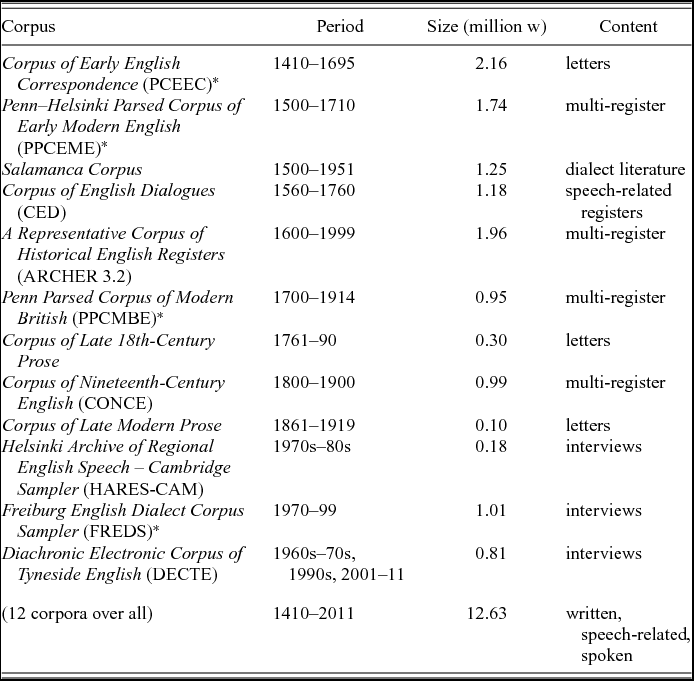
For more detailed dialectal or chronological analysis of the Dative Alternation we have added nine further corpora, giving a time-span from 1410 to 2011 (see table 1). Each corpus has to be taken on its own terms: they differ in periodisation, register and compilation principles, and there is occasional overlap too (see note 4 above). Only the Penn parsed corpora (omitting PCEEC) can be considered a relatively homogeneous and balanced family of corpora. Our overall statistics come from Penn. Other corpora, however, provide essential supplementary material on various levels: larger size, greater proportion of spoken or speech-based data, non-standard dialect evidence and twentieth-century data.
British corpora examined (diachronically sorted)Footnote 6
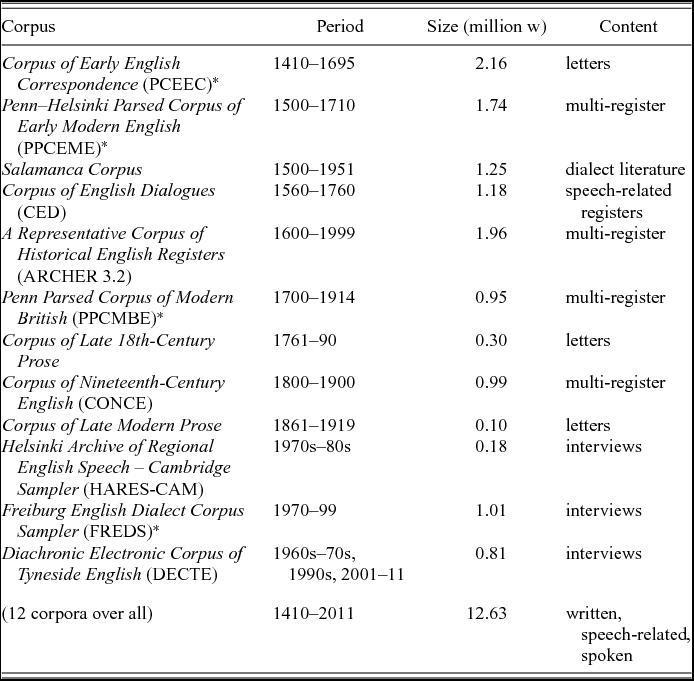
Some are part-of-speech tagged (marked with * in the table); many are not. It is therefore impractical to make a complete search for all potential examples of patterns (1)–(4). Since, however, the alternation characteristically involves a limited number of verbs, we constructed a maximal list of potential lemmas in the following way. We combined the largely overlapping lists of present-day ditransitive verbs attested by Gerwin (Reference Gerwin2013) and Siewierska & Hollmann (Reference Siewierska, Hollmann, Hannay and Steen2007), the latter explicitly starting from a list derived from Levin (Reference Levin1993: 45–7), together with those verbs from ICE-GB classified as ‘alternating’ by Ozón (Reference Ozón2009: 109–12), whose initial list was also based on earlier studies. Of course, these PDE alternations do not necessarily encompass all the verbs that alternated in the past (Wolk et al. Reference Wolk, Bresnan, Rosenbach and Szmrecsanyi2013: 386). In addition, therefore, we considered verbs that early grammarians mention in their works (1586–1900), adding procure.
This list comprised 68 lemmas. We had to exclude dye and do because of the number of forms in earlier periods of the language, the huge degree of homonymy with other lexical items (e.g. die), and the high frequency of do in other constructions. The loss is not serious: dye does not occur in the double object construction in our Penn data, nor in the British National Corpus, nor apparently in the Corpus of Historical American English or the Corpus of Contemporary American English, while do + double object occurs largely in such fixed idioms as do someone good/harm/a favour, where the Od slot is rarely reduced to the pronoun form it (see below). The final list of 66 pre-selected verb lemmas is as follows:
afford, ask, assign, award, blow, boil, bring, bung, buy, cause, charge, cook, cost, credit, cut, deal, deliver, deny, design, draw, drop, earn, fax, feed, fetch, file, find, forward, get, give, grant, hand, hire, leave, lend, loan, make, offer, owe, pass, pay, play, post, present, procure, promise, purchase, quote, read, relate, rent, return, save, sell, send, set, sew, show, sock, take, tape, teach, tell, throw, win, write
We constructed for each of our chosen verbs a comprehensive list of every attested form, based on (i) concordances of each corpus used, (ii) the list of historical variants in the Oxford English Dictionary, and (iii) the list of dialectal variants in the English Dialect Dictionary (Wright 1896–1905). For each verb in a given corpus we then did a regular expression string search for every possible spelling (some 130 forms of write, for instance).
The output of the verb searches was much too large to be filtered manually and coded, so we progressively limited the set of data under consideration, taking our cue from the fact that those standard descriptions of English which mention the V–Od–Oi pattern at all nearly always give examples where one or both of the NPs are pronominal. All the concordance outputs from a given corpus for the different verbs were concatenated into a file. A series of searches was then run on these twelve files, looking for occurrences of each of the personal pronouns falling within five words of the verb. Once again, the pronoun searches involved as search term a comprehensive list of every attested form of that particular personal pronoun, including dialectal variants. For this article we took the outputs for the pronoun it, which ought to contain the kind of example that is easily the most common exponent in present-day English of the V–Od–Oi pattern.Footnote 7 The output from the second search for it was then itself sorted in a concordance program, allowing us to eliminate by inspection the vast majority of false positives. The remaining cases, belonging to one of the four patterns under investigation, were then entered in our usage database and coded for a number of linguistic and metalinguistic parameters. Even when the verb lemma was known to take part in alternation between double object and prepositional patterns, we had to recognise that certain idioms might be frozen in one variant or another and therefore should not count as alternating; for instance, give it a go, give it a try.
Other problematic types which were excluded include to-prepositional phrases of non-recipient/beneficiary function with a literal or abstract locative (8a); clausal objects (8b), and gapped clauses such as (8c). On the other hand, we have retained phrasal verbs (9a) and reflexive pronouns (9b), in line with previous studies.
- (8)
(a) I will haue no hande in sendinge itt to sea, where I dare not goe my self (PCEEC, Cornwall 1630)
(b) oweth it all to his not beeing of the Corporation (PCEEC, Prideau 1680)
(c) [he shew'd it to some of the Council,] and they to the rest (PPCMBE, kimber–1742)
- (9)
(a) I have by Foster sent yow it down (PCEEC, holles.pos 1570–1640)
(b) If tha wants onny supper tha mun goa an buy it for thisen (SC, YORK_John 1876)
3 Data analysis
3.1 General data
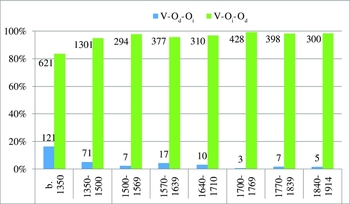
In the Penn parsed corpora we have compared patterns (1) and (3), V–Oi–Od and V–Od–Oi, finding a huge preponderance of the former over the latter: 4,029 to 241. Of those 241 examples with direct before indirect object, 192 (at a rate of 9.1%) occur in the Middle English (ME) data, 34 (3.3%) in early Modern English (EModE), and just 15 (1.3%) in LModE (see figure 1). These bald figures serve to show both why so much discussion of Dative Alternation in the Modern period has ignored V–Od–Oi, a pattern which constitutes only 2.3 per cent of the double object examples in PPCEME and PPCMBE, and also why we needed to move beyond these standard historical corpora to investigate it. Even 2.3 per cent is not entirely negligible, and our much fuller data on it-patterns in twelve corpora (including PPCEME and PPCMBE) will show why V–Od–Oi deserves attention.
Relative proportions in Penn parsed corpora: V–Od–Oi and V–Oi–Od (percentages and raw figures, N = 4,270) Footnote 8

3.2 It-dataset
We preface our historical discussion of pronoun data in the Dative Alternation with a brief resumé of earlier work. Pattern (3), V–Od–Oi, is seen as the ‘conservative pattern’ (Gast Reference Gast2007: 52) and pattern (1), V–Oi–Od, ‘a relatively recent innovation’ (Gerwin Reference Gerwin2013: 457). In Old English both are already attested, and with much higher frequency than the prepositional patterns, although De Cuypere (Reference De Cuypere2015 [2014: 6, 11]) has recently shown that V–Od–Op is lexically restricted but ‘not rare’. With two pronominal objects pattern (3) is strongly preferred (Koopman & van der Wurff 2000: 262).
The prepositional variant increases in frequency ‘with striking rapidity’ during late ME (Visser 1963–73: I.624) and becomes ‘a fully viable option’, even ‘somewhat more common’ than the V–Oi–Od variant (McFadden Reference McFadden and Lightfoot2002: 112). The fronted prepositional pattern V–Op–Od is also attested but gradually wanes due to ‘systemic pressure’ (Fischer Reference Fischer and Blake1992: 381–2). With two pronominal objects the pattern V–Od–Oi is the ‘norm’ (Allen Reference Allen1995: 206), whereas the counterpart V–Oi–Od is ‘infrequent’ in both early and late ME (Koopman & van der Wurff 2000: 266).
Things seem to have changed little during EModE. The combination of a pronominal Od followed by a nominal Oi is ‘at least moribund’ in the 16th century, except for biblical language (Allen Reference Allen1995: 421). With pronominal objects the pattern V–Od–Oi is still dominant (Visser 1963–73: I.623). In the LModE period there are still sufficiently numerous examples of V–Od–Oi with pronominal objects for it to be ‘accounted acceptable standard’ (Denison Reference Denison and Romaine1998: 239), though it is now less common than the prepositional variant V–Od–Op. In the early twentieth century, the latter order is regarded as ‘ordinary usage’, and is ‘extremely frequent’ with it as Od (Jespersen 1909–49: III.288; Poutsma 1914–29: I.154–5).
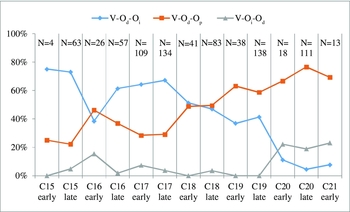
Our dataset from the twelve corpora listed in table 1 consists of 1,499 examples containing the pronoun it in one of three possible NP argument positions: as theme in the direct object position (by far the most common), as recipient or beneficiary in the complement of a preposition, or as indirect object. The next stage is to restrict the data to the 1,327 cases with it as direct object – still an arbitrary restriction, but in practice a reasonable one for exploring the history of V–Od–Oi. However, there is one obvious and immediate problem. All studies of the Dative Alternation recognise that variation is significantly affected by such factors as length of NP, weight, topicality, or even whether the NP consists solely of a personal pronoun: NPs that are pronominal and therefore also light, short and (usually) topical will strongly tend to favour structures which place them to the left of heavier, longer, more information-rich NPs. Evidently, then, examples with direct object it are a very skewed subset of the possible data, since V–Od–Oi and V–Od–Op are often likely to be favoured over V–Oi–Od just because Od is the pronoun it. To mitigate this problem, our analysis considers only those 835 examples where the recipient/beneficiary is also pronominal, on the working hypothesis that having both argument NPs in the form of personal pronouns should largely control for the factors of weight, etc. In this subset there are only three patterns, (1)–(3), as the order (4) only occurs five times in our data and never with Od = it.
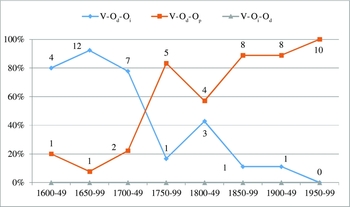
Plotting this data gives figure 2, showing (i) an early fall in V–Od–Oi between the late seventeenth and early eighteenth centuries, made up for entirely by a relative increase in V–Od–Op; (ii) a steep fall between the late nineteenth and early twentieth centuries compensated for by both of the other two patterns; and (iii) the very recent arrival of the now-standard V–Oi–Od as a serious contender, at least with two pronominal objects and Od = it.
Composite graph of patterns in twelve corpora with Od = it and Oi/Op = personal pronoun (percentages and raw figures, N = 835)

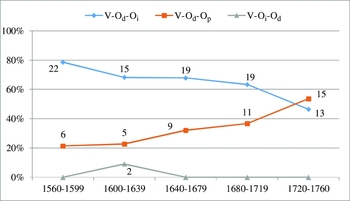
Data in CED (1560–1760) with Od = it and Oi/Op = personal pronoun (percentages and raw figures, N = 136)

Data in ARCHER 3.2 (1600–1999) with Od = it and Oi/Op = personal pronoun (percentages and raw figures, N = 68)

The composite graph is convenient for showing general trends but has no statistical validity: the data come from disparate corpora of very varied make-up, including diachronic corpora with non-matching chronological divisions. However, if we look at individual corpora, these trends are confirmed. To illustrate the two turning points at the start of the eighteenth and twentieth centuries, we have chosen CED, which covers the time-span 1560–1760 and is made up of dialogue excerpts, and ARCHER 3.2, a multi-register corpus made up of formal and informal language 1600–1999.
In what follows we analyse the distribution of the three variants in Dative Alternation, attending to verb lemma (section 3.3), objects (section 3.4) and dialect (section 3.5).
3.3 Verb lemmas
Previous studies have consistently concluded that the Dative Alternation is strongly influenced by verb lemma (e.g. Mukherjee Reference Mukherjee2005; Wolk et al. Reference Wolk, Bresnan, Rosenbach and Szmrecsanyi2013; De Cuypere Reference De Cuypere2015 [2014] and references therein). Of our list of 66 pre-selected verb lemmas, 38 are attested in the it-dataset in at least one of the three variants.Footnote 9 Of those 38, the V–Od–Oi pattern occurs with 21, and with 9 it is the most frequent pattern attested – tell, ask, deny, send, lend, give, show, deliver, pay (sorted by frequency). With afford and promise this is the only variant documented, albeit with just 1 and 3 instances, respectively. By contrast, the present-day canonical order V–Oi–Od occurs with 14 lemmas, and, in fact, with 7 of these there is only 1 example of each. This pattern is the most common option with the verb teach, however.
The prepositional variant V–Od–Op is widespread and occurs with all but 4 verb lemmas (afford, ask, promise, teach). It is the only pattern documented for 14 verbs and the most frequent choice with another 9. As pointed out in the introduction, we have taken into account the prepositions to and for, and their respective spelling variants. Unsurprisingly, to is far more frequent than for, adding up to 87 per cent of the instances in V–Od–Op and combining with 26 different lemmas. The preposition for occurs with 16 different verbs.
In his study of ditransitive verbs with ICE-GB data, Mukherjee (Reference Mukherjee2005: 83–4) classifies verb lemmas into ‘typical’, ‘habitual’ and ‘peripheral’ ditransitives, based on two kinds of frequency information: their overall frequency and their frequency as ditransitive verbs. In the spirit of Mukherjee's classification, give and send stand out as ‘typical’ verb lemmas in our it-dataset, comprising 49 per cent of the instances (28 and 21 per cent, respectively, of the overall 835 total). Both lemmas are found in the three patterns, and both show over 50 per cent V–Od–Oi order, followed by the prepositional order V–Od–Op, and the present-day canonical V–Oi–Od lagging behind. Taking (arbitrarily) the figure of 20 instances as frequency cut-off point, the ‘habitual’ verb lemmas in our data are (in order of frequency) tell, show, bring, deliver, lend, read, pay, take, return. Altogether they make up 35 per cent of the it-subset. The remaining 27 lemmas can be considered ‘peripheral’, with fewer than 20 attested instances each.
If we examine closely the behaviour of the top 11 verb lemmas, typical and habitual, we observe that V–Od–Oi is the most frequent pattern with 7 verbs (tell, send, lend, show, give, deliver, pay), while it is not attested with read. None of the top lemmas have the present-day canonical variant V–Oi–Od as the preferred option, and 3 verbs do not show this pattern in our data, namely read, return, take. The prepositional option V–Od–Op is attested with higher frequency than the non-prepositional variants with 3 verbs (take, return, bring) and it is the only variant documented with the lemma read.
3.4 Objects
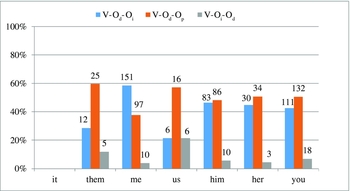
Properties of the objects have also been singled out as a potentially influential factor in the choice of one or another variant. As previously mentioned, the it-subdataset (N = 835) always has Od = it and the Oi/Op is always a personal pronoun; thus we cannot address the factor of pronominality. We can nonetheless observe trends concerning the choice of personal pronoun in Oi/Op function. First, the personal pronoun can be preceded by a preposition or can appear on its own. The distribution turns out to be rather even: 47 per cent as Op (N = 390) and 53 per cent as Oi (N = 445). Second, the person of the Oi/Op pronoun can be local, i.e. first and second, or non-local, i.e. third person. PDE studies often report that local persons favour non-prepositional variants, while non-local persons lean towards the prepositional pattern (e.g. Bresnan & Nikitina Reference Bresnan, Nikitina, Uyechi and Wee2009: 17–18; Haddican Reference Haddican2010: 2431–2). In our data these generalisations only really hold for the very frequent 1 sg. me, which strongly prefers double object patterns (particularly V it me), whereas the equally frequent 2 pers. you has a roughly equal distribution between Oi and Op, and 1 pl. us shows a preference for the prepositional pattern. It is true that taken together the local pronouns divide 302 as Oi vs 245 as Op, though the non-local pronouns show no preference: 143 Oi vs 145 Op.
The distribution of the three syntactic variants plotted in figure 5 clearly indicates that V–Od–Oi is the preferred variant with me. The combination with him shows an even distribution between V it him and V it to him. With her and with you the pattern V–Od–Oi scores over 40 per cent, a little below the prepositional variant but way above that for V–Oi–Od. On the other hand, V–Od–Oi is less common with us and with them,Footnote 10 which have the highest rates of use of the canonical pattern V–Oi–Od, at 21 and 12 per cent, respectively. Regarding the use of V–Oi–Od, Siewierska & Hollmann (Reference Siewierska, Hollmann, Hannay and Steen2007: 95) observe that in their present-day Lancashire data the canonical pattern ‘exhibits a dispreference for third person recipients’, with just one case of the combination V him it. Our historical data does show a low frequency of this particular order (6%), but it is nonetheless similar to V you it (7%) and in fact higher than V me it (4%). As for the third variant, the prepositional V–Od–Op clearly dominates with us and them, scores over 50 per cent with her and with you, but has a lower rate of use with the pronoun me.
Combinations of Od = it with personal pronouns (percentages and raw figures, N = 835)

3.5 Dialect
It was mentioned in the introduction to this article that syntactic variation in PDE concerns in essence patterns (1) and (2), while pattern (3) is confined to certain dialects of British English. Broadly speaking, Hughes et al. (Reference Hughes, Trudgill and Watt2012: 20) note that the pronominal pattern of (3), as in She gave it him, is ‘very common indeed’ in northern England, but it is ‘also quite acceptable to many southern speakers’. For their part, Kortmann & Lunkenheimer (Reference Kortmann and Lunkenheimer2013: feature 232) report that alternation between canonical V–Oi–Od and dialectal V–Od–Oi is ‘neither pervasive nor extremely rare’ in dialects of the North of England, ‘pervasive or obligatory’ in dialects of the Southwest, and extant but ‘extremely rare’ in East Anglia and in dialects of the Southeast of England.
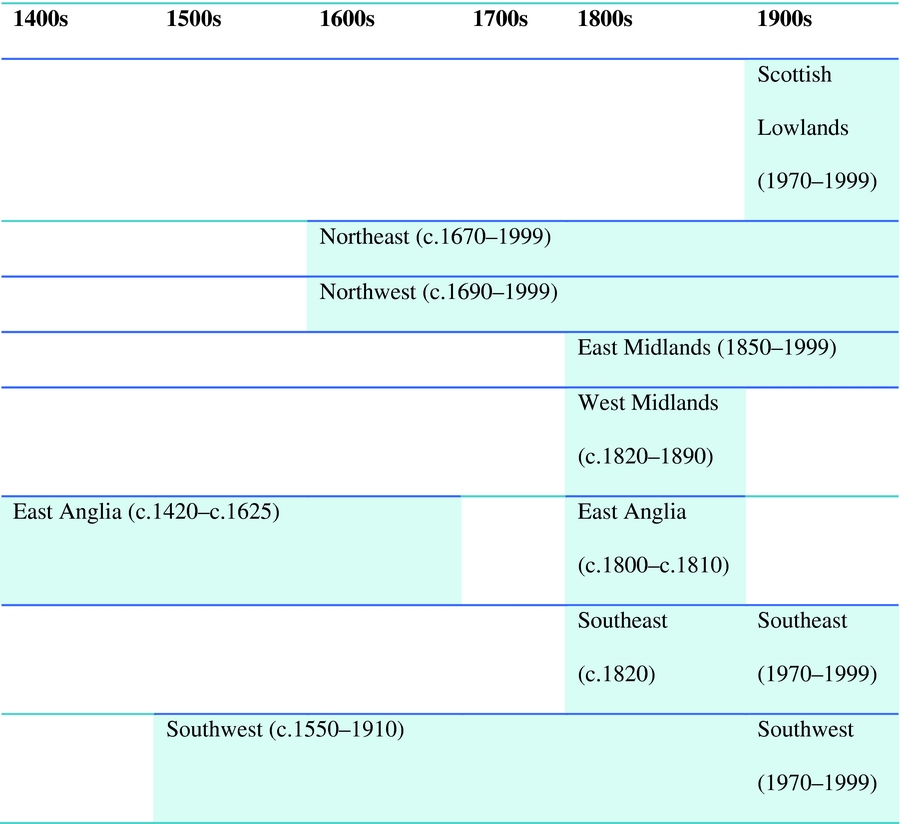
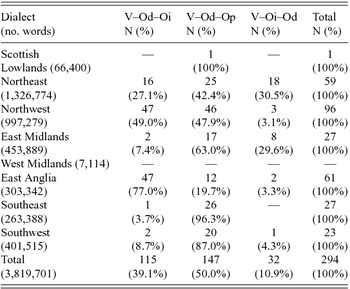
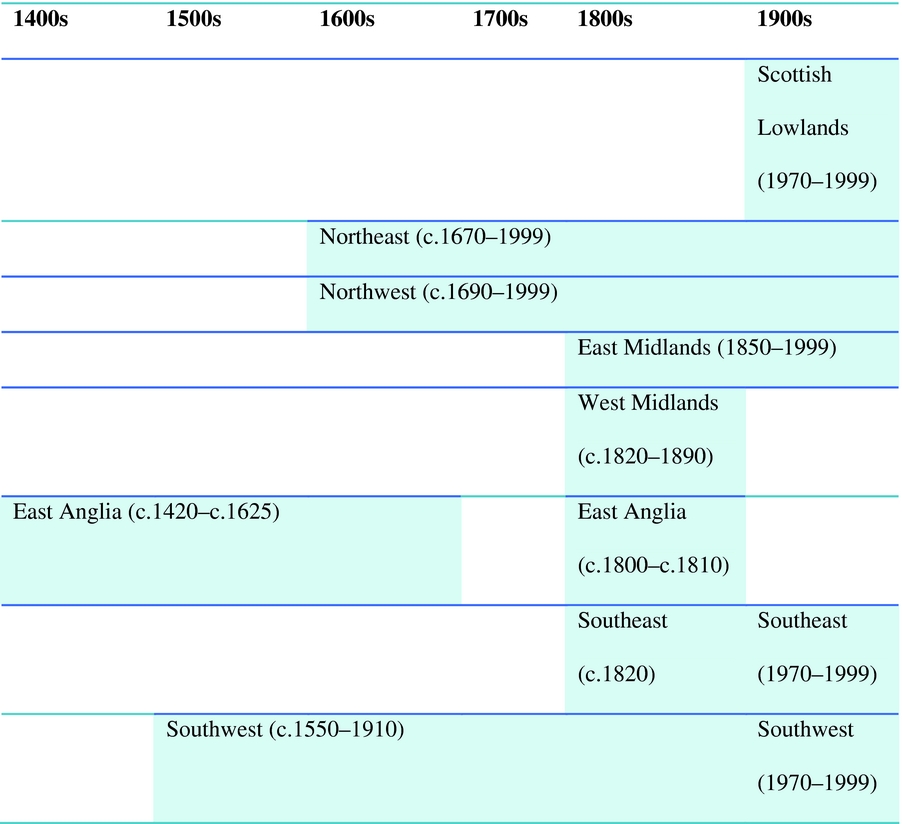
We have attempted to examine dialectal variation in our historical data, too. Seven of the twelve corpora studied contain dialect data: three from the late twentieth and early twenty-first centuries (FREDS, HARES-CAM, DECTE), and four from earlier periods (PCEEC, PPCEME, Salamanca Corpus, the Corpus of Late 18th-Century Prose). The dialect areas represented are Southwest, Southeast, East Anglia, West Midlands, East Midlands, Northwest, Northeast and Scottish Lowlands. Given the heterogeneous nature of the corpora examined, the regional areas are not uniformly represented over time; for instance, the data from East Anglia date primarily from the early fifteenth to the early seventeenth century, as we can see in figure 6. For this reason, we have analysed trends within each dialect area rather than across dialects, and the focus is on pattern (3), as this is the dialectal variant in present-day usage. Table 2 shows the distribution of the 294 instances of patterns (1)–(3) documented in a total of c. 3.9 million words.
Dialect data with Od = it and Oi/Op = personal pronoun (diachronic distribution of known dialect data, N = 294)
Dialect data with Od = it and Oi/Op = personal pronoun (raw figures and percentages by dialect and double object variant)

As we can see in table 2, the northern areas show a considerable frequency of V–Od–Oi, especially the northwest, in which it is the preferred pattern, slightly outnumbering the prepositional variant. This is in line with earlier studies on present-day dialect variation which have associated the pattern V–Od–Oi with northern England, and not only with two pronominal objects but also in combinations of nominal objects or nominal and pronominal objects (e.g. Haddican Reference Haddican2010: 2424; Hughes et al. Reference Hughes, Trudgill and Watt2012: 20). PDE data also points to pattern (3) as being more characteristic of the northwest than the northeast; for instance, in the Bolton area pronominal sequences such as give it me are ‘more usual’ than give me it (Shorrocks Reference Shorrocks1999: 81), and in Lancashire dialect generally ‘there is a clear preference’ for the V–Od–Oi pattern, with give it me ‘nearly twice as common’ as the canonical give me it (Siewierska & Hollmann Reference Siewierska, Hollmann, Hannay and Steen2007: 96). From a historical perspective, our data from the Corpus of Late 18th-Century Prose (1761–90) document 48 per cent of examples with V–Od–Oi, compared to a low 4 per cent of present-day canonical V–Oi–Od (see also Denison Reference Denison and Romaine1998: 239). Since our northern data cover a long historical time span from the seventeenth century to the early twenty-first century, we can infer that expressions such as give it me have been common in the north historically, especially in the northwest.
In contrast with northern regions in England, pattern (3) is absent in our data from the Scottish Lowlands, in which only one example has been documented, and that shows the prepositional variant V–Od–Op. This can be accounted for by the fact that our sample is limited to the late twentieth century (figure 6): on the one hand, pattern (3) has an overall low frequency in PDE, and on the other it has been observed elsewhere that there is an ‘attested absence’ of this feature in Scottish English (Kortmann & Lunkenheimer Reference Kortmann and Lunkenheimer2013: feature 232).
In our data, V–Od–Oi seems to be infrequent in both southern regions. Previous work on PDE has consistently concluded that this order is attested in the south, for instance in enclaves such as London and Cornwall (Haddican Reference Haddican2010: 2426; Hughes et al. Reference Hughes, Trudgill and Watt2012: 20, quoted above). However, previous work has also claimed that in the south the non-prepositional variant V–Oi–Od is ‘particularly popular’, especially in the southeast (Szmrecsanyi Reference Szmrecsanyi2013: 69), and with two pronominal objects the prepositional pattern V–Od–Op is ‘well established’ in the southwest and some enclaves in the southeast and East Anglia (Orton et al. Reference Orton, Sanderson and Widdowson1978: map S1; Gerwin Reference Gerwin2013: 455). Our southeast samples date all but one from the late twentieth century, and thus the trends reported in earlier studies are confirmed, but this does not allow us to draw further conclusions. Our southwest samples do cover a long historical time-span from the late sixteenth century to the present day, and for this dialect table 2 suggests that V–Od–Oi does occur, but it is indeed less frequent than the prepositional and the non-prepositional canonical types.
In our Midlands data, pattern (3) is clearly not a popular variant: no instances have been documented in the West Midlands region and barely two examples have been attested in the East Midlands, none in Cambridgeshire (1970s–80s). The time range in our sample starts in the mid nineteenth century, which may help to explain the few instances in the East Midlands, but it must also be noted that V–Od–Oi has not been reported as characteristic of this region in the literature on present-day usage; the preference is clearly on the side of the prepositional variant. The absence in the West Midlands is more unexpected in that pronominal V–Od–Oi has been found with a relatively high frequency in some present-day studies (e.g. Gerwin Reference Gerwin2013: 453–5). However, our sample amounts to only c.7,100 words and there are no examples of the alternative patterns either.
The variant V–Od–Oi is clearly a frequent option in our East Anglia data. Except for one instance dating from the early nineteenth century, the attested examples for this region come from the late ME and the EModE periods, periods during which pattern (3) with the indirect object following the direct object was generally highly frequent (see figure 2). In contrast, PDE studies have reported that alternation between V–Oi–Od and dialectal V–Od–Oi is ‘extremely rare’ in East Anglia, and that with two pronominal objects the prepositional pattern V–Od–Op is ‘well established’ in some enclaves of this region (see references above). The distribution in figure 6 thus allows us to conclude that in early English examples such as give it me were not confined to the same dialect areas as today.
4 Early grammars
As noted in section 2, one of the strands in our study investigates the treatment of double objects in the (normative) grammatical tradition. The eighteenth and nineteenth centuries saw the publication of numerous grammars laying down rules about ‘(in)correct’ and ‘(im)proper’ English, and there is evidence that normative rules have brought about change in the historical development of various morphological and syntactic features (Yáñez-Bouza, forthcoming). We have seen in this article that variation has been gradually restricted in present-day standard British English to patterns (1) and (2), and that pattern (3) is confined to certain dialects only. Bearing in mind that the main turning points in our usage data have been attested in the early eighteenth century and in the early twentieth century, it seems natural to consider the potential influence of early (1500–1700) and late (1700–1900) Modern English normative works.
We have examined a precept corpus of 170 sources, the majority of which are grammar books, but we have also consulted a representative number of provincial glossaries and dictionaries. Here we summarise the findings regarding awareness of syntactic variation and change over time, awareness of regional differences, and attitudes towards the prepositional and non-prepositional variants, with special attention to pattern (3) give it me.Footnote 11
The Dative Alternation is discussed in very few works before the eighteenth century, probably because EModE grammars typically focused on morphology and orthography rather than syntax. 18th-century works paid more attention to syntax, and thus we see an increasing number of sources in which one or more Dative Alternation variants are discussed. The prepositional pattern V–Od–Op is very often referred to, either in variation with V–Od–Oi, which grammarians tend to read as the preposition being ‘understood’ (10), or most often in contrast with V–Oi–Od (11).
(10) The dative sign, to, after verbs of giving, lending, pardoning, &c. is often understood; as, he gave it me; that is, to me (Brittain Reference Brittain1788: 22).
(11) The preposition to is almost constantly dropt after send, give, lend, &c. and when it is so, the word that is connected by to comes before the object of the verb: He gave not [to] God the glory. This, if completed, should be retransposed – He gave not the glory to God (Fogg Reference Fogg1796: 112).
Early grammarians often state that with two objects the indirect object is commonly placed first (V–Oi–Od), but at the same time with two pronominal objects the present-day dialect pattern V–Od–Oi is perceived as natural usage, from the late seventeenth century to the late nineteenth century, as in Sweet (Reference Sweet1903 [1898]: II.16): ‘if both [objects] are pronouns, the accusatival pronoun precedes: “give it me!”’. Pre-1900 grammarians do not seem to report explicitly on contemporary diachronic change. There is one author, however, who shows awareness of reduction in variation from the early eighteenth century to the early nineteenth century; interestingly, the rule for Crombie is the present-day non-standard order V–Od–Oi:
(12) After verbs of giving, telling, sending, promising, offering, and others of like signification, the thing is very generally placed before the person. In the time of Swift and Addison this rule was not uniformly observed. We find authors of that period saying indiscriminately, ‘Give it us’, and ‘Give us it’; ‘Tell him it,’ and ‘Tell it him’; ‘He promised me it,’ and ‘He promised it me.’ In Scotland these two modes of expression still obtain. In England they are now reduced under one general rule. We say, ‘Give it me,’ ‘Tell it him,’ ‘He sent it us.’ (Crombie Reference Crombie1830: 271)
That the pattern V–Od–Oi is common usage in both early and late Modern English can also be inferred from the fact that there is no strong criticism of this word order, and that there are very few prescriptive remarks overall. Rather than proscribing combinations such as give it me, what grammarians tend to do is to prescribe either give me it or give it to me. For instance, in the mid nineteenth century Crane recommends the prepositional pattern V–Od–Op over examples such as ‘the keeper showed it us’ and ‘John told it his brother’: ‘[t]his form of expression is not to be recommended: the preposition should always be supplied’ (Crane Reference Crane1843: 57). Others go further and describe the order V–Oi–Od as elegant, yet as opposed to pattern V–Op–Od: ‘After Verbs of shewing, giving, &c. the Preposition, to, is elegantly omitted before the Pronoun, e.g. “I give him the Book” for “I give to him the Book”’ (Ash Reference Ash1766: 79).
Whereas dialect variation is a much talked-about topic in present-day literature, we found no remarks on variation across English dialects in the pre-1900 works consulted, not even in provincial dictionaries and glossaries. However, what we do find are passages pointing to variation between Scottish English and English south of the Lowlands border. Rather consistently, the late eighteenth- and nineteeth-century authors born in Scotland that we examined regard the present-day standard pattern V–Oi–Od as a Scotticism, hence ‘improper’ and ‘bad English’, and state that this word order should be corrected to the present-day non-standard pattern V–Od–Oi. For example, Mitchell (Reference Mitchell1799: 54) writes in his work on Scotticisms as follows: ‘Give me it, show me it; Sc. – Give it me, show it me. The former is Scotch, the latter English’.
Based on the normative works consulted, we can conclude that pre-1900 normative grammarians are not to blame either for the suppression of variation or for the restriction to dialect use.
5 Closing remarks
5.1 Overview of data analysis
By considering a wider range of sources than have been used previously, we have demonstrated that the reversed double object pattern is too widespread to be ignored in the overall history of the Dative Alternation. Standard written ModE and especially PDE are evidently somewhat atypical. Early normative works did not play a role in the suppression of variability in the Dative Alternation patterns, and the limitation to dialect use of V–Od–Oi for pronominal arguments seems to be a twentieth-century phenomenon. We can point to the importance of distinguishing among Dative Alternation verbs and concentrating (to use Mukherjee's notion) on the typical and habitual members, while the two pronouns it as Od and me as Oi or Op stand somewhat apart from other personal pronouns.
It is one of the best generalisations of PDE syntax that indirect objects precede direct objects. The semantic correlate of this observation is that recipient or beneficiary precedes theme or patient. Both expectations are defeated by the pattern V–Od–Oi, which therefore seems to stand outside the core of ordinary syntax. Consider now another marginal double object pattern, the one illustrated by (13):
(13) Again, if I give it a push upon the other side (PPCMBE, faraday–1859)
In (13) the pronoun it refers to a sheet of paper. The formal structure may be V–Oi–Od, but the pattern is hardly a prototypical double object construction: it here is semantically less of a recipient than a patient/theme (cf. if I push it), while give is a light verb rather than a true 3-place verb with full semantics. Here then is a different way in which the prototypical double object structure can be extended.
How does a parser – whether a human hearer or a computer program – deal with a VP sequence that starts with a potential 3-place (Dative Alternation) verb and continues with it? There are various ways the sequence may continue:
- (14)
(a) The verb is in 3-place use, the structure involves a double object, and it is a genuine indirect object recipient, referring for instance to a child, animal or collective entity.
(b) The verb is in 3-place use, the structure involves a double object, and it is a direct object – our recessive V–Od–Oi pattern.
(c) The verb is in 3-place use, the structure involves a prepositional object, and it is a direct object – a pattern that seems to be on the rise over the long term.
(d) The verb only has one object, and it is a direct object – 2-place use is common with most of the top eleven verbs other than give.
(e) The verb is used as a light verb in a multi-word verb, and it is syntactically a kind of indirect object but with the semantics of a direct object – another pattern which we suspect is on the increase.
For a parser, the range of possibilities at this stage is quite wide, though context and successive words will quickly home in on just one. How to represent these possibilities syntactically is obviously highly theory-dependent.
5.2 Approaches to the pronoun dataset
Fischer & van der Wurff pointed out some time ago (Reference Fischer, van der Wurff, Hogg and Denison2006: 190) that V–Od–Oi order predominated for examples with two pronouns long after V–Oi–Od had become the norm for full NP objects, and our evidence clearly supports their claim. This means that our restricted dataset of two-pronoun examples can only have limited utility as a proxy for the full range of NPs. It raises the possibility too that the pronoun material may operate to different rules. How should this be handled? We can only sketch some intriguing possibilities here.
Haddican suggests that V–Od–Oi order with a pronominal Od might ‘involve some kind of short object movement preferentially available to pronouns, akin to Romance clitic climbing, object shift in Germanic, English particle verb constructions, etc.’ (2010: 2427). For some of his informants, however, he suggests that the pattern may actually represent V–Od–Op with a null preposition (Haddican Reference Haddican2010: 2430), a revival of a suggestion made by Jespersen (1909–49: III.289) that the pattern results from progressive phonetic reduction of it to > it. Jespersen's suggestion had in turn been prefigured by early grammarians – as for example in (11) above – who talk of the preposition having been ‘dropt’. We will instead sketch a different approach.
5.3 Prefabricated expressions
There is a growing literature in corpus linguistics, psycholinguistics and other branches of the subject on the significance of prefabs in language, which we take as a pre-theoretical cover-term for ready-made multi-word strings. Opaque idioms (red herring), transparent but formulaic utterances (Good morning!), and grammatical patterns may all constitute prefabs of different degrees of schematicity, whose parts may be inflected or may be interrupted by freely chosen elements (Bybee Reference Bybee, Hoffmann and Trousdale2013: 54).
Consider now the curious idiom get it over with (Denison Reference Denison1984), apparently frozen apart from the inflection of get. In fact the object slot is not fixed and can be filled productively by different NPs, albeit far less frequently than with it. We speculate that our V–Od–Oi data incipiently shows similar behaviour. Of the 835 tokens in our it-dataset, 393 have V–Od–Oi (Od = it), and of these, 151 (38%) have V it me, including 45 (11%) with the lemma give, thus give / gives / gave / giving / given it me. Although the frequency of patterns with it straight after the verb might seem to be enhanced artificially by our self-selected dataset in which the direct object must be it, note that the number of V–Od–Oi examples with Od = them that we found in an earlier search for other pronouns was relatively and absolutely very much smaller: just 2 vs 1327 with it; for comparison, them is under eight times less frequent than it in the BNC.
High token-frequency items often resist a general tendency of a type towards obsolescence, for example preserving conservative morphology that less frequent items are losing; see Bybee (Reference Bybee, Hoffmann and Trousdale2013) for a convenient survey of work on exemplar theory, entrenchment and frequency effects. For whatever reason, the order V–Od–Oi has over the course of time dwindled away in many dialects and in most syntactic configurations. Where it remains fairly resilient, as discussed in section 3 above, a significant proportion of the tokens involved are prefabs.
The subtle interaction of productive syntax and prefabs is best handled in an exemplar model (Bybee Reference Bybee, Hoffmann and Trousdale2013) such as a Construction Grammar account. Dative Alternation would be the most schematic, over-arching construction. Patterns (1), (2) and (3) are subconstructions, with (3) occupying historically the central position, sharing with (1) an absence of preposition and with (2) the thematic order of constituents. Included in (3) particularly are prefabs involving ‘typical’ verb lemmas like give and/or the direct object it and/or the indirect object me. Over time, (3) begins to lose its importance in the grammar, while in some dialects the prefab variants develop greater autonomy by constructionalisation. Further work may be able to confirm whether the proportion of prefabs shows a diachronic increase, which would lend support to this sketch. And to the extent that the give it me pattern is recognised as characteristic of certain regional speeches, it is contributing to their enregisterment.
Whereas generative grammarians like to model the use of language as far as possible by productive rules, usage-based linguists tend to give weight to entrenchment of patterns through repetition. The trading relationship between grammatical rules and prefabs remains an important research topic, both for production and reception (parsing). The synchronic possibilities listed in (14) and the diachrony of the double object pattern discussed in this article provide a rich source for further research.