Introduction
Since colonial times, a mid-level set of actors in Africa has worked to mediate between a predominantly rural populace and an exogenous structure, whether the colonial state or the international development apparatus (Escobar Reference Escobar1994). Most scholarship on African “middle figures” (Hunt Reference Hunt1999:2) emphasizes their historical relationship to the colonial state to complicate the understanding of colonialism as a unidirectional encounter between agentic colonizers and passive African populations. This interdisciplinary research highlights how middle figures produced culture and could resist—or profit from—translating colonial policies into practice (see Cooper Reference Cooper1994; Lawrance, Osborn, & Roberts Reference Lawrance, Osborn, Roberts, Lawrance, Osborn and Roberts2006; Peterson Reference Peterson2004).
Theorization of middle figures in the postcolonial era likewise complicates development as encounter, intervening in instrumentalist accounts of aid to center the meaning-making of “development brokers” (see Bierschenk, Chauveau, & Olivier de Sardan Reference Bierschenk, Jean-Pierre Chauveau and Jean-Pierre Olivier de Sardan2002; Fechter & Hindman Reference Fechter and Hindman2011; Lewis & Mosse Reference Lewis and Mosse2006; Swidler & Watkins Reference Swidler and Watkins2017). These brokers work across levels of scale, from NGO offices in national capitals to district headquarters or village-based trainings (Swidler & Watkins Reference Swidler and Watkins2017). Rather than scaffold the colonial state, however, postcolonial middle figures have contributed to the developmentalist state’s erosion by providing parallel services and redirecting “development rent” to decentralized spaces (Bierschenk, Chauveau, & Olivier de Sardan Reference Bierschenk, Jean-Pierre Chauveau and Jean-Pierre Olivier de Sardan2002). This has not necessarily been by choice. The aid apparatus demands that actors do translational work and primarily employs them in extra-statal institutions.
While critical development scholars point to the role of middle figures outside of government in de-legitimizing the African state, I argue that middle figures also constitute the state and help assert state authority in their roles as civil servants. Middle figures within government renegotiate and reclaim “state legitimacy lost on paper” (Bierschenk, Chauveau, & Olivier de Sardan Reference Bierschenk, Jean-Pierre Chauveau and Jean-Pierre Olivier de Sardan2002:36) through their everyday actions and inactions. In so doing, they preserve state influence over aid processes, even as much of the scholarship on the African developmentalist state highlights its weakening in relation to funders and NGOs (Carnoy Reference Carnoy1995; Reimers Reference Reimers1994; Samoff Reference Samoff1999).
This article focuses on one ethnographic case—the 2016 government-led review of Malawi’s Readmission Policy, which banned the permanent expulsion of pregnant girls from school in 1993—to show how state disempowerment in Malawi was not wholesale, though foreign funding for the Readmission Policy bypassed the government. Rather, middle figures in Malawi’s Ministry of Education, Science, and Technology (MoEST) shaped the policymaking process in strategic and often subtle ways. With “nothing but time,” MoEST actors controlled the pace of policy reform, leveraging techniques of time (mis)management to assert ownership over both policy process and content. By highlighting these civil servants and their non-governmental colleagues, this article demonstrates how a middle figure analysis continues to nuance our understanding of governance in Africa. It destabilizes a presumed dichotomy between powerful, foreign funders and powerless, local recipients of aid prevalent in mainstream development discourse, and challenges the treatise that African state sovereignty has simply eroded.Footnote 1
Malawi is a fruitful space in which to explore middle figures and state/non-state relations, given the high percentage of the national budget derived from overseas development assistance (ODA). International funders provide approximately 40 percent of Malawi’s annual budget, including 87 percent of its development account (Kadzakumanja Reference Kadzakumanja2016). In 2017, Malawi’s net ODA reached USD1.24 billion (World Bank 2017b) with a total GDP of just USD5.4 billion and a population of 18 million (World Bank 2017a). Finally, international funders have redirected ODA from the Malawian government toward NGOs for decades (Cammack Reference Cammack2012; Resnick Reference Resnick, Resnick and van de Walle2013; Wroe Reference Wroe2012), with the 2012 Cashgate Scandal the most recent justification for diverting aid from state coffers.Footnote 2
The Readmission Policy is likewise useful to think with as an example of a hybrid state/development initiative. In Malawi, as in much of the world, schoolgirl pregnancy is a deeply contested social and moral issue. Diverse actors deploy formal education to shape sexual and social relations, with girls’ bodies standing in for the family, community, and nation. Pregnant schoolgirls embody sexual shame, producing profound moral anxiety across African contexts about shifting modes of social and economic reproduction (Johnson-Hanks Reference Johnson-Hanks2006; Parikh Reference Parikh2015; Stambach Reference Stambach2000; Thomas Reference Thomas2003, 2007).
At the same time, girls’ education is viewed by development actors as a high-yield investment that brings significant returns to low-income states and their populations (see Levine, Lloyd, Green, & Grown Reference Levine and Lloyd2008). Here, the value of educating a girl is calculated by multiplying schooling’s inherent good by a range of public health, social, and economic indicators said to improve by keeping her in class and delaying childbearing. In this equation, pregnant students are liabilities (Moeller Reference Moeller2018; Vavrus Reference Vavrus2003). As Malawi’s official stance on student pregnancy, the Readmission Policy is both symbolically and politically meaningful.
The Readmission Policy’s Conception in Malawi
Prior to 1993, a student found pregnant in Malawi was permanently expelled from school. The Readmission Policy, the first of its kind in the region, granted young mothers the right to re-enroll after a one-year suspension. It was born amidst a groundswell of socio-political change, as Malawi adopted a “global policy package” of political democratization, economic neoliberalization, and free primary education (Kendall Reference Kendall2007). The country’s 1994 multi-party elections ended the thirty-three-year reign of Hastings Kamuzu Banda, who had declared himself “Life President” of the Republic of Malawi. Legalizing school return for young mothers was part of a broader overhaul of the way that Malawians thought about citizenry and the state.
More specifically, the Readmission Policy emerged from the sustained efforts of elite stakeholders within the Ministries of Education and Gender; advocacy from the National Commission for Women and Development in Malawi; and the mobilization of activists who worked as part of a USD10.5 million USAID-funded girls’ education project, Girls’ Attainment in Basic Literacy and Education (GABLE). According to Esme Kadzamira and Pauline Rose (Reference Kadzamira and Rose2001), the GABLE project exemplifies the disproportionate influence that international funders have on educational policymaking in Malawi, as previously girls’ education was not a government priority.Footnote 3 Since GABLE, however, girls’ education has remained the target of substantial aid funding and MoEST attention.
Still, the Readmission Policy has failed to get most young mothers back in school (Liwewe Reference Liwewe2012; Samati Reference Samati, Ackerman and Abay2013). It is bureaucratically cumbersome, requiring that a pregnant teenager write a letter to withdraw from school, wait at least one year to seek re-entry after giving birth, and reapply for enrollment. Ministry officials suggest that girls re-enroll at a different school than the one they originally attended. This stipulation has significant implications for young rural women, who often already had to walk long distances to reach their catchment school. The policy is not implemented evenly in practice, with teachers and administrators adjudicating school return on a case-by-case basis. Young fathers are also supposed to be expelled, but this requirement is rarely enforced. Nor does the policy address challenges facing young mothers who seek re-entry, including stigma from teachers and peers, issues with infant feeding, and a lack of childcare options or school fees.
Given these concerns and others, in 2016, officials at the MoEST initiated a formal review of the Readmission Policy. The review was funded by international organizations and catalyzed by two years of organizing by girls’ education advocates in civil society. Throughout the review process, Malawian middle figures framed the national policy agenda, determined the form and content of policy reform, and chose which voices would be represented. Middle figures remained uniquely situated to liaise between communities “on the ground,” government actors, and international funders. Different sets of middle figures, however, had different levels of influence over the process and policy outcome. And they had different visions for Malawian schools.
Methodology
This article draws on a year of multi-sited ethnographic research in Malawi on the discursive and material environments in which policy on schoolgirl pregnancy was understood as necessary, implemented, and reformed. It is situated within a broader anthropology of policy that argues that policy serves as a technique of governmentality to produce particular subjects and social relations within a field of shifting power (Shore, Wright, & Pero Reference Shore, Wright and Però2011; Sutton & Levinson Reference Sutton and Levinson2001). Within this framework, policy is socio-cultural practice (Bartlett & Vavrus Reference Bartlett and Vavrus2017).
Methods included semi-structured interviews, archival research, participant observation in rural classrooms and homes, NGO trainings, and government policy reform meetings. I interviewed over 125 stakeholders, including pregnant students, student mothers, parents, teachers, religious leaders, and village heads in one peri-urban district; NGO workers involved in the Readmission Policy negotiations and girls’ education programming; government officials in the education, gender, and health sectors at district and national levels; and representatives from bi- and multi-lateral funding agencies. I gathered archival materials such as project evaluations and promotional reports at relevant national organizations (Malawian NGOs and the MoEST), and at international organizations (UN bodies, the World Bank, bilateral organizations, and international NGOs).
In 2016, I observed Ministry-level policy review sessions, a National Stakeholders’ meeting, and policy dissemination workshops.Footnote 4 I watched the official review of the Readmission Policy unfold and stall over the course of a year, interviewing participants throughout. By entering the spaces in which development policy was debated, I employed what Jen Sandler and Renita Thedvall (Reference Sandler and Thedvall2017) call meeting ethnography. Meeting ethnography in the field of international development provides rare data sources on the interactions that link funders, governments, and NGOs. It moves beyond analysis of official discourse to show how such discourse is negotiated and produced by middle figures (Kendall & Silver Reference Kendall, Silver, Sandler and Thedvall2017). Before describing the production of a revised Readmission Policy, I briefly review the literature on mediators across time, noting what a middle figure analysis can reveal about development and the state in Africa.
Middle Figures and the African State
Scholars use diverse terms to describe African brokers. I rely on Nancy Rose Hunt’s (Reference Hunt1999) term “middle figures,” coined in her study on childbirth and its medicalization in the former Belgian Congo, for its spatial metaphor. In general, middle figures exist in relation to other social categories. While Hunt employs the language of highs and lows, evoking socio-economic class, I focus on the work that middle figures do to bridge indigenous and exogenous categories, between “insiders” and “outsiders.” Significant issues arise when theorizing indigeneity and exogeny. How does one define the indigenous or exogenous? Do meaningful boundaries exist to mark their distinction? I proceed with caution, drawing attention to what is theoretically useful about a relationship between local majorities and global configurations, while acknowledging that the determination of who counts as an insider or an outsider is ever-changing. I treat middle figures as a Weberian ideal type, deployed to make sense of what is, in reality, a wide range of actors operating under varied circumstances.
The majority of scholarship on African middle figures situates their historic production during colonialism. During the colonial era, middle figures emerged as mediators of diverse relations. In a range of occupations, they labored to bridge linguistic and cultural differences, and to manage the acquisition and distribution of land, labor, and money (Lawrance, Osborn, & Roberts Reference Lawrance, Osborn, Roberts, Lawrance, Osborn and Roberts2006). Colonial-era intermediaries were integral to the functioning of the colonial state, as European officials, especially early on, rarely learned African languages beyond regional lingua francas.
As the colonial project evolved, colonial-era middle figures governed local areas as traditional authorities and chiefs; translated, recorded, and ran daily colonial administration and clerical services; and slowly filled the ranks of the health and education sectors. In their range of (relatively) privileged positionalities, these new—and sometimes unexpected—elites meted out access to the colonial state and its services. Writing on colonial-era middle figures problematizes an encounter paradigm, framing European presence on the African continent instead as a process of “routines, transactions, and exchange” (Hunt Reference Hunt1999:323–24).
Scholarship that seeks to define middle figures in the independence and postcolonial eras is less theoretically cohesive. Some describe the transition from colonial-era middle figures to a postcolonial middle class as relatively straightforward, as former colonial employees deployed the skills and knowledge gleaned from their previous positions to situate themselves in similarly privileged postcolonial spaces (Eckert Reference Eckert, Lawrance, Osborn and Roberts2006; Klein Reference Klein, Lawrance, Osborn and Roberts2006). Others trace the transition of mediators of the colonial era to nationalist activists, who employed the skills gained from experience working in the colonial state to undermine it (Cooper Reference Cooper1994; Derrick Reference Derrick1983; Peterson Reference Peterson2004).
More recent work highlights the daily experiences of development fieldworkers as they have negotiated economic crisis market reform, democratization, and a shifting African state since the 1970s. Critical development scholars have documented how structural inequities between international funders and the recipients of development funds have resulted in the funders having an outsized impact on historically sovereign arenas such as state economic and governance policymaking (Kadzamira & Rose Reference Kadzamira and Rose2001; Kendall Reference Kendall2007; T. Mkandawire Reference Mkandawire2010). They have shown how funder conditionalities, including the imposition of structural adjustment policies, have weakened the institutional structure and staffing of many recipient states (Anders Reference Anders2010; Carnoy Reference Carnoy1995; Reimers Reference Reimers1994; Samoff Reference Samoff1999). They have analyzed the key ideological and practical roles played by international funders in reshaping the “civil society” arena in many countries, including through placing NGOs in competition with government for international funding sources and tasking NGOs with serving as watchdogs for state corruption (Blundo & LeMeur Reference Blundo and Le Meur2009; Ferguson Reference Ferguson2006; Ferguson & Gupta Reference Ferguson and Gupta2002).
In this arrangement, government officials are actively disempowered, while international development organizations are strengthened, and NGOs take on roles that parallel the state itself. Thus, new forms of “neoliberal governmentality” (Ferguson & Gupta Reference Ferguson and Gupta2002) increase the extent to which mediating actors are relied upon to do the daily work of service provision across sectors. Although they are more difficult to define, middle figures remain central to governance in Africa.
Claire Mercer (Reference Mercer2002) cautions, however, that NGO/state relations are contested and contextual, with NGOs supporting neoliberal democratic states and destabilizing others. Further, in settings where international funders have implemented neoliberal economic policies, lines have blurred between state and non-state sectors. According to Michael Bratton (Reference Bratton1989), both state and NGO stakeholders can assert control over each other; the extent to which they do so is a matter of politics. Kendra Dupuy, James Ron, and Aseem Prakash (Reference Dupuy, Ron and Prakash2016) show that low- to middle-income states concerned with the influence of foreign aid on domestic politics have moved to impose restrictions on NGOs receiving aid. Restrictions take a range of forms and can include necessitating government to sign off on transfers of money between international funders and NGOs, as is the case in Malawi. Here, state-based middle figures retain the power of the pen, and actors across institutions shape ever-evolving state/NGO/funder relations in their daily work.
Middle Figures and Malawi’s Readmission Policy
Between its introduction in 1993 and 2016, Malawi’s Readmission Policy was expanded once, in 2006, when more elaborated guidelines for implementation were issued. The 2006 guidelines, however, remained concise and failed to address key barriers impeding the policy’s success. I turn now to trace the 2016 policy reform process chronologically from its planning phase to the dissemination of a new version in December 2017. At each stage, I ask who drove the policy agenda forward (or stalled it), who claimed to represent the rural majority, who asserted authority, and when. I show how the Malawian government maintained meaningful control over the process and product through the actions of its civil servants, even as it received no funding for the initiative. Middle figures in the MoEST used timing, in particular, as a strategy through which to assert their ownership over Malawian schools and educational policy.
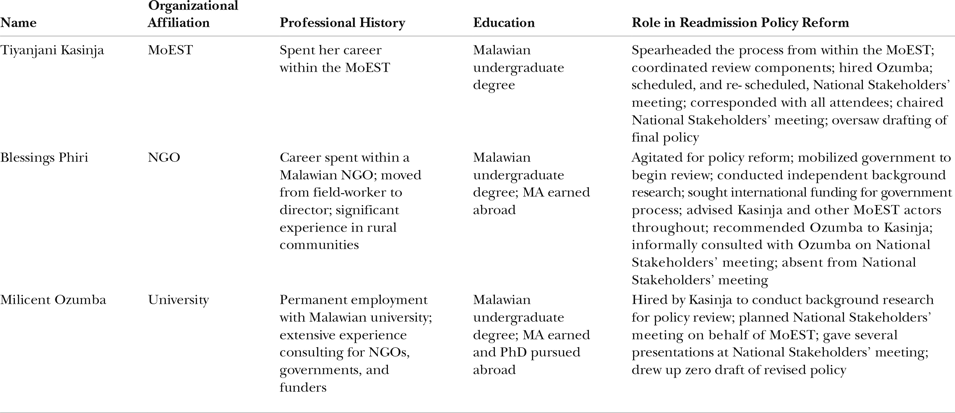
I focus on three central middle figures: (1) Blessings Phiri, a well-respected NGO activist and civil society leader in the field of girls’ education; (2) Tiyanjani Kasinja, a mid-level manager in the MoEST; and (3) Milicent Ozumba, a widely-known expert on girls’ education based at a research university.Footnote 5 These three women had much in common: each was middle-aged, upper-middle class, urbanized, and Christian. Each had earned a bachelor’s degree in Malawi; each regularly interacted with international funders in their work. Yet Phiri and Ozumba had also earned advanced degrees abroad. Further, while Kasinja spent limited time in “the field”—code for the mostly rural areas targeted by development organizations—Phiri built her career in community mobilization, and Ozumba had vast research experience in rural schools. While these women were not the only actors involved in policy reform, their participation was significant, and each represented a different kind of middle figure involved in shaping girls’ education and government policymaking (see Table 1).
Key Middle Figures Involved in Readmission Policy Reform

Other MoEST officials: Faith Mbendera, Arthur Mulima, Alinafe Makhuva
Prioritizing the Readmission Policy (2014–2016)
Middle figures across institutions expressed interest in reviewing the Readmission Policy. Malawian officials working for international funders wrote money for the review into their budget lines for several consecutive years. NGO Director Blessings Phiri advocated for policy reform in a series of meetings with MoEST officials from 2014 to 2016. Phiri felt that the original policy had failed to address the cultural dimensions of gender equality, to engage key community-level players, and to take a holistic approach to youth sexuality. She explained:
[I]t’s very important to have specific attention on issues of reproductive health [in a new policy]…because much as we might deny this fact…there is a lot of sexual activity going on among our children, so a lot of talk should also be around sexual and reproductive health issues, and there is need to have some level of openness around these issues so that we can help our girls. If they can’t abstain they have to protect themselves. (Fieldnotes November 25, 2016)
Phiri acknowledged that the MoEST might take issue with her stance, as they maintained a strict, abstinence-based policy in teaching about sexual and reproductive health (SRH) and barred the provision of contraception at schools. With the authority of significant experience working “on the ground,” however, Phiri’s assessment of the policy’s import for girls carried extra weight. Her concerns were echoed by other NGO representatives, including members of the National Girls’ Education Network, a consortium of organizations working on girls’ education and health, who selected the policy as a key advocacy goal for 2016.
Within the MoEST, officials flagged the Readmission Policy for review, given the “magnitude of the problem” of teenage pregnancy in Malawi.Footnote 6 Tiyanjani Kasinja highlighted a failure in format; she was concerned that the 1993 version was distributed as a circular, which was easy to dismiss or to misrecognize as unofficial. Kasinja was also disturbed that the 2006 set of guidelines, published by the MoEST to supplement the initial one-page circular, bore the flag of the bilateral organization that had sponsored its printing on the cover. “We weren’t happy when [the revised document] came out,” Kasinja told me, “because it had that symbol there; [The flag] could be on back but shouldn’t be on front” (Fieldnotes December 7, 2016). That a Malawian government policy had another country’s flag so prominently displayed signaled, for Kasinja, the extent of Malawian disempowerment at the hands of international funders.
For her part, gender specialist Faith Mbendera was concerned over the policy’s paradoxical stance toward student sexuality. She told me:
We have to review [Readmission Policy]. [Because], in our disciplinary rules and regulations…if you find a girl and a boy kissing or doing anything indecent— maybe they are engaging in sex—we exclude [expel] them from school. So, the argument from parents is like, you excluded my child just because she was being intimate with somebody, but someone is pregnant, meaning she did it, but we say she will go back to school while my child will not come back to school [for kissing]. (Interview July 18, 2016)
Government actors further acknowledged that it was most often not schoolboys, but rather men—teachers or community members—who impregnated schoolgirls. Some argued that a new version needed to be explicitly linked with Malawi’s criminal justice system. They pointed to gaps in the existing policy: there was no provision for rape, no instructions for private or religious schools, no guidelines for resistant grandparents, no instruction for what to do with girls on bursaries who became pregnant. MoEST officials frequently noted the need for greater psycho-social support for returning mothers. They did not, however, acknowledge a need for material support—a barrier to school return that emerged consistently in my work with girls themselves—as a practical or even symbolic priority. Nor did they echo Phiri’s concern over limitations in the current SRH curriculum offered in schools.
In May 2016, Phiri requested an interdepartmental meeting at the MoEST to discuss the necessary procedural components for a policy review. Phiri and her MoEST counterparts agreed upon some form of baseline research; some form of National Stakeholders’ meeting in which relevant parties from civil society, government, and funding bodies would come together to debate and draft a new version; and a series of meetings within the MoEST to finalize a document. Throughout, Phiri made verbally explicit the MoEST’s ownership of both policy and process, even if they would not be funding it.
Ownership has been a central thematic in development circles since the 2004 Paris Declaration for Aid Effectiveness, which highlighted the need for “partner countries” to assume greater ownership over aid in an effort to increase efficacy. In theory, ownership signifies a power shift away from funders so that partner countries set their own development priorities and control funds. At each step of the Readmission Policy review process, Malawian middle figures did call the policy a government initiative, put the government logo on communications, and run invitations through government email accounts. Though non-governmental actors drafted provisions and designed research, they explicitly directed that “government leads the process, as usual.” I heard over and over that “girls’ education is the government’s” and that “schools belong to the MoEST.”
Yet an extensive literature on the relationships among funders, governments, and non-governmental actors in Africa demonstrates that a discursive commitment to government ownership has not been mirrored in development practices (Esser Reference Esser2014; Hyden Reference Hyden2008; Unsworth Reference Unsworth2009). In Malawi, this was certainly the case, as not a single dollar for girls’ education, or for the Readmission Policy review, went to the MoEST. In general, international funders contracted international NGOs (who subcontracted Malawian NGOs) to implement programming in Malawi’s schools. Kasinja explained, “We don’t know how things are being done, really. Because it’s like Ministry is out…We don’t think Malawi is benefiting” (Interview June 10, 2016).
Not only was the Ministry excluded from matters pertaining to the financing and implementation of girls’ education projects, but it was also left out of planning. I witnessed awkward conversations in which NGO representatives would inform MoEST officials about funder plans for multi-million-dollar projects to be rolled out in MoEST schools. During one conversation between Phiri and a high-ranking MoEST official, Phiri shared that a large conference had been held in a neighboring country for a project to be funded in Malawi. Representatives across Malawian civil society had been flown to attend. Both women agreed that excluding the Ministry was wrong. The official concluded: “I don’t know how people think.”
Funders were aware of this awkward situation; one British official admitted that coordination was difficult, and that there was “a bit of a rift now since Cashgate” (Interview September 22, 2016). She agreed that funders needed to be more forthcoming with the government and work harder to meet government-designated priorities. But she confessed that Cashgate had made this kind of coordination work less necessary since the government had been sidelined.
Funders’ paternalism toward government was both widespread and historic. One newspaper headline read: “Donors Not Head Teachers” and then quoted the German ambassador to Malawi: “I sometimes get annoyed when donors are asked like headmasters about what they think.” He then went on to “sugges[t] ways that can help Malawi getting out of [its] pitiable state” (Chafulumira Reference Chafulumira2016). Similarly, a Japanese ambassador stated: “I cannot…emphasise [enough] the importance of self-reliance and working diligently with what is available on the ground instead of always relying on handouts” (Ponje Reference Ponje2016:33).
Malawi’s staggering debt created space for such statements, and for resigned acknowledgments by Malawians over the state of things. Another headline read “Government Cries for Mercy,” before describing how “Treasury has gone down on bended knee pleaded with the World Bank for softer repayment terms” (L. Mkandawire Reference Mkandawire2016). Malawi’s disempowerment via international funders was known to all, and Malawians with whom I spoke expressed their frustration with funders and government alike.
Within government, officials seemed particularly vexed by one issue—the full board policy. In addition to redirecting program funding from government, funders had recently ended the system of providing civil servants cash allowances to attend trainings or workshops. Previously, attendees would receive a daily subsistence allowance to compensate for travel, food, room and board. Given limited salaries, inflation, and poverty, many stakeholders opted out of staying in hotels or eating at restaurants, saving their allowances in cash. This practice offended funders, who decried Malawi’s “allowance culture” and, as part of a broader anti-corruption drive, came together in 2015 to initiate a “full board system” in which money for workshops would be paid directly from funders to vendors. Ironically, this system cost funders and their implementing NGO partners more money; they often put attendees up at exorbitantly expensive lodges instead of more modest ones. Many people from rural backgrounds expressed discomfort with these spending choices, and fieldworkers lamented the redirection of funds from the rural poor to primarily foreign-owned hotels in the capital.
Across government, officials were infuriated. In response to what they felt was condescension and wastefulness, civil servants began to boycott trainings. They shared stories of colleagues going on strike against funder-sponsored events, over-charging hotels for all-inclusive services, or delaying the completion of their required components in development projects in protest. Kasinja explained: “Nowadays civil servants are not going to full board meetings. The UN is crying, because civil servants aren’t coming. They can’t do anything without us. So, if they want to mistreat us, we will mistreat them. They can’t do anything without government” (Fieldnotes December 7, 2016). Malawian government officials were so frustrated that there were internal debates over whether to stop signing the contracts which allowed the transfer of money from foreign governments to NGOs—a single point of leverage.
In the process of the Readmission Policy Review, MoEST actors adopted similar strategies—they delayed or rushed the process; they added components at the last minute, causing disarray in funding budgets; they postponed meetings. These moves, regardless of their effect, represented a form of protest against a system that relied upon the government in name, that held the government responsible for particular outcomes, but that discounted the government in all other ways. They were “weapons of the weak” (Scott Reference Scott1987), deployed not by peasants but by elite government officials to resist inequitable terms of engagement. By examining each stage of the Readmission Policy review process, we can see where middle figures in the MoEST reshaped the landscape of governance in powerful ways.
Baseline Research (May 2016–December 2016)
After Phiri and her counterparts in the National Girls’ Education Network partnered with MoEST officials to prioritize the Readmission Policy for review and agreed on its necessary components, significant debate ensued over the process of data collection. This debate was, in essence, about which set of actors could best represent voices “from the ground” in a cost- effective manner.
Phiri wanted to use existing research. Four well-known empirical studies of the Readmission Policy and its effects had been conducted in Malawi between 2000 and 2017. Phiri felt that these were sufficient to inform a revised version, while government actors wanted a new study carried out by government. A MoEST-led baseline study, government officials explained, would bring the perspectives of rural community members into the discussion. Arthur Mulimba, a senior MoEST manager, explained:
[W]e need to know whether our girls are going back to school when they drop out. Otherwise we might be thinking for them. We say, we want you to go back to school, but them, they say we don’t want [to]. We are not actually having voices from the girls; we are having voices from people like you. (Interview December 7, 2016)
According to Kadzamira and Rose (Reference Kadzamira and Rose2001), village-level stakeholders in Malawi were not historically represented in education policymaking. MoEST officials agreed that voices from rural communities, not from “people like you”—Malawian middle figures or outsiders such as myself—needed to be represented. MoEST officials halted the review process until this new research was agreed upon and funded.
In response to MoEST pressure to collect new data, Phiri offered a second option, suggesting to government officials that she reach out to contacts at peer NGOs and ask them to draw on their existing contacts in rural communities to collect data on behalf of the government. This would expedite the process and minimize the cost. But the MoEST also rejected this proposal. According to Mulimba: “[I]f we’re looking for government policy, it has to be government championing the effort. The structure that [Phiri] proposed…can be the same, but government needs to take the leadership role, recognize the stakeholders in the back, but take the lead” (Interview December 7, 2016). A former professor-turned-politician also expressed concern over data validity in Phiri’s scheme.
In the end, the government asked funders to hire a consultant, Milicent Ozumba, to manage research on their behalf. Ozumba was formally employed by the funder, but she answered to the MoEST. Like many academics in Malawi, Ozumba took consultancies to supplement her university income (Biruk Reference Biruk2018). Academics offered a uniquely critical voice vis-a-vis the government; as middle figures, they did not rely on the MoEST to implement programming.
Together, Ozumba, Phiri, and I designed the research, including the target population, methodology, and focus group discussion (FGD) protocol. While originally the MoEST had wanted a more modest study, both Ozumba and Phiri insisted that, now that new research was being conducted, a wider range of village-based representatives be included. Kasinja resisted on account of scale and cost. Eventually, the coalition of Phiri, Ozumba, and Kasinja finalized a study that used FGDs to collect opinions of teachers, students, school committees, traditional leaders, returning and non-returning mothers, and grandparents in eight schools across Malawi’s six education divisions. Having conceded the issue of participation, Kasinja demanded that the MoEST select which districts and schools would be sampled. As middle figures, this threesome determined exactly who would, and who would not, be represented in the study. They used the inclusion of village-level stakeholders as a point of negotiation through which to work out the nuances of ownership.
Once the MoEST approved the sampling and research design, Ozumba recruited eighteen research assistants to complete data collection. Delays in getting the money released from the funders, due to delays in the government’s request for money, left the data collectors just one week to visit all educational districts, prepare transcripts, and submit reports to Ozumba. The final reports were notably concise. Research assistants were given immense leeway in translating the conversations into reports submitted to Ozumba who, in turn, had mere days to code and analyze the data for a presentation to the MoEST.
In general, FGD participants agreed that student pregnancy was a significant issue in their schools and communities. They highlighted poverty as both a primary cause of pregnancy and a barrier to school return for new mothers. Parents expressed concern over peer pressure. Everyone, including students themselves, emphasized a need for greater psychosocial and material support for young mothers. Though the MoEST had demanded to monitor the process, they did not send representatives out for data collection, nor did they read the reports.
Throughout baseline research, Ozumba remained in close contact with both Kasinja and the funder, who would give her conflicting information about necessary procedural components and timelines. Kasinja herself rarely communicated with the funder, preferring to go through Ozumba. No money reached the MoEST. Payment for consulting and for field-level research went to Ozumba or to vendors. For their part, MoEST actors made changes to the policy review process without telling the funder, who then had to adjust and re-adjust the budget accordingly. Ozumba negotiated a tense environment in which her employer was contractually the funder, while officially she was working for the MoEST. She also worked to incorporate MoEST voices, alongside those of rural stakeholders, into her baseline research. She made a specific trip to Lilongwe to interview relevant MoEST actors on their opinions of the existing policy and hopes for a new one. According to Ozumba, the funder didn’t want to pay for this part of the process. “But how,” she asked, “can you do a zero [first] draft without talking to the government?” (Fieldnotes December 7, 2016).
The timeline from agreeing on necessary review components to the National Stakeholders’ meeting was repeatedly extended. MoEST actors delayed the process in initially asking the funders for support, in concerns over data validity and sampling, and in completing basic procedural components. These delays signaled moments in which government actors asserted authority—actual ownership—over the process, despite their fiscal disempowerment. The persistent, strategic interventions and careful cultivation of social networks with MoEST officials by Phiri and Ozumba ensured that the revision moved forward. Part of this work included knowing when to defer to government.
Throughout the research process, civil society and MoEST actors each claimed to stand in for, involve, or exclude the voices of rural Malawians. The government wavered on how best to represent rural concerns; they insisted on collecting fresh data on the Readmission Policy for the sake of inclusion, but streamlined the actual research design for efficiency. Non-governmental actors, who were most familiar with day-to-day issues in rural communities, sought efficiency through the use of existing research, but then, once new research was on the table, insisted on broadening the number of local groups represented. This debate reflects tensions over who could claim to own the policy review.
National Stakeholders Meeting (December 2016)
Middle figures in and outside of government continued to debate whose voices to include, and when, in the planning of the policy review’s capstone event. To supplement research conducted by Ozumba, government actors called for a National Stakeholders’ meeting, to be held at a high-end hotel in Lilongwe. The meeting would bring together representatives from departments across the MoEST—including central- and district-level officers; other ministries, including the Ministry of Health and Ministry of Gender; a range of NGOs; and officials from funding bodies, including the sponsoring organization. This meeting offered a broader range of institutions and actors the chance to participate in shaping a revised policy. It was chaired by Kasinja, who created an initial list of invitees. Ozumba and Phiri supplemented this list, insisting that some community-based representatives be included, such that the meeting not be just made up of “those of us who sit in offices.” How, they asked, could a national meeting of this kind be held without school-level actors? Again, MoEST and civil society actors had different visions for inclusion, and again, Ozumba and Phiri pushed for greater representation of village-level actors.
Together, Ozumba and Phiri created a list of ten Traditional Authorities and local girls’ education activists to invite to the meeting. The funder agreed to subsidize their travel from across the country. After the MoEST abbreviated and approved the revised guest list, Kasinja sent out official invitations on government letterhead. Phiri and Ozumba sent a draft program to the MoEST for revision and further approval. The two had allotted significant time during the program—two and a half hours—to presentations given by community-level stakeholders. This signaled their commitment to validate the experiences of those most fluent with the policy’s enactment.
Unfortunately, several last-minute eventualities further limited the participation of “local stakeholders,” including a sudden change of the meeting’s date—Kasinja’s decision. Kasinja announced the date change with such late notice that the teacher advocate didn’t receive news until he had already left his house with packed bags to catch a minibus to the capital. Phiri herself was unable to attend the final meeting given the date change, despite her central role in the entire process. In the end, about forty participants came and went throughout the day, with several organizations conspicuously absent, including the Ministries of Health and Gender, key members of the National Girls’ Education Network, and the funder itself. Kasinja noted this in her concluding remarks, and attributed it to the full board policy:
Attrition rates [have been] high—we know that’s what happens with full board workshops; we know how it goes now. We know we have left some stakeholders [out] like the police, but Gender, Health we invited; they didn’t come. We will try and invite again…People opt to come where [sic] there’s money, people say. Not where there’s nothing. (Fieldnotes December 19, 2016)
By blaming low turnout on funder policy, rather than the MoEST’s last-minute date change, Kasinja failed to take responsibility for attendance, even as she otherwise claimed governmental ownership. She used a high visibility platform to express her distaste for the full-board approach.
Much of the day was spent in heated conversation about what a new Readmission Policy should include. Participants debated to what extent schools should seek to prevent student pregnancy, as originally suggested by Phiri, rather than respond to it. Key questions included whether schools should provide SRH services or referrals, and whether the policy should remain punitive. The MoEST’s official stance, which its representatives reinforced in passionate speeches, was that schools were a space for children; that abstinence-only was the MoEST’s singular policy; and that the Readmission Policy existed to ensure girls’ right to schooling, not to condone student sexuality. Government officials wanted to maintain the one-year required withdrawal period for pregnant girls, ostensibly for prenatal health, but also to signify a form of punishment in a climate where, as Mbendera noted, simply kissing on school grounds would result in permanent expulsion.
The Readmission Policy, MoEST actors admitted, was paradoxical in that it acknowledged student sexuality without providing meaningful preventative measures, but that paradox was acceptable and necessary. Condoms were never appropriate in Malawian schools. Some NGO representatives, particularly from the public health sector, pushed back against what they considered to be the MoEST’s hard line. They found the MoEST’s stance naïve at best, and dangerous at worst.
For their part, village-based representatives gave formal presentations—in designated slots after a series of speeches by MoEST officials—on their girls’ education-related advocacy, the state of student pregnancy in their areas, and their thoughts on the Readmission Policy. Most agreed with the MoEST’s stance on sex and schooling. They strongly supported a young mother’s right to return to school (unlike many rural stakeholders), yet they were concerned about the provision of contraception in schools. They unanimously opposed abortion.
One Traditional Authority explained in Chichewa: “…Just knowing that someone was pregnant, and they aborted—in the village that is an offense. We open a case against that one, because when the person was getting ready to have sex with a man, they knew what we are doing here” (Fieldnotes December 19, 2016). A parent representative spoke just once the entire day to condemn abortion. Since the meeting was conducted in English, Malawi’s official language, her participation—and that of other Chichewa-only speakers—was rendered mostly symbolic. Overall, like FGD participants, local stakeholders wanted a new Readmission Policy to provide more material and psychosocial support to returning mothers.
Ozumba was the only stakeholder to suggest that the MoEST coordinate with other sectors to link students to safe, legal abortion—currently illegal in Malawi except to save a mother’s life. She argued that cases of rape and incest deserved separate consideration.
Draft and Final Policies (January 2017–December 2017)
At the National Stakeholders’ meeting, scheduled presentations and plenary sessions ran long, leaving just thirty minutes for group work and collaborative drafting. Ozumba wrote the zero draft alone, and did so in a way that espoused a more progressive viewpoint on schooling and sexuality:
The need for sexual reproductive health education and services cannot be over-emphasized in the context of high sexual activity amongst adolescent youth. The policy is regarded as crucial in ensuring that responses to adolescent pregnancies are not only reactive but proactive as well by instituting measures that prevent their occurrence and re-occurrence. (Readmission Policy Zero Draft January 30, 2017)
Ozumba submitted the draft to the MoEST in January 2017, after which another task-force meeting was held that was, according to reports, similar in form and content to the first. Then, in late 2017, the MoEST ended Ozumba’s contract without explanation. The final product, Ozumba told me at the time, would likely exclude many of her suggested components. It would, she thought, conform to the existing parameters acceptable to the MoEST, including the complete banning of SRH service provision at schools. This was well within the MoEST’s purview. Despite lacking funds to implement programs, the MoEST managed development organizations’ access to Malawian schools and codified all official policy related to them. Funders and civil society representatives readily acknowledged this.
With regard to the Readmission Policy, MoEST officials had their own particular ideas about what made the policy fail in the first place. These were different than the viewpoints provided by Phiri or Ozumba, and different again from those of girls whose lives were affected by pregnancy, whose access to schooling was limited by gatekeepers or by poverty, and whose voices emerged, albeit truncated, in the FGD reports.
Alinafe Makhuva, a high-ranking MoEST official, told me that her Ministry is “the last line of defense” against NGOs who want to implement initiatives like the distribution of condoms at schools. She continued:
We have to defend our culture. I’ve traveled, I know elsewhere things are rotten. We don’t want that culture here! We have our own culture which we are proud of. We don’t want 16-year-olds, 14-year-olds to be engaging in sex just because they are protected, they think it’s free for all! It’s a sin against God! (Interview August 2, 2016)
Makhuva’s vision of Malawian culture reflected a broader evangelical ethos. In Malawi, (primarily Christian) religion and education are entwined both philosophically and in practice (Stambach Reference Stambach2010). I watched the MoEST’s abstinence-only official curriculum be enacted in a language of sin and salvation, and I watched faith leaders campaign against any loosening of restrictions to SRH laws, including abortion. Like Makhuva, leaders of faith-based organizations saw themselves as defending Malawi against the intrusion of foreign lifestyles, even as they received support from international funders (Boyd Reference Boyd2015; Stambach Reference Stambach2010). NGOs represented the threat of sexual liberalism against which Malawian institutions must be guarded. Makhuva concluded, “All in all, even if the NGOs work, even if they do whatever they are doing, we are [the] central point because the schools belong to us, okay? And we...have to be on watch what is going in the schools.”
MoEST officials drew up the new Readmission Policy in December 2017. They did so without Phiri or Ozumba, though the two had shaped the review each step of the way. MoEST actors made some significant changes from the original version; they shortened the one-year withdrawal of young mothers to six months and acknowledged the need for a more comprehensive sex education curriculum. They prioritized psycho-social support for young mothers and victims of gender-based violence. Still, the provision of SRH services remained firmly the province of the Ministry of Health, forbidden on school grounds. The extent to which these policy shifts will be carried out remains to be seen. To become truly comprehensive, Malawi’s life-skills curriculum would need significant revision, requiring substantial funding and political will for a highly controversial initiative.
Conclusion
In Malawi, middle figures involved in the Readmission Policy reform leveraged their diverse institutional positions to create policy to be funded by international bodies and rolled out in schools nationwide. They did so in ways that reflected their own particular moral sensibilities and that bore wide-ranging consequences for both Malawian girls and for girls across the region in contexts with school re-entry policies modeled after that of Malawi. While it was widely accepted that a new policy on student pregnancy needed to incorporate the experiences of village-based actors, middle figures were sent to distill this “on-the ground” viewpoint. Like their historic counterparts, middle figures involved in the Readmission Policy reform had significant leeway in the translation of rural voices.
By examining the actions—and limitations—of Phiri, Ozumba, and Kasinja as representatives of distinct types of middle figures, we can better understand the interrelations of state and non-state actors. Though similar in demographic profiles, Phiri, Kasinja, and Ozumba had different educational and career trajectories, and different incentives for and approaches to policy reform. They had different relationships with funders and different levels of influence over the revised policy. Finally, they had different visions for Malawian schools.
Phiri and Ozumba, as middle figures in an NGO and in academia, respectively, did most of the legwork. They designed and conducted baseline research, planned meetings, and drafted policy documents. They sought to increase the inclusion of rural stakeholders throughout the process. Phiri was passionate about girls’ education and worked tirelessly, and often in unseen and strategic ways, to get the Readmission Policy review project on the table and to move it along when it was stalled by the MoEST. Phiri’s vision for schools, which included a more comprehensive sexuality curriculum, reflected her own brand of evangelical-infused feminism and her deep history working in rural communities. Ozumba pushed controversial topics forward. She argued that schools should provide SRH services to students in addition to a comprehensive curriculum. She discussed abortion in a very public forum, and she created a zero draft that was beyond what the MoEST would accept. Ozumba’s suggestions drew from empirical research in Malawian schools and belief in public health “best practice.”
Yet it was governmental middle figures who edited and disseminated each product of the review in a deliberate signaling of ownership. Despite the complete exclusion of the Malawian government from project financing, middle figures in the MoEST demonstrated their continued authority in strategic ways. They called for extra procedural requirements and failed to act at key moments, creating delay after delay. As Phiri told me, the government “has nothing but time.” These actions and inactions in the Readmission Policy review mirrored a broader move across government to protest the wholesale treatment of Malawians by international funders. Timing—postponing or rushing steps—and participation—choosing when or whether to show up—were key strategies the MoEST used to (re)assert authority.
State-based intermediaries also defined the parameters of moral acceptability and legislative possibility around student sexuality. Just as student pregnancy gets at the heart of transnational moral anxiety, the Readmission Policy reflects the MoEST’s understanding of what it means to be a moral (Christian, conservative) Malawian. Middle figures in the MoEST saw themselves as guardians of both girls’ rights—from potentially resistant rural communities—and Malawian values—from the encroachment of foreign ways of being. Kasinja, like her MoEST colleagues Mbendera, Mulimba, and Makhuva, had a more conservative vision for schools than either Phiri or Ozumba, though all were practicing Christians.
In part, this difference reflected to whom each party answered. MoEST actors knew that rural communities, like the local representatives at the National Stakeholders’ meeting, tended to resist any loosening of mores around sexuality in Malawian schools. The MoEST met with backlash over the original Readmission Policy and would again face angry teachers and parents over curricular changes or SRH service provision in schools. Phiri, who had personally campaigned for the ground-breaking 1993 policy, was well aware of this. She envisioned a middle ground of sorts—a broader curriculum that included community sensitization around SRH issues, but no service provision at schools. While MoEST actors had largely given up on receiving ODA for their projects, however, Phiri’s organization relied on it. Phiri could not act out of frustration over or fatigue with development practices in the same way as MoEST actors, nor did she necessarily want to. She was far more willing to “partner” with international funders, who were, of course, also more willing to partner with her. For her part, Ozumba was independent from each Ministry, funders, and rural stakeholders, and espoused an entirely different approach.
In the end, the MoEST codified what was appropriate in schools. MoEST actors used a revised Readmission Policy to shore up their moral and political authority over schools. Development here was not something imposed in the name of human rights, or of a more “liberal” approach to student sexuality from funders to government.Footnote 7 It was instead the government—comprised of a set of individuals with particular, religiously-infused moral codes—who used international funding to shape possibilities for wellbeing in rural communities. This is very different from what Kadzamira and Rose (Reference Kadzamira and Rose2001) described of the early 1990s, when funders drove educational policymaking in Malawi and prioritized girls’ education. It is also different from the bulk of the literature in critical development studies on the state of the state in Africa.
Attention to the creative leveraging of different kinds of middle figures can enrich our understanding of the ever-shifting relations between states, NGOs, and funders in diverse African contexts. It can uncover new lines of critique and new pockets of resistance that may limit the ability of funders to fully dominate development interactions. It is too early to determine whether critiques of power from within government will be more actively made, recognized, or acted upon, or whether they will have long-term consequences. But they would be invisible in discourse analysis of official reports. To recognize these shifts requires ethnographic attention to the everyday actions of middle figures themselves.
Acknowledgments
I would like to thank Dr. Nancy Kendall and Dr. Claire Wendland for their extraordinary insight and thoughtful mentorship. I am grateful to those in Malawi who took the time and energy to share their experiences with me, and in particular to the three women featured in this piece. Fieldwork and writing have been generously supported by the NAEd/Spencer Foundation, the Social Science Research Council, the International Chapter of the P.E.O. Sisterhood, and UW-Madison’s Global Health Institute.