1. Introduction
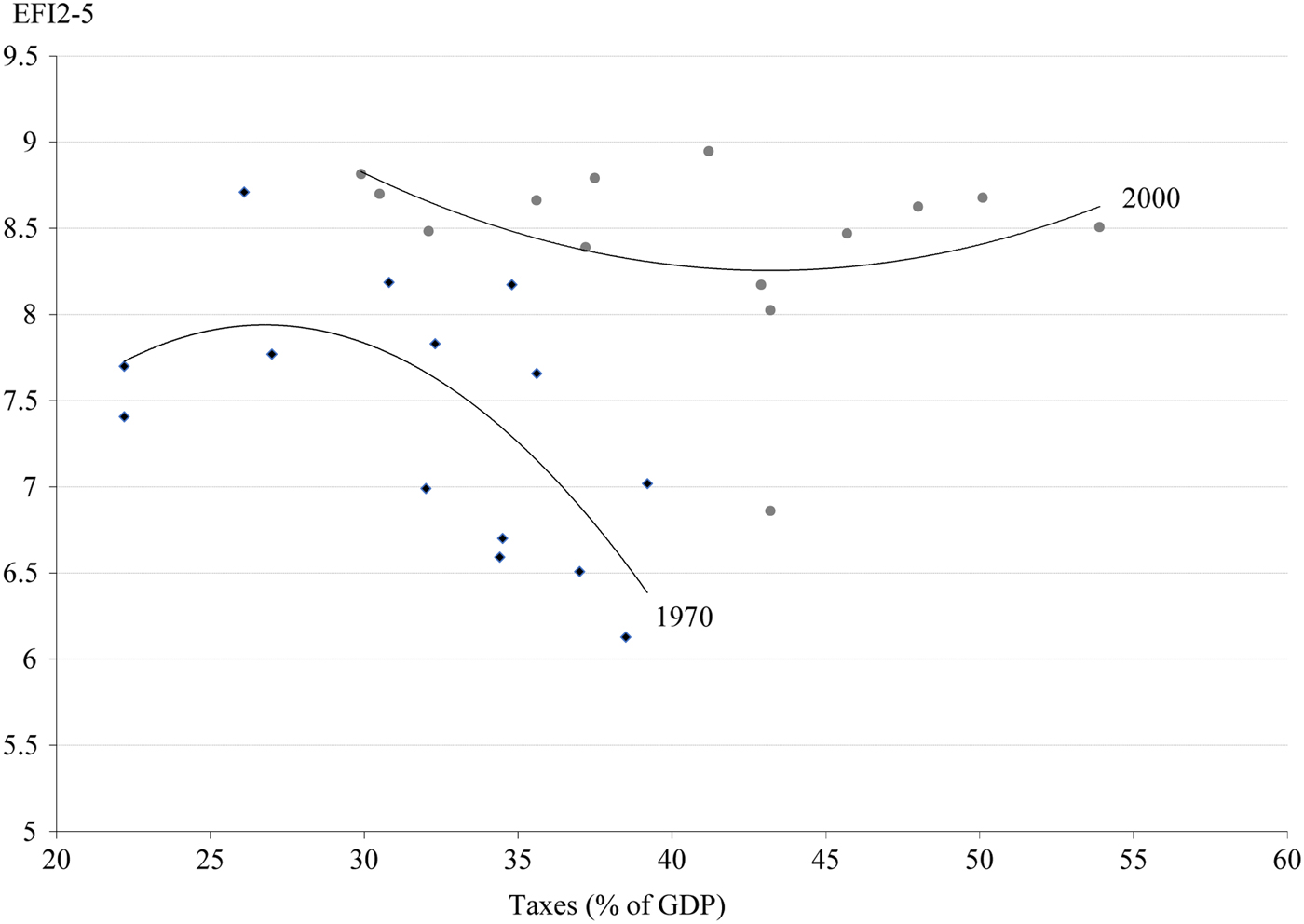
The fact that some countries combine a large public sector and high taxes with high levels of economic freedom is increasingly being recognized and discussed (Bergh, Reference Bergh2006; Bergh and Erlingsson, Reference Bergh and Erlingsson2009; Horpedahl, Reference Horpedahl2013; Huskinson and Lawson, Reference Huskinson and Lawson2014; Ott, Reference Ott2018). In OECD countries, this pattern is the result of a process occurring in the 1980s and 1990s, when several countries with large public sectors implemented reforms that increased the level of economic freedom without substantially shrinking the size of the welfare state. This development is conveniently illustrated using the Economic Freedom Index (Gwartney et al., Reference Gwartney, Lawson and Hall2015) discussed in more detail in section 2. The index quantifies economic freedom in five areas. The first area of the index captures freedom from intrusive government, while the average of areas 2–5 can be interpreted as capturing the economic freedom of institutions (area 2) and policies (areas 3–5). Figure 1 illustrates how the economic freedom of institutions and policies is correlated with a standard measure of government size (i.e. total tax revenue as a percentage of GDP) for OECD countries in 1970 and 2000. In 1970, countries with higher taxes also had lower degrees of economic freedom of institutions and policies, on average. In 2000, that negative correlation had ceased to exist and, if anything, the pattern had become U-shaped.
Economic freedom (average across dimensions 2–5) and tax revenue relative to GDP in OECD countries.

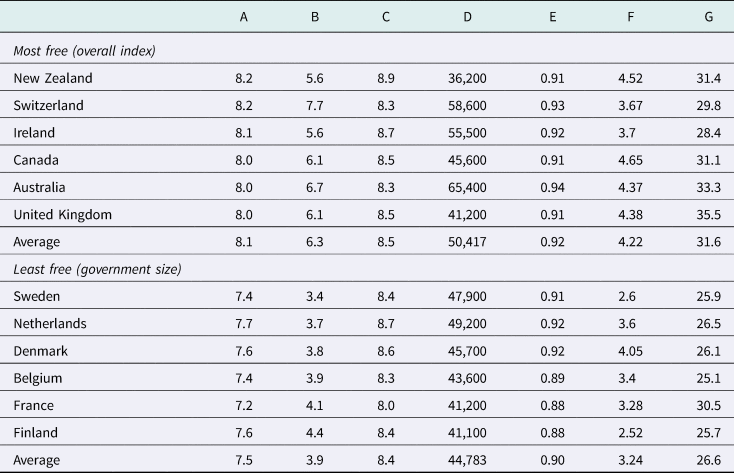
In many social and economic respects, countries that combine large public sectors with otherwise high levels of economic freedom perform just as well as, or better than, countries with uniformly high levels of economic freedom. Table 1 compares the freest OECD countries (measured using aggregate economic freedom) with the OECD countries having the most intrusive government sectors (measured by the first dimension of the index). If big government is a major obstacle to prosperity, the latter group of countries should be doing much worse – but they are not.
Economic freedom and social outcomes in selected OECD countries, 2015.

Sources: Gwartney et al. (Reference Gwartney, Lawson and Hall2015) (A–C); CIA fact book (D and F), United Nations Development Programme (E), and Standardized World Income Inequality Database 4.1, Solt (Reference Solt2008) (G).
Notes: A. Aggregate economic freedom, B. Freedom from big government (area 1), C. Economic freedom of policies and institutions (average for areas 2–5), D. GDP per capita (in PPP dollars), E. Human development index (HDI), F. Infant mortality, G. Gini (net income).
The freest countries and the countries with the largest public sectors are strikingly similar when it comes to the economic freedom of institutions and policies (the average for areas 2–5 of the Economic Freedom Index is 8.5 for the former and 8.4 for the latter group). Countries with big government have slightly lower GDPs per capita, but they score almost as high on the Human Development Index and have lower infant mortality and income inequality. The government size area of the Economic Freedom Index is based on government consumption spending, transfers and subsidies, government enterprises and investment and top marginal tax rates. Except for government enterprises and investment, the differences between rich countries are driven largely by welfare state spending. As a result, the “most free” countries in Table 1 are all typically classified as all “residual,” “marginal,” or “targeted” welfare states in the welfare state classification literature, whereas the countries with the most intrusive government sectors are mostly from the “universal,” “encompassing,” or “social democratic” category (Bambra, Reference Bambra2007; Bergh, Reference Bergh2004; Esping-Andersen, Reference Esping-Andersen1990; Korpi and Palme, Reference Korpi and Palme1998).
The patterns just described suggest two questions: First, if big government is harmful to economic and social outcomes, why aren't the countries with the most intrusive governments doing worse than they are? Second, if some countries have found the key to combining prosperity and equality, why aren't more countries copying the strategy of Sweden et al.?
This paper introduces the concept of Hayekian welfare states and argues that it can help to answer both these questions. This concept can also help in general to explain the successful coexistence of economic freedom and big government. The term “Hayekian” alludes both to the tendency to evolve through trial and error and to the tendency to have a public sector that is large in a fiscal sense without being highly vulnerable to the Hayekian knowledge problem, as described by Hayek (Reference Hayek1945). In a nutshell, a Hayekian welfare state is an ideal type with three characteristics:
• a high state capacity that enables it to implement far-reaching policies,
• an ability to learn from experience and experimentation and alter policies accordingly, and
• a tendency to the combine rule of law with a public sector that is large in a fiscal sense without being vulnerable to the Hayekian knowledge problem.
The term “state capacity” above is used as defined by Skocpol (Reference Skocpol, Evans, Rueschemeyer and Skocpol1990) to denote the ability of states to achieve official goals, especially over the opposition of powerful social groups or in the face of difficult economic circumstances. Because the Hayekian welfare state is an ideal type, no existing country conforms completely to these criteria. When central decision making is present, the Hayekian knowledge problem cannot be completely avoided, but it can be more or less severe.
The paper continues as follows. Section 2 discusses the relationship between prosperity and different types of economic freedom, concluding that the rule of law is the component of economic freedom most strongly associated with prosperity, whereas size of government is not. Section 3 describes the Hayekian knowledge problem and introduces a distinction between big government in a fiscal sense and big government in the sense of requiring considerable central knowledge. Section 4 presents the Hayekian welfare state in theoretical terms and illustrates the empirical relevance of the concept using pensions in Sweden as an illustrative case. Section 5 concludes with a brief discussion of the potential for other countries to learn from the example of the Scandinavian welfare states.
2. Economic freedom and prosperity
Research on economic freedom often relies on the Economic Freedom of the World Index published yearly by the Fraser Institute (see Hall and Lawson (Reference Hall and Lawson2014) and Berggren (Reference Berggren2003) for overviews of economic freedom research). Because the index has five areas, most scholars who use it assume implicitly that economic freedom is a combination of the following five dimensions:
• The Size of Government (EFI1) area measures government size using indicators such as public consumption and transfers relative to GDP, top marginal tax rates, and state-owned enterprises.
• The Legal Structure and Security of Property Rights (EFI2) area quantifies the quality and integrity of the legal system and the protection of property rights, and can be thought of as an attempt to quantify the rule of law.
• The Access to Sound Money (EFI3) area captures the effect of high and unpredictable changes in inflation and money supply.
• The Freedom to Trade Internationally (EFI4) area combines measures of trade taxes, tariff rates, trade barriers, and capital market controls to create a composite measure of freedom to trade.
• Finally, the Regulation of Credit, Labor, and Business (EFI5) area quantifies the regulation of credit markets, labor markets, and business in general.
The dimensionality of economic freedom is not settled simply because the Fraser Institute currently produces a five-dimensional index. In fact, the first two reports (EFW, 1975–1995 and EFW, 1997) had four dimensions, and the next three (EFW, 1998/99; EFW, 2000; EFW, 2001) had seven (all reports are available at www.freetheworld.com). The current five-dimensional structure was established with the 2002 edition.
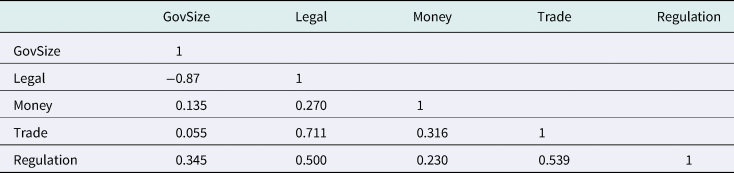
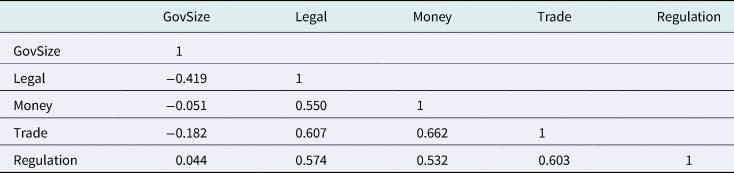
One salient possibility is that the five dimensions are proxies for the same latent variable, in which case the economic freedom concept is unidimensional. A simple correlation matrix (shown in Table 2 for the years 1980 and 2000) is sufficient to illustrate that there are indeed strong positive correlations between all dimensions of economic freedom – except for the first dimension, which captures freedom from large, intrusive government. In other words, countries with low levels of market regulation are also likely to be countries with high freedom to trade internationally, low and stable inflation, and a legal system with high integrity that protects private property rights. They are not, however, necessarily countries with limited government.
Pairwise cross-country correlations in economic freedom (1980)

Pairwise cross-country correlations in economic freedom (2000)

The existence of successful countries with large public sectors and otherwise high levels of economic freedom challenges the view that all types of economic freedom foster prosperity. It bears noting, however, that the purpose of the Economic Freedom Index was never to find characteristics that are correlated with prosperity, but rather to facilitate quantitative examinations of the effects of economic freedom on various social and economic outcomes. In that vein, a small but important strand of the literature has examined the link between the different components of economic freedom and prosperity in more detail using statistical techniques for data segmentation.
Starting from the fundamental question “What is freedom?” Leschke (Reference Leschke2000) uses factor analysis to conclude that there are two conceptually different types of economic freedom: one describing the appropriateness of the framework in which the market operates, and another describing the degree of political intervention in the market process. While neither of these dimensions has a strikingly high correlation with aggregate economic freedom, a linear combination of them can explain 93% of aggregate economic freedom. Both measures are found to be strongly associated with various measures of prosperity (e.g. GDP per capita, growth, and the Human Development Index). Interestingly, the size of government dimension in the Fraser index is not singled out by the factor analysis and is thus not used in either of Leschke's dimensions.Footnote 1
In a similar analysis, Rode and Coll (Reference Rode and Coll2012) used cluster analysis to rearrange the Economic Freedom Index into seven clusters to examine what policies matter the most for growth (measured as growth of GDP per capita over the 1992–2007 period). The authors found that a cluster including legal quality and limited business regulations is the only one significantly linked to growth in regressions using levels of economic freedom. In a first-difference analysis, increases in government size and labor market regulations (which end up in the same cluster) were, however, associated with lower growth. These findings fit well with the empirical literature on government size and growth surveyed by Bergh and Henrekson (Reference Bergh and Henrekson2011), in which the association between government size and growth is typically found to be negative when estimated for rich countries using variation in government size and growth within countries over time (i.e. using panel data with country fixed effects). As discussed by Bergh and Henrekson (Reference Bergh and Henrekson2011), the pattern in these studies also fits well with standard neo-classical growth models in which government size does not affect long-run growth rates, but changes in taxes and government spending do affect growth during the transition from one steady state to another.
The data-driven statistical approaches of Leschke (Reference Leschke2000) and Rode and Coll (Reference Rode and Coll2012) differ regarding the appropriate dimensionality of economic freedom, but they both single out legal quality as the aspect of economic freedom that is the most important for prosperity. Similar results were presented by Berggren and Jordahl (Reference Berggren and Jordahl2005), who studied the sub-dimensions of the Economic Freedom Index, and could be found in the literature on institutions as fundamental causes of growth (Acemoglu et al., Reference Acemoglu, Johnson, Robinson and Durlauf2005; Rodrik et al., Reference Rodrik, Subramanian and Trebbi2004). Leschke (Reference Leschke2000) and Rode and Coll (Reference Rode and Coll2012) also agreed that government size is not strongly related to prosperity. In a recent paper, Ott (Reference Ott2018) showed that excluding the size of government dimension from the index results in stronger correlations between economic freedom and alternative types of freedom as well as between economic freedom and happiness.
In contrast to the clear empirical findings regarding legal quality, the results regarding the association between government size and growth are mixed and more difficult to interpret: Increases in government size seem to be detrimental to growth, high levels are not and several countries combine large public sectors with high levels of prosperity. As noted by several authors, the content and structure of the public sector is at least as important as is its size in a fiscal sense. Along these lines, the next section introduces a distinction between two different types of big government.
3. Two types of big government
How surprising is the finding that having a large public sector is not necessarily a major obstacle to prosperity? The degree of surprise depends on one's priors. There are different reasons to expect a large public sector to be harmful for economic development. Reasons based on neo-classical economic theory typically start by noting that taxes and transfers cause distortions and weaken incentives for work and innovation. In contrast, Hayekian reasons related to the knowledge problem described by Hayek (Reference Hayek1945) are less frequently cited, but when they do apply they are persuasive.
In standard neo-classical economics, it is easy to show how a large public sector can harm the economy because of distortions and disincentive effects. The same theories and models, however, also provide several efficiency-based justifications for government interventions to correct market failure (e.g. Barr, Reference Barr1992, Reference Barr1998). As a result, neo-classical theory suggests that different types of public spending may have different effects on growth. Devarajan, Swaroop, and Zou (Reference Devarajan, Swaroop and Zou1993) distinguished between productive and unproductive public spending to separate spending that complements private sector productivity from spending that does not. If governments implement policy recommendations from neo-classical economics by adequately correcting market failure, emphasizing productive public spending and refraining from highly distorting interventions and unproductive spending, a bigger public sector may well boost growth (cf. Lindert, Reference Lindert2004).
That last statement, however, rests on a crucial “if.” From a public choice perspective, political failures imply that trying to correct market failures and aiming to implement optimal policies are risky endeavors and may do more harm than good. In public choice theory, countries with bigger public sectors are expected to suffer more from political corruption, rent seeking, and regulatory capture (Mueller, Reference Mueller2003; Myrdal, Reference Myrdal1960; Stigler, Reference Stigler1971; Tullock, Reference Tullock1967). Even in cases of undeniable market failure, political failure might well worsen conditions.
While the concept of market failure and the distinction between productive and unproductive spending have become widely used, they both ignore the amount of knowledge needed for government intervention to succeed. By shifting attention to the knowledge requirement, it becomes clear that the Hayekian knowledge problem provides further reasons to expect problems when policy makers intervene in the economy. These reasons differ fundamentally from those based on neo-classical economic theory.
Hayek (Reference Hayek1945) famously described the information necessary for governments to succeed in interventions and planning as existing “solely as the dispersed bits of incomplete and frequently contradictory knowledge which all the separate individuals possess” (p. 519). Even in the unlikely scenario that the government is fully informed at one point in time, that information will become dated when something relevant changes. When the government has only incomplete information about the preferences and circumstances of the actors in society, the probability that centrally planned interventions will do more harm than good must be acknowledged. In a complex world, actions often have unexpected consequences. As a worst-case scenario, Hayek (Reference Hayek1944) depicted government planning as a “road to serfdom,” making society less livable, more brutal, and more despotic.Footnote 2 Was he wrong?
An important difference between the neo-classical and the Hayekian warnings against big government is that the neo-classical theory offers detailed instructions on how to design policies, whereas the Hayekian argument suggests that centrally planned policies not informed by central knowledge are (more or less) doomed to fail. As was shown in section 1, it is undeniable that at least some countries have, for at least some time, avoided Hayek's “road to serfdom.” To understand how that is possible, a distinction between two types of government size is useful.
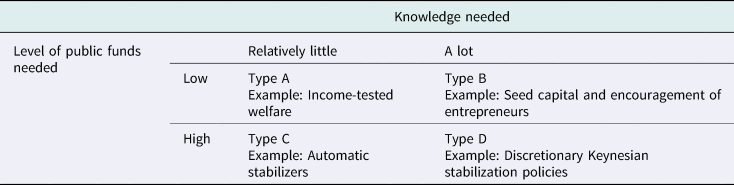
Government programs differ in the amount of knowledge needed and the amount of public funds needed. Programs that require a lot of knowledge are not necessarily programs that require a lot of public funds, and vice versa. Table 3 (based on Bergh, Reference Bergh2015) illustrates the typology.
A typology of government spending programs

Program types A and B both require relatively limited public funds, but differ in how much knowledge the government needs for successful implementation; for example, an income-tested welfare program requires relatively little public funds and relatively little central knowledge. In contrast, programs of type B are relatively cheap in a fiscal sense, but the knowledge problem makes them difficult to implement successfully; examples of such programs include public seed capital, encouragement of entrepreneurs, and similar activities that require the government to pick winners.Footnote 3 Program types C and D both require a lot of public funds but differ in their knowledge requirements. Type-D programs require not only large amounts of public funds, but also knowledge that any central planner is precluded from ever possessing, because it is complex, dispersed, and rapidly changing; a discretionary Keynesian stabilization policy is a good example of such a program.
A central key to understanding why some countries have large public sectors that seem to do very little harm to (or even to promote) their economic development is the existence of type-C programs. These require large amounts of public funds and, while the knowledge problem is challenging, it is not insurmountable for a country with enough state capacity. While discretionary Keynesian stabilization policies are difficult because they basically require decision makers to distinguish short-term GDP fluctuations from business cycles, social insurance schemes that react to fluctuations in a predictable and stabilizing manner function as automatic stabilizers (Darby and Melitz, Reference Darby and Melitz2008) and they require much less knowledge to work as intended.
One implication of the above distinction is that a government with only limited public funds could still do a lot of harm to the economy by engaging in highly distortionary and unproductive activities and spending. Another implication is that big government (in a fiscal sense) is not doomed to fail. Simply put, the effect of government size on economic development depends not only on the amount of public funds needed, but also on the amount of knowledge needed.
The next section uses the case of Sweden and a special focus on pensions to illustrate certain Hayekian aspects of the Swedish welfare state: The recent reforms of the pension system exemplify the ability to learn from experimentation and devise a system that is big in a fiscal sense with relatively low central knowledge requirements.
4. The Hayekian welfare state: Some examples from Sweden
In this section I use some examples from Sweden to illustrate how experimentation and state capacity can facilitate reforms that render the welfare state less vulnerable to the Hayekian knowledge problem. Importantly, this exercise is not meant to imply that Sweden in some sense is a Hayekian welfare state. As noted in section 3, the Hayekian welfare state is an ideal type that combines high state capacity, experimentation, the rule of law, and a welfare state that is large in a fiscal sense without being vulnerable to the Hayekian knowledge problem. In practice, most countries possess these characteristics to varying degrees. In fact, Hayek (Reference Hayek1976: 124–125) noted that the process of learning by trial and error “must involve a constant disappointment of some expectations” (see further Lewis, Reference Lewis2016).
A brief economic history of Sweden
The history of Sweden and the Swedish welfare state contains some useful examples of both experimentation and disappointment, and also of learning and reform. Highly stylized, Sweden's economic history can be described in three phases (see Bergh, Reference Bergh2014 for a less stylized version):
(1) economic growth and income compression (1870–1970);
(2) economic problems and welfare state over-shooting (1970–1995);
(3) economic growth with a reformed welfare state (1995–?).
The problematic period, which started in around 1970, is a good starting point for a discussion of Hayekian aspects of the Swedish welfare state. During this period, economic and social policies in Sweden are often considered to have failed. Making policy mistakes, however, can also be an important learning experience, and the period has in fact been described by Lindbeck (Reference Lindbeck1997) as “the Swedish experiment.” During this period, Sweden suffered from failed macroeconomic policies that included far-reaching attempts at Keynesian management of household demand in trying to smooth out economic fluctuations, and at the subsidization of non-competitive industries. Policy in other areas was also very ambitious and demanding in its knowledge requirements. Through a combination of high marginal taxes and generous social transfers, the ambition was to reduce inequality in disposable income – already low by international standards – even further (see Henrekson, Reference Henrekson1996; Lindbeck, Reference Lindbeck1997). Importantly, most OECD countries in the 1970s pursued policies that were interventionist and hostile toward economic freedom, but Sweden had the state capacity to take these policies further then most OECD countries did.
Towards the end of the problematic period, several gloomy predictions were made regarding the future of the Swedish model. In October 1993, The Economist published an article on Sweden headlined “Worse and worse,” describing a country with increasing public debt, a budget deficit of 13% of GDP, and a currency falling rapidly after a grand failure to defend the fixed exchange rate. Free-market think tanks at this time used Sweden as a discouraging example (e.g. Stein, Reference Stein1991). What followed was instead a remarkable revival of the Swedish welfare state that combined some degree of welfare state retrenchment with substantial increases in the economic freedom of institutions and policies. For a description of the development of economic freedom in Sweden relative to other OECD countries, as well as details of the reforms, see Bergh and Erlingsson (Reference Bergh and Erlingsson2009) and Bergh (Reference Bergh2014).
One Hayekian aspect of the Swedish experience is that the problematic period was an important source of learning that paved the way for the reforms that helped Sweden get back on track. For stabilization policies, that learning process has been well documented by Jonung (Reference Jonung1999). The case of pensions in Sweden is another interesting case from a Hayekian perspective.
Pensions in Sweden
Designing and implementing a pension system is in many ways a risky task for the reasons that Hayek (Reference Hayek1945) described. Central decisions must be made, for example regarding benefit levels, retirement age, and financing. The financial viability of a pension system depends on factors such as productivity growth, population growth, and life expectancy. Even under the unlikely assumption that sufficient knowledge is available to policy makers when the system is put in place, there are no guarantees that preferred pension levels and retirement rules will remain feasible and desirable.
In fact, a large theoretical political economy literature predicts that pensions will expand beyond optimal size in democracies (Browning, Reference Browning1975; Casamatta et al., Reference Casamatta, Cremer and Pestieau2000; Sjoblom, Reference Sjoblom1985; with confirming empirical evidence in Breyer and Craig, Reference Breyer and Craig1997). In a nutshell, overexpansion occurs because policy makers who introduce non-funded so-called pay-as-you-go (PAYG) pensions will benefit current voters by shifting costs to future generations who cannot vote at the time the decision is made. A typical feature of these models is that the resulting equilibrium is stable, implying that contractionary reform will be politically difficult or even impossible.
Against this background, the Swedish case is interesting for at least two reasons. First, because it initially confirms the standard theories. A PAYG system was introduced and subsequent drops in fertility and productivity led to financial problems. Second, Swedish policymakers somehow managed to replace the old pension system with a new one that is much less vulnerable to the Hayekian knowledge problem. How was this possible?
Often described as the first public pension system in the world, the Swedish pension system was introduced in 1913. The system was a funded one with benefits linked to contributions, complemented by a small means-tested benefit (see Lindbeck and Persson, Reference Lindbeck and Persson2003, on how pension systems can be classified into unfunded versus fully funded, defined benefit versus defined contribution, and actuarial versus non-actuarial). With the introduction of the basic pension, decided on in 1946, the defined contribution feature was replaced by a defined benefit, non-funded PAYG system. In such a system, future pensioners are promised certain benefit levels, and the primary policy instrument available to policy makers is the tax rate on current workers. Succeeding with such a system requires knowledge of the pension levels preferred by people, and feasible pension levels as determined by future demographics, productivity, and employment.
Given the political economy literature described earlier, showing that pensions will expand beyond optimal size in democracies, the decision of the Swedish Parliament in 1994, to introduce a new pension system that took Sweden back to a defined contribution system, was a remarkable one. After almost a century of expanding pensions in Sweden, five political parties (at the time representing roughly 85% of the voters) agreed on a new system designed to halt and perhaps even reverse the increase in public pension expenditure, and also introduced a funded part to complement the PAYG part.
As it turned out, Selén and Ståhlberg (Reference Selén and Ståhlberg2007) demonstrated that the Swedish pension reform was compatible with the above-mentioned political economy results because of the 16-year phase-in period of the new system. By comparing the net effects of the new and old systems, they found that the contributions of the working generation (age <53) were reduced by more than their expected benefits, and as a result the median voter would favor the reform.
Identifying the need for pension reform and agreeing on a new system sufficiently early to allow for a 16-year phase-in period, however, was not a trivial task even in a well-functioning democracy. As demonstrated by Bergh and Erlingsson (Reference Bergh and Erlingsson2009), commissions were initiated in 1984 to propose adjustments of the existing system. In 1990 these commissions concluded that fundamental reform was needed. A new commission was initiated to propose a new system, which was presented in 1994. Decisions were made in the Swedish parliament in 1994 and 1999.
In several respects, the new system is closer to the Hayekian welfare state ideal than was the old one. The new system does not have one fixed retirement age, but instead allows people to choose freely when to retire after the age of 61 (starting in 2020, this limit will be 62). The degree of retirement can be 25, 50, 75, or 100%, and pensions are adjusted in a budget-neutral manner based on remaining life expectancy. Compared with systems having a fixed retirement age, a system having a flexible retirement age and actuarial adjustment of pension level requires less central knowledge to work. In fact, as individuals made retirement decisions based on their own preferences and financial circumstances, the new system generated new knowledge. It turned out that some preferred to retire before the age of 65, and others preferred to retire later. Perhaps more surprisingly, a public commission (Departementserien, 2011) concluded that people in general do not prefer to retire at one single time (the way the designers of the old system had implicitly assumed), but instead prefer to combine work and retirement in varying proportions, which is allowed in the new system.
The new system results in pensions that are relatively low, with typical replacement rates of around 50% of the final working wage. As a result, most people top up their pension with private savings to reach their desired level of income smoothing over the lifecycle. The combination of a relatively low benefit in the mandatory system and optional topping up minimizes the risk of central decisions forcing people to over-save, thus making use of the decentralized knowledge that each person has regarding his or her preferences and economic circumstances.
5. Conclusion: can the “road to serfdom” be avoided?
The countries in the bottom half of Table 1, which successfully combine large public sectors with high levels of economic freedom and prosperity, suggest that Hayek's “road to serfdom” is not necessarily a consequence of big government as measured by fiscal statistics regarding taxes and public spending. The success of the Nordic countries became particularly obvious after the financial turmoil in the wake of the 2008 global financial crisis, and since then the question has been asked several times (cf. Lakey, Reference Lakey2016): how does a country become more like Sweden, Denmark, or Finland?
A first step toward answering that question is to remind oneself of the bumpy road these countries have taken to get to where they are today. There are many descriptions of Sweden's economic history, for example, but few convey the unplanned, evolutionary nature of that path. The present analysis suggests that even in the presence of convincing explanations of how Sweden and the other Nordic countries became successful, it would still be difficult for other countries to copy the features identified by those explanations. These countries arrived at where they are through a process of trial and error, and the errors have sometimes been substantial.
The ability to implement far-reaching policies, learn from experience, and adjust policies according to this experience requires high levels of state capacity. Is it possible for all countries to achieve the state capacity needed to behave like a Hayekian welfare state? That remains an open question. It should be noted, however, state capacity is closely linked to high levels of social trust in the population. In the words of Newton, Stolle, and Zmerli (Reference Newton, Stolle, Zmerli and Uslaner2017: 2), “social trust between citizens improves cooperative relations, reduces social conflict, and facilitates compromise,” and as discussed by Bjørnskov (Reference Bjørnskov2010) social trust will produce good governance by making citizens sophisticated consumers of politics. Empirically, social trust has been linked to some types of reform capacity (Berggren et al., Reference Berggren, Daunfeldt and Hellström2016) and to welfare state size (Bergh and Bjørnskov, Reference Bergh and Bjørnskov2011).Footnote 4 Without sufficient levels of social trust, achieving sufficient state capacity and reform capacity may thus be difficult.
The perspective described in this paper has implications for future research and several other strands of literature. Most obviously, quantitative empirical research requires that the measurement problem can be handled. As already noted, accounting for knowledge requirements in public sector activities is important in studying the effects of government size on growth. The knowledge perspective would also be a potentially interesting dimension to incorporate in the literature on comparing and classifying welfare states (Esping-Andersen, Reference Esping-Andersen1990; Hall and Soskice, Reference Hall and Soskice2001; Scruggs and Allan, Reference Scruggs and Allan2008). The idea that government grows as a result of social trust and state capacity can also be contrasted and compared to other popular explanations of government size such as Wagner's law (Durevall and Henrekson, Reference Durevall and Henrekson2011; Wagner, Reference Wagner1893) and the compensation hypothesis (Katzenstein, Reference Katzenstein1985; Rodrik, Reference Rodrik1998). I leave these extensions and applications for future research.
Finally, what are the lessons for other countries from the Nordics? The answer suggested here is not to copy the blueprint for the Swedish welfare state, for example, but rather to try to foster the state capacity needed for successful learning from experimentation. For many countries, the main message is a warning: trying to build a fiscally large welfare state without the fundamentals of state capacity and social trust may turn out to be a dangerous strategy. The fact that some countries succeed in combining a large public sector with high levels of economic freedom does not mean that all countries are able to do so.
Acknowledgements
I am grateful for financial support from the Swedish Research Council (Vetenskapsrådet, grant 2103-734), Johan och Jakob Söderbergs Stiftelse (grant 47/19), and Jan Wallanders och Tom Hedelius stiftelse (grant P19-0180). A special thanks goes to Bob Lawson and James Gwartney for helping me understand the history of the Economic Freedom Index.