Introduction
Jealousy is a complex emotion involving the perception of a threat of loss of something that the person values, which includes affective, cognitive, and behavioral components.Reference Van Sommers1, Reference Mullen2 Although different items, people, or conditions may be the object of jealousy, sexual jealousy is the most typical form, involving the perception of a threat of loss of a valued relationship to a real or imagined rival, and is the focus of the present article.
Jealousy is rarely considered to be a primary emotion, since it requires certain types of social relationships, for instance some triadic conflicts, to be fully expressed.Reference Panksepp3 The primary feelings experienced when facing the potential loss of a social relationship, as triggered by the conviction of a spouse or loved one's infidelity, range widely among different people, from anxiety or anger to sorrow.Reference Parrott4 According to the affective neuroscience perspective of Panksepp,Reference Panksepp5 jealousy is bound to take on a larger variety of affective dynamics than is generated by any single one of the various emotional primes that can be aroused during jealousy.Reference Panksepp3
From the evolutionary perspective,Reference Hart and Legerstee6 the peculiar function of jealousy is to warn that the sexual partner is potentially desirable and attractive, can betray the other, and strangers can jeopardize the stability of the couple, which is fundamental for the rearing of children, as they require specific care for a long time before they become mature and can survive on their own. According to this perspective, jealousy would be a primary emotion,Reference Buss7, Reference Marazziti8 as SokoloffReference Sokoloff9 suggested in 1947, when he said, “Jealousy is not only inbred in human nature, but it is the most basic, all-pervasive emotion which touches man in all aspects of every human relationship.”
Jealousy has long attracted the interest of both psychiatrists and psychologists, but only recently has it became the focus of neuroscientific investigation.Reference Panksepp3 In spite of its universality and the severity of some of its forms,Reference Marazziti, Sbrana and Rucci10 jealousy is totally absent as a specific entity in the American classification system of psychiatric disorders (DSM-IV-TR); it is, however, hidden in other diagnostic categories, such as depression, obsessive-compulsive disorder, or paranoia.Reference Marazziti8 Therefore, while considering the recent emphasis on dimensional approaches of core psychiatric symptoms rather than on disorders (eg, the Research Domain Criteria (RDoC) project of the National Institute of Mental Health),Reference Morris and Cuthbert11 it should be debated if jealousy itself could be considered a symptom endophenotypeReference Panksepp5, Reference Panksepp12 across distinct nosological categories, as recently proposed for the impulsivity/compulsivity dimensionReference Robbins, Gillan and Smith13 or for social cognitive deficits.Reference Zucker, Losh and Bulik14, Reference Derntl and Habel15
The current article aims to provide a step forward in the understanding of the neural and cognitive bases of this complex affective symptom, while presenting and discussing recent empirical findings on the most severe form of jealousy, delusional jealousy.
Jealousy
Jealousy is a heterogeneous and common condition ranging from normality to pathology, with different degrees of intensity, persistence, and degrees of insight. Several studies, carried out in different countries, have underlined that jealousy is present everywhere, and what differs from one society to another is the level of jealousy considered “normal.” A recent study in Italy reported that at least 10% of healthy subjects are excessively affected by jealous thoughts.Reference Marazziti, Sbrana and Rucci10 If the recognition of pathological jealousy, at least in its most severe (eg, paranoid) forms, is relatively easy, setting boundaries for the so-called normal jealousy is an elusive, if not impossible, task.Reference Tarrier, Beckett and Harwood16, Reference Kingham and Gordon17
In psychological terms, the distinction between reactive jealousy and suspicious jealousyReference Rydell and Bringle18 could be useful to better understand the development of delusional jealousy. Reactive jealousy is triggered by a real transgression, in particular a sexual affair impairing some critical aspect of the relationship, such as its exclusivity. Alternatively, suspicious jealousy occurs with no betrayal or other significant event, and it is triggered by minor or unspecific cues.Reference Rydell and Bringle18 Reactive and suspicious jealousy are mainly associated with distinct antecedents: reactive jealousy is more closely related to characteristics of the relationship with the partner, whereas suspicious jealousy is more closely related to characteristics of the individual who is experiencing the jealous feelings, such as insecurity or low self-esteem.Reference Parrott4 Reactive jealousy is generally characterized by anger, fear, and sadness,Reference Rydell and Bringle18 while suspicious jealousy is characterized by high levels of anxiety, doubts, suspiciousness, and insecurity. In subjects presenting suspicious jealousy, the intensity of worries and anxiety about the partner's behavior is excessive; in the absence of real clues, complex cognitive constructions are triggered by neutral clues and lead the subject to search for infidelity and constantly monitor the partner's behavior. Suspicious jealousy often results in interpreting the partner's behavior in a way that is biased toward perceiving ambiguous events as more threatening to the romantic relationship than objective information would indicate.Reference Rydell and Bringle18
Delusional jealousy
In its delusional form, also defined as Othello's syndrome, jealousy is characterized by a range of irrational thoughts, focused on the certainty of the partner's sexual unfaithfulness based on unfounded evidence, which may lead to extremely aggressive behaviors, such as stalking, suicide, and murder.Reference Camicioli19 Delusional jealousy is a clinical phenomenon at the interface between psychiatry and neurology,Reference Camicioli19 if we consider that it has been frequently described in psychiatric disorders,Reference Soyka and Schmidt20 such as schizophreniaReference Soyka21 and alcoholism,Reference Michael, Mirza and Mirza22 and in neurological disorders, such as stroke and neurodegeneration.Reference Ortigue and Bianchi-Demicheli23, Reference Graff-Radford, Whitwell and Geda24 Interestingly, in a recent cross-sectional study,Reference Poletti, Perugi and Logi25 20 patients with Parkinson's disease (PD) were reported to develop delusional jealousy that resulted independent of the presence of dementia and was significantly associated with dopamine agonist therapy. Furthermore, in a subgroup of 5 cognitively preserved PD patients, delusional jealousy appeared after a relatively short period of treatment with dopamine agonists (2.3 ± 1.2 years).
The trigger of delusions by dopamine agonists may be due to their ability to induce states of aberrant salience attribution,Reference Nagy, Levy-Gigi and Somlaiu26 a phenomenon that is hypothesized to be at the basis of delusion development in schizophrenia.Reference Kapur27 The mesolimbic striatal dopamine signaling system is involved in the conversion of neural representations of environmental stimuli from a neutral and cold bit of information into an attractive or aversive entity; therefore it is a critical component of the “attribution of salience,”Reference Kapur27 a process whereby events and thoughts come to grab attention, drive action, and influence behavior because of their association with reward or punishment. When an altered dopaminergic system produces an aberrant attribution of salience to external stimuli, neutral and fortuitous events gain attention and importance, and become meaningful. Delusions may thus derive from seemingly plausible top-down cognitive explanations that some individuals attribute to these experiences of aberrant salience of stimuli in order to understand them. Once the patients complete such an explanation, an “insight or psychotic relief” occurs that serves as a guiding cognitive scheme for further thoughts and actions. Moreover, it may lead the subjects to search for further confirmatory evidence to support delusional explanations.Reference Kapur27 This mechanism could suggest that the nonphysiological tonic dopaminergic stimulation associated with the dopamine-agonist therapy, which is able to induce an aberrant salience attribution,Reference Kapur27 may play a crucial role in the development of delusions in medicated PD patients.
In the clinical practice of a referral outpatients’ center for movement disorders, delusional jealousy appears as one of the most common types of delusions in medicated PD patients; not surprisingly, besides our cross-sectional study,Reference Poletti, Perugi and Logi25 delusional jealousy has been frequently reported in PD,Reference Graff-Radford, Whitwell and Geda24, Reference Cannas, Solla and Floris28, Reference Graff-Radford, Ahlskog and Bower29 while other types of delusions have been reported only seldom in this clinical population.Reference Stefanis, Bozi and Christodoulou30 While supposing that dopamine agonists increase the risk of developing delusions by inducing an aberrant salience attribution process,Reference Nagy, Levy-Gigi and Somlaiu26, Reference Kapur27 why are jealousy delusions over-represented in PD patients, comparison with other types of delusions? Furthermore, while considering that jealous thoughts are less common in delusions of psychiatric patients,Reference Appelbaum, Clark Robbins and Roth31 why is delusional jealousy over-represented in comparison with other types of content-specific delusions in patients with neurodegenerative diseases?Reference Ortigue and Bianchi-Demicheli23, Reference Graff-Radford, Whitwell and Geda24 The answer to these questions is important for two reasons. From a theoretical point of view, it could suggest further clues on the neuroanatomical and neurochemical basis of jealousy, and from the clinical point of view, it could help to prevent or to better manage jealousy and its pathological forms, such as delusional jealousy.
Neural bases of jealousy, love, and sexual desire
A starting point is perhaps to look at the neural bases of jealousy. Unfortunately, the neurochemical and neuroanatomical bases of jealousy have been poorly investigated by neuroscience.Reference Panksepp3 One study reported that obsessive jealousy is associated with a specific abnormality of the platelet serotonin transporter,Reference Marazziti, Akiskal and Rossi32 while suggesting a role of the serotonergic system at least in obsessional jealousy. A functional magnetic resonance imaging (fMRI) studyReference Takahashi, Matsumara and Yahata33 with a behavioral task involving jealousy-arousing scenarios reported that men and women recruit different brain networks in the experience of jealousy. In men, jealousy mostly involves activation of the visual cortex, limbic systems, and related structures (amygdala, hippocampal regions, and hypothalamus) and of somatic and visceral areas (eg, insula). In women, the activation is recorded in the so-called mentalizing network (posterior temporal sulcus and angular gyrus) and in the visual cortex, in the middle frontal gyrus, thalamus, and cerebellum. Overall, these fMRI findings highlighted that jealousy is associated with the recruitment of brain areas mediating mentalizing, basic emotions, and somatic and visceral experience. An electroencephalography (EEG) studyReference Harmon-Jones, Peterson and Harris34 with a behavioral game task evoking jealousy reported a greater left prefrontal activation while subjects experienced that feeling. Taken as a whole, these findings suggest that jealousy recruits a pattern of cortical and subcortical structures and is modulated by monoaminergic systems. These findings are corroborated by those emerging from a lesion studyReference Shamay-Tsoory, Tibi-Elhanany and Aharon-Peretz35 reporting that the mentalizing network, including the ventromedial prefrontal cortex (vmPFC), plays a fundamental role in mediating the understanding of complex social emotions such as envy and gloating. Jealousy, like envy and gloating, involves a process of social comparison with potential competitors: Jealousy is characterized by the fear of losing a loved one to another person; envy is characterized by the wish to possess what another person has or his/her or success, and/or the wish that the other person did not possess the desired characteristic or object; gloating is characterized by the pleasure associated with undesirable events happening to another person.
Furthermore, while considering the strong relationship between love and jealousy, the investigation of neural bases of the experience of being in love could also help us to better understand the neural bases of jealousy. An increasing number of neuroimaging studies have explored the brain activations of individuals experiencing love.Reference Bartels and Zeki36–Reference Xu, Aron and Brown40 These studies, which have been recently reviewed,Reference Ortigue, Bianchi-Demicheli and Patel41, Reference De Boer, van Buel and Ter Horst42 highlight the role of the reward-related striatal dopamine signaling system for motivating individuals in pair bonding, and that the experience of love also involves the activation of higher cognitive processes, such as social cognition and bodily self-representation.Reference Ortigue, Bianchi-Demicheli and Patel41 Although these studies provide intriguing results, they also present significant limitations, such as the choice of love-evoking tasks and selection bias based on gender, duration of love affair, and cultural differences.Reference De Boer, van Buel and Ter Horst42
It is interesting to underline that the dopaminergic system also plays a major role in sexual arousal and sexual performance.Reference Heaton43 Not surprisingly, neuroimaging studies have shown that sex drive and love are regulated by many overlapping regions.Reference Fisher, Aron and Brown44 Authors of a recent review of fMRI studies on sexual desire and love suggest that one may consider sexual desire and love on a spectrum that evolves from integrative representations of affective visceral sensations (mainly associated with insula activation) to an ultimate representation of feelings incorporating mechanisms of reward expectancy and habit learning (mainly associated with the frontostriatal dopaminergic system).Reference Cacioppo, Bianchi-Demicheli and Fru45
Parkinson's disease, frontostriatal circuits, and delusional jealousy
The analysis of dysfunctional neural networks in PD patients and the effects of dopaminergic drugs on them, in relation to neural networks associated with feeling jealousy, could permit us to better understand the phenomenon of delusional jealousy in this clinical population.
In the early clinical stages of PD, the functioning of the “dorsolateral” frontostriatal circuit (linking the dorsal striatum and the dorsolateral portions of the prefrontal cortex), which mediates executive control functions, is impaired by striatal dopamine depletion and, therefore, is restored by dopaminergic drugs, such as levodopa and dopamine agonists.Reference Cools46, Reference Poletti and Bonuccelli47 At the same time, the functioning of the “orbital” frontostriatal circuit (linking the ventral striatum with medial portions of the prefrontal cortex), which mediates reward processing, is preserved and therefore overdosed by dopaminergic drugs.Reference Cools46, Reference Poletti and Bonuccelli47 Dopaminergic drugs interfere with reward processing by facilitating dopaminergic bursts and hampering dopaminergic dips, and this interference should be stronger for tonic-acting dopamine agonists in comparison to phasic-acting levodopa.Reference Frank, Seeberger and O'Reilly48 While considering the role of the dopaminergic system in love and sexual desire,Reference Cacioppo, Bianchi-Demicheli and Fru45 the increased dopaminergic stimulation of the orbital frontostriatal circuit facilitates the evaluation of stimuli as positive rewards, but may also produce an aberrant salience given to the relationship with the loved one, and consequently also an increased fear of losing this relationship. Furthermore, basal ganglia and their connections with the prefrontal cortex (PFC) play a major role in habit formation,Reference Yin and Knowlton49 and preliminary empirical evidence suggests that the nonphysiological stimulation of dopaminergic drugs may interfere with habit formation in PD patientsReference Marzinzik, Wotka and Wahl50; thus we must investigate whether dopaminergic drugs may facilitate a progressive transformation of jealousy into a “habit” associated with a shift of neural control from ventromedial striatum-PFC circuits to dorsolateral striatum-PFC circuits.Reference Yin and Knowlton49
In addition to drug-related risk factors, PD patients present other risk factors for suspicious jealousy, because they can experience altered affective status,Reference Aarsland, Marsh and Schrag51 low perceived quality of life,Reference Knipe, Wickremaratchi and Wyatt-Haines52 and sexual dysfunctions.Reference Bronner53 To summarize, the development of delusional jealousy in PD is probably due to the complex interaction of different risk factors, such as premorbid idiosyncratic personality factors (low or high levels of jealousy), affective factors (depression, anxiety, low perceived quality of life), disease-related physical effects (ie, sexual dysfunction), and dopamine agonist side effects (delusion proneness and aberrant salience of social bonds, especially for the relationship with the partner).
Discussion
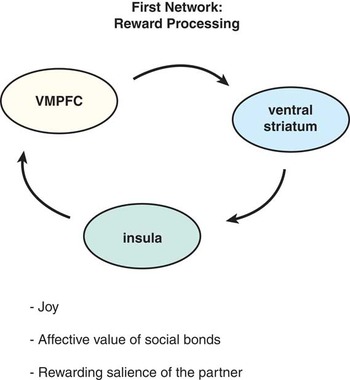
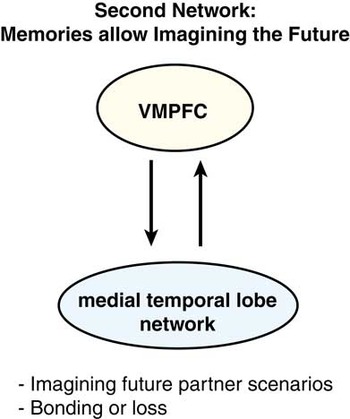
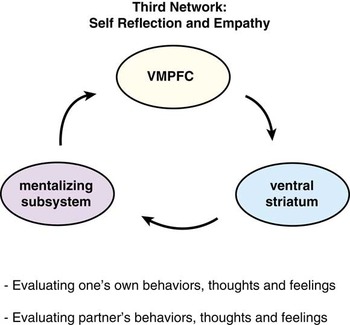
The study of PD patients has highlighted the possible major role of the orbital frontostriatal circuit in the clinical phenomenon of delusional jealousy. While the ventral striatum is mainly involved in reward processing,Reference Cools46, Reference Poletti and Bonuccelli47 the ventromedial prefrontal cortex (vmPFC) is involved in many other high-order cognitive and affective functions, as recently proposed in a new conceptual framework by Roy etal.Reference Roy, Shohamy and Wager54 At least three of the proposed high-order functions of vmPFC-based neural networks could be involved in the experience of jealousy, and therefore in its delusional expression (Figures 1–3).
Neural network of reward processing, involved in the processing of the affective value of the social bond and of the rewarding salience of the partner. VMPFC=ventromedial prefrontal cortex.

A framework for vmPFC functions
The first network includes the vmPFC, ventral striatum and pallidum, amygdala, ventral tegmental area, periaqueductal gray (PAG), and parts of the insula and lateral PFC. This neural network is involved in reward processing, emotion processing, and autonomic/endocrine responses, globally providing the generation of affective value (Figure 1).Reference Roy, Shohamy and Wager54 The second and the third vmPFC-based neural networks both include neural structures of the default mode network (DMN)Reference Andrews-Hanna, Reidler and Sepulcre55 (ie, a set of brain regions that becomes engaged when individuals are resting, compared with when they are engaged in a goal-directed task). The DMN core includes the cortical midline and is connected to two distinct DMN subsystems—one mainly including the medial temporal lobe (MTL) and involved in the act of simulating the future by using mnemonic imagery-based processes, and the other mainly encompassing the temporo-parietal junction, lateral temporal cortex, and temporal pole, which is preferentially activated when participants reflect on their present mental states or infer others’ mental states (ie, ToM tasks).
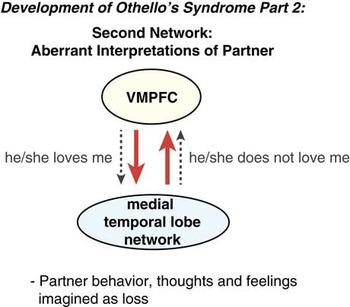
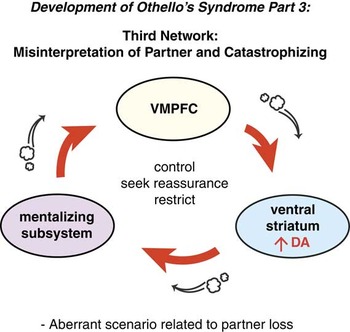
The second neural network includes the anterior and dorsal portion of the vmPFC, the posterior cingulate cortex (PCC), and the MTL subsystem of the DMN, and is involved in constructing internal models of the world based on mnemonic information, and in using them to prospect future scenarios (Figure 2).Reference Roy, Shohamy and Wager54 The third neural network is based on the second DMN subsystem and on cortical and subcortical structures that are also part of the first neural network (ie, ventral striatum and pallidum, amygdala, ventral tegmental area, PAG, and parts of the insula and lateral PFC): This neural network is engaged when subjects must refer to their own mental states (self-reflection) or of others (theory of mind and empathy) (Figure 3).Reference Roy, Shohamy and Wager54
Neural network of future imagination, which is involved in the construction of future partner scenarios of bonding or loss.

Neural network of self-reflection, empathy, and mentalizing, which is involved in the processing of mentalizing one's own and the partner's behaviors, thoughts, and feelings.

The interaction of these neural networks and related functions allows vmPFC to link situational appraisals to specific patterns of behavioral and autonomic response elicited by the particular context. Therefore, Roy etal concluded that:
the main function of vmPFC probably regards the infusion of conceptual information into the generation of affective responses: this critical process is one of combining elemental units of information—from sensory systems, interoceptive cues and long-term memory, into a gestalt representation of how an organism is situated in the environment, which then drives predictions about future events: authors conclude their theoretical review suggesting that a straightforward term for such process is affective meaning (p 153).Reference Roy, Shohamy and Wager54
Neural and cognitive bases of (delusional) jealousy
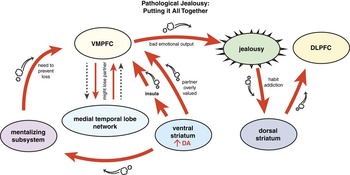
Analysis of vmPFC-based high-order functions,Reference Roy, Shohamy and Wager54 fMRI findings on normal jealousy,Reference Takahashi, Matsumara and Yahata33 and frontostriatal circuitry in PDReference Cools46, Reference Poletti and Bonuccelli47 suggests a core of neural and cognitive/affective correlates of jealousy, particularly of its delusional expression, which will be examined herein (Figures 4–7). Frontostriatal circuits, vmPFC, and insula would be mainly involved in the evaluation of the rewarding nature of the social bonds and in the representation of associated emotions and somatic sensations, globally providing an affective meaning to the relationship with the partner. The mentalizing network would play a role in representing behaviors, thoughts, and feelings of the loved one, and in self-related processes related to his/her possible loss. The construction of internal models of the relationship with the partner and imagination of future scenarios followed by its potential loss would be modulated by a MTL subsystem of the DMN. As it is involved in all these neural networks, the vmPFC therefore probably plays a key role in the integration of these affective and conceptual responses that are activated during the jealousy experience; moreover, further investigation must be done regarding whether frontostriatal circuits play a role in the progressive consolidation of jealousy as a “habit,”Reference Yin and Knowlton49 and how alterations of dopaminergic connections may interfere with this process.
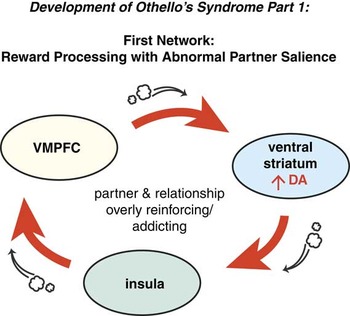
First process involved in the development of delusional jealousy, with an attribution of aberrant salience to the partner. DA=dopamine.

The identification of a core of neural and cognitive/affective bases of jealousy suggests how this feeling may become delusional thoughts: alterations of the dopamine signaling system could cause an aberrant salience given to social bonds, especially to the relationship with the partner (Figure 4). Alterations of the MTL subsystem of the DMN could cause an aberrant construction scenario related to the potential loss of the partner (Figure 5). Finally, alterations of the mentalizing network could cause aberrant representations of behaviors, thoughts, and feelings of the loved one, and aberrant constructions of self-related process related to his/her possible loss (Figure 6). Delusional jealousy probably arises when at least three conditions are present simultaneously: (1) an aberrant salience given to the relationship with the loved one; (2) aberrant representations of the partner's behaviors, thoughts, and feelings; and (3) aberrant scenarios related to the potential loss of the relationship (Figure 7).
Second process involved in the development of delusional jealousy, with an aberrant construction of future scenarios of loss of partner.

Third process involved in the development of delusional jealousy, with misinterpretations of partner's behaviors, thoughts, and feelings and consequent catastrophizing tendency.

The whole process hypothesized at the basis of (delusional) jealousy development. The shift form ventral to dorsal striatum and related prefrontal connections may be involved in the progressive transformation of a jealousy behavior into a habit. This model may explain the development of jealousy and also of delusional jealousy if core neural bases are altered and core cognitive/affective functions aberrant, as reported in many psychiatric (schizophrenia and alcoholism) and neurodegenerative diseases (Alzheimer's disease, frontotemporal dementia, Parkinson's disease, and Lewy body dementia). DLPFC=dorsolateral prefrontal cortex.

The universality of jealousy, which is present at different degrees in each subject,Reference Marazziti, Sbrana and Rucci10 may explain why this feeling is a symptom described in psychotic, mood, anxiety, and personality disorders.Reference Marazziti8, Reference Soyka and Schmidt20 Moreover, the proposed neural and cognitive correlates may also provide an explanation of the evidence that its delusional form is common in different psychiatric disorders, such as schizophreniaReference Soyka21 and alcoholism,Reference Michael, Mirza and Mirza22 and in different neurological disorders, such neurodegenerative diseases (Alzheimer's disease, behavioral variant of frontotemporal dementia, PD, and Lewy-body dementia).Reference Graff-Radford, Whitwell and Geda24 All these disorders share, at different degrees of impairment, neural alterations of at least the dopamine striatal signaling systemReference Howes, Kambeitz and Kim56–Reference Klein, Eggers and Kalbe60 and the vmPFC,Reference Pomarol-Clotet, Canales-Rodriguez and Salvador61–Reference Perneczky, Drzezga and Boecker65 and cognitive alterations of at least reward processingReference Gradin, Kumar and Waiter66–Reference Gleichgerrcht, Ibanez and Roca68 and mentalizing.Reference Shamay-Tsoory, Aharon-Peretz and Levkovitz69–Reference Poletti, Enrici and Adenzato71 In summary, these shared alterations should confirm that, although jealousy is a common feeling, delusional jealousy may arise only with the combination of aberrant salience given to the relationship with the loved one and aberrant representations of the partner's behaviors, thoughts, and feelings.
Jealousy as symptom endophenotype or RDoC construct
Recent dimensional approaches to psychiatry disordersReference Morris and Cuthbert11 attempt to characterize them as clusters of core symptoms (or symptom endophenotype), which are more easily linked to brain and genetic processes. Within this clinical and empirical perspective, therefore, there is a decreased concern that some endophenotypes may be found in several distinct nosological categories by reducing the need for abused concepts, such as that of comorbidity.Reference Panksepp12 For example, impulsivity and compulsivity have been proposed as symptom endophenotypes, presenting comorbidities and commonalities across a range of disorders (attention deficit/hyperactivity disorder, substance dependence, obsessive-compulsive, and eating disorder), and are associated with dysfunctions of frontostriatal loops.Reference Robbins, Gillan and Smith13
The RDoC projectReference Morris and Cuthbert11 proposed a two-dimensional matrix with “constructs” (dimensions of observable behavior and neurobiological measures, regarding brain organization and functioning) that can be described at different levels of analysis (genes, molecules, cells, circuits, physiology, behavior, self-reports, and paradigms). The proposed description of core neural and cognitive bases of jealousy and of its delusional expression, present in distinct neuropsychiatric disorders, therefore, could characterize jealousy as a symptom endophenotype, or a “construct” in the RDoC matrix.
Conclusions
In conclusion, a convergent amount of data from neuroimaging and from psychiatric and neurological disorders has confirmed the role of dopaminergic frontostriatal circuits, vmPFC and insula, and related functions of reward processing, mentalizing, and self-related processing in the feeling of jealousy and in its delusional form. However, the studies of neural bases of jealousy are just at their beginning, and further investigations are strongly needed to elucidate the biological roots of this emotion that still represents a great mystery of human nature.