Introduction
The superfamily Ascaridoidea consists of about 50 genera of parasites whose hosts belong to all the main groups of vertebrates (Fagerholm, Reference Fagerholm1991; Sprent, Reference Sprent1992). Some of the parasites, such as Toxocara canis and T. cati (worms of canids and felids, respectively), can cause dangerous zoonosis in humans (Despommier, Reference Despommier2003). Toxascaris leonina, a parasite of both canids and felids, may also be considered as a zoonotic agent (Cho et al., Reference Cho, Lee, Lee, Kang, Ock, Honk, Lee and Yu2009). A detailed species identification of the above-mentioned nematodes is necessary for their systematics, life-cycle studies and epidemiology, or for diagnostic purposes. In such cases, morphological studies are not enough because, according to other authors, a differentiation of closely related nematodes based only on their body structure is difficult and sometimes impossible (Zhu et al., Reference Zhu, Gasser, Chilton and Jacobs2001). This is especially true for both larval stages and when only fragments of nematodes are available for analysis (Dick et al., Reference Dick, Dixon and Choudhury1991). For example, the nematode found in Malaysian cats was, for many years, regarded as T. canis based on its morphological traits (Lee et al., Reference Lee, Cheng and Bohar1993). However, subsequent molecular studies of rDNA have demonstrated it to be a different species (Zhu et al., Reference Zhu, Jacobs, Chilton, Sani, Cheng and Gasser1998), which was eventually called Toxocara malaysiensis (Gibbons et al., Reference Gibbons, Jacobs and Sani2001).
Many authors confirm that both the first (ITS-1) and the second (ITS-2) internal transcribed spacer regions of rDNA are species-specific genetic markers for a broad range of parasitic nematodes (Gasser et al., Reference Gasser, Chilton, Hoste and Stevenson1994; Campbell et al., Reference Campbell, Gasser and Chilton1995; Chilton et al., Reference Chilton, Gasser and Beveridge1995). An analysis of these regions allows for species identification of closely related nematodes. This was an important tool to confirm species distinction among morphologically similar specimens from different taxonomic groups, such as Haemonchus contortus and H. placei (Stevenson et al., Reference Stevenson, Chilton and Gasser1995), Trichuris suis and T. trichiura (Cutillas et al., Reference Cutillas, Callejon, de Rojas, Tewes, Ubeda, Ariza and Guevara2009) or the zoonotic nematodes: T. canis, T. cati and T. leonina mentioned above. Jacobs et al. (Reference Jacobs, Zhu, Gasser and Chilton1997) demonstrated for the first time that morphologically well-described adult nematodes, such as T. canis, T. cati and T. leonina, may be differentiated on the basis of their ITS-2 sequence. Zhu et al. (Reference Zhu, Gasser, Chilton and Jacobs2001) found that the level of sequence differences among species ranges from 26 to 50%, whereas there is almost no variation (0–0.6%) within the same species.
Analyses of ITS sequences make it possible not only to differentiate species but also to reveal intraspecific polymorphic differences. While there are parasites in which differences occur very rarely, there are also some for which rDNA ITS-1 and ITS-2 regions reflect considerable intrapopulation variability (Zhu et al., Reference Zhu, Gasser, Chilton and Jacobs2001). ITS sequences of T. canis, T. cati and T. leonina from various countries can be found in GenBank (the National Center for Biotechnology Information; NCBI). For T. canis, it was demonstrated that geographical latitude does not play any significant role in polymorphic differences. Sequences are almost constant, and small changes (to 0.4%) are mostly insertions or substitutions. For T. cati from Malaysia, a little larger variability in ITS sequences (2.9%) was observed in comparison to species originating from Australia. The number of ITS sequences available for T. leonina is limited to specimens obtained from one host species (dog) from three different geographical regions, Australia (data from the GenBank), China (Li et al., Reference Li, Zhu, Gasser, Lin, Sani, Lun and Jacobs2006) and the UK (Jacobs et al., Reference Jacobs, Zhu, Gasser and Chilton1997; Zhu et al., Reference Zhu, Gasser, Jacobs, Hung and Chilton2000).
There are scant data concerning variability of ITS-1 and ITS-2 regions of T. canis, T. cati and T. leonina from Europe, and they concern specimens from the UK only. We would now like to broaden the scope of the investigation with material from Central Europe. The three species collected in Poland were subjected to a molecular study and the results were compared with the available data obtained by other authors. It is worth noting that T. leonina specimens isolated from foxes represented unique material, as up until now ITS sequences of the species have only been analysed in dogs.
Materials and methods
Parasite material
The study was done on 130 adult nematodes, including 50 specimens of T. canis collected from six dogs and seven foxes (Vulpes vulpes), 10 specimens of T. cati from four cats and 70 specimens of T. leonina from seven foxes. Nematodes from dogs and cats were collected from faecal material, whereas the specimens from foxes were collected by necropsy. All hosts originated from south-western Poland. Worms were washed with distilled water and then stored at − 20°C. Both male and female nematodes were examined. Each specimen was identified on the basis of its morphological features and nucleotide sequence of ITS-1 and ITS-2.
DNA isolation and amplification
From each nematode, genomic DNA was isolated using a Genomic Mini kit (A&A Biotechnology, Gdynia, Poland). The ITS-1 and ITS-2 rDNA were amplified by polymerase chain reaction (PCR). For the ITS-1 region, primers described by Ishiwata et al. (Reference Ishiwata, Shinohara, Yagi, Horii, Tsuchiya and Nawa2004) were used: F2662 (5′–GGCAAAAGTCGTAACAAGGT–3′) and R3214 (5′–CTGCAATTCGCACTATTTATCG–3′); for the ITS-2 region, primers described by Jacobs et al. (Reference Jacobs, Zhu, Gasser and Chilton1997) were used: NC13 (forward, 5′–ATCGATGAAGAACGCAGC–3′) and NC2 (reverse, 5′–TTAGTTTCTTTTCCTCCGCT–3′). The primers used, especially those for ITS-2, were constructed for distinguishing closely related species. Importantly, they do not amplify either the human DNA or the host DNA of nematodes, which excludes the possibility of incorrect species identification on the basis of the ITS sequence. The PCR had 30 cycles: initial denaturation at 94°C for 2 min, denaturation at 94°C for 30 s, annealing at 55°C for 30 s, extension at 72°C for 30 s, and the final extension at 72°C for 2 min (Thermal cycler, Eppendorf, Hamburg, Germany). The PCR (10 μl) was prepared using 1 × buffer for PCR (Finnzymes, Vantaa, Finland), 1 U Taq polymerase (Finnzymes), 50 pmol each primer, 2 nmol deoxynucleoside triphosphates (dNTP; mix). For each sample around 1 μg DNA was added. Negative controls without DNA were used for each PCR reaction to verify the purity of the used reagents. PCR products were analysed on a 2% agarose gel with addition of ethidium bromide, and then visualized with a transilluminator (Herolab, Wiesloch, Germany). In order to achieve repeatability of the results, PCR reactions of individual species were conducted separately.
Single-strand conformation polymorphism
All 130 samples were examined using the single-strand conformation polymorphism (SSCP) method. The volume of 5 μl PCR product was mixed with 7.5 μl of SSCP loading buffer (95% formamide, 0.1% bromophenol blue). After denaturation at 95°C for 5 min and snap-cooling on a freeze block ( − 20°C), PCR products were loaded on a non-denaturing 10% polyacrylamide gel (50% acrylamide/bisacrylamide 49:1, 10 × Tris/borate/EDTA (TBE) buffer, tetramethylethylenediamine (TEMED), 10% ammonium persulphate). After completion of the electrophoresis the gel was subjected to silver staining to visualize the SSCP band patterns (Sanguinetti et al., Reference Sanguinetti, Dias Neto and Simpson1994).
Sequencing
For DNA sequencing 27 samples were chosen: 10 of T. leonina and 7 of T. canis obtained from 5 foxes, 6 of T. canis from 2 dogs and 4 of T. cati from 4 cats. PCR products were purified with a PCR Purification Kit (Qiagen, Hilden, Germany). The sequencing was performed with the BigDye Terminator v3.1 on an ABI Prism 3130XL Analyzer (Applied Biosystems, Foster City, California, USA). Sequence chromatograms were checked for accuracy, and contigs were edited and assembled using FinchTV 1.3.1 (Geospiza Inc., Seattle, Washington, USA), and GeneDoc 2.7.000 (http://www.nrbsc.org/). Nucleotide sequences were compared with GenBank sequences using the BLAST program, and sequence alignments by MEGA 5 software (Tamura et al., Reference Tamura, Peterson, Peterson, Stecher, Nei and Kumar2011).
Phylogenetic analysis
Phylogenetic and molecular evolutionary analyses were conducted with MEGA version 5 (Tamura et al., Reference Tamura, Peterson, Peterson, Stecher, Nei and Kumar2011). ITS-1 and ITS-2 sequences of T. canis, T. cati and T. leonina from other parts of the world were downloaded from GenBank for phylogenetic comparison. Statistical methods used were neighbour-joining (NJ) (Saitou & Nei, Reference Saitou and Nei1987) and maximum parsimony (MP). Bootstrap resampling (Felsenstein, Reference Felsenstein1985) was then done and the number of bootstrap replications was set at 500. Bootstrap consensus trees were produced to visualize the results. Trees are drawn to scale, with the lengths of branches calculated with the average pathway method (Nei & Kumar, Reference Nei and Kumar2000) and are in the units of the number of changes over the whole sequence. Branches corresponding to partitions reproduced in less than 50% of bootstrap replicates are collapsed. Percentages of replicate trees in which the associated taxa clustered together in the bootstrap test (500 replicates) are shown next to the branches. Evolutionary distances were computed using the Maximum Composite Likelihood method (Tamura et al., Reference Tamura, Nei and Kumar2004) and are in the units of the number of base substitutions per site. Phylogenetic analysis involved 16 nucleotide sequences for ITS-1 and 12 for ITS-2. All positions containing gaps and missing data were eliminated. There were a total of 378 (ITS-1) and 245 (ITS-2) positions in the final dataset. Sequences obtained in this study are marked with asterisks and accession numbers of the used taxa are given in the trees.
Results
The specific affinity of the nematodes studied was determined on the basis of ITS-1 and ITS-2 region sequences. The length of ITS-1 sequences was 486 bp for T. canis, 482 bp for T. cati and 458 bp for T. leonina, while the length of ITS-2 sequences was 323 bp, 335 bp and 273 bp, respectively. The SSCP approach clearly differentiates individual species, since T. canis, T. cati and T. leonina samples display different band patterns, which creates an opportunity for rapid species verification with the use of the same primers. In our study the band pattern for all samples of the same species was the same, both for ITS-1 and ITS-2. No intraspecific polymorphism was found. Additionally, no differences were recorded among T. canis depending on the host (dog or fox).
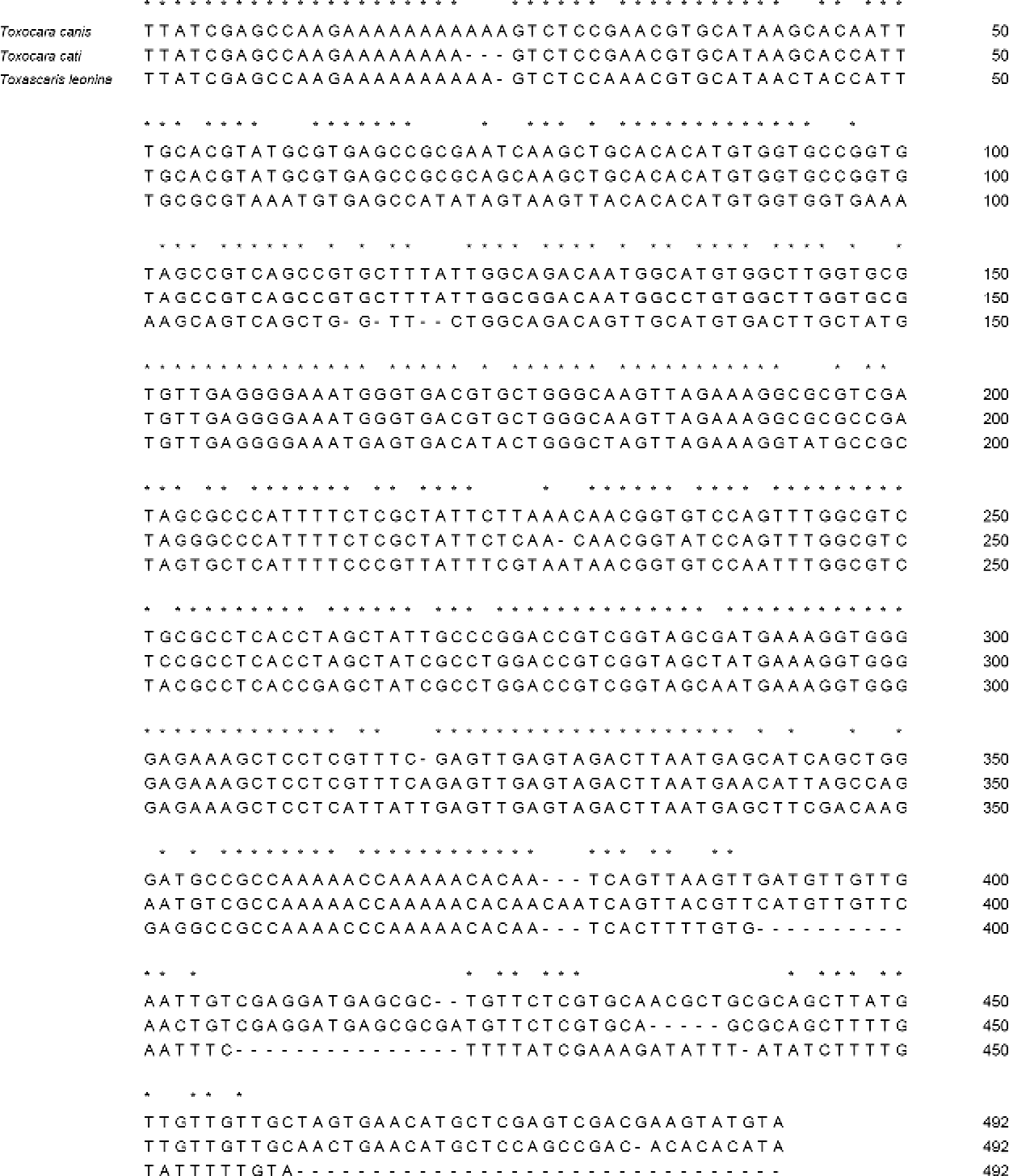
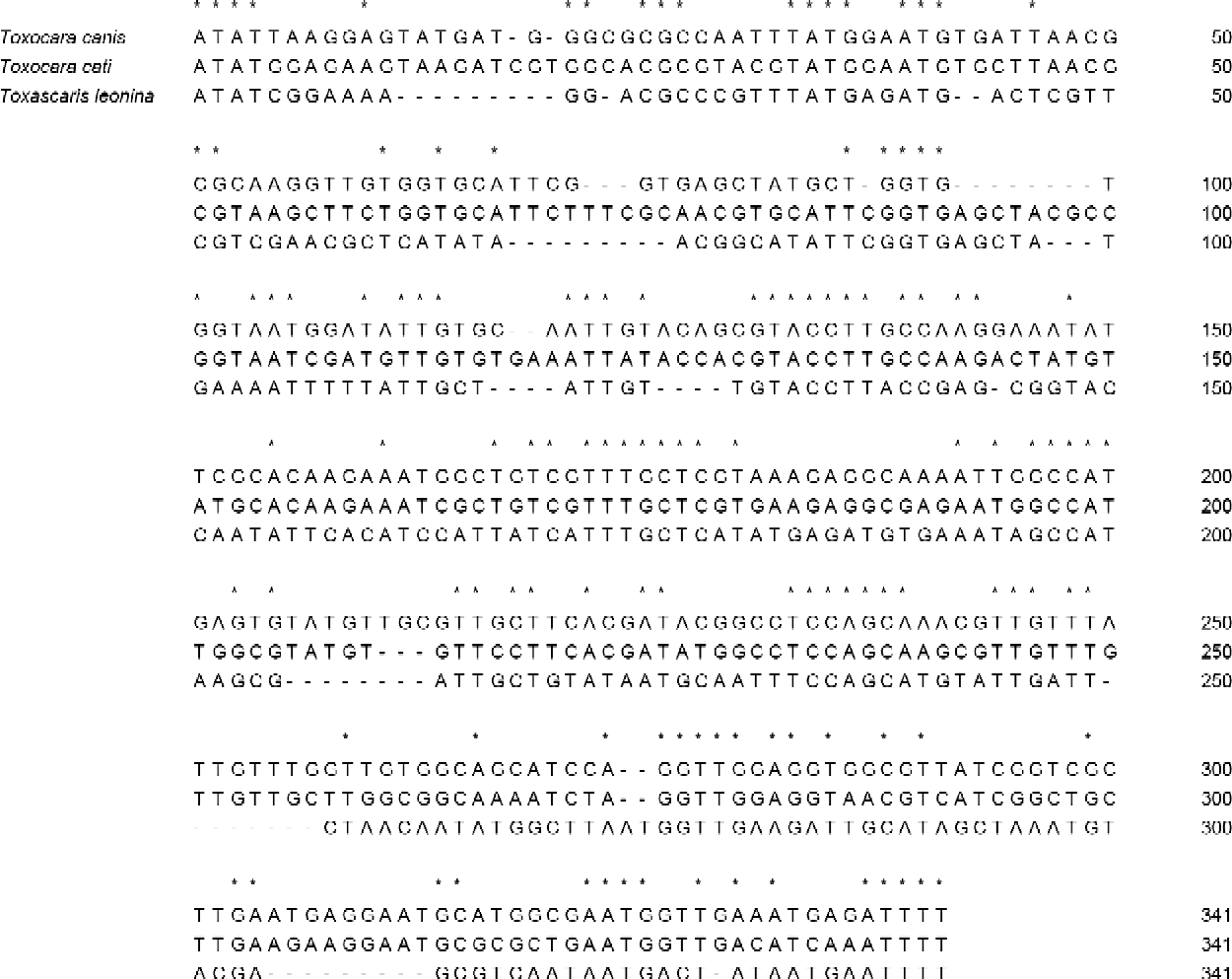
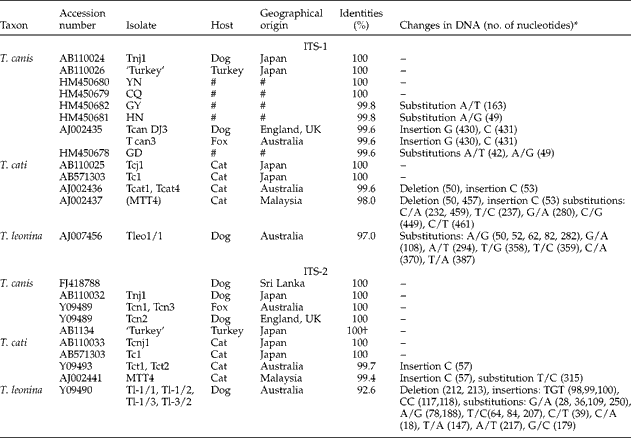
ITS-1 for T. canis, T. cati and T. leonina possess longer homological domains (e.g. at positions 289–313, 320–339) (fig. 1) than ITS-2 sequences, in which homological sequences are very short (e.g. at positions 131–137, 172–178) (fig. 2). Obtained ITS sequences were compared with those of the same species deposited in GenBank (table 1). It was found that T. canis specimens (collected from both dogs and foxes) from Poland are not different in the ITS-1 region from the specimens from Japan, but differ slightly (two insertions) from the isolates collected from a dog from the UK and a fox from Australia. The ITS-2 fragment shows 100% homology with all the isolates deposited in GenBank; but the sequence of this fragment in T. canis larva isolated from a turkey had five unidentified nucleotides, which hinders a full comparison of this fragment.
The alignment of ITS-1 sequences of Toxocara canis, Toxocara cati and Toxascaris leonina. *Indicates that bases at this alignment position are the same for all three species.

The alignment of ITS-2 sequences of Toxocara canis, Toxocara cati and Toxascaris leonina. *Indicates that bases at this alignment position are the same for all three species.
The comparison of ITS-1 and ITS-2 of T canis, T. cati and T. leonina originating from Poland with sequences from GenBank.
#Lack of data about origin and host.
* Numbering relative to samples from Poland.
† Five nucleotides unidentified.
The ITS-1 and ITS-2 sequences of T. cati from Poland did not differ from an isolate from Japan, but differed slightly from isolates from Australia (0.3–0.4%). The largest difference found was with the isolate from Malaysia, as ITS-1 showed a 2% difference. There were mainly substitutions, deletions and insertions (table 1).
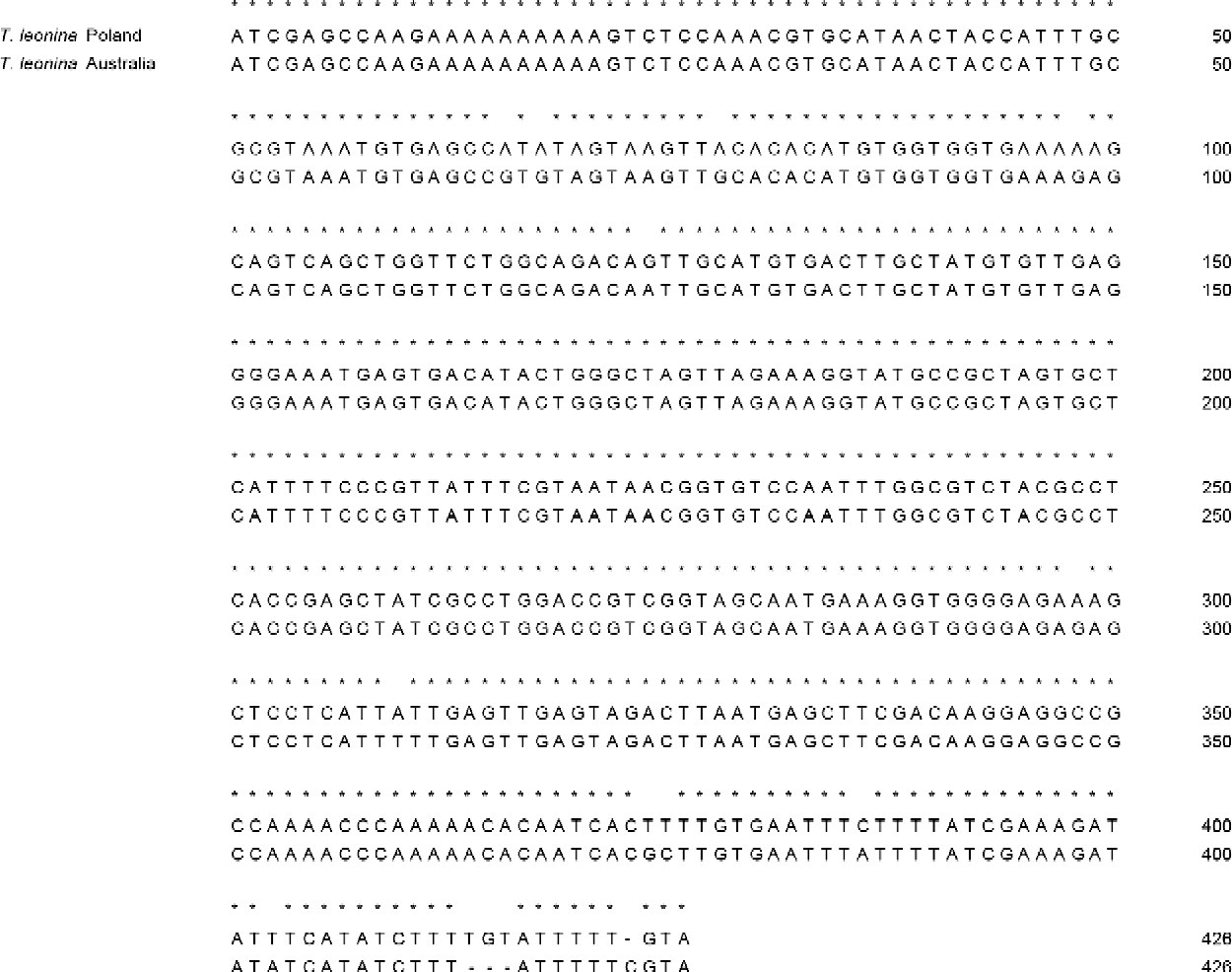
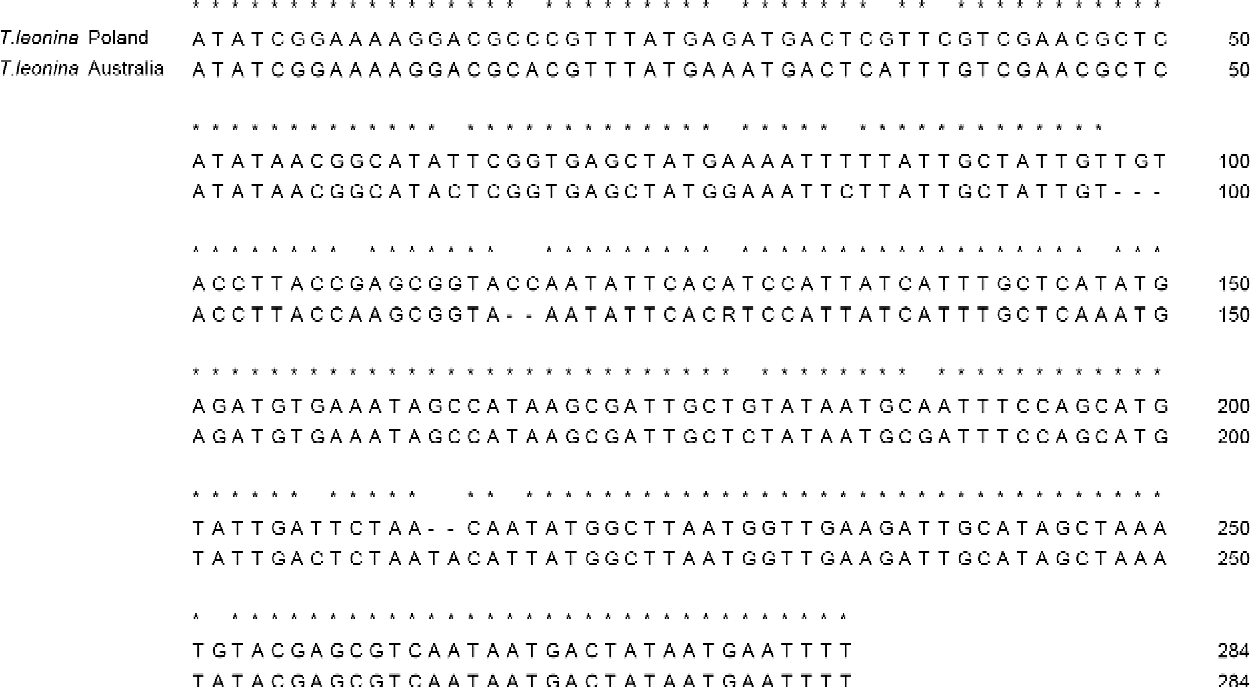
The largest differences were established between T. leonina collected from foxes in Poland and T. leonina collected from dogs in Australia. The ITS-1 region demonstrated a 3% difference. As many as 11 substitutions (7 transitions and 4 transversions), 3 insertions and 1 deletion were observed in this region (fig. 3, table 1). The ITS-2 region differed even more (7.4%) with 14 substitutions (10 transitions and 4 transversions), 5 insertions and 2 deletions (fig. 4, table 1). The sequences of T. leonina obtained in this study have been deposited in GenBank under the accession numbers: HM800922 and HM800923.
The alignment of ITS-1 sequences of Toxascaris leonina from Poland and Australia. *Indicates that bases at this alignment position are the same for specimens from Poland and Australia. The nucleotide sequence of ITS-1 T. leonina from Poland appears in GenBank under accession number HM800922.
The alignment of ITS-2 sequences of Toxascaris leonina from Poland and Australia. *Indicates that bases at this alignment position are the same for specimens from Poland and Australia. The nucleotide sequence of ITS-2 T. leonina from Poland appears in GenBank under accession number HM800923.
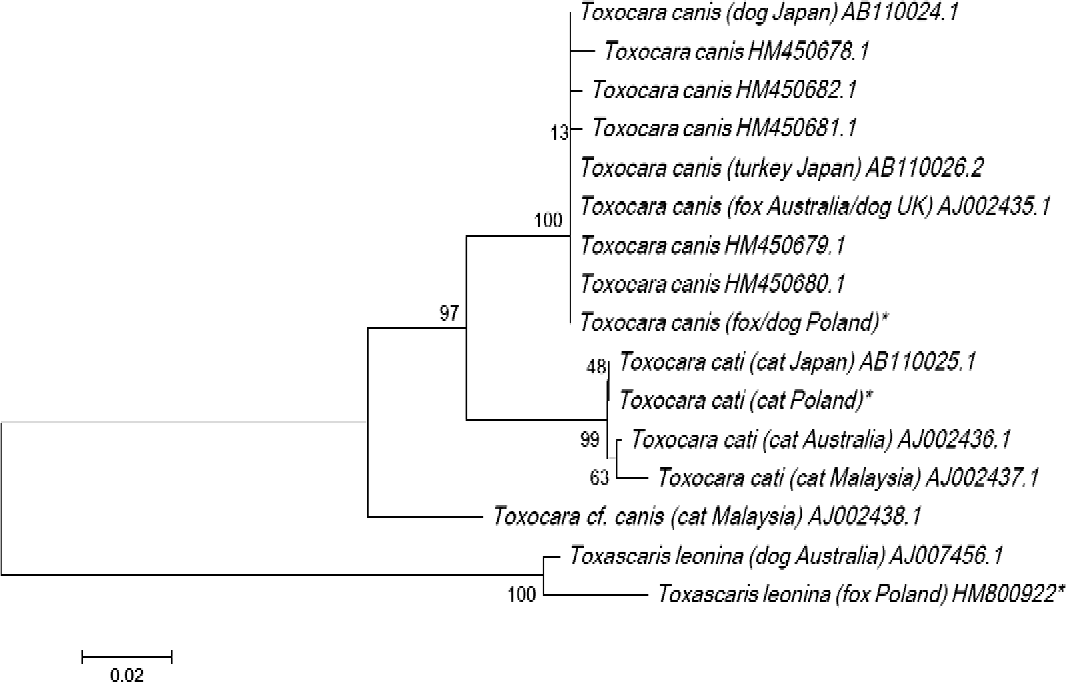
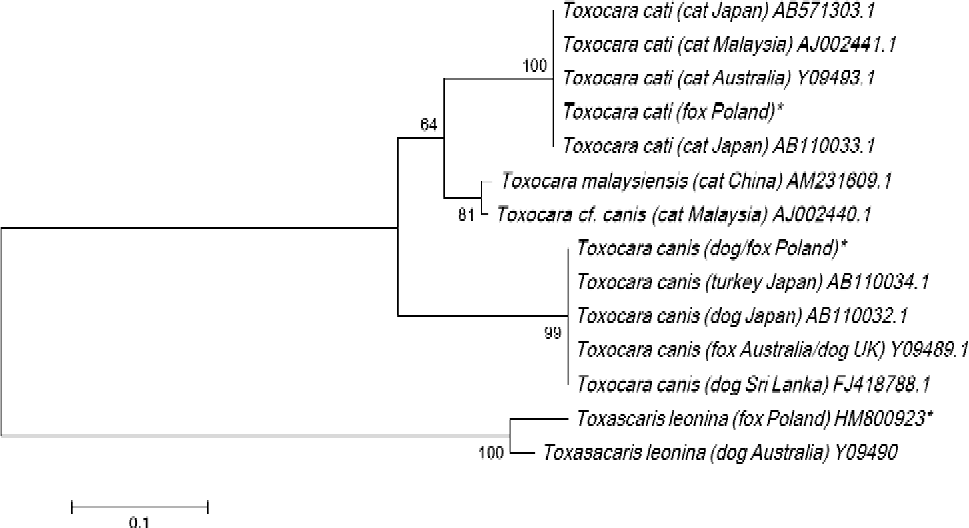
Phylogenetic analysis involved 16 nucleotide sequences for ITS-1 and 12 for ITS-2. Bootstrap consensus trees obtained in MP and NJ methods represent the same topology, both for ITS-1 and ITS-2 regions (figs 5–8). These analyses not only confirm the molecular differences between species of Toxocara but also show a clear difference between T. leonina from Poland and Australia.
Phylogenetic relationship of Toxocara canis, T. cati and Toxascaris leonina from Poland and other regions of the world inferred from the ITS-1 sequence using the Maximum Parsimony (MP) method. The scale bar indicates the proportion of sites changing along each branch. Analyses were conducted in MEGA 5. *Indicates taxa examined in the present study.
Phylogenetic relationship of Toxocara canis, T. cati and Toxascaris leonina from Poland and other regions of the world inferred from the ITS-1 sequence using the neighbour-joining (NJ) method. The scale bar indicates the proportion of sites changing along each branch. Analyses were conducted in MEGA 5. *Indicates taxa examined in the present study.
Phylogenetic relationship of Toxocara canis, T. cati and Toxascaris leonina from Poland and other regions of the world inferred from the ITS-2 sequence using the Maximum Parsimony (MP) method. The scale bar indicates the proportion of sites changing along each branch. Analyses were conducted in MEGA 5. *Indicates taxa examined in the present study.
Phylogenetic relationship of Toxocara canis, T. cati and Toxascaris leonina from Poland and other regions of the world inferred from the ITS-2 sequence using the neighbour-joining (NJ) method. The scale bar indicates the proportion of sites changing along each branch. Analyses were conducted in MEGA 5. *Indicates taxa examined in the present study.
Discussion
The rDNA sequence analysis of ITS-1 and ITS-2 regions of T. canis, T. cati and T. leonina has never been done before in Poland. Thus, the results of our study were to be compared with data available from other countries. Our investigation was focused on the study of ITS-1 and ITS-2 fragments of the species in relation to their geographical location and on differences between rDNA of the nematodes from various hosts (relates to T. canis and T. leonina). The ITS fragment variation in nematodes of one or of closely related species, depending on various geographical regions or host species, was studied earlier by other authors. The lack of polymorphism in five species of Trichostrongylus from one country was demonstrated by Hoste et al. (Reference Hoste, Chilton, Gasser and Beveridge1995). Similar data were obtained for Trichostrongylus columbriformis (Hoste et al., Reference Hoste, Gasser, Chilton, Mallet and Beveridge1993) and Baylisascaris procyonis (Blizzard et al., Reference Blizzard, Davis, Henke, Long, Hall and Yabsley2010), which came from different geographical sites. Small polymorphic intraspecific changes (from 0 to 0.9%) were observed in the nematodes of the Strongylus genus (Campbell et al., Reference Campbell, Gasser and Chilton1995), and also in Ascaris suum, A. lumbricoides, Parascaris equorum, Anisakis simplex and Hysterothylacium aduncum (Zhu et al., Reference Zhu, Gasser, Jacobs, Hung and Chilton2000). In some cases, the molecular analysis of ITS regions resulted in a revision of species classification. Thus, in the case of three species of Teladorsagia, the lack of a clear variation of their ITS-2 fragment showed it to be one species (Stevenson et al., Reference Stevenson, Gasser and Chilton1996), while in Hypodontus macropi from three different host species, the changes in ITS-2 were so significant (25.0–28.3%) that they pointed to the existence of three different nematode species (Chilton et al., Reference Chilton, Gasser and Beveridge1995).
The rDNA ITS fragments are commonly used as genetic markers in the specific identification of nematodes. Some authors have analysed both ITS-1 and ITS-2 (Zhu et al., Reference Zhu, Jacobs, Chilton, Sani, Cheng and Gasser1998, Reference Zhu, Gasser, Jacobs, Hung and Chilton2000; Ishiwata, Reference Ishiwata, Shinohara, Yagi, Horii, Tsuchiya and Nawa2004; Li et al., Reference Li, Lin, Chen, Sani, Song and Zhu2007; Cutillas et al., Reference Cutillas, Callejon, de Rojas, Tewes, Ubeda, Ariza and Guevara2009; Blizzard et al., Reference Blizzard, Davis, Henke, Long, Hall and Yabsley2010), but the majority of them study only one fragment (ITS-2), where microheterogeneity is observed much more often (Hoste et al., Reference Hoste, Gasser, Chilton, Mallet and Beveridge1993, Reference Hoste, Chilton, Gasser and Beveridge1995; Campbell et al., Reference Campbell, Gasser and Chilton1995; Chilton et al., Reference Chilton, Gasser and Beveridge1995; Stevenson et al., Reference Stevenson, Chilton and Gasser1995, Reference Stevenson, Gasser and Chilton1996; Epe et al., Reference Epe, Samson-Himmelstjerna and Schnieder1997, Reference Epe, Meuwissen, Stole and Schnieder1999; Jacobs et al., Reference Jacobs, Zhu, Gasser and Chilton1997; Newton et al., Reference Newton, Chilton, Beveridge and Gasser1998; Zhu & Gasser, Reference Zhu and Gasser1998; Li et al., Reference Li, Zhu, Gasser, Lin, Sani, Lun and Jacobs2006). In our study of rDNA of T. canis, T. cati and T. leonina, both fragments, ITS-1 and ITS-2, were analysed. It was revealed that the ITS-2 fragment of those species was more specific. Longer homological domains (even 20 nucleotides long) were observed in the ITS-1 region than in the ITS-2 region, where homologies in the examined species did not exceed seven nucleotides (figs 1 and 2).
In our study, ITS sequences of specimens from Poland were compared with specimens of the same species deposited in GenBank or in the literature. A comparison of these fragments in T. canis and T. leonina originating from different hosts (foxes and dogs) was performed. Previously, such a comparison was only done in relation to T. canis. Similarly to previous research (Jacobs et al., Reference Jacobs, Zhu, Gasser and Chilton1997; Epe et al., Reference Epe, Meuwissen, Stole and Schnieder1999; Zhu et al., Reference Zhu, Gasser, Jacobs, Hung and Chilton2000), no changes in ITS sequences in T. canis originating from foxes and dogs were observed. Besides, the sequences in the specimens from Poland did not differ in comparison with the sequences from specimens from other geographical locations, such as Japan, England, Australia and Sri Lanka.
Regarding T. leonina, which is a much less common parasite, current data about ITS sequences only concerned the nematodes infecting dogs in Australia, the UK and China. Previous research demonstrated homogeneity of these sequences irrespective of the geographical location (Jacobs et al., Reference Jacobs, Zhu, Gasser and Chilton1997; Li et al., Reference Li, Zhu, Gasser, Lin, Sani, Lun and Jacobs2006). In the present work, 70 T. leonina specimens collected from foxes in Poland were submitted to a molecular analysis and the ITS sequences of the nematodes turned out to be identical. When both ITS regions of T. leonina from Poland were compared with the sequences of this species from GenBank (Australia) 3% differences occurred in the ITS-1 region, and 7.4% in the ITS-2 region. However, it should be noted that T. leonina sequences from GenBank concerned the nematodes collected from dogs, and our sequences were related to those collected from foxes. Therefore, it is difficult to ascertain whether the observed differences are connected with the distant geographical location or, rather, with parasitizing different host species (different biotope) of the studied specimens. Large differences in ITS-2 sequence between individuals of the same species might point to extensive intraspecific variability or to species distinctiveness, as previously suggested by Chilton et al. (Reference Chilton, Gasser and Beveridge1995). In the Trichostrongylus genus for example, the level of differences between species ranged from 1.3 to 7.6% (Hoste et al., Reference Hoste, Chilton, Gasser and Beveridge1995). Analyses of polymorphic changes in T. cati showed no changes in ITS sequences within one host, but changes occurred in specimens originating from different geographical locations (the difference in ITS-1 region between T. cati from Malaysia and Australia was 2.9% and in ITS-2, 0.3%) (Zhu et al., Reference Zhu, Jacobs, Chilton, Sani, Cheng and Gasser1998). We suspect that polymorphic changes demonstrated in T. leonina do not depend on the host species, but rather on the geographical location. On the other hand, there are investigations suggesting a possible verification of the species status of morphologically indistinguishable parasites due to significant differences in nucleotide sequences of ITS-2 between the nematodes from different host species (Chilton et al., Reference Chilton, Gasser and Beveridge1995).
The analysis of ITS of T. cati did not show intraspecific differences among the specimens, but such differences, though small, were noted when the sequences obtained in our study were compared with the sequences from specimens from other places in the world. The ITS sequences of T. cati from Poland differed slightly from those originating from Australia (0.3–0.4%) and the differences were much more significant for the nematode from Malaysia (2% in ITS-1 and 0.6% in ITS-2). According to Zhu et al. (Reference Zhu, Jacobs, Chilton, Sani, Cheng and Gasser1998, Reference Zhu, Gasser, Jacobs, Hung and Chilton2000), rDNA microheterogeneity within T. cati originating from different geographical locations is the basis for evolutionary changes leading to a separation of new populations at the molecular level. Such changes in DNA probably preceded separation of the new species of Toxocara in Malaysia – Toxocara malaysiensis, described by Gibbons et al. (Reference Gibbons, Jacobs and Sani2001). It is worth mentioning that the species is not limited to Malaysian islands, but its presence was also confirmed in China (Li et al., Reference Li, Zhu, Gasser, Lin, Sani, Lun and Jacobs2006). Our study shows clear differences between rDNA of T. leonina from Poland and other places in the world (Jacobs et al., Reference Jacobs, Zhu, Gasser and Chilton1997; Li et al., Reference Li, Zhu, Gasser, Lin, Sani, Lun and Jacobs2006). This microheterogeneity may also indicate the presence of fixed changes within the rDNA of this species; especially since the sequences were identical in 70 specimens from Poland.
The results of the study suggest that the rate of evolutionary changes within the rDNA of T. canis, T. cati and T. leonina are different. No polymorphic changes in ITS-1 and ITS-2 of T. canis collected from the dog or the fox, and even of T. canis larvae isolated from the turkey liver, were observed (Ishiwata et al., Reference Ishiwata, Shinohara, Yagi, Horii, Tsuchiya and Nawa2004). Additionally, the ITS fragments of T. canis obtained in different regions of the world were identical. Therefore, the DNA of this species should be considered as conservative. In contrast, microheterogeneity of T. cati depends on the latitude. The ITS fragments of the specimens from Malaysia differ from the specimens from Japan and Australia by 2.9% (Zhu et al., Reference Zhu, Gasser, Jacobs, Hung and Chilton2000). The most clearly marked rDNA microheterogeneity was observed in T. leonina, comparing specimens from Poland with specimens from other parts of the world (2–7.4%). The level of differences in ITS-2 nucleotide sequence between T. leonina from Poland and Austrialia seems to exceed the within-species variation. Further analyses, including morphological examinations, should be undertaken to clarify the phylogeny of Toxascaris sp. This subject is particularly interesting in evolutionary terms and it would be worth exploring it on material obtained at the same latitude but from different hosts. This would allow us to determine whether the revealed changes in the rDNA of T. leonina were connected with the parasite biotope (host species) or the geographical location.
Acknowledgements
The authors are grateful to Dr Tomasz Luty for assistance in collecting the nematodes. This work was supported by an internal research project grant of the University School of Physical Education in Poznań, Poland.