


1. Introduction
Large Language Models (LLMs) without doubt represent one of the most exciting areas in current Artificial Intelligence (AI) research. Since the emergence of ChatGPT in 2022 (Ray Reference Ray2023), LLMs have become the foundation for driving innovation in fields like healthcare, finance, science, and more (Brown et al. Reference Brown2020; Zhao et al. Reference Zhao2024).
Astronomical data discovery via advanced querying of the astronomy science archives is a very specialized activity that requires a high level of domain specific knowledge. LLMs’ ability to infer information could facilitate these tasks. For example, by analyzing unstructured data such as titles and abstracts from scientific publications, LLMs can provide insights into object classification (Hegselmann et al. Reference Hegselmann2023), perform assessments about how to improve queries over tabular data from archives, and assist in new discoveries (Romera-Paredes et al. Reference Romera-Paredes2024). Taking advantage of the platform developed in the context of ESA’s Virtual AssistantFootnote † (EVA), and its integration in the ESASkyFootnote ‡ web application and Datalabs environment Footnote §, our proposal explores the possibility of using LLMs to facilitate the exploitation of ESA’s astronomy archives in an innovative way.
1.1. EVA: ESA Virtual Assistant Platform
EVA is a web-based platform designed to enable the creation, training, deployment and operation of domain-specific virtual assistants by leveraging state-of-the-art conversational AI methodologies (Doctor Reference Doctor2022). These virtual assistants operate as intelligent software agents that interact with users via chat-based interfaces, facilitating natural language dialogues to provide context-aware assistance and execute relevant actions (López-Caniego & Doctor Reference López-Caniego and Doctor2022). These agents support task-oriented flows to deliver actionable insights and perform user-specific operations within the ESA Science department ecosystem.
1.2. ESASky
ESASky is a multi-mission, multi-wavelength, and multi-messenger web-based application designed to facilitate the discovery and exploration of heterogeneous astronomical datasets. The platform leverages Virtual Observatory (VO) standards and interoperability protocols to enable seamless communication with ESA’s Astronomy Science Archives, as well as with distributed external data centers worldwide. Through these mechanisms, ESASky performs real-time queries to retrieve observational data, source catalogs, and spectral information corresponding to a user-defined region of the sky. ESASky also offers users the possibility to discover the data contents of the astronomy archives using Natural Language Processing (NLP) via the EVA platform (see Figure 1). The EVA bot in ESASky translates the interactions from the users into Application Programming Interface (API) commands.
ESASky EVA VA User Interface.

Figure 1 Long description
The image shows a screenshot of the ESASky EVA VA user interface. The main section displays a star field with various data overlays, including markers and an orange outline. The left sidebar contains a list of catalogues such as HSC, Gaia DR1, and 2MASS, with options to filter by gamma-ray, optical, and radio. The right sidebar includes a search bar and a list of actions like 'Display image observations' and 'Display catalogues'. Below the star field, there is a table with columns for name, RA, Dec, and various magnitudes. The table lists multiple entries with corresponding values.
1.3. ESA Datalabs
ESA Datalabs is a cloud-based platform designed to support interactive scientific analysis by providing online access to ESA’s computational infrastructure and data archives (Navarro et al. Reference Navarro2024). The platform enables users to develop and execute custom code within a web-based environment, eliminating the need for local installations. Multiple computational environments are available, integrating both established and emerging analysis tools, as well as legacy software, all accessible through a standard web browser. Most environments are deployed via JupyterLab interfaces, which are tailored to meet the requirements of specific missions and scientific domains, ensuring optimized workflows for domain-specific data processing and analysis.
2. EVA RAG Architecture in ESASky
LLMs have demonstrated state-of-the-art performance across a wide range of NLP tasks, often achieving strong results without requiring task-specific prompts. However, their effectiveness in domain-specific applications remains constrained by incomplete coverage of specialized knowledge during pretraining, difficulties in integrating new information, and the tendency to generate hallucinated content (Lewis et al. Reference Lewis2020). In the context of the EVA virtual assistant in ESASky, we want to go one step beyond and use LLMs to improve on the interactions between the users and the web application. Furthermore, we want to explore the possibility of using RAG to enhance the response from the LLM with astronomical information obtained from the SIMBAD Astronomical Object Database created and maintained by the Strasbourg astronomy Data Center. The SIMBAD database provides tabular information about billions of objects studied in the scientific literature in the last century.
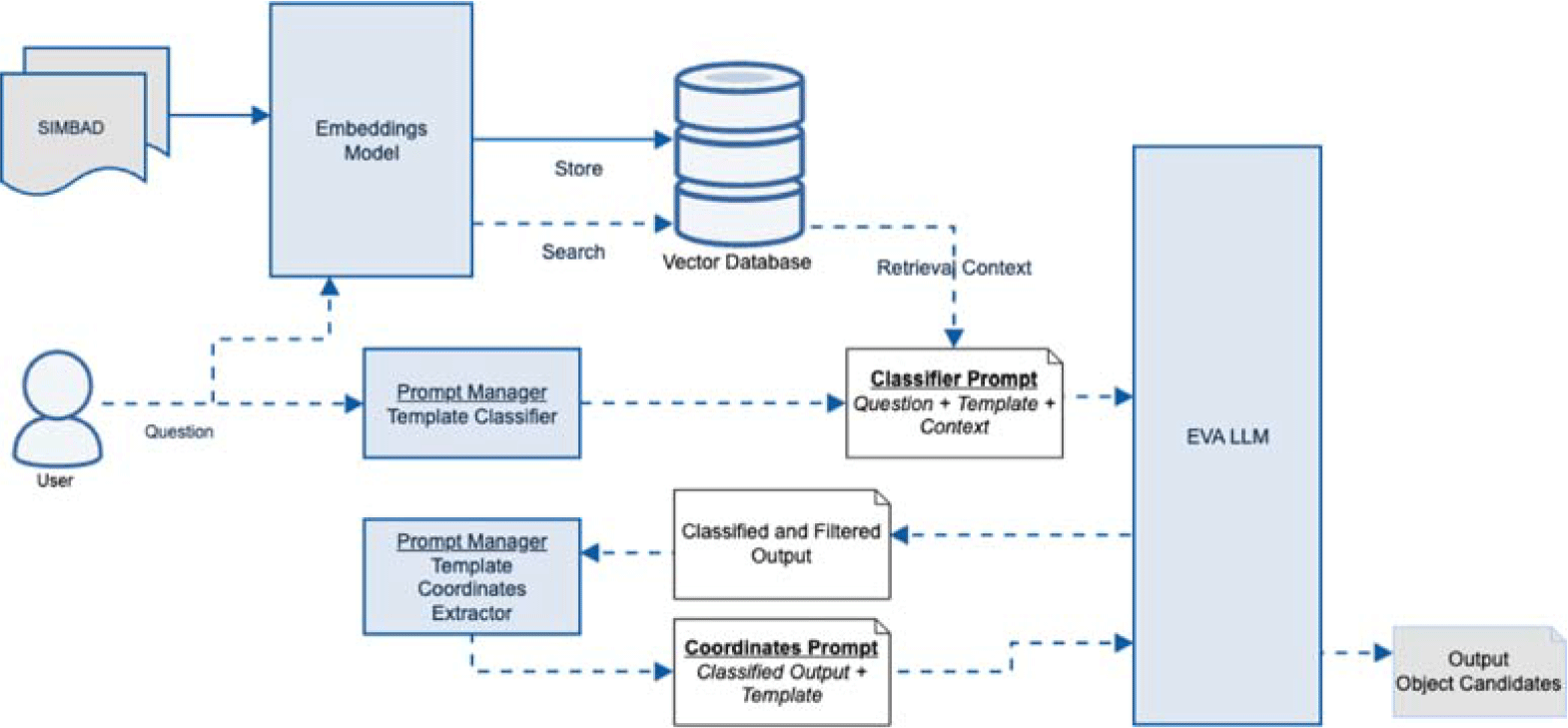
Figure 2 illustrates the architecture of the proposed RAG pipeline, which integrates SIMBAD data into the LLM workflow to enable domain-specific and context-aware responses within ESASky. The pipeline is divided into two main stages: (1) Data Indexing (on top of the diagram and making use of solid arrows, this phase occurs typically offline) where SIMBAD tabular data, including object coordinates and associated metadata, are processed and indexed using semantic representations for efficient retrieval; and (2) Context Retrieval (its flow is represented using dashed arrows), where user queries are interpreted and enriched with relevant astronomical context extracted from the indexed data before being passed to the LLM for response generation. This design ensures that the model operates on accurate, up-to-date information, reducing hallucinations and improving reasoning over domain-specific datasets.
RAG Pipeline.

By integrating generative LLM capabilities with authoritative external knowledge sources, the pipeline is able to process unstructured textual information (titles and abstracts) within SIMBAD tabular entries. It relies on semantic inference to identify entries relevant to the user-specified astronomical object, including cases where the object is not explicitly mentioned in the title or abstract. The system subsequently produces a structured JSON output containing coordinates and other metadata associated with the inferred object type, providing programmatic access that can be used in later stages for advanced analyses and automated workflows.
3. Agentic RAG evolution
LLMs perform well in inferring information from astronomical publications thanks to the RAG architecture, even though they have not been specifically trained on the domain. The proof of concept described here is very promising and has helped us to validate our proposal. However, conventional RAG implementations are constrained by rigid, predefined workflows that lack the flexibility required for multi-step reasoning, communication with external systems and the orchestration of complex tasks.
To address these limitations, we are experimenting evolving the system to work with Agentic RAG, an advanced framework that integrates autonomous AI agents into the RAG pipeline. In this context, our agents adopt agentic design principles like reflection, planning, dynamic tool utilization, and multi-agent collaboration to optimize retrieval strategies, iteratively refine contextual representations, and adapt task execution workflows in real time. This agent-driven approach significantly enhances the adaptability, scalability, and context-awareness of RAG systems. Furthermore, it extends our prototype functionality by enabling seamless integration with ESA Datalabs and the automatic generation of executable Jupyter notebooks that provide programmatic access to ESA’s Astronomy archived information related to the queried astronomical objects.
4. Discussion
In this work, we demonstrate that LLMs can effectively infer information from astronomical publications when integrated with a RAG architecture. RAG has emerged as a powerful paradigm for enhancing LLMs by incorporating real-time information retrieval, enabling the generation of contextually accurate and up-to-date responses. Furthermore, we present the use of multi-agent systems as a promising approach to support the scientific community by automating the generation of source code required to access archival data.
5. Acknowledgements
We would like to acknowledge the Data Science and Archives Division at the European Space Astronomy Center (ESAC) for supporting this project. This research has made use of the SIMBAD database, operated at CDS, Strasbourg, France.