Introduction
This reflective analysis links contemporary Western cultural practices of a curatorial nature undertaken outdoors by members of the general public. These have shown notable, digitally enabled growth in recent decades: examples cited here are from Europe, the United States and Canada. The questions I ask are as follows: in which historical, social and cultural context have the practices emerged? How they are linked to each other (if at all), including in conscious terms? Which audiences do they target and what is their desired impact on those audiences? What issues arise from their presence in public space and how might these be resolved? The research is based on secondary sources, and the perspective is archaeological, considering materials, agency/intent, setting and processes of deposition and deterioration. I draw on existing studies in contemporary archaeology and heritage (as well as my own academic and applied experience in those disciplines), and also in ethnography, including folklore studies, and in cultural geography. Only a few of the practices discussed have been the subject of detailed empirical research, which I have not conducted personally. Instead, my argument draws on this research, while also highlighting phenomena so far examined in more limited ways (observed/recorded informally by myself or by professional colleagues in archaeology, or documented by journalism or social media).
I hope to encourage further in-depth study and debate on the origins, role and treatment of these phenomena in society, especially since their right to occupy certain spaces is frequently contested. In advocating further documentation, I note that because the practices involve semi-legal colonization of public space, and have individual, emotional concerns at their core, their very nature could potentially be altered by the systematic large-scale observation or interviewing of practitioners. Even though the practices are, in some sense, performative (Santino Reference Santino2004), the performance itself is often surreptitious, with viewing and other forms of subsequent participation intended to be serial in nature (McNeill Reference McNeill2007). Immersive ethnographic studies of practice in one locality, as undertaken in some of the research cited here (Thurgill Reference Thurgill2016), may be a better way forward, along with archaeological-type field recording of relevant material (e.g. Houlbrook Reference Houlbrook2017) and pursuit of a more systematic, in-depth netnography (Kozinets Reference Kozinets2015) which I do not claim to be able to undertake here.
In considering why these practices are occurring now and the nature of their linkages, I identify postmodern interest in mundane and consumer objects, in ‘other’ or repressed voices and identities, in the individual, and in popular culture and the image, all forming an important shared context. The practices involve cumulative deposits or installations of mundane (often mass-produced) objects – toys, padlocks, stones, ribbons, foodstuffs – in outdoor public spaces, usually transit spaces. Issues of audience, and the importance of visual and other settings to interpretations of these deposits as (a) waste versus value (art/heritage) material and (b) spatial intrusion versus placemaking are relevant (see Draus et al. Reference Draus, Haase, Napieralski, Qureshi and Roddy2020; DeSilvey Reference DeSilvey2017; Herzfeld and de Cesari 2015; McNeill Reference McNeill2007). The practices have conscious frameworks of meaning and intent, and are positioned to enable large audiences to pass, view and contribute to the deposits. The assemblage and presentation of cultural material within overt, conscious structures of meaning define the term ‘curation’ (see chapters in Schorch and McCarthy Reference Schorch. and McCarthy2018); thus I will refer to the practices in this way, rather than as, for example, ‘folk assemblages’ (Santino Reference Santino2004). This helps to place them within a materially focused cultural-heritage management discourse. I will pay close attention in the latter connection to how far such curation represents community. In Western heritage management and curation, community participation/engagement in the production and exploration of material heritage (including ‘community archaeology’) remains a shibboleth, yet the terms are increasingly interrogated by scholars (e.g. Waterton Reference Waterton2015; Berger, Dicks and Fontaine Reference Berger, Dicks and Fontaine2020). I stress the need to understand the exact structures of participation and meaning involved in these public-generated curations, because these structures condition how sustainably and agreeably the practices relate to the places, societies and materials involved.
The practices are undoubtedly contested. If the typically mass-consumed objects involved are removed from their intended settings, they may often be viewed by non-participants, landowners and/or public agencies as nonrecyclable ‘waste’. If left in situ, their accumulation can be perceived by the same parties as damaging the environment in terms of aesthetics, access, safety or wildlife well-being, and removed on these grounds (see e.g. Orange and Graves-Brown Reference Orange and Graves-Brown2019; and the examples discussed below). I suggest that solutions to recurring contestation may lie in challenging the practitioners (who can be shown often to intend ephemerality in their curations) and their audiences, including managers of the spaces in which the curations appear, to add value and history to deposits and improve their sustainability by actively pursuing their renewal, development and adaptation in situ. This already occurs to some extent, though sometimes in an appropriative ‘safe-spacing’ and standardizing way which may push original activity elsewhere. Concerning ‘fairy’ deposits (discussed first below) in the UK there are money-making ‘fairy trails’ in private woodlands at Northwood, Yorkshire (www.northwoodtrail.co.uk), Mottisfont, Hampshire (owned by the charity the National Trust) and Trap Grounds Nature Reserve, Oxford (also a charity) that produce seasonal fairy trails to attract visitors and income (Herring Reference Herring2019; www.nationaltrust.org.uk/mottisfont). At Furzey Gardens in the New Forest National Park visitors are encouraged to contribute their own fairy-themed offerings to trails in a structured, income-generating way: ‘Use the special letter packs available to purchase from the tea rooms to write to the Fairy Queen – and she will write back!’ (www.minsteadtrust.org.uk/furzey-gardens). In the field of tree depositions, also discussed below, an alternative health practitioner has persuaded civic authorities in Henley (Oxfordshire, UK) to designate ‘wishing trees’ on a linear transit route (Marsh Meadows, on the banks of the river Thames). The public are encouraged to deposit ribbons on the trees, creating a visitor attraction which may benefit local businesses tapping interest in the magical, occult and pagan (Henley Standard 2017). On a transit path through the grounds of Strawberry Hill House, a heritage site adjacent to Queen Mary University (Twickenham, London, UK), students are encouraged by the university authorities to attach personal wishes expressed on paper, such as ‘I want to pass my finals’ to a specific tree (personal observation, January 2020). Some UK national parks and nature reserves provide ‘attraction’ maps guiding visitors to trees where other visitors have cumulatively pressed coins into the trunks, despite the fact that massive depositions of this type have sometimes endangered the health of trees (Houlbrook Reference Houlbrook2014, 157–59; 164–65; 181–88). Yarn bombing, also discussed here, has been invited into some public urban spaces by their managing authorities, even while it is contested in other similar spaces as environmentally damaging (BBC News 2015; Hahner and Varda Reference Hahner and Varda2014, 301–2).
I argue that we need to build a better understanding of the context, links and intent of the above practices to enable productive management to happen more widely. In Stephane Borraz’s work on one category of curation (love-locking), he proposes further investigation of how public space is challenged by performances that privatize it, making use of ‘standard industrialized objects’ which become ‘singular, decommoditized and unalienable’ in particular settings (Borraz Reference Borraz2019, 19). This theme is pursued here, with archaeological emphasis on how often (typically undeveloped, ‘unloved’) marginal and transit spaces are colonized in this fashion.
Curation of everyday and transitory objects: the individual as defined by visible consumption
The recent history of cultural collecting and the current sociocultural roles of consumer artefacts (including attitudes to their disposal) are pertinent to this discussion. We can consider them using the trope of consumer ‘innocence’ about object life cycles. In Orhan Pamuk’s 2012 novel Museum of innocence the narrator discovers his personal identity by minutely curating the material history of his lost beloved – from cigarette ends to tickets, bills, earrings and hair slides. In doing so, he finds he has also curated the history of daily life in 1970s–1980s Istanbul, a newly consumerist society. His curation, notably including artefacts relating to daily transit (streets, bars, cars and ferries), foregrounds the narrator’s formation and belonging within this past world. It reveals daily life in that world to have been precious, transient, texture-rich and emotion-ridden in ways which its ‘innocent’ inhabitants (multiple, dissonant groups, not a single community and linked most powerfully by consumer culture itself) rarely considered. Discarding soft-drink cans, gridlocking the streets with rusting American cars, importing throwaway fashions and admiring the spectacle of burning petrol spills on the Bosphorus, this public was ‘innocent’ about consumption outcomes in a way seen as unaffordable today. The creation of a museum ends this innocence, while preserving it forever in time. The novel comments on a wider loss of innocence about consumption from the 1990s, as Western museums started to collect, value and interpret mundane/popular culture at scale, recognizing its transient nature.
Museological interest in transient material culture was notable during the coronavirus pandemic, with curators seeking artefacts and accounts of how extreme temporary restrictions on movement (‘lockdowns’) were affecting consumption. Many such artefacts were digital, reflecting not just temporary limits on the physical sharing of tangible items, but also the generally rising importance of digital communications and artefacts in Western cultural consumption (Sayej Reference Sayej2020; Historic England 2020; Twitter’s #viralshadows and #signsoflife archives). The flourishing in the last two decades of websites such as eBay and Pinterest, of charity shops and other accessible forms of consumer-goods exchange, and of television programmes which show how mundane items from the recent past accrete collectable value (e.g. Kahn Reference Kahn2012), have all encouraged and reflected celebration and curation of the everyday at an official level. The accepted role of mass-made, transient consumer objects in social identity building, and at the same time a persistent innocence about their long-term futures, strongly conditions the types of public curation studied here.
Notwithstanding the themes and frameworks which these activities consciously reference (fairies, folklore, nature, travel, paganism, witchcraft, urban subversion, religious festivals and beliefs, feminism), I suggest that another a major link between them is the assertion of individual identity, promoted via digital channels and only sometimes set within a loose group structure. This is not community activity (undertaken by, or consciously on behalf of, a consistent, self-identifying social subgroup, co-resident or otherwise). While undertaken in public domains (drawing attention to and effectively curating otherwise unloved transit zones) and by members of the public, for a public audience, these are atomized material statements. The focus on the individual is unsurprising in a 21st-century Western consumerist context. We can consider the promotion of the individual as a cultural, economic and political unit by conservative discourse of the 1980s–1990s, the growth of individually participant-powered television shows from the early 2000s (Enli Reference Enli2009; Lunt Reference Lunt2009), and the recent development of Internet platforms all promoting the individual in social, work-linked and political environments (Vivienne and Burgess Reference Vivienne and Burgess2013). Such platforms typically place emphasis on capturing and presenting the image of an individual’s person, possessions, achievement or experience at a peak moment, before or during the act of consumption. The image is not just the record, but the whole credentials of the event. Surfing this trend, professional cultural curators have started to present their materials as visual ‘events’ online to encourage public consumption at specific times. Though this is often within the claimed arena of community engagement, it is not clear which community is targeted or reached: issues around curatorial hegemonism and populism persist (Blain and Wallis Reference Blain and Wallis2008, 216; Bonacchi and Moshenska Reference Bonacchi and Moshenska2015; Taylor Reference Taylor2015; Taylor and Gibson Reference Taylor and Gibson2016). The profusion of professional digital cultural-heritage content in response to COVID-19 movement restrictions may further undermine the notion that digital space = community, showing digital reach as limited by the ‘echo chamber’ of audience identity. The approach certainly contrasts starkly with the cases studied here, of individuals’ conscious digital communication/promotion of themselves to targeted audiences through the serially participative physical curation of consumer artefacts in specific places.
Below I explore under broad headings a number of types of contemporary public curations and identify what I see as linking features: their embeddedness in consumer culture, their focus on individuality and the image, their enablement by the digital realm, their targeting of transit spaces and audiences, and their transgressive nature. I argue that ordinary people are assembling and interpreting materials in specific frameworks of meaning in ways conditioned by postmodernity (legitimizing a focus on the image, the popular/mundane object and the individual voice), by consumerism (which provides a wealth of cheap mass-produced goods with built-in obsolescence), and by post-industrial hankerings for and reclaimings of the open, and of the natural, spiritual, supernatural or folkloric realms.
Intended ephemerality, depositor ‘innocence’ and contestation
I will explore ‘fairy’ depositions first; these lack much research to date. Although their informing concept is supernatural, they do not predominantly seem organized around any defined belief system. From 2005, installation of miniature ‘fairy doors’ in agreed public locations (e.g. shopfronts, libraries) in Ann Arbor, the US, was a self-promotional hobby for the children’s author Jonathan Wright (Belazel Reference Belazel2006; Wright Reference Wright2007). This seems the original reference point for current materializations of the fairy interest – the latter ultimately rooted in late 19th-/early 20th-century reactions to rationalism and the industrial (Hanson Reference Hanson1993; Staples Reference Staples2000).
In recent UK cases, ordinary actors, especially children, have used the concept to frame their material colonization of everyday environments – often nondescript, semi-wooded transit zones through urban or suburban environments. The materials used range from mass-made toys or other items, adapted and labelled (e.g. as gifts to fairies), through purpose-made (purchased or home-crafted) objects such as small doors echoing the original Wright trope, to natural elements like tree stumps (adapted by painting or shaping). Examples of all these item types within a single geographical cluster in suburban Southampton, the UK, were documented on Twitter by a professional archaeologist, James Brown, as they increased in number during a coronavirus lockdown in spring 2020 (Brown, 28 April 2020). Here and in other cases, items accumulate within a self-designated area which the depositing actors have clearly visited repeatedly: deposits are planned and self-consciously aggregated. The shared features of the materials deposited assert depositors’ interest (however superficial) in non-mainstream beliefs, and form a colonizing challenge to physical spaces with unclear ownership. Notionally, these are radical social angles. Yet many deposits reflect and draw on the norms of consumer culture (especially children’s culture: cf. adapted bags, wooden flowers and toys in Southampton, and similar items seen in another case in Pembrokeshire, the UK; Brown, 21 April 2020; BBC News 2018c).
There is little sign that the deposits are intended as permanent, given their vulnerability and their positioning on well-used transits, the latter feature seemingly intended to capture audience and participation. Perhaps because of this expected ephemerality (‘innocence’ about objects’ future), the ownership of and rules governing the spaces used seem largely irrelevant to the depositors. Indeed a belief is evident, as discussed below, that the small nondescript areas chosen should be open to this use. Though deposits are deliberately cumulative, with audience a likely consideration behind this, the making of an individual statement seems central for the actors. Personal names, often evidently those of children, informally inscribed on deposited items further suggest a concern with individual assertion (Brown, 21 April 2020; BBC News 2018c). We can note the customer-focused pre-sale personalization of such items by a Southampton retailer of fairy doors who also sells related mass-made products (That’s TV Solent Reference Solent2016).
The visual obtrusiveness of accumulated mass-produced, non-degradable items can lead to contestation and critique. James Brown’s Twitter record of fairy depositions is accompanied by professional judgements: items in bright, artificial materials are disfavoured over adaptations of natural features (Brown, 28 April 2020). Similar types of professional attitude appear in the cases of Wayford Woods, Somerset (discussed below), and the Furzey Gardens fairy deposits discussed above, where visitors are asked by signage to leave only biodegradable fairy offerings and avoid the use of glitter. On the basis of their exposed, transit-zone locations and their use of low-cost consumer items, it appears that most fairy deposits are intended as ephemeral. Depositors show ‘innocence’ about their long-term assimilation to the environment – perhaps a desire to believe that they really will disappear by magic, or alternatively form a personalized archaeological deposit for future generations to uncover. In this aspect the deposits recall the intendedly ephemeral masses of personalized bouquets, cards, balloons and many other items (including graffiti) deposited at recent public scenes of tragedy and/or sites associated with deceased celebrities in a ritualized, pilgrimage-type connection. The fact that these ultimately have to be sifted, cleared away and destroyed (and sometimes selectively curated) by civic authorities is not overtly acknowledged (see Greenhalgh Reference Greenhalgh2008; Orange and Graves-Brown Reference Orange and Graves-Brown2019, 353; Senies Reference Senies2006). Like the fairy deposits and more traditional pilgrimage practices, such practices have materiality at their core, specifically in the action of depositing material items (‘ritual litter’).
While acknowledging the ephemerality of their curations, the fairy depositors, like others discussed below, seem to expect a physical audience of some duration to justify their activity: rapid removal offends. In Southampton, as Brown records, depositions grew especially numerous during the spring 2020 COVID-19 lockdown, during which people could leave home for only one exercise session per day and were required to ‘stay local’. Contestation arose in the wider resident population, encountering the deposits on regular transits of the local area. The speed and immediacy of unofficial removals undertaken by these residents offended depositors. Handmade signs were erected in the deposition area, demanding an end to removals, designating them theft and stating that ‘residents’ (clearly meaning only part of the local community in the above context) maintained them ‘for children’, consciously identifying the actions as curations (Brown, 28 April, 30 May 2020).
Site-managing authorities also contest such depositions, as documented in 2015 at Wayford Woods, Somerset, the UK, a trust-owned landed estate open to the public. Here, ‘fairy’ depositions by visitors were notable in their scale, investment and permanency (some screwed to trees such as a ‘fairy playground’ with equipment about 60 centimetres high). The use of non-natural materials, and extensive digital publicization of the deposits (including via social media), encouraging their growth, were seen to damage the environment as volumes increased. Removals were initially undertaken by other members of the public, and ultimately by the trustee body itself (Lusher Reference Lusher2015). As with other ‘fairy’ deposition clusters, there appears to have been no real or self-conscious community structure in the practice, though actors were apparently sometimes group-reified (as e.g. day tourists, families, working-class) by those contesting the practice (elderly people, locals, walkers, trustees). Official signage was eventually put in place by the trustees, requesting the use of temporary installations and visually unobtrusive materials (a ‘professional’ approach focusing on setting and aesthetics). However, this approach was not entirely successful as it did not avoid further removals, nor did it give the environment a ‘natural’, unaltered appearance.
For professional curators of natural and cultural places, a recently appealing solution to such potential conflicts has been the neutral physical (or digital) space, where ‘communities’ are permitted to undertake their own curatorial initiatives on a permanent or fixed-term basis. Similar approaches by city planners, formally setting aside spaces for informal or marginal activities (and thus ultimately controlling those activities), have been critiqued in recent academic studies (Draus et al. Reference Draus, Haase, Napieralski, Qureshi and Roddy2020, 331–34; Belia et al. Reference Belia, Buikema, Schavemaker, Sitiza and Wevers2019; Simon Reference Simon2010, 85–127). The degree to which the public feel able to use such spaces expressively, in however incoherent or challenging a way (still less as a unified community), remains unclear (see conclusions in Merrill Reference Merrill2015; Fredheim Reference Fredheim2018). The proposed solution may indeed be frustrating: once an official platform is given, some kind of evaluation by the hosting authorities may be expected, yet the opposite actually occurs. Even if such safe spaces are offered to pre-existing public curations (as could have been done by reserving a section of Wayford Woods for fairy deposits, though the issues of Web-driven visitor numbers, aesthetics and environmental sustainability would have remained), they may fail to allow development of, or give adequate value to, the original phenomenon in all its freedom and transgression.
The next type of public curation I will consider has been increasingly prevalent, and studied, in the last decade. It involves the attachment of padlocks to street furniture, almost exclusively in urban transit zones and especially bridges (whether these span rivers or railways; see Borraz Reference Borraz2019; Houlbrook Reference Houlbrook2017; Reference Houlbrook2021a). Where a route links globally visited places, as in the case of the Pont des arts, Paris, or the Charles Bridge, Prague, especially dense levels of this activity can be noted, clearly connected to considerations of audience (Santino Reference Santino2004 notes that in many such pilgrimage-type cases audiences, however fluid and accidental, are intended to become active participants in the practice themselves). ‘Love-locking’ again draws on a literary trope (a scene in a 2006 romantic novel by F. Moccia) creatively adapted and disseminated through materialization and high (cumulative) visibility to large physically present audiences, but also to digital audiences. The activity is overtly individualized (a depositing couple, partnership or family often inscribe names, dates and messages on their locks). Borraz’s research documents how most lock depositors on the Pont des arts since 2008, including long-distance tourists, embed the use of personal social media within their actions, as both record and immediate publication of those actions.
The depositions are highly structured and planned (locks are frequently pre-ordered and pre-inscribed) and highly serious and emotive in the moment they are undertaken (Borraz Reference Borraz2019, 12–13, identifies these as pilgrimage-type practices; Margry Reference Margry2008, 17; Vikan Reference Vikan1994; Orange and Graves-Brown Reference Orange and Graves-Brown2019, 349, note the importance of social media in amplifying modern pilgrimage-type deposits and their impact). Both physical (recorded) action and materiality seem essential elements in the practice. For example, at the Pont des arts, Borraz documents an unsuccessful attempt at intervention by civic authorities concerned to preserve the pre-existing historic environment (lock accumulations change the aesthetics and can cause structural damage). The way the case played out showed that for the practitioners, their depositions could not be meaningfully replaced by individuals’ making and disseminating ‘selfie’ images of their visits to the bridge, which the authorities tried to promote as an alternative (Borraz Reference Borraz2019, 9–10). The essential need to capture a physical audience partly explains this. Houlbrook’s (Reference Houlbrook2017) systematic fieldwork showed that bridges with different levels of transit footfall in the city of Manchester, the UK, had correspondingly varying densities of love-locks. Materiality also seems vital – even if the practice is represented by an image, there has to be a material element to make it worthwhile, and thus worth documenting. Notwithstanding the need for audience, privacy during the act of installation itself is usually important. This is apparently not only because depositions are taken seriously and emotionally, but because public spaces are being illicitly encroached upon. Further security of individual assertion in these spaces, as well as the assurance of audience, is achieved by taking part in a cumulative action, which anonymizes and neutralizes transgression. Borraz records new depositors enjoying and paying close attention to previous deposits (displaying a curatorial outlook). This, and the enthusiastic sharing of the practice via digital media, seem to be the only group-related aspects of the phenomenon: few if any community aspects are apparent.
Notwithstanding the symbolism of permanence involved in this practice, lock depositors demonstrate expectations of ephemerality in the same way as others discussed here: lock accumulations are widely known to be regularly removed by the authorities. As the ultimate acknowledgement of transience, some locks are even affixed to waste bins near bridges. Houlbrook’s study demonstrates the regular erasure and reinscription of original dedications on locks, as well as post-depositional removal of locks (with duplicate keys) by the original depositors. As the completion (using-up) of the (recorded) deposition, the key is usually thrown away, in symbolic defiance or determined innocence of what change will prevail in the future. The record (which now extends to GPS recording of the key-drop coordinates; see Borraz Reference Borraz2019, 13) and the performance of the physical, material action seem to make the expected future removal irrelevant. Anticipatory signage forbidding the practice may, in the light of this accepted ephemerality, actually encourage the perceived need to colonize ‘unloved’ transit spaces (as in the case of yarn bombing, discussed below). Given the dominant factors again visible in this practice – assertion of the individual (through material action), audience capture and the buffering of transgression through the accumulation of deposits and their placing in transit zones, acknowledged ephemerality with deliberate innocence about long-term futures, and a personalized digital record – alternative official provision of permanent ‘community’ spaces/modes for the depositions may lack take-up.
Audience, expression and transgression
I will discuss some further linked phenomena in relation to how the role of the individual cultural creator and their audience has changed in the postmodern era, affecting curatorial conceptions of who creates meaningful culture, and how. From the 1990s (just as museums embraced ephemeral popular culture), heritage specialists preoccupied with the cultural character of landscapes showed interest in contemporary art involving ephemeral (recorded) human–landscape interaction – as in the work of Richard Long, who arranged natural objects to reflect his walking journeys (www.richardlong.org; Renfrew Reference Renfrew2003). The artist ‘Banksy’ was journeying through UK urban landscapes, imposing on them unauthorized, anonymous images critiquing the societal and environmental decay they embodied (Hansen Reference Hansen2018). Intendedly ephemeral, highly dependent on spatial context and media record, such art forms made their creators famous, even as the latter concealed themselves in terms of traditional artist/art identifiers (style, medium, signature and portability/consumption). Gallery installations using mundane objects/spaces in unpredictable ways – a bisected animal in formaldehyde, a disordered bed – have since further shifted concepts of the visible creator, of art/heritage locations, of art as material culture and of permanence (see e.g. Stallabrass Reference Stallabrass2006). Such artistic phenomena, which capture large-scale audiences through outdoor/transit route positioning, are accessible through their use of the mundane; are deliberately ephemeral, inviting ‘consumption’ by virtual means and the secondary image; and now influence public perceptions of art and heritage via the state-backed mainstream – cf. the mass poppy installations and sand portraits of war poets commissioned to commemorate the UK’s First World War armistice centennial in 2018 (BBC News 2018a; 2018b).
This context, of notionally anonymous individuals manipulating the mundane and the ephemeral for media record and thereby mass audience, seems to inform many of the informal public curation practices I explore here, which sometimes include inscriptions/graffiti, as already noted (see Orange and Graves-Brown Reference Orange and Graves-Brown2019). The collection and grouping of stones in public space is one such practice. It has typically appeared in spectacular and/or remote locations, and been undertaken by leisure travellers (Barkham Reference Barkham2018; see also McNeill Reference McNeill2007), but participation in it appears to have increased recently. During coronavirus lockdowns, it has involved more everyday locations. Ordinary local countryside and beaches can become the setting, as at Whitley Bay, Tyne and Wear, the UK, with its multiple large towers of plain and painted stones, and Avon Beach, Cheshire, the UK, with its large numbers of individually painted pebbles (BBC News 2020a; 2020b). I encountered long caterpillars of arranged inscribed and painted stones produced during spring 2020 lockdowns in public transit spaces (bridges, town centres) in southern UK towns during summer 2020 (e.g. Enford, Wiltshire; Weymouth, Dorset; Reading, Berkshire; see also Houlbrook Reference Houlbrook2021b).
These creations are consciously ephemeral (located in uncontrolled spaces; dismantlable; the materials largely coming from, and subject to, nature), as well as highly individualized. As with love-locking and fairy depositions, their locations in transit spaces and their cumulative nature attract audiences, and at the same time buffer the transgressiveness of the (vitally) material, individual, recorded action. Though stone cairns are not usually signed, they have unique photographically recorded and digitally publicized forms, while painted pebbles are often signed or tagged: authorship is asserted. Stone curations rarely take over large proportions of a landscape; rather, they are accumulated in particular zones, where they become designedly obtrusive. The open-air natural locations seem taken by depositors to allow freedom to impose a mark. The implied message (‘I was here’) signifies the socio-economic identity of the creator, in the era of travel as a consumer item and digitally recorded accomplishment. This is amplified by another message (‘I have created something’), echoing the sense of the contemporary conceptual art described above, where a record of making, rather than permanency, is central. The absent creators, having recorded and disseminated the creative moment, seem little concerned with long-term preservation, and may never visit their creations again. This intended ephemerality can both confound and reassure site managers contesting stone curations as intrusive and hard to control or dismantle at scale. The sense of ever-renewed production by an ever-shifting group appears to constitute the only ‘community’-related aspect of these depositional practices.
‘Yarn bombing’, which is now fairly well studied academically (where stone curation is not), involves covering civic furniture (e.g. trees, statues, lampposts, railings) with knitted additions, often in a cumulative way. Transit spaces are again important: the practice is heavily concentrated in urban/urban fringe transits with high footfall. This practice directly references or positions itself as art. The original reference point (disseminated globally via digital, image-based records) is the practice of US-based Magda Sayeg (now a celebrity artist), who decorated her storefront and surrounds in this way from 2005 onwards (Wollan Reference Wollan2011). Yarn bombers often name-tag their work, consciously acting as individual creators and curators. Small groups, frequently framing their activity in this field around femaleness (textile crafts being traditionally gendered) and/or subversion of the urban landscape, fulfil the same kind of supportive anonymizing function as does the cumulative nature of the deposits (both enable individual transgression in public space). In acknowledgement of the transgressive nature of the practice, deposits are usually made nocturnally, in surreptitious fashion (Hahner and Varda Reference Hahner and Varda2014, 303–5; 309–10; Millie Reference Millie2019, 1277–78; 1279–80).
Actors may physically create and install deposits under the protection of a group format, yet they overwhelmingly publicize and communicate their actions within personal digital networks, where the image is central. Out-of-place, brightly coloured and obtrusive to their intendedly large physical audience, yarn depositions can be contested by place-managing authorities on the grounds of environmental damage as well as aesthetics (BBC News 2015). As in other cases studied here, depositors appear to have ‘innocence’ about the long-term future of their materials. Many plan to remove their work shortly after installation, while others simply expect deposits to decay in situ, notwithstanding the known long-term survival of yarn and dye components in the environment. Despite this intended ephemerality, depositors may, as in other cases discussed above, object to reactive or too-rapid destruction of their deposits, to which they have ascribed value and identity and for which they expect an audience of some duration (Hahner and Varda Reference Hahner and Varda2014, 304; Millie Reference Millie2019, 1278–79). As in stone curation, fairy depositions or love-locking, individualized material action seems irreplaceable in this practice. A digital record is also vital (again as in other cases) in securing an audience, and supports actors’ acceptance of ephemerality in their work. A yarn bomber in Liverpool, the UK, is recorded as saying, ‘I like seeing other people’s reactions to it … whenever anything goes up I watch social media very very closely that day’ (Millie Reference Millie2019, 1275–76; 1281–83).
Attachment to/operation in ‘community’ structures
Individual concerns appear overdetermining in the practices I explore here, even for those carried out within group frameworks. I explored the sociocultural context for this feature in an earlier section. Some personal observations made within the field of professional heritage practice (not constituting systematic fieldwork) can be used to briefly illustrate this in the first instance. In 2018, I worked as a museum consultant with the Whitley Community Development Association, in the UK, a charity based on a 1930s council estate. Presentation and interpretation of ‘community’ artefacts within the newly regenerated 1930s community centre was one aim in a grant-funded community heritage project – the intent was effectively community (re)colonization of a public space. My role was to evaluate already collected and incoming documents, photographs and artefacts, and develop plans for interpretation. The process revealed nearly all of the items to be mundane, widely replicated products of the recent, post-Second World War past, with strong personal histories and local connections. Examples include trophies won by youth sports teams, programmes of school plays from the 1960s and photocopies of newspaper clippings.
In the project’s original design, the aim was to highlight significant themes of social change, including early 20th-century housing reforms, 1980s council house purchase schemes, transport shifts and social isolation/youth alienation. Yet the artefacts which the residentially defined ‘community’ selected for curation did not recognize or contribute to such overarching, group-focused interpretation. Dominant concerns with asserting personal/family identity within the notional ‘community’ curation framework became clearer as I explored potential for collecting oral histories of the area, partly via an existing project Facebook site (‘The Whitley Museum’, at www. facebook.com/groups/100437123626158). This site used stimulus posts to attract community responses. It soon became apparent that the main contributors to the site were a distinct subgroup – almost all over fifty years old, and frequently resident at a distance (e.g. Australia, the US) with familial ties to the estate – a highly specific, virtual group, rather than the local ‘community’ as a whole. Contributors typically responded to posts (e.g. ‘Does anyone remember Building/Street X?’) with very short comments or exchanges specific to personal histories/relationships, e.g. ‘My dad worked there in the 1960s’ or ‘We lived at number X just opposite. Our neighbours were the Z and Y families.’ Very little wider community-related information or discussion was seen as necessary or able to be offered.
While these Facebook contributions might have been useful in drawing experiential heritage maps of the estate, wider-ranging contributions were needed to build a long-term, compelling interpretation of the estate’s history. Contributors here were making individualized, cumulative depositions of mundane objects at a specific virtual and physical place. Ephemerality was accepted and an immediate, targeted/participative audience was mainly of concern (Facebook contributions were not offered as permanent records, and appeals for more detailed interviews for archiving through the site were not productive). The original project of a long-term curation by and for ‘the community’ in fact produced a set of individually focused, intendedly ephemeral deposits.
Recent types of curation around trees return my discussion outdoors while bringing the issue of community to the fore. All are linked by the use of trees’ physical forms as a useful display arena and by the other features of public informal curations I have identified above, and some are consciously in the realm of ritual. The association of ritual and materiality has been studied extensively in archaeology (Insoll Reference Insoll2011), including the archaeology of the contemporary world, where ‘ritual litter’ has become an issue in heritage management (see Orange and Graves-Brown Reference Orange and Graves-Brown2019; Blain and Wallis Reference Blain and Wallis2008). Frameworks for ritual can include paganism, folklore, mysticism and mainstream religious beliefs (Thurgill Reference Thurgill2016, 136–84; Houlbrook Reference Houlbrook2014, 87–88, 166–67, 194–96; Reference Houlbrook2018).
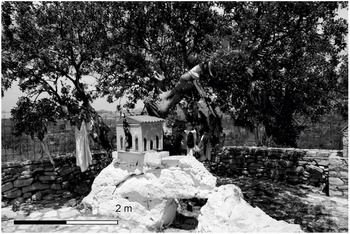
A Cretan case was recently recorded by a colleague working in my main research field of Aegean archaeology (Krzysztof Nowicki, personal communication). The context here is the long-established tradition in Greek Orthodox Christianity of hanging miniature body-part or whole-body representations on church altars or icons in association with prayers for health. It is an individual, private act at the moment of deposition. By its cumulative nature, it has a publicly visible dimension and a desired audience, but is notably individually centred and distinct from coordinated public dedications in the same Greek Orthodox tradition, as of basil sprigs or communion bread (Teske Reference Teske1985). In this context, deposits recently found by Nowicki on a tree near Perama in west Crete, on a transit path leading to a chapel of Saint Fainourios, are of interest. The saint is a traditional intercessor for lost things, and sometimes also for fertility (see Marianthi Reference Marianthi2006 on still-vibrant folklore traditions). Nowicki reports that the tree (Figure 1) has been bedecked over time with low-cost mundane items of a specific personal type never deposited in church settings – women’s underwear, babies’ dummies. The framework of meaning for the deposits appears to relate to fertility, childbirth and/or the loss of a child. As with many of the deposition types discussed above, we see a public transit space which has been colonized through individual actions. These actions are anonymized and made visible by the material accumulation involved, potentially producing a site of pilgrimage.
Tree near the chapel of Saint (Ayios) Fainourios, Perama, west Crete, 2018 (K. Nowicki).

The physical place of deposition shows concerns with audience, given the placement in a transit location, proximity to existing specific sites of public interest (e.g. heritage buildings), and the tree form and its widely acknowledged/shared symbolic associations.
In this and other cases that I discuss within this section, the physical setting of deposition shows concerns with audience in multiple respects. Transit location is one of them, adjacency to existing specific sites of public interest (e.g. heritage buildings) another; the tree form and its widely acknowledged/shared symbolic associations are a third (cf. the rag-tree near the ruins of St Mary’s priory cited by Santino (Reference Santino2004) and the case of Ankerwycke below; McNeill (Reference McNeill2007) discusses sense of place as both established/enhanced by, and establishing, informal ‘serial collaborations’ like those discussed here). The Perama tree depositions are planned actions, with serious emotional resonance. Individually centred, they use the community concept of Orthodox belief and a specific place to help signal meaning to an audience, and are intentionally ephemeral, innocent about the future of the deposited objects. There may be no current interest in digitally disseminating images of the practice (I could not find any), but this may not remain the case for long.
Trees in German cities are still frequently decorated with eggs during Easter, in the conscious folk tradition of the Östereierbaum (Newell Reference Newell1967). As in other informal public curations, an emphasis on transit areas can often be observed (for example, the verges and alleys of residential fringes in Heidelberg, which I noted in 2010–12). This practice parallels (and may partly inspire) recent Western trends of adding Christmas decorations to evergreen species in urban transit spaces, as in the Thames water meadows of Reading, the UK, during 2017 (personal observation), and as documented in a recent Canadian case where a couple and associates decorated trees in their local park (Kost Reference Kost2019). There are also much less symbolically focused cases, such as recent ‘shoe trees’ in the US, similarly located in transit locations and thus apparently similarly concerned with audience and participation; see Shepherd Reference Shepherd2019). In all these cases, depositors clearly need to plan their actions, based on either previous visits to the deposition place as audience, or awareness of it through digital networks. Permanence does not seem intended in these practices, and would make little sense in seasonal frameworks of meaning. Rather, action, audience, materiality and digital record are core. Actors use community seasonal/religious celebrations to obtain temporary licence for personal transgression in public space, expecting and often undertaking removal of their items afterwards. That they are nonetheless annoyed by any unexpected, non-official removal (as reported in the Canadian case) demonstrates that they do ascribe value to their actions. Although the latter examples seem less private than other depositional practices discussed here, we can again note an apparently minimal role for ‘community’ structure, aside from the generally shared context of seasonal celebration.
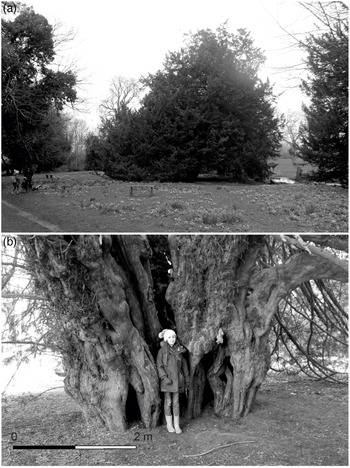
Where traditions around the agency of a specific tree or place exist, these can favour a more deliberate ‘community’ type of framing for depositions. This is documented in Thurgill’s (Reference Thurgill2016) immersive ethnographic study of practices around a massive yew on a pedestrian transit route adjacent to ruins of a medieval priory at Ankerwycke, the UK (Figure 2). The priory forms a focus within a riverside walk in an urban fringe area. Perhaps originally associated with the building, the tree is popularly reputed to be 2,500 years old and to be indirectly linked with Magna Carta, which was signed at Runnymede immediately across the river in 1215, as well as with King Henry VIII. Located on land owned and managed by the National Trust, the tree is the focus of seasonal ceremonies and deposits by the neo-pagan Circle of Ankerwycke organization (Thurgill Reference Thurgill2016, 161–3; at the time of writing in 2022 the group no longer had an individual Web presence, but see www.gyldenfellowship.co.uk). The group is notionally a community, yet in the affluent context of the London conurbation, members of this and linked groups using the above website come from a wide geographical radius. Anyone interested may copy the material element of the depositional practices, but they must be part of the group to join physically in the ceremonies, which occur in a group of up to fifty people. Deposits (seen consciously as votives) are mundane objects (some organic), and consumer innocence applies, with expected ephemerality in the deposits left. One circle member told Thurgill (Reference Thurgill2016, 162), ‘normally the National Trust gets rid of them for us’. There is no protocol about the correctness of items deposited. For example, pumpkin lanterns, which are now widely marketed in plastic versions and have no documented place in British folk or pagan traditions, are left at the tree in a ceremony occurring close to Hallowe’en. In this and other ceremonies, public space near the tree is claimed by the group in diverse and ephemeral ways, including choreographed movement (processions, circles; see Thurgill Reference Thurgill2016, 163–83). Actors then cumulatively place ribbons (representing thoughts/wishes/bonds), candles, incense, posies and other items around the tree’s roots and branches. The transit location attracts a wider public audience and participation (e.g. ribbon tying) following the ceremonies. The massing of materials aids visibility and is encouraged by the seasonal/periodic structure of deposition.
Ankerwycke yew, 2020, a from the north, b the massive trunk and downcurving branches (S. Wallace).

As with the other practices discussed in this paper, the group nature and cumulative aspects of these activities help to buffer the risks of individual transgression in a public space. At the same time, individuality is core. Material, individualized (recorded) elements of the practice cannot be meaningfully replaced. Ceremonies are recorded and publicized in closed, personal digital channels (Thurgill could not access information about the ceremonies unless he physically took part). They include enactments of individualized roles, such as that of the ‘Sun God’, using individually acquired costumes of commercial materials and designs, which do not adhere to any community-defined or community-authenticated tradition. Lines spoken in these enactments are read from mobile phones: again, consumer products and materials enable individuality, materiality and action. At the end of the spring ceremony, the participants shriek aloud the name of their own group, highlighting an ultimately narrow, identity-focused nature for the practice, rather than any community reference (Thurgill Reference Thurgill2016, 171–72).
At the Neolithic henge of Avebury, Wiltshire, the UK (also managed by the National Trust), massive old oak trees on one bank of the monument lie on a transit path traversed by hundreds of daily visitors at peak times (personal observation, August 2019, and social media records, cited below). The ancient ceremonial site clearly offers one framework of place meaning for the multiple ribbon depositions placed on the oaks in recent years (see Blain and Wallis Reference Blain and Wallis2008, 217–18, for pagan interest in pilgrimages and celebrations at Avebury). But multiple interests and identities are co-sited. For those interested in mysticism/fantasy, the belief that the trees inspired J.R.R. Tolkien’s fictional world is a central attraction. The practice of tying ribbons or rags on certain trees also has roots in folk traditions (as noted above; see Santino Reference Santino2004). International Web-based communities participate in the curation, recording and promoting of it via personalized digital media (Elyse 2017; Jensen Reference Jensen2015; Whistlecraft Reference Whistlecraft2017). Regarding contestation, the National Trust as site manager may periodically remove ribbons as ritual litter (as at Ankerwycke) but has not tried to divert depositions into any designed ‘community space’ (a difficult task when specific natural features are the focus). However, in a new project which I observed through personal participation at Ankerwycke (‘Runnymede Explored’, the trust is restructuring the transit zone around the yew to encourage viewing only, rather than tangible, material interaction (which is, of course, core to the various public curations discussed here). As in the case of the Stonehenge monument, formal access for ‘legitimate’ rituals and depositions at certain times of year may be pressured for if too many restrictions are imposed; some kind of group structure for depositors would seem essential to achieving this (Blain and Wallis Reference Blain and Wallis2008).
Lastly, I consider another notional community framework for outdoor public curations, which is Goddess worship, a minority/alternative belief system (see Tulley (Reference Tulley2018) for details of the latter’s antecedents in modern Wicca practices, and its formalization by a US-based theologian, Carol P. Christ). Its ‘thealogy’ and practices draw, consciously and without concern for historical context or accuracy, on the interpreted practices and iconography of ancient Mediterranean/Near Eastern cults. Trees may be incorporated in depositional practices associated with Goddess worship as good physical display areas, but in terms of symbolism, trees are not central. Instead, Mediterranean archaeological sites recorded as locations of ancient cult activity are targeted for depositions through a conscious mode of pilgrimage by participant believers. These are scattered internationally (though mostly originating from Anglo-Saxon societies) and linked primarily by digital means. Many have wider shared interests in travel, feminism and mysticism.
The movement has been anthropologically researched at the empirical level, while material from participants’ depositional activities is frequently encountered by heritage professionals and visitors on ancient Mediterranean sites (Rountree Reference Rountree2001; Reference Rountree2007). It is difficult to see the depositing population as representing anything other than a fluid, temporary community of (atomized) practice. Practitioners mostly lack residential or background links to the localities concerned, and often access sites as part of highly organized and targeted tours. As in other activities studied here, a serious framework of meaning around communing with nature (via the Goddess as a nature spirit/deity) is linked to the moment of deposition (dedication). Images and accounts of making deposits are framed by depositors’ individual identities, and are disseminated widely in digital form (in a way not seen, for example, in the tree deposition at Perama, which is closely linked to the practices of an established, rather than an alternative, religion).
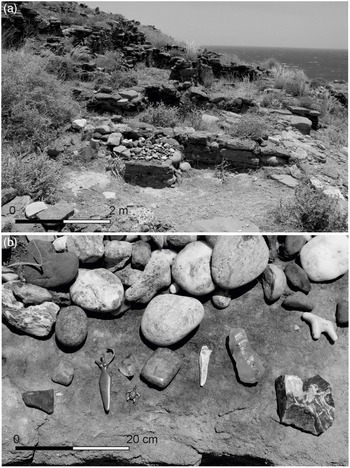
Although seen by participants as existing in a kind of continuum with ancient cult practice, these depositions involve transgressive, visible colonization of publicly owned and overtly managed space. The areas chosen are typically important visitor transits or focal points (hill summits, inner caves, cupule stones) which are sometimes only loosely linked to documented ancient cult locales. Examples include the Myrtos Fournou Korifi and Psychro Cave sites in Crete (personal observation (figure 3) and as documented in Neave Reference Neave2014; Reference Neave2015). Given the managed environments in which they are sited, the deposits seem recognized as ephemeral, with a notable ‘innocence’ demonstrated by depositors about the end destination of the items concerned. Tight rules on content are lacking, and deposits can include symbolically natural offerings such as leaves, oil, fruit and vegetables (anachronistic kiwis and oranges indicate few concerns with replicating any ancient dedication practice). Consumer items deposited, as at pagan ceremonies at sites in Northern Europe (Blain and Wallis Reference Blain and Wallis2008, 9), include mass-made reproductions of ancient artefacts (e.g. goddess figurines, pots; see figure 3). Primary accounts by participants suggest that an audience beyond the co-worshipper group is unwelcome at the time when these transgressive, emotive depositions are actually being made. However, the later digital dissemination of images of the deposits, and the latter’s self-conscious obtrusiveness (although accumulations tend to be relatively low in volume at any one site), suggest a wish for an audience.
Myrtos Fournou Korifi, a Bronze Age Cretan settlement, a depositions on a wall adjacent to the shrine building, 2017, from the west, b close-up (S. Wallace).

Conclusions: contestation, class and challenging ‘innocence’ in public curations
COVID-19-related restrictions on movement have witnessed both a growth in volume, and innovatory trends, in unofficial public curations. Yet the phenomena were already established (and contested) before the pandemic, and have notable common features. The evidence suggests that they have influenced each other, both through the unmediated physical experiences they provide to transitory audiences, and through digital records and discourses (mostly originated and controlled by individuals) with a global reach. If they continue to grow in post-pandemic conditions (potentially involving more localized transits, and more varied uses of outdoor urban and semi-urban space, as more people work from home), will contestation increase? If so, it may not always come from official bodies, but may take the form of competing or aggressive parallel deposits – which ironically can attract intervention from authorities when original deposits have become classed as established or valued parts of the setting, or as ‘art’ as opposed to ‘artefacts’. We can note the recent addition of graffiti to a pandemic-era Banksy image in the UK, with the official response being the placement of a screen to protect the original equally unofficial image (PA Media 2021). An unspoken distinction is made here between two sorts of unauthorized deposition. Orange and Graves-Brown (Reference Orange and Graves-Brown2019) note a similar distinction in highlighting how a David Bowie fan mural on a much-used London transit route was afforded official protection, whereas elsewhere in the same city, material deposits of gifts and flowers commemorating another deceased pop star, George Michael, in a wealthy residential area have been removed in deference to neighbours’ objections to mess.
Alternatively, will well-intentioned deflection (‘safe-spacing’) or appropriation by the official guardians of public space ultimately reduce the spontaneity of original curations, and what kinds of creative reaction will this drive in turn? The intended ephemerality of these curations seems important in deciding how to manage them sensitively, and I have additionally suggested here that ‘community’ does not appear especially relevant in the phenomena (individualism, instead, being at the forefront), making permanent set-aside locales for them unattractive. The element of transgressivity also militates against this, while the significance attributed to materiality makes a virtual deposition environment pointless.
Socio-economic class (in some sense the opposite of community; see Smith Reference Smith2009; Hahner and Varda Reference Hahner and Varda2014, 307–8) seems likely to structure future iterations of these practices. The investment of very different social statuses and cultural values in the practices as discussed above may work against the creation of communities through them, while also influencing future directions. For example, wealthy leisure travellers may build stone piles in remote spots and deposit offerings to goddesses, but be less likely to padlock historic bridges at home; while the educated environmentally aware middle classes seeking alternative lifestyles or a return to nature may contribute ribbons to wishing trees, but be less likely to hang underwear on a tree to ask a saint for fertility assistance within an existing Christian folk cult tradition, or install commercially made cheap glittery plastic fairy doors in woodlands. At the same time, such practices are linked by contemporary consumption behaviours and assumptions which cut across both class and digital culture.
Can the feature of intended ephemerality and ‘innocence’ about the long-term destinations of artefacts be used to encourage development of these practices in socially and environmentally sustainable ways? Site managers could potentially embrace the impermanence of the deposits, accepting their value in providing insight on, and influencing, contemporary society, and in forming part of its material legacy. Selective removal (for permanent professional curation) of elements within deposits shows that this already occurs (Orange and Graves-Brown Reference Orange and Graves-Brown2019, 354). Yet because cumulation and place are clearly important to the meanings of the practices, selective removal is not a universal answer. Instead, encouraging the deliberate layering of stories onto deposited items through their ongoing adaptation in situ, with the production of a concurrent digital record, could help keep volumes of deposits under control, and produce audience-appealing visual change within an evolving framework of intent and value.
The final loss of consumer ‘innocence’ as defined here may be assisted through this approach. Research on second-hand exchange shows that consumers can value object stories (Böhlin Reference Böhlin2020), but that this depends heavily on object type, original commercial value, and social class (Balthazar Reference Balthazar2016; Lovatt Reference Lovatt2015; Waight Reference Waight2015). My own behind-the-scenes observation of items donated to a charity shop in a middle-class UK residential area in 2014–18 noted very high volumes of merchandise (especially lunchboxes) from the Disney fairytale film Frozen (2013). While the lunchboxes were in perfect condition, they were rapidly perceived as unfashionable and thus discarded by ‘innocent’ consumers. The shop was unable to sell them, and they ended in landfill even as local families were visibly consuming exactly the same item but in brand-new forms. Value was unable to be added anywhere in the process: the artefacts were apparently too strongly imbued with the values of a cheap material (plastic) and a commercial identity (merchandise) to allow the inscription of other values, and so were easily divested (Roster Reference Roster2001). However, in the curations discussed above, exactly the same kinds of object can potentially be given layered function and meaning in their setting by altering their relative positions and adapting their inscriptions and forms, as well as through the addition of new objects.
To encourage stewardship of what might otherwise become waste material at what Lane and Watson (Reference Lane and Watson2012) call the ‘meso level’, guardians of public spaces where deposits have been made might offer active suggestions for adaptations via signage, as has already been done, but can also powerfully and visibly take part in these adaptations themselves as part of the clearly desired participative audience (reassembling fairy dwellings/stone cairns; redecorating padlocks; or retying, marking or braiding tree ribbons). Santino (Reference Santino2004) notes his deliberate participation in the rag-tree well deposition he studied. Where these practices occur at official cultural and natural heritage sites, Blain and Wallis (Reference Blain and Wallis2008) recommend active reference to them in official interpretive discourse. Managers could also digitally disseminate examples of ‘renewed’/reworked depositions in situ on their established digital culture platforms, thus enlarging the audience and overtly seeking to explode potentially hegemonic curatorial views on place and culture. This would offer recognition to public curations, while allowing them to retain their expressive and transgressive qualities. During and after COVID-19, such re-curation may offer a new and important means of tangible communication, humanizing sterile transit and fringe spaces and promoting the growth of incipient community structures among people using those spaces (sometimes in new ways). The apparent intent of many existing public curations – to assert personhood, to make place, and to provide a material, meaningful focus in impersonal transit environments – can be celebrated. Intentionally ephemeral, these curations reflect changing public understanding of art, space and heritage, and question established professional heritage tenets about ‘community’ engagement and the curation/conservation of special places for the future (see e.g. DeSilvey and Harrison Reference Desilvey and Harrison2020; Rico Reference Rico2016). Instead, they focus on the individual’s transient material experience and the preservation of that experience with a digital record, effectively creating new sites of both material and digital cultural heritage. As incomes and tourism decline and mass physical congregations in high-profile public spaces remain curtailed for various reasons (whether COVID-19 or tighter tourism control), closer attention to these public informal curations might help to develop the professional management of natural and cultural spaces in exciting new ways.
Acknowledgements
The impetus for this paper arose partly in considering open-air deposition in a ritual connection by ‘ordinary’ ancient actors, in connection to my excavations previously sponsored by the Greek Culture Ministry and British School at Athens. The paper also builds on my experiences in UK heritage management since 1996 (National Trust for Scotland; National Trust; Whitley Community Development Organisation; Invisible Palace Project, London). I thank these bodies for their collaboration, as well as Professor Krzysztof Nowicki.
Competing interests
The author declares none. No funding was received for the writing of this article.
Saro Wallace is currently a Senior Research Fellow of the Gerda Henkel Foundation 2021–23. After obtaining her Ph.D. in classical archaeology from the University of Edinburgh (2001) she held full-time UK lectureships in archaeology and museum studies to 2010, and continuous research fellowships and visiting professorships thereafter (University of Warsaw, 2010; University of Heidelberg, 2010–12; Albright Institute, 2012–13; Center for Hellenic Studies, Harvard University, 2015–16). She was Honorary Research Fellow in the Department of Archaeology at the University of Manchester 2016–20. Among her part-time posts in cultural-heritage management are those of archaeologist in the National Trust for Scotland 1996–2001, museum consultant for Whitley Community Development Association in 2018, and archaeology/heritage specialist research lead for the Runnymede Explored project, National Trust and the Invisible Palace Project, London, 2020–21. Since 2003 she has established, directed and published archaeological projects in Crete, most recently at and around the prehistoric site of Karphi, under the auspices of the British School at Athens.