Introduction
Previous studies have shown that poultry are able to select their own diet from various feedstuffs in order to meet their nutritional requirements (Malheiros et al., Reference MALHEIROS, MORAES, COLLIN, DECUYPERE and BUYSE2003). In poultry, calcium (Ca) and phosphorus (P) are essential nutrients for various biochemical pathways and skeletal integrity with the physiological roles of these two macro-minerals being intricately linked (Rath et al., Reference RATH, HUFF, HUFF and BALOG2000; Selle et al., Reference SELLE, COWIESON and RAVINDRAN2009). Under certain physiological conditions, the need for Ca and the appetite for Ca is greatly increased. For example, egg laying birds have a much higher Ca demand during reproduction than other vertebrates (Graveland and Berends, Reference GRAVELAND and BERENDS1997). To meet the Ca and P requirement of poultry, diets are enriched with limestone, inorganic-P supplements such as dicalcium phosphate and in some instances, meat-and-bone meal (Selle et al., Reference SELLE, COWIESON and RAVINDRAN2009). However, the amount of Ca in the diet has both financial and nutritional implications. Excess dietary Ca impedes the availability of other minerals such as phosphorus (P), magnesium (Mg) manganese (Mn), zinc (Zn) and, through the formation of Ca-phytate complexes, reduces the efficacy of phytase (Driver et al., Reference DRIVER, PESTI, BAKALLI and EDWARDS2005; Selle et al., Reference SELLE, COWIESON and RAVINDRAN2009). In addition, high dietary Ca concentrations may reduce the energy value of the diet through the chelation of lipids (Driver et al., Reference DRIVER, PESTI, BAKALLI and EDWARDS2005). Studies by Atteh and Leeson (Reference ATTEH and LEESON1984) showed that the formation of insoluble soaps between dietary fat and Ca during digestion rendered them both unavailable to the bird. However, increasing the Ca content of the diet increased soap formation and exacerbated the decrease in Ca retention and bone Ca content (Atteh and Leeson, Reference ATTEH and LEESON1985). This presents a conundrum to poultry nutritionists. Decreasing the amount of Ca in poultry diets may lead to improved growth performance, P digestibility and phytase efficacy, however, this would lead to health and welfare implications, compromising skeletal integrity and increase the prevalence of leg health problems.
Choice feeding systems are reliant on the principle that individual birds in a flock are able to select between various feed ingredients according to their needs and production capacities (Olver and Malan, Reference OLVER and MALAN2000). This is not possible when pelleted diets are used, such as in broiler production. Of the available literature, little is available pertaining to choice feeding of Ca for broilers. Furthermore, the diets used in these studies have not included the use of exogenous phytases. This paper reviews the interactions between dietary Ca, phytate and phytase as well as choice feeding systems in poultry. The potential application of feeding a separate source of Ca to broilers is also discussed.
The role of calcium and phosphorus in nutrition
This wide ranging topic is beyond the scope of a single review and so only a brief description will be provided. For a comprehensive review of Ca metabolism in poultry see De Matos (Reference DE MATOS2008) and for P metabolism see Suttle (Reference SUTTLE2010). The control of Ca metabolism is highly efficient and tightly regulated in poultry. Calcium is the most prevalent mineral in the body and 99% is found in the skeleton (Underwood and Suttle, Reference UNDERWOOD and SUTTLE2001a). Thus, the predominant role of Ca provides structural strength and support in bones but it is also a critical component in many of the biochemical pathways in the body such as muscle and nerve conduction, blood coagulation, eggshell calcification and control of hormone secretions such as vitamin D3 and parathyroid hormone (De Matos, Reference DE MATOS2008). Deficiencies in Ca lead to the development of rickets and tibial dyschondroplasia, as well as increased mortality in chicks and reduced body weight in mature animals (Underwood and Suttle, Reference UNDERWOOD and SUTTLE2001a).
Phosphorus is the second most abundant mineral in the body and 80% is found in bones (Underwood and Suttle, Reference UNDERWOOD and SUTTLE2001b). Phosphorus is involved in many essential physiological functions and is critical to growth performance and bone mineralisation (Letourneau-Montminy et al., Reference LETOURNEAU-MONTMINY, NARCY, LESCOAT, BERNIER, MAGNIN, POMAR, NYS, SAUVANT and JONDREVILLE2010). Similar to Ca, the major use of P in the body relates to the formation and maintenance of bone. However, P is also required for phospholipids which contribute to cell membrane fluidity and integrity and for the phosphate buffer system which helps maintain osmotic and acid-base balance and plays vital roles in metabolic functions (Underwood and Suttle, Reference UNDERWOOD and SUTTLE2001b). Phosphorus deficiencies in poultry lead to similar outcomes as for Ca deficiency and include loss of skeletal integrity, appetite, subnormal growth in young animals and weight loss in older animals (Christensen et al., Reference CHRISTENSEN, NIELSEN, YOUNG and NØDDEGAARD2003; Narcy et al., Reference NARCY, LETOURNEAU-MONTMINY, MAGNIN, LESCOAT, JONDREVILLE, SAUVANT and NYS2009).
Interactions between dietary calcium, phytate and phytase
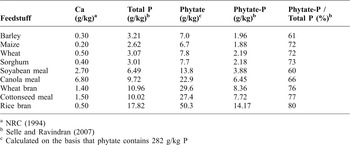
Phytate (myo-inositol hexaphosphate; IP-6) occurs naturally in plants and serves as the storage form of P (Tamim et al., Reference TAMIM, ANGEL and CHRISTMAN2004). The primary storage compartment of phytate in plants is seeds, which are used extensively in pig and poultry diets. However, phytate-P has a low bioavailability in monogastric animals (Simons et al., Reference SIMONS, VERSTEEGH, JONGBLOED, KEMME, SLUMP, BOS, WOLTERS, BEUDEKER and VERSCHOOR1990). Different feedstuffs vary in their concentration of phytate-P as well as the proportion of P that is bound to phytate (Table 1). For example, the concentration of phytate-P varies from approximately 0.2% in maize to around 1.4% in rice bran whilst the proportion of P bound to phytate ranges from 60% (soyabean meal) to 80% (rice bran) (Selle et al., Reference SELLE, RAVINDRAN, COWIESON and BEDFORD2010). Therefore the composition of the diet influences the amount of available-P in the diet. Consequently, poultry diets are supplemented with inorganic sources of P to meet the nutritional requirements of the bird.
Typical concentration of calcium, total phosphorus, phytate, phytate-phosphorus, and proportion of phytate-phosphorus in common feedstuffs (Selle et al., Reference SELLE, COWIESON and RAVINDRAN2009).

a NRC (Reference NRC1994)
b Selle and Ravindran (Reference SELLE and RAVINDRAN2007)
c Calculated on the basis that phytate contains 282 g/kg P
To liberate P from phytate, exogenous phytases are increasingly being used in both pig and poultry diets (Selle et al., Reference SELLE, COWIESON and RAVINDRAN2009). Phytate has 12 reactive sites which range from being strongly acidic (pK1.5-2.0) to weakly acidic (pK 9.0-11.0) and in the digestive tract of poultry, phytate carries a strong negative charge that is capable of binding di- and trivalent cations such as Zn2+, Cu2+, Ni2+, Co2+, Mn2+, Fe2+ and Ca2+ (Angel et al., Reference ANGEL, TAMIM, APPLEGATE, DHANDU and ELLESTAD2002). Formation of these complexes reduces not only the availability of these minerals but also that of phytate-P. Importantly, Angel et al. (Reference ANGEL, TAMIM, APPLEGATE, DHANDU and ELLESTAD2002) reported that Ca may play the most defining role in the formation of mineral phytate complexes as well as reducing the efficacy of both endogenous and exogenous phytases. This relationship has important implications for poultry nutrition.
The solubility and stability of phytate-mineral complexes are pH-dependent (Tamim et al., Reference TAMIM, ANGEL and CHRISTMAN2004). Selle et al. (Reference SELLE, RAVINDRAN, CALDWELL and BRYDEN2000) reported that most chelates with divalent mineral cations are soluble below pH 3.5 whilst maximum insolubility occurs between pH 4 and 7. However, limestone which is commonly used in poultry diets as a source of Ca has a high acid binding capacity and has been shown to increase digesta pH therefore favouring Ca-phytate interactions and reducing the efficacy of exogenous phytases (Selle et al., Reference SELLE, COWIESON and RAVINDRAN2009).
Phytases are phosphatases that are classified according to the phytate phosphate group they hydrolyse first. Accordingly, 3- and 6-phytatses commence dephosphorylation at the C3 and C6 positions, respectively (Kies et al., Reference KIES, VAN HEMERT and SAUER2001). The action of these phytases differs in the number of phosphates that are able to be liberated, the location sequence of phosphate removal as well as their activities at different pH (Tamim et al., Reference TAMIM, ANGEL and CHRISTMAN2004). Exogenous phytases are predominantly active in acidic pH conditions such as in the fore-stomach (crop, proventriculus and gizzard) of poultry and the stomach of pigs (Selle and Ravindran, Reference SELLE and RAVINDRAN2007; Selle et al., Reference SELLE, COWIESON and RAVINDRAN2009). For example, the 3-phytase from Aspergillus niger has two optimal pH levels; 2.5 and 5.0 whilst the 6-phytase from Peniophora lycii is between 4.5-5.0 (Lassen et al., Reference LASSEN, BREINHOLT, OSTERGAARD, BRUGGER, BISCHOFF, WYSS and FUGLSANG2001; Tamim et al., Reference TAMIM, ANGEL and CHRISTMAN2004). Plant phytases such as those endemic in barley, rye, triticale and wheat have lower efficacy than microbial phytases since they have a narrower pH range of activity and are susceptible to proteolytic degradation in low pH environs such as the gastric gut (Selle and Ravindran, Reference SELLE and RAVINDRAN2007). Most plant phytases are also heat labile and thus activity is reduced in steam pelleted diets. Mucosal phytases have also been identified in the small intestine of poultry. However, their efficacy is largely thought to be rendered insignificant due to the levels of Ca present in poultry diets (Tamim et al., Reference TAMIM, ANGEL and CHRISTMAN2004). Because the pH of the small intestine of broilers is between 5.5 and 6.6 (Shafey et al., Reference SHAFEY, MCDONALD and DINGLE1991), dietary Ca and phytate complex thus making the phytate molecule unavailable for phytase activity.
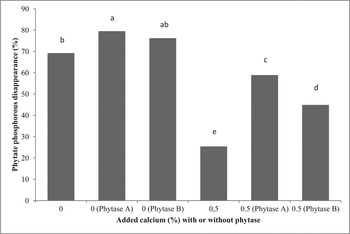
Demonstrating the influence of dietary Ca on both endogenous and exogenous phytase efficacy, Tamim et al. (Reference TAMIM, ANGEL and CHRISTMAN2004) showed in broilers that were fed diets without supplemental Ca (0.2% total Ca) or exogenous phytases that 69% of phytate-P was hydrolysed (at the ileal level) from corn-soy based diets (Figure 1). However, when diets were enriched with 0.5% Ca, the birds’ capacity to hydrolyse phytate-P was reduced to 25%, representing a 44% reduction in endogenous phytase efficacy. Moreover when diets without Ca were supplemented with either a 3- or 6-phytase (500 FTU/kg) phytate-P disappearance increased to 79% and 76%, respectively. However, when diets with 0.5% Ca were supplemented with either phytase, phytate-P digestibility increased to 59% and 45% for the 3- and 6-phytase diets respectively, a result considerably lower than for the low Ca diet with no supplemental phytase. This work confirmed that of Sebastian et al. (Reference SEBASTIAN, TOUCHBURN, CHAVEZ and LAGUE1996) who reported dietary Ca concentrations had a significant effect on the response to phytase and that growth performance and mineral utilization in broilers were optimised in diets supplemented with 0.6% Ca and phytase compared to those with 1.0% Ca. Both of these studies show the negative influence of dietary Ca in poultry diets on both phytate-P digestibility and phytase efficacy and suggest that poultry diets with high Ca concentrations may be detrimental to performance.
Effect of added calcium and phytase on phytate phosphorus disappearance in the gastrointestinal tract (up to the ileum) of 24 day old broilers (Tamim et al., Reference TAMIM, ANGEL and CHRISTMAN2004). a-c Means without a common superscript differ significantly (P<0.05). 1 Phytase A is a 3-phytase (Natuphos 10,000 G, BASF Corp.). 2 Phytase B is a 6-phytase (Ronozyme P CT, Roche Vitamins).

Choice feeding
Poultry have been shown to exert dietary preferences and appear to be able to select a diet from different sources that is suited to their needs (Henuk and Dingle, Reference HENUK and DINGLE2002). Interest in choice-feeding of poultry has been apparent since reports by Kempster (Reference KEMPSTER1916) and Rugg (Reference RUGG1925) reported that choice-fed laying hens produced more eggs than those fed a single mixed ration. Since this early work, dietary selection by poultry has been shown for specific amino acids such as lysine (Newman and Sands, Reference NEWMAN and SANDS1983), methionine (Steinruck et al., Reference STEINRUCK, ROTH and KIRCHGESSNER1990), total protein (Forbes and Shariatmadari, Reference FORBES and SHARIATMADARI1994; Delezie et al., Reference DELEZIE, MAERTENS, HUYGHEBAERT and LIPPENS2009), selenium (Zuberbuehler et al., Reference ZUBERBUEHLER, MESSIKOMMER and WENK2002) and calcium (Wood-Gush and Kare, Reference WOOD-GUSH and KARE1966; Hughes and Woodgush, 1971; Joshua and Mueller, Reference JOSHUA and MUELLER1979). A review by Henuk and Dingle (Reference HENUK and DINGLE2002) reported that the practice of choice feeding was historically a by-product of the poultry management and infrastructure available in the early to mid-20th century. However, as poultry production moved from small holder farms to more intensive and mechanised systems, feed delivery systems changed from being floor based manual systems to automated feeding systems capable of delivering complete diets. One consequence of this process has been to remove the ability of poultry to choice feed.
Typically, choice feeding systems separate the dietary ration into an energy source, a protein source and in the case of laying hens, a Ca source. Adaptation to a choice feeding system may be influenced by the period of time necessary for the individual to associate the organoleptic properties of the different feeds with their nutritional consequences (Rose and Kyriazakis, Reference ROSE and KYRIAZAKIS1991). Previously, laying hens were thought to be more adaptable than broilers to choice feeding regimes since broilers have only short periods of time to learn to make the appropriate choices (Forbes and Shariatmadari, Reference FORBES and SHARIATMADARI1994). However, Delezie et al. (Reference DELEZIE, MAERTENS, HUYGHEBAERT and LIPPENS2009) showed that broiler chickens that were provided a separate protein source were able to adapt to this feeding regime from as early as day old.
Reviewing the available literature, the results for choice feeding of poultry appear equivocal and perhaps are indicative of the complexity of nutritional studies. For example, Rose and Kyriazakis (Reference ROSE and KYRIAZAKIS1991) reported that the total protein intake for poultry differs based on sex, growth and temperature and that a choice feeding system saved up to 5% in protein intake. Whilst Yao et al. (Reference YAO, TIAN, XI, HAN, XU and WU2006) reported for broilers that were provided with either a complete diet, a protein concentrate and ground corn or soyabean meal and mixed concentrate without soyabean meal that choice fed birds had reduced performance compared to birds fed the complete diet. However, results for choice feeding of Ca in the available literature appear to generally be more consistent. Though not wholly in agreement with the early work of Kempster (Reference KEMPSTER1916) and Rugg (Reference RUGG1925), Olver and Malan (Reference OLVER and MALAN2000) showed that egg weight, shell thickness and FCR were all significantly improved in choice-feeding hens compared to hens fed a conventional mash diet. However, there was no difference in egg production.
Comparison of results between studies is made difficult due to differing experimental designs as well as the dietary component that has been separated from the mixed ration. Studies such as those by Joshua and Mueller (Reference JOSHUA and MUELLER1979) have applied choice feeding of a separate Ca source from day-7 whilst Wood-Gush and Kare (Reference WOOD-GUSH and KARE1966) induced Ca deficiencies in broilers prior to the application of a choice feeding regime. Laying hens that are fed Ca deficient diets cease egg production quickly and mobilise bone Ca stores in order to maintain blood Ca concentration, therefore a long period of deprivation is necessary and may confound these studies.
Development of calcium specific appetite
The term ‘calcium specific appetite’ refers to the ability of an animal to selectively consume a Ca-rich source in order to meet its minimum requirements (Lobaugh et al., Reference LOBAUGH, JOSHUA and MUELLER1981). A specific appetite for Ca has been well documented in domestic rats since the preliminary work of Richter and Eckert (Reference RICHTER and ECKERT1937) who first demonstrated an observed preference for dietary Ca in parathyroidectemomized rats when compared to control animals. Dietary induced Ca deficiency has also been shown in rats to result in an increased appetite for Ca. Rats that were fed a Ca deficient diet and subsequently offered the choice of either a Ca deficient diet or one with added Ca, showed a preference for the Ca supplemented diet (Widmark, Reference WIDMARK1944). This same appetite has also been shown to exist in chickens (Wood-Gush and Kare, Reference WOOD-GUSH and KARE1966).
Numerous studies in laying hens have demonstrated a specific appetite for Ca that has been shown to increase in the afternoon as well as on shell-forming compared with non shell-forming days (Hughes, Reference HUGHES1972; Gilbert, Reference GILBERT1983). Work in broilers by Wood-Gush and Kare (Reference WOOD-GUSH and KARE1966) demonstrated in Ca deficient birds that were offered a choice between two diets which differed only in the presence or absence of added Ca that there was a preference for the Ca supplemented diet. This result was interpreted to confirm the ability of broilers to select Ca to meet requirements. However, Hughes and Wood-Gush (Reference HUGHES and WOOD-GUSH1971) reported that the development of a specific appetite for Ca could be a learned behaviour rather than homeostatic control. The authors hypothesised that this appetite may be driven by some discriminable property of the diet and not for Ca per se since visual or taste cues were required by the birds to differentiate between the diets in their study.
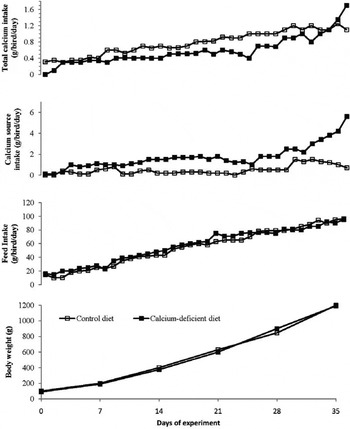
Following on from the work of Hughes and Wood-Gush (Reference HUGHES and WOOD-GUSH1971), Joshua and Mueller (Reference JOSHUA and MUELLER1979) investigated behavioural factors that may be involved with the development of a Ca specific appetite in broiler chicks. The effects of dietary Ca content and visual cues on Ca appetite as well as the effect of previous group training on the subsequent total Ca intake of individual broilers were investigated. The results demonstrated that birds fed a Ca deficient diet had significantly increased intake of the separate source of Ca (calcite) throughout the experiment than those birds fed the control diet; 1.7 g/day and 0.3 g/day, respectively (Figure 2). In another experiment, 28 d old birds were individually housed and provided washed sand, a washed sand/calcite mix and either the control or calcium deficient diet in coloured feeders. The results from this study were equivocal with only a small proportion of the birds fed the Ca deficient diet having consumed the Ca source whilst none from both groups consumed sand. However, no effect of colour or position of the feeders was observed. In their final study, group housed birds fed a Ca deficient diet and a separate Ca source consumed significantly more of the Ca source compared to control fed birds and continued to do so when placed into individual cages. However, when the Ca deficient group was transferred to the control diet, their intake of the separate Ca source declined immediately and by the completion of the study there was no difference between groups. The results of these experiments were interpreted to indicate that the broilers were able to regulate their intake of Ca in proportion to their requirements as well as that of the dietary concentration and that the development of choice feeding may be influenced by peer association and may be important in the adaption to this feeding regime.
Regulation of calcium specific appetite
Animals are thought to be able to recognise the nutritive value of Ca before clinical signs of deficiency develop and this may suggest that the onset of a Ca specific appetite is not a direct response to deficiency (Tordoff, Reference TORDOFF2001). Using rodent models, there is evidence that the hypothalamic-hypophysial-adrenal axis is involved in feeding behaviour with respect to quantitative and qualitative aspects (diet or macro-nutrient preferences) (Malheiros et al., Reference MALHEIROS, MORAES, COLLIN, DECUYPERE and BUYSE2003). A review by Tordoff (Reference TORDOFF2001) indicates that Ca appetite is inversely related to blood Ca concentrations. In perhaps the first attempt to investigate the regulating mechanisms involved in broilers, Hughes and Wood-Gush (Reference HUGHES and WOOD-GUSH1972) observed in Ca deficient birds that were administered with a subcutaneous injection of a 4% Ca borogluconate solution and a choice between a diet deficient in Ca and the same diet with Ca, that the onset of the Ca appetite was delayed. Despite these findings, a definitive mechanism regulating Ca intake has yet to be defined with no clear consensus in the available literature.
Hughes and Wood-Gush (Reference HUGHES and WOOD-GUSH1971) showed that the Ca specific appetite is also subject to other controlling factors and in certain circumstances palatability may take precedence over nutritional need. Sources of Ca differ substantially in their palatability and this can therefore influence intake of separate Ca sources. In keeping with this notion, Wood-Gush and Kare (Reference WOOD-GUSH and KARE1966) showed in Ca deficient broilers, the type of Ca supplement influenced the consumption of Ca with deficient birds rejecting calcium lactate in preference for water. Furthermore, Hughes and Wood-Gush (Reference HUGHES and WOOD-GUSH1971) fed birds a diet containing quinine, a known highly aversive flavour, and reported that the presence of quinine was sufficient to completely block the intake of a Ca supplemented diet with birds electing to consume the alternative Ca-deficient and quinine free diet. These same authors suggested that the specific appetite is a learnt behaviour that is reinforced with post-prandial effects and that palatability may influence this response.
Total calcium, calcium source, feed intake and body weight of broilers fed a calcium-deficient or control diet. Adapted from Joshua and Mueller (Reference JOSHUA and MUELLER1979).

Potential application of separate feeding of calcium
Diets are formulated to meet the nutritional requirements of the average bird in a broiler flock. However, these diets will inevitably be in excess of the requirements of smaller broilers below the mean and will be inadequate for heavier birds above the mean (Delezie et al., Reference DELEZIE, MAERTENS, HUYGHEBAERT and LIPPENS2009). Historical recommendations for dietary Ca were based on those published in 1984 and 1994 by the NRC and these guidelines are still used as a benchmark in contemporary broiler nutrition, at least for research purposes. Importantly, these are for birds weighing 1.5 kg with a feed conversion ratio of 2.0 and as such do not reflect modern genotypes. Due to improvements in feed efficiency, it has been suggested that a 2004 male broiler fed according to NRC recommendations would consume approximately 11% less Ca than its 1984 counterpart (Driver et al., Reference DRIVER, PESTI, BAKALLI and EDWARDS2005). Yet the same authors found that modern broilers did not demonstrate higher requirements for Ca during the grower phase (19-42 d) than those recommended by the NRC guidelines. Though the current dietary Ca recommendation (1.0%) for 0-16 d old broilers was found to be suitable for maximum bone ash, it was excessive for all other production data. In fact, body weight gain and FCR were optimised at or below 0.625% dietary Ca. Joshua and Mueller (Reference JOSHUA and MUELLER1979) showed in broilers fed a Ca deficient diet consumed significantly more of a separate Ca source than control fed birds, However, the total amount of Ca consumed per day by choice fed birds was significantly less than birds fed the control diets (Figure 2). This may suggest that the concentration of Ca supplied in modern poultry diets are in excess of the Ca requirements of the bird.
By separating Ca from the mixed diet portion, individual birds could optimise Ca intake relative to their requirement. Changes in requirements as birds grow could also be met by associated changes in selection (Forbes and Shariatmadari, Reference FORBES and SHARIATMADARI1994). Henuk and Dingle (Reference HENUK and DINGLE2002) reported that the advantages of choice feeding also extend to reductions in mixing costs and may be of particular benefit to small producers who could use feedstuffs available onsite. Furthermore, a reduction in the dietary concentration of Ca in mixed rations may improve the efficacy of both endogenous and exogenous phytases and reduce the amount of excreted P, a widely accepted environmental problem facing both pig and poultry producers (Selle et al., Reference SELLE, RAVINDRAN, CALDWELL and BRYDEN2000).
The ‘extra-phosphoric’ effect of phytase may also be improved by feeding Ca separately. Phytate in its native form is not only complexed with P but also with various cations, protein, lipids and starch (Ravindran et al., Reference RAVINDRAN, SELLE, RAVINDRAN, MOREL, KIES and BRYDEN2001). Although still contentious, phytate has been shown in some studies to reduce amino acid digestibility (Selle et al., Reference SELLE, COWIESON and RAVINDRAN2009) whilst the use of microbial phytases has been reported to have positive effects on protein availability in poultry (Selle et al., Reference SELLE, RAVINDRAN, CALDWELL and BRYDEN2000). Ravindran et al. (Reference RAVINDRAN, CABAHUG, RAVINDRAN, SELLE and BRYDEN2000) showed in broilers that were fed wheat-sorghum based diets with two levels of non-phytate P that the inclusion of phytase improved amino acid digestibility compared to birds fed diets without phytase and that this improvement was more pronounced in the lower non-phytate P diet. What is more, significant interactions between the level of dietary P and phytase were found for the digestibility of histidine, arginine, leucine, threonine, and valine. This result was considered to imply that inorganic Ca and/or P limited the response to phytase. Since dietary Ca in complete rations may complex with phytate from the vegetable component, separation of Ca from mixed rations may improve Ca digestibility as well as phytase efficacy and this may have implications for amino acid digestibility.
Dietary Ca may also interact with inorganic P in the lumen of the gut to form calcium-phosphates (Selle et al., Reference SELLE, COWIESON and RAVINDRAN2009). The solubility of Ca phosphates are highly pH dependent and with increasing pH they become less soluble (Moore and Miller, Reference MOORE and MILLER1994). The addition of Ca as limestone in poultry diets has been shown to increase the digesta pH from 5.6 to 6.1 in the small intestine (Shafey, Reference SHAFEY1999). Therefore the effect of limestone on gut pH and the formation of Ca-phosphate precipitates is relevant. It may be possible with the separate feeding of Ca to poultry that a reduction in their formation may occur.
Conclusions
Current recommendations for Ca concentrations in broiler diets may be excessive to the requirements of broilers and contribute to the formation of insoluble mineral-phytate complexes that reduce phytase efficacy and the availability of other minerals from the diet. Utilisation of phytate-P can be improved by feeding Ca strictly to minimum requirements (Underwood and Suttle, Reference UNDERWOOD and SUTTLE2001b). However, reducing the amount of Ca in poultry diets may lead to Ca-deficiencies and consequently health and welfare issues. A Ca specific appetite has been shown to exist in chickens and may provide scope to remove exogenous Ca sources from mixed diets that could instead be provided as a separate feedstuff and consumed in accordance with the individual requirements of the broiler (choice feeding). By removing added Ca from poultry diets whilst providing a separate source of Ca to maintain bird requirements, improved efficacy of phytase, increased P-digestibility whilst maintaining skeletal integrity may be achieved. Furthermore, since diets are formulated for total Ca rather than digestible-Ca the Ca requirement of poultry may also be better understood through a separate feeding regime.
A search of the available literature suggests that the use of a choice feeding regime for Ca in broilers has not been investigated using modern broiler strains and with diets supplemented with exogenous phytases. The application of this feeding regime in broilers requires further investigation.