Introduction
While there is mounting evidence of a link between anxiety disorders and suicide ideation, attempts, and death in adolescent (Boden et al., Reference Boden, Fergusson and Horwood2007) and mixed-age groups (Placidi et al., Reference Placidi, Oquendo, Malone, Brodsky, Ellis and Mann2000; Sareen et al., Reference Sareen2005; Hawgood and De Leo, Reference Hawgood and De Leo2008; Fawcett, Reference Fawcett, Wasserman and Wasserman2009; Nepon et al., Reference Nepon, Belik, Bolton and Sareen2010), the role of anxiety in late-life suicidal behavior has received relatively little attention. This is surprising in light of the following: (1) the elderly have the highest suicide rates in most countries worldwide (Hawton and van Heeringen, Reference Hawton and van Heeringen2009); (2) feelings of anxiety are common in older people, affecting up to 24% in community samples (Bryant et al., Reference Bryant, Jackson and Ames2008); and (3) anxiety is amenable to treatment (Fawcett, Reference Fawcett, Wasserman and Wasserman2009).
The sparse literature regarding anxiety disorders and suicide in later life is inconsistent. A Swedish record linkage study demonstrated elevated risk for suicide after age 70 in patients with depressive neurosis and comorbid anxiety neurosis (Allgulander and Lavori, Reference Allgulander and Lavori1993). Later, in another Swedish study that employed a different research approach, relatives of elderly suicide decedents were interviewed and medical records were reviewed (Waern et al., Reference Waern2002). Anxiety disorders were more prevalent among the suicide cases (15%) than in a population comparison group (4%) and a three-fold increase in suicide risk was reported. No such association could be shown, however, in a study of similar design that was set in Hong Kong (Chiu et al., Reference Chiu2004). Relatively low rates of anxiety disorders were observed in both suicide cases (2%) and controls (1%) in that study.
Focusing on anxiety symptoms rather than diagnoses, a longitudinal population study involving persons aged 16–74 years showed that perceived nervousness, uneasiness, and anxiety predicted attempted suicide (Ringbäck Weitoft and Rosén, Reference Ringbäck Weitoft and Rosén2005). The authors of a large mixed-age clinical study reported a two-fold increase in the likelihood of reporting suicidality in persons with self-reported anxiety symptoms (Diefenbach et al., Reference Diefenbach, Woolley and Goethe2009). The association could not be accounted for by psychiatric diagnoses. There are a few studies that examine associations between anxiety symptoms and suicide ideation in older patients. One of these focused on persons aged 59 years and above who took part in a late-life depression study (Jeste et al., Reference Jeste, Hays and Steffens2006). Those who endorsed comorbid anxiety had greater suicide ideation than those who did not. Secondary analysis of data from two clinical trials for the maintenance treatment of late-life depression revealed an association between symptoms of anxiety and suicide ideation (Cohen et al., Reference Cohen, Gilman, Houck, Szanto and Reynolds III2009). Results from clinical studies such as these cannot be directly generalized to older persons in the community setting, where subthreshold symptoms of anxiety are highly prevalent and associated with considerable distress (Bryant et al., Reference Bryant, Jackson and Ames2008). Therefore, we wanted to explore possible relationships between anxiety symptoms and suicidal feelings in a representative population sample of older people. The objectives of the present study, which is part of the longitudinal gerontological and geriatric population studies in Gothenburg (Skoog, Reference Skoog2004), were threefold. First, we hypothesized a relationship between anxiety symptom burden and suicidal feelings and aimed to test this in a population sample of 70-year-olds. Second, we wanted to determine whether such an association would remain after adjustment for major depression diagnosis. Finally, we aimed to identify specific anxiety symptoms that were independently related to suicidal feelings.
Methods
Participants
Data was derived from the multidisciplinary H70 study, a longitudinal gerontological and geriatric population study that was initiated in 1971 in Gothenburg, Sweden, to study health and health-related factors in the elderly population (Skoog, Reference Skoog2004). The 70-year-olds who provided data for this study were born in 1930. Persons living both in private households and in institutions were included. Birth dates, names, and addresses were obtained from the Swedish Population Register. In 2000–2001, all persons born in 1930 on days 3, 6, 12, 18, 21, 24, and 30 of each month were invited to a health examination (n = 875). Five persons could not be reached, ten died before examination, 18 could not speak Swedish, and 15 had emigrated out of Sweden, leaving an effective sample of 827. Of these, 579 (229 men and 350 women) accepted participation in the psychiatric part of the examination, corresponding to a response rate of 70.1%.
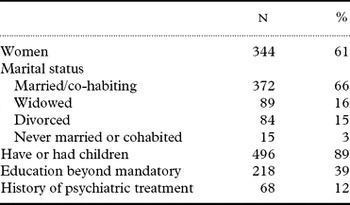
There were no differences between participants and non-participants regarding sex, marital status, or history of in-patient psychiatric care during the past two years. Non-participants had a higher three-year mortality rate, both among women (9.0% vs. 2.3%, p < 0.001) and men (23.7% vs. 7.5%, p < 0.01). Subjects with dementia (n = 14) were excluded from the study. Anxiety symptom data were missing for a further five subjects, leaving 560 individuals for this analysis. Sociodemographic characteristics of the study sample are shown in Table 1.
Sociodemographic characteristics in a population sample of 70-year-olds without dementia (N = 560).

Procedure
The interviews were performed by experienced psychiatric nurses according to a semi-structured schedule. Informed consent was obtained from all subjects. The study was approved by the Ethics Committee for Medical Research at the University of Gothenburg.
Measures
Psychiatric symptoms were rated with the Comprehensive Psychopathological Rating Scale (CPRS; Åsberg et al., Reference Åsberg, Montgomery, Perris, Schalling and Sedvall1978), which consists of 65 items covering a broad range of psychopathology. The applicability of this scale for an older (60+) population has been demonstrated and reliability was shown to be similar to that for a younger population (van der Laan et al., Reference van der Laan, Schimmel and Heeren2005). In order to quantify the anxiety symptom burden, the Brief Scale for Anxiety (BSA; Tyrer et al., Reference Tyrer, Owen and Cicchetti1984) was derived from the CPRS. This scale (see supplementary material attached to the electronic version of this paper at www.journals.cambridge.org/jid_IPG) consists of ten items, eight of which are reported by the subject and two that are observer-rated. Items are scored from 0 to 6 points, yielding a maximum total score of 60 points.
Thoughts about death and suicide were rated according to Paykel et al. (Reference Paykel, Myers, Lindenthal and Tanner1974; see supplementary material attached to the electronic version of this paper at www.journals.cambridge.org/jid_IPG). For the purpose of this paper, responses to the Paykel questions were dichotomized: no suicidal feelings during the past month/any suicidal feelings during the past month. Major depression was diagnosed in accordance with DSM-IV, utilizing a computer algorithm based on relevant CPRS items (Mellqvist et al., Reference Mellqvist, Wiktorsson, Joas, Östling, Skoog and Waern2011). Dementia, which was used as an exclusion criterion only, was diagnosed as previously described (Skoog et al., Reference Skoog, Nilsson, Landahl and Steen1993).
Statistical analyses
For subjects with one missing BSA item (n = 19), item scores were imputed using the expectation maximization algorithm in SPSS. Fisher's exact test was used to test for differences in proportions. The t-test was used to examine group mean differences with regard to the discrete variable (BSA score). Binary logistic regression models were used to study factors influencing suicidal feelings. For tests of associations between individual symptom items and suicidal feelings, each item was dichotomized as follows: a rating of 0 or 1 indicated absence of that specific symptom and ratings from 2 to 6 indicated presence of that symptom.
Statistical significance was determined with p-values < 0.05. Significant items were introduced in a multivariate logistic regression model in order to determine signs/symptoms independently associated with suicidal feelings. In a final regression model, the categorical diagnosis of major depression was replaced with specific CPRS depression symptoms (as listed in Table 4). All statistical analyses were performed with SPSS (version 15.0, SPSS Inc, Chicago, IL, USA).
Results
Past month anxiety symptom burden
The mean BSA total score was 8.9 (SD 6.1). Scores ranged from 0 to 35 (median 7). As anticipated, lower scores were observed in men (mean 7.6, SD 5.5) than in women (mean 9.8, SD 6.4, t = –4.297, 558 df, p < 0.001).
Past month suicidal feelings
Feeling that life was not worth living at some point during the last month was reported by 2.1% of the subjects and death wishes were acknowledged by 1.6%. Thoughts of taking one's own life were acknowledged by 0.5% but none had seriously considered taking their own life during the past month. None had attempted to take their own life during this period. Any suicidal feeling during the past month was reported by 2.9% of the subjects. No sex difference could be shown (women, 3.7% and men, 1.3%, p = 0.118).
Relationship between BSA score and suicidal feelings
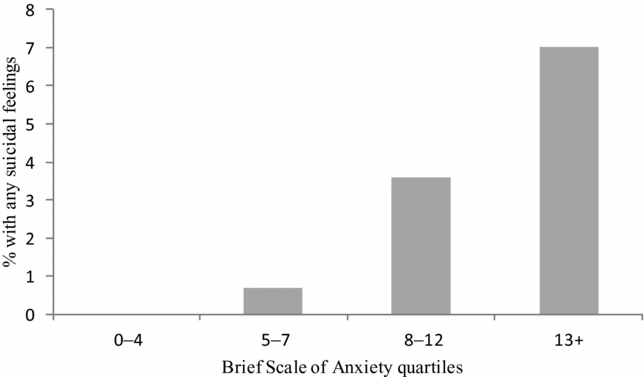
The group with any suicidal feelings during the past month (n = 18) had a significantly higher mean BSA score (17.7, SD 8.1) than those with no such feelings (8.6, SD 5.9, t = –6.4, 558 df, p < 0.001). Figure 1 shows proportions with suicidal thoughts by interquartile range categories of BSA scores.
Proportion of cases with suicidal feelings by interquartile range categories of BSA scores in a population sample of 70-year-olds without dementia (N = 560).

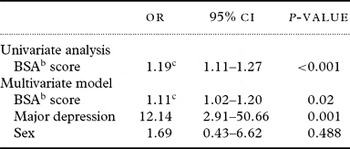
In a binary logistic regression model, BSA score was positively associated with suicidal feelings (Table 2). Eighteen persons (3.2% of the total sample) met criteria for major depression. Table 2 shows further that the association between anxiety score and suicidal feelings remained after adjustment for major depression and sex. A one-point increase in BSA score was associated with an 11% increase in the odds of having suicidal feelings in that model.
Results of univariate and multivariate logistic regression models regarding associations between anxiety score and past month suicidal feelings a in a population sample of 70-year-olds without dementia (N = 560).

a Includes life-weariness, death wishes, and suicidal ideation in accordance with Paykel et al. (Reference Paykel, Myers, Lindenthal and Tanner1974).
b BSA (Tyrer et al., Reference Tyrer, Owen and Cicchetti1984).
c OR refers to a one-unit increase in BSA score.
Note: BSA = Brief Scale for Anxiety; OR = odds ratio; CI = confidence intervals.
BSA items
The internal consistency (Cronbach's α) for the ten BSA items was 0.61. The mean κ value for inter-rater reliability for the dichotomized items was 0.79 (SD 0.19). Relatively low κ values were noted for observed autonomic disturbances (0.55) and observed muscular tension (0.58), both of which are signs rather than symptoms. The highest κ value was noted for aches and pains (1.00).
Individual BSA items and associations with suicidal feelings
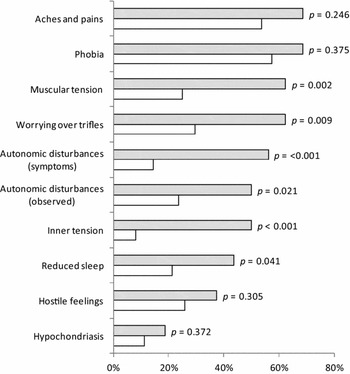
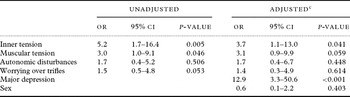
Figure 2 shows proportions scoring 2 or more on each anxiety symptom for participants with and without past month suicidal feelings. Binary logistic regression models were used to identify specific anxiety items associated with suicidal feelings, with p < 0.01 due to the relatively large number of symptoms being tested. Muscle tension, Worrying about trifles, Symptoms of autonomic disturbances, and Inner tension were associated with suicidal feelings.
Proportions scoring at least 2 on individual Brief Scale for Anxiety items in a population sample of 70-year-olds with (gray bars) and without (white bars) suicidal feelings (N = 560).
Note: p-values refer to results of binary logistic regression analyses.

The four BSA items with significant associations in the binary analyses were introduced in a multivariate logistic regression model. Inner tension (participant reported) and Muscular tension were associated with suicidal feelings in the unadjusted model. Inner tension remained a significant factor in the model adjusted for sex and major depression, with an odds ratio indicating a strong association with suicidal feelings (Table 3).
Results of multivariate binary regression models of selected anxiety symptoms a and past month suicidal feelings b in a population sample of 70-year-olds without dementia (N = 560).

a A symptom is rated as present if rated ≥2 on the Comprehensive Psychopathological Rating Scale (Åsberg et al., Reference Åsberg, Montgomery, Perris, Schalling and Sedvall1978).
b Includes life-weariness, death wishes, and suicidal ideation in accordance with Paykel et al. (Reference Paykel, Myers, Lindenthal and Tanner1974).
c Adjusted for major depression and sex.
Note: OR = odds ratio; CI = confidence intervals.
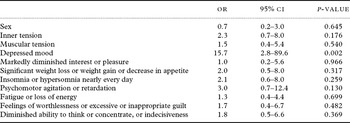
Neither Inner tension nor Muscular tension remained in a final model that included the eight individual DSM-IV depression symptoms (Table 4). Depressed mood was the only depression symptom that was significantly associated with suicidal feelings in that model.
Results of the final regression model showing associations with past month suicidal feelings a in a population sample of 70-year-olds without dementia (N = 560).

a Includes life-weariness, death wishes, and suicidal ideation in accordance with Paykel et al. (Reference Paykel, Myers, Lindenthal and Tanner1974).
Note: A symptom is rated as present if rated ≥2 on the Comprehensive Psychopathological Rating Scale (Åsberg et al., Reference Åsberg, Montgomery, Perris, Schalling and Sedvall1978). OR = odds ratio; CI = confidence interval.
Discussion
Findings
To our knowledge, this is the first study to examine the association between anxiety symptoms and suicidal feelings in a population sample of older people. Symptoms of anxiety were common among the 70-year-olds who took part in our study, as previously reported in a study on well-functioning septuagenarians (Mehta et al., Reference Mehta2003). Our finding of an association between anxiety symptom burden and suicidal feelings could not be attributed entirely to co-existing major depression. One specific symptom, Inner tension, showed a strong independent association with suicidal feelings. This symptom can be conceived as more relevant to a “core” manifestation of anxiety than some of the other BSA items such as aches and pains and hostile feelings. The association with suicidal feelings was no longer significant, however, when major depression was replaced by individual depression symptoms in the multivariate model.
Past month suicidal feelings were noted in 2.9% of the 70-year-olds in our study. We chose to focus on past month suicidal feelings in order to coincide with the time period for the CPRS measures of psychopathology. This means that our prevalence figures regarding suicidal feelings are not directly comparable to those published in the original study by Paykel et al. (Reference Paykel, Myers, Lindenthal and Tanner1974). In that study, almost one-tenth of those aged 60 years and above reported suicidal feelings during the past year. A similar figure was reported in an Italian population aged 65 years and over (Scocco and De Leo, Reference Scocco and De Leo2002). The shorter time span in the current study would in part explain our lower figure. There are a couple of studies utilizing a one-month period. Higher rates were shown for 85-year-olds (16%, Skoog et al., Reference Skoog1996), and for persons enrolled in a home-delivery meal program (14%, Sirey et al., Reference Sirey2008). The lower rate in the current study was anticipated as 70-year-olds would be expected to be physically healthier, less disabled, and less likely to be dealing with issues of age-related loss, which might generate suicidal feelings.
The Paykel questions encompass a broad range of suicidal feelings including life-weariness and death wishes, and the associations observed in this study cannot be directly extrapolated to more serious types of suicidal behavior. However, as such feelings may signal a serious suicidal process (Waern et al., Reference Waern, Beskow, Runeson and Skoog1999), individualized clinical assessments are required not only for older patients with suicide ideation and attempts but also for those who express that they are tired of life or wish to be dead.
Older adults with anxiety symptoms encounter problems in regulating emotional responses (Orgeta, Reference Orgeta2011) and may be more likely to experience stress related to everyday hassles. The latter has been shown to be associated with the wish to die in a community sample of persons aged 65 years and over (Lapierre et al., Reference Lapierre2012). This could be taken into consideration in the planning of individualized interventions for older persons with anxiety and suicidal feelings.
Strengths and limitations
A major strength of the study was the careful evaluation of symptoms by trained psychiatric research nurses. Most of the studies that have previously examined associations between anxiety and suicidal behavior have lacked such a measure (Fawcett, Reference Fawcett, Wasserman and Wasserman2009). The CPRS is a comprehensive instrument that has been shown to be reliable in the rating of symptoms in older adults (van der Laan et al., Reference van der Laan, Schimmel and Heeren2005). While the BSA was derived from this rating scale, one clear limitation is the fact that the psychometric properties of the BSA remain to be elucidated. The internal consistency was questionable in the current study. Some of the items included in the BSA are not specific to anxiety disorders and might be related to suicidal feelings for other reasons. Further, the BSA has not been validated and it is yet unknown how the instrument performs in relation to other scales designed specifically to rate anxiety symptoms in older persons such as the Geriatric Anxiety Inventory (Pachana et al., Reference Pachana, Byrne, Siddle, Koloski, Harley and Arnold2007). While inter-rater reliability was good in the current study, it was better for the reported symptoms than for the two observer-rated signs (Autonomic disturbances and Muscle tension). This was the case in the above-cited Dutch study as well. In future studies, interviewers could be trained more intensively in the rating of these signs. Also, a more objective measure of muscle tension could be added to the study protocol.
The greater three-year mortality rate among non-participants indicates that our sample is healthier than the underlying population. We have previously reported a relationship between suicidal feelings and three-year mortality in octogenarians (Skoog et al., Reference Skoog1996), and such an association might be the case in this 70-year-old cohort as well. Further, while participants and non-participants did not differ with regard to recent psychiatric hospitalization, we cannot rule out that persons with symptoms of anxiety and or/suicidal feelings might be less likely to participate in this type of study. Thus, the proportion with suicidal feelings reported here may underestimate that for the population as a whole, and determinants of suicidal feelings may differ in those who do and do not choose to take part in a research study.
While our results support a relationship between anxiety symptoms and suicidal feelings in an older adult population, our study was cross-sectional in design and we cannot clarify the directionality of the association. It is possible that the presence of suicidal thoughts makes older adults anxious. Lastly, this was a population-based study and anxiety was conceptualized using a dimensional approach. The current study did not have the power required to test whether specific anxiety disorders were independently related to suicidal feelings in this population.
Findings contribute to the rather sparse literature on anxiety and suicidality in later life. The cohort studied was a “young” elderly cohort and further studies are needed to examine whether results can be extended to encompass also “old” elderly. The role of specific symptoms related to both anxiety and depression needs further clarification in the study of suicidal behavior in late life.
Conflict of interest
None.
Description of authors’ roles
M. Jonson drafted the paper under the supervision of M. Waern who designed this substudy; I. Skoog designed the original population study and supervised data collection; M. M. Fässberg took part in data processing and interpretation of results; T. Marlow was responsible for the statistical design of the study and carried out the statistical analysis together with M. Jonson; and all authors assisted with the writing of the paper.
Acknowledgments
The study was made possible by grants from The Swedish Research Council (11267, 2005-8460, 825-2007-7462, 2008-7245-5895-70, 2009-62X-21079-01-3), The Swedish Council for Working Life and Social Research (no. 2001-2835, 2001-2646, 2003-0234, 2004-0150, 2004-0145, 2006-0020, 2008-1229, 2006-0596, 2008-1111, 2006-1506, 2010-0870), The Alzheimer's Association Stephanie B. Overstreet Scholars (IIRG-00-2159), and the Bank of Sweden Tercentenary Foundation.