Introduction
As different studies register loneliness feelings from childhood to older age (e.g. Qualter et al., Reference Qualter, Vanhalst, Harris, Van Roekel, Lodd, Bangee, Maes and Verhargen2015), loneliness is currently seen as one of society's main problems (de Jong Gierveld et al., Reference de Jong Gierveld, van Tilburg, Dykstra, Vangelisti and Perlman2018). Following the cognitive discrepancy theory, loneliness may emerge as a result of perceived discrepancies among desired and actual social relationships, both qualitatively and quantitatively (Perlman and Peplau, Reference Perlman, Peplau, Duk and Gilmour1981; Bekhet et al., Reference Bekhet, Zauszniewski and Nakhla2008). Precipitating events could increase or decrease desired or actual social relationships, and such changes could cause loneliness (Perlman, Reference Perlman2004). Moreover, how a person reacts to and copes with a situation are important factors that further influence loneliness experiences (Perlman, Reference Perlman2004). To date, little qualitative research is available on lifecourse and loneliness experiences, even though this could provide important insights into the possible influence of adversity over time (Rönka et al., Reference Rönkä, Taanila, Rautio and Sunnari2018). Hence this study focuses on understanding how precipitating events and coping strategies throughout the lifecourse may influence current loneliness experiences in older adults.
Cognitive discrepancy theory
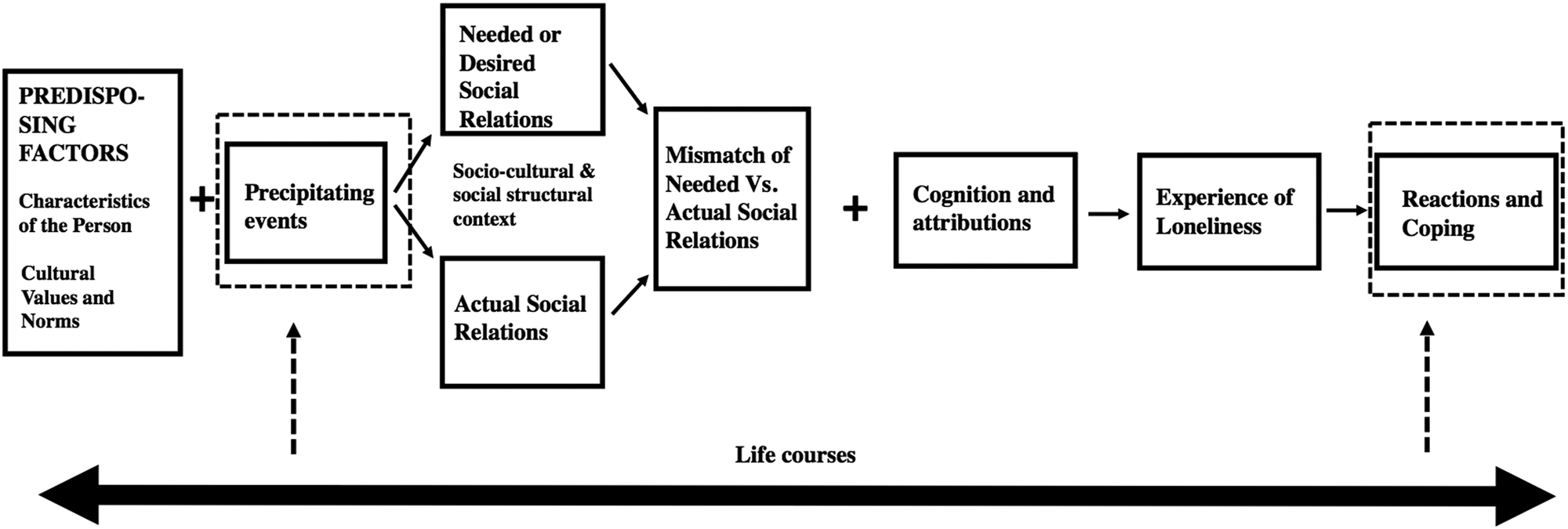
The present study draws on the cognitive discrepancy theory of Perlman and Peplau (Reference Perlman, Peplau, Duk and Gilmour1981), which posits that loneliness is subjective and distressful, occurring because of a discrepancy between actual and expected quality and quantity of social relationships. In brief, the theory distinguishes between predisposing factors and precipitating events. Predisposing factors can relate to individual personality characteristics like low self-esteem, anxiety and introversion, which are related to the risk of becoming lonely (Hawkley et al., Reference Hawkley, Hughes, Waite, Masi, Thisted and Cacioppo2008; Rokach, Reference Rokach, Sha'ked and Rokach2015); or to more general aspects like cultural values and norms, as observed in individualist and communal cultures (van Staden and Coetzee, Reference van Staden and Coetzee2010), but which are not necessarily the cause of loneliness. Precipitating events, on the other hand, are specific circumstances or events that cause changes and discrepancies between a person's achieved social relationships and their desired or expected social relationships, potentially triggering loneliness (Perlman and Peplau, Reference Perlman, Peplau, Duk and Gilmour1981): widowhood or divorce in later life (van Tilburg et al., Reference van Tilburg, Aartsen and van der Pas2015; Davies et al., Reference Davies, Crowe and Whitehead2016), retirement (Segel-Karpas et al., Reference Segel-Karpas, Ayalon and Lachman2018) or health-related factors like chronic illness (Victor et al., Reference Victor, Scrambler and Bond2009). This discrepancy between achieved and desired relationships does not necessarily lead to loneliness though. Several factors may affect how a person reacts to their own situation: in their cognitive discrepancy theory, Perlman and Peplau (Reference Perlman, Peplau, Duk and Gilmour1981) posit that cognition and attributions (e.g. controllability) influence the experience of loneliness, and that loneliness experiences are influenced by the person's reactions to and coping with the situation. In line with their definition of loneliness, coping strategies may focus on improving the achieved level of social relationships and adapting desired levels of social contact to realistic levels. Improving relates to active coping, adaptation to regulative coping (Schoenmakers et al., Reference Schoenmakers, van Tilburg and Fokkema2015). The severity of loneliness is therefore not only affected by the social relationships that are desired and unfulfilled: the prospect of time is also relevant towards changing difficult relationships and the potential to adapt to the situation (Perlman and Peplau, Reference Perlman, Peplau, Duk and Gilmour1981).
Studies have examined parts of the cognitive discrepancy theory (e.g. Dykstra and Fokkema, Reference Dykstra and Fokkema2007; Burholt and Scharf, Reference Burholt and Scharf2014; Burholt et al., Reference Burholt, Windle and Morgan2017) and deepened our understanding of the model. For example, Burholt et al. (Reference Burholt, Windle and Morgan2017) extend the discrepancy theory by including the relevance of the socio-cultural and social structural context (the social environment) as potential influencers on actual or desired social relationships. The social environment stands for the context in which people live, including personal and institutional attitudes and values they interact with, in terms of issues such as discriminatory attitudes or stigma (Burholt et al., Reference Burholt, Windle and Morgan2017). In our view, the cognitive discrepancy theory of loneliness presently undervalues an important aspect of studying loneliness, namely the lifecourse perspective. The current study therefore adds this aspect to the model (outlined in Figure 1).
An adapted version of the cognitive discrepancy model of loneliness of Perlman and Peplau (Reference Perlman, Peplau, Duk and Gilmour1981), with integration of the socio-cultural and social-structural characteristics of the environment by Burholt et al. (Reference Burholt, Windle and Morgan2017).

Precipitating events: need for a lifecourse perspective
A lifecourse perspective stresses that health and psychological wellbeing in later life are shaped by previous lifetime experiences (Kuh et al., Reference Kuh, Ben-Shlomo, Lynch, Hallqvist and Power2003; Umberson et al., Reference Umberson, Williams, Thomas, Liu and Thomeer2014). Investigating only the current circumstances and conditions of older persons without attention for the previous lifecourse will neglect a nuanced understanding of loneliness (Nicolaisen and Thorsen, Reference Nicolaisen and Thorsen2014; Merz and de Jong Gierveld, Reference Merz and de Jong Gierveld2016). Hence studying loneliness in old age calls for a lifecourse perspective, which is crucial towards understanding loneliness and its effects (de Jong-Gierveld, Reference de Jong-Gierveld1998). Lifecourses are considered as trajectories resulting from the interplay between agency (i.e. individual choices) and the social structure or context of the individual, urging us to explore life events, life transitions, linked lives (social relations), the historical and cultural context (location in time and place), and the intersection between those key elements (Elder et al., Reference Elder, Johnson, Crosnoe, Mortimer and Shanahan2003). In order to grasp loneliness as a lived experience, loneliness needs to be assessed as subjective experience connected to the present time and place and the individual lifecourses of the persons experiencing it (Tiilikainen and Seppänen, Reference Tiilikainen and Seppänen2017; Tiilikainen, Reference Tiilikainen2020). A lifecourse approach has been recently employed in studies on loneliness among older people (e.g. Tiilikainen and Seppänen, Reference Tiilikainen and Seppänen2017; Tiilikainen, Reference Tiilikainen2020) and youth (e.g. Rönkä et al., Reference Rönkä, Taanila, Rautio and Sunnari2018). Tiilikainen and Seppänen (Reference Tiilikainen and Seppänen2017) examined how the experiences of emotional loneliness are embedded in everyday life, and states that for some older people loneliness has been present for nearly a lifetime.
Applied to loneliness, this means that although later-life conditions like poor health (Victor et al., Reference Victor, Scrambler and Bond2009) and later-life events like widowhood (Davies et al., Reference Davies, Crowe and Whitehead2016) can trigger loneliness, events earlier in life – in childhood or adulthood – can make individuals more or less vulnerable to loneliness in later life (Nicolaisen and Thorsen, Reference Nicolaisen and Thorsen2014). A quantitative study of centenarians in the United States of America demonstrates that the experience of negative life events earlier in the lifecourse (death of a spouse, residential change) is associated with increased risk of loneliness in later life (Hensley et al., Reference Hensley, Martin, Margrett, MacDonald, Siegler and Poon2012). Still, research on the lifecourse and loneliness in later life remains limited (Hagan et al., Reference Hagan, Manktelow and Taylor2020). Hagan et al. (Reference Hagan, Manktelow and Taylor2020) stated that the influence of cumulative disadvantages on loneliness in later life is understudied. To understand loneliness fully, it is important to investigate the role of significant life events during the lifecourse (Nicolaisen and Thorsen, Reference Nicolaisen and Thorsen2014; Merz and de Jong Gierveld, Reference Merz and de Jong Gierveld2016). Consequently, the first research aim will be to investigate the precipitating events throughout the lifecourse that influence current loneliness in older adults.
Coping strategies within a lifecourse perspective
The way people cope can lower the impact of adverse life events and circumstances, not only in the short term but also in the long-term development of physical and mental health (Skinner et al., Reference Skinner, Edge, Altman and Sherwood2003). Older adults differ in their ability and capacity to deal with life events. They may unfold substitute skills, collaborative relationships or creative strategies to deal with adverse life events in general (Moos et al., Reference Moos, Brennen, Schutte and Moos2006) and loneliness in particular (Kharicha et al., Reference Kharicha, Manthorpe, Iliffe, Davies and Walters2018). Older people's current coping strategies, however, might be developed and influenced over the lifecourse and formed by individual coping strategies and different contexts (Kharicha et al., Reference Kharicha, Manthorpe, Iliffe, Chew-Graham, Cattan, Goodman, Kirby-Barr, Whitehouse and Walters2020). A lifecourse perspective might therefore contribute to our current knowledge on coping strategies and their influence on current loneliness, resulting in the second research aim.
Current study
This study elaborates on the cognitive discrepancy model (as modified by Burholt et al., Reference Burholt, Windle and Morgan2017) by using a lifecourse perspective. The focus lies on how precipitating events earlier in life may influence current loneliness feelings and how older adults cope with loneliness throughout the lifecourse, as well as how these coping strategies are connected with their current loneliness feelings.
Our specific research questions are:
(1) How do precipitating events throughout the earlier lifecourse influence current loneliness feelings in older adults?
(2) How do older people cope with loneliness throughout the lifecourse? And how are these coping strategies connected with their current loneliness feelings?
Methods
Data collection and sample
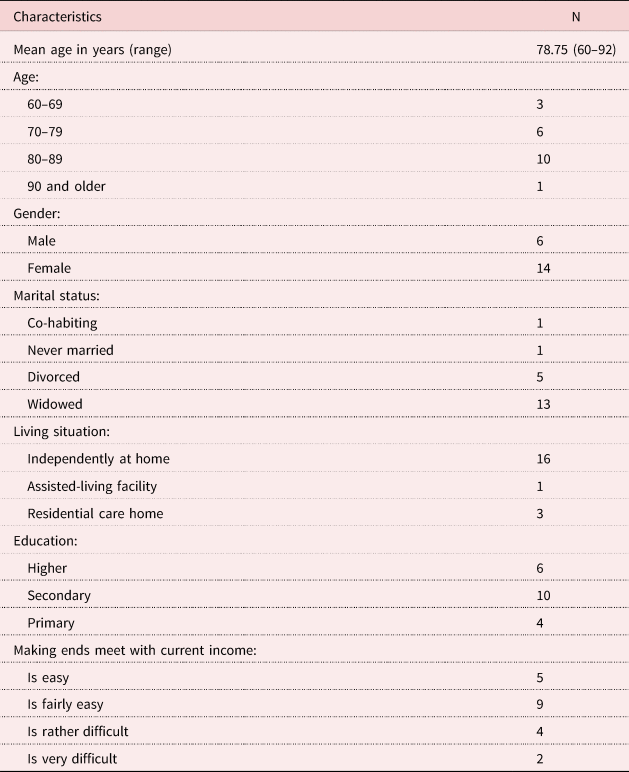
The consolidated criteria for reporting qualitative research (COREQ checklist) was used to clearly depict the method of our study (Tong et al., Reference Tong, Sainsbury and Craig2007). The data used are the life stories of 20 lonely older people living in the Belgian region of Flanders. Data were collected between November 2019 and March 2020. Professionals working with older adults daily, such as physiotherapists, general practitioners and social workers from municipalities across Flanders, talked to potential respondents about the study and the search for respondents. Respondents had to identify themselves as lonely and be willing to talk about their life stories and feelings of loneliness. When older adults were interested in participating and gave their consent, the professionals provided their contact information to the researchers. During the intake, the de Jong-Gierveld six-item loneliness scale (de Jong Gierveld and van Tilburg, Reference de Jong Gierveld and van Tilburg2006) was administered and respondents needed to obtain a score of 2 or higher, which might indicate being lonely. The first author (LS) prepared the data collection with support from co-authors ED, SD and LDD. LS conducted the interviews, together with two MSC students trained as researchers. All interviewers were female. LS is a PhD fellow researcher and has experience in the fields of social gerontology, loneliness and qualitative research. The interviews lasted between 60 and 240 minutes (average duration 135 minutes). Data saturation was obtained. Table 1 presents the socio-demographic data for the 20 respondents. Respondents' ages ranged from 60 to 92 (average age = 78.75 years), and most of them were female (N = 14). All respondents were Belgian nationals, and most were widowed (N = 13). No one had a migration background.
Socio-demographic data of respondents

Note: N = 20.
Ethics
One of the main ethical considerations of this study was to minimise harm to respondents. It was recognised that loneliness is an emotive and sensitive subject, which may require respondents to revisit painful or uncomfortable periods of their past or current life. It was acknowledged by the researchers that respondents might experience distress during the qualitative interview, therefore the decision was taken to conduct narrative interviews, as this approach is appropriate for emotive and sensitive topics (Petty, Reference Petty2017). The researchers also visited respondents approximately one week beforehand in order to communicate the purpose of the interview and the study. This encouraged and fostered the creation of a safe atmosphere, a very important prerequisite to facilitate talking about personal loneliness experiences (Kirkevold et al., Reference Kirkevold, Moyle, Wilkinson, Meyer and Hauge2013). At the briefing on the previous week, and at the moment of the interview, respondents were informed about the voluntary nature of their participation and their right to refuse to answer any questions. They also knew they had the right to withdraw from the study at any time. Respondents were guaranteed confidentiality and signed an informed consent form. They were free to choose where the interview would take place; all respondents chose to be interviewed in their home environment. No one else except for the researchers was present during the interviews. Respondents were likewise informed in advance that certain emotions may be evoked during or after the interview. Dickson-Swift et al. (Reference Dickson-Swift, James, Kippen and Liamputtong2009) argue that there are multiple ways of dealing with respondents' emotions when interviewing, ranging from strong empathy and adopting the emotions to complete neutrality. For our research, we took the middle ground. We did not take over the emotions but were empathetic: we showed respect for the emotion by letting it happen, giving it space, for example by putting a hand on the person's arm and waiting. When certain emotions, stress or sadness arose during the interviewing process, the interviewer repeated the option of taking a break or stopping the interview. Two interviews were ended earlier, after one hour. At the end of the interview, time was spent with respondents to talk about less-emotive issues in order to enhance their mood and enable them to move away from any distressing emotions raised by the interview. Contact details of the researchers as well as for any psychological help after the interview were also provided. This study was approved by the Ethical Committee for Social Sciences and Humanities of Vrije Universiteit Brussel (VUB).
Interview scheme: modified version of the life-story interview guidelines of McAdams
The role of the lifecourse has steered our viewpoints from the beginning of this study. We followed the basic interview scheme of McAdams (Reference McAdams2008), where respondents identify their life chapters, significant life events and future plans, yet making some adaptations to better fit the research aim. The main adaptation of the life-story guideline of McAdams was our deletion of the sections on key scenes in the life story (e.g. vivid adult memory; wisdom event; religious, spiritual or mystical experience), on personal ideology, and on the life theme. We made this adaptation because of the time-consuming nature of the McAdams interview and given the sensitive subject and often-vulnerable respondents. In the first phase, at the start of each interview, we focused on respondents' actual life story, inviting them to think of their own life as a novel and to divide it into different chapters. Respondents chose the number of chapters (McAdams recommends between two and seven), then titled and briefly summarised each chapter. These chapters were visualised during the interview for both the interviewer and the respondent, by writing down the titles of the chapters and the corresponding relevant key words together with the respondent. The second part of the interview focused on some important key scenes during the respondents' life. We asked them to talk about one high point, one low point and one turning point for each life chapter. In the third phase, we asked questions about their feelings of loneliness during the lifecourse, such as ‘When did you experience loneliness (in which chapter)?’, ‘What caused your loneliness?’, ‘How did you cope with this situation?’ The fourth phase was related to their proudest moment in life and to talking about their main life lesson. In the fifth phase, respondents were asked to imagine and describe their future chapter. Given that most people did not regularly share their life story in this way, the final section included some additional reflective questions. The interviewer asked each respondent to take a moment to reflect on this interviewing method and to share their life story. The interview scheme is in the online supplementary material.
Member-check interviews
Because of the multitude of information, the complexity of the life stories and the sensitivity of the topic, follow-up interviews were organised aimed at asking additional clarifying questions (Harvey, Reference Harvey2015; Birt et al., Reference Birt, Scott, Cavers, Campbell and Walter2016). These follow-up interviews were conducted with the purpose of member-checking, i.e. confirming whether the content and interpreted meanings from prior interviews were in line with the respondent's experiences (Wester and Peters, Reference Wester and Peters2004). Eight older adults participated in those member-check interviews, which were prepared at the individual level. Based on the analysis of the first interview (Harvey, Reference Harvey2015), additional (clarifying) questions were prepared and a timeline was added, visualising the most important events that influenced respondents' loneliness throughout their lifecourse. The timeline was used as a guided visualisation, both for the respondents and the researchers. Respondents were asked if they wanted to add or modify anything.
As the respondent and the researcher met for the third time, trust grew. Respondents who had previously found it difficult to talk about their lives, experiences and emotions had less difficulty doing so during the member-check interview. As a result, respondents sometimes brought in new information during this conversation. These interviews took place within two to three months of the first interview and lasted between 35 and 75 minutes. As other qualitative research examining socially frail older adults also member-checked approximately half of the respondents (e.g. Machielse and Duyndam, Reference Machielse and Duyndam2020), our eight follow-up interviews seemed adequate.
Data analyses
A narrative approach was chosen to respect the respondent's voice and perspective (Bohlmeijer et al., Reference Bohlmeijer, Westerhof, Randall, Tromp and Kenyon2011). Narrative enquiry allows older adults to explore and construct their own lifecourse – which is complex, intense and embodied with changes (Phoenix et al., Reference Phoenix, Smith and Sparkes2010) – without losing authenticity (Riessman and Quinney, Reference Riessman and Quinney2005). The goal consists of developing stories, focusing on what is relevant according to the narrator, the storyteller (Riessman and Quinney, Reference Riessman and Quinney2005; Hill and Burrows, Reference Hill and Burrows2017). As researchers, we were involved on a spectrum between story analyst and storyteller (Smith and Sparkes, Reference Smith and Sparkes2008; Smith, Reference Smith, Lyons and Coyle2016) to conduct a joint meaning construction for the narrated events (de Medeiros and Rubinstein, Reference de Medeiros and Rubinstein2015). In the interview process, joint meaning is built in the moment through a series of questions and responses, assumptions and confirmations, and building a trustful relationship during the interviews (Mishler, Reference Mishler1986; Kvale, Reference Kvale2008). Both interviewer and respondent bring their own meanings to the interview, to the topic of the interview, to each other, and so on in an attempt to establish a better understanding of each other's perspective (de Medeiros and Rubinstein, Reference de Medeiros and Rubinstein2015). A key component in the co-construction of meaning during an interview is the interviewer's ability to listen carefully and with purpose (de Medeiros and Rubinstein, Reference de Medeiros and Rubinstein2015). The member-check interviews contributed further to the co-construction of meaning.
The analysis was conducted as follows: LS searched for expressions concerning life events and experiences of earlier life during the participants' lifecourses (i.e. during childhood, youth, adulthood or later life, but not recently within later life) which are still of impact today and relevant for their current loneliness feelings. Smith and Sparkes (Reference Smith and Sparkes2008) mention that there is no clear or straightforward method to conduct narrative analysis. Researchers have to make difficult and complex decisions about their analytical work that they estimate are most appropriate for their particular purpose (Smith and Sparkes, Reference Smith and Sparkes2008). Our analyses focused on the four main strategies within the dialogical narrative analysis, described by Smith (Reference Smith, Lyons and Coyle2016). These strategies are not linear or fixed, yet the researcher engages in the process of moving backwards and forwards from these phases during the analysis. The first strategy focuses on getting the story. Interviews were audio recorded and transcribed verbatim. During and after each interview, notes and memos were written down. The second strategy focuses on getting to delve into the stories, with subsuming as an important aspect. After getting the story, LS conducted a subsuming stage whereby the 20 interviews were reread multiple times. Within this strategy of delving into the stories, identifying narrative themes and the stories' structure are important aspects. To best meet the essence of narrative reconstruction, we systematically moved backwards and forwards between the ‘whats’ and the ‘hows’ of the narratives (Smith, Reference Smith, Lyons and Coyle2016). To analyse the ‘whats’ (content), a data-driven narrative analysis was conducted to identify central themes – life events, circumstances, coping strategies and their link with current loneliness – within stories (Smith, Reference Smith, Lyons and Coyle2016). The analyses aimed to find new categories and themes and was therefore conducted inductively: data were analysed by means of an open coding method through which new labels were generated from reading and analysis of the transcripts (Elo and Kyngäs, Reference Elo and Kyngäs2008). A theme captures something important about the data in relation to the research questions and represents some level of patterned response or meaning within the dataset (Braun and Clarke, Reference Braun and Clarke2006). Within this study a theme was narrated by at least two respondents. A constant comparison process was applied: when new themes, new labels or new sub-labels were discovered in new interviews, these were controlled for their presence within the earlier interviews. During this process, the code manual or labelling scheme was adapted and refined based on these new insights (Dierckx de Casterlé et al., Reference Dierckx de Casterlé, Gastmans, Bryon and Denier2012).
To analyse the ‘hows’ (structure of the story, plot) of the narrations, a holistic approach (Lieblich et al., Reference Lieblich, Tuval-Mashiach and Zilber1998) was followed to develop the life stories. This holistic approach or analysis does not fail to acknowledge the what or the content of the narrations – rather, it is necessary for keeping the story together, to structure the story (Lieblich et al., Reference Lieblich, Tuval-Mashiach and Zilber1998). The results will always describe an overview of each respondent's entire life story, so that results are situated within the spirit of the story and can be interpreted in relation to other parts of the lifecourse. The third strategy of the dialogical narrative analysis focuses on opening up analytical dialogue, whereby questions can reveal what was unknown about the story. For example, questions are raised such as ‘Which stories are affecting the respondent and the researcher emotionally?’ and ‘Would the respondent, the storyteller, tell their story to everybody or not, and why not?’ These responses are not applied within our results, but asking certain questions enhanced reflection on the stories (Smith, Reference Smith, Lyons and Coyle2016). The fourth strategy focuses on pulling the analysis together; here we chose to move from a story analyst to a storyteller (Smith, Reference Smith, Lyons and Coyle2016), and the Results section will often tell larger parts of someone's life story.
LS was primarily responsible for completing the analysis, but feedback was obtained from the co-authors on a regular basis to deepen the analyses. This process helped strengthen the validity of the analysis. In this way, the co-authors brought different perspectives to the data interpretation. When the co-authors disagreed on the assigned labels, they discussed the interpretation of these labels and the coding was re-examined until consensus was reached. The results are based on this iterative labelling process (Aspers and Corte, Reference Aspers and Corte2019). We continued this process until no new codes emerged from the analysis and all the variations of codes were identified with consensus. The number of interviews ensured the researchers reached data saturation, meaning that additional data did not lead to new emerging themes as new data repeated what was expressed in previous data (Saunders et al., Reference Saunders, Sim, Kingstone, Baker, Waterfield, Bartlam, Burroughs and Jinks2018).
Concerning the validation of narrative research, Riessman (Reference Riessman2008) indicates that trustworthiness is more relevant than truth worthiness, whereby the evaluation of trustworthiness seems to be important. Trustworthiness was conducted for this research as follows: first, data gathering and analysis were outlined and described comprehensibly. Second, long quotations were used to respect the storyteller's voice. Third, the plots of the narratives and the main themes were discussed with the respondents in the member-check interviews and with different colleagues (with experience in loneliness, mental health, social gerontology) to ensure that the chosen themes were consistent with the narrations. Last, the original transcripts of the interviews were in Dutch, so the English translations of the quotations were verified by a native speaker to ensure the accuracy and closeness of the narrations.
Findings
The narrations of precipitating events throughout the earlier lifecourse which can influence current loneliness feelings in older adults
The life stories revealed the lifetime impact of experiencing precipitating events during childhood and adulthood, leading to vulnerability to loneliness later in life. Life stories also indicated the relevance of certain unrealised life events (i.e. events that did not happen), which seem to have an impact on loneliness later in life. Last, stories told concerning events that did not have an impact earlier in life appeared relevant in the emergence of loneliness in later life.
Early life circumstances can have an impact on long-term loneliness
The importance of childhood circumstances seemed to return in several life stories, not only for loneliness feelings during childhood but also in later life. The following two older adults, for example, talked about feeling abandoned or unwanted by their parents, and how that still had an impact on their feelings of loneliness today.
A first life story is from a 68-year-old divorcee with three children. She talked about how she endured loneliness almost constantly throughout her life. She had three different partners in her life, and was separated from her children for several years and was not allowed to see them. She grew up in a poor family, and tells how she felt unwanted by her parents and how this influenced her life:
Loneliness has often been there, almost constantly in my life … Our father was away a lot, he had to work and then you feel lonely because my mother didn't look after me, so I often felt alone. And when my father was dying, he said to me on his deathbed: ‘my child, you are going to suffer, because you are an unwanted child’ … If you feel unwanted as a child, you feel alone, you feel lonely.
She talked about how she used to feel ignored at home and how she still felt like that today and how that caused her loneliness: ‘So I've never counted for anything – in my youth, as a mother, or now. I just don't matter.’ Some respondents indicated using different coping strategies during their lifecourse. Her life story expressed her need to find a partner at the age of 18, when she became legally an adult, in order to escape her loneliness at the parental home:
I wanted to leave home as soon as possible. I didn't have many options then, as a young woman. I had to find a partner to live with so I could get away. A woman living alone, you didn't do that back then, so I had to find someone.
This narrative is an example of a life story indicating how individuals construct their own lifecourse through the choices and actions they take within the opportunities and constraints of history and social circumstance. In her life she had three different partners; after each breakup, she wanted to find a new partner as soon as possible. Due to the many negative experiences with her partners, she finally decided she was better off on her own. She mentions how she now copes with her loneliness feelings in a more regulative way: ‘Actually, now I don't do anything, I just wait until my daughter comes. Normally she comes every week. I am certainly not looking for a new partner.’
The life story of this 68-year-old divorcee, like many others, highlights the importance of the lifecourse as a function in terms of loneliness later in life. In several life stories, experiencing loneliness as early as childhood was a result of not feeling wanted or accepted. This life story highlights the importance of the previous lifecourse on the development of coping strategies throughout life. During her lifetime, this 68-year-old divorcee learned to cope with her loneliness, and learned that searching for a new partner to overcome her loneliness was not a solution. She currently utilises alternative strategies.
A second example is a single 86-year-old man who tells how his upbringing had an impact on his life today. Also, his social circumstances had an impact on his entire lifecourse. He lived with his parents and sister all his life, never had a relationship and always struggled with his sexual orientation. He was a land surveyor and worked mostly for the government. At the age of 60 he retired. Thirteen years ago his sister died, as he was left alone in the house. He decided to move to an assisted-living facility. He talked about his childhood and upbringing, and how this still influenced his loneliness today:
Yes, so my first stage of life, in the beginning … I'm actually a replacement child, do you know what that is? My parents had my sister, then a second child who only lived for one year and died of tapeworm, they were devastated by this loss. They were advised to have another child. They wanted a girl but got a boy, me, and they tried to raise me as a girl and of course that didn't work out … That was very difficult, and I was very lonely … I feel as if I wasn't loved as a child, and that they didn't want to accept me as a boy … Not being able to be who you are, not being accepted as you are, that's lonely.
He mentioned further how this impacted his life:
For example, I didn't start a family. And that was, yes, because of fear of commitment too. I wasn't able to bond with someone through marriage or a steady relationship. My whole life I have missed intimacy, and that makes me feel lonely even today.
Respondents shared how they managed their loneliness during their life. These two life stories demonstrate the influence of previous life experiences on loneliness later in life. During his childhood the man developed a lifelong vulnerability to loneliness. He had a hard time forming relationships because he never learned how to be emotionally close, which affects his loneliness today.
The narrations of coping strategies by older adults with previous loneliness experiences described mostly that the respondent used similar coping strategies throughout their life. This man mentioned that attending school and the youth organisation were important for him to cope with his loneliness. Later in life he visited sex workers in order to find some intimacy. Nowadays, he is still actively searching for social contact: ‘Now I go to the cafeteria, where I can sit every afternoon. That does me a lot of good.’ This life story shows that the coping strategies remained during his lifetime. His main coping strategy was to actively seek contact, both socially and physically.
Critical life events have an impact on later-life loneliness
Older respondents indicated that life events during adulthood, such as conflicts with colleagues and friends or spousal infidelity, caused loneliness feelings not only at the moment they happened but retained an impact on their current loneliness feelings, in later life.
An 81-year-old widow narrated her story about a conflict at work when she was 58, which caused some isolation at her workplace and which still influenced her current loneliness. She worked as a physical education teacher at the same school her whole life. Throughout her life she suffered from many health problems, had many operations, problems with her back and so on. At a certain point she got extra support during her classes, but shortly thereafter three colleagues started a petition because they did not agree with her getting this extra support. This was the start of a conflict at work, the consequences of which she still experiences:
The whole thing was very cruel. I lost several girlfriends – at least I thought they were my girlfriends, they were more than just co-workers. And I believe this still affects my sense of loneliness today. Since it happened, I have lost some confidence in people.
This life story shows how the loss of friendships and her loss of confidence in certain friends persist for an extended period throughout life, continuing to affect her loneliness later in life. Hers is a third example of the use of coping strategies for loneliness during the lifecourse. When she used to experience loneliness feelings at work, earlier in life, she focused more with her husband on organising events for good causes and invited many people to their home. Now, later in life, she still uses certain active coping strategies. For example, she shops several times a day, in that way trying to come into contact with people:
I go shopping in the morning for a loaf of bread, and in the afternoon I go back to buy toppings, hoping to meet more people. Or I just drive around, I do that now and then when I feel lonely. It helps.
A 60-year-old divorcee described how her divorce 20 years ago impacted her entire life up to now. She grew up together with her sister at their aunt's house, because their mother had died. The bond with her sister was not optimal because her sister did not get along with their aunt and uncle. The respondent described that as a young child she felt abandoned by her mother and her sister. Later on, now 20 years ago, she was abandoned by her husband. He cheated on her with another woman, and they divorced. Since then, she also lost contact with her family, with the sole exception of her son. She mentioned experiencing loneliness continuously during the past 20 years: ‘Yes, and that sad loneliness in those 20 years, all those emotions and that loneliness, those years were the worst.’ After her divorce she raised her son all by herself, which was not easy. Because of that she rarely had time for herself:
I was very lonely, all on my own, and it's been 20 years, I've been divorced for 20 years, and it really hit me hard at the time … Yes, I was so lonely, I sacrificed all my energy and everything else to my son … Do you understand? I erased myself.
Later in her life, several years ago, she met someone at the local swimming pool:
I met someone at the pool, but he's gay so we were just friends. I was really doing better, we went out a lot, did all kinds of things together, I was a lot less lonely, I had a friend.
After a while this friend abandoned her too:
Suddenly he didn't want anything to do with me anymore. The police came, he had filed a complaint for stalking. I didn't understand and to this day I still don't know what happened exactly. I didn't do anything wrong. So, I was abandoned again. Now I don't need anyone around me anymore, I've had enough.
She mentioned that she has always been afraid of being abandoned again:
The way it is now, I am no longer open to a relationship. I've been hurt so much, and was abandoned by my father and mother, my husband and my family. I literally only have my son and my doctor, who I see occasionally, and that's it. Not that simple.
In her narrative, she mentions how she avoids social contact and was never motivated to seek new relationships or contacts, or repair broken relationships due to conflict. She describes how she has used this similar coping strategy for her loneliness for the last 20 years.
When I start feeling the pain, I watch television or I pray, it's distracting. I've been doing that for the last 20 years, but I just can't anymore.
She tells how she is not able anymore to trust people or to meet with new people. She feels that the way she manages her loneliness is not helpful: ‘It does not help me. I know I should meet people, but I just can't anymore.’
This life story shows how certain negative events in her case, such as being abandoned multiple times, triggered loneliness each time during her life journey. Every lost relationship stands for her loneliness. To her, these are critical life events that she could not manage and which she invariably avoided. As a result, she never learned how to handle these feelings of rejection and loneliness. For this reason, she persists in using various negative coping strategies, such as isolation for extended periods of time.
An 82-year-old widow lost her husband earlier in life, at age 62. She married in her twenties, had a son, worked all her life as a pharmacy assistant and did not experience any loneliness until her husband suddenly died: ‘And then, two months before he was to retire, he had a brain haemorrhage and died. For the first time, I was lonely and felt great sadness.’ She could cope with this loss and her loneliness did not become severe thanks to her active coping, she tells. She became a volunteer:
My husband died and all of a sudden I was on my own. But so what, I'm only 62, what I did was, around the corner there is a care institution for older people. I started keeping older people company, I did that for three years.
Several years later she started a new relationship:
We had a LAT [living apart together] relationship for 15 years, sometimes at his house, sometimes at my apartment. And the day of our 15th anniversary he laid the key on the table and said, ‘I want my freedom back.’ I was 80 and he was 79. When that happened, two years ago, my loneliness began. I lost him as a partner, emotionally, but also other social contacts, some friends we used to see together.
She talked about how she now coped differently with her loneliness due to physical limitations, compared with the first time:
This is worse than the first time around. I could walk and do volunteer work, so that helped … But now it's different. I play cards every week, but that's not enough, and now with the coronavirus it's not happening either, there is always something, it won't happen in the summer either, things are always getting cancelled. It's just not enough … This makes it all much harder.
Nowadays she just waits: ‘I just wait it out till it passes.’
This woman's life story shows how loneliness can be temporary in life. She experienced loneliness through the loss of her husband but sought contact and escaped these feelings for the first time. Therefore, it was transient in nature. In many life stories, older people express that they have experienced loneliness at certain times in their lives, temporarily. Later in her life, at an older age, she is unexpectedly abandoned by her new partner, which caused her to experience loneliness to this day. While she used to actively manage her loneliness, she can no longer do so due to physical barriers. Besides not being able to adapt her coping strategy to her new life, her feelings of loneliness are no longer transient. Due to limited possibilities to cope with loneliness, it has developed into a chronic form.
Unrealised life events during the lifecourse and their impact on later-life loneliness
Through two life stories telling about unrealised events we see their impact on loneliness today. We have discussed the 86-year-old man and the impact of not finding a partner during his life. Another 81-year-old widow revealed the relevance of a certain unrealised event which seemed to have an impact on loneliness later in life. The widow talked about her good and happy marriage. She and her husband were not able to have children for biological reasons (she suffered from tuberculosis), although they had both wanted to start a family. When everyone around her became parents, it was hard on her. She tells how she used to deal with this in her late twenties, early thirties: ‘I'd cry when I saw a pregnant woman in the street. That period was so hard and painful.’ She says she was a very social person, and had the chance to become a mother figure to her best friend's son. Together with her husband they often looked after many of their friends' children. The death of her husband several years ago increased her loneliness feelings, but the fact that they could not raise their own children still had an impact on her loneliness today. This became clear from her life story:
Now I'm alone, my husband died 12 years ago. His death has intensified my loneliness. And that's the worst part, he's not coming back, and you can't do anything about it. Yes, I miss him a lot, especially because we have no children. And then your acquaintances say: ‘Yes but do you think that if you had children, you would see them every day?’ I know, I know, but when it comes down to it, for a decision or something else, then you'd have someone you can trust 100 per cent and ask for help.
She still struggles with this today:
And I have no one left. There are some people I can rely on, several who take very good care of me, yet that isn't satisfying. They obviously cannot replace having children or the loss of my husband. That makes me feel lonely, now that I have no family anymore, that I cannot count on any real family. That will always feel like a loss to me.
Within the life stories, older adults talked about unrealised events during their lives, and how these affect their feelings of loneliness today. All of these stories include the absence of someone, a partner or child. This loss can still affect them into later life. Moreover, loneliness can happen due to unrealised events and get stronger in combination with other losses. The accumulation of these feelings can strengthen feelings of loneliness.
Earlier life events which unexpectedly impact loneliness in later life
In different life stories, life events that happened earlier in life had no significance for feelings of loneliness at the time, but later did turn out to have an impact on loneliness. For example, a 75-year-old widow says that she moved to her partner's birthplace in her twenties and that she was glad about that decision back then. However, her partner died recently and her circle of acquaintances in her ‘new’ place appeared to be very limited:
Maybe I shouldn't have moved. My closest girlfriends live far away and that affects how lonely I feel now. It gets harder to travel when you're old … I feel like that move from years ago is having an impact now … Perhaps if I wasn't living here, I would feel less lonely.
Life events during earlier life can cause a lack of certain relationships today, and can cause feelings of loneliness later in life. Despite not being influential in early life, these events become significant later in life. This again indicates the importance of the lifecourse as a significant aspect of loneliness feelings in later life.
Discussion
This study elaborates on the cognitive discrepancy model of loneliness (Perlman and Peplau, Reference Perlman, Peplau, Duk and Gilmour1981, as modified by Burholt et al., Reference Burholt, Windle and Morgan2017), by using a lifecourse perspective. We first investigated how precipitating events earlier in life influence current loneliness, subsequently expanding the knowledge on how older adults cope with their loneliness throughout the lifecourse and how this impacts their current loneliness experiences. In order to answer the research questions, we collected the life stories of 20 lonely older adults living in Belgium, using the adapted version of the McAdams life-story interview scheme.
Regarding the first research question, on the role of (negative and positive) precipitating events throughout the earlier lifecourse, our results revealed three main findings. First, the narratives provide support for the lifelong influence of negative precipitating events on current feelings of loneliness. Certain negative life events can have a long-lasting influence on loneliness in later life. Although research focuses mostly on the role of recent old-age life events (e.g. Cohen-Mansfield et al., Reference Cohen-Mansfield, Hazan, Lerman and Shalom2016; Switsers et al., Reference Switsers, Dury, Dierckx and De Donder2023), the importance of earlier life events should not be neglected if we are to understand older people's current loneliness. Our qualitative findings support the quantitative findings of Kamiya et al. (Reference Kamiya, Doyle, Henretta and Timonen2014) and Ejlskov et al. (Reference Ejlskov, Bøggild, Kuh and Stafford2020) highlighting the effect of childhood events on current loneliness in later life. Relationship adversities experienced during childhood (e.g. maternal or parental neglect) and childhood traumas (e.g. premature death of a parent) continue to influence loneliness levels much later in life. Our results are in line with Tiilikainen and Seppänen (Reference Tiilikainen and Seppänen2017) and Tiilikainen (Reference Tiilikainen2020), who found that complex parenthood and troubling childhood experiences during the earlier lifecourse can still have an impact on the experience of loneliness in later life. Second, the life stories revealed the relevance of certain unrealised life events (e.g. remaining childless) on loneliness later in life. The specific example connects with several recent studies that found childlessness to be related to increased loneliness in later life (Vozikaki et al., Reference Vozikaki, Papadaki, Linardakis and Philalithis2018; Zoutewelle-Terovan and Liefbroer, Reference Zoutewelle-Terovan and Liefbroer2018). Not having children may be a cause of loneliness but being a parent does not always protect one from being lonely (Zhang and Hayward, Reference Zhang and Hayward2001). For some people life without children can have advantages, for some disadvantages, for others it might have no effects (Dykstra and Hagestad, Reference Dykstra and Hagestad2007). Other studies indicate that different unrealised life events might be related to increased loneliness too, such as never having married (Gibney et al., Reference Gibney, Moore and Shannon2019). Not having followed long-term education for at least eight years also seems related to loneliness in later life (Vozikaki et al., Reference Vozikaki, Papadaki, Linardakis and Philalithis2018). Third, our findings add that even though earlier life events might have had no impact on loneliness feelings earlier in life (such as relocation of neighbourhood at a younger age), certain life events (unexpectedly) can influence old-age loneliness.
Last, cumulative effects of adverse and traumatic events (childhood misfortunes, divorce, bereavement, depression) were noticeable throughout the lifecourses of our respondents. Our study underlines the cumulative-disadvantage theory that adverse events and circumstances can accumulate throughout life (Dannefer, Reference Dannefer2020).
Regarding the second research question, on how older adults cope with their loneliness throughout the lifecourse, two ‘profiles’ are found. First, several respondents used the same coping strategy to deal with loneliness throughout their entire lifecourse. Even though coping is considered to be dynamic, fluctuating over time in reaction to changing situations (Moos and Holahan, Reference Moos and Holahan2003), several individuals responded with a single, consistent coping style that they use in a variety of situations (Endler, Reference Endler, Bäckman and von Hofsten2002). An explanation might be that one's personality influences coping strategies: Carver and Connor-Smith (Reference Carver and Connor-Smith2010) found that different meta-analyses connect personality traits such as extraversion, optimism, openness and conscientiousness more to problem-focused coping strategies, and neuroticism more to emotion-focused coping strategies. As personality might remain constant over the lifecourse (Caspi and Roberts, Reference Caspi and Roberts2009), people's coping styles tend to remain stable too. It should nonetheless be pointed out that this consistent coping style among respondents could prove to be unsuccessful when used repeatedly, thus failing to resolve or diminish the loneliness experienced. This can be connected to what Young (Reference Young1994) terms ‘early maladaptive schemas’. These schemas are the deepest cognitive levels and the core of personality, are developed during childhood, and perpetuate the use of negative coping strategies such as avoidance, social isolation and self-sacrifice (Young, Reference Young1994). The schemas are pervasive throughout the lifetime and might be dysfunctional to a certain degree (Young et al., Reference Young, Klosko and Weishaar2003). Although this has not been researched before, it could be hypothesised that certain early maladaptive schemas developed in childhood influence old-age loneliness. This is in line with Morgan et al. (Reference Morgan and Burholt2022), who argue that when emotion-oriented coping strategies are used in isolation, these coping strategies might contribute to loneliness.
Second, the results also contain life stories where older people adopt a ‘flexible, learning approach’ throughout life, adapting their coping strategies based on certain positive or negative experiences and improving their skills to cope with loneliness. The ability to deal with changes during the lifespan and use a variety of coping strategies is connected with the construct of resilience (Wiles et al., Reference Wiles, Wild, Kerse and Allen2012; Stephens et al., Reference Stephens, Breheny and Mansvelt2015). Resilience is defined as a successful adaptation process, the capacity to respond and react to adverse life events, or the ability to bounce back from difficult life conditions. People use external and internal resources within such reactions and responses (Wiles et al., Reference Wiles, Wild, Kerse and Allen2012) to overcome adversities such as loneliness. However, as one ages several internal and external resources might change (Randall et al., Reference Randall, Martin, Bishop, Poon and Johnson2011). While respondents explained having developed resilient ways of coping with loneliness during the lifecourse, because of age-related changes in people's resources they could no longer cope with loneliness in later life in a preferred way, resulting in increased loneliness. Societal awareness should be raised about the impact of individual, environmental and structural factors which can exclude older persons (Van Regenmortel et al., Reference Van Regenmortel, De Donder, Dury, Smetcoren, De Witte and Verté2016; Walsh et al., Reference Walsh, Scharf and Keating2017) and make it more difficult to cope with loneliness. In broader public health terms, attention is needed for preconditions so that people have the resources to cope if and when loneliness feelings surface. Focusing only on people's individual skills and competences in order to manage loneliness seems inadequate. This is in line with research indicating that several age-friendly-based factors such as low access to social services, limited opportunities for mobility and barriers to social activities seem to relate to higher feelings of loneliness (Gibney et al., Reference Gibney, Moore and Shannon2019). It might be that people living in less age-friendly communities have fewer options to cope with loneliness effectively. Attention for age-friendly and caring communities is therefore warranted.
Study limitations and paths for future research
Although this study adds a nuanced understanding of loneliness experiences within a lifecourse perspective and focuses on the cognitive discrepancy model of loneliness (Perlman and Peplau, Reference Perlman, Peplau, Duk and Gilmour1981), it has some limitations that may constitute opportunities for future research. First, given the value of member-check interviews, one of our limitations concerning our data focuses on the fact that only eight member-check interviews were conducted. Due to COVID-19 lockdown restrictions from 18 March 2020, the data gathering for this research, in terms of member-check interviews, ended. In addition, independent coding of the interviews by multiple co-authors as a first step to ensure the validity of findings may have been too rigorous an approach. A second limitation of this study focuses on the fact that most respondents were female and widowed. It was difficult to find male respondents who were willing to talk about their loneliness experiences. Other research also indicates that compared to women, men wrestle with talking about loneliness (Franklin et al., Reference Franklin, Barbosa Neves, Hookway, Patulny, Tranter and Jaworski2019).
Third, the relationship of the individual to society, which is sometimes called the micro–macro-link or the relation of agency to structure (Bouvier, Reference Bouvier, Jarvie and Zamora-Bonilla2011), seems to be relevant towards understanding loneliness experiences. Viewed from this perspective, loneliness is not only the attribute of individuals but an experience that is also influenced by social and structural conditions (Burholt et al., Reference Burholt, Windle and Morgan2017; de Jong Gierveld et al., Reference de Jong Gierveld, van Tilburg, Dykstra, Vangelisti and Perlman2018). These might not only refer to societal-contextual factors (macro-link), but recent studies have shown the positive (cross-sectional) association between community factors (meso-/exo-link) and older adults' wellbeing (Zhang et al., Reference Zhang, Zhang, Zhou and Yu2018), and loneliness in particular (Kemperman et al., Reference Kemperman, Berg, Perrée and Uijtdewillegen2019). It is, however, also obvious that communities are constantly in motion and that community changes strongly affect older people (Buffel and Phillipson, Reference Buffel and Phillipson2019). It might therefore be interesting for further research to conduct, in addition to individual life stories as we did, community life stories to investigate the role of contextual transitions on loneliness during the lifecourse. Fourth, this study has found relevance for adding the lifecourse perspective to the cognitive discrepancy model of loneliness. Although we only focused on the role of precipitating events and coping strategies throughout the lifecourse, other aspects of the cognitive discrepancy model of loneliness might also benefit from a lifecourse perspective in order to expand our knowledge of understanding loneliness, such as the focus on needed or desired social relationships, or cognition and attributions.
Last, all respondents had Belgian roots; it might be valuable to study the lifecourses of migrant older adults with loneliness feelings (Wu and Penning, Reference Wu and Penning2015), as this might reveal unprecedented knowledge on the implications of migration during childhood or adulthood for loneliness in later life. Other events, for example historical or political, might contribute from a lifecourse perspective, in order to explore their relevance concerning loneliness feelings later in life. This paper focused only on one aspect of lifecourse theory – the importance of precipitating life events to understand current loneliness. However, lifecourse theory as formulated by Elder (Reference Elder1994) also entails factors like examining contextual concepts such as linked lives (social embeddedness), geographical location and historical time.
Implications
Building on recent attention for moving from loneliness reduction to loneliness prevention (de Jong Gierveld and Fokkema, Reference de Jong Gierveld, Fokkema, Sha'ked and Rokach2015; Newall and Menec, Reference Newall and Menec2015), our findings make a plea for the lifelong prevention of loneliness. More attention is needed for the role of precipitating negative events during childhood and adulthood, as those events might still be impacting loneliness in later life. Additionally, prevention of loneliness needs to be seen within a broader perspective. The findings revealed that not only precipitating negative events are of relevance to loneliness in later life, also age-related changes and people's personal resources are relevant towards coping with loneliness effectively. Furthermore, as loneliness is not only the attribute of individuals but an experience that is also influenced by social and structural conditions (Burholt et al., Reference Burholt, Windle and Morgan2017; de Jong Gierveld et al., Reference de Jong Gierveld, van Tilburg, Dykstra, Vangelisti and Perlman2018), applying a community- (meso) and structural- (macro) level approach for researching loneliness during the lifecourse seems relevant.
Supplementary material
The supplementary material for this article can be found at https://doi.org/10.1017/S0144686X23000715.
Acknowledgements
We would like to thank all the participants for their contribution and the care organisations for helping with the recruitment of participants. We also thank our MSC students, Julie De Loose and Marie Charlotte Hillen, for helping conduct the interviews.
Author contributions
ED, SD and LDD helped prepare the interview scheme. All authors contributed to the design of the study. LS was responsible for the data collection process and performed the data analyses. All other authors interpreted the findings. LS drafted the manuscript with the help of all authors. All authors contributed to refining the manuscript and approved the final version.
Financial support
This work was supported by the Research Foundation Flanders (FWO – FWOTM865).
Competing interests
The authors declare no competing interests.
Ethical standards
Ethical approval and permission to conduct the study was granted by the Ethical Committee for Social Sciences and Humanities of Vrije Universiteit Brussel (file number ECHW_167).