INTRODUCTION
Plough-less tillage systems (‘non-inversion tillage’, ‘conservation-tillage’ or ‘minimum tillage’ (MT)) of seedbed preparation for crops are widely used throughout the world (Allmaras & Dowdy Reference Allmaras and Dowdy1985; Cannell Reference Cannell1985; ECAF 2001; Hobbs Reference Hobbs2007) and continue to increase (Basch Reference Basch2009; Kassam et al. Reference Kassam, Friedrich and Derpsch2010). The main benefits of MT include control of soil erosion (Woodruff & Siddoway Reference Woodruff and Siddoway1965; Wischmeier & Smith Reference Wischmeier and Smith1978; Mannering & Fenster Reference Mannering and Fenster1983; Davies & Finney Reference Davies and Finney2002; Lal Reference Lal2010), reduced production costs with yields at least as good as conventional tillage (CT) (Allmaras & Dowdy Reference Allmaras and Dowdy1985), reductions in fuel use, machinery costs and working time (Davies Reference Davies, Baumer and Ehlers1989; Rasmussen Reference Rasmussen, Baumer and Ehlers1989; Bonari et al. Reference Bonari, Mazzoncini and Peruzzi1995; Sijtsma et al. Reference Sijtsma, Campbell, McLaughlin and Carter1998), increased profitability (Verch et al. Reference Verch, Kachele, Holtl, Richter and Fuchs2009), sequestration of carbon in the soil (Balesdent et al. Reference Balesdent, Chenu and Balabane2000; Mishra et al. Reference Mishra, Ussiri and Lal2010; Farina et al. Reference Farina, Seddaiu, Orsini, Steglich, Roggero and Francaviglia2011) and improvements in soil biota as well as reductions in aphids, one of the most serious of cereal pests (Holland Reference Holland2004; Rothwell et al. Reference Rothwell, Chaney, Haydock, Cole and Schmidt2005; Kennedy et al. Reference Kennedy, McDonald, Connery and Purvis2010). The main disadvantages of MT are considered to be an increase in activity and abundance of all species of slugs (Voss et al. Reference Voss, Ulber and Hoppe1998; Andersen Reference Andersen1999) and increased weed infestations, particularly grass weeds such as sterile brome (Anisantha sterilis L.) (Lintell Smith et al. Reference Lintell Smith, Freckleton, Firbank and Watkinson1999; Davies & Finney Reference Davies and Finney2002; Torresen et al. Reference Torresen, Skuterud, Tandsaether and Hagemo2003; Kreye Reference Kreye2004; Bond et al. Reference Bond, Davies and Turner2007; Kennedy et al. Reference Kennedy, McDonald, Connery and Purvis2010). The adoption of MT in Europe has been reviewed by Holland (Reference Holland2004) and in the UK by Morris et al. (Reference Morris, Miller, Orson and Froud-Williams2010). The current interest in MT throughout Europe is part of a wider response to smaller financial returns (Davies & Finney Reference Davies and Finney2002) and this together with high work rates and lower costs (Fortune et al. Reference Fortune, Kennedy, Mitchell, Dunne, Murphy, Connery and Grace2005; Forristal & Murphy Reference Forristal and Murphy2009) are among the reasons for adoption of the system by Irish cereal growers.
The greatest pest concerns of Irish cereal growers adopting MT are aphids/BYDV and slugs. The former has been investigated by Kennedy et al. (Reference Kennedy, McDonald, Connery and Purvis2010) and Kennedy & Connery (Reference Kennedy and Connery2011). Slugs (Gastropoda: Pulmonata) are a major crop pest in Western Europe, particularly when favoured by moist summers and mild winters (Port & Port Reference Port and Port1986; Moens Reference Moens and Henderson1989; Godan Reference Godan1999). In the UK, the two crops at greatest risk from slug damage are winter wheat, especially if sown late, and potatoes (Gould Reference Gould1961; Port & Port Reference Port and Port1986). Additionally, slugs are regarded by UK growers as the pest causing most concern and the one most encountered in first, second and third wheat crops after rape (Glen Reference Glen and Henderson1989). Using cage trials, Barratt et al. (Reference Barratt, Byers and Bierlein1994) found crop yields were inversely related to slug density. However, Glen et al. (Reference Glen, Wiltshire and Milsom1988) found a poor relationship between slug damage and slug numbers alone and later reported the importance of seedbed conditions and depth of sowing as being contributing factors influencing slug damage (Glen et al. Reference Glen, Milsom and Wiltshire1989; Glen Reference Glen2000). Slug populations have been found to be greater in crops established after direct drilling or non-inversions tillage than after CT (plough) (Glen et al. Reference Glen, Wiltshire and Milsom1984, Reference Glen, Wiltshire and Milsom1988; Voss et al. Reference Voss, Ulber and Hoppe1998; Holland Reference Holland2004) and are regarded as key pests in low-input farming systems (Glen et al. Reference Glen, Wiltshire, Wilson, Kendall and Symondson1994). In general, the sizes of slug populations that have been found in non-inversion tillage are intermediate between those found in direct drilled crops and those of CT (Kendall et al. Reference Kendall, Chinn, Glenn, Wiltshire, Winstone, Tidboald, Glenn, Greaves and Anderson1995; Symondson et al. Reference Symondson, Glen, Wiltshire, Langdon and Liddell1996). In the USA, where non-inversion/conservation tillage is widely practised, Grant et al. (Reference Grant, Yeargan, Pass and Parr1982) found that both slug populations and foliage damage were greater in direct-drilled alfalfa crops than those established by CT. Increased slug populations in maize fields established by reduced tillage, and especially in direct-drilled crops, were noted in Ohio by Willson & Eisley (Reference Willson and Eisley1992). Both slug numbers and crop damage were also found to increase in maize and soybean crops in the Midwest USA, corresponding with the greater adoption of conservation tillage, by Hammond (Reference Hammond and Henderson1996) and Hammond et al. (Reference Hammond, Beck, Smith, Amos, Barker, Moore, Siegrist, Slates and Ward1999). Crop residues are reported to favour slugs. Hammond & Stinner (Reference Hammond and Stinner1987) found larger populations of slugs in maize and soybean fields that had greater amounts of crop residues. Similarly, in winter wheat, the greatest slug populations were found in plots where straw was chopped and incorporated, particularly shallow incorporation by non-plough tillage, compared with plots in which straw was baled and removed (Kendall et al. Reference Kendall, Chinn, Glenn, Wiltshire, Winstone, Tidboald, Glenn, Greaves and Anderson1995; Glen et al. Reference Glen, Wiltshire, Walker, Wilson and Shewry1996; Symondson et al. Reference Symondson, Glen, Wiltshire, Langdon and Liddell1996).
One of the benefits reported for MT is the increased abundance of earthworms, particularly of the deep-burrowing species (Jordan et al. Reference Jordan, Leake and Ogilvy2000; Rothwell et al. Reference Rothwell, Chaney, Haydock, Cole and Schmidt2005). Earthworms are major contributors to the quality and productivity of soils. They improve the nutrient content of soil by breaking down organic matter, increasing microbial activity and helping in the formation of soil aggregates leading to improved soil structure and preventing erosion (Guild Reference Guild and McE. Kevan1955; Ehlers Reference Ehlers1975; Edwards et al. Reference Edwards, Shipitalo and Norton1988; Holland Reference Holland2004). Earthworm burrows, which are lined with more available mineral nutrients for root growth than surrounding soil, facilitate soil aeration, soil drainage and the penetration of plant roots (Barnes & Ellis Reference Barnes and Ellis1979; Edwards & Lofty Reference Edwards and Lofty1980). These improvements to the soil have been shown by Edwards & Lofty (Reference Edwards and Lofty1978, Reference Edwards and Lofty1980) to significantly increase barley plant numbers and amounts of root and stem tissue. Earlier reports of increased yields of several crops obtained by various investigators by adding earthworms to soil have been listed by Edwards (Reference Edwards and Appelhof1981). Ploughing has been shown to damage and kill a large proportion of the earthworm population in the soil and to expose others to predators and desiccation (Cuendet Reference Cuendet and Satchell1983; House & Parmelee Reference House and Parmelee1985). Established earthworm burrow systems, especially those of the deep burrowing species, are damaged and habitats destroyed due to changes in soil temperature, moisture and food availability (Edwards Reference Edwards and Satchell1983; Chan Reference Chan2001; Kladivko Reference Kladivko2001). In contrast to ploughing and other forms of cultivation, much greater earthworm abundance was found for comparisons with direct-drilled crop land (Edwards Reference Edwards1975; Edwards & Lofty Reference Edwards and Lofty1982; Ehlers Reference Ehlers1975; Kladivko et al. Reference Kladivko, Akhouri and Weesies1997). However, direct drilling of cereal crops is not common in northern Europe but as outlined earlier non-inversion tillage is practised and this method of crop production has been reported to support greater earthworm populations than those found in conventionally tilled crops (Jordan et al. Reference Jordan, Leake and Ogilvy2000; Hutcheon et al. Reference Hutcheon, Iles and Kendall2001; Rothwell et al. Reference Rothwell, Chaney, Haydock, Cole and Schmidt2005). Chan (Reference Chan2001) considered that conservation tillage systems potentially enabled earthworms to play a more important role in the functioning of farm systems than under CT, because of their abilities to modify the soil's physical environment and nutrient cycling. Conservation tillage, especially if combined with the return of crop residues and the chopping and spreading of straw, have been found to increase earthworm populations (Barnes & Ellis Reference Barnes and Ellis1979; Fraser & Piercy Reference Fraser and Piercy1998; Chan & Heenan Reference Chan and Heenan2006).
The most important group of pest predators in European cereal fields are carabid beetles (Sunderland Reference Sunderland1975; Thiele Reference Thiele1977; Luff Reference Luff1987; Sunderland et al. Reference Sunderland, Crook, Stacey and Fuller1987; Bohan et al. Reference Bohan, Bohan, Glen, Symondson, Wiltshire and Hughes2000). Carabid beetles are considered sensitive indicators of habitat quality and bioindicators for cultivation impacts. They seem to be negatively affected by deep ploughing and enhanced by reduced tillage systems (House & All Reference House and All1981; Kromp Reference Kromp1999). In addition to cultivation, other factors influencing carabid abundance in fields are: soil type, moisture, organic matter content and pH, crop type, available prey and field size (House & Stinner Reference House and Stinner1983; Kromp Reference Kromp1999; Holland & Luff Reference Holland and Luff2000; Irmler Reference Irmler2003; Holland Reference Holland2004). Straw incorporation by non-inversion tillage was reported by Symondson et al. (Reference Symondson, Glen, Wiltshire, Langdon and Liddell1996) to favour one of the larger carabid species. Carabids are known to include aphids and slugs in their diet which, in northern Europe, are the most important pests of cereals (Gould Reference Gould1961; Sunderland Reference Sunderland1975; Port & Port Reference Port and Port1986; Sunderland et al. Reference Sunderland, Crook, Stacey and Fuller1987; Glen et al. Reference Glen, Milsom and Wiltshire1989; Bohan et al. Reference Bohan, Bohan, Glen, Symondson, Wiltshire and Hughes2000). There is some evidence that this predatory activity by some carabid species results in increased crop outputs (Helenius Reference Helenius1990; Symondson Reference Symondson1993; Symondson et al. Reference Symondson, Glen, Wiltshire, Langdon and Liddell1996; Bohan et al. Reference Bohan, Bohan, Glen, Symondson, Wiltshire and Hughes2000).
The objective of the present study was to test the following hypotheses: (i) slug numbers and damage are greater in MT than CT cereals and greater in straw incorporated than no-straw treatments within these two cultivation methods. (ii) Earthworm populations, particularly deep-burrowing species, are greater in MT than CT and in straw than no-straw treatments. (iii) Carabid beetles, especially those known to prey on slug pests in cereals, are more abundant in MT than CT and in straw than no-straw treated crops. Based on the evidence in the literature it was also hypothesized that small carabid species, including predators of cereal aphids, are more plentiful in CT than MT. The completion of the investigation on two differing soil types, at relatively close proximity to each other, for an extended period (9 years in this case) would provide cereal growers with reliable empirical data regarding the investigated species.
MATERIALS AND METHODS
Experimental design
A split plot experimental design was used for Trial 1. MT and CT plots, each 24 × 36 m (main plots), were sown with winter barley at the same location from 2001 to 2003 and with winter wheat from 2004 to 2009. Plots of each cultivation were randomized within each of four adjacent blocks. Plots were split so that one half (12 × 36 m), randomly selected, received a treatment of chopped straw. Split plots were surrounded by a fallow strip 1 m wide. A plastic barrier was erected centrally in each longitudinal fallow strip to restrict movement of soil animals between plots. Barriers were of transparent 800 g thermal UVI plastic, 1 × 40 m (extending 2 m beyond plot ends). Plastic sheets were centrally folded and suspended on a high tensile 3 mm diameter wire, tied tightly to a timber post inserted in the soil at either end of plots and projecting 350 mm above the soil surface. The remaining 150 mm of plastic was buried in the soil in a furrow previously prepared by a single-board plough. Plastic barriers were supported by inserting 75 × 75 mm timber posts into the soil at 5 m intervals and projecting 350 mm above the soil surface. Plastic was fastened to posts by means of nailed timber batons, and remained in place for the 9 years of the study. Trial 2, a split plot design was also used. Straw and no-straw treatments were applied as main plots. Each of the 24 × 30 m main plots were split and MT and CT treatments were applied to subplots (12 × 30 m). Treatment combinations were randomized to plots across four blocks. An internal sub-plot (30 × 8 m) was used for invertebrate investigations. The effects of the method of cultivation and soil incorporation of straw on slug abundance and damage and on earthworm populations were measured. Additionally, the effects of cultivation and straw treatments on carabid beetle occurrence were measured in Trial 1.
Sites and soils
Trial 1 was conducted in the ‘Road Field’ at Oak Park, Carlow, (52°51′N, 6°55′W, 56·08 m asl; 30-year average annual rainfall 790 mm). The site consists of a moderately deep (0·6–0·7 m), light-textured, free draining Brown Earth (Entisol – Soil Survey Staff USDA 2010) derived from calcareous outwash gravels composed mostly of limestone (90%+). The soil profile consists of light-textured plough layer (Ap horizon), containing 13–15% clay (by volume), overlying a light textured subsoil (Bt horizon) containing 15–18% clay (by volume), which in turn overlies coarse limestone sand and gravels. This Class B soil has low moisture-holding capacity and is subject to drought in dry seasons (Conry & Ryan Reference Conry and Ryan1967). The preceding crops on the site were three spring barleys, prior to which was winter barley which was preceded by a grass ley. Trial 2 was conducted in the ‘Hockey Field’ at Knockbeg, Carlow, (52°51′N, 6°56′W, 54·56 m asl; 1·75 km from Trial 1). The site consists of a deep, heavy textured, free-draining Grey Brown Podzolic soil (Hapludalf – Soil Survey Staff USDA 2010) derived from calcareous glacial till (boulder clay) composed mainly of limestone (90%+). The soil profile consists of a heavy loam plough layer (Ap horizon) containing 24–26% clay (by volume) over a heavy subsoil layer (Bt horizon) containing 40–50% clay (by volume), which in turn overlies the calcareous parent material at a depth of at least 1 m. This Class A1 soil, due to its clay over clay-loam texture, has a high moisture-holding capacity and is seldom subject to drought (Conry Reference Conry1987). The preceding crops were: winter wheat, winter barley, mixed in 1998 (crops included peas, beans, lupins, rape, maize and hemp); prior to this were winter barley and winter wheat in alternate years except for sugar beet in 1995. The site was ploughed in September 1992, following grass.
Straw
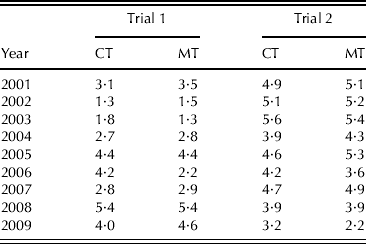
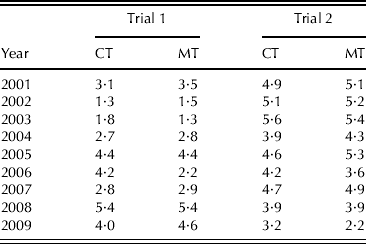
On 23 August 2001, straw from elsewhere on the farm was weighed, spread and chopped in situ on Trial 1 by means of a precision-chop forage harvester. For Trial 2, straw from the preceding crop was treated in a similar manner in the third week of August. The combine harvester used in subsequent years had an integrated straw chopper and spreader, which enabled straw from the preceding crop to be applied to those plots selected for straw incorporation and also determine the mass of straw applied. Straw was chopped to less than 100 mm in length. The weight of straw applied (Table 1) was estimated based on weighing both straw and grain from other experimental plots over a number of seasons. In the case of winter barley and winter wheat, the yields of straw for both were 0·51 those of grain yield, respectively.
Estimated mass of straw (t/ha) applied to CT and MT plots in the period 2001–09
Cultivations
MT comprised two passes for Trial 1 and one pass for Trial 2 with a shallow tine cultivator without soil inversion within 1 week of harvesting the preceding crop. A trailed Horsch FG 7·5 m cultivator with wide sweep shares was used in 2001. Subsequently, a similar type mounted Horsch Terrano 3 FX 3 m cultivator was used. Cultivation depth was c. 75 mm. Cultivation was followed by rolling (one pass) with a Cambridge-type roller (Vaderstad Rollex 620, 2500 kg and 6·2 m). CT comprised ploughing, 200–250 mm deep, with a Kverneland ES 80 4-furrow reversible plough. Soil was cultivated (one pass) with a rotary powered harrow and crumbler roller (Lely Roterra 2·5 m) immediately prior to sowing. Cultivation depth was 100–120 mm. Plots were sown with a trailed Vaderstad Rapid 300 S disc cultivator drill, 3 m wide with drill spacing of 125 mm. This seeder is fitted with a cultivator system of tines and discs that were used at a shallow depth of c. 50 mm. Sowing depth was 40 mm. Plots of Trial 1 only were rolled (one pass) post-sowing.
Husbandry
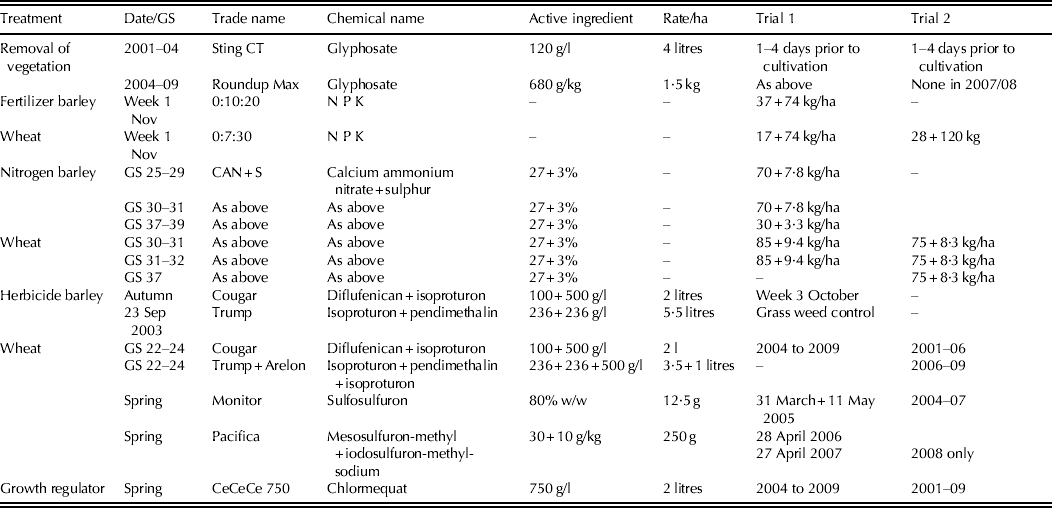
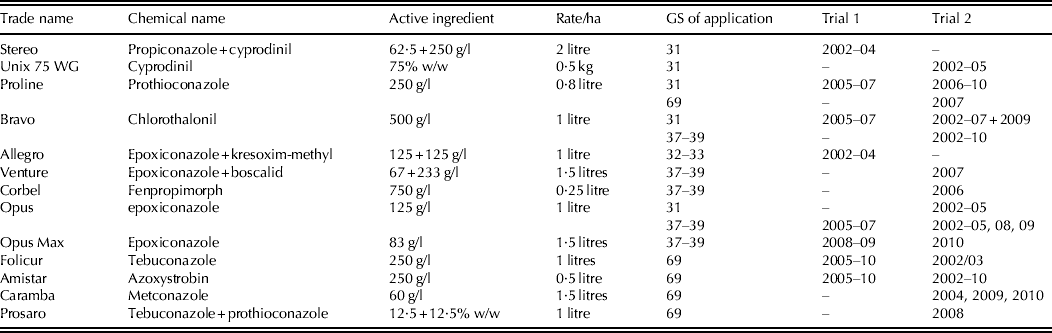
Barley was sown (175 kg/ha) on 12 September 2001 and 10 September 2002 and 2003. Wheat was sown (200 kg/ha) between 6 and 17 September each season. Barley seed was treated with the fungicide panoctine-plus (guazatine 300 g/l + imazalil 25 g/l) at 2 litres/t, while wheat seed was treated with panoctine at 2 litres/ha. Details of fertilizers and agrochemicals used are presented in Tables 2 and 3.
Fertilizers and herbicides applied to Trials 1 and 2, 2001–10

Fungicide treatment of barley and wheat, 2002–10
Slugs
One refuge trap and one slug-mat per plot were used each season to monitor slugs for 6 weeks, from early November to mid-December. Refuge traps of marine-ply timber were 300 × 300 × 10 mm and had pointed timber legs 120 mm in length on each corner. In week 1, the trap was positioned 3 m from the western (W) end and along a longitudinal axis 4·5 m from the southern (S) side of plots. Twelve grams of molluscicide pellets (Draza – 3% methiocarb) were placed centrally beneath each trap, which was pressed into the soil to leave c. 20 mm between the trap and the soil surface. Each week, slug number and species were recorded and traps repositioned a further 2 m along the longitudinal axis. Slug pellets from previous trap positions were collected and disposed of each week. Bayer-Slug-mats, 440 × 440 mm, were placed on the soil surface and anchored at each corner by inserting 160 mm steel pins into the soil. Mats comprised a plastic ‘envelope’, grey on top with a black underside, between which was a thermal barrier to prevent the heat from the sun disturbing slugs. In week one the mat was positioned 16 m from the end of the plot (described above).
Slug damage
Plants and soil from two 250 mm drill lengths and 80–100 mm deep were collected from each plot in late autumn at Zadoks plant growth stage (GS) 21–23 (Zadocks et al. Reference Zadocks, Chang and Konzak1974; Tottman et al. Reference Tottman, Makepeace and Broad1979) and brought to the laboratory. The sampling locations were 10 and 20 m from W-end and 4 m from S-side of plots. Seedlings (with remains of mother seed attached) were gently separated from the soil and the number of plants with and without slug damage (either shredding or severing of leaves and stems) was recorded. Soil was hand sorted to recover un-germinated seeds, which were examined by stereomicroscope for evidence of slug damage and the number damaged recorded.
Earthworm sampling
Two samples were collected each season from pre-selected positions in Trials 1 and 2, in the period between November and February when soil conditions were suitable. In 2001, sampling positions were 6 and 16 m from the W-end of plots and on a longitudinal axis 3 m from the S-edge of plots. In each succeeding season, sampling positions were extended by 1 m. Soil was excavated from within an open-ended steel frame, 250 × 250 × 250 mm, and placed in containers which were sealed and brought to the laboratory. Each sample was hand sorted thrice and earthworms were collected washed in tap water, dried on absorbent paper and weighed. Excavated sample pits were each flooded with 2–3 litres of 0·25% formalin solution and over a 30–60 min period, depending on soakage of formalin, emerging earthworms were collected. Earthworm fresh weight was recorded and earthworms were killed and stored in 4% formalin to await identification. Soil was returned to trial sites following the extraction of earthworms. Species were assigned to ecological groups following Bouché (Reference Bouché1977). These are: Epigeic – non-burrowing pigmented earthworms living in the soil litter, e.g. Lumbricus rubellus, L. castaneus and Satchellius mammalis. Endogeic – horizontal-burrowers, unpigmented, top-soil feeders, e.g. Allolobophora chlorotica, Aporrectodea caliginosa, Aporrectodea rosea, Octolasion cyaneum and Murchieona minuscula. Anecic – large, deep-burrowers, e.g. Lumbricus terrestris and Aporrectodea longa.
Beetles
Two pitfall traps, each 75 mm diameter and 100 mm deep, were operated in Trial 1 for the five seasons 2006–10. Weekly trapping of beetles commenced in the last week of April and continued for 12 weeks. The trapping medium was ethylene glycol, 30 mm deep. Beetles from each trap were sorted weekly and stored in ethanol (100% – 46·1 g/mole) prior to enumeration and identification. Traps were positioned on the longitudinal axis used for slug monitoring, one being 10 m and the second 20 m from the W-end of the plot.
Identifications
The keys used for identifications were: earthworms –Sims & Gerard (Reference Sims and Gerard1999); slugs – Quick (Reference Quick1949, Reference Quick1960) and Cameron et al. (Reference Cameron, Eversham and Jackson1983); carabid beetles – Lindroth (Reference Lindroth1974).
Plant and tiller density
Cereal ear density was recorded at GS 90 by counting plants within a quadrat (500 × 500 mm). Quadrat counts were made at four positions, c. 6 m from the ends of the plots and 6 m apart on the longitudinal axis 2 m from the plot's edge.
Data analysis
Data was analysed using analysis of variance for split-plot design (PROC MIXED) (SAS 2004). The model had terms for the cultivation method, straw, cultivation method × straw and incorporated the block and block × cultivation method as random effects (Trial 1) and the block × straw method as random effects (Trial 2). For analysis of data combined across years, year was included in the analysis model as a blocking factor (fixed effect). Pre-specified hypotheses were tested at P ⩽ 0·05. Subsequently, pairwise comparisons were made and these were considered significant where Tukey–Kramer-adjusted P < 0·05. Slug, earthworm and beetle numbers were log transformed and slug damage was transformed to the arcsin of the square root.
RESULTS
Slugs
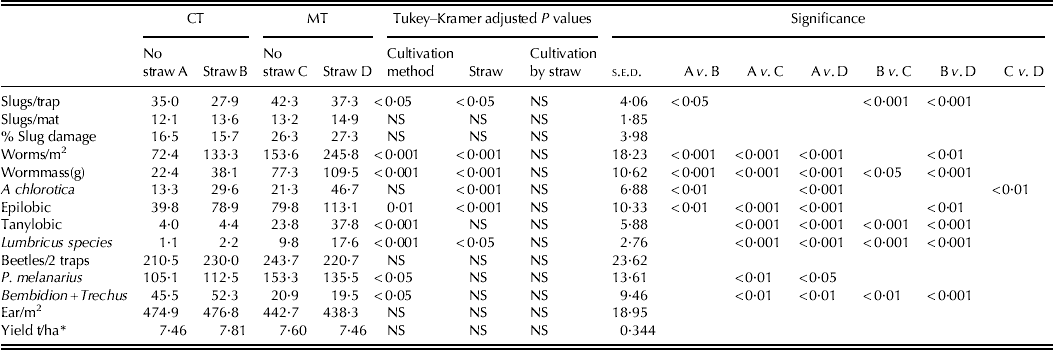
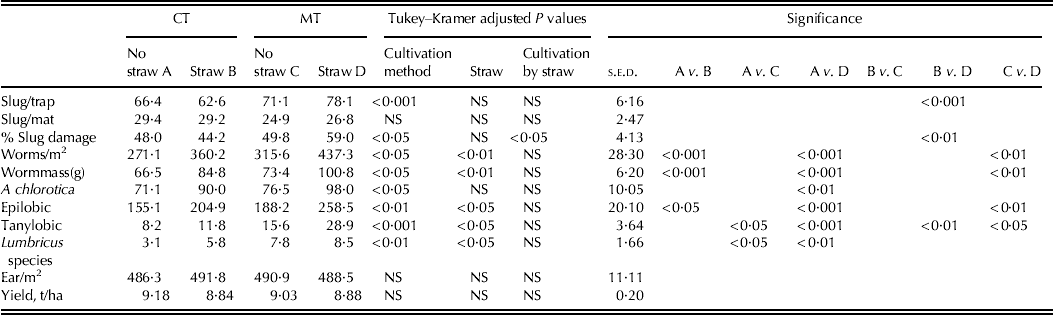
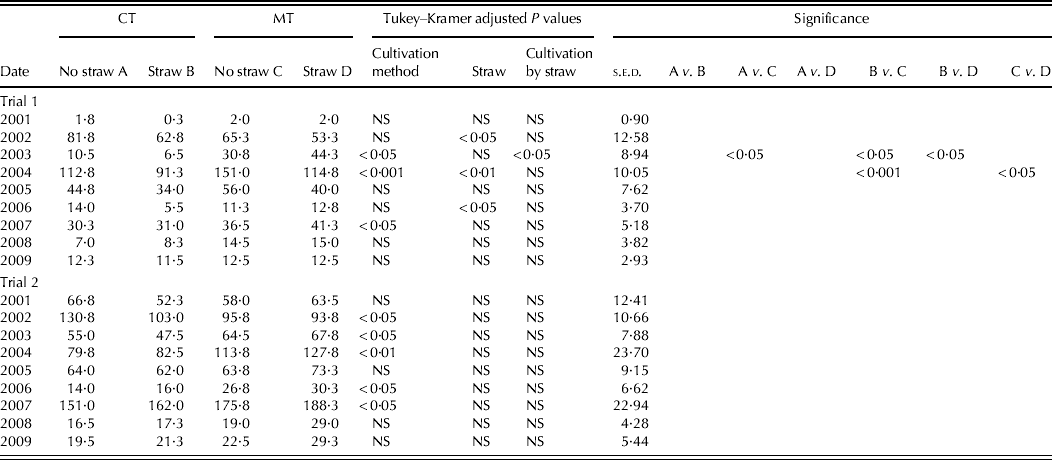
The abundance of slugs beneath refuge traps over a 6-week period in autumn for the two trials for each of 9 years is summarized in Tables 4 and 5 and detailed in Table 6. Slugs were more numerous in MT than in CT plots, with the effect being significant (Tukey–Cramer adjusted P value for ‘cultivation method’ <0·05) for 3 of the 9 years in Trial 1 and 5 years in Trial 2. Over the 9 years, mean slug numbers were 26·5 and 15·7% greater in MT than CT plots in Trials 1 and 2, respectively, differences between cultivation methods being significant (P < 0·05 and P < 0·001) for both trials. The number of slugs did not increase over the course of the 9 years in either CT or MT plots. In general, slugs were most plentiful in years 7, 2 and 4 and were fewest in years 8, 9 and 6. Using year as a fixed effect, slug numbers showed a significant (P < 0·001) difference between years at each trial.
Mean number per season of slugs, slug damage, worm number and mass/m2, carabid beetles/2 traps, P. melanarius, the genera Bembidion and Trechus in Trial 1 in the period autumn 2001–10. Measurements are for MT and CT with and without soil incorporation of straw. Cereal ear density/m2 and grain yield, t/ha are also given
NS, not significant.
* Mean of 6 years grain yield of wheat.
Mean number per season of slugs, slug damage, worm number and mass/m2, in CT and MT cereals in trial 2 (Knockbeg) in the period autumn 2001–10. Measurements are for each system of cultivation with and without soil incorporation of straw. Cereal ear density/m2 is also given
The number of slugs captured beneath refuge traps, over a 6 week period (November–December), at Trials 1 and 2, 2001–09
Slug numbers were greater on no-straw plots than on those in which straw was incorporated. For combined cultivation methods (MT + CT), slugs were significantly more numerous on no-straw than straw plots for 3 of the 9 years in Trial 1 and also for the aggregate data for all years (see ‘straw’ P values, Table 6). The corresponding comparisons at Trial 2 were not significant. Only in one year, 2004, and only in Trial 1 were slugs significantly (P < 0·05, C v. D, Table 6) greater in no-straw MT plots when compared with straw treated MT plots. Within CT plots, slug numbers for the 9 years were 25% greater in no-straw than straw treated plots in Trial 1 and 6% greater in Trial 2. These differences were not significant for individual years in Trial 1 (A v. B, Table 6) but were significant (P < 0·05) for the aggregate yearly data (Table 4).
The contemporaneous use of slug mats with refuge traps showed there were 2·6-fold more slugs recorded for the latter, with the relationship in numbers per year between the two methods being (r = 0·66, d.f. = 17, P < 0·01). There was no significant difference in slug numbers beneath mats either for cultivation or straw treatment in any year or for combined years in either trial.
Slug species
In Trial 1, the number of slugs recorded beneath refuge traps over the 9 years was 5133. The species composition was: Deroceras reticulatum (M.) 96·9%, Arion hortensis (F.) 2%, Milax species 0·2% and others 0·9%. The species beneath slug-mats were: D. reticulatum 92·9%, A. hortensis 3%, Milax species 0·1% and others 4%. At Trial 2, D. reticulatum was again the dominant species. Of the 10 131 slugs beneath refuge traps, D. reticulatum comprised 76·5% of the slug fauna, A. hortensis 22·2%, Milax species 0·7% and unidentified species 0·6%. The slugs beneath mats were D. reticulatum 72·3%, A. hortensis 26·5%, Milax species 0·8% and unidentified 0·4%.
Slug damage
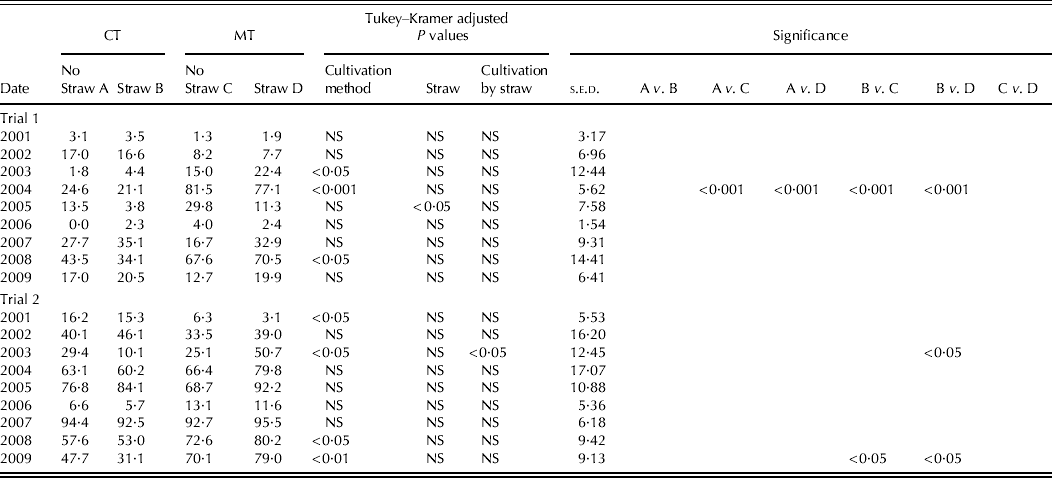
While slug damage to cereal leaves had a similar positive trend to that of slug abundance in refuge traps, the overall relationships in Trial 1 (r = 0·23, d.f.=35, P < 0·01) and Trial 2 (r = 0·48, d.f. = 35, P < 0·01) were poor. As with slug numbers, damage differed significantly between years in each trial. Feeding by slugs on cereal leaves was significantly greater in MT than CT plots in 3 of the 9 years in Trial 1 and in 4 years in Trial 2 (Table 7). The combined data for slug damage for all years showed MT had more damage to leaves than CT crops in Trials 1 and 2. The latter difference was significant (P < 0·05) in Trial 2 but not in Trial 1. The examination of soil samples post-plant GS 21 to measure slug damage to un-germinated seed showed damage in Trial 1 only for autumn 2008. In straw-treated MT and CT plots, 2% of seed had slug damage, while MT without straw had 2·5% damage with none in CT plots without straw. In Trial 2, a small amount of slug damage to seed was recorded each year with the exception of 2005. The yearly mean level of slug damage to seed was 1·3% (range 1–2%).
The percent slug damage to cereal leaves each season in CT and MT cereals, Trials 1 and 2, 2001–09
Ear density and grain yield
The ear density of wheat was significantly lower in MT plots in 3 years in Trial 1 and 1 year in Trial 2 when compared with CT plots. However, the mean ear density for all years was only 7·4% lower for MT relative to CT plots in Trial 1 and was similar in Trial 2. The overall effect of straw incorporation in the soil on ear density was negligible. There was no relationship between ear density and either slug density or slug damage to cereal leaves in corresponding years in Trial 1 (R 2 = 0·004 and R 2 = 0·25, respectively) or Trial 2 (R 2 = 0·003 and R 2 = 0·04, respectively). No variation in tiller density, either between treatments or between years, could be attributed to slug damage.
In Trial 1, grain yields were affected by barley yellow dwarf virus disease in the first 3 years and are not included. The mean yields of wheat for the 6 years in Trial 1 for CT, CT + straw, MT and MT + straw were 7·46, 7·81, 7·6 and 7·46 t/ha, respectively, and for Trial 2, 9·18, 8·84, 9·03 and 8·88 t/ha, respectively. There was no consistent effect of cultivation method or straw incorporation on grain yield. There was no relationship between grain yield and slug numbers or slug damage to cereal leaves in Trial 1 (R 2 = 0·32 and R 2 = 0·23, respectively) or in Trial 2 (R 2 = 0·22 and R 2 = 0·01, respectively).
Earthworms
Effect of cultivation
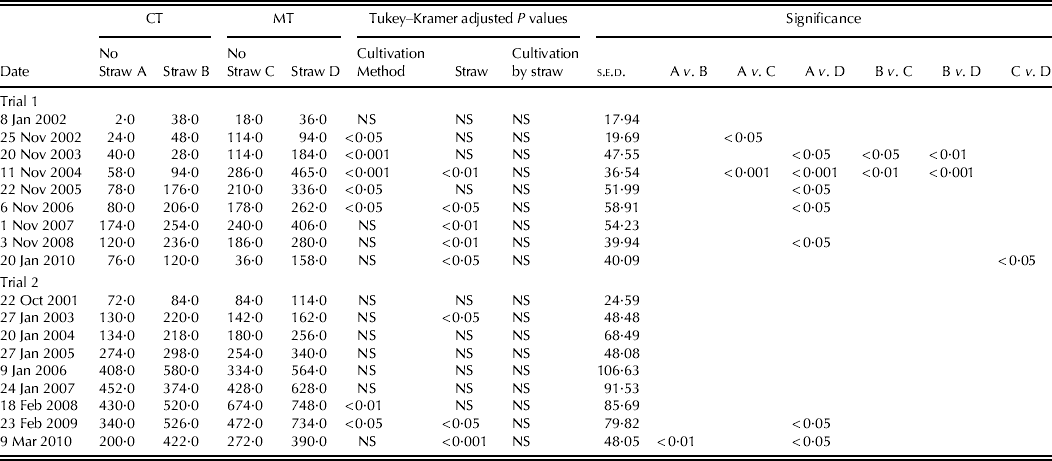
Earthworm numbers were greater in MT than CT plots in each of the 9 years in Trial 1 and in 7 of the 9 years in Trial 2 (Table 8). These effects were significant for 5 and 2 years, respectively. Over the 9 years there were 94% more earthworms in MT when compared with CT plots in Trial 1 and 19·3% in Trial 2. These differences were significant (P < 0·001 and P < 0·05, respectively). In the absence of straw, earthworms were twice as numerous (P < 0·001) in MT than CT plots in Trial 1 and 1·16-fold greater (non-significant) in Trial 2. Earthworm numbers increased over the first 7 years for each trial and in both straw and no-straw plots of MT and CT cultivations. In year 8 worm numbers were moderately fewer than for year 7 but were considerably reduced in all treatments in year 9 due to severe ground frost. Over the 9 years there was a significant (P < 0·001) effect of year on earthworm numbers at each trial site. Comparing the effects of MT and CT on worm numbers (combined data for straw and no-straw) for the first 7 years showed worm numbers in Trial 1 increased significantly in MT plots from 27/m2 in 2001 to 323/m2 in 2007, coefficient = 44·4, R 2=0·596, P < 0·05. The corresponding values for CT plots were 20/m2 in 2001 to 214/m2 in 2007, coefficient = 31·7, R 2=0·921, P < 0·001. At Trial 2, worm numbers increased significantly from 99/m2 in 2001 to 711/m2 in 2007, coefficient = 100·7, R 2=0·965, P < 0·001. The respective values for CT plots were 78/m2 in 2001 to 475/m2 in 2007, coefficient = 70·9, R 2=0·871, P < 0·01.
The number of earthworms extracted per square metre of soil and to a depth of 250 mm, Trials 1 and 2, 2001–10
Effect of straw
Straw incorporation greatly increased earthworm numbers. These increases, for combined cultivation methods (‘straw effect’, Table 8) were significant in 5 of the 9 years and significant (P < 0·001) for combined years in Trial 1. Similarly in Trial 2, such increases were significant in 3 of the 9 years and for the 9 years combined (P < 0·01). In MT plots in Trial 1, there was a major increase in earthworm numbers in straw relative to no-straw between years 3 and 4. A similar increase in earthworm numbers was recorded between years 4 and 5 for CT plots and also in this period for MT and CT plots in Trial 2. In Trial 1, MT plots treated with straw had greater earthworm numbers than those without straw in each of 8 years but the difference was only significant in one year. Earthworm abundance in MT straw plots, for the 9 years combined, was 1·6-fold greater than for no-straw plots but not significant (C v. D, Table 4). Earthworms were also more numerous in straw than no-straw CT plots, in 8 of the 9 years, although only one of these (2009) was statistically significant (P < 0·01). The mean number of earthworms in CT straw, for all years, was 1·8-fold greater (P < 0·001; A v. B, Table 4) than that for no-straw.
In Trial 2, earthworms were more plentiful, though not significantly so, in MT straw than in no-straw plots in each of the 9 years. The combined 9-year data for MT plots showed there was a significant (P < 0·01; C v. D, Table 5) 1·4-fold greater earthworm numbers in straw than no-straw plots. Earthworms were again more numerous in straw than in no-straw CT plots in each of 8 years. However, only in one year, 2009/2010, was the difference significant (P < 0·01). Over the 9 years, earthworms were a significant (P ⩽ 0·001) 1·3-fold more plentiful in straw than no-straw CT plots.
Earthworm species
Nine earthworm species were identified in Trials 1 and 2, of which seven species were common. Those for Trials 1 and 2, respectively, were: Allolobophora chlorotica (Savigny) 55·8 and 73·7%, Aporrectodea caliginosa (Savigny) 16·6 and 6·6%, Aporrectodea rosea (Savigny) 11·4 and 11·4%, Lumbricus terrestris (Linnaeus) 8·7 and 1·2%, L. festivus (Savigny) 3·7 and 0·2%, L. rubellus (Hoffmeister) 2·2 and 2·5%, L. castaneus (Savigny) 0·2 and 1·6%. The remaining species were Aporrectodea longa (Ude) 1·2% and Octolasion cyaneum (Savigny) 0·1% in Trial 1, and Murchieona minuscula (Rosa) 1·4% and Satchellius. mammalis (Savigny) 1·4% in Trial 2. Unidentified earthworms were segregated into three groups: juvenile epilobous and tanylobous and fragmented earthworms. Of total earthworms in Trial 1, juvenile epilobous comprised 51·9%, juvenile tanylobous 11·3%, while 5·6% were fragmented. These groups comprised 57·8, 4·6 and 5% of total earthworms in Trial 2, respectively. The 9-year aggregate data for A. chlorotica, the numerically dominant species at each trial, showed earthworms were plentiful in MT relative to CT. Differences were significant in Trial 2 (P < 0·05) but not in Trial 1. Numbers of A. chlorotica were greater in straw than no-straw treatments with the overall positive impact of straw on earthworm numbers significant in Trial 1 (P < 0·001), while only a trend was observed in Trial 2. MT and CT straw treated plots had significantly (both P < 0·01) more A. chlorotica in Trial 1 (A v. B and C v. D, Table 4) while differences in Trial 2 were not significant. Juvenile epilobous and tanylobous earthworms were also more numerous in MT than CT plots and in straw rather than no-straw plots (Tables 4 and 5). Lumbricus species comprised almost 15% of adult earthworms in Trial 1 and 5·5% in Trial 2. Earthworms of this genus were absent in year 1 of Trial 1 but reached their highest density in year 4. In Trial 2, Lumbricus species increased 5-fold over the 9 years, co-efficient = 2·73, R 2 = 0·765, P < 0·05. Eighty-nine percent of Lumbricus earthworms in Trial 1 occurred in MT plots, while in Trial 2 the value was almost 65%. Lumbricus were significantly more numerous in MT than in CT plots at Trial 1 (P < 0·001) and Trial 2 (P < 0·01) and were significantly more plentiful in straw than in no-straw plots (both P < 0·05). Within MT and CT cultivations in each trial, however, the differences in Lumbricus earthworms in straw and no-straw plots were not significant (A v. B and C v. D, Tables 4 and 5). Examining the data for A. chlorotica, Lumbricus species, juvenile epilobus and tanylobous for the 9 years, where year was used as a fixed effect, showed a significant effect (P < 0·001) for each category in Trials 1 and 2.
Ground beetles
A total of 19 130 carabid beetles, comprising 45 species, were captured in Trial 1 in the 5 years 2005–10. The 10 most abundant species were: P. melanarius (I.) 53%, Nebria brevicollis (F.) 8·5%, Bembidion tetracolum (Say) 6·1%, B. lampros (H.) 4·1%, Harpalus rufipes (D.) 3·8%, Agonum dorsale (P.) 3%, A. muelleri (H.) 2·7%, Loricera pilicornis (F.) 2·7%, Calathus fuscipes (G.) 2% and T. quadristriatus (S.) 1·6%. Only in one year, 2010, did the method of cultivation significantly (P < 0·001) affected the total number of carabid beetles when more were captured in MT compared with CT plots. The inclusion or omission of straw within either MT or CT cultivations did not significantly affect beetle numbers. Aggregating beetle numbers for 5 years did not show a significant effect, either for the method of cultivation or straw treatment, but did show a significant (P < 0·001) year effect.
P. melanarius, the most common and one of the larger beetles trapped during the present study, was 33% more in MT than in CT plots. This beetle was significantly more in MT relative to CT plots in 2 of the 5 years (both P < 0·05). The aggregate number of P. melanarius for the 5 years showed this species was significantly (P < 0·05) more abundant in MT than in CT (Table 4). P. melanarius numbers did not differ significantly between straw and no-straw for combined cultivations (MT + CT) or within MT and CT, either annually or for the combined 5 years. The smaller beetles were observed to be more prevalent in CT than in MT plots. Consequently, the numbers of five Bembidion species, B. lampros, B. tetracolum, B. obtusum (Ser.), B. aeneum (G.), B. guttula (F.) and T. quadristriatus were pooled and analysed. The results showed that these six species were 2·4-fold more abundant in CT than in MT plots. Differences were significant in 2005 (P < 0·001), 2006 (P < 0·01) and 2008 (P < 0·05). Numbers of these beetles did not differ significantly between straw and no-straw plots of either MT or CT cultivations in any year or for the aggregate data for the 5 years. The aggregate numbers of these six species showed beetles were significantly (P < 0·05) more numerous in CT than in MT plots. There was a significant yearly difference (P < 0·001) in the number of all beetles and P. melanarius as well as all Bembidion species plus T. quadristriatus for the 5 years.
DISCUSSION
Slugs
The finding of larger slug numbers on MT relative to CT plots in each trial of the present study affirms the proposed hypothesis and accords with the literature. The finding of larger numbers of slugs in systems of reduced- or conservation-tillage, non-inversion tillage and direct-drilled crops when compared with that for mouldboard ploughing followed by different cultivation (CT) methods has been reported for various regions and crops (Hunter Reference Hunter1967; Grant et al. Reference Grant, Yeargan, Pass and Parr1982; Glen et al. Reference Glen, Wiltshire and Milsom1984, Reference Glen, Wiltshire and Milsom1988; Port & Port Reference Port and Port1986; Willson & Eisley Reference Willson and Eisley1992; Kendall et al. Reference Kendall, Chinn, Glenn, Wiltshire, Winstone, Tidboald, Glenn, Greaves and Anderson1995; Symondson et al. Reference Symondson, Glen, Wiltshire, Langdon and Liddell1996; Voss et al. Reference Voss, Ulber and Hoppe1998; Christian et al. Reference Christian, Bacon, Brockie, Glen, Gutteridge and Jenkyn1999; Hammond et al. Reference Hammond, Beck, Smith, Amos, Barker, Moore, Siegrist, Slates and Ward1999; Glen Reference Glen2000). Hunter (Reference Hunter1967) was among the earliest workers to show, by experimentation, that cultivation reduces slug numbers. He concluded that slugs were killed by the mechanical action of implements; even ploughing alone reduced slug numbers. Ploughing alone was also found by Glen et al. (Reference Glen, Milsom and Wiltshire1990) to reduce both slug numbers and biomass by 84 and 81%, respectively, in the upper 100 mm of soil. They also found that ploughing followed by secondary cultivations significantly reduced slug biomass relative to ploughing alone. In the UK, Christian et al. (Reference Christian, Bacon, Brockie, Glen, Gutteridge and Jenkyn1999) found slugs were much more plentiful on direct-drilled winter wheat than on ploughed wheat, and similar findings were recorded by Grant et al. (Reference Grant, Yeargan, Pass and Parr1982) for alfalfa in the USA. The MT system used in the present study involved shallow cultivation without soil inversion. This MT system, which is common with practitioners in Ireland, is broadly similar to that for non-inversion tillage in Europe (Kendall et al. Reference Kendall, Chinn, Glenn, Wiltshire, Winstone, Tidboald, Glenn, Greaves and Anderson1995; Voss et al. Reference Voss, Ulber and Hoppe1998; Rothwell et al. Reference Rothwell, Chaney, Haydock, Cole and Schmidt2005). Slug numbers in areas cultivated by non-inversion tillage are generally intermediate between ploughed plots and no-tilled plots (Kendall et al. Reference Kendall, Chinn, Glenn, Wiltshire, Winstone, Tidboald, Glenn, Greaves and Anderson1995; Symondson et al. Reference Symondson, Glen, Wiltshire, Langdon and Liddell1996) and non-inversion methods of tillage generally have less effect on slug populations than ploughing combined with subsequent cultivations (Glen et al. Reference Glen, Wiltshire and Milsom1984, Reference Glen, Wiltshire, Wilson, Kendall and Symondson1994, Reference Glen, Wiltshire, Walker, Wilson and Shewry1996; Glen & Symondson Reference Glen, Symondson and El Titi2003). Glen & Symondson (Reference Glen, Symondson and El Titi2003) concluded that the greater the number of cultivation operations and the more intensive the method of cultivation the more likely it is that slug numbers will be substantially reduced, and that non-inversion tillage is generally less effective in reducing slug numbers than CT. Tillage with tines and discs was found by Kendall et al. (Reference Kendall, Chinn, Glenn, Wiltshire, Winstone, Tidboald, Glenn, Greaves and Anderson1995) to cause greater suppression of slug populations than a single pass non-inversion tillage system (Dutzi cultivator) with slug numbers consistently higher on direct-drilled plots. Similar findings have been reported for winter oilseed rape (Voss et al. Reference Voss, Ulber and Hoppe1998) with increased slug abundance and activity in non-inversion and zero-tillage relative to conventional ploughing.
Organic matter, such as crop residues, is believed to favour slug populations (Port & Port Reference Port and Port1986; Glen Reference Glen2000). Glen et al. (Reference Glen, Wiltshire and Milsom1984) suggested that slug populations increase in the presence of straw because it provides an additional source of food to the crop which may contribute to slug survival and that straw may also hide slugs from predators. Comparisons of slug numbers in plots where straw residues were left with those where straw was burnt have shown higher slug numbers for straw plots (Glen et al. Reference Glen, Wiltshire and Milsom1984, Reference Glen, Wiltshire and Milsom1988; Christian et al. Reference Christian, Bacon, Brockie, Glen, Gutteridge and Jenkyn1999). However, straw burning has been shown to have little direct effect on slug numbers (Edwards Reference Edwards1977); therefore, the conclusions that straw favours slug populations in the UK investigations seems reasonable. As well as the favouring of slug populations in winter wheat by straw residues, Glen et al. (Reference Glen, Wiltshire, Walker, Wilson and Shewry1996) also found that straw or stubble from the previous cereal crop resulted in higher slug populations in oilseed rape, particularly when incorporation of straw was shallow and where the tillage did not include ploughing. However, at a long-term study site in the UK, which compares more closely with the present study reported, consistently more slugs were recorded in plots where straw was chopped and incorporated compared with plots where straw was baled and removed and only the stubble was incorporated (Kendall et al. Reference Kendall, Chinn, Glenn, Wiltshire, Winstone, Tidboald, Glenn, Greaves and Anderson1995; Glen et al. Reference Glen, Wiltshire, Walker, Wilson and Shewry1996; Symondson et al. Reference Symondson, Glen, Wiltshire, Langdon and Liddell1996). Despite the evidence to-date in the literature, the incorporation of straw either in MT or CT cereal plots in the two trials of the present study, on two differing soil types, and on the same large-scale plots (recommended by Port & Port (Reference Port and Port1986) for obtaining long-term data on slugs) over a period of 9 years did not show an increase in slug numbers resulting from straw incorporation. The latter finding was unexpected and contrary to the hypothesized effect of straw on slug abundance. The barriers between plots in Trial 1 would have greatly reduced or prevented any possible intermixing of slugs between plots, thereby further supporting the finding of an absence of an effect of straw on slugs. The finding of an absence of slug proliferation resulting from straw incorporation is of considerable importance to MT practitioners in Ireland.
It is generally agreed that weather conditions influence slug abundance with damp springs and summers together with mild winters favouring populations (Martin & Kelly Reference Martin and Kelly1986). Moens (Reference Moens and Henderson1989) states that a succession of wet summers combined with mild winters favour slug populations while dry summers and severe winters reduce populations. Wet summers were also noted by Gould (Reference Gould1961) to be associated with serious slug problems in winter wheat in areas with heavy land. Similarly, Rogers-Lewis (Reference Rogers-Lewis1977) found that in wet years, slug damage is often a major problem affecting ware potatoes, particularly on the heavier silt soils. In their modelling of climate effects on slug populations, Choi et al. (Reference Choi, Bohan, Powers, Wiltshire, Glen and Semenov2004) confirmed the association between rainfall and abundance. Glen et al. (Reference Glen, Wiltshire and Milsom1984, Reference Glen, Wiltshire and Milsom1988) found that slugs were few in the upper 100 mm of soil during dry summers, however, numbers rapidly recovered in autumn when the soil became moist again; he thereby concluded that slugs had penetrated deep into the soil in dry periods. Numbers of all species of slugs found in cereal fields fluctuate widely within and between years even when agricultural practices do not change (Port & Port Reference Port and Port1986). Glen (Reference Glen and Henderson1989) states that not all fluctuations in slug numbers can be explained by weather conditions. Glen et al. (Reference Glen, Wiltshire and Milsom1988) found that slug numbers fell sharply even though conditions remained moist and there was no obvious change in husbandry practices, while at other sites slug numbers remained high. In the present study there were significant differences in slug numbers between years. However, there was no evidence that either MT or CT methods of cultivation promoted a build-up in slug numbers. There was no simple regression relationship between rainfall in any year or in the period May–September and slug abundance in November–December. Neither was there any simple relationship between rainfalls in any year with slug numbers in the subsequent year. However, examining a smoothed version of the relationship between cumulative rainfall from June–November and slug numbers (a thin plate spline fitted using SAS Proc TPSpline) and the width of confidence intervals for the fitted smooth showed strong evidence of a non-linear trend. At low levels of cumulative rainfall, there was indication of an increase in slug numbers as rainfall increased but at higher levels of cumulative rainfall there was a clear collapse in numbers. This pattern was robust to adjustments to the period involved and was consistent for each site and the mean of the two sites.
The reason for the difference in slug species composition at the two sites is most probably soil type. Based on the examination of slug damaged wheat seed in the UK, Gould (Reference Gould1961) noted Agriolimax reticulatus (Deroceras reticulatum) was usually the only species found in large numbers. This species was also regarded by Stephenson (Reference Stephenson1975) as the most important in damaging cereals by attacking the seed and grazing on the leaves. Glen (Reference Glen and Henderson1989) states that typically one or more Arion species occur with D. reticulatum. D. reticulatum is also listed as a prominent pest of agriculture and horticulture by Godan (Reference Godan1999) and attacking maize and soybean in the US (Hammond Reference Hammond and Henderson1996; Hammond et al. Reference Hammond, Beck, Smith, Amos, Barker, Moore, Siegrist, Slates and Ward1999). South (Reference South1992) considers D. reticulatum as the most economically important slug in many parts of the world.
Damage to plants
In general, there was a positive though not significant relationship between slug numbers and proportion leaf damage. For example, slug numbers were 2-fold greater in Trial 2 compared with Trial 1, with the corresponding difference in damage to leaves being 2·3-fold. The most notable and unexplainable exception to this trend was in Trial 1 in 2008 when relatively high levels of leaf damage were recorded while slug numbers in traps were relatively low. As might be expected, slug damage to leaves was significantly greater in MT when compared with CT plots, which coincides with slug abundance. In keeping with slug abundance, slug damage was greater, though not significantly so, in no-straw than in straw treated plots of each method of cultivation and at each Trial. The relationship between leaf damage and slug abundance in the present study supports that of Glen et al. (Reference Glen, Spaull, Mowat, Green and Jackson1993), who found that the proportion of seedlings grazed by slugs was correlated with the number of slugs trapped before drilling, at drilling and after crop emergence. In laboratory experiments Stephenson (Reference Stephenson1975) found that while slugs shred cereal leaves, they do not cut-off plants at ground level; in field observations he noted that, in spring, the plants grew away from such damage. Feeding by slugs on the first leaves of cereals to emerge was regarded by Moens (Reference Moens and Henderson1989) to have no impact on plant development since the terminal bud was protected at the base of the first joint.
The most serious damage to winter wheat is the feeding on the seed embryo, which prevents germination (Gould Reference Gould1961; Stephenson Reference Stephenson1975). In caged trials with various crop species and differing D. reticulatum densities, Barratt et al. (Reference Barratt, Byers and Bierlein1994) found that crop yields were inversely related to slug density, seedling damage and mortality during crop establishment. The proportion of wheat seed killed by slugs was found by Glen et al. (Reference Glen, Milsom and Wiltshire1989) to be directly related to the biomass of slugs living in the top 100 mm of soil and was inversely related to the depth of seed and the percentage of fine soil aggregates (<6 mm) in the seed bed. Earlier laboratory investigations by Stephenson (Reference Stephenson1975) showed that deep planting protected seed from damage by slugs. In the field Glen et al. (Reference Glen, Milsom and Wiltshire1989, Reference Glen, Milsom and Wiltshire1990) reported that winter wheat seed sown at 55 mm had 9% slug damage while that sown at 19 mm had 26% damage. Late-sown crops of winter cereals are usually considered to be at greater risk from slug damage than early-sown crops (Port & Port Reference Port and Port1986) because the wetter conditions later in the year promote slug activity and cereal emergence is delayed in cooler sites so that crops are at risk for longer. In addition to enhancing slug numbers, the literature also reports that straw is associated with increased seedling damage. Damage to cereal seedlings was found by Glen et al. (Reference Glen, Wiltshire and Milsom1984) and Smith et al. (Reference Smith, Jordan, Kendall, Glen and Hardcastle1985) to be greatest where straw remained on the soil surface (47%) and was reduced by incorporation (13%) or by burning (5%).
In the present study, slug damage to cereal leaves was widespread and in some years severe, while damage to seed and seedlings was very slight. Slug damage was not related to either ear density prior to harvest or grain yields and is not considered to have impacted on these parameters. These findings in regard to leaf damage support similar findings by Stephenson (Reference Stephenson1975) and Moens (Reference Moens and Henderson1989). The very low level of slug damage to seed and seedlings is due in part to the depth of sowing (40 mm) and to the relatively early date of sowing which would have favoured the reasonably quick establishment of plants thus avoiding the risk of slug damage.
Earthworms
Earthworms were significantly greater in MT compared with CT plots in Trials 1 and 2. This finding agrees with the proposed hypothesis on the effects of cultivation on earthworm abundance and concurs with the literature. Cultivation affects earthworm habitats by destroying established burrow systems and by changing the soil temperature, moisture and food availability (Edwards Reference Edwards and Satchell1983). Ploughing was estimated by Cuendet (Reference Cuendet and Satchell1983) to damage 27–41% and kill 18–28% of all earthworms. Ploughing also exposes earthworms to predation and desiccation (House & Parmelee Reference House and Parmelee1985) and is especially damaging to deep burrowing anecic species, e.g. L. terrestris and A. longa (Kladivko Reference Kladivko2001). The more drastic the type of cultivation and the more operations involved the greater the detrimental effect on the soil fauna (Edwards Reference Edwards1975, Reference Edwards1977). Where drastic forms of soil cultivation are involved, such as that currently used for potato production, together with the mechanical harvesting of the crop, earthworm populations can be virtually eliminated within a single year (Curry et al. Reference Curry, Byrne and Schmidt2002). Many studies, involving various crops and locations, have shown greater earthworm abundance in direct-drilled crops when compared with CT systems (Barnes & Ellis Reference Barnes and Ellis1979; Gerard & Hay Reference Gerard and Hay1979; Edwards & Lofty Reference Edwards and Lofty1982; House & Parmelee Reference House and Parmelee1985; Jordan et al. Reference Jordan, Stecker, Cacnio-Hubbard, Li, Gantzer and Brown1997; Kladivko et al. Reference Kladivko, Akhouri and Weesies1997; Wuest Reference Wuest2001; Peigné et al. Reference Peigné, Cannavaciuolo, Gautronneau, Aveline, Giteau and Cluzeau2009; Umiker et al. Reference Umiker, Johnson-Maynard, Hatten, Eigenbrode and Bosque-Perez2009). However, conservation or reduced cultivations, comparable to MT in the present study, have also been reported to support grater earthworm populations than conventional plough-based cultivation systems (Haukka Reference Haukka1988; Jordan et al. Reference Jordan, Leake and Ogilvy2000; Emmerling Reference Emmerling2001; Hutcheon et al. Reference Hutcheon, Iles and Kendall2001; Wuest Reference Wuest2001; Rothwell et al. Reference Rothwell, Chaney, Haydock, Cole and Schmidt2005). In comparing conservation and plough based tillage systems over a 10-year period in Britain, Jordan et al. (Reference Jordan, Leake and Ogilvy2000) and Hutcheon et al. (Reference Hutcheon, Iles and Kendall2001) found earthworm biomass increased by 36% for the former method. Over the same time period El Titi & Ipach (Reference El Titi and Ipach1989) found that both numbers and biomass of earthworms, in Germany, were up to 6-fold higher in conservation tillage relative to CT. A 6-fold increase in earthworm numbers in conservation tillage relative to CT, over 30 years, was recorded in NW USA by Wuest (Reference Wuest2001). In Australia, Chan & Heenan (Reference Chan and Heenan2006) recorded 6·6 times more earthworms in wheat grown in no-till plots with crop stubble retained relative to wheat in tillage of 3-passes of a ‘scarifier’ and stubble burnt. Intensive rotary cultivation followed by ploughing was found by Bostrom (Reference Bostrom1995) to kill 73–77% of earthworms; however, one year later, he found that the biomass in tilled plots returned to levels seen in undisturbed lucerne leys. He concluded that the large amount of organic matter ploughed under, which served as a food for earthworms together with the supply of cocoons in the soil, allowed endogeic earthworms to make a fast recovery. The decline in earthworm populations under continuous arable cropping was regarded by Edwards & Lofty (Reference Edwards and Lofty1982) as being due to a combination of mechanical damage to earthworms during cultivation and to decreased availability of food resulting from accelerated disappearance of organic matter.
Overall, earthworm numbers increased in both MT and CT plots and in both straw and no-straw plots of each tillage system over the course of the present study. Total earthworm numbers and biomass as well as numbers of A. chlorotica, Lumbricus species and juvenile epilobous and tanylobous worms for the 9 years, in each trial, showed significant differences between years. This trend was consistent and significant in both trials over the first 7 years of the study. The reversal in this trend in Trial 2 in the last 2 years was most probably due to unusually severe and prolonged periods of frost prior to sampling of earthworms, which had to be delayed until late February/early March rather than the targeted sampling period of November–December. In Trial 1, earthworm sampling occurred on 3 November in the second last year but not until 20 January 2010 for the 2009/10 season. The unexpected finding of the present study was the increase in earthworm numbers in CT plots with succeeding years, particularly for the no-straw plots, albeit from somewhat low initial populations. This finding supports the trend observed by Edwards (Reference Edwards and Appelhof1981) that continuous winter wheat may lead to increased populations of earthworms based on comparisons with wheat grown in rotation with other crops. The maximum earthworm densities for the no-straw CT plots in Trials 1 and 2 were 174/m2 and 452/m2, respectively. Earlier, at the site of Trial 1 but separated from it by 620 m, Schmidt et al. (Reference Schmidt, Curry, Hackett, Purvis and Clements2001) recorded 55 earthworms/m2 after 4 years of CT wheat on a loam to sandy loam soil while in direct drilled wheat having a clover under-storey they recorded 483 worms/m2. The latter cropping system was found by Schmidt et al. (Reference Schmidt, Clements and Donaldson2003) to support an earthworm density of 1097/m2 at a UK site. The highest earthworm densities recorded in the present study may well have been the maximum each trial could sustain under the cultivation and husbandry employed. However, the reduced earthworm densities in the last 2 years of the study are attributed to unfavourable weather conditions which may have resulted in earthworms retreating to lower soil depths, entering enforced quiescence or possible mortality due to extreme frosts (down to –15 °C).
Over the 9 years there were significantly more earthworms in straw-treated plots, for the combined cultivation systems, than in those without straw in Trials 1 and 2. In CT plots, there were significantly more worms over the 9 years in straw-treated plots than in no-straw plots in each trial. Earthworm biomass showed similar trends to that for earthworm numbers. Earthworm abundance was generally increased where straw and crop residues were retained on the soil surface. In comparing the effects of chopping and spreading straw with straw burning in direct-drilled crops, Barnes & Ellis (Reference Barnes and Ellis1979) found no difference in the overall earthworm population. However, they found significantly larger numbers of deep burrowing (anecic) species on the chopped and spread areas whereas on burnt areas numbers of the horizontal burrower (endogeic) A. chlorotica were significantly greater. Crop residues on the soil surface in no-till systems are available as a food supply to earthworms for a longer period of time than if incorporated with a tillage implement (Kladivko Reference Kladivko2001). Additionally, Kladivko (Reference Kladivko2001) considers that surface residues serve as a mulch giving protection from inclement weather, thus greatly favouring earthworms. These surface residues, which contribute to higher soil organic carbon, are particularly important to deep burrowing species since these feed primarily on residues at the soil surface, pulling them into their permanent burrows (Edwards & Lofty Reference Edwards and Lofty1980; Kladivko Reference Kladivko2001; Umiker et al. Reference Umiker, Johnson-Maynard, Hatten, Eigenbrode and Bosque-Perez2009). Direct seeding of crops into living mulch or bicrop (e.g. clover) can greatly increase numbers of some earthworm species (Schmidt et al. Reference Schmidt, Clements and Donaldson2003; Pelosi et al. Reference Pelosi, Bertrand and Roger-Estrade2009). Retaining stubble as surface mulch for successive years was found by Mele & Carter (Reference Mele and Carter1999) to support consistently higher earthworm densities while the incorporation of stubble reduced densities by 53% compared with stubble mulch across texturally different soils. The absence of a positive response to stubble incorporation reported by Mele & Carter (Reference Mele and Carter1999) may possibly have been due to the mechanical damage to earthworms by the rotary hoe used to incorporate the stubble and working at a depth of 100 mm. Soil incorporation of straw was found by Fraser & Piercy (Reference Fraser and Piercy1998) to result in greater earthworm abundance in the 4th year of their investigations, while the removal of straw residues was reported by Haukka (Reference Haukka1988) to reduce earthworm populations by 50%.
A reduced beneficial effect of straw on earthworm abundance might have been anticipated within the CT plots since the straw and indeed the stubble from the pervious crop was widely dispersed within the plough-cultivation soil layer and as such was likely to be less available to earthworms than that in MT plots in which a considerable portion of straw and stubble remained on the soil surface. The positive impact of straw on earthworm abundance within each system of cultivation and at each trial site was rather similar thus increasing the robustness of the finding.
Species
Over the 9 years a total of 11 earthworm species were recorded of which 7 species were common to both trials. Endogeic species comprised almost 84% of the earthworm fauna at Trial 1 and 92% at Trial 2. The percent anecic species at Trial 1 was almost 10% and at Trial 2 was 1·2%. A. chlorotica (endogeic), the numerically dominant species in the present trials, was more plentiful in MT than CT and in straw than no-straw plots. These differences were significant for cultivation treatment in Trial 2 and for straw treatment in Trial 1. Over the 9 years and across the two cultivation systems, Lumbricus species (anecic and epigeic) in each trial were significantly more abundant in MT than in CT and in straw relative to no-straw. However, within cultivation systems numbers of Lumbricus worms did not differ significantly between straw and no-straw treatments. The species composition and relative abundance of species recorded in the present study were broadly similar to those recorded in other Irish studies (Curry Reference Curry1976; Schmidt & Curry Reference Schmidt and Curry2001; Schmidt et al. Reference Schmidt, Curry, Hackett, Purvis and Clements2001). The finding of fewer A. chlorotica in CT relative to MT concurs with the findings of Edwards & Lofty (Reference Edwards and Lofty1982) who found 3·4 times more of this species in direct drilled than ploughed plots but also found these differences were much less than that recorded for the anecic species L. terrestris and A. longa. This differential effect of cultivation on different earthworm species has also been recorded by other workers. Gerard & Hay (Reference Gerard and Hay1979) found that the impact of cultivations was less detrimental to A. chlorotica than all other species. Chan (Reference Chan2001) considered endogeic species can increase under tillage especially if there is an increased food supply. This view is also supported by Rothwell et al. (Reference Rothwell, Chaney, Haydock, Cole and Schmidt2005) who concluded endogeic species could withstand CT practices. In contrast with the above, Bostrom (Reference Bostrom1995) found that while A. caliginosa was initially killed by cultivation, one year later the biomass and abundance of this species was greater in ploughed treatments than in undisturbed leys and attributed these findings to initially low earthworm abundance and increased food supply provided by ploughing down crop residues. Additionally, Pelosi et al. (Reference Pelosi, Bertrand and Roger-Estrade2009) found 2·8 times more endogeic earthworms in conventional tilled and organic wheat than in wheat direct drilled into a living mulch.
There is extensive evidence of the detrimental impact of tillage on anecic earthworms which is mostly reported for comparisons between direct-drilled crops and those sown by CT (Gerard & Hay Reference Gerard and Hay1979; Kladivko et al. Reference Kladivko, Akhouri and Weesies1997; Kladivko Reference Kladivko2001; Chan Reference Chan2001; Rothwell et al. Reference Rothwell, Chaney, Haydock, Cole and Schmidt2005; Peigné et al. Reference Peigné, Cannavaciuolo, Gautronneau, Aveline, Giteau and Cluzeau2009). Edwards & Lofty (Reference Edwards and Lofty1982) reported that after 8 years L. terrestris and A. longa were 17·5 times more numerous in direct drilled relative to ploughed plots while at a second site the difference was 37·3-fold. Edwards & Lofty (Reference Edwards and Lofty1982) also found that populations of these species were intermediate between those for direct drilling and ploughing for less intensive cultivations such as chisel-plough.
Straw incorporation in each trial of the present study resulted in greater numbers of A. chlorotica, with the effect being significant in Trial 1. In contrast Barnes & Ellis (Reference Barnes and Ellis1979) found A. chlorotica were more abundant in areas where straw was burnt than where it was chopped and spread. Also, Edwards & Lofty (Reference Edwards, Lofty and Gossbard1979) found A. chlorotica increased significantly in numbers as a result of all straw removal treatments and was most in plots where straw was spread and burnt. The incorporation of straw, in the present study, had a significant beneficial effect on Lumbricus (anecic and epigeic) numbers for combined but not within cultivation systems. The chopping and spreading of straw on the soil surface was also found by Barnes & Ellis (Reference Barnes and Ellis1979) to significantly increase the number of deep burrowing species, relative to straw removal. It is possible some conditions favouring L. terrestris and A. longa may be unfavourable to A. chlorotica and A. caliginosa; Edwards & Lofty (Reference Edwards and Lofty1982) reported a significant negative correlation between populations of L. terrestris and A. longa and between those of A. chlorotica and A. caliginosa.
Beetles
The aggregate numbers of 45 carabid species captured, over a 12-week period, for each of 5 years did not show a significant effect for either method of cultivation or straw treatment but did show a significant difference between years. Trapping of beetles commenced in the 5th year of the present study and this should have contributed to a stabilization of the effects of treatments. Further enhancement of this stabilization was also likely to result from the physical separation of treatments by the use of plastic barriers which were erected four years before the commencement of beetle trapping. P. melanarius, the most common and largest beetle encountered, was significantly more numerous in MT relative to CT plots in 2 of the 5 years as well as for the aggregate data for the 5 years. Small species (5 Bembidion + T. quadristriatus) were significantly more abundant in CT relative to MT plots in 3 of the 5 years as well as for aggregate numbers over the 5 years. Straw incorporation had no effect on carabid numbers within either method of cultivation or for combined cultivations. The results support the proposed hypothesis regarding effects of cultivation on carabid species but not that for the effect of straw on beetles.
In general, conservation/non-inversion tillage supports greater arthropod communities including carabid beetles than CT (Edwards Reference Edwards1977; House & All Reference House and All1981; Kromp Reference Kromp1999; Witmer et al. Reference Witmer, Hough–Goldstein and Pesek2003; Thorbek & Bilde Reference Thorbek and Bilde2004; Menalled et al. Reference Menalled, Smith, Dauer and Fox2007). The effects of cultivations on carabid beetles have been outlined by Kromp (Reference Kromp1999), Holland & Luff (Reference Holland and Luff2000), Hance (Reference Hance and Holland2002) and summarized by Holland (Reference Holland2004). Using emergence traps, which avoid the known limitations of pitfall traps (Luff Reference Luff1975; Adis Reference Adis1979; Sunderland et al. Reference Sunderland, De Snoo, Dinter, Hance, Helenius, Jepson, Kromp, Lys, Samu, Sotherton, Toft and Ulber1995) Purvis & Fadl (Reference Purvis and Fadl1996, Reference Purvis and Fadl2002) and Holland & Reynolds (Reference Holland and Reynolds2003) showed ploughing affected survival in many species. Holland & Reynolds (Reference Holland and Reynolds2003) quantified these reductions for some species but also found that almost 90% more Notiophilus biguttatus emerged from ploughed than from unploughed ground. Despite the evidence of the general impact of cultivations on carabids some species are found in greater abundance on ploughed than on unploughed land. Holland & Luff (Reference Holland and Luff2000) list 47 taxa of which 20 favoured ploughed, 21 favoured unploughed and six were neutral to either form of tillage. Adults of small carabid species (body length <6 mm), such as Bembidion species and T. quadristriatus were more prevalent in ploughed plots whereas six of the eight taxa associated with non-inversion tillage, including P. melanarius, were larger (mostly >10 mm) while yet other species were equally distributed between these cultivation systems. Holland & Luff (Reference Holland and Luff2000) also found this species-specific response to cultivation method was reasonably consistent in most years. In contrast, Baguette & Hance (Reference Baguette and Hance1997) considered smaller species, e.g. Bembidion species, were more vulnerable to ploughing and were favoured by conservation tillage. The findings of Hatten et al. (Reference Hatten, Bosque–Perez, Labonte, Guy and Eigenbrode2007) of a relationship between beetle size/species and tillage regime in the USA is similar to that reported for the UK by Kendall et al. (Reference Kendall, Chinn, Glenn, Wiltshire, Winstone, Tidboald, Glenn, Greaves and Anderson1995). Hatten et al. (Reference Hatten, Bosque–Perez, Labonte, Guy and Eigenbrode2007) found larger species (>14 mm) more common in no-tillage, small species (<7 mm) in CT and intermediate sizes (7–14 mm) occurring equally between tillage systems. There is evidence to indicate the association of carabids with different systems of cultivation is not size-specific. Based on the catches of beetles in emergence traps, Holland & Reynolds (Reference Holland and Reynolds2003) concluded size was not an important determinant for carabids to survive cultivation. The results of the present study, which shows the most abundant and large species P. melanarius was more numerous on MT than CT while the smaller Bembidion species and T. quadristriatus were more numerous on CT than on MT plots, clearly supports the findings of Kendall et al. (Reference Kendall, Chinn, Glenn, Wiltshire, Winstone, Tidboald, Glenn, Greaves and Anderson1995) and Hatten et al. (Reference Hatten, Bosque–Perez, Labonte, Guy and Eigenbrode2007). The carabid species assemblage present in fields is determined by multiple factors (House & Stinner Reference House and Stinner1983) the more important being soil type and moisture status and crop type (Holland & Luff Reference Holland and Luff2000) as well as field size, soil pH, organic matter and sand content of soil (Irmler Reference Irmler2003). Since most of these factors were common to all treatments and as plots were separated by plastic barriers and sampled over a 12-week period coinciding with the peak emergence period for many carabids (Holland & Reynolds Reference Holland and Reynolds2003), the results of the present study are considered to provide a reasonably accurate reflection of the impact of treatments on carabid beetles.
The incorporation of straw did not have any effect on abundance of either total beetles (45 species), the large beetle P. melanarius or the smaller five Bembidion species+T. quadristriatus between MT and CT tillage either for individual years or for the aggregate beetle numbers for the 5 years. While the pitfall traps used have known limitations (Luff Reference Luff1975; Adis Reference Adis1979; Sunderland et al. Reference Sunderland, De Snoo, Dinter, Hance, Helenius, Jepson, Kromp, Lys, Samu, Sotherton, Toft and Ulber1995) this method is commonly used for carabid investigations and in the present study their limitations were likely to have been mitigated by the use of physical barriers between plots. This finding differs from that of Symondson et al. (Reference Symondson, Glen, Wiltshire, Langdon and Liddell1996) who, also using pitfall traps, reported greater numbers of P. melanarius where straw was incorporated by non-inversion tillage. Symondson et al. (Reference Symondson, Glen, Wiltshire, Langdon and Liddell1996) showed P. melanarius to be an important predator of slugs, finding that 84% of beetles contained slug remains; they also found this beetle to be more plentiful in areas of high slug biomass while Bohan et al. (Reference Bohan, Bohan, Glen, Symondson, Wiltshire and Hughes2000) confirmed a significant spatial aggregation between P. melanarius and slugs. The carabid species encountered in the present study include predators of the aphid pests of cereals, including those vectoring virus diseases of cereals (Sunderland Reference Sunderland1975; Sunderland et al. Reference Sunderland, Crook, Stacey and Fuller1987; Kennedy Reference Kennedy1994; Kennedy & Connery Reference Kennedy and Connery2001).
It is concluded that MT increases slug numbers, slug damage and earthworm numbers, particularly of deep-burrowing species, relative to CT cultivations. Straw incorporation does increase earthworm numbers but not slugs, slug damage or carabid beetles. The large variation in slug populations between years was affected by factors other than husbandry including method of cultivation and straw incorporation. One factor identified was cumulative rainfall in the period June to November. Slug damage to cereal leaves does not affect ear density or grain yield in either MT or CT crops when sown at 40 mm and before 18 September.
The authors acknowledge the assistance of Teagasc farm staff with plot husbandry.