Research on endangered languages has generally focused on documenting the speech patterns of remaining speakers (e.g., Austin & Sallabank, Reference Austin and Sallabank2011; Dorian, Reference Dorian1989); a central objective of this work has been to capture the array of typological diversity among languages of the world. In these accounts, linguistic variation across community members may be described, but it is rarely modeled using variationist methods, with some language death researchers going so far as to say that the variability found in language death contexts is inherently different from that found in healthy language contexts (e.g., Campbell & Muntzel, Reference Campbell, Muntzel and Dorian1989; Cook, Reference Cook1989).
This perspective has been challenged, however, by variationist sociolinguists such as Wolfram (Reference Wolfram, Chambers, Trudgill and Schilling-Estes2004:780) who have argued that “the variability typifying obsolescing forms is … no different from the variability that characterizes healthy languages and language varieties,” further advocating for the extension of variationist approaches to language death contexts (777–79). Following up on this point, Kasstan (Reference Kasstan2019:29) called for “more research at the intersection of variationist sociolinguistics and the study of language obsolescence, so that interactions between linguistic decay, emergent variation and social meaning can be more clearly integrated into contemporary models of language variation and change.” And Nagy (Reference Nagy2017:58) asserted the value of examining smaller minority and endangered languages with a variationist lens, finding “the same sort of orderly heterogeneity frequently observed in large languages.”
In this vein, we aim to demonstrate the value of variationist paradigms—the systematic identification of attested variants and the modeling of their distribution across speakers—in the study of first-person-singular (1sg) subject expression in Louisiana French, which is undergoing gradual language death (Picone, Reference Picone1997). In the variety of Louisiana French that we examine, there exist numerous phonological variants of the atonic pronoun je, pronounced [ʒə], due to allophonic variation between [ʒ] and [h], [s], [z], and [ʃ]. An unexpressed subject, Ø, may also occur, and the tonic pronoun mon ‘me’ may be variably appended to the clitic pronoun, or it may be used alone without an overt clitic pronoun (e.g., mon était à l’école ‘I was going to school,’ participant OFS2). Although previous research has investigated phonological variation in atonic pronouns (e.g., Dajko, Reference Dajko2009) and the rise of the tonic pronoun mon (Dubois, Reference Dubois and Donabédian2001; Rottet, Reference Rottet, Valdman, Auger and Piston-Hatlen2005), there exists no research uniting these questions into a multivariate analysis of 1sg subject expression in Louisiana French—perhaps in part due to the wide array of variants attested. In taking on this challenge, our goal is to offer a proof of concept of the valuable methodological and theoretical contributions that this sort of analysis can make to research on language variation and change more broadly.
First, we aim to contribute to methodological discussions in variationist sociolinguistics by investigating a case of heightened variation–a linguistic variable that is made up of numerous variants–and by offering one way in which cases of increased variability can be analyzed quantitatively. Cases of extreme variation are not uncommon in contexts of language death (Dressler, Reference Dressler1972; Harrison & Anderson, Reference Harrison, Anderson, Anderson, Rood and Dwyer2008; King, Reference King and Dorian1989; Palosaari & Campbell, Reference Palosaari, Campbell, Austin and Sallabank2011; Schmidt, Reference Schmidt1985; inter alia), though largely such cases have been examined via a typological documentation lens rather than a variationist one. That is, while variants are noted, with a special focus on typological frequency, their patterning and conditioning is not typically modeled. We argue in particular that our discussion of how we coded 1sg subject expression in Louisiana French may provide methodological tools to researchers in healthy language contexts as well, especially since variationist research has traditionally skewed toward recoding or simplifying the variants observed into a binary variable (Johnson, Reference Johnson2009). We thus build on work that demonstrates the value of documenting and modeling more than two variants (e.g., Gudmestad, Edmonds, Donaldson, & Carmichael, Reference Gudmestad, Edmonds, Donaldson and Carmichael2018; Szmrecsanyi, Biber, Egbert, & Franco, Reference Szmrecsanyi, Biber, Egbert and Franco2016) in order to provide a fuller picture of variation.
Additionally, we aim to demonstrate that variationist investigations of declining languages have the potential to contribute fruitful theoretical insights to research on language variation and change more broadly. We analyze data from interviews with twenty-nine Louisiana French speakers in a corpus including both fluent speakers and semi-speakers (cf., Dorian, Reference Dorian1973, Reference Dorian1977). Crucially, the inclusion of semi-speakers, or nonfluent speakers who never fully acquired the language due to insufficient input or opportunities to speak it, can shed light on the ways variation is acquired, especially in a context with limited input and no formal mechanisms for acquiring the language. Moreover, in the case of endangered minority languages such as Louisiana French, the evolution of the language is subject to regular forces of language change, as well as external impetuses for change such as language contact. However, often in these contexts (apart from largescale revitalization efforts), there is less standardization pressure in terms of spoken and written language. In the community in which we situate our study, for example, very few speakers are literate in French (Dajko, Reference Dajko2009:72), and it is rare that they have extensive exposure to nonlocal varieties of French. This means, in some ways, such factors are controlled for, making this linguistic situation particularly informative for the ways that language change progresses in the absence of such external standardization pressures. We believe that the analyses we present offer evidence to indicate that the language-internal processes of variation and change in a context of obsolescence are governed by similar forces as healthy languages.
Background
Endangered languages
Language endangerment occurs when intergenerational transmission declines, as speakers of a language (or language variety) shift to another language as their primary mode of communication. In the case of gradual language death, or “[t]he loss of a language due to gradual shift to the dominant language in language-contact situations” (Campbell & Muntzel, Reference Campbell, Muntzel and Dorian1989:184-85), the reasons for a shift are often social in nature, relating to the social value or prestige of the dominant language in contrast to the obsolescing one. In gradual language death, it is common for language shift to occur first in public domains and then later in private domains (such as conversations among family members in the home). There is also rarely institutional support for such minority languages, as they are not used in schools or other formal settings, and “[t]his weakening of normative pressures may contribute to the hypervariation in phonological, morphological, and syntactic features that appears to accompany, or at least be common in, the gradual dissipation of a speech community that language endangerment entails” (Harrison & Anderson, Reference Harrison, Anderson, Anderson, Rood and Dwyer2008:247). While language death literature has acknowledged the presence of variability (and even hypervariability) in language contact situations more broadly, it has been less common for researchers to use a variationist sociolinguistic lens on such situations. More recently, however, Blainey (Reference Blainey2017), Nagy (Reference Nagy2017), and Kasstan (Reference Kasstan2019) have advanced what we know about sociolinguistic variation in situations of language obsolescence, while acknowledging the challenges of applying variationist methods to such contexts.
Blainey (Reference Blainey2017) drew attention to Weinreich's (Reference Weinreich1974:3) assertion that investigations of language death must include social variables, advocating for their examination while also outlining the challenges for variationist researchers in language death situations. Of particular relevance to the current study are two issues. First, the specific social factors that are investigated depend on the community (3–4); thus, in some situations, extralinguistic variables that are not typically studied in healthy language communities need to be considered (e.g., exogamy). However, as Blainey noted, in the case of Louisiana French, there is evidence that traditional social factors like age and gender are important. The second issue is that the multivariate statistical analyses that are a hallmark of variationist linguistics will only be possible if sufficient variation exists in the community (13).
Nagy stressed the importance of increasing the diversity of varieties examined in variationist sociolinguistics to include more investigations of declining languages. She argued that, “In addition to documenting these varieties, [variationist research of endangered languages] contributes to better understanding the processes of language variation and change in lesser-studied varieties, in order to see how well generalizations based on larger and better-documented languages can account for new types of data” (Reference Nagy2017:34). In short, variationist studies of obsolescing languages have the potential to make theoretical contributions to sociolinguistics, as the findings that emerge from these investigations may strengthen or refute generalized knowledge that has been built on analyses of healthy varieties.
Kasstan (Reference Kasstan2019) sought to challenge the notion that endangered languages are monostylistic, an often cited but rarely tested notion within the language death literature. Via a Labovian approach to style-shifting, Kasstan demonstrated that palatalized variants of /l/ in Francoprovençal varied in systematic ways across speech styles (via a targeted elicitation task for speakers’ “best Francoprovençal” versus conversational speech). Supplementing this analysis with an examination of metalinguistic commentary, Kasstan argued that the innovation and spread of palatalized variants across different speaker communities was driven by social and stylistic factors—namely, the iconic (and distinctive from French /l/) nature of these variants, and their valorization by New Speakers within the Arpitan revitalization movement. In the current project, we build on these insights by contributing new empirical knowledge about a particular variable phenomenon in a declining language—1sg subject expression in Louisiana French.
Louisiana French
French came to be spoken in the Louisiana territory in the late 1600s, brought by European colonizers who were in search of an outlet to the Pacific Ocean. A number of varied indigenous groups were living in South Louisiana at that time, including modern-day Terrebonne and Lafourche parishes, where descendants of Houma, Chitimacha, and Biloxi-Chitimacha-Choctaw tribes continue to live along the bayous that represent their ancestral homelands. There is no documentation of the original indigenous languages spoken by these groups, as language shift toward the dominant colonial language, French, supplanted their use centuries ago (Dajko, Reference Dajko2009). These tribes represent some of the last remaining speakers of Louisiana French, as Francophone Louisiana has drastically shifted toward a monolingual English-speaking norm over the past century (e.g., Dubois & Horvath, Reference Dubois and Horvath2000). At present, within Terrebonne and Lafourche Parishes, most fluent speakers of French are aged sixty and older. However, as is common within language death situations (cf., Dorian, Reference Dorian1977), there are a number of semi-speakers.
Some linguistic features that are common within Louisiana French derive from the regionally marked varieties of French brought by settlers (e.g., asteur ‘now’ rather than maintenant; après+infinitive to express present progressive; nous-autres/vous-autres ‘we/y'all’ rather than nous/vous; allophonic variation between /ʒ/ and /h/) and are thus found in other Francophone locales, whereas others are less common in the Francophone world but fit patterns of regularization and simplification that frequently occur in situations of language death (e.g., verb regularization; lack of subjunctive mood) (Rottet, Reference Rottet2001). Regional variation within Louisiana includes a distinction between quoi ‘what’ (Western/‘Prairie’ dialects) and qui ‘who’ (Eastern/‘Bayou’ dialects); Eastern varieties also feature allophonic alternation between [ʒ] and [h], while Western varieties do not (Dajko & Blainey, Reference Dajko, Blainey, Detey, Durand, Laks and Lyche2016). Below we describe the variable forms of 1sg subject expression within the speech community of interest.
Subject expression
Twelve 1sg subject forms have been documented in the variety of Louisiana French spoken in Terrebonne and Lafourche Parishes (Carmichael & Gudmestad, Reference Carmichael and Gudmestad2019). Phonological variation in the clitic pronoun je ‘I’ includes realization as [ʒə] or [ʃə], as in other varieties of French, and less common allophones [sə], [zə], and [hə]. The variable use of the tonic pronoun mon ‘me’ as a subject also occurs. It may be used alone (as in mon a pas changé ‘I didn't change, participant OFS7) or in conjunction with an atonic pronoun (as in mon je veux faire ‘Me, I [ʒə] want to do it’, participant SS1). Moreover, an unexpressed subject (i.e., the absence of an overt subject form) is attested (Rottet, Reference Rottet1996).Footnote 1
The variation in 1sg subject forms have been examined in different ways depending on researcher interests and on the variation present in the community in question. For example, in Terrebonne and Lafourche Parishes, Rottet (Reference Rottet1996) noted phonological variants of [ʒ] in the atonic pronoun je as [ʃ], [s], [z], and [h], though he did not examine their patterning explicitly. He did, however, examine the patterning of tonic, atonic, and unexpressed subjects (je, mon je, mon, and Ø). Working on a variety of Louisiana French without as much phonological variation, Dubois (Reference Dubois and Donabédian2001) focused on morphosyntactic variation with the presence or absence of the atonic and tonic pronouns (je, moi je, and moi Footnote 2). Salmon (Reference Salmon2007) and Dajko (Reference Dajko2009) examined phonological variation between [ʒ], [h], and [z] more broadly, though each coded for 1sg contexts in particular since this is highest frequency environment for [ʒ]. These examinations have resulted in documentation of some linguistic and social patterning to this variation.
The [h] variant of the atonic pronoun was found to be more frequent when followed by a vowel compared to a consonant (Rottet, Reference Rottet1996) and also more frequent in casual speech than careful speech (Dajko, Reference Dajko2009). In contrast, [z] was found to be less frequent in casual speech by Dajko (Reference Dajko2009), who argued that [z] was an identity marker for French-speaking Indians in the community, contrasting themselves with Cajuns. Rottet (Reference Rottet1996) found that younger speakers used the tonic pronoun mon more often and atonic pronoun je less often than older speakers and argued that usage of mon alone was a relatively recent innovation in the community of Terrebonne-Lafourche. Rottet (Reference Rottet1996) also noted an increase in unexpressed subjects among younger and less fluent speakers in the community. And Rottet (Reference Rottet2001) found that men and Indians used mon more than women and Cajuns.
While these findings point to systematicity in the variable use of 1sg subject expression, they stem from univariate analyses, which leaves open the question as to the ways in which multiple factors may work in concert. To our knowledge, Dubois (Reference Dubois and Donabédian2001) is the only study to have conducted a multivariate analysis of subject expression in Louisiana French. Dubois investigated a western variety of Louisiana French, spoken in St. Landry Parish. She analyzed interview data gathered from thirty White/Cajun, not Indian, speakers and examined the tonic pronoun moi, the atonic pronoun je, and the use of both forms together, moi je.Footnote 3 She conducted three separate multivariate analyses. In the analysis that focused on moi, for example, the tonic pronoun was compared to the use of moi je. She found that verb type influenced the use of the three subject forms. Moi alone was favored by regular verbs and the irregular verb être ‘to be’ and disfavored by the irregular verb avoir ‘to have’ and verbs of opinion and belief. The other two variants (je alone and moi je) were favored with verbs of opinion and belief (e.g., moi connais ‘I know’) and avoir and disfavored with regular verbs and être. Gender and age did not significantly predict the use of any 1sg subject form. The study also showed that only speakers with a weak degree of exposure to French used moi alone, which Dubois interpreted as indicative of their limited exposure to the language.
We seek to build on Dubois's work by broadening the subject forms investigated to include the full spectrum of variants observed in Terrebonne-Lafourche varieties of Louisiana French (including phonological variants of je and the unexpressed subject) and by expanding the independent variables analyzed by looking to other variationist research (namely, subject expression in Spanish), in order to provide a more comprehensive account of the variation observed. We thus address the following research questions:
(1) What 1sg subject forms does this group of Louisiana French speakers use?
(2) What factors predict the realization of phonological 1sg subject pronouns in Louisiana French?
(3) What factors predict the use of morphological 1sg subject pronouns in Louisiana French?
Method
Participants
All participants (N = 29) were speakers of Louisiana French, members of the Point-Au-Chien Indian Tribe, and residents of Terrebonne and Lafourche Parishes. Full participant information is provided in the Appendix and summarized here. Participants ranged in age from twenty-eight to seventy-three (M = 47.6, SD = 12.7). Their highest level of education ranged from second grade to some college. Fourteen participants were female. They identified their first language as English (n = 6), French (n = 17), or both languages (n = 3); three participants did not provide this information.
While most speakers, young and old, were fluent speakers of Louisiana French, we included in our sample eight semi-speakers, or nonfluent speakers who learned Louisiana French through intergenerational transmission.Footnote 4 These speakers were identified as nonfluent either by themselves or by fellow community members, who characterized their speech as “baroque” (‘broken, strange’) or “manière drôle” (‘sort of funny’) or “pas bien” (‘not good’). Previous research on semi-speakers has demonstrated that community members are generally able to make this distinction and identify less-proficient speakers of the minority language (Carmichael, Reference Carmichael2007, Reference Carmichael2017; Rottet, Reference Rottet1996). In fact, part of the definition of a semi-speaker is that their differences from the older fluent norm are noticed and looked upon as mistakes, unlike those of the younger fluent speakers (Dorian, Reference Dorian1977). The semi-speakers in this study span a wide range of ability. The most proficient speakers were able to carry on a full conversation, although leaning heavily on codeswitching into English and occasionally coining neologisms, while the speakers on the low end of proficiency were differentiated from passive bilinguals by the ability to produce novel utterances in French. Only speakers who were able to complete the majority of the interview using French phrases were included in this study. Whereas many studies of endangered languages do not include semi-speakers, others point to the significance of including them in research on language change, noting that the “last generation speakers of endangered languages, that is languages with small and dwindling speaker communities, can and do introduce grammatical and phonological innovations […] semi-speakers should therefore never be ignored in doing fieldwork in endangered speech communities” (Harrison & Anderson, Reference Harrison, Anderson, Anderson, Rood and Dwyer2008:266–67).
Data
The data came from sociolinguistic interviews completed in 2007-2008 in which participants were prompted to share memories from childhood, family traditions, and stories about their lives. We coded and analyzed 15-45 minutes of each interview, selected based on the most fluid speech segments and narrative-style stories. The interviews were conducted in French by the second author of the paper and a Cajun (white) community member from the nearby town of Houma who spoke the local dialect fluently.
Data coding and analysis
The envelope of variation is defined functionally (Walker, Reference Walker2010:13-14) as the subject position of 1sg verbs, and we coded the specific 1sg subject forms that occurred in these contexts in the interview segments (N = 2,131). We recognize that the ideal variationist analysis may be one in which all 1sg subject forms are examined in one statistical model because a single analysis would enable us to investigate 1sg subject expression as a unified phenomenon. However, the large number of variants that occurred in our dataset and the low frequency with which the participants used some of these forms (see Results)—two characteristics that are common in declining languages (e.g., Harrison & Anderson, Reference Harrison, Anderson, Anderson, Rood and Dwyer2008; Kasstan, Reference Kasstan2019; Palosaari & Campbell, Reference Palosaari, Campbell, Austin and Sallabank2011)—meant that a single statistical model that included all variants observed our dataset was not possible. To capture as many variants as possible, we opted to perform two separate analyses, each with a different dependent variable, and distinguished between phonological and morphological pronouns in the analyses. The first dependent variable focused on phonological variants, for which we analyzed the forms that occurred at least fifteen percent of the time in the dataset. The four variants were unexpressed subject, [ʒ], [h], and [ʃ]. The second dependent variable considered morphological variation and the tonic pronoun mon. The two categories were the presence and absence of mon. We later suggest that fitting multinomial regression models or fitting multiple regression models that focus on different features of a variable phenomenon (phonological and morphological variants in the case of the current study) might prove fruitful in the case of healthy languages with many variants as well (e.g., Gudmestad et al., Reference Gudmestad, Edmonds, Donaldson and Carmichael2018).
We tested ten linguistic and social factors as fixed effects in the models. The social factors were age, gender, and fluency. Speaker age and gender have been shown to be connected to aspects of variation that affect 1sg subject expression in Louisiana French—in terms of both allophonic (Dajko, Reference Dajko2009; Salmon, Reference Salmon2007) and morphosyntactic (Rottet, Reference Rottet1996) variation. We investigated age as a continuous factor and gender as binary (women, men). Given the importance of fluency in understanding language practices in situations of language death (Dorian, Reference Dorian1978; Dubois & Noetzel, Reference Dubois and Noetzel2005), we examined possible differences between fluent speakers and semi-speakers, categorized according to the community-based descriptions above.
Concerning the linguistic factors, we drew on two strands of scholarship. One is previous research on subject expression in Louisiana French, from which we identified four factors: verb category, following sound, tonic pronoun, and atonic pronoun. Verb category constitutes a simplified version of the verb type factor investigated by Dubois (Reference Dubois and Donabédian2001). The “er” category consists of regular verbs that end in er in the infinitive (e.g., parler ‘to talk,’ dancer ‘to dance’). The ‘other’ verbs in our dataset generally have suppletion in their conjugation (e.g., aller ‘to go,’ pouvoir ‘to be able,’ savoir ‘to know’), though there are exceptions (e.g., partir ‘to leave,’ apprendre ‘to learn,’ vivir ‘to live’). Following sound was also included as a predictor, with the sound coming after the dependent variable coded as a consonant or vowel (Rottet, Reference Rottet1996). Tonic pronoun was included in the phonological model only; it distinguished between the presence and absence of the tonic pronoun mon. Similarly, the atonic pronoun factor was analyzed in the morphological model only and differentiated between the presence and absence of an atonic pronoun.
The other area is variationist research on subject expression in Spanish (e.g., Carvalho, Orozco, & Shin, Reference Carvalho, Orozco and Shin2015). Although French is not typically a pro-drop language, Spanish is. Two factors found to be important predictors across studies are referent continuity and perseveration. Referent continuity (also called switch reference) concerns the subject form of the preceding tensed verb and whether this form is the same or different from the context being analyzed (see Nagy [Reference Nagy2015] for a similar effect on subject expression in other languages). The preceding tense verb could be produced by the participant or an interviewer. Unexpressed subjects are more likely when there is no change in referent and overt subjects are more likely when there is a change in referent (e.g., Otheguy & Zentella, Reference Otheguy and Zentella2012, chapter 8). Perseveration (also called priming and coded differently across investigations) identifies the subject form of the previous mention of the same referent and determines whether the subject form is similar or different from the context being analyzed (e.g., Cameron & Flores-Ferrán, Reference Cameron and Flores-Ferrán2004). The final linguistic factor is the frequency of the verb in the interview, for which we analyzed the natural logarithm of the frequency scores as a continuous factor. Frequency of the verb has been found to have an independent effect on subject expression (e.g., Bayley, Greer, & Holland, Reference Bayley, Greer and Holland2013) and a mediating effect on other significant constraints (e.g., Erker & Guy, Reference Erker and Guy2012).
Examples of our data and coding are available in (1) and (2). The subject form analyzed in these examples is in bold; the subject form of the preceding tensed verb is in all capital letters (i.e., referent continuity), and the previous mention of the same referent is underlined (i.e., perseveration). It is worth noting that the subject form analyzed for referent continuity and perseveration is the same in example (1).
(1) OFS 5: JE crois ça je l'ai rencontré une fois mais ‘I believe that I found it once but’
dependent variable: [h]
age: 54
fluency: fluent
gender: female
tonic pronoun: absent
verb category: other
following sound: consonant
perseveration: different ([ʃ])
referent continuity: same (je)
log-verb frequency: 2.615
(2) SS 7: ouais j’étais trop fou ‘yeah I was very crazy’
Interviewer: TU faisais le party toujours et ‘you always used to party and’
SS 7 : mon j’ai jamais arrêté ça so {laugh} ‘I never stopped that so {laugh}’=
dependent variable: presence of mon
age: 39
fluency: semi-speaker
gender: male
atonic pronoun: present
verb category: other
following sound: vowel
perseveration: different ([z])
referent continuity: switch (tu)
log-verb frequency: 2.348
We fit two mixed-effects regression models using SAS® softwareFootnote 5—one for the phonological dependent variable and one for the morphological dependent variable. Each model included a random effect for participant, enabling us to account for individual variability. In the mixed-effects models, the nominal variables had a reference-point category against which the nonreference point categories were compared. We selected the unexpressed subject as the reference point for the phonological dependent variable because it allowed us to examine differences between the use of overt clitic pronouns against a non-overt subject. For the morphological dependent variable, we modeled the log-odds of the presence of mon. The reference points for the nominal independent variables were female (gender), fluent (fluency), er verbs (verb category), consonant (following sound), tonic pronoun (absent), atonic pronoun (absent), (same) referent continuity, and (different) perseveration. Age and log-verb frequency were continuous factors, so they did not have a reference point. In order to determine whether each model fit the observed data well, we computed the proportions of outcomes that were correctly predicted by each model and compared that prediction to a corresponding null model (i.e., a model with only the dependent variable). Moreover, when fitting both mixed-effects models, we employed the Kenward-Roger method for computing the denominator degrees of freedom and the restricted maximum likelihood method to compute the estimated values of the fixed and random effects (e.g., McNeish, Reference McNeish2017). These methods were important for our analyses because they enabled us to reduce the rate of type-I error, reduce bias in the estimation of random effect, and include all participants in the analysis, even when the amount of data they contributed to the dataset was limited.
Results
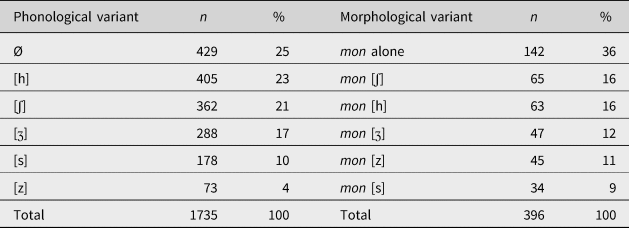
We organize the results around the research questions. We begin with the first question concerning the subject forms produced by the participants in this sample. The repertoire of subject forms includes twelve different forms: unexpressed subjects (Ø), five bare clitic forms ([h], [ʃ], [ʒ], [s], [z]), five doubled clitic forms (mon [h], mon [ʒ], mon [z], mon [s]), and the tonic pronoun mon without an accompanying atonic pronoun. Table 1 provides the frequency of use of these forms and distinguishes between phonological and morphological variants, and Figure 1 illustrates the distribution of all subject forms together. When all forms are considered collectively, the most frequent form was the unexpressed subject, occurring in twenty percent of the 1sg subject contexts that we analyzed. The three other forms that were used at least ten percent of the time were overt atonic subjects: [h], [ʃ], and [ʒ]. When the participants used mon, they used it more often with an overt clitic pronoun (n = 254) than alone (142 contexts). Overall, however, it was much more common for speakers to not use mon (n = 1735).
Distribution of 1sg subject forms (N = 2131; see Table 1 for token counts.)

Frequency of 1sg subject forms

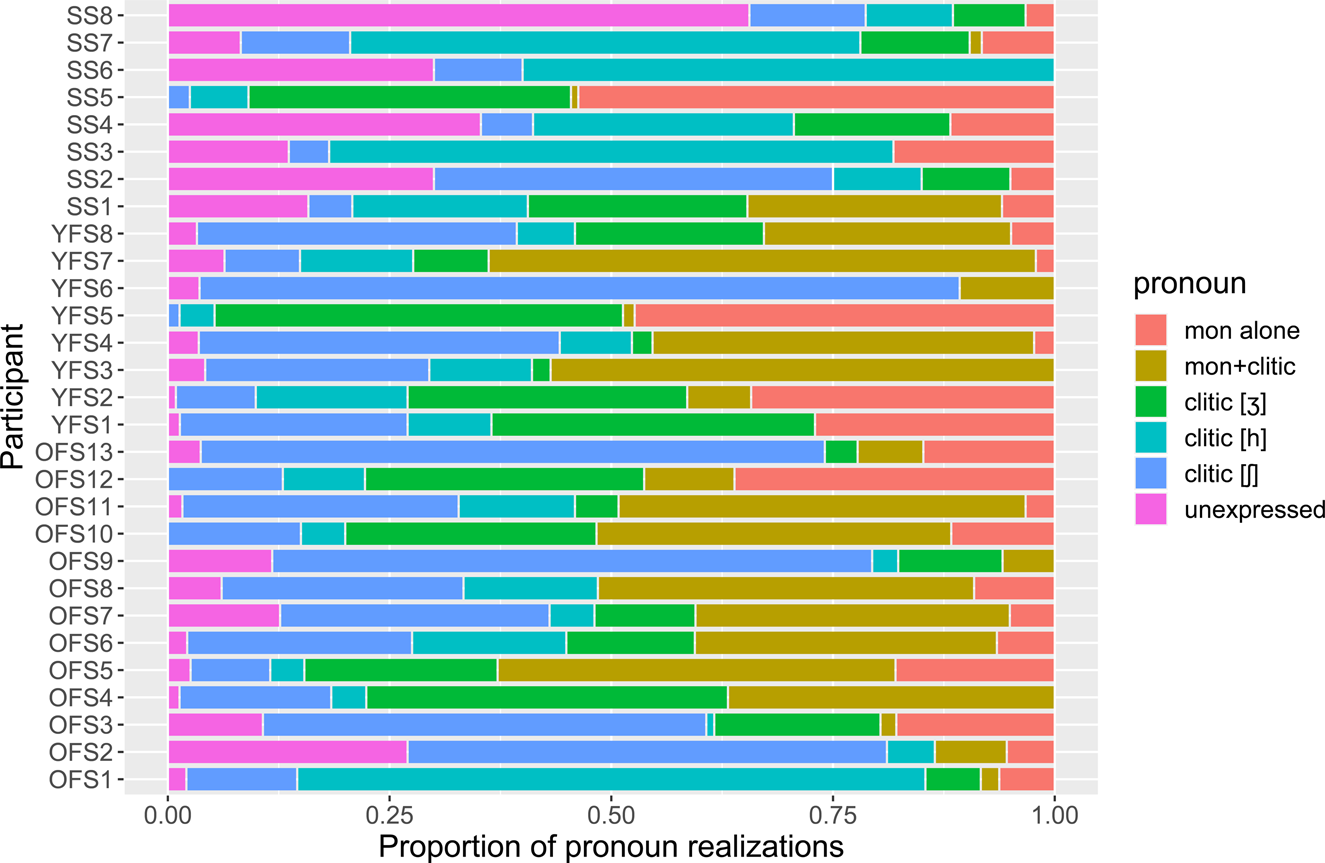
To provide a visual representation of the distribution of some of the more frequent forms among individuals, Figure 2 illustrates the realizations of tonic and atonic pronouns for each speaker. It can be observed that fluent speakers (participant aliases that begin with “OFS” and “YFS”) tended to use overt atonic pronouns more than semi-speakers (participant aliases that begin with “SS”), and although mon (alone and with clitic) was found across a number of speakers, it appeared in highest rates among semi-speakers. There are also some semi-speakers who never use the phonological variant [h].
Pronoun realization (n = 1880) across participants (N = 29).

The patterns in Figures 1 and 2 echo some previous findings and challenge others. To begin with, we identified the same twelve forms that occurred in data elicited from a translation task in Carmichael and Gudmestad (Reference Carmichael and Gudmestad2019), suggesting internal validity of this dataset and the particular forms that are in common use in this community regardless of task type. We also see many of the variants identified in previous work on Louisiana French, although the rates at which they appear differ in various ways. In particular Dubois (Reference Dubois and Donabédian2001) argued that mon alone was the result of limited exposure to the language; since we see its use distributed across fluent and nonfluent speakers alike, our data challenges this interpretation—at least for this particular dialect of Louisiana French. Also noteworthy, the most frequent form in the dataset was the unexpressed subject, occurring 20% of the time. This is a notable increase in the unexpressed subject compared to Rottet's (Reference Rottet1996) findings with data collected in this same community using similar methods 15 years earlier, in which he found an overall rate of 2.7% unexpressed subjects (with his youngest speakers, a mix of fluent and semi-speakers who were under thirty years of age in 1993, featuring the highest rate of unexpressed subjects in his corpus at 7%). This shift toward an increase in unexpressed subjects cannot be explained by contact with English, where the subject is typically expressed, nor can it be explained by limited exposure since it is present in even our oldest fluent speakers. Thus, it appears that these data suggest the advancement of the change in progress originally noted by Rottet (Reference Rottet1996), taken up by both fluent and nonfluent speakers.
Next, we turn to the two mixed-effects models, in which each dependent variable and nominal independent variable have a reference point and the other category (or categories) of these variables is (are) compared to the reference point. A positive estimate signifies a higher log-odds of using a nonreference point category (compared to the reference point), whereas a negative estimate denotes a lower log-odds of using a nonreference point category. The p-value shows whether the effect is significant (α = 0.05; significance is when p < α).
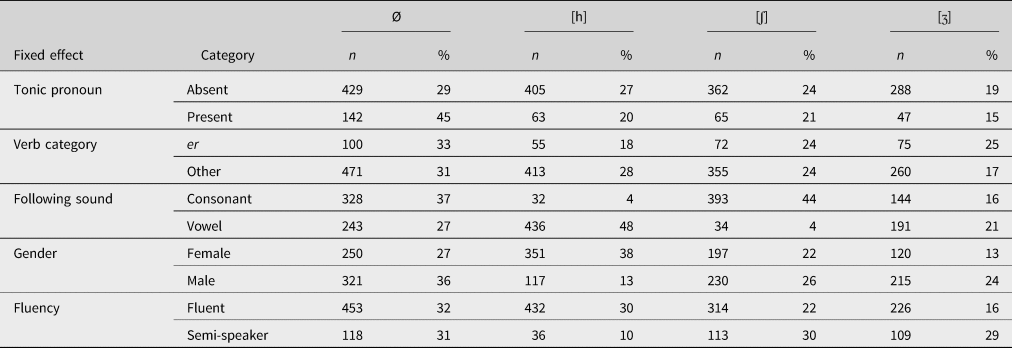
The first mixed-effects model pertained to the second research question and examined the most frequent phonological pronouns: Ø, [h], [ʃ], and [ʒ] (n = 1,801). This analysis included the use of these subject forms with and without mon. The frequency of the four variants was as follows: Ø (n = 571, 32%), [h] (n = 468, 26%), [ʃ] (n = 427, 24%), and [ʒ] (n = 335, 19%). Thus, this model has a multinomial dependent variable. With this type of regression, the reference point of the dependent variable (Ø in this case) is compared to each of the nonreference-point categories. This model revealed that tonic pronoun, verb category, following sound, speaker gender, and fluency predicted the use of the phonological variants (see Table 2 for the distribution of the significant independent variables across the variants). None of the significant factors were strongly correlated. Age, referent continuity, perseveration, and log-verb frequency were not significant. We explored interactions between the significant social factors (gender and fluency). They were strongly correlated with significant fixed effects, so they were removed from the model. The results for the fixed effects are available in Tables 3 through 5 and the details of the random effect are in Table 6. This model accurately predicted 67% of the data, whereas a null model correctly predicted 32% of the data. Thus, the model illustrated in Tables 3 through 6 does a good job of fitting the data.
Frequency of the phonological variants across categories of significant fixed effects

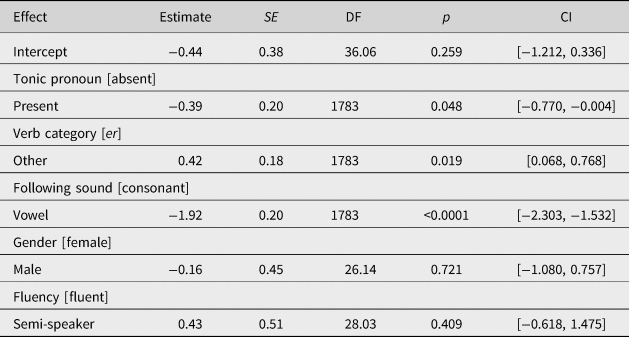
Details of the fixed effects in the phonological regression model: Ø versus [h]

Note. The reference point for the dependent variable is the unexpressed subject. The reference points for the nominal independent variables are bracketed.
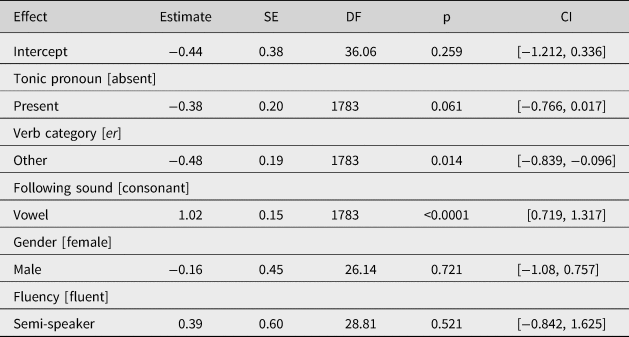
While there is a separate table for each comparison in the regression (Table 3: Ø versus [h], Table 4: Ø versus [ʃ], and Table 5: Ø versus [ʒ]), it is important to note that these results come from a single mixed-effects model. To facilitate the understanding that the results come from one mixed-effects model, we discuss each significant independent variable in turn. Beginning with tonic pronoun, the model revealed that speakers were less likely to use [h] and [ʃ] compared to Ø when the tonic pronoun mon was present (versus absent). The variant [ʒ] patterned in the same direction as the other overt pronouns but was not significant. The findings for this factor suggest the use of an overt phonological pronoun discourages the use of mon.
Details of the fixed effects in the phonological regression model: Ø versus [ʃ]

Note. The reference point for the dependent variable is the unexpressed subject. The reference points for the independent variables are bracketed.
Details of the fixed effects in the phonological regression model: Ø versus [ʒ]

Note. The reference point for the dependent variable is the unexpressed subject. The reference points for the independent variables are bracketed.
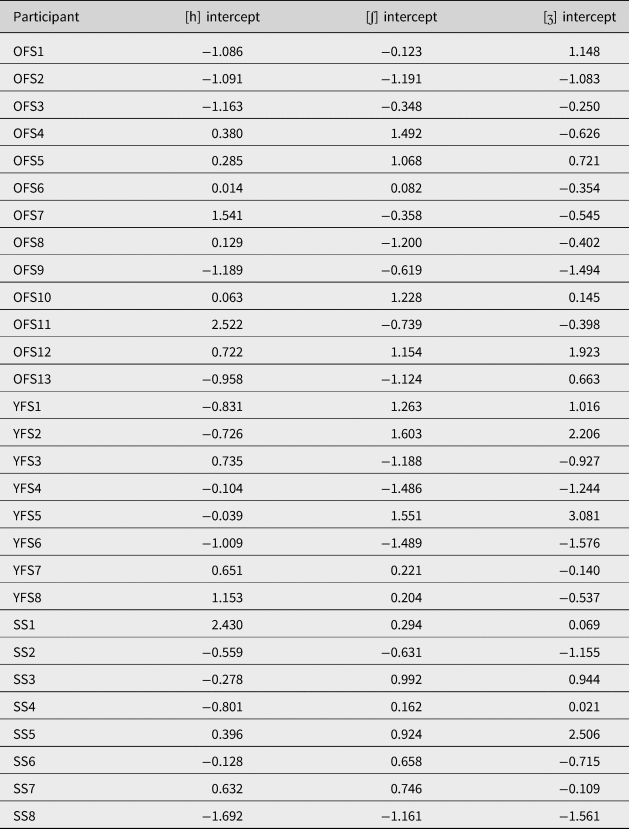
Results for the random effect in the phonological mixed-effects model

For verb category, the findings differed for each comparison. Speakers were more likely to use [ʃ] with verbs other than er verbs. The opposite pattern was observed for [ʒ]. They were less likely to use [ʒ] versus an unexpressed subject with other category verbs compared to er verbs. This factor was not significant for [h] compared to Ø. Thus, despite similarities among the phonological variants with the tonic pronoun variable, the results for verb category suggest that the phonological variants may exhibit different linguistic patterns of use.
The third significant linguistic factor was the following sound, which constrained the use of each phonological variant in the mixed-effects model. Regarding the comparisons between [h] and Ø and between [ʒ] and Ø, the participants exhibited a higher likelihood of using [h] and [ʒ] when the following sound was a vowel compared to a consonant. They were also less likely to use [ʃ] when the following sound was a vowel compared to a consonant. These findings align with previous documentation of Louisiana French used in this region (Rottet, Reference Rottet2001).
Regarding gender, men were less likely than women to use [h] compared to Ø, and there were no significant differences between [ʃ] or [ʒ] and Ø. Salmon (Reference Salmon2007) and Dajko (Reference Dajko2009) also found men to be less likely to use [h] than women in analyses of this variation beyond the 1sg subjects, which they argued was a reflection of women maintaining the French language longer than men due to gendered distributions of labor that meant men worked in (predominantly Anglophone) positions outside the home. Thus, the present investigation adds to the evidence that [h] represents a gendered form of variation within the community, contributing support for the claim that linguistic variables can take on social meaning in obsolescing languages (see Kasstan [Reference Kasstan2019] for additional evidence in Francoprovençal).
The final significant factor was fluency. Semi-speakers were less likely than fluent speakers to use [h] compared to Ø; no significant differences were found for the other comparisons in the model. Thus, although it was reasonable to expect that fluency modulated the use of 1sg subjects (e.g., Dubois & Noetzel, Reference Dubois and Noetzel2005), we found that its effect on the phonological variants was limited to certain forms, specifically the comparison of [h] and Ø. Notably, this patterning for [h] is not unexpected given prior research. In a broader examination of the [h] allophone that was not limited to its use in subject expression, Carmichael (Reference Carmichael2017) noted that this variant was exceedingly infrequent in the speech of Point-Au-Chien Indian semi-speakers, which she argued was evidence that this form of variation was not acquired by some speakers as a result of increased exogamy and movement away from the predominantly Francophone environments down the bayou. Our analysis builds on Carmichael's findings. However, to clarify, while this particular form of variation was not acquired by all semi-speakers, several other forms were, highlighting the importance of considering semi-speaker data in language death situations.
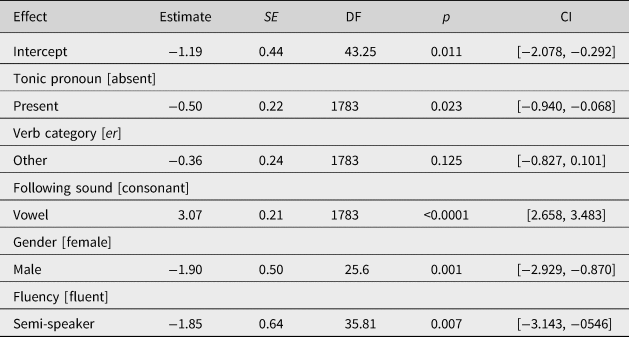
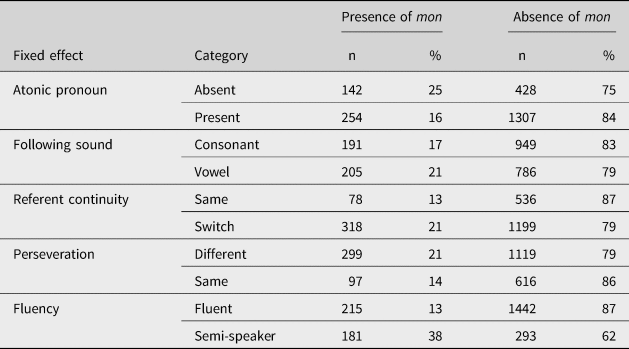
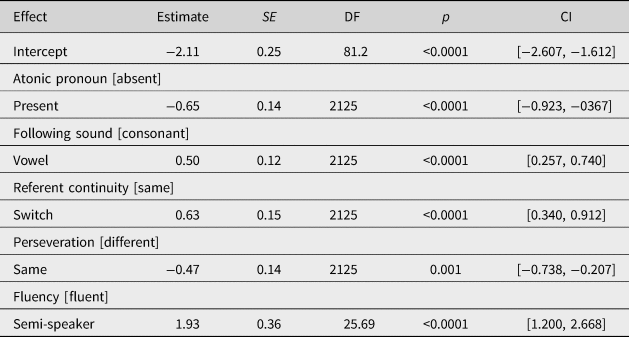
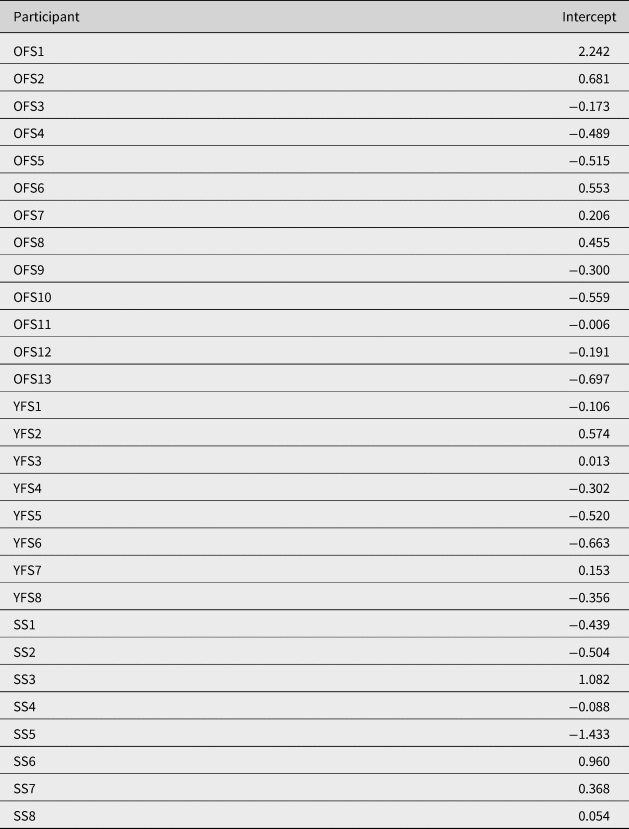
Lastly, we fit a mixed-effects model to investigate the use of the tonic pronoun mon and to answer the third research question. For this model, we analyzed the entire dataset (N = 2,131). The frequency of the two categories of the dependent variable was as follows: presence of mon (n = 396, 19%) and absence of mon (n = 1735, 81%). In this model we found that atonic pronoun, following sound, referent continuity, perseveration, and fluency were significant (see Table 7 for the distribution of the significant, independent variables across the categories of the dependent variable). Tables 8 and 9 provide the results for the fixed and random effects, respectively. Verb category, log-verb frequency, gender, and age were not significant.
Frequency of the morphological variants across categories of significant fixed effects

Details of the fixed effects in the morphological regression model

Note. The model fits the log-odds of using mon. The reference points for the independent variables are bracketed.
Results for the random effect in the morphological mixed-effects model

Concerning the significant linguistic factors, the speakers were less likely to use mon when an atonic pronoun was present. This result aligns with the findings from the phonological model, such that when speakers produce an overt subject form, they tend to use either an atonic or tonic subject, not both (thus, the subject form mon je–regardless of phonological realization of je–was dispreferred). The participants were more likely to use mon when the following sound was a vowel. To our knowledge, the present investigation is the first to examine the role of this factor on the use of the mon—initially coded for due to our phonological considerations in this study. That is, by expanding our definition of subject expression to include phonological and morphosyntactic variants, we were able to uncover a pattern that was not previously tested for. Participants were also more likely to use mon when there was a switch in referent from the preceding tensed verb (referent continuity). Research on Spanish has consistently reported that overt pronouns are more likely than unexpressed subjects in switch-reference contexts (e.g., Carvalho et al., Reference Carvalho, Orozco and Shin2015). The current study's findings share similarities with this trend in Spanish, though the results are not identical. Foremost, the phonological model did not reveal a significant effect for referent continuity, meaning that overt atonic pronouns were not more likely to occur than unexpressed subjects in contexts of switch reference. However, the significant results in the tonic model suggest that mon was favored in contexts of switch reference. For the final linguistic factor, perseveration, the participants were less likely to use mon when the subject form of the previous mention of the same referent was also mon, a finding that diverges from findings on Spanish and that invites future research. Lastly, fluency was the sole constraining social factor; semi-speakers were more likely to use mon than fluent speakers. That is, while mon is not restricted to nonfluent speakers nor does it appear to be an innovation stemming from semi-speakers’ imperfect acquisition of French (evidenced by its attestation in fluent speaker groups across Louisiana), it does appear to be a preferred variant for semi-speakers. This perhaps echoes Rottet's (Reference Rottet1996) points about the salience of tonic pronouns in language-acquisition contexts and suggests an important arena where research on language acquisition might provide insights on the processes of acquisition in language death situations—especially the acquisition of particular forms of variation.
This model correctly predicted 84% of the observations in the dataset, whereas a null model accurately predicted 81% of the data. Thus, the model illustrated in Tables 8 and 9 does a slightly better job of fitting the data than a null model.
Discussion
The answers to our research questions are as follows:
(1) The participants produced twelve 1sg subject forms: the unexpressed subject, [h], [ʃ], [ʒ], [s], [z], mon [h], mon [ʒ], mon [z], mon [s], and mon alone.
(2) Tonic pronoun, verb category, following sound, speaker gender, and fluency impacted the use of the most frequent phonological variants.
(3) Atonic pronoun, following sound, referent continuity, perseveration, and fluency predicted the use of the tonic pronoun mon.
Thus, these findings suggest that 1sg subject expression in the French of the Point-Au-Chien Indians of Terrebonne and Lafourche Parishes in Louisiana patterns in complex and systematic ways according to both linguistic and social factors, and that this is true for fluent and semi-speakers. This lends support to claims by Wolfram (Reference Wolfram, Chambers, Trudgill and Schilling-Estes2004) and others that language variation in language death contexts is similar to that found in healthy language contexts because our analysis provides evidence of the multidimensional systematicity of this variation (i.e., it is conditioned by a range of factors). The fact that patterning was robust for semi-speakers aligns with research in the field of second language acquisition that has demonstrated that learners at different proficiency levels show complex and systematic variability in their additional language (Geeslin & Long, Reference Geeslin and Long2014). In other words, it is not a feature that is restricted to highly proficient speakers. The significance of gender as a predictor of 1sg subject expression in Louisiana French may point to potential social significance of this variation, as some other researchers have noted in language death situations (e.g., Kasstan, Reference Kasstan2019; Wolfram, Reference Wolfram, Chambers, Trudgill and Schilling-Estes2004:780), though further analysis is needed for such a claim.
We assert that not only were variationist methods suitable and valuable in analyzing this dataset, but that examinations of variation in language death contexts can also provide broader insights to variationists. To begin with, our analysis points to some methodological concerns that are not necessarily specific to obsolescing languages, but this lens of “heightened variation” allowed us to engage with them. By endeavoring to capture all forms of variation in subject expression, not just the phonological variation in atonic pronouns or the morphosyntactic variation in tonic pronouns, we provide a model for applying multivariate analyses to variation with many forms (cf., Gorman & Johnson, Reference Gorman, Johnson, Bayley, Cameron and Lucas2013). Moreover, while the large number of forms that the participants used for 1sg subjects prevented us from being able to analyze all forms in one mixed-effects model, we explored other ways of conducting a variationist analysis. We decided to fit two models: one consisted of the four most frequent phonological variants and the other centered on the tonic pronoun mon. The disadvantages of this analysis are that there are other forms that have not yet been accounted for (e.g., [s]) and that the separation of phonological and morphological forms into two analyses meant that we modeled two phenomena. We attempted to address the latter by including the independent variables of tonic pronoun and atonic pronoun in the phonological and morphological models, respectively. The fact that each of these independent factors was significant allowed us to begin to see the ways in which the phonological and morphological variants are connected in participants’ use of 1sg subject expression. Despite these disadvantages, there are benefits to the decision to fit two models. One strength is specific to Louisiana French: We were able to explain the multifactorial use of more 1sg subject variants than had been investigated previously (Dubois, Reference Dubois and Donabédian2001). Another advantage is that we offered a possible way to extend the variationist approach to a linguistic variable with numerous variants by way of the two mixed-effects models that we fit, including the atonic and tonic pronoun independent variables in order to document the relationship between these forms of variation.
Another issue we faced in this study that is common to language death situations (Blainey, Reference Blainey2017)—but not necessarily limited to language death situations—was that of small token counts. Although we found sufficient variation is 1sg subject forms in order to perform multivariate statistical analyses on our data, not all participants contributed enough observations for the models to converge. One solution could have been to eliminate these participants from the model. However, since these participants still contribute knowledge about subject expression, we were motivated to try to keep them in the analysis. Therefore, we used the Kenward-Roger method to compute the denominator degrees of freedom, which leads to a conservative type-I error rate in our model (McNeish, Reference McNeish2017). We also employed the restricted maximum likelihood estimation approach to reduce the bias in the random effect estimates. Such approaches might be relevant to any researcher studying forms of variation with low token counts. Thus, with both methodological issues, we see how research on obsolescing languages can provide insights about the choices we make as researchers because the current study could not be undertaken without finding proper solutions for some of these commonly worked-around issues.
Beyond methodological insights, we contend that variationist research on obsolescing and minority languages can provide a unique lens into the acquisition of variation precisely due to the circumstances of these language situations. For example, in the case of Louisiana French among the Point-Au-Chien Indians, this sample of speakers has minimal contact with mainstream, institutionalized varieties of French and is not literate in French. This means that their vernacular speech in some ways controls for the kinds of hypercorrection that is observed in healthy language contexts (e.g., Labov, Reference Labov and Bright1966). In other words, these factors are controlled for. And yet we still see evidence of both socially and linguistically constrained forms of variation, which we are able to document and explain. Another opportunity we wish to highlight in analyzing variation in language death situations is the light such analyses may shed on the acquisition of variation. Especially in the case of semi-speakers, who have limited input and yet still demonstrate robust acquisition of existing variation, we can circumscribe the limits and reaches of socially meaningful variation even in a context in which domains of use and diversity of interlocutors are greatly diminished. Indeed, we suggest that a key direction for future research on variation in obsolescing languages is to analyze the difference between New Speakers (e.g., Kasstan, Reference Kasstan2019), who actively participate in language revitalization often in institutionally supported ways, and semi-speakers who do not have revitalization efforts behind them.
Conclusion
We examined 1sg subject expression in a variety of Louisiana French spoken in Terrebonne and Lafourche Parishes where twelve subject forms exist. Multivariate analyses of a subset of the forms demonstrated that the participants’ systematic use of these forms is conditioned by a range of linguistic and social factors. Further research is needed to examine in greater detail all twelve forms that occurred in our dataset and to investigate other communities of Louisiana French speakers to determine how generalizable the findings are. We demonstrated that use of variationist methods is robust for situations of language death and, in doing so, contributed additional evidence to support the claim that variability in obsolescing languages is systematic, just as it is in healthy languages (Kasstan, Reference Kasstan2019; Wolfram, Reference Wolfram, Chambers, Trudgill and Schilling-Estes2004).
We furthermore offered examples of how variationist research on obsolescing languages can provide key methodological and theoretical insights on variationists sociolinguistics. First, the solutions we adopted to address the methodological challenges that we encountered may be useful to other researchers who are working with variables that have many variants and for those who are working with variants that have very low frequency for some speakers. Moreover, we proposed that additional research on semi-speakers in language death situations could advance what we know about the acquisition of socially meaningful variation.
Acknowledgments
This work was supported by a grant from the Virginia Tech Institute for Society, Culture and Environment. We also thank the Point-Au-Chien Indian Tribe for welcoming us into their homes and their communities to document their speech, and Rocky McKeon for conducting interviews alongside the second author.
Appendix Participant Information