I. INTRODUCTION
In recent years, nuclear fusion has attracted the attention of scientists, and nuclear fusion energy can be considered as a clean and unlimited energy source for mankind in the future. It is being developed internationally through the International Thermonuclear Experimental Reactor Project, which aims to demonstrate that the combustion of deuterium–tritium plasma extends in the fusion reaction. Tungsten is considered as the most promising candidate for designing plasma facing materials for the first wall and the divertor in future nuclear fusion power reactors, due to some attractive engineering properties at higher temperatures.Reference Tanabe, Noda and Nakamura1–Reference Zhang, Wen and Zhang6 Examples include high melting point, high strength at elevated temperatures, high thermal conductivity, low sputtering yield in radiation environment, and low tritium inventory. However, also there are shortcomings of using pure tungsten metal, such as its low ductility, high ductile-to-brittle transition temperature and low recrystallization, high-temperature or recrystallization brittleness, radiation-reduced brittleness, and hardness associated with fracture toughness at low temperatures. In addition, H/He, neutron irradiation, and high heat flux cause extensive damage to the plasma facing materials. These problems exert a negative influence on the applications of plasma facing materials and restrict their utilization in the nuclear fusion environment.Reference Kajioka, Sakamoto, Nakai, Kobayashi, Kurishita, Matsuo and Arakawa7–Reference Xu, Beck, Armstrong, Rajan, Smith, Bagot and Roberts9 Therefore, many properties of pure tungsten metal need to be improved to withstand better in the nuclear fusion environment. In other words, it is very important to develop novel tungsten materials with high ductility, high stability, high temperature resistance and high irradiation properties. The engineering properties of pure tungsten metal can be improved effectively using alloying. For example, by alloying with other related elements, the thermodynamic properties of pure tungsten metal improved effectively.Reference Kim, Oh, Oh and Moon10,Reference Dosovitskiy and Samoilenkov11 The tungsten–zirconium material to be studied in this paper has also attracted many researchers’ interests. Ren et al.Reference Ren, Liu and Ning12 studied the microstructure and mechanical properties of tungsten–zirconium reactive materials. The sample of tungsten–zirconium reactive material was prepared by hot-pressing elemental powder mixtures. The mass ratio of zirconium to tungsten in the sample was 66:34, and the maximum quasi-static compressive strength was about 1880 MPa. Luo et al.Reference Luo, Wang, Jiang, Mao and Li13 studied the impact-initiated characters of tungsten–zirconium energetic fragments. The reaction of high-energy tungsten–zirconium fragments under impact conditions was related to the shock energy, which was codetermined by the impact velocity of the fragments, the materials used, and the thickness of the plates. For high-energy fragments of tungsten–zirconium-based alloy composites, the critical energy was about 3.8 MJ/m2. Effective energy was codetermined by impact pressure and shock energy. As impact pressure increased, effective energy first increased and then decreased. When impact pressure was 16.4 GPa, effective energy reached the maximum. Fu et al.Reference Fu, Liu, Wang, Li, Zhu, Zhang, Zhang and Hu14 studied high-temperature deformation behaviors of tungsten–zirconium based on an amorphous interpenetrating composite. The amorphous interpenetrating composite of tungsten–zirconium consisted of two interconnected phases of tungsten and zirconium of amorphous state. The deformation behavior of the composite material was described from the aspects of its structure, properties of tungsten, and amorphous state. McCaffertyReference McCafferty15 used graph theory to model the passivity or corrosion behavior of binary tungsten–zirconium alloy in various electrolytes, and the correlation coefficient between the predicted critical alloy composition based on the graph theory approach and the experimental alloy composition was 0.932. Xie et al.Reference Xie, Zhang, Liu, Fang, Miao, Wang and Liu16 studied the grain growth behavior and mechanical properties of zirconium microalloying. Dense fine-grained W–1.0 wt% Zr alloys were fabricated by spark plasma sintering. Grains of tungsten–zirconium alloy were stable at an annealing temperature below 1400 °C, while those of pure tungsten metal were significant at an annealing temperature above 1100 °C. The relative density of tungsten–zirconium alloy sample was above 97.1%, and hardness was 445 HV. Tensile test shows that the toughness of the tungsten–zirconium alloy was higher at 400 °C than that of pure tungsten metal at 200 °C. The tungsten–zirconium alloy had an elongation value of about 20% at 700 °C and 104% higher than that of pure tungsten metal. Its tensile properties improved effectively, such as the enhanced grain boundary cohesion, which was due to zirconium microalloying. At 1400 °C annealing, growth of the tungsten grains in the alloy was rapid, showing that the addition of a small amount of zirconium (1.0 wt%) effectively inhibits tungsten boundary migration and that tungsten grains were stable at high temperature. A suitable zirconium alloying element can combine well with tungsten grains to form a solid solution. However, excess zirconium can cause agglomeration in grain boundaries.Reference Chen, Luo, Chen, Zan, Zhu, Xu, Luo, Chen and Wu17 In addition, microalloying can also be performed by adding minor active elements such as zirconium, titanium, and hafnium to strengthen the grain boundaries of refractory materials. These microalloying elements can react with impurities such as O and C to form high-melting-point compounds.Reference Kharchenko and Bukhanovskii18 Due to the absorption of oxygen in tungsten by zirconium, nanoscale zirconia particles were formed, which reduces the adverse effect of oxygen and effectively strengthens the grain boundaries of tungsten. As a result, fracture strength and toughness of tungsten in room temperature significantly improved.Reference Xie, Liu, Fang, Zhou, Wang and Liu19 From a theoretical perspective, based on the first-principles plane-wave pseudopotential method, the 4d and 5d transition metal elements (zirconium, hafnium, rhenium, molybdenum, tantalum, and niobium) were selected as tungsten alloying elements to study the relationship between the transition metal and single vacancy diffusion. Formation energy of single vacancy was calculated by the adjacent positions of each transition metal. Zirconium, hafnium, rhenium, and molybdenum solute atoms had beneficial effects on the formation of single vacancy compared with niobium and tantalum atoms. Regardless of the solute atoms, migration barrier energies of single vacancy in the tungsten lattice were smaller than that of pure tungsten at 1.674 eV. In particular, the effect of zirconium on the diffusion of vacancy in the tungsten lattice was the highest. In the tungsten–zirconium system, the minimum migration barrier energy was about 0.859 eV.Reference Wen, He, Cui, Pan, Huang and Zhao20 At the same time, first-principles calculations also showed that cohesion effect of transition metals such as zirconium, hafnium, and rhenium on tungsten grain boundaries can significantly strengthen the grain boundaries and improve grain growth at high temperatures, which further reduces the fracture toughness of tungsten alloys.Reference Setyawan and Kurtz21 In addition, when zirconium was in substitutional sites of the tungsten lattice, the solution energy of zirconium was less than zero, which suggests that zirconium elements were easily dissolved in tungsten.Reference Kong, Wu, You, Liu, Fang, Chen, Luo and Wang22 However, so far, the influence of zirconium alloying and zirconium atomic concentration on the crystal structures and mechanical properties of pure tungsten metal is rarely reported, and the theoretical research is even less. Improving the mechanical properties of plasma facing materials irradiated by deuterium–tritium plasma is one of the most important issues in the International Thermonuclear Experimental Reactor Project. Although tungsten alloys are usually not used for structural purposes because of their brittleness at low temperatures, they can retain structural integrity during their lifetime. Therefore, mechanical properties of tungsten-based materials are especially important for their application in the nuclear fusion environment. Based on the plastic properties and toughness/brittleness, the composition of the binary tungsten–zirconium alloys can be further optimized.
In addition, due to the high cost and time-consuming nature of the traditional alloy process design, computational materials science can help design tungsten–zirconium alloy materials by studying the relationship between structure and performance of the materials. The emphasis of computer simulation is to find theoretical parameters to improve the performance of specific alloys, which greatly reduces the number of combinations required.Reference Shi, Tanaka and Kohyama23–Reference Yang, Wu, Cui, Chen, Shi, Wang and Yan27 At the same time, the density functional theory (DFT) is a method of efficient approximation for determining a multielectronic systemReference Shi, Gao, Liu, Zhao, Wu, Ju, Ouyang and Xiao28 structure, which obtains the total energy of a multielectronic system according to the principle of energy minimization. In this paper, structural models with a minimum energy were used to study the mechanical properties.
Therefore, we studied the crystal structures and mechanical properties of binary W1−xZrx alloys (x = 0, 0.0625, 0.125, 0.1875, 0.25, and 0.5) based on the first-principles method. We investigated the cell volume (V), lattice constants (LC), formation energies (E f), and elastic constants (C ij) of binary W1−xZrx alloys and determined their mechanical parameters such as the ratio of bulk modulus to shear modulus (B/G ratio), Young’s modulus (E), Poisson’s ratio (ν), and Cauchy pressure (C′). Finally, we evaluated the ductility and mechanical strength of binary tungsten–zirconium alloys.
II. MODEL AND COMPUTATIONAL METHODS
A series of calculations in this paper were based on the DFT and plane-wave pseudopotential method in the VASP.Reference Kresse and Hafner29,Reference Kresse and Furthmüller30 The interaction between valence electron and core ion was described using the projector-augmented wave (PAW)Reference Blӧchl31 method. The valence electrons of W and Zr atoms were W-6s 25d 4 and Zr-5s 24d 2, respectively. The generalized gradient approximation (GGA) of Perdew and Wang (PW91)Reference Wang and Perdew32 was used to deal with the exchange-correlation part. The structural calculation model of 2 × 2 × 2 Asupercell with 16 atoms was used for all tungsten–zirconium alloys. The tungsten atoms were replaced with zirconium atoms, and the tungsten–zirconium alloys with different zirconium concentrations were obtained. They were named pure W, W0.9375Zr0.0625, W0.875Zr0.125, W0.8125Zr0.1875, W0.75Zr0.25, W0.5Zr0.5, and pure zirconium, respectively. The Brillouin-zone sampling of all binary tungsten–zirconium alloys was 11 × 11 × 11 Monkhorst–Pack meshReference Monkhorst and Pack33 and a hexagonal close packing (HCP) zirconium metal phase with 10 × 10 × 6 Monkhorst–Pack mesh. The energy cutoff of 450 eV was set for all the calculations. The k-mesh and charge density mesh (ENCUT) were tested in our study, and all tests supported that the final parameters presented in the computational details part are accurate enough. All the calculations used Gaussian smearing method of width 0.05 eV to deal with the metallic systems. The equilibrium lattice constant of BCC tungsten was calculated as 3.176 Å, which quite well matches with other theoretical and experimental data.Reference Jin, Liu, Zhou, Zhang and Lu34,Reference Kittel35 This shows the accuracy of our results.
Symmetric operation was applied to the cubic crystal according to the continuum elasticity theory.Reference Wallace36,Reference Zhao, Winey and Gupta37 The cubic crystal structure has only three independent elastic constants: C 11, C 12, and C 44. Therefore, the elastic constant matrix of cubic crystal is as follows:
 $$[C] = \left[ {\matrix{ {{C_{11}}} & {{C_{12}}} & {{C_{12}}} & 0 & 0 & 0 \cr {{C_{12}}} & {{C_{11}}} & {{C_{12}}} & 0 & 0 & 0 \cr {{C_{12}}} & {{C_{12}}} & {{C_{11}}} & 0 & 0 & 0 \cr 0 & 0 & 0 & {{C_{44}}} & 0 & 0 \cr 0 & 0 & 0 & 0 & {{C_{44}}} & 0 \cr 0 & 0 & 0 & 0 & 0 & {{C_{44}}} \cr} } \right]\quad .$$
However, for the hexagonal crystal system, there are five independent elastic constants: C 11, C 12, C 13, C 33, and C 44. Hence, the elastic constant matrix of hexagonal crystal system is as follows:
 $$[C] = \left[ {\matrix{ {{C_{11}}} & {{C_{12}}} & {{C_{13}}} & 0 & 0 & 0 \cr {{C_{12}}} & {{C_{11}}} & {{C_{13}}} & 0 & 0 & 0 \cr {{C_{13}}} & {{C_{13}}} & {{C_{33}}} & 0 & 0 & 0 \cr 0 & 0 & 0 & {{C_{44}}} & 0 & 0 \cr 0 & 0 & 0 & 0 & {{C_{44}}} & 0 \cr 0 & 0 & 0 & 0 & 0 & {{{C{}_{11} - C{}_{12}} \over 2}} \cr} } \right]\quad .$$
According to the Hooks law, with a small strain (δ) on the solid lattice of tungsten–zirconium alloys, the energy changes ΔE is given as the quadratic function of the strains (δ), as follows:
 $$\Delta E = {V \over 2}\sum\limits_{i,j = 1}^6 {{C_{ij}}{e_i}{e_j}} \quad ,$$
where ΔE is the energy changes of the unit cell before and after deformation, V is the volume of unstrained unit cell, C ij is the elastic constant, and e i and e j are the components of strain matrix. These elastic constants can be obtained by fitting the energy changes (ΔE) versus the strains (δ). The relationship between total energy changes (ΔE) and the strains (δ) is shown in Table I. In addition, the correlation coefficient between the fitted curve and the calculated point is above 0.99, which indicates the calculation accuracy and also that the calculation method can obtain more accurate mechanical constants.
The relationship between total energy changes (ΔE) and the strains (δ) of cubic and hexagonal crystals.

Then, using these elastic constants, the mechanical parameters of the binary tungsten–zirconium alloy, namely Bulk modulus, Shear modulus, Young’s modulus, Poisson’s ratio, and Cauchy pressure, are calculated according to the Voigt–Reuss–Hill scheme:Reference Voigt38–Reference Hill41
 $$B = {{{C_{11}} + 2{C_{12}}} \over 3}\quad ,$$
 $$G = {{3{C_{44}} + {C_{11}} - {C_{12}}} \over 5}\quad ,$$
 $$E = {{9BG} \over {3B + G}}\quad ,$$
 $$\nu = {{3B - 2G} \over {2\left( {3B + G} \right)}}\quad ,$$
 $$C' = {{{C_{12}} - {C_{44}}} \over 2}\quad .$$
III. RESULTS AND DISCUSSION
A. The energetics and microstructure of binary tungsten–zirconium alloys
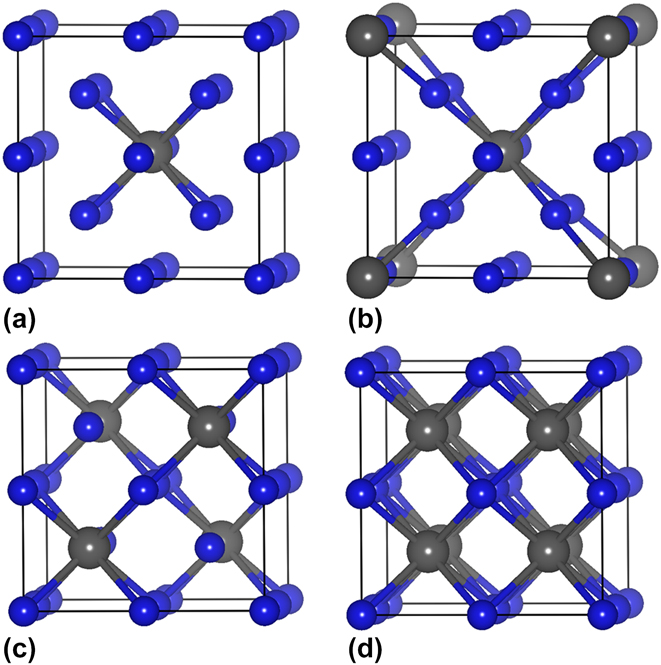
Firstly, we studied and optimized the atomic location and configuration of the tungsten–zirconium alloy with different zirconium concentrations and then selected the configuration with the lowest total energy for further study. Figure 1 shows the four lowest energy atomic configurations of binary W1−xZrx alloys, with the x values of 0.0625, 0.125, 0.25, and 0.5, respectively: Fig. 1 (a) W0.9375Zr0.0625 alloy, (b) W0.875Zr0.125 alloy, (c) W0.75Zr0.25 alloy, and (d) W0.5Zr0.5 alloy. The results show that the BCC structure is still maintained in the binary tungsten–zirconium lattice, while the zirconium atom is ensures the highest symmetry of the structure of tungsten–zirconium alloys. This indicates that binary tungsten–zirconium alloys can form solid solution at the atomic level.
The optimal atomic arrangements of the BCC W1−xZrx (x = 0.0625, 0.125, 0.25, and 0.5) alloys in a 2 × 2 × 2 supercell. (a) W0.9375Zr0.0625 alloy, (b) W0.875Zr0.125 alloy, (c) W0.75Zr0.25 alloy, and (d) W0.5Zr0.5 alloy. Large gray and small blue balls are Zr and W atoms, respectively.

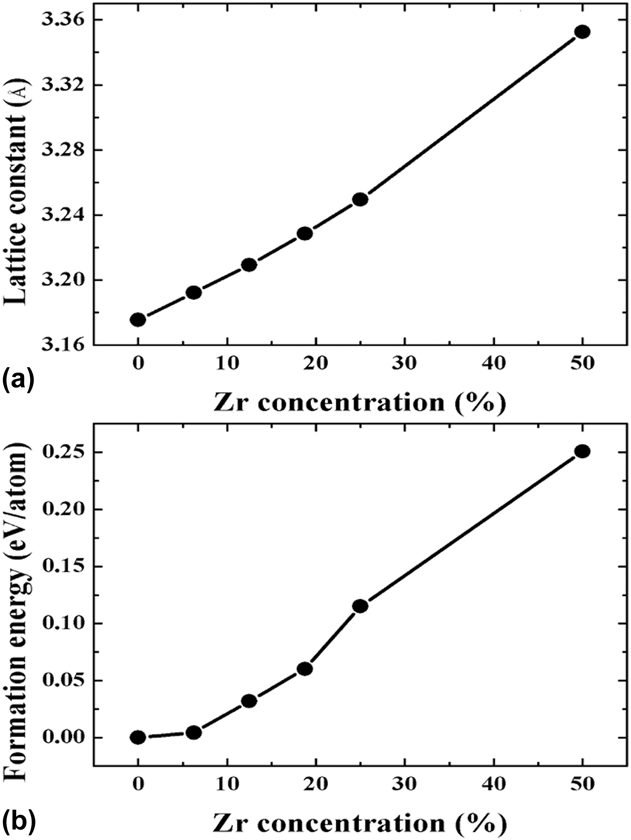
In addition, we calculated the total energy as a function of volume, then used Birch–Murnaghan equation of state to fit these results, and calculated the equilibrium lattice constants of binary tungsten–zirconium alloys. Figure 2(a) shows the equilibrium lattice constants of binary W1−xZrx alloys, which change with the zirconium concentration x. Meanwhile, the calculated lattice constants and cell volumes are shown in Table II. The lattice constants of tungsten–zirconium alloys increase almost monotonically with an increasing zirconium concentration because the radius of the zirconium atom is higher than that of the tungsten atom. It is worth mentioning that we also tested the total energies of the alloys in BCC tungsten lattice and compared them with those of alloys in HCP zirconium lattice with the same concentration ratio. The total energies of binary tungsten–zirconium alloys in the BCC tungsten lattice are smaller than that of alloys in the HCP zirconium lattice. For example, the total energy of W0.5Zr0.5 alloy with BCC tungsten lattice (−166.98 eV) is smaller than that of W0.5Zr0.5 alloy with HCP zirconium lattice (−163.46 eV). This indicates that binary tungsten–zirconium alloys can form a solid solution in the BCC tungsten lattice. In addition, we also compared the 2 × 2 × 2 supercell with a zirconium atom and 4 × 4 × 4 supercell with eight zirconium atoms and found that the periodicity of the zirconium position has little influence on the mechanical properties. The mechanical properties are mainly associated with the solubility of zirconium atoms.
Lattice constants (a) and formation energies (b) of BCC W–Zr alloys as a function of Zr concentration.

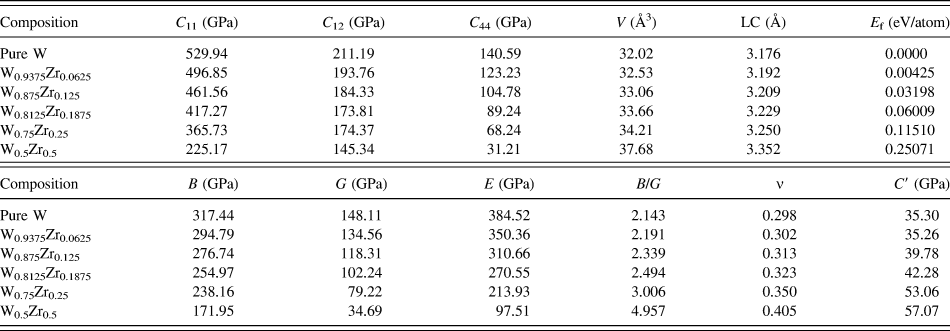
The elastic constants (C ij), cell volumes (V), formation energies (E f), bulk modulus (B), shear modulus (G), Young’s modulus (E), B/G ratio, Poisson’s ratio (ν), and Cauchy pressure (C′) of BCC W1−xZrx alloys.

To evaluate the structural stability of binary tungsten–zirconium alloys, we thus calculated the formation energies of binary W1−xZrx alloys, which are as follows:
 $${E_{\rm{f}}} = {1 \over N}\left[ {{E_{{\rm{W}} - {\rm{Zr}}}} - \left( {1 - x} \right){E_{\rm{W}}} - x{E_{{\rm{Zr}}}}} \right]\quad ,$$
where x is the concentration of the zirconium atoms, N is the total atomic number of the alloy structure, and E W, E Zr, and E W–Zr are the total energies of pure tungsten metal, pure zirconium metal, and binary tungsten–zirconium alloy, respectively. Based on the definition of formation energy, when the formation energy is negative, the structure of binary tungsten–zirconium alloy is thermodynamically stable. Figure 2(b) shows the functional relationship between the formation energy and zirconium concentration. Meanwhile, the calculated formation energies are shown in Table II. As shown in the table, the formation energy of binary tungsten–zirconium alloys is positive and increases with the increase in zirconium concentration, which suggests that the thermodynamic stability of binary tungsten–zirconium alloys is relatively poor. At the same time, this also indicates that it is necessary to have an endothermic reaction to form solid solution of tungsten–zirconium alloys. However, the two tungsten–zirconium alloys with the concentration of zirconium atoms less than 12.5% show positive but very low formation energies, close to zero. These results show that the two alloys have good thermodynamic stability and can easily form alloy solid solution at the atomic level. It is also worth noting that the formation energies of all the tungsten–zirconium alloys are relatively small. As shown in Table II, the maximum formation energy of tungsten–zirconium alloy is only 0.25071 eV/atom, which further shows that the tungsten–zirconium alloys can form a solid solution at the atomic level.
B. The bond lengths of binary tungsten–zirconium alloys
The formation energy of binary tungsten–zirconium alloy is studied by analyzing the bond length of the tungsten–zirconium alloy, depending on the bonding interaction between zirconium and tungsten atoms. The average bond lengths between the zirconium and the nearest neighboring tungsten atoms are 2.795 Å, 2.779 Å, 2.807 Å, 2.811 Å, and 2.903 Å for zirconium concentration x 6.25%, 12.5%, 18.75%, 25%, and 50%, respectively. On the basis of the above bond length analysis, when the concentration of zirconium atoms is lower than 12.5%, the W–Zr bond length decreases with the increase in zirconium concentration. This shows that the bonding interaction between tungsten and zirconium atoms enhances with a higher zirconium concentration. However, when the concentration of zirconium atoms is higher than 12.5%, the W–Zr bond length increases with an increasing zirconium concentration, indicating that the bonding interaction decreases. In particular, when the concentration of zirconium atoms is 50%, the bond length of Zr–W becomes larger and the bonding interaction between tungsten and zirconium atoms further decreases. In other words, since all the tungsten atoms are surrounded by the nearest neighbor zirconium atoms, there is no W–W bonding in the case of W0.5Zr0.5; thus, the formation energy is a larger positive number.
C. Charge density upon zirconium alloying in the case of W0.9375Zr0.0625 alloy
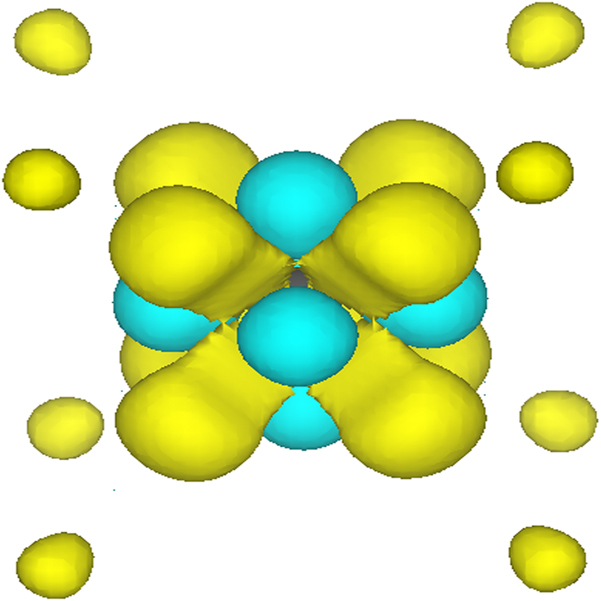
The charge transfer between tungsten and zirconium atoms essentially reduces the energy of tungsten–zirconium alloys. Tungsten (1.7) has a higher electronegativity than zirconium (1.33), indicating that a small charge will shift from zirconium to tungsten. Based on the differential charge density, Fig. 3 shows a clear pattern of charge transfer between zirconium and tungsten. The atomic configuration is shown in Fig. 1(a). The yellow and blue charges in the charge–density diagram in Fig. 3 represent the gain and loss of electrons, respectively. The eight tungsten atoms obtained electrons from the nearest neighboring zirconium atom by charge transfer. In addition, we can also analyze charge transfer based on Bader charge analysis. Prior to alloying, the original zirconium atom had 4 valence electrons and tungsten atom had 6 valence electrons. After alloying, our calculations show that the Bader charge of zirconium is 2.9386 e, and the Bader charge of eight tungsten atoms adjacent to the zirconium atom is 6.0592 e; this means that the zirconium atom loses about 1.0614 e, and the tungsten atoms which are the closest to the zirconium atom average obtained about 0.0592 e. The charge transfer results in the negative charge of tungsten and the positive charge of zirconium. However, the isosurface value of the differential charge density is only 0.00793895 e/Å3 because the charge transfer between the tungsten and zirconium atoms is very little. Interestingly, however, charge transfer promotes the enhancement of the metallic bonding of tungsten–zirconium alloys, which will be discussed further in a later section.
Charge transfer upon Zr alloying in the case of W0.9375Zr0.0625 alloy. The atomic configuration is shown in Fig. 1(a). The color and size of W and Zr atoms are the same as in Fig. 1. The yellow and blue of the charge density diagram in Fig. 3 indicate the gain and loss of the charge, respectively. The value of the isosurface is 0.00793895 e/Å3.

D. The mechanical properties of binary tungsten–zirconium alloys
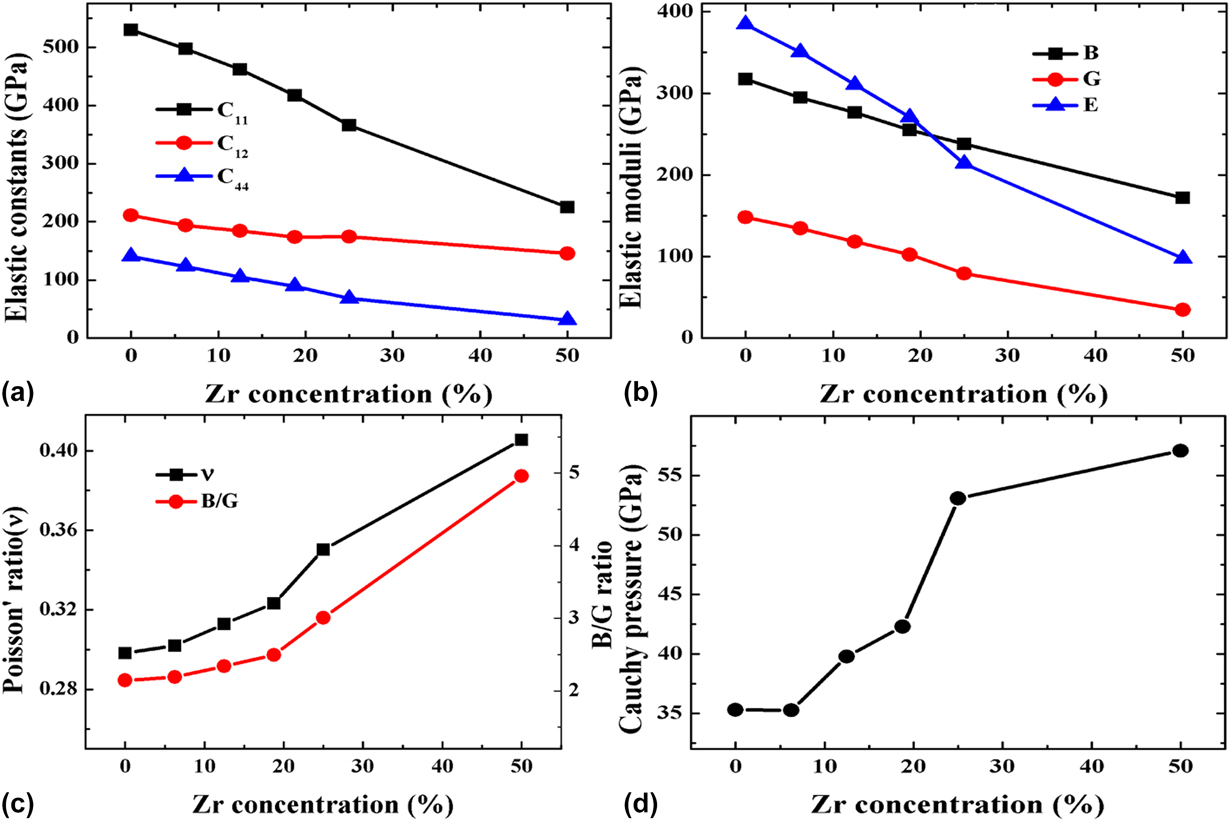
Firstly, we calculated the elastic constants and elastic modulus of pure tungsten metal and compared them with other theoretical and experimental valuesReference Hu, Shang, Wang, Darling, Butler, Kecskes and Liu42–Reference Kushwah, Sharma and Tomar44 to verify the accuracy of our calculation results. For the elastic constant C 11 of pure tungsten metal, the calculated data (529.94 GPa) matches very well with the experimental value (533.00 GPa).Reference Söderlind, Eriksson, Wills and Boring43 Also, for the bulk modulus of pure tungsten metal, the calculated value (317.44 GPa) matches very well with the experimental data (314.33 GPa).Reference Söderlind, Eriksson, Wills and Boring43 And then we investigated the elastic constants of binary tungsten–zirconium alloys with different zirconium concentrations in the BCC tungsten structure. The calculated elastic constants are listed in Table II, and the relationship between the elastic constants and zirconium concentrations is shown in Fig. 4(a). As shown in Fig. 4(a), the elastic constants C 11 and C 44 decrease almost obviously with increasing zirconium concentrations. The elastic constant C 11 is a very important mechanical parameter related to the hardness of cubic crystals. The value of C 11 dropped from 529.94 GPa of pure tungsten metal to 225.17 GPa of W0.5Zr0.5 alloy, indicating that the hardness of binary tungsten–zirconium alloys decreases with increasing zirconium concentrations. The elastic constant C 12 represents the resistance of cubic crystals to lateral deformation. The value of C 12 decreased from 211.19 GPa of pure tungsten metal to 145.34 GPa of W0.5Zr0.5 alloy, which shows that the ability of binary tungsten–zirconium alloys to resist lateral deformation decreases with increasing zirconium concentrations. However, zirconium alloying had no significant effect on C 12 value. In addition, we also calculated the elastic constants of pure zirconium metal; the values of C 11, C 12, C 13, C 33, and C 44 are 141.70 GPa, 70.58 GPa, 73.58 GPa, 163.76 GPa, and 22.99 GPa, respectively.
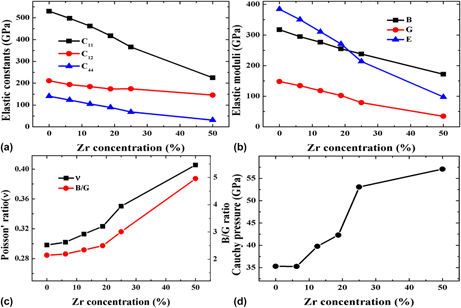
Elastic constants (a), elastic moduli (b), Poisson’s ratio and B/G ratio (c), and Cauchy pressure (d) of BCC W–Zr alloys as a function of Zr concentration.

Based on the elastic constants investigated above, the elastic moduli are calculated according to formula (2), (3), and (4). Figure 4(b) shows the functional relationship between the elastic moduli and zirconium concentration. Meanwhile, the calculated elastic moduli data are shown in Table II. The elastic moduli also include three mechanical parameters, which are bulk modulus, shear modulus, and Young’s modulus. The elastic moduli represent the ability of the material to resist deformation, indirectly indicating the mechanical strength of the material.Reference Meradji, Drablia and Ghemid45 The bulk modulus of binary tungsten–zirconium alloys decreases obviously with increasing zirconium concentrations. The value of the bulk modulus decreased from 317.44 GPa of pure tungsten metal to 171.95 GPa of W0.5Zr0.5 alloy. Young’s modulus and shear modulus also decrease obviously with increasing zirconium concentrations. However, the Young’s modulus curve drops more rapidly compared with the bulk modulus. The value of Young’s modulus dropped from 384.52 GPa of pure tungsten metal to 97.51 GPa of W0.5Zr0.5 alloy. The value of shear modulus dropped from 148.11 GPa of pure tungsten metal to 34.69 GPa of W0.5Zr0.5 alloy. As a result, we can conclude that the mechanical strength of binary tungsten–zirconium alloys is lower than that of pure tungsten metal. However, its mechanical strength is much better compared with pure zirconium metal.
According to Pugh theory,Reference Pugh46 the ratio of bulk modulus to shear modulus (B/G ratio) can describe the ductility of metallic materials. The larger the B/G ratio, the better the ductility of the metallic materials.Reference Shang, Hector, Shi, Qi, Wang and Liu25–Reference Yang, Wu, Cui, Chen, Shi, Wang and Yan27,Reference Lin, Luo, Chen, He and Zhao47 Figure 4(c) describes the relationship between B/G ratio and Poisson’s ratio as a function of zirconium concentration x, respectively. As shown in Fig. 4(c), the B/G value increases gradually with increasing zirconium concentrations. When the zirconium concentration x is 0.5, the B/G ratio is 4.957, which is higher than that of pure tungsten metal (2.143). These data indicate that the ductility of tungsten–zirconium alloys is better than that of pure tungsten metal. It can be further shown that zirconium alloying of tungsten can significantly increase the ductility of pure tungsten metal. The ductility of the metallic materials can also be characterized using Poisson’s ratio. As shown in Fig. 4(c), Poisson’s ratio also increases with increasing zirconium concentrations, similar to B/G ratio. When zirconium concentration x reaches 0.5, the Poisson’s ratio of W0.5Zr0.5 is 0.405, which is also higher than that (0.298) of pure tungsten metal.
Normally, metallic bonding and covalent bonding behaviors of metallic materials can be reflected by Cauchy pressure.Reference Kamran, Chen and Chen48 If the Cauchy pressure is positive, the metallic material exhibits mainly metallic bonding interaction, while showing the ductility of the material. The higher the Cauchy pressure, the stronger the metallic bonding interaction with each other and the more malleable the metallic material. In the same way, if the Cauchy pressure is negative, the metallic material is brittle. The lower the negative value, the stronger the covalent bonding and the more brittle the metallic material. As shown in Fig. 4(d), the Cauchy pressures of binary tungsten–zirconium alloys are positive due to the dominance of metallic bonding in tungsten–zirconium alloy materials. At the same time, the Cauchy pressure increases quickly with increasing zirconium concentrations. The results show that a higher zirconium concentration in the BCC tungsten lattice can enhance the metallic bonding. The conclusion of the analysis is consistent with that in Sec.III.C for the charge distribution analysis, and the same conclusion is verified in the later projected densities of states (PDOS) analysis.
Finally, it is worth noting that the random distribution of zirconium atoms in the BCC tungsten lattice has little effect on the mechanical properties of binary tungsten–zirconium alloys. The mechanical parameters of W0.75Zr0.25 alloy are listed in Table III; it contains four disordered random distributions of zirconium atoms in the BCC tungsten lattice, which are different from the ordered configurations. As shown in Table III, the mechanical parameters of the disordered and ordered alloy configurations are very similar. These data suggest that the random distribution of zirconium atoms in the BCC tungsten lattice has no significant effect on the mechanical properties of binary tungsten–zirconium alloys. In experiments or production, the disorder distribution of zirconium atoms in the BCC tungsten lattice may exist due to the influence of various factors. However, the mechanical properties of tungsten–zirconium alloys may not be affected by the random distribution of zirconium atoms.
Mechanical parameters of W0.75Zr0.25 alloy of different Zr distributions in the unit cell. GPa is a unit of the elastic constants, B, G, E, and C′.

E. The electronic structures of binary tungsten–zirconium alloys
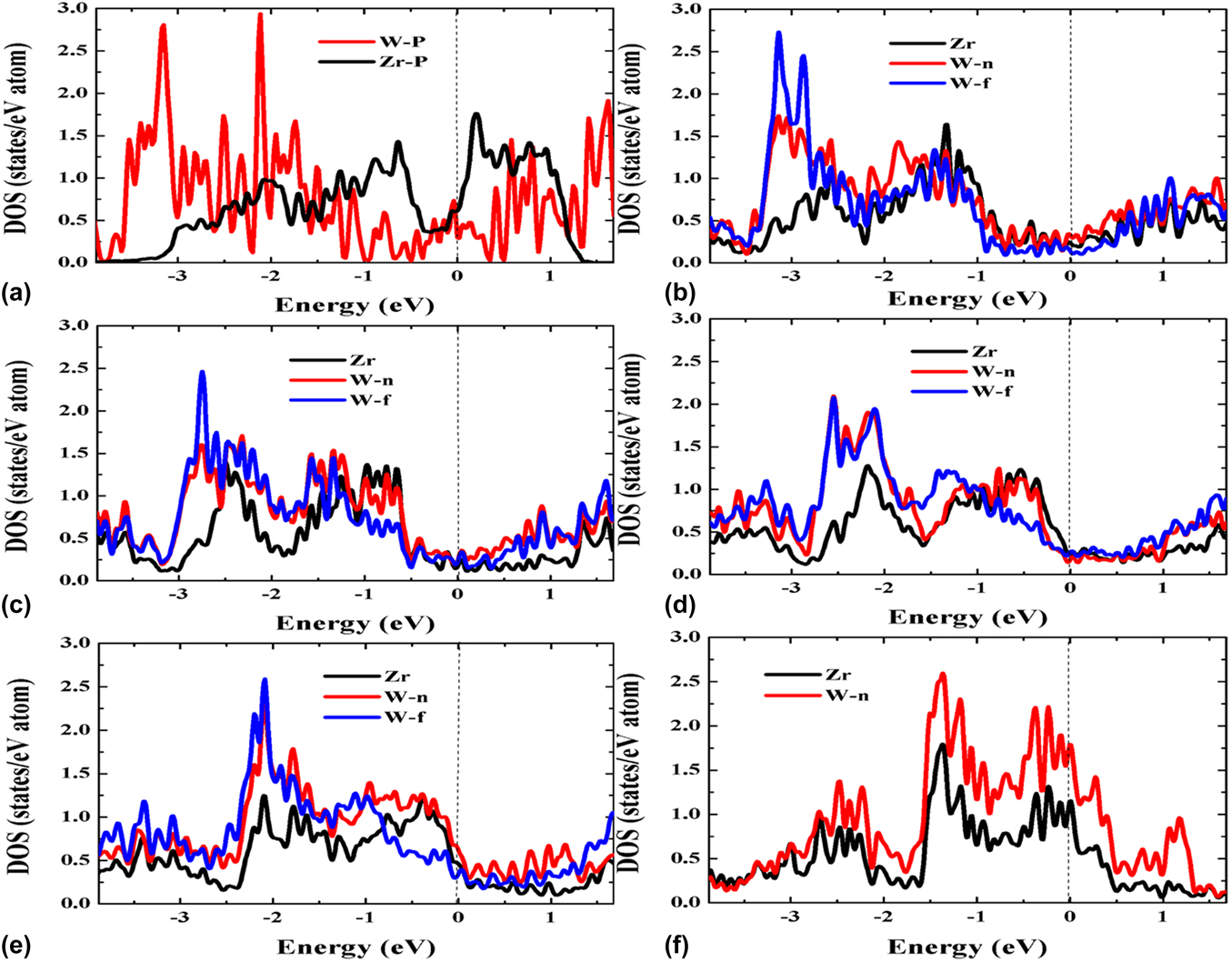
Density of states can be used to explain the W–Zr bonding interaction. The PDOS of tungsten and zirconium atoms are shown in Fig. 5: (a) pure W and pure Zr metals; (b) W0.9375Zr0.0625 alloy; (c) W0.875Zr0.125 alloy; (d) W0.8125Zr0.1875 alloy; (e) W0.75Zr0.25 alloy; and (f) W0.5Zr0.5 alloy. “W-n,” “W-f,” and “W-P” are the PDOS of tungsten nearest neighbor to zirconium, far away from zirconium, and pure tungsten metal, respectively. “Zr” and “Zr-P” are the PDOS of zirconium atoms in the tungsten–zirconium alloys and pure zirconium metal, respectively. The energy is with respect to the Fermi level. As shown in Fig. 5, the Fermi levels of pure tungsten and pure zirconium metal span the minimum depth of the PDOS, which can clearly separate the bonding and antibonding states in the electronic structure of the tungsten–zirconium alloys. All tungsten–zirconium alloys exhibit metallic properties. At the same time, the effect of zirconium alloying increases the energy levels of the tungsten and zirconium states compared with pure metal. The energy of binary tungsten–zirconium alloys is larger than that of pure tungsten and pure zirconium metal, thereby resulting in the positive formation energy. However, as shown in Figs. 5(b) and 5(c), the energy levels of W0.9375Zr0.0625 and W0.875Zr0.125 alloys have little change compared with pure metals, especially near zero energy. Therefore, although the two alloys show positive formation energy, it is close to zero. In other words, the solid solution of the two alloys is relatively stable. As the concentration of zirconium atoms increases, energy levels of tungsten states and zirconium states increase, which further increases the energy levels of binary tungsten–zirconium alloys. Finally, the formation energy increases with the increase in zirconium atoms concentrations. Moreover, the zirconium states and tungsten states of W0.9375Zr0.0625 alloy and W0.875Zr0.125 alloy overlap more than the other alloy materials. This explains that the bonding strengths of the W0.9375Zr0.0625 alloy and W0.875Zr0.125 alloy are higher than those of other alloy materials. In addition, bonding becomes more metallic in the tungsten–zirconium alloys. As the concentration of zirconium atoms increases, the Fermi level moves from the lowest position of the PDOS to the left peak, which is mainly due to the d-electrons of the tungsten–zirconium alloys. The change in the electronic structure properties depends entirely on the change in the total number of valence electrons of the tungsten–zirconium alloys.
The PDOS of W and Zr atoms in BCC W1−xZrx alloys. (a) Pure W and pure Zr metal, (b) W0.9375Zr0.0625 alloy, (c) W0.875Zr0.125 alloy, (d) W0.8125Zr0.1875 alloy, (e) W0.75Zr0.25 alloy, and (f) W0.5Zr0.5 alloy. “W-n,” “W-f,” and “W-p” are the PDOS of W nearest neighbor to Zr, far away from Zr, and pure W metal, respectively. “Zr” and “Zr-p” are the PDOS of Zr atoms in the W–Zr alloys and pure Zr metal, respectively. The energy is with respect to the Fermi level.

IV. SUMMARIES AND CONCLUSIONS
On the basis of the first-principles calculation method, the influence of zirconium alloying on the crystal structures and mechanical properties of BCC tungsten–zirconium alloys was studied. In this paper, A 16-atom solid solution model of W1−xZrx (x = 0, 0.0625, 0.125, 0.1875, 0.25, and 0.5) alloys was established to study the lattice constants, cell volumes, formation energies, and elastic constants. We found that the formation energy of W0.9375Zr0.0625 alloy is the lowest, indicating that it has the most stable thermodynamic structure. When the concentration of zirconium atoms is lower than 12.5%, the tungsten–zirconium bonding interaction is strengthened. By calculating elastic constants, the elastic modulus and other mechanical parameters are obtained. With the increase in zirconium concentration, the elastic constants and elastic modulus of tungsten–zirconium alloys are further decreased. It is shown that the mechanical strength of tungsten–zirconium alloys is lower than that of pure tungsten metal. Notably, however, it is still better than that of pure zirconium metal. In addition, ductility of pure tungsten metal can be significantly improved based on the analysis of the B/G ratio and Poisson’s ratio of tungsten–zirconium alloys. Metallic bonding of the tungsten–zirconium alloy is enhanced by the analysis of Cauchy pressure (C′) with a higher zirconium concentration in the BCC tungsten lattice.
HIGHLIGHTS
(1) The microstructure and mechanical properties of the W1−xZrx alloys are calculated using DFT.
(2) When the concentration of zirconium atoms is lower than 12.5%, the structures of binary tungsten–zirconium alloys can be thermodynamically stable.
(3) Zirconium alloying enhances the ductility of pure tungsten metal substantially.
(4) The mechanical strength of binary tungsten–zirconium alloys is slightly lower than that of pure tungsten metal but higher than that of pure zirconium metal.
ACKNOWLEDGMENTS
This work was sponsored by the National Natural Science Foundation of China (No. 61762045), the Science and Technology Key Project of Jiangxi Provincial Department of Education (GJJ151146), the Natural Sciences Project of Jiangxi Science and Technology Department (20151BBE50079), and the Patent Transformation Project of Intellectual Property Office of Jiangxi Province (the application and popularization of the digital method to distinguish the direction of rotation photoelectric encoder in identification).