


Introduction
Governments around the world are actively promoting the reduction of carbon emission intensity (CEI) to help address environmental challenges (Zeng et al. Reference Zeng, Abedin, Lucey and Ma2025). CO2 is a major driver of environmental degradation and has adverse impacts on nations, societies and individuals (Zhao et al. Reference Zhao, Wang, Dong and Dong2022, Kartal Reference Kartal2023). Delays in emission reductions will result in far higher costs of remediation (Bian & Zhang Reference Bian and Zhang2025). In fact, for countries in the process of industrialization and urbanization, decoupling of carbon emissions from economic growth is more urgent, as well as being realistic to achieve. As a core indicator of economic carbon efficiency, urban CEI can more accurately reflect the real progress made by large economies in balancing development and emission reductions (Dong et al. Reference Dong, Yu, Hadachin, Dai, Wang, Zhang and Long2018). Without effective action to cut CEI, countries and regions face severe risks. China being the biggest developing country and a major carbon emitter means that carbon reduction is at once a global duty and a domestic necessity (Fu et al. Reference Fu, Fan, Zhang, Wang, Pan and Wen2025, Han & Li Reference Han and Li2025); its cities are under growing pressure to reduce CEI (Ren & Wang Reference Ren and Wang2024, Zeng & Zhang Reference Zeng and Zhang2024).
Studies on CEI have primarily focused on its measurement, regional disparities and policy recommendations (Lin & Ma Reference Lin and Ma2022). In particular, studies on regional disparities often employ spatial econometric models to reveal the key factors influencing CEI (Yan et al. Reference Yan, Deng, Peng and Jiang2023); for example, digital technology can significantly enhance urban energy efficiency and reduce CEI (Zhang et al. Reference Zhang, Fan and Zeng2025). From a policy perspective, scholars have extensively evaluated the effectiveness of various carbon emission policies, providing valuable insights for policy design (Xu et al. Reference Xu, Ye, Jahanger, Huang and Zhao2023). China has achieved remarkable results in reducing CEI, but the current regional imbalance and environmental complexity require that emission reduction strategies consider system coordination among multiple entities.
China has now adopted a comprehensive approach to cutting CEI through its strategy of industry–finance collaboration (IFC). This innovative strategy is a cooperative model in which the industrial and financial sectors achieve mutual benefit through resource sharing and complementary strengths (Qiu et al. Reference Qiu, Bian, Ren, Chai, Gao and Wu2024). China has introduced a series of policies and institutional arrangements to advance the development of IFC (Appendix S1, Fig. S1). IFC has undergone a complex developmental process, gradually evolving into a cooperative model suited to China’s distinctive development characteristics (Appendix S1).
Existing research on IFC has largely concentrated on its impact on production efficiency, supply chain management and corporate development (Bustinza et al. Reference Bustinza, Vendrell-Herrero and Jabbour2024, Wang & Hou Reference Wang and Hou2024). Deep integration between the industrial and financial sectors can facilitate capital allocation and enhance operational stability (Huang et al. Reference Huang, Chen, Su and Sahin2025). Furthermore, industrial finance plays a role in bolstering supply chain resilience (Suominen Reference Suominen2004). From the perspective of enterprise growth, innovation is the primary driver of corporate development (Ma et al. Reference Ma, Zeng and Abedin2025b). IFC is often associated with enhancing innovation capabilities and market competitiveness, allowing enterprises to secure sustained financial support (Xu et al. Reference Xu, Zhao and Yang2019). The core idea of the IFC pilot policy is to channel financial resources towards low-carbon projects through innovative financial instruments and data support, thereby reducing CEI.
Three specific measures to reduce CEI are mainly included. First is the establishment of industry standards to guide structural optimization; pilot cities can then reduce CEI from the source through strict industrial policies. Second is the promotion of the construction of data platforms to achieve precise control; pilot cities can thus achieve data traceability and optimization by establishing carbon emission monitoring and management platforms, and thereby reduce CEI. Third is the innovation of financial instruments; for instance, encouraging the development of green credits (banks giving priority to lending money to enterprises or projects that are environmentally friendly and energy-saving) and funds to support carbon reduction. IFC represents a new approach to reducing China’s CEI.
However, whether and how IFC affects CEI remains unclear. To rigorously examine this issue and uncover its underlying mechanisms, we empirically investigated the impact of IFC on urban CEI and the mechanisms underlying this. Specifically, the research objectives of this paper are to: (1) analyse whether IFC impacts CEI and, if so, better understand the causal relationship; (2) deeply explore the specific channels and mechanisms through which IFC affects CEI; and (3) investigate whether different regional characteristics lead to any differences in the emission reduction effect of IFC.
This research offers a novel perspective by assessing the impact of IFC on reducing urban CEI from the viewpoint of industrial integration and the specific underlying mechanisms linking IFC and CEI. By examining the effects of green technological innovation (GTI), technology finance (TF) and talent gathering (TG), the study systematically reveals how IFC influences CEI through multiple channels. Methodologically, this study integrates the difference-in-differences (DID) approach with a panel quantile regression model to assess and strengthen such policy impacts. The effective integration of DID and panel quantile models addresses two core challenges in policy evaluation: the analysis of heterogeneous effects and causal inference. In addition, the IFC model forms an essential part of China’s innovative financial support system for low-carbon development. Exploring how the IFC model facilitates the low-carbon transition of cities can provide valuable insights and lessons for the application of innovative financial instruments in other countries and regions seeking low-carbon growth.
According to the theory of industrial integration, different industries can break traditional boundaries and improve their overall efficiency through the cross-penetration of factors (Matarneh et al. Reference Matarneh, Piprani, Ellahi, Nguyen, Le and Nazir2024). The universality of this theory stems from its revelation of the profound symbiotic relationship between industrial development and financial capital rather than merely describing a partial phenomenon in a specific country. It emphasizes that the free flow and integrated application of production factors across sectors can generate synergies, create new value chains and improve the productivity of entire systems (Fig. 1). IFC is essentially a new business model in which financial institutions engage in deep cooperation with industry to achieve benefit-sharing and risk-sharing. This reduces the risks associated with information asymmetry (Qiu et al. Reference Qiu, Bian, Ren, Chai, Gao and Wu2024). In addition, financial institutions can provide convenient services for enterprises (Zhao et al. Reference Zhao, Wu and Sun2024). Under the IFC model, green enterprises can build digital credit records with financial institutions and promote green development, thereby helping to reduce CEI (Rehman et al. Reference Rehman, Shahzad, Hanif, Arshad and Sergi2024). Our first hypothesis is that IFC significantly reduces CEI.
Potential mechanisms by which industry–finance cooperation might affect carbon emission intensity.

IFC might influence CEI through three mechanisms: GTI, TF and TG. According to innovation ecosystem theory, industrial integration can promote the development of green innovation (Lee et al. Reference Lee, Wang, He and Wang2023). This transcends traditional linear innovation models, emphasizing that innovation constitutes a complex and symbiotic network process (Deng Reference Deng2025). GTI has enriched the theory of innovation ecosystems. GTI refers to the systematic innovation of technological means to achieve sustainable development (Zhang et al. Reference Zheng, Zheng and Zhu2024). GTI promotes the transformation of energy and resource systems, thereby contributing to the solving of environmental crises (Wang et al. Reference Wang, Duan and Zheng2025). Financial support is indispensable for enterprises engaged in GTI (Ma & Appolloni Reference Ma and Appolloni2025). The IFC model enables financial institutions to access enterprise information in a timely manner, helping to overcome information asymmetry and reducing firms’ financing costs. By adopting advanced technologies to reduce environmental costs, firms can strengthen their competitive advantage. Under this model, firms are more motivated to pursue GTI. The development of GTI contributes to reducing CEI. Our second hypothesis is that IFC significantly reduces CEI by promoting GTI.
The development of TF is the result of the integration of finance and technology. It embodies the theory of financial innovation (Khraisha & Arthur Reference Khraisha and Arthur2018). The fundamental purpose of financial innovation is to enhance the operational efficiency and economic effectiveness of the financial system, thereby channelling capital more effectively towards the most productive sectors (He et al. Reference He, Chen, Wang and Zhang2025). With the wave of digitalization sweeping across industries, advanced digital technologies have been applied in finance, giving rise to TF (Fang et al. Reference Fang and Liu2024). The IFC model helps financial institutions and enterprises build trust, making it possible for financial institutions to gain access to a wider range of internal and external corporate data (Yang et al. Reference Yang, Han and Deng2025). This difficult-to-obtain corporate data will become the ‘new oil’ for TF, providing essential support for its advancement. Furthermore, TF can enhance financial inclusion and precision by fostering innovation in financial products, supporting clean production in urban industries and reducing CEI. Consequently, our third hypothesis is that IFC significantly reduces CEI by advancing TF.
Human capital theory emphasizes that knowledge and skills lead to accumulative and spillover effects (Apergis et al. Reference Apergis, Polemis and Soursou2022). The phenomenon of TG is a concentrated manifestation and powerful verification of human capital theory, reflecting its core logic and dynamic processes (Xu et al. Reference Xu, Fei, Chen, Hong and Shen2025). IFC strengthens collaboration and communication between urban financial institutions and industries, enabling financial institutions to provide funding to local enterprises and thereby alleviating their financial constraints. Under the IFC model, enterprises with access to financial support can offer competitive salaries and benefits to high-skilled workers, thus attracting high-calibre talent. TG is a rational choice for human capital investment (Yueyue et al. Reference Yueyue, Nordin and Panatik2024); it enhances knowledge-sharing and exchange, which stimulates innovative thinking and might increase the pace of low-carbon development in cities. Therefore, our fourth hypothesis is that IFC significantly reduces CEI through TG.
Methods and data
Methods
We divided cities into a treatment group (cities implementing IFC) and a control group (cities without IFC pilots). We also distinguished a pre-intervention phase (before IFC implementation) and a post-intervention phase (post IFC implementation). To enhance the model’s robustness, control variables and fixed effects were introduced as per Equation 1:
 $$\ln \,CE{I_{ii}} = {\beta _0} + {\beta _1}IF{C_{ii}} + \rho Contro{l_{ii}} + {\mu _t} + {\gamma _i} + {\varepsilon _{ii}}$$
where CEI denotes urban carbon emission intensity, IFC denotes the industry–finance collaboration pilot policy, Control stands for control variables, ρ denotes the coefficient of the Control variable, µ captures time-fixed effects, γ accounts for city-fixed effects and ϵ represents the random disturbance term. We focus on the estimated coefficient β 1, which captures the effect of the IFC pilot policy on urban CEI.
DID is an important method for evaluating the effects of a policy or event (Yang et al. Reference Yang, Fan, Shao and Yang2017). The DID model effectively identifies the causal relationship between IFC and CEI. Furthermore, by grouping cities, we examined the variation in the impact of IFC on CEI across resource-dependent (highly dependent on the extraction and primary processing of one or two resources, such as coal and oil, for which the industrial structure is extremely narrow) and non-resource-dependent cities (the defining characteristic of non-resource-dependent cities is that their economic development has moved beyond a singular reliance on local, finite natural resources, shifting instead to a diversified and sustainable growth model centred on human capital, knowledge, capital, technology and services), different types of resource-dependent cities (developing, declining and regenerating cities) and cities in the eastern, central and western regions (this classification is primarily based on a combination of geographical location, level of economic development and industrial structure). Based on the DID model, a panel quantile regression model can clearly indicate the changing trends of variables under different conditions (Wang et al. Reference Wang, Zeng and Liu2019). The panel quantile regression model enabled a more comprehensive understanding of IFC and offered multiple layers of verification regarding its impact. The implementation of panel quantile regression involved the following key steps: first, IFC was chosen as the independent variable, whereas CEI was the dependent variable; and second, for model construction, we built the conditional distribution function to examine the impact of IFC on different quantiles of CEI, as per Equation 2:
 $$CE{I_{{Y_{it}}}}\left( {\tau {\rm{|}}IF{C_{it}}} \right) = {\alpha _i} + IFC_{it}^T\beta \left( \tau \right),\left( {i = 1,2 \ldots n;t = 1,2 \ldots T} \right)$$
where CEI represents the conditional distribution function of carbon emission intensity, Y denotes the dependent variable at different quantile points, τ denotes different quantile points, α is the intercept term, IFC is the matrix of explanatory variables, n is the sample size, T is the study period and β denotes the impact coefficients at different quantiles.
Data
We utilized annual data from 260 cities in China from 2011 to 2022. Carbon emission data were collected from the Global Atmospheric Research Emissions Database of the Netherlands Environmental Assessment Agency. Green patent data were obtained from the China Research Data Service Platform (CNRDS). Other variable data came from the China Statistical Yearbook and China City Statistical Yearbook from 2011 to 2022. CEI as the explained variable was measured using CO2 emissions per unit of gross domestic product (GDP) data (Zhang et al. Reference Zhang, Deng, Phillips, Fang and Wang2020).
China’s central government launched the pilot policy for IFC and the first batch of 37 pilot cities, including Beijing, in 2016, with new batches to be introduced every 4 years. In 2020, the second batch of pilot cities was launched, incorporating new cities such as Zhengzhou while also eliminating certain cities from the first batch.
Based on the existing literature, we selected seven variables that might influence CEI (Grossman & Krueger Reference Grossman and Krueger1995, Eskeland & Harrison Reference Eskeland and Harrison2003, Yi & Zhang Reference Yi and Zhang2024). Economic development level (EDL) was measured by per capita real GDP. Government intervention level (GIL) was measured by the ratio of public spending to GDP. Foreign direct investment (FDI) was measured by the ratio of investment from other countries to the country’s own GDP. The proportion of secondary industry (PSI) was assessed by the ratio of the contribution of the secondary sector to GDP. Scientific research expenditure (SRE) was represented by the proportion of science and technology expenditure in general budget expenditures. Human capital level (HCL) was assessed based on the ratio of students attending regular higher education institutions to the overall urban population. Financial support level (FSL) was represented as the proportion of financial institutions’ year-end loan balances to GDP.
GTI was measured as the ratio of green technology patents to the urban population (Zhao et al. Reference Zhao, Chen and Zhang2023). TF was measured as the ratio of financial technology (fintech) firms to the urban population (Chaudhry et al. Reference Chaudhry, Ahmed, Huynh and Benjasak2022). For TG, we used the proportion of total employment in six key sectors (scientific research and technical services, education, finance, computer services and software, leasing and business services, and culture and entertainment) relative to the urban population (Wei Reference Wei2023).
Results
Urban CEI over time
Urban CEI has decreased over time (Fig. 2). The trends regarding the CEI values for the control group (treat = 0) and the treatment group (treat = 1; Appendix S1, Fig. S2) differed, revealing that treatment cities reached significantly lower CEI levels than non-IFC cities.
Diagrammatic maps of urban carbon emission intensity in (a) 2011 and (b) 2022.

Has IFC impacted CEI and how might it have done so?
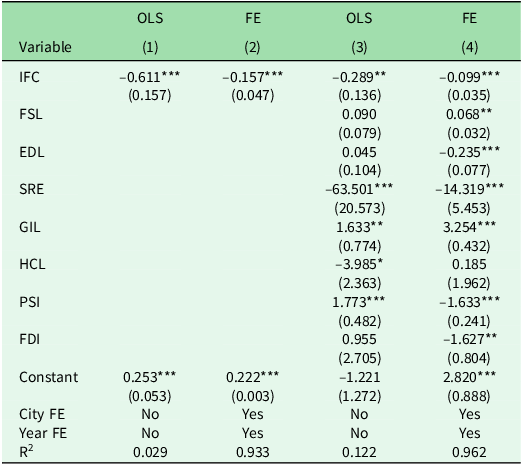
The parallel trend test indicates that there were no significant differences in CEI between the treatment and control groups before the policy implementation (Appendix S1 Fig. S3), whereas the regression coefficients of IFC on CEI were negative (Table 1), suggesting that IFC has had a significant effect on CEI reduction. A robustness test corroborated the impact of IFC on urban CEI (Appendix S1, Table S1).
Results of analysis of the impacts of industry–finance cooperation (IFC) on carbon emission intensity from ordinary least squares (OLS) regression to test this relationship and the fixed-effects (FE) model based on OLS to solve the problem of missing variable deviation and to enhance the robustness of the OLS regression. Cluster-robust standard errors are given in parentheses, clustered by city.

***, ** and * indicate the significance level of the coefficients at 1%, 5% and 10%, respectively.
EDL = economic development level; FDI = foreign direct investment; FSL = financial support level; GIL = government intervention level; HCL = human capital level; PSI = proportion of secondary industry; SRE = scientific research expenditure.
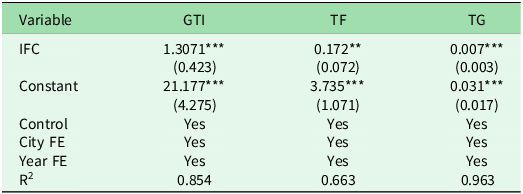
That IFC might have contributed to reducing urban CEI by promoting GTI is suggested by the observed significant positive effect of IFC on GTI (Table 2). IFC might also have reduced urban CEI by advancing TF (Table 2) and through TG (Table 2).
Results of the three pathways (promoting green technological innovation (GTI), advancing technology finance (TF) and through talent gathering (TG)) through which industry–finance cooperation (IFC) might influence carbon emission intensity: numerical values represent the coefficients of each variable (cluster-robust standard errors are given in parentheses).

***, ** and * indicate the significance level of the coefficients at 1%, 5% and 10%, respectively.
FE = fixed effects.
Has the impact of IFC on CEI differed among the various regions assessed?
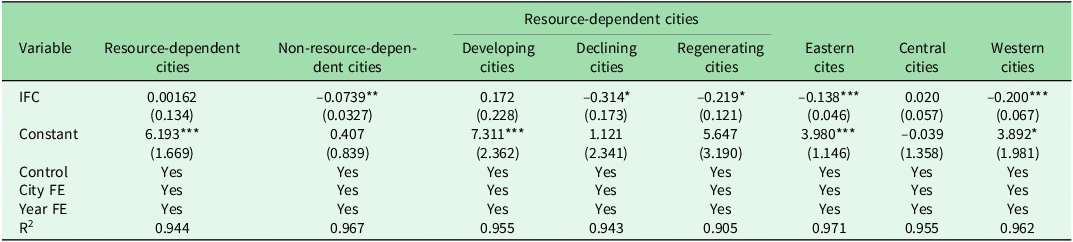
For non-resource-dependent cities, the coefficient of IFC was negative and statistically significant, whereas for resource-dependent cities, the coefficient was not significant (Table 3). For developing cities, the coefficients of IFC were not significant, whereas those for both declining and regenerating cities were significantly negative, indicating that IFC might indeed have reduced CEI in cities undergoing transformation (Table 3). For both eastern and western regions, which are key to China’s strategic development, the coefficients of IFC were negative and statistically significant (Table 3). In contrast, the coefficient of IFC on CEI in the central region was not significant.
Results from the comparison of city types (resource-dependent and non-resource-dependent cities, different types of resource-dependent cities) and regions (eastern, central and western): numerical values represent the coefficients of each variable (cluster-robust standard errors are given in parentheses).

***, ** and * indicate the significance level of the coefficients at 1%, 5% and 10%, respectively.
FE = fixed effects; IFC = industry–finance cooperation.
The panel quantile regression model captured heterogeneity across different quantiles. The absolute value of the IFC coefficient continued to decline at higher quantiles, again highlighting the development challenges faced by high-carbon regions, where the effectiveness of IFC is evidently weaker (Fig. 3).
Results of the visualization: the horizontal axis represents increasing quantile points, corresponding to rising levels of carbon emission intensity (CEI). The vertical axis represents the influence of the industry–finance cooperation (IFC) coefficient. Negative values indicate that IFC can reduce CEI.

Discussion
We find that IFC appears to contribute to reducing urban CEI. One possible explanation for this is that IFC provides a strong platform for low-carbon technological innovation. Under the guidance of policy and the pressure of market competition, financial institutions and industrial organizations establish deep strategic partnerships (Zheng et al. Reference Zheng, Zheng and Zhu2024). Unfortunately, the effectiveness of financial instruments in reducing carbon emissions has been hindered by several problems, including capital misallocation and information asymmetry (Sadiq et al. Reference Sadiq, Paramaiah, Dong, Nawaz and Shukurullaevich2024, Wu et al. Reference Wu, Wen, Nie and Gao2024). Our findings indicate that IFC, by fostering organizational transformation through the integration of financial institutions and industrial organizations, partly compensates for these shortcomings; it represents a new business model. IFC guides capital towards green technology through its platform effect, which is essentially a process of correcting market failures (Tirole Reference Tirole2015). This aligns with the view in institutional economics that organized markets can reduce transaction costs. However, the capacity of IFC to reduce CEI varies among regions, the carbon reduction levels of which vary significantly (Ma et al. Reference Ma, Yan, Li, Liu and Zeng2025a).
A successful low-carbon transition relies on the coordinated integration of technology, finance and human capital. We show that IFC may reduce urban CEI through promoting GTI, advancing TF and through TG. These three paths are not isolated but rather have mutually reinforcing, circular and cumulative linkages; this is the core of IFC as a system platform. First, technological innovation plays an important role in reducing carbon emissions (Zou et al. Reference Zou, Ma, Liu and Gao2024), but here, unlike in previous studies, we explore its role in the impact of IFC policies specifically on urban CEI. IFC bridges the financing gap through market-based instruments such as venture capital and green credit, thereby accelerating the commercialization of low-carbon technologies. Second, our finding that IFC helps to improve the level of TF is consistent with the conclusions of Zhang et al. (Reference Zhang, Deng, Phillips, Fang and Wang2020). Zhao et al. (Reference Zhao, Wu and Sun2024) and Wang and Ma (Reference Wang and Ma2024) also argue that the development of digital finance contributes to improving the level of green development. Building on this, our study focuses on the carbon-reduction effects of IFC in promoting TF, and it verifies this important finding through an econometric analysis. With respect to TG, Zhao et al. (Reference Zhao, Li, Yang, Zhang and Guo2025) demonstrated that the regional concentration of highly skilled talent can significantly reduce regional CEI, which is in line with our findings. It is notable that TG may exacerbate the ‘Matthew effect’ among cities, leading to an excessive concentration of talent in top-tier cities (Su Reference Su2026). Meanwhile, regions undergoing high-carbon transformation face a talent depletion crisis, indicating that policies need to balance efficiency and regional equity.
Unlike in non-resource-dependent cities, IFC has had almost no effect on reducing the CEI of resource-dependent cities. This phenomenon reflects the fact that resource-dependent cities are more likely to face consequences from their over-reliance on resources. Cai et al. (Reference Cai, Lee, Khan and Yuan2024) and Wang and Zhang (Reference Wang and Zhang2025) indicated that the effectiveness of IFC depends on specific conditions. In the context of the ‘resource curse’ in resource-dependent cities, IFC may undergo structural failure. For resource-dependent cities engaged in transformation (referring to cities that used to heavily rely on a single natural resource, such as coal, oil and metal minerals, for development but are now actively seeking sustainable development through industrial diversification, technological upgrading and other means to break away from their dependence on the original single resource), it appears that IFC can serve as an accelerator of reducing CEI. Compared with eastern and western cities, IFC has had no discernible impact on the CEI of central cities, which tend to settle into path dependence, where path optimization is hindered by a reluctance to undergo self-reinforcement (Zhang et al. Reference Zheng, Zheng and Zhu2024, Wang et al. Reference Wang, Duan and Zheng2025); if IFC cannot reshape the local path dependency structure, it may not be able to exert its positive effects. Therefore, the development of IFC in the central region should aim to promote it as a financial lever for institutional change, fostering a new path of green development with self-reinforcing capabilities.
IFC may serve as an effective approach for China to achieve its low-carbon goals. These research findings are expected to provide actionable insights and empirical evidence for global policymakers and stakeholders to address complex challenges such as environmental change. This might then inform governments regarding the optimization of IFC policy to reduce carbon emissions. The present findings may also help to inform other countries and regions with similar circumstances; however, China is distinctive in that its government plays a significant role in both financial resource allocation and industrial development. Government intervention not only builds bridges between financial institutions and industrial organizations but also guides the operation of IFC through industrial policy and regulation. Therefore, whether and how IFC might be effectively adapted to contexts with different levels of government intervention and financial liberalization remain open questions. Future research could explore these questions through comparative studies across diverse institutional contexts. Although we identify three different mediating pathways (GTI, TF and TG), these are at the macro level of cities, and we lack direct evidence from micro-level firms and financial institutions. Future research that might use matched ‘financial institution–firm’ paired data would be able to reveal how IFC affects CEI at the underlying micro level.
Conclusion
IFC appears to have significantly reduced urban CEI by promoting GTI, advancing TF and through TG. This impact varies depending on resource endowment, regional characteristics and prevailing CEI. Issues such as an over-reliance on resources lead to an overall insignificant carbon reduction effect of IFC in resource-dependent cities. However, for resource-dependent cities undergoing transformation, such as declining or regenerating cities, IFC seems to have had a significant carbon reduction impact. These conclusions have important policy value for promoting high-quality economic development and coordinating carbon emission reduction targets in China.
Supplementary material
To view supplementary material for this article, please visit https://doi.org/10.1017/S0376892926100368.
Acknowledgements
We thank Nicholas Polunin and the two anonymous reviewers for their valuable comments on previous versions of this manuscript.
Financial support
This work was supported by the Outstanding Innovative Talents Cultivation Funded Programs 2025 of Renmin University of China.
Competing interests
The authors declare none.
Ethical standards
Not applicable.