

I. Introduction
As observers of society, we are inescapably prisoners in Plato's cave, where the sense we make of our observations is shaped by the mental maps we construct to order those observations. For the most part, fiscal theorists have worked with a mental map that treats government as a sentient being and assimilates fiscal phenomena to the choices of that being; if people write the first draft of the manuscript of social life through their market activities, the state is the editor who polishes and perfects the manuscript. The alternative mental map that I explore here treats government as a form of “catallaxy,” where fiscal outcomes are emergent and not direct objects of choice; the relationship between state and market is coeval and not sequential.1
In volume 2 of Law, Legislation, and Liberty (Chicago: University of Chicago Press, 1976), esp. 107–20, F. A. Hayek distinguishes between an economy and a catallaxy. An “economy” refers to some individual unit that exercises choice, whereas a “catallaxy” refers to the entire nexus of economizing units, a nexus which itself is not a choosing, economizing unit.
The distinction between mental maps that I explore here contains both old and new sources of inspiration. The old sources pertain to a distinctly Continental orientation toward public finance that flourished alongside the Anglo-Saxon orientation until the late 1930s.2
The contrast in orientations is presented in Jürgen G. Backhaus and Richard E. Wagner, “The Continental Tradition in the Theory of Public Finance: An Exercise in Mapping and Recovery,” Journal of Public Finance and Public Choice, forthcoming; and in Jürgen G. Backhaus and Richard E. Wagner, “From Continental Public Finance to Public Choice: Mapping Continuity,” History of Political Economy 37 (2005), annual supplement.
For a crisp presentation of what can be done in this respect, see Joshua M. Epstein and Robert Axtell, Growing Artificial Societies: Social Science from the Bottom Up (Washington, DC: Brookings Institution, 1996). The pioneering effort within this genre is Thomas C. Schelling, Micromotives and Macrobehavior (New York: Norton, 1978).
Mitchel Resnick, Turtles, Termites, and Traffic Jams: Explorations in Massively Parallel Microworlds (Cambridge, MA: MIT Press, 1994), 68–74.
If fiscal phenomena are assimilated to acts of ruler's choices, the traffic jam would have to be portrayed as a gigantic car that is moving backward. This is the approach taken by representative agent modeling, which has parsimony and tractability on its side, along with an obviously fictive character. In contrast, agent-based computational modeling is now starting to provide platforms for exploring the generation of such emergent outcomes as traffic jams and government budgets as objects in their own right. While the arrival of this analytical opportunity is relatively new, the underlying ideas are relatively old, going back at least to the spontaneous-order theorists of the Scottish Enlightenment of the eighteenth century.5
See, for instance, David Daiches, Peter Jones, and Jean Jones, A Hotbed of Genius: The Scottish Enlightenment, 1730–1790 (Edinburgh: Edinburgh University Press, 1986).
I begin this essay by contrasting the common, “disjunctive” approach to political economy with the alternative, “conjunctive” approach that I pursue here. Within a conjunctive political economy, government is a nexus of transactions and not some sentient creature, Leviathan or otherwise. Within this transactional nexus, a government's budget is treated as an aggregation across politically organized enterprises that themselves emerge in bottom-up fashion. Within a democratic polity, that budget is generated within a legislature that is conceptualized as a peculiar type of market forum. A society thus contains an ecology of enterprises, some privately organized and others politically organized, whose organizational rules and modes of operation generate both cooperation and conflict. This bivalent relationship between the two types of enterprise arises because politically established enterprises bear a parasitical relationship to market-based enterprises, due to the impossibility of economic calculation in a wholly collectivized economy. Following this sketch of a conjunctive political economy, I reconsider some traditional canons of taxation, for these were crafted originally in the context of a disjunctive political economy. In particular, fiscal sociology becomes the alternative point of orientation for the concerns that traditionally have been addressed by those canons.
II. Polity and Economy: Disjunctive or Conjunctive?
In his 1896 treatise on public finance, Knut Wicksell complained that the theory of public finance “seems to have retained the assumptions of its infancy, in the seventeenth and eighteenth centuries, when absolute power ruled almost all Europe.”6
Knut Wicksell, “A New Principle of Just Taxation” (1896), in Richard A. Musgrave and Alan T. Peacock, eds., Classics in the Theory of Public Finance (London: Macmillan, 1958), 82.
F. Y. Edgeworth, “The Pure Theory of Taxation,” Economic Journal 7 (1897): 46–70, 226–38, and 550–71; F. P. Ramsey, “A Contribution to the Theory of Taxation,” Economic Journal 37 (1927): 47–61.
Raghbendra Jha, Modern Public Economics (London: Routledge, 1998), xii.
The alternative is a conjunctive political economy, which transforms public finance into the study of how people govern themselves. Government is conceptualized not as some sentient being that intervenes into the market, but rather as an institutionalized process or forum within which people interact with one another. This distinction between alternative conceptualizations of political economy corresponds, in turn, to distinct sociological circumstances to which the abstract terms “market” and “state” pertain.
For an absolutism of the form represented by a Louis XIV, it is quite reasonable to model subjects as relating to one another within a market economy, and to model rulers as intervening into the market economy on terms of their choosing. Kings could, of course, differ greatly in the choices they made, but fiscal phenomena would arise out of their choices in any case. One branch of choice-theoretic public finance, of which Edgeworth and Ramsey were the prime initiators, has sought to lay down norms for some relatively benevolent ruler, as illustrated by maxims to minimize the excess burden from taxation or to tax equals equally. In contrast, another branch of choice-theoretic public finance, of which the Italian economist Amilcare Puviani was the prime initiator (through his theory of fiscal illusion), has sought to portray maxims by which a ruler could maximize the present value of his personal account.9
Amilcare Puviani, Teoria della illusione finanziaria (Palermo: Sandron, 1903). Puviani has not been translated into English, but he is available in German: Die Illusionen in der öffentlichen Finanzwirtschaft (Berlin: Dunker and Humblot, 1960). A précis of Puviani's argument is presented in James M. Buchanan, Public Finance in Democratic Process (Chapel Hill: University of North Carolina Press, 1967).
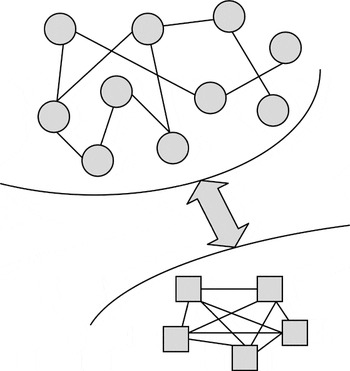
Figure 1 presents a simple graphical portrayal of a disjunctive political economy. The circles denote individual citizens and the squares denote members of a ruling cadre, or perhaps a royal family. In this figure, the members of the ruling cadre are fully connected, to indicate that they act as a single unit (or, equivalently, as an equilibrated collection of people). A king and his family would be a sociological instantiation of such an analytical construction. In contrast, the individual citizens who relate to one another within the market economy form an incompletely connected network, following economist Jason Potts's fecund formulation for modeling continuing processes of evolutionary development.10
Jason Potts, The New Evolutionary Microeconomics (Hants, UK: Edward Elgar, 2000).

Disjunctive political economy
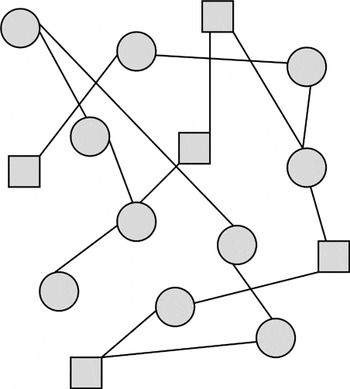
Within a network-based analytical framework, economic or social transformation would be represented as a change in the connective geometry by which a society is described. As a hereditary monarchy gives way to some democratic or republican regime, a transformation occurs in the connective structure of the society. Royal families lose their lands and privileges, get jobs, and become relatively ordinary; the sociological disjunction between rulers and ruled erodes. The situation after this erosion has occurred is portrayed in figure 2, where the squares and circles in the disjunctive parts of figure 1 have commingled to produce the society represented by figure 2. In this alternative representation, government is no longer a creature that lords it over society, for it is a catallaxy and not an economy. It is, of course, always possible to aggregate over the activities of the various squares depicted in figure 2, and refer to this aggregate as indicating something called “government output.” But this would be little different from aggregating over the circles and calling the result “market output.”

Conjunctive political economy
The sociology of figure 1 implies a strong separation between rulers and ruled. The sociology of figure 2 implies a setting where some members of a family might staff political positions while others staff commercial and industrial positions. A brother may occupy a political node while a sister occupies a commercial node. Any particular classroom, clubhouse, or pew will contain members who are or will be found in both categories of position.
III. Crossing the Budgetary Bridge
For a disjunctive political economy, it is reasonable to consider taxation to be independent of expenditure. A ruler wants revenue for purposes that originate with him, and that revenue is to be extracted from his subjects. Rulership is the practice of intervention into society, as contrasted to participation in transactions within society. It is imaginable that a ruler would instruct his tax collectors to extract revenue in a horizontally equitable manner. The historical record would not seem to show much evidence for the realization of such products of the imagination.11
For some relevant treatments, see Charles Adams, For Good and Evil: The Impact of Taxes on the Course of Civilization (London: Madison Books, 1993); and Carolyn Webber and Aaron Wildavsky, A History of Taxation and Expenditure in the Western World (New York: Simon and Schuster, 1986).
The articulation of a conjunctive political economy requires us to recognize the underlying transactional character of state budgetary operations. In this recognition lies the chasm between rulers choosing to tax people and people choosing to tax themselves.12
In this particular regard, see Joel Slemrod and Jon Bakija, Taxing Ourselves: A Citizen's Guide to the Great Debate over Tax Reform (Cambridge, MA: MIT Press, 1996).
One snare is to embrace an imposta grandine assumption (literally a “hailstorm tax”). This assumption, which treats taxes as uncaused causes or external injections into society, was discussed extensively in the classic Italian literature that embraced a conjunctive political economy.13
For an extensive survey of the classic Italian literature, see James M. Buchanan, “‘La Scienza delle finanze’: The Italian Tradition in Fiscal Theory,” in Buchanan, Fiscal Theory and Political Economy (Chapel Hill: University of North Carolina Press, 1960), 24–74. For an effort to relate that literature to the public choice scholarship that has developed since Buchanan wrote, see Richard E. Wagner, “Public Choice and the Diffusion of Classic Italian Public Finance,” Il pensiero economico italiano 11 (2003): 271–82.
The tension between these two snares is expressed crisply in Attilio da Empoli, Lineamenti teorici dell'economia corporativa finanziaria (Milano: Giuffrè, 1941), 91–136.
The snare of treating taxation as an uncaused cause is the typical treatment of taxation in the theory of public finance. Taxes are exogenous injections into a society, and fiscal analysis explores some of the consequences of those injections. One of those consequences is excess burden. The analysis of excess burden entails the claim that taxes impose a double burden on taxpayers: one is the direct burden of transferring resources to government; the other is an additional loss of utility (an excess burden) that arises out of tax-induced shifts in patterns of activity. In any case, a tax is equivalent to a hailstorm—recognizing, of course, that hailstorms can differ in the amount of damage they wreak.
Excess burden is a plausible tool for a disjunctive political economy when power resides with some relatively enlightened ruler. It may even be a useful tool for a less enlightened ruler who nonetheless felt it prudent to avoid skinning his flock while trying to shear them closely. Excess burden is of less significance within the context of a conjunctive political economy. Within this alternative context, a tax cannot simply be injected from outside a society, for it can only emerge from within the society. There are, moreover, two broad forms of such emergence. One is where fiscal outcomes reflect a broad consensus or concurrence among the affected parties, while the other is where fiscal outcomes reflect a domination of the victorious over the subdued, a situation that tends to undermine the transactional character of democratic budgeting if the domination becomes anything other than transitory and short-lived.
Suppose Prima, Secundo, and Terza inhabit a small town. They support a town enterprise to construct a project to eradicate mosquitoes from a nearby swamp. They agree that doing this represents a distinct improvement over the alternative. There are, of course, an indefinitely large number of ways the revenues could be collected. A simple one would be an equal per-capita assignment of liability: this would be a form of head tax for which conventionally there is no excess burden, because the tax would not induce any shift in market-based conduct. To allow for a standard excess burden, suppose a tax is imposed on the consumption of electricity. The tax would induce people to use less electricity, and it is this substitution away from electricity that is the source of the conventional excess burden. Yet the participants agreed to the entire fiscal operation, which means that they must have anticipated that they will be better off by having done so. (As to why they might have chosen to tax electricity and not create a head tax, several explanations are possible. A simple one is that the instrument to tax electricity was already in place, whereas a head tax would have required the creation of a new office to implement the tax.) While there is a clear burden associated with the tax, a burden which represents the resources necessary to construct the project, it is equally clear that there is no excess burden associated with the project. If anything, there is an excess benefit to the extent that the mosquito protection allows people to attain utility gains. The tax is simply one side of a transaction, and it cannot be reasonably appraised outside of the full transaction that caused the tax to appear.
An alternative to all participants agreeing to tax themselves is for a majority to impose some of the cost on an objecting minority. Prima and Secundo might own property in a low-lying area that is prone to flooding (and thus a breeding ground for mosquitoes), while Terza lives securely on higher ground. Rather than Prima and Secundo forming a joint venture to protect their property, they use their legislative majority to declare it a public project, thereby forcing Terza to contribute to the support of that project. It makes no sense to speak of the tax as possessing an excess burden for Prima and Secundo, for it is one side of a transaction by which they achieve a more highly desired state of affairs. Terza, of course, is helping to support a project that she would veto if she could, and so perhaps could be thought to bear an excess burden as she reduces her consumption of electricity in consequence of the tax. To claim that an excess burden exists in the aggregate, however, requires some presumption that utilities can be added across people. Such a claim also shifts analytical attention away from the fiscal process that generated the outcome and onto one hypothesized consequence of that process. About all that can really be said about the situation is that it improved the situation for Prima and Secundo while worsening it for Terza.
Once it is recognized that a tax arises from internally generated transactions and not from outside interventions, claims about excess burden would seem to lose a good deal of their significance, at least in the aggregate.15
Richard E. Wagner, “Some Institutional Problematics of Excess Burden Analytics,” Public Finance Review 30 (2002): 531–45.
A monarch or despot may stand outside the system over which he rules and into which he injects taxes as he chooses. Within a democratic polity, however, there is no such outside position from which taxes can be injected. Taxes emerge from within the polity, and must do so because the combination of less market output and more political output generates a higher level of utility for some people. Without doubt, taxation also generally involves a good number of people in paying for output they do not value, or value less than the sacrificed market output the tax makes necessary. Those people are burdened directly by the tax, and then burdened again as they rearrange their market conduct in response to the tax extractions imposed on them. To reduce this outcome to some measure of excess burden requires a problematical presumption about aggregation (on the one hand), and obscures the underlying character of the fiscal process that generated that outcome (on the other hand).
To be sure, one can leave a restaurant without tipping. Governments, in contrast, will not allow you to opt out of the tax system, though they do have procedures in place by which people can contest their assignments of tax liability. While taxes are part of the transactional nexus of governmental fiscal activity within a conjunctive political economy, they possess an involuntary character that distinguishes them from market prices. In his treatise on eminent domain, legal scholar Richard Epstein describes taxes as “forced exchanges.”16
Richard A. Epstein, Takings: Private Property and the Power of Eminent Domain (Cambridge, MA: Harvard University Press, 1985).
For one survey of this literature, see Thomas S. McCaleb and Richard E. Wagner, “The Experimental Search for Free Riders: Some Reflections and Observations,” Public Choice 47, no. 3 (1985): 479–90.
On the other hand, the standard of a forced exchange holds that taxes should seek to mirror the voluntary payments that people would have made had they not engaged in free-riding. While there is no way to determine precisely what the terms of those unmade transactions would have been, there are some general principles that can be brought to bear in shedding some light onto the distinction between cases when taxes are plausibly one side of a forced exchange and when they are simply forced exactions imposed on political losers for the benefit of political winners. It is possible to claim that taxes are the prices we pay for civilization, but this does not warrant that any and all taxes qualify as reasonable applications of the principle of forced exchange. To speak of taxes as prices is a simile that is both useful and corruptible. It is a useful simile because it expresses a truth about any claim that people genuinely choose to tax themselves, which they would only do if they valued the resulting public services more highly than they valued the options they sacrificed in exchange. It is a corruptible simile because it can be used to justify the imposition of force without concomitant exchange.
Earlier I noted two snares to be avoided when attempting to construct a bridge between the taxing and spending sides of the budget. The second snare is the assumption that the two sides of the budget are fused. To avoid this second snare while retaining the transactional character of democratic governance, democratic states are treated as ecologies of political enterprises and the legislatures that inhabit those states as peculiar market forums. This treatment corresponds to a conceptualization where taxation entails the assignment of obligations to stock the budgetary commons while appropriation entails the allotment of rights to graze that commons, and where the legislature serves as the arena wherein those various obligations and rights are articulated.18
Richard E. Wagner, “Property, Taxation, and the Budgetary Commons,” in Donald Racheter and Richard E. Wagner, eds., Politics, Taxation, and the Rule of Law: The Power to Tax in Constitutional Perspective (Norwell, MA: Kluwer Academic Publishers, 2002), 33–47.
IV. An Emergent Ecology of Political Enterprises
Suppose figure 2 above represents the enterprises within a society. The circles denote market-based enterprises and the squares denote politically-based enterprises. A government's budget is an aggregation over the set of politically-based enterprises. Likewise, the size of the market economy is gauged by aggregation over the set of market-based enterprises. The society itself is comprised of an emergent ecology of enterprises of the two forms, with each enterprise having various connections to other enterprises within the society. Within this ecology, some enterprises will expand while others contract; moreover, the patterns of connection among enterprises will change through time. The entire ecology constitutes an evolving, emergent order. Within this emergent framework, a government's budget emerges from the bottom, so to speak, and is not imposed from the top. Budgets are objects that are generated through various forms and processes of interaction, and are not products of some ruler's choice.
Markets and polities provide alternative forums within which enterprises can be organized. The abstract construction of the model of a market economy is based on the presumption that human relationships are governed by private property and freedom of contract and association. That institutional framework provides a catallactical forum within which enterprises are created and operated. Polities, too, contain enterprises—only the forum within which those enterprises are created entails somewhat different rules from those created within the market forum. Nonetheless, the legislature provides an alternative forum for the organization of enterprises within an overall ecology of enterprises. In this vein, political scientist Vincent Ostrom describes how the organization of water supply involves both market-based and politically-based enterprises, in contrast to a formulation that would treat the provision of water as either a market-based or a politically-based activity.19
Vincent Ostrom, “The Water Economy and Its Organization,” Natural Resources Journal 2 (1962): 55–73. For a review of Ostrom's contributions to polycentrism and the organization of self-governance, see Richard E. Wagner, “Self-Governance, Polycentrism, and Federalism: Recurring Themes in Vincent Ostrom's Scholarly Oeuvre,” Journal of Economic Behavior and Organization 57 (June 2005): 173–88.
A legislature is like a peculiar market forum, in that it provides a venue wherein those who sponsor political enterprises seek support from citizens who have the means available to support those enterprises.20
To say that they have the means of support does not imply that they turn it over voluntarily, for if they did the state would be a regular market forum and not a peculiar one.
It is a truism to say that people who direct capital to political enterprises do so because they anticipate that they will receive a higher return than they would receive from an alternative use of that capital. It is also the case that political enterprises typically cannot compete on equal terms with market-based enterprises. At first glance, these two propositions might seem to conflict. This conflict is resolved once it is recognized that the people who direct capital to political enterprises do not direct capital from their personal accounts, but use capital from the accounts of other people, and do so through taxation. The creation of political enterprises allows the sponsors of those enterprises to leverage their own supply through their share of taxation with capital provided by other taxpayers who would not have chosen to invest in the political enterprise.
Political enterprises are created in the anticipation that they will generate returns to their controlling investors, and those investors comprise only a subset of the entire set of tax-induced investors. This brings into the foreground the nature of the returns that political enterprises generate. They do not generate capital appreciation, as they do not operate with transferable ownership. Neither do they offer dividends, at least in any direct manner. There are, however, two types of indirect return that political enterprises offer to their controlling investors and supporters. One type of return takes the form of lower prices to favored customers. The other type of return accrues through higher factor prices paid to favored suppliers.
Whether the political enterprise is a school, a hospital, or a highway department, profits are appropriated in some fashion, as such appropriation is a necessary element in the generation of support for the enterprise. For market-based enterprises, the appropriation takes place directly through monetary payments and is simple to see. For political enterprises, the appropriation is indirect and can follow different particular channels in different cases. Consider, for instance, how a politically organized hospital can return profits to its supporters. One obvious question this raises is the identity of the hospital's supporters, both in the legislature and outside of it. Outside the legislature, that support can be divided between support among input suppliers and support among output demanders. On the demand side, the hospital might offer low-cost services to particular groups of demanders. That lower cost will be financed by imposing higher costs on some people. Much of that higher cost is imposed through taxation, which allows political enterprises to charge people who do not consume the enterprise's services, thereby making possible price reductions to those who do consume those services. As a result of this form of political price discrimination, political enterprises are able to gain standing in the commercial marketplace amid profit-seeking firms, as the Italian economist Giovanni Montemartini explained with particular insightfulness in 1900.21
Giovanni Montemartini, “Le basi fondamentali della scienza finanziaria pura,” Giornale degli Economisti 11 (1900): 55–76; English translation in Richard A. Musgrave and Alan T. Peacock, eds., Classics in the Theory of Public Finance (London: Macmillan, 1958), 137–51.
Profits can also be appropriated on the factor supply side of the market, with the specific channels of appropriation again depending on details about the service in question. For a politically organized hospital, profits might be appropriated by the physicians who practice there. They could also be appropriated by the manufacturers of medical equipment who supply state-of-the-art equipment to the enterprise. Pharmaceutical manufacturers might gain also, through increased sales of patented drugs. The hospital might employ a unionized labor force, at least in some parts of its operation, with some of the returns to politically organized hospitals accruing in the form of supra-competitive wages. The central point in any case is that the appropriation of profit is not abolished by the creation of a political enterprise, for without profit to be appropriated there would not have been any interest in creating the enterprise. The shift from market-based to politically-based enterprise changes only the form that appropriation takes, and encases that appropriation in a fog of indirect transactions that would surely have made Amilcare Puviani proud of his articulation of fiscal illusion.
Within the legislative type of market forum, legislative participants seek to develop connections between people who have enterprises for which they are seeking support and people who have the means available to support political enterprises. Within ordinary market forums, all connections are crafted voluntarily. This is not the case with the legislative type of market forum. While the entrepreneurial creation of political enterprises arises voluntarily, the extraction of support for those enterprises typically involves a good deal of duress. Nonetheless, the legislature occupies an intermediary position within this transactional nexus, and it is out of this position that a good deal of the phenomena of public finance emerges in democratic polities. When we look at the aggregate of political enterprises, those enterprises obviously generate revenues sufficient to cover their costs of operation. If they failed to do so, political enterprises would be shrinking in the aggregate.
People who have ideas for enterprises have two forums through which they can seek to pursue those plans, a market forum and a political forum. A dichotomy between private and public goods seems to map directly and immediately into a dichotomy between markets and governments as methods of economic organization, with markets organizing the supply of private goods and governments organizing the supply of public goods. The effort to work with this dichotomy has spawned much analysis and disputation about the public or private character of numerous goods and services, most of it relatively inconclusive. There are numerous instances where similar enterprises are organized in both market-based and politically-based manners. Just as there are privately organized hospitals, so are there governmentally organized hospitals. There are tennis courts and golf courses organized by the private sector, and there are also golf courses and tennis courts organized through governmental arenas. It is the same for parks and other recreational facilities more generally, for libraries, and for educational services. There are governmentally sponsored enterprises that seek to help people learn foreign languages, and there are market-based enterprises that seek to accomplish the same thing. It is the same for the provision of security services. Indeed, private policing services may well exceed, in terms of both budgets and the number of people employed, the aggregate volume of policing services provided by governmental bodies. In short, the theory of public goods would seem to have relatively little to do with the phenomena of public finance. The dichotomy between public and private goods seems to map naturally into a disjunction between domains, with government providing public goods and market-based organizations providing private goods. This disjunction, however, does not conform at all well to reality.
V. Property, Taxation, and Parasitical Political Pricing
It is unlikely that the market and the political forums for the creation of enterprises will ever be fully harmonious, because their respective rules of operation are incongruent. Indeed, it is really inconsistent to conceptualize a market economy as operating according to the rules of private property and freedom of contract and association, while simultaneously treating the state as operating a form of fiscal commons that is layered with rules that assign various duties and privileges, because these two institutional arrangements and systems of governance will generate zones of conflict.22
A related claim is advanced in Liam Murphy and Thomas Nagel, The Myth of Ownership (Oxford: Oxford University Press, 2002), but Murphy and Nagel conceptualize the state as a sentient, acting creature and not as an interactive process.
There is a well-elaborated economic theory of how an organized pattern of human relationships can emerge within the framework of private property, with market prices playing an important part in terms of the guidance they give to people throughout the range of their commercial activities. When we turn to the organization of a totally collectivized economy, we encounter a proposition about the impossibility of economic calculation because of the absence of prices that accompanies the absence of private property.23
See, for instance, the essays collected in F. A. Hayek, ed., Collectivist Economic Planning (London: Routledge, 1935). For more recent but complementary treatments, see Paul Craig Roberts, Alienation and the Soviet Economy (New York: Holmes and Meier, 1990); and Peter J. Boettke, Why Perestroika Failed: The Politics and Economics of Socialist Transformation (London: Routledge, 1993).
Maffeo Pantaleoni, “Considerazioni sulle proprieta di un sistema di prezzi politici,” Giornale degli Economisti 42 (1911): 9–29 and 114–33. Pantaleoni's argument is treated in Richard E. Wagner, “Parasitical Political Pricing, Economic Calculation, and the Size of Government: Variations on a Theme by Maffeo Pantaleoni,” Journal of Public Finance and Public Choice 15 (1997): 135–46.
To be sure, there are various types of parasite-host relationships. In some cases there is a zone or range of mutual benefit, where the host is also better off because of the presence of the parasite. This mutual benefit comports with the classically liberal theory of the state, wherein the state supports a regime of private property. This zone of mutual benefit is one of concordant relationships among political and market enterprises. There will also be zones where the parasite's gain requires the host to lose. It is easy enough to imagine an urban transit industry that contains many different enterprises, all initially established through market arrangements. There can be political enterprises that are beneficial to the market-based enterprises: the various activities associated with traffic control are surely an example. Into this ecology of enterprises, inject a politically organized bus enterprise. This enterprise could be financed wholly by fares from riders. This approach would fuse the two sides of the budget, and would be unlikely to promote a successful political enterprise.
The ability to tax and appropriate brings a second pricing system into play, a political pricing system. The tax allows the bus enterprise to charge people who do not ride the bus, which in turn strengthens the competitive position of the bus enterprise because it can collect revenues both from riders and from taxpayers who are charged for not-riding. Furthermore, the political enterprise may be able to impose disabilities on competitive enterprises through regulation.25
See, for instance, Daniel B. Klein, Curb Rights: A Foundation for Free Enterprise in Urban Transit (Washington, DC: American Enterprise Institute, 1997).
There is an indefinitely large number of ways by which a government can use taxation and regulation to secure advantages for the enterprises it sponsors relative to other enterprises within a society. The parasitical nature of politically-based enterprises suggests that such enterprises will often seek to degrade the competitive ability of market-based enterprises located in their vicinity, and yet at the same time those political enterprises require the calculational guidance that only market-generated prices can offer. Furthermore, the transactional character of democratic government leads to the realization that there are also market-based enterprises that will gain from the activities of political enterprises. Within the emergent ecology of enterprises that constitutes a conjunctive political economy, there is no arena where political enterprises confront market enterprises as general, opposed classes. For a political enterprise cannot inject itself into society from the outside, but rather emerges from inside society, which requires in turn that it possess supporters among some of the market-based enterprises.
VI. From Tax Canons to Fiscal Sociology
The history of fiscal theorizing contains numerous efforts to state principles of good or sound fiscal conduct. One of the most cited formulations occurs in Adam Smith's mini-treatise on public finance in the fifth book of The Wealth of Nations. There, Smith laid down four canons of good taxation: (1) taxes should be levied in proportion to property, (2) taxes should be certain and not arbitrary, (3) taxes should be convenient to pay, and (4) taxes should be economical to administer, for both the taxpayer and the government. Smith's canons have certainly been influential in subsequent fiscal scholarship, as they have been cited continuously in that scholarship. Whether those canons are effective in practice is a different matter, and one whose truth is not so easy to discern.
A few years before Smith, the cameralist scholar Johann Heinrich Gottlob von Justi presented six canons for taxation.26
Johann Heinrich Gottlob von Justi, Natur und Wesen der Staaten, reprinted from the 1771 edition (Darmstadt: Scientia Verlag Aalen, 1969). Smith did not cite Justi, and it seems likely that the two formulations of tax canons were advanced independently of one another. The cameralists emerged around 1500 in Central Europe, and were influential into the early nineteenth century. For a brief treatment, with citations to the source literature, see Jürgen G. Backhaus and Richard E. Wagner, “The Cameralists: A Public Choice Perspective,” Public Choice 3, no. 1 (1987): 3–20.
The first three of Justi's canons are similar to Smith's four canons, while Justi's final three canons cover territory not articulated by Smith. Justi's canons would seem clearly to place more constraints on the use of taxation than would Smith's. More than tax canons are involved, however, in a comparison between Smith and Justi. For Smith, taxation was ideally to be the exclusive source of state finance. Were Smith to have his way, the state would divest itself of such non-tax sources of revenue as lands and enterprises, and would rely wholly upon taxes imposed upon market-based commercial activity. In this formulation, the state was treated as existing and operating outside the framework of the market economy and intervening into the market economy to procure its revenues. The canons of taxation were to provide guidance for keeping the subsequent disturbances to the market economy in check.
In sharp contrast, Justi argued that ideally a state would not tax at all, because it should be able to derive all of its revenue from its operation of enterprises and the working of its lands. For Justi, a prince who resorted to taxation was verging on being a failure at his princely tasks. For Justi, the state was envisioned ideally as participating within the market economy on an equal basis with all other participants. To be sure, ideals are rarely found mirrored in practice. Yet the difference between Smith and Justi points to the divergent directions that different articulations of the theory of public finance might take, as illustrated by the earlier distinction between conjunctive and disjunctive visions of political economy.
There would surely be strong agreement that it would be wrong for two diners in a restaurant to force a third diner to pay part of their bill. But where does taxation play into this? Suppose we start with a uniform, broad-based tax. A measure that grants a tax credit to one particular person is equivalent to one diner sending part of his bill to the other diners in the restaurant. These things happen all the time in legislation. For instance, a tax credit might be offered to firms whose exports exceed $5 million annually. Alternatively, a credit might be offered for athletic arenas whose construction was finished during 1994 and which cost more than $50 million. Yet again, a credit might be offered for assisted living facilities that treat more than thirty dementia patients or, alternatively, less than ten. In all of these cases, and the myriad more like them, some people secure tax reductions that imply higher taxes for others, under the presumption that the total revenue generated by the broad-based tax is independent of the various exceptions and exemptions that are part of the structure of the tax.
There is, to be sure, a substantial literature that seeks to use equilibrium models to explain tax structure, including the domination of complexity over simplicity.27
This literature is examined in Walter Hettich and Stanley L. Winer, Democratic Choice and Taxation (Cambridge: Cambridge University Press, 1999).
The relevant essays are collected in Rudolf Hickel, ed., Die Finanzkrise des Steuerstaats: Beiträge zur politischen Ökonomie der Staatsfinanzen (Frankfurt: Suhrkamp, 1976). For a recent survey of fiscal sociology, see Jürgen G. Backhaus, “Fiscal Sociology: What For?” in Jürgen G. Backhaus and Richard E. Wagner, eds., Handbook of Public Finance (Norwell, MA: Kluwer Academic Publishers, 2004), 521–41.
Fiscal sociology entails a consideration of the relation between fiscal institutions and practices and the qualitative character of social relationships. For instance, compare a broad-based tax with a set of narrow-based taxes that raise the same revenue. The standard analysis of excess burden would focus on the greater excess burden associated with the set of narrow-based taxes. A fiscal sociology crafted for an emergent ecology of enterprises would focus on the changes in the pattern and character of societal relationships that evolve in response to different tax forms.29
A preliminary effort in this direction is set forth in Richard E. Wagner, “States and the Crafting of Souls: Mind, Society, and Fiscal Sociology,” Journal of Economic Behavior and Organization, forthcoming.
Truly broad-based taxes on income or consumption conform more closely to reasonable notions of generality or uniformity in taxation than do narrow-based taxes, including broad-based taxes that have been narrowed through exemptions, exclusions, phase-ins, phase-outs, credits, grandfather clauses, and so on, all of which lead in the direction of each person's being assigned a unique tax liability. A centerpiece of democratic ideology is the belief that taxation is something we do to ourselves, in contrast to speaking of victors as imposing taxes on the vanquished. So long as taxes are generally or universally applicable, it is plausible to believe in the sentiment that we choose to tax ourselves. As taxes come increasingly to be used as rewards to supportive constituencies and as penalties for others, however, this belief that we are taxing ourselves for our common purposes would seem to become increasingly mythical. It is here, in such considerations as these concerning the evolving character of societies through time, that fiscal sociology comes potentially into play, as an emergent and evolutionary alternative to the standard constructions of Paretian welfare economics.
In thinking of taxation within the context of fiscal sociology, it would seem potentially instructive to ponder some similarities between governments and hotels that bear upon the fiscal sociology of taxation and politically organized enterprises.30
For an imaginative and constructive comparison of cities and hotels, see Spencer McCallum, The Art of Community (Menlo Park, CA: Institute for Humane Studies, 1970).
A hotel is, of course, operated as a business. This is to say that it seeks to provide services that people are willing to buy. To the extent it does so, people support it and the hotel flourishes. A hotel exists in a world of open mobility and freedom of competition. People can take their meals inside the hotel or out. They can have their drinks inside the hotel or out. A hotel must attract residents, it cannot force them to stay and support the hotel. A well-working government should be attractive to people. This attractiveness will be reflected in the increased desires of people to locate within the boundaries of that government, which in turn translates into increased land values. Public services that make a government more desirable have the potential of paying for themselves, just as any profitable commercial enterprise pays for itself. Such considerations point toward a possible framework for injecting the entrepreneurial and commercial principles of service provision into the conduct of government, provided that competition, openness, and mobility can be maintained.31
In this regard, see, for instance, Fred E. Foldvary, “Public Revenue from Land Rent,” in Backhaus and Wagner, eds., Handbook of Public Finance, 165–94; and the essays collected in Kenneth C. Wenzer, ed., Land-Value Taxation: The Equitable and Efficient Source of Public Finance (Armonk, NY: M. E. Sharpe, 1999).
VII. Conclusion
It is natural for a choice-theoretic orientation toward public finance to create a focus on pivotal choices, such as choices among forms of taxation, which, if made correctly, will lead to a better state of affairs, in keeping with the equilibrium methodology of comparative statics applied to a disjunctive political economy; for what is taking place is the simple replacement of one equilibrium with another. Nonetheless, within the context of a conjunctive political economy, some contours of which I have sketched here, there is no magical, singular choice to be made. Emphasis is shifted to the nexus of relationships within which people govern themselves, and to our understanding of the operating features and characteristics of that nexus. It is the quality of the emergent nexus and not the quality of some ruler's choices that governs the quality of social life. Leonard E. Read's famous essay I, Pencil (1958) is worth pondering in this regard.32
This essay is available from the Foundation for Economic Education, http://www.fee.org, which Read established in 1946 and ran until his death in 1983.