Introduction
Ectopic parathyroid glands are a common cause for failed parathyroid exploration and persistent hyperparathyroidism. Their presence may result in increased morbidity related to more extensive dissection at initial operation or because of scarring encountered at re-operation. The literature suggests that parathyroid ectopia occurs in 4–20 per cent of patients.Reference Peeler, Martin, Sandler and Goldstein1–Reference Kaplan, Yashiro and Salti3
This study aimed to: determine the incidence of ectopic abnormal parathyroid glands in our series of 351 parathyroidectomies, identify their specific locations and propose a surgical algorithm to locate a missing parathyroid gland.
Materials and methods
Data, including location, weight and number of pathological glands, were extracted from the senior author's (RJAE's) database of parathyroid operations conducted between June 2001 and February 2008. This was a consecutive series and included minimal access parathyroidectomy, four-gland exploration at patient request and four-gland exploration as a result of localisation failure.
An ectopic superior parathyroid gland was defined as a gland in a location other than within 1 cm of the cricothyroid junction on the posterior surface of the upper pole of the thyroid gland. An ectopic inferior parathyroid gland was defined as a gland in a location other than on the inferodorsal aspect of the inferior pole of the thyroid lobe or within the region of the thyrothymic ligament caudal to the inferior pole.
Based on the distribution and frequency of ectopic parathyroid glands, an algorithm for a systematic approach to locating missing parathyroid glands was devised.
Results
Patients
A total of 351 procedures were performed for hyperparathyroidism on 346 patients. Seventy-four per cent of the patients (n = 257) were female and 26 per cent (n = 89) were male. Mean age was 53 years (range, 14–88 years).
Overall, 285 procedures (81 per cent) were for primary hyperparathyroidism and 66 (19 per cent) were for secondary hyperparathyroidism. Sixteen out of 351 procedures (4.5 per cent) were revision operations; 11 were for primary hyperparathyroidism and 5 were for secondary hyperparathyroidism. In the primary hyperparathyroid series, 24 operations involved parathyroid hyperplasia and 261 were for presumed parathyroid adenomata. Two patients were subsequently diagnosed as having familial hypercalcaemic hypocalciuria, one after undergoing two procedures. Two patients had a double adenoma and a further patient had three separate adenomata removed on three separate occasions.
A flowchart of the surgical procedures conducted is presented in Figure 1.
Flowchart of surgical procedures.

Ectopia
In total, 38 ectopic glands were found during 36 procedures (10 per cent). The incidence of ectopia was higher in the secondary hyperparathyroid series, at 14 per cent (n = 9), compared to 9 per cent in the primary hyperparathyroid series (n = 27).
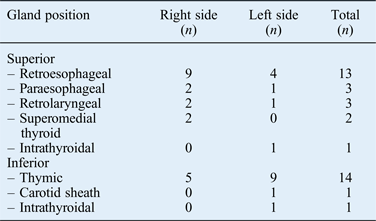
Ectopic glands were superior in 22 cases (58 per cent) and inferior in 16 cases (42 per cent). Ectopic glands were slightly more frequently situated on the right side (53 per cent) than the left side (47 per cent). The results are summarised in Table I.
Distribution of ectopic parathyroid glands
The commonest location of an ectopic superior parathyroid gland was in the retroesophageal space (13 glands, 34 per cent). Superior parathyroid glands were also found in: a paraesophageal location (three glands, 8 per cent), a retrolaryngeal location (three glands, 8 per cent), the superomedial thyroid position (two glands, 5 per cent) and an intrathyroidal position (one gland, 3 per cent). Ectopic retroesophageal and paraesophageal superior parathyroid glands were more commonly found on the right side.
Ectopic inferior parathyroid glands were most commonly found within the thymus; overall, this was the commonest place for an ectopic parathyroid gland in our series (14 glands, 37 per cent). An inferior parathyroid gland was located in the carotid sheath in one patient (3 per cent). One patient (3 per cent) had an intrathyroidal inferior parathyroid gland.
The mean weight of ectopic parathyroid glands was greater than the mean weight of those found in normal anatomical locations. The mean weight of ectopic parathyroid glands was 1148 mg. The mean weight of normally positioned parathyroid glands removed for primary hyperparathyroidism was 708 mg and for secondary hyperparathyroidism was 623 mg.
We assessed the mean weight of ectopic glands according to their location. The mean weight of paraesophageal superior parathyroid glands was 1940 mg; however, out of three glands in this position, one weighed 5200 mg, resulting in a skewed mean. The mean weight of retroesophageal superior parathyroid glands was 748 mg and the mean weight of retrolaryngeal superior parathyroid glands was 437 mg. The mean weight of thymic inferior parathyroid glands was 1468 mg, although this result is skewed as one resected gland weighed 6000 mg. These results go some way to support the theory of acquired migration of superior glands into the retroesophageal space during deglutition due to their mass effect.
In the series of revision cases, 5 procedures were performed on secondary hyperparathyroid patients and 11 on primary hyperparathyroid patients. One patient with familial hypercalcaemic hypocalciuria underwent a revision procedure. A further two patients underwent failed revision procedures, although an adenoma was removed in one patient and a second retroesophageal adenoma was subsequently removed from the same patient during a second ultimately successful revision (included in the series). The incidence of ectopia in the revision primary hyperparathyroid series was 55 per cent (six patients), although this would be 64 per cent if it included the undiscovered ectopic gland. The incidence of ectopia in the revision secondary hyperparathyroid series was 20 per cent (one patient).
Discussion
It is vital that the surgeon undertaking parathyroid surgery has a thorough understanding of normal anatomy and potential sites for parathyroid ectopia, in order to maximise success rates and minimise the need for re-exploration. Parathyroid glands may lie in an ectopic position as a consequence of abnormal migration during embryogenesis or secondary to acquired migration. The greater propensity for inferior parathyroid ectopia in previous reports has been attributed to longer and more variable embryological migration of inferior parathyroid glands compared to superior parathyroid glands.Reference Ott, Lawrence, Jorgensen, Calandra, Henkin and Barbato4
Inferior parathyroid glands may be ectopic in a low (excessive migration) position or, less commonly, in a high (undescended) position. In excessive migration, inferior parathyroid glands may be located in the anterior mediastinum in the lower portion of the thymus, but they have been reported as caudal as the pericardium.Reference Randolph, Urken and Randolph5 Failure of complete descent may be associated with a focus of thymic tissue, and is often found at the carotid bifurcation, but can extend even higher in the neck to the hyoid bone or mandible. Rarely, inferior parathyroid glands can be intrathyroidal.Reference Wang6
Embryologically, superior parathyroid ectopia is reported as being less common than inferior parathyroid ectopia. The former may be due to abnormal descent, resulting in a laterally placed gland associated with the carotid artery, or may rarely be intrathyroidal.Reference Wang6
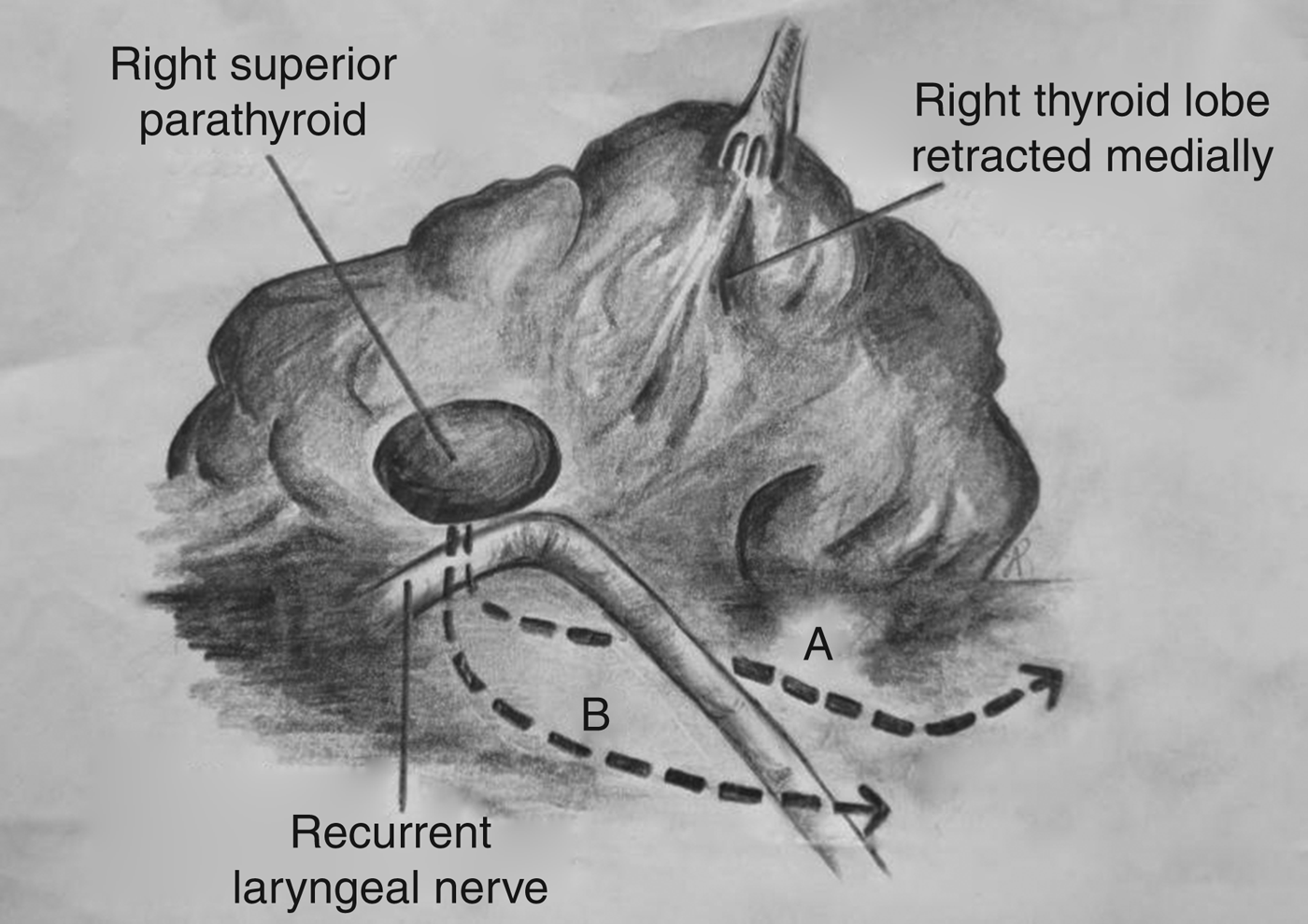
Acquired migration is the change in position of a previously normally located gland to an ectopic location. An abnormally enlarged gland may be displaced because of its mass and the regional dynamics (i.e. swallowing, negative intrathoracic pressure and fascial planes).Reference Peeler, Martin, Sandler and Goldstein1 Superior parathyroid glands are particularly prone to acquired migration. They migrate posteriorly and inferiorly into a paraesophageal or retroesophageal location (Figure 2). Inferior parathyroid glands may migrate through the thyrothymic ligament into the thymus.Reference Phitayakorn and McHenry7
Diagrammatic representation of the passage of acquired migration of a superior parathyroid gland into the retroesophageal (‘A’) and paraesophageal (‘B’) gutters.
In this series, we report an incidence of parathyroid ectopia of 10 per cent. This is in keeping with the incidence reported in the literature (4–20 per cent).Reference Peeler, Martin, Sandler and Goldstein1–Reference Kaplan, Yashiro and Salti3 However, there is no standard definition of parathyroid ectopia. For example, Phitayakorn and McHenry report an incidence of 16 per cent, but classify a parathyroid gland located in the thyrothymic ligament as ectopic,Reference Phitayakorn and McHenry7 which we consider to be a normal anatomical location.
In our study, the rate of ectopia was greater for superior glands (58 per cent), which is contrary to previous reports in the literature. The commonest site of an ectopic superior parathyroid gland was retroesophageal. The most likely explanation for this is acquired migration due to a mass effect of enlarged glands. We found that the incidence and the mean weight of retroesophageal glands were greater than those of retrolaryngeal and paraesophageal glands. We believe that the higher incidence of retroesophageal glands on the right is due to the relative laterality of the recurrent laryngeal nerve on the right side compared to the left, which effectively increases the likelihood of a migrating superior gland descending behind the nerve and then into the retroesophageal gutter. This relative laterality is caused by the brachiocephalic artery around which the right nerve travels, compared to the aortic arch around which the left nerve travels. The largest ectopic inferior parathyroid gland located in the thymus weighed 6000 mg, and its location also supports the acquired migration theory.
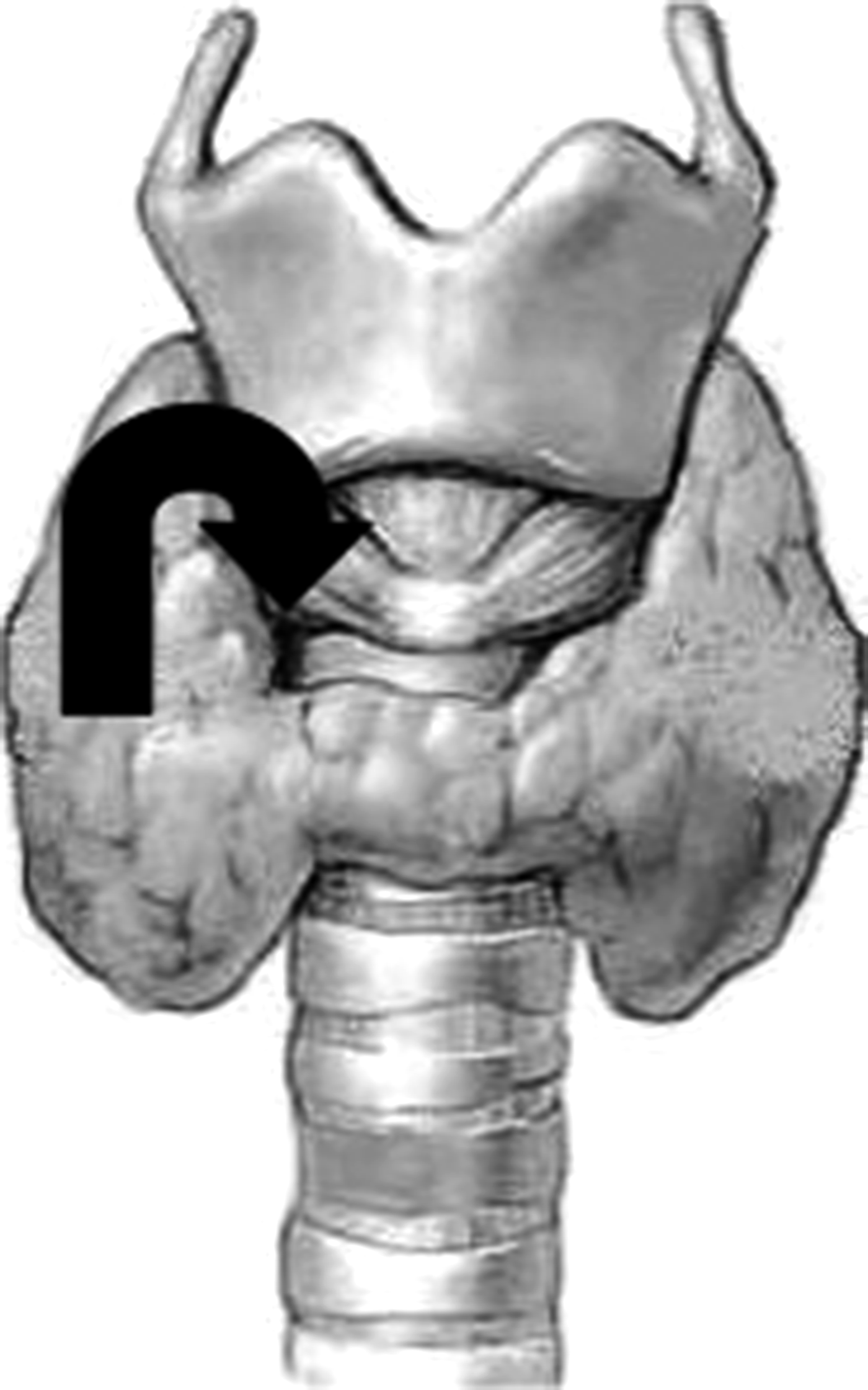
Two patients had an ectopic superior parathyroid gland located superomedial to the thyroid (Figure 3). Because a normal parathyroid gland search is conducted with the thyroid lobe retracted medially, a gland in this position may be missed as it is covered by the superior pole. For this reason, our surgical algorithm advocates dividing the superior pole vessels to retract the superior pole down and opening up Joll's triangle when a superior gland is ‘missing’.
Diagram illustrating the superomedial thyroid position (arrow), located in a plane between the medial surface of the superior thyroid pole and the cricothyroid muscle.
The incidence of ectopic glands in our primary hyperparathyroid series must be qualified by the recognition that in the series there were five surgical failures in which less than four glands were identified. It is therefore possible that the incidence of ectopia in the primary hyperparathyroid series is higher, at 32 out of 285 (11 per cent).
It is hard to comment further on the accuracy of ectopia incidence in the secondary hyperparathyroid series. As renal failure causes chronic stimulation of ectopic parathyroid rests, which may then develop into autonomous glands, the total number of glands removed may or may not represent the true total number. One patient remains profoundly hypoparathyroid (with parathyroid hormone levels less than 3 nmol/l) some years after a three-gland parathyroidectomy, whilst another had five glands removed at first exploration. A further patient has undergone revision parathyroidectomy, having had four glands removed previously, to have a further two glands removed.
Surgical algorithm
From our series, we have developed an algorithm which outlines the order of ectopic areas to search in the event that a parathyroid gland is not found in the normal anatomical position (Figure 4).
Surgical algorithm for finding (a) a missing inferior parathyroid gland and (b) a missing superior parathyroid gland.
A missing inferior parathyroid gland should initially be sought in the normal anatomical locations of the lower pole of the thyroid gland and the thyrothymic ligament. If the gland is not located in these positions, a transcervical thymectomy should be performed. If thymic examination is negative, the next step is exploration of the carotid sheath. The ectopic gland may be located anywhere from the carotid bifurcation to the vessel origin in the mediastinum. It is occasionally posterior and lateral to the carotid artery, and less frequently lateral to the jugular vein.Reference Peeler, Martin, Sandler and Goldstein1 Finally, one should consider an intrathyroidal inferior parathyroid gland. These glands are not usually palpable and should be suspected if a systematic exploration fails to locate the missing gland. Intrathyroidal inferior parathyroid glands may subsequently be located with high-resolution ultrasound scanning and managed with thyroid lobectomy. We do not advocate thyroid lobectomy in primary surgery without imaging evidence of an intrathyroidal adenoma.
If a superior parathyroid gland cannot be located in its normal anatomical location, the search should be extended to the retroesophageal gutter, followed by the paraesophageal gutter. Retroesophageal glands are often implied by a fullness of fat just above the recurrent laryngeal nerve when the thyroid lobe is retracted medially. Delivering this fatty tissue with two pairs of forceps will bring the gland so that it is pulled from behind the oesophagus to be visible above the nerve. If still not located in these positions, the retrolaryngeal space should be checked; this may be explored by twisting the thyroid cartilage to open up the space on one side. Finally, consider an intrathyroidal superior parathyroid gland, which will need to be managed by subsequent thyroid lobectomy following localisation with high-resolution ultrasound scanning.
• Parathyroid ectopic adenoma occurred in 10 per cent of cases
• A systematic surgical search is vital for finding a missing adenoma
This algorithm allows a systematic and thorough search of the neck to identify the majority of ectopic parathyroid glands. A small number of glands in unusual ectopic locations, such as the tongue base, hypopharynx, pericardium and aortopulmonary window, will not be found using this algorithm. In such cases, pre-operative and intra-operative localisation techniques, in addition to the more frequently used technetium sestamibi and high-resolution ultrasound scans, may be necessary.
Conclusion
In our series, parathyroid ectopia was evident in 10 per cent of explorations. Superior parathyroid ectopia was more common than inferior parathyroid ectopia. The commonest sites for ectopic parathyroid adenomata were within the retroesophageal space and within the thymus. From our series, we have devised a systematic surgical algorithm to aid the search for a missing adenoma.
Acknowledgement
We would like to acknowledge Miss Asmitha Prabhakaran (medical student) for the Figure 2 artwork.