1. Introduction
Across the World Health Organization member states, an estimated 126,670 organs were transplanted in 2015 (Global Observatory on Donation and Transplantation, 2015). This figure pales in comparison to the number of patients with end-stage organ failure: within the US alone, nearly 120,000 patients are on the transplantation waitlist, and an estimated 20 people die each day while waiting for a transplant (US Department of Health and Human Services, 2018). Despite progress in transplantation medicine, there remains a worldwide shortage of organs available.
In the face of a global shortage, countries vary widely in their rates of deceased organ donation (IRODAT, 2017). Cross-country analyses suggest that this may be influenced by the type of legislation implemented – whether a country presumes consent (such that residents are organ donors by default unless they ‘opt out’), or requires explicit consent (where residents actively ‘opt in’ for organ donation) (Abadie and Gay, Reference Abadie and Gay2006; Gimbel et al., Reference Gimbel, Strosberg, Lehrman, Gefenas and Taft2003; Johnson and Goldstein, Reference Johnson and Goldstein2003; Shepherd et al., Reference Shepherd, O'Carroll and Ferguson2014). Experimental research suggests that the default influences individual decision-makers by communicating a recommendation or by normalizing organ donation (Davidai et al., Reference Davidai, Gilovich and Ross2012; Mckenzie et al., Reference McKenzie, Liersch and Finkelstein2006). Correspondingly, several countries have reported increases in the donor pool after presumed consent laws were passed (Rithalia et al., Reference Rithalia, McDaid, Suekarran, Myers and Sowden2009; Shum and Chern, Reference Shum and Chern2006).
While a causal link has not been established definitively, a systematic review of the literature concluded that ‘[i]n the four best quality between-country comparisons, presumed consent law or practice was associated with increased organ donation – increases of 25–30%, 21–26%, 2.7 more donors per million population, and 6.14 more donors per million population in the four studies’ (Rithalia et al., Reference Rithalia, McDaid, Suekarran, Myers and Sowden2009). Comparing similar countries that differ in their organ donation policies, Davidai et al. (Reference Davidai, Gilovich and Ross2012) show that donation rates are six time greater in countries with presumed consent than in countries where donation requires explicit consent. Taken together, the extant literature suggests that the introduction of presumed consent would result in an increase of donation rates (Li et al., Reference Li, Hawley and Schnier2013; Oz et al., Reference Oz, Kherani, Rowe, Roels, Crandall, Tomatis and Young2003; Ugur, Reference Ugur2015) and ultimately better health outcomes: ‘as impressive as 130,000 [annual] solid organ transplants worldwide may be, it is estimated that this number represents less than 10% of the global need’ (WHO, 2020a, 2020b).Footnote 1
Although the potential implications of policy types are sizable, to the best of our knowledge, there has been no study that uses data from all continents to explore in a systematic manner what drives countries to choose presumed over explicit consent. This is what this paper does: by identifying mechanisms that have led countries to establish opt-out laws, this paper aims to inform future debates on the suitability of such laws in different contexts.Footnote 2
Our data set includes all countries present in the International Registry on Organ Donation and Transplantation dataset (IRODaT – Gómez et al. (Reference Gómez, Pérez and Manyalich2014)). This leaves us with 93 countries from all five continents, which we categorize as explicit consent (if they require individuals to opt in as donors; N = 48), presumed consent (if consent is assumed, unless indicated otherwise; N = 39), and unclear/mixed policy (no legislation in this matter, no organs procurement from the deceased, no national organ networks, or unclear policy; N = 6). We focus on those variables that the previous literature has considered to be relevant with regards to decisions about deceased organ donations (Abadie and Gay, Reference Abadie and Gay2006; Rithalia et al., Reference Rithalia, McDaid, Suekarran, Myers and Sowden2009; Shepherd et al., Reference Shepherd, O'Carroll and Ferguson2014): religion and system of beliefs; public preferences for redistribution and for a public health system; economic and technological capacity to carry out transplants; legal traditions; and altruism. Hence, we collect data on economic development, social equality, health outcomes, state religiosity, religion preferences, legal system, urbanization, human development, political preferences, and altruism.
Results reveal a few key predictors. First, countries with civil law regimes are more likely to pass presumed consent laws. Second, compared to Protestant countries, Catholic countries are considerably more likely to hold presumed consent laws – we find no significant effects for other religious faiths. Third, most of our results suggest that countries with a larger religious population (including believers of any faith) do not have presumed consent policies. Fourth, presumed consent is less likely in countries with higher pro-social behavior. Taken together, these results suggest that the legislator is to some extent (but not fully) responsive to the preferences of the public.Footnote 3
2. Data and empirical specification
Countries are selected if they are in the International Registry on Organ Donation and Transplantation dataset (IRODAT – Gómez et al. (Reference Gómez, Pérez and Manyalich2014)). This leaves us with 93 countries, which we categorize as follows: explicit consent (countries that require individuals to opt in as donors; N = 48), presumed consent (countries where consent is assumed, unless indicated otherwise; N = 39), and unclear/mixed policy (countries that do not have legislation in this matter, do not procure organs from the deceased, do not have national organ networks, or cannot be identified clearly as having either explicit or presumed consent; N = 6). Tables 1 and in the supplementary materials provide the list of countries, their current legislation status and the sources used, whereas Figure 1 in the supplementary materials shows a world map with the main variables of interest: donation laws, legal origins, and religious faith.
For each country, we collect information on main religion, state religiosity and % of religions population to capture the dominant credo and system of beliefs regarding the dead and their bodies – in particular, predominant religion of each country is determined as the largest religious community according to CIA (2018). Size of public sector, size of public health system and maximum tax rates are used to proxy political preferences, in particular preferences for redistribution and for a public health system. GDP per capita, degree of urbanization, life expectancy, literacy rate, formal education levels, and OECD membership capture economic development and technological capacity. Mortality rate for ages 5–14 and physicians per thousand people capture health outcomes and capacity of the health system. Legal system captures the preferences and modus operandi of the legislator. Democracy index, Gini index and percentage of members of parliament who are women capture the level of equality and social development. Blood donations per capita and giving index score measure altruism. Lastly, religious and ethnic fragmentation proxy for social cohesion. Table 3 in the supplementary materials gives further details on the sources of all independent variables, whereas Table 4 provides the descriptive statistics and further details.
To find the key predictors of presumed consent, we adopt a machine learning-based approach to sort through all the possible partial correlations between predictors and organ donation consent laws. We use the Lasso regression approach and an exhaustive search model (all details in sections 2.1 and 2.2 of the supplementary materials). Results are remarkably consistent across the different approaches we use: legal origins is the only variable that is always included. Main religion, and variables regarding health outcomes (children mortality rate), political preferences (public sector size) and political development (democracy index) are typically selected, too. When included, religious fractionalization and altruism tend to be a key predictor of organ donation laws as well – since data on ethnic fractionalization, religious fractionalization, and proxies for altruism exist only for a subset of countries, we do not include them in the main analysis.
In order to show the relative importance of each variable, and the direction of the correlation, we run the following linear model using the variables most frequently selected by the machine learning algorithms:

Policyi is a dummy that captures presumed consent (1 = presumed consent; 0 = explicit consent), i denotes country, and X denotes the vector of independent variables. The variables included in X are legal origins, mortality rate (ages 5–14), dominant religion,Footnote 4 state religiosity, % who are religious, log of GDP per capita, size of the public sector, democracy index, degree of urbanization, and OECD membership. The supplementary materials show that results hold when we include all remaining ones in a series of robustness checks.
3. Results
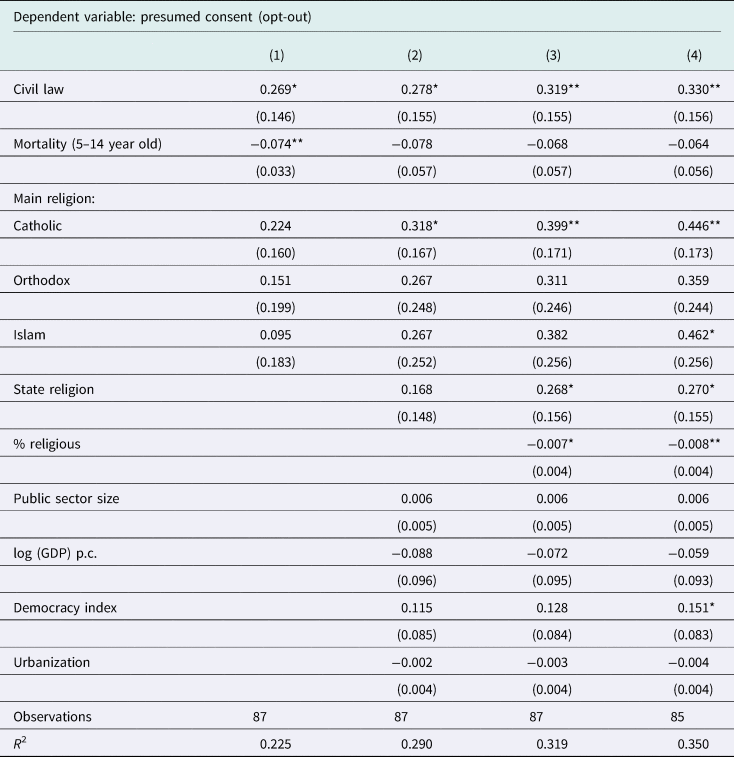
Table 1 confirms that the strongest predictors of presumed consent are legal origins and religion. Civil law countries are more likely than common law countries to have an opt-out system. The magnitude of the observed effect is large: caeteris paribus, civil law countries are five times more likely to pass presumed consent laws than common law countries.Footnote 5
Drivers of presumed consent legislation

Standard errors in parentheses. ***p < 0.01, **p < 0.05, *p < 0.1.
Dependent Variable: 1 = Presumed consent (‘opt-out’); 0 = Explicit consent (‘opt-in’). Civil Law: legal system based on civil law only (base category: common law or neither. Unreported category: both civil law and common law). State religion: dummy variable for holding an official, government-endorsed religion. Main religion: base category = ‘Other Christian’; unreported category = ‘Other’. Not shown: OECD membership (dummy). See Tables 3 and 4 in the supplementary materials for more details on the variables.
The influence of a country's predominant religion does not pale in comparison. Namely, countries where Catholicism dominates are around four times more likely to enact presumed consent than countries where Protestantism dominates. We find no significant results for other religions when we compare them to Catholicism. Column (4) excludes Australia and Germany, since both countries have virtually the same number of Protestants and Catholics according to official statistics.Footnote 6 Excluding both does not alter our results: When we include them, the resulting p-values for Catholicism are 0.043, 0.024, 0.020, and 0.039 (for all four possible combinations). The impact of health outcomes (proxied by child mortality) is on the other hand, less clear. Whereas results suggest that countries with lower child mortality rates are more likely to have presumed consent, this effect vanishes once we control for political and social development outcomes.
Apart from legal origins and religious faith, we find that countries with a larger proportion of religious population – regardless of faith – tend to prefer explicit consent systems. Everything else held constant, a country where half its residents hold any religious faith will implement presumed consent with a probability close to 80%, whereas that probability drops to around one third for a country where everyone is religious. However, as discussed below, this result is not robust to all specifications.
Table 9 in the supplementary materials replicates Table 1 with the inclusion of countries where the policy is not clear (i.e. where the dependent variable is 1 for presumed consent and 0 for explicit consent/no policy/unclear/mixed). All results hold.
3.1. Robustness checks and alternative explanatory variables
Figure 3 in the supplementary materials shows that results for civil law, Catholicism, and altruism are robust to the inclusion of all remaining controls described above. However, results regarding proportion of religious population reveal that, whereas clearly suggestive, we cannot make statements as conclusive as with the case of the other three explanatory variables.
Using data from Montalvo and Reynal-Querol (Reference Montalvo and Reynal-Querol2005) and Dražanová (2019), we also assess whether ethnic and religious fragmentation can predict presumed consent (as mentioned above, since data on these dimensions exist only for a subset of countries, we do not include them in the main analysis). Results are unambiguous: countries with higher religious fragmentation are less likely to have presumed consent. This suggests that policy-makers might be more reluctant to impose organ donations where societies are less homogeneous. All details can be found in sections 2.1 and 2.2 of the supplementary materials.
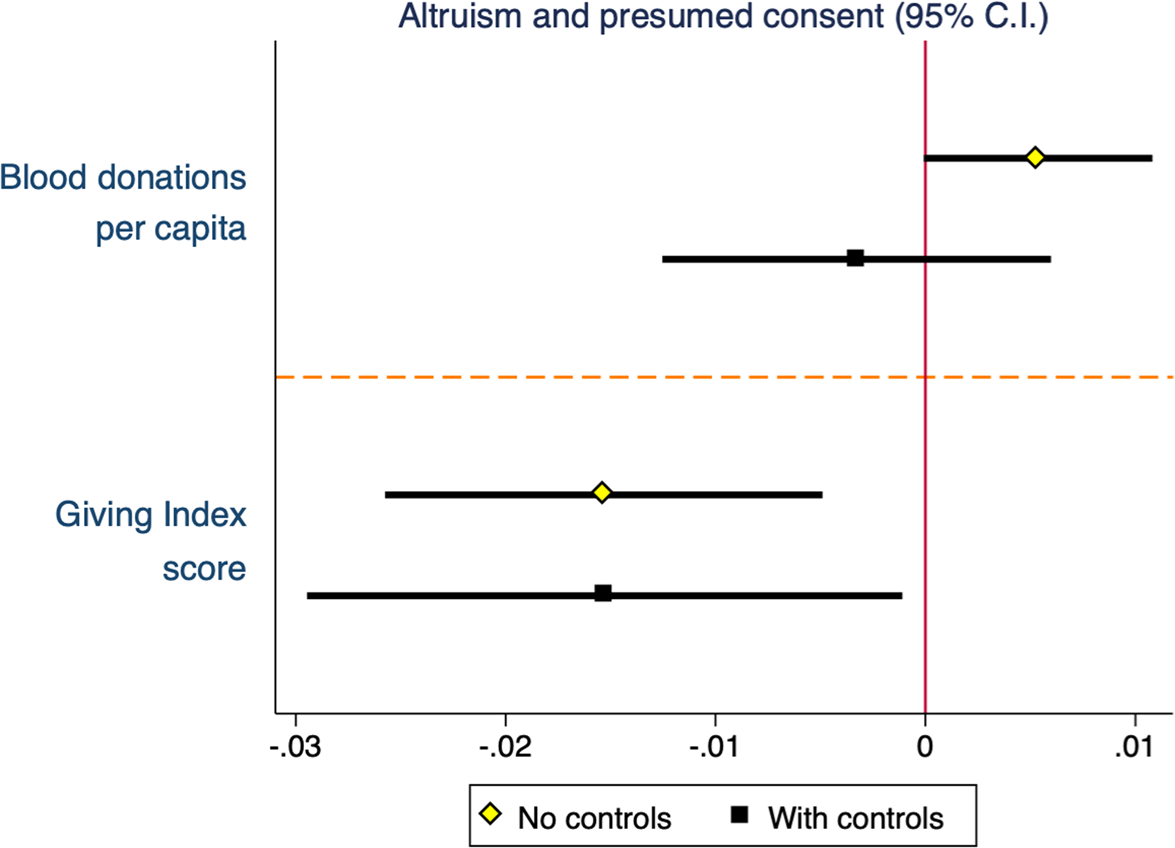
Finally, Figure 4 in the supplementary materials shows that – with only the exception of altruism – no other variables have explanatory power at conventional statistical levels: when we include measures that capture pro-social behavior, we find that lower levels of altruistic behavior are associated with opt-out consent systems – see Figure 1 (as with religious fractionalization, we test altruism separately because of data constraints). We proxy altruism with ‘giving index’, a measure constructed by the Charities Aid Foundation by means of a worldwide survey (Charities Aid Foundation, 2017). Specifically, it is computed based on the proportion of people who report one or more of the following non-health-related altruistic behavior in the month prior to being interviewed: helping a stranger, donating money, and volunteering. We find that countries in which residents report higher levels of giving are more likely to enact explicit consent. To be precise, the predicted probability of having opt-out for a country with a giving score of 25% is around three times larger than for a country with a score of 50%.
95% confidence intervals. Bars with an empty diamond: no controls added. Bars with a solid square: full set of controls. Model: $Policy_i = \alpha + {X}^{\prime}_i\beta + \gamma z_i + \varepsilon _i$ , where z is the relevant variable, Policyi is a dummy for presumed consent, X i is a vector of country-specific controls: mortality rate among those aged 5–14 year old, state religion, main religion, percent who are religious, legal origins, GDP per capita, democracy index, and OECD membership. N = 79.

4. Discussion and remarks
We find that the historical origin of a country's laws is the strongest predictor of organ transplant policies: countries with civil law regimes are more likely to enact presumed consent policies, whereas common law countries are more likely to prefer explicit consent rules.
Historically, the common law tradition originates from the laws of England, whereas the civil law tradition has its roots in the Roman law, and was adopted and exported by France. These two legal systems operate in very different ways: civil law relies on professional judges, legal codes, and written records; whereas common law focuses on lay judges, broader legal principles, and oral arguments (Glaeser and Shleifer, Reference Glaeser and Shleifer2002). Furthermore, common law follows the legal principle of stare decisis – i.e. precedent is binding – while this is not necessarily the case for civil law (Dainow, Reference Dainow1966). Since legal traditions were typically introduced into colonized countries through conquest, persisted after independence, and varied between common and civil law colonizers, they provide a natural experiment for researchers to trace the effects of legal system variation on various outcomes (Anderson, Reference Anderson2018).
Among other findings, civil law regimes are more likely to impose military conscription (Mulligan and Shleifer, Reference Mulligan and Shleifer2005), to have government ownership of media (Djankov et al., Reference Djankov, Glaeser, La Porta, Lopez-de-Silanes and Shleifer2003) and banks La Porta et al. (Reference La Porta, Lopez-de-Silanes and Shleifer2002), to strictly regulate labor markets (Botero et al., Reference Botero, Djankov, La Porta, Lopez-de-Silanes and Shleifer2004), to favor a heavier hand of government ownership and more hierarchical regulation (D'Amico and Williamson, Reference D'Amico and Williamson2015; La Porta et al., Reference La Porta, Lopez-de-Silanes and Shleifer2008), and to be more comfortable with a centralized and activist government than common law regimes (Mahoney, Reference Mahoney2001). Adding to this literature, our findings suggest that donation laws also tend to reflect the polity's default position on broader conceptions of the relationship between the individual and the state (Healy, Reference Healy2005). Notably, by highlighting how the more interventionist approach of civil law countries extends to the area of organ donation laws, our results underscore how legal origins have consequences that extend into the sphere of health: previous research has suggested that better health outcomes in countries with civil law legal origin seem to result from greater decentralization of government funds, higher rates of urbanization, and less ethnic fractionalization (Scanlon, Reference Scanlon2016). Results in this paper add a fourth mechanism: presumed consent. While it has been claimed that ‘default saves lives’ in organ donation (Johnson and Goldstein, Reference Johnson and Goldstein2003), the evidence suggests that a country's legal origins is what dictates its default in the first place. This complements recent work highlighting the impact of legal origins on the HIV rates of females in Sub-Saharan Africa (Anderson, Reference Anderson2018).
Our finding has also relevant implications for Legal Origins Theory: critics have argued that legal origins are ‘merely a proxy’ for political, historical or social developments that occurred as the legislation was being developed (La Porta et al., Reference La Porta, Lopez-de-Silanes and Shleifer2008; Spamann, Reference Spamann2015). In clear contrast to this, organ donation laws did not appear until well into the second half of the 20th century – organ transplants were not feasible in a safe and systematic way until the 1970s.Footnote 7 That is, many decades after the establishment of the legal system. While it is plausible that a lurking unobserved confounder explains both legal origins and contemporary policies, it is likely that the major channel by which legal origins may have affected organ donation laws is via the modus operandi inherent to each type of legal system – i.e. a preference for ‘private market allocations vs. a preference for state-based allocations’ (La Porta et al., Reference La Porta, Lopez-de-Silanes and Shleifer2008). In this sense, organ donation laws are a perfect case in point to illustrate that countries design laws consistently with their legal traditions, which is in essence the core of Legal Origins Theory.
In this respect, future research should shed light on whether legal origins have a similar predictive power on other contemporary policies. For instance, with regards to the current Covid-19 pandemic, results in this paper and the previous literature suggest that civil law and common law countries would respond in a different fashion. Whereas civil law countries could be expected to implement centralized policies with very specific regulations on what citizens may or may not do, common law countries would, in principle, be expected to respond in a more de-centralized, less regulatory-driven fashion.
The second key predictor of donor legislation is religion. Catholic countries are nearly 30 percentage points more likely to legislate presumed consent than Protestant-dominant countries. Notably, this is not driven by religious credo, since formally all religions endorse deceased organ donation (Bruzzone, Reference Bruzzone2008). In particular, Protestant and Catholic leaders express equal levels of support to deceased donations (Oliver et al., Reference Oliver, Woywodt, Ahmed and Saif2011). We thus contend that our observed findings reflect the institutional and social dynamics induced by these two different religious affiliations.
In previous research, Protestantism has been associated with higher levels of altruism (Bekkers and Schuyt, Reference Bekkers and Schuyt2008; Mocan and Tekin, Reference Mocan and Tekin2007). It has been shown to encourage lay members to engage in voluntary activities both inside and outside the church (Arruñada, Reference Arruñada2010; Lam, Reference Lam2006), to encourage the pursuit of social responsibility among its members (relative to other religions) (Lam, Reference Lam2002), and to rely on more horizontal structures than Catholicism (Lipset, Reference Lipset2013; Rose, Reference Rose1954).Footnote 8 On the other hand, Catholicism has been characterized by more hierarchical structures and a greater reliance on the government to take responsibility, favoring the provision of social services within its own hierarchy and limiting lay involvement. In particular, lower levels of volunteering have been found among Catholics as compared to Protestants (Lam, Reference Lam2002). Although religious leaders in Catholic and Protestant countries have no direct say on legislation, historically dominant religions are likely to leave a long-lasting imprint on cultures and may shape people's attitudes – even if they are not religious themselves (Halman and Luijkx, Reference Halman and Luijkx2006; Kaasa, Reference Kaasa2013). That is to say, religions may have affected the legislator's policy choices through the political culture they contribute to shape. In this light, the state having limited say regarding organs from the deceased seems to fit within the general lack of hierarchization intrinsic to Protestantism, leaving more room for individual altruism to dictate organ donation decisions.
Beyond the Protestant−Catholic distinction, countries with a larger religious population (including believers of any faith) are less likely to hold opt-out policies. Although formally no major religion opposes donations (Bruzzone, Reference Bruzzone2008), research has shown that religiosity is negatively associated with willingness to donate organs (Rumsey et al., Reference Rumsey, Hurford and Cole2003; Ugur, Reference Ugur2015; van Dalen and Henkens, Reference van Dalen and Henkens2014; Wakefield et al., Reference Wakefield, Watts, Homewood, Meiser and Siminoff2010; Wong, Reference Wong2010). These two results suggest policy-makers are responsive to citizens' demands to some extent. If religious individuals have a stronger hesitation to donate and this translates into lobbying against presumed consent, such political pressure is more likely to be successful in countries where the presence of religious groups (of any kind) is more widespread. Nonetheless, we caution that – unlike dominant religion – the proportion of religious adherents is not robust across all model specifications. Further, the measure of religiosity that we use (from the CIA World Factbook) is not as precisely estimated as other variables in our data set (details in the supplementary materials). Thus, we are circumspect regarding the association between the proportion of a religious population and organ donation laws.
Finally, our results suggest that presumed consent systems are associated with lower levels of non-health-related philanthropy and lower levels of pro-social behavior. This confirms the findings in Shepherd et al. (Reference Shepherd, O'Carroll and Ferguson2014). Although this result may seem surprising, experimental research suggests that opt-in policies portray donation as an active, altruistic act (Davidai et al., Reference Davidai, Gilovich and Ross2012; Miller et al., Reference Miller, Currie and OCarroll2019). This portrayal aligns with the norm of giving as an active process that exists in countries where philanthropy is high (Shepherd et al., Reference Shepherd, O'Carroll and Ferguson2014). Conversely, opt-out policies depict donation as a mundane form of community service, akin to paying one's tax (Davidai et al., Reference Davidai, Gilovich and Ross2012; Miller et al., Reference Miller, Currie and OCarroll2019). In turn, this representation may encourage donation in countries where altruism is lower. In other words, if policy-makers rationally respond to citizens' preferences and social norms, they should enact presumed consent where altruism is lower, and require explicit consent where pro-social behavior is higher. Our data are consistent with this hypothesis.
In a period when many countries are re-visiting their organ donation laws (only in 2018, Argentina, the Netherlands and Ukraine have updated them), our findings have relevant policy implications. However central the role of legal origins may be, the salience of the religious and social values dimensions highlight the importance of recognizing that adoption of presumed consent does not occur in a vacuum. In many recent commentaries, leading policy makers and researchers have been advocating for a presumed consent policy in a blanket manner – as if it were the panacea for the worldwide organ shortage. However, findings in this paper and previous research emphasize the need for parallel measures in order to guarantee the success of opt-out systems (Bilgel, Reference Bilgel2012; Domínguez and Rojas, Reference Domínguez and Rojas2013; Li et al., Reference Li, Hawley and Schnier2013; Shepherd et al., Reference Shepherd, O'Carroll and Ferguson2014; Zúñniga-Fajuri, Reference Zúñiga-Fajuri2015). Similarly, several countries have debated this possibility in the public space, but concluded that cultural factors rendered an opt-out policy impractical (Etheredge et al., Reference Etheredge, Penn and Watermeyer2018). This highlights that governments would do wisely to anticipate more resistance in contexts that may not be as friendly.
As La Porta et al. (Reference La Porta, Lopez-de-Silanes and Shleifer2008) note, states may apply the tools characteristic of their legal style to areas of regulation where they are inappropriate. Presumed consent laws are likely to be a good example if the legislator fails to register public preferences that are opposed to such procedures. For instance, if the legislator in a common law country aims to implement presumed consent, it is likely to face resistance from different actors (e.g. civil society or the bureaucracy). In that case, it would be wise to learn from Norway or Malta, countries that have a mixed common law/civil law system and have successfully implemented presumed consent.Footnote 9 More generally, by highlighting the characteristics most frequently associated with organ donation laws, this paper provides a checklist of possible resistance factors for policy-makers who may try to implement presumed consent. Overall, the implication is clear: when calls are made for governments to switch to presumed consent, discussions should move beyond behavioral science research to consider the broader socio-cultural context.
Supplementary material
Supplementary materials can be found at www.guillemriambau.com.
Acknowledgement
We would like to thank Julien Labonne and Risa Toha for useful insights. All errors are ours.
Financial support
This work was supported by a grant awarded to Jean Liu from the National University of Singapore Humanities and Social Sciences research fund (grant number: HSS-1502-P02).