Introduction
Neuropsychological dysfunction in the context of depression is a risk factor for suicidal behavior, with executive dysfunction thought to play a predominant role. We had previously identified a post-hoc-derived executive performance factor that discriminated subjects with past histories of highly lethal suicidal behavior (Keilp et al. Reference Keilp, Sackeim, Brodsky, Oquendo, Malone and Mann2001), that correlated with language fluency and a secondary measure (Failure to Maintain Set) from the Wisconsin Card Sorting Test (WCT). The lack of any differences on standard WCT measures (e.g. category attainment, errors, perseverative errors) and Failure to Maintain Set's association with ventral prefrontal function (Stuss et al. Reference Stuss, Levine, Alexander, Hong, Palumbo, Hamer, Murphy and Izukawa2000) led us to hypothesize that other measures sensitive to ventral prefrontal dysfunction might be useful as a way to characterize deficits associated with suicidality.
Subsequent studies have found attempter/non-attempter differences on tasks whose common feature is an association with ventral prefrontal function, including decision-making measures such as the Iowa Gambling Task (Jollant et al. Reference Jollant, Bellivier, Leboyer, Astruc, Torres, Verdier, Castelnau, Malafosse and Courtet2005, Reference Jollant, Guillaume, Jaussent, Bellivier, Leboyer, Castelnau, Malafosse and Courtet2007, Reference Jollant, Lawrence, Olie, O'Daly, Malafosse, Courtet and Phillips2010; Westheide et al. Reference Westheide, Quednow, Kuhn, Hoppe, Cooper-Mahkorn, Hawellek, Eichler, Maier and Wagner2008) and the Cambridge Gambling Task (Clark et al. Reference Clark, Dombrovski, Siegle, Butters, Shollenberger, Sahakian and Szanto2011), behavioral measures of impulse control (Swann et al. Reference Swann, Dougherty, Pazzaglia, Pham, Steinberg and Moeller2005; Dougherty et al. Reference Dougherty, Mathias, Marsh-Richard, Prevette, Dawes, Hatzis, Palmes and Nouvion2009; Wu et al. Reference Wu, Liao, Lin, Tseng, Wu and Liu2009) and measures of mental flexibility such as Reversal Learning (Dombrovski et al. Reference Dombrovski, Clark, Siegle, Butters, Ichikawa, Sahakian and Szanto2010). However, deficits in standard WCT indices have been found in suicide ideators (Marzuk et al. Reference Marzuk, Hartwell, Leon and Portera2005) and not all studies find differences in individuals at risk for suicidal behavior (e.g. self-injurers) using performance measures of impulsiveness (Janis & Nock, Reference Janis and Nock2009).
In a recent review, Jollant et al. (Reference Jollant, Lawrence, Olié, Guillaume and Courtet2011) speculate that a network of brain regions implicated in the performance of decision-making tasks, which include the ventral prefrontal cortex, anterior cingulate and amygdala, are probably involved in suicidal behavior. However, this review also highlighted the diversity in patient samples that have been studied with regard to clinical state, medication status and nature of attempts, complicating any conclusions that might be drawn. There have been few studies that have examined larger samples of past attempters during a period of presumptive risk, using a comprehensive battery, to determine whether deficits on individual executive measures reflect a more general deficit, or even more fundamental impairments in basic information processing.
These basic neuropsychological functions have received less consideration in studies of suicidal behavior, despite their ability to differentiate attempters. Impaired attention control (Williams & Broadbent, Reference Williams and Broadbent1986; Becker et al. Reference Becker, Strohbach and Rinck1999; Cha et al. Reference Cha, Najmi, Park, Finn and Nock2010) has been found in suicide attempter and at-risk samples, especially if provocative distractors (i.e. suicide-related words) are used. In an interim analysis including our original sample and a portion of this sample (Keilp et al. Reference Keilp, Gorlyn, Oquendo, Burke and Mann2008), past attempters performed more poorly than non-attempters on a Stroop task, but not a Continuous Performance Task, suggesting that conflict detection measures may be especially sensitive to an information-processing deficit associated with suicidal behavior (one aim of this study was to determine whether these deficits stand out against the background of a larger neuropsychological battery). Memory performance is also deficient in suicide attempters, on both standard list learning tasks and autobiographical measures (Keilp et al. Reference Keilp, Sackeim, Brodsky, Oquendo, Malone and Mann2001; Sinclair et al. Reference Sinclair, Crane, Hawton and Williams2007; Arie et al. Reference Arie, Apter, Orbach, Yefet and Zalzman2008). It is not known whether these deficits underlie, or are associated with, the executive impairments found in other studies.
It is also not known whether different types of suicidal behavior are associated with different types of neuropsychological impairment. In our previous work, for example, deficits in executive performance were found in those who had made highly lethal past attempts (Keilp et al. Reference Keilp, Sackeim, Brodsky, Oquendo, Malone and Mann2001). Deficits in decision making are reported to be most pronounced in violent past attempters (Jollant et al. Reference Jollant, Bellivier, Leboyer, Astruc, Torres, Verdier, Castelnau, Malafosse and Courtet2005).
The purpose of this study was to systematically assess a new, larger sample of medication-free individuals with a past history of suicidal behavior who were currently depressed (major depressive disorder or type I bipolar disorder) and therefore in a period of risk. In our previous study (Keilp et al. Reference Keilp, Sackeim, Brodsky, Oquendo, Malone and Mann2001), a post-hoc discriminant analysis found two dimensions in our data corresponding to impairments related to depression itself, and to higher lethality past suicide attempt. A strategy to distinguish these two dimensions in our previous data was built into the design of the current assessment battery, which assessed eight domains of functioning. Four domains were expected to reflect depression-related impairments: domains assessing motor speed, psychomotor performance, attention and memory (Veiel, Reference Veiel1997; Zakzanis et al. Reference Zakzanis, Leach and Kaplan1998; Baune et al. Reference Baune, Miller, McAfoose, Johnson, Quirk and Mitchell2010). Four additional domains were designed to assess executive functions that were most likely to be affected by past suicide attempt status, including abstract/contingent learning (Keilp et al. Reference Keilp, Sackeim, Brodsky, Oquendo, Malone and Mann2001; Marzuk et al. Reference Marzuk, Hartwell, Leon and Portera2005), working memory (Keilp et al. Reference Keilp, Sackeim, Brodsky, Oquendo, Malone and Mann2001), language fluency (Bartfai et al. Reference Bartfai, Winborg, Nordström and Asberg1990; Keilp et al. Reference Keilp, Sackeim, Brodsky, Oquendo, Malone and Mann2001; Audenaert et al. Reference Audenaert, Goethals, Van Laere, Lahorte, Brans, Versijpt, Vervaet, Beelaert, Van Heeringen and Dierckx2002) and impulse control (Swann et al. Reference Swann, Dougherty, Pazzaglia, Pham, Steinberg and Moeller2005; Wu et al. Reference Wu, Liao, Lin, Tseng, Wu and Liu2009; Dougherty et al. Reference Dougherty, Mathias, Marsh-Richard, Prevette, Dawes, Hatzis, Palmes and Nouvion2009). Relative to the assessment in our earlier study, our assessment of abstract/contingent learning was enhanced with the addition of a computerized Object Alternation task, which, along with gambling tasks and reversal learning, is one of the best-validated measures of ventral prefrontal dysfunction (Zald & Andreotti, Reference Zald and Andreotti2010). Specific measures of impulsiveness (Go–No Go and Time Estimation; Keilp et al. Reference Keilp, Sackeim and Mann2005) were also included.
We hypothesized that depressed attempters and non-attempters would not differ on measures of motor speed and psychomotor performance, and most aspects of attention and memory, and that both groups would perform worse than healthy volunteers on these measures. Past attempters were expected to perform worse than non-patients and non-attempters on executive measures, including abstract/contingent learning, working memory, language fluency and impulse control tasks. Because the relationship between neuropsychological performance and suicide attempt may be mediated by characteristics of suicidal behavior, we also assessed the influence of level of current suicidal ideation, severity of past attempts and the violence of past attempts in supplementary analyses, to determine whether these factors contributed to attempter/non-attempter neuropsychological differences.
Method
Sample
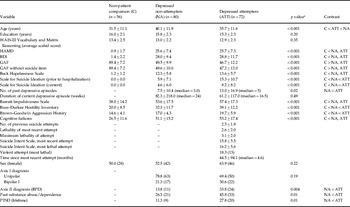
Participants were 152 patients meeting DSM-IV criteria for a current major depressive episode (major depressive disorder or type I bipolar disorder; type II were excluded based on their variability and our earlier work; Harkavy-Friedman et al. Reference Harkavy-Friedman, Keilp, Grunebaum, Sher, Printz, Burke, Mann and Oquendo2006) and 56 non-patient comparison subjects. Characteristics of the samples are presented in Table 1. Patients were currently depressed, with a Hamilton Rating Scale for Depression (HAMD, 24-item) score >16 at the time of recruitment. Non-patients were free of current or past Axis I or Axis II disorders. All subjects were free of neurological disease and gross organic brain dysfunction by clinical history and examination, and all had an estimated IQ > 80. None had current psychosis or current substance abuse/dependence. Of the participating patients, 72 had made at least one prior suicide attempt and 80 had no history of suicidal behavior. All subjects were either medication free or washed out of medications for participation in associated biological studies for at least 2 weeks prior to their assessment (6 weeks for fluoxetine). This study was approved by the local Institutional Review Board and all participants gave written informed consent.
Demographic and clinical rating data

WAIS-III, Wechsler Adult Intelligence Scale, 3rd revision; HAMD, 24-item Hamilton Rating Scale for Depression; BDI, Beck Depression Inventory; GAF, Global Assessment of Functioning; BPD, borderline personality disorder; PTSD, post-traumatic stress disorder.
a Omnibus ANOVA for continuous variables, χ2 for categorical variables.
Values given as mean ± standard deviation or % (n).
Instruments
Diagnosis was established in patients using the Structured Clinical Interview for DSM-IV, Axis I (Spitzer et al. Reference Spitzer, Williams, Gibbon and First1990) and Axis II (First et al. Reference First, Spitzer, Gibbon, Williams and Loma1996). Psychiatric illnesses were ruled out in non-patients using the non-patient version of the SCID (First et al. Reference First, Spitzer, Gibbon and Williams1997). Other clinical ratings have been described previously (Mann et al. Reference Mann, Waternaux, Haas and Malone1999) and are listed in Table 1. Pre-morbid intellectual ability was assessed with the Vocabulary and Matrix Reasoning subtests from the Wechsler Adult Intelligence Scale, 3rd revision (WAIS-III; Wechsler, Reference Wechsler1997; subjects with an average scaled score <7 on these subtests were excluded). Subjective cognitive complaint was assessed with the Cognitive Failures Questionnaire (Broadbent et al. Reference Broadbent, Cooper, FitzGerald and Parkes1982). History of past suicidal behavior was assessed using the Columbia Suicide History Scale (Oquendo et al. Reference Oquendo, Halberstam, Mann and First2003) and intent with the Suicide Intent Scale (Beck et al. Reference Beck, Beck and Kovacs1975). Severity of past suicide attempts was quantified using Beck's medical damage rating of physical injury resulting from an attempt (Beck et al. Reference Beck, Beck and Kovacs1975), which ranges from 0 (no physical damage) to 8 (death).
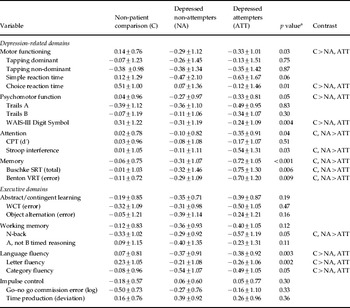
Subjects were evaluated in eight neuropsychological domains, with the first four targeting core deficits in depression and the second four a broad array of executive functions associated with suicidal behavior in prior studies. These domains, and the tests included in them, were as follows: (1) Motor Function [Finger Tapping Test, Simple and Choice Reaction Time (RT)], (2) Psychomotor Function (Trail Making Test, WAIS-III Digit Symbol subtest), (3) Attention [Continuous Performance Test – Identical Pairs, 4-digits fast condition (CPT), computerized Stroop task], (4) Memory [Buschke Selective Reminding Test (SRT), Benton Visual Retention Test (VRT), administration D], (5) Abstract/Contingent Learning [Wisconsin Card Sorting Test (WCT), computerized Object Alternation test], (6) Working Memory (computerized N-Back Test, A, Not B Logical Reasoning Test), (7) Language Fluency (Letter and Animal/Category tasks), and (8) Impulse Control (computerized Go–No Go and Time Estimation/Production tasks). All tasks have been used in our previous studies (Keilp et al. Reference Keilp, Sackeim, Brodsky, Oquendo, Malone and Mann2001, Reference Keilp, Sackeim and Mann2005), with the exception of Object Alternation, which is a computerized adaptation of a primate task similar to that used by other investigators (Zald et al. Reference Zald, Curtis, Chernitsky and Pardo2005), sensitive to ventral prefrontal dysfunction (Zald et al. Reference Zald, Curtis, Chernitsky and Pardo2005; Zald & Andreotti, Reference Zald and Andreotti2010), and included as a complement to the WCT, which is primarily associated with dorsolateral dysfunction (Stuss et al. Reference Stuss, Levine, Alexander, Hong, Palumbo, Hamer, Murphy and Izukawa2000). A detailed description of this task is presented in the Appendix. The principal measures from each task (see Table 2) were converted to Z scores based on age-, sex- and/or education-corrected external norms (Wechsler, Reference Wechsler1997; Keilp et al. Reference Keilp, Sackeim and Mann2005; Spreen & Strauss, Reference Spreen and Strauss2006) and averaged to compute domain scores.
Neuropsychological performance measures

CPT, Continuous Performance Test; WCT, Wisconsin Card Sorting Test; SRT, Selective Reminding Task; VRT, Visual Retention Test.
a ANCOVA with main effect for group, covarying presence of borderline personality disorder.
Statistical analyses
Demographic and clinical data were compared using a one-way ANOVA and post-hoc Neuman–Keuls tests for continuous variables and χ2 tests for categorical variables. Analyses of neuropsychological scores proceeded in a hierarchical fashion to control experiment-wise error rate. Neuropsychological domain scores were compared simultaneously among groups in a repeated-measures General Linear Model with neuropsychological domain (eight levels) and subject group (three levels) as factors. Covariates for clinical variables that might affect group differences were tested together in the first step of the analysis; only those having a significant effect on test performance were retained for the final model. A significant effect for subject grouping in this final model led to evaluation of individual domain scores, followed by evaluation of individual tests. An α level of 0.05 was maintained at each level of the analysis. Supplemental analyses were conducted covarying suicidal ideation, comparing subjects with high versus low lethality past suicide attempts (high = medical damage rating >4, injury requiring major medical intervention), and comparing subjects who had used a violent method in their most lethal attempt (firearm, drowning, cutting, jumping, or hanging) to those who had used a non-violent method (overdose, substance ingestion).
Correlations (non-parametric, to minimize distributional effects) were computed between domain or test scores that distinguished past attempters and clinical variables.
Results
Demographic and clinical characteristics
Depressed non-attempters were older than past attempters, and both patient groups were older than non-patients. However, groups were equivalent in education level and estimated intelligence, and all test scores were adjusted for normative age effects. Non-attempters and past attempters were both comparably depressed with comparable levels of functional impairment [Global Assessment of Functioning (GAF) score]. Suicide attempters had more past major depressive episodes, in addition to higher levels of current suicidal ideation, self-reported hostility and past aggressive behavior. Subjective complaints of cognitive impairment were equally elevated in both patient groups compared with non-patients. Median time since most recent attempt was approximately 5 months (range 4 days to 37 years). For attempters, approximately half of the most recent attempts were within 1 year of evaluation (n = 39). There were significantly more individuals with a past history of substance use disorder, borderline personality disorder (BPD) and post-traumatic stress disorder (PTSD) among suicide attempters relative to non-attempters, all conditions that might affect cognitive performance (and that were tested as covariates). The percentage of unipolar and bipolar subjects did not differ between attempters and non-attempters, and no significant performance differences were found between the groups in any domain. The suicide attempter group had, on average, made 2.5 prior attempts of moderate lethality.
Neuropsychological performance
In the first step of the analysis of neuropsychological performance, dichotomous covariates for presence of bipolar disorder, history of substance use disorder, BPD and PTSD were entered simultaneously. Age was not included as a covariate because all test scores were adjusted for normative age effects. The number of past depressive episodes was tested separately as a covariate in patients alone as detailed below. A covariate effect was found for the presence of BPD (F 1,200 = 3.89, p = 0.05) because of their paradoxically better performance on impulse control tasks (t 146 = 3.00, p = 0.003). All other co-morbidity covariates were non-significant (all p > 0.10), so that only presence/absence of BPD was retained as a covariate in both the main analysis and all subsequent lower-level analyses.
A reduced model was then applied, including group (attempter/non-attempter/non-patient) as a factor and presence/absence of BPD as a control variable. Effects for group (F 2,203 = 7.08, p = 0.001) and the group by domain interaction (F 14,1421 = 1.94, p = 0.02) were statistically significant.
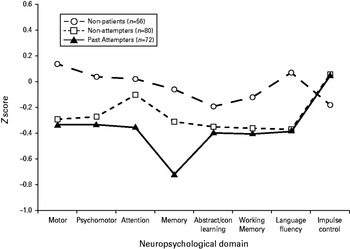
In comparisons of individual domain scores (Fig. 1), significant group differences were found in the Motor (F 2,203 = 3.77, p = 0.03), Psychomotor (F 2,203 = 3.02, p = 0.05), Attention (F 2,203 = 3.33, p = 0.04), Memory (F 2,202 = 7.11, p = 0.001), and Language Fluency (F 2,203 = 6.07, p = 0.003) domains. No group differences were found for the Abstract/Contingent Learning (F 2,201 = 1.68, p = 0.19), Working Memory (F 2,203 = 2.18, p = 0.12) and Impulse Control (F 2,200 = 1.20, p = 0.30) domain scores. [Groups differences in Abstract/Contingent Learning domain were non-significant if based on Fail to Maintain rather than error scores (F 2,201 = 1.29, p = 0.28).]
Average standardized neuropsychological performance across eight domains of function in non-patients, depressed non-attempters and depressed past suicide attempters.

In the Motor, Psychomotor and Language Fluency domains, both depressed groups performed significantly worse than non-patients (Table 2). Differences in these domains were attributable to poorer patient performance on Choice RT (F 2,202 = 4.50, p = 0.01), WAIS-III Digit Symbol (F 2,203 = 5.60, p = 0.004), and both letter (F 2,203 = 6.30, p = 0.002) and category fluency (F 2,202 = 3.14, p = 0.05) tasks. Simple RT approached significance (F 2,199 = 2.85, p = 0.06), contributing to the overall Motor domain difference.
In the Attention and Memory domains, past attempters performed worse than both depressed non-attempters and non-patients. On individual tests, past attempters performed worse than both other groups on the Stroop interference measure (F 2,203 = 3.75, p = 0.03), Buschke SRT (F 2,202 = 5.31, p = 0.006) and Benton VRT (F 2,199 = 4.88, p = 0.009). Although there were no differences in the Working Memory domain overall, N-back performance was significantly poorer in past attempters (F 2,195 = 3.07, p = 0.05).
In an additional analysis to evaluate the effect of number of past episodes of depression on these group differences, non-patients were excluded and non-attempters compared directly to past attempters. Non-attempter/attempter differences on the Stroop (F 1,145 = 6.62, p = 0.01), Benton VRT (F 1,141 = 4.75, p = 0.03) and N-back (F 1,137 = 5.67, p = 0.02) were maintained even when the number of past depressive episodes (log transformed to normalize distribution) was included as a covariate, along with BPD. The difference in Buschke SRT (F 1,144 = 3.55, p = 0.06) became marginal, even though number of past depressive episodes was not a significant covariate (F 1,144 = 0.37, p = 0.54).
Including primary diagnosis (unipolar versus bipolar) as an additional factor did not alter the significance of any attempter/non-attempter difference. This variable and its interactions were not significant in any comparison.
Current suicidal ideation
When current suicidal ideation was included as a covariate in group comparisons (in addition to BPD), the subject group effect (F 2,198 = 6.87, p = 0.001) and group by domain interaction (F 14,1386 = 1.90, p = 0.02) in the main analysis remained significant. Covariate effects for current suicidal ideation (F 1,198 = 0.40, p = 0.53) and the ideation by domain interaction (F 7,1386 = 0.70, p = 0.67) were not significant. Differences in the Attention (F 2,198 = 4.00, p = 0.02) and Memory (F 2,197 = 8.40, p < 0.001) domains remained significant with ideation as a covariate, as did differences in Stroop interference (F 2,198 = 3.47, p = 0.03), Buschke SRT (F 2,197 = 7.15, p = 0.001), Benton VRT (F 2,194 = 4.88, p = 0.009) and N-back (F 2,190 = 4.11, p = 0.02). Current suicidal ideation was not a significant covariate in any of these comparisons, nor was it significant in any other domain, including executive function domains.
Attempt lethality
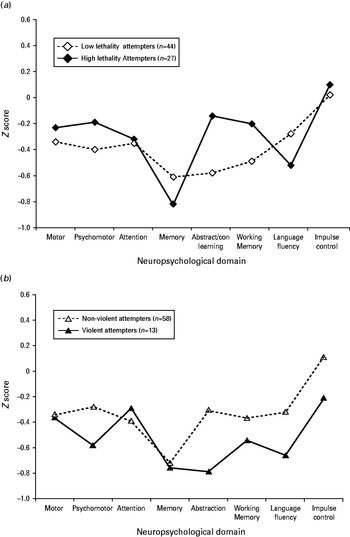
When past attempters are divided into those with high (n = 27) versus low (n = 44) lethality past attempts (Fig. 2a), there were no significant differences in domain scores between them, although high lethality attempters paradoxically outperformed low lethality attempters at a trend level in the Abstract/Contingent Learning domain (F 1,66 = 3.51, p = 0.07). Within that domain, high lethality attempters performed significantly better on Object Alternation (F 1,57 = 6.01, p = 0.02). High lethality attempters also performed better on Trail Making Part B (F 1,67 = 5.52, p = 0.02), a psychomotor tests with executive components. Differences on Attention and Memory measures, or on N-back, were not accounted for by markedly poorer performance in the high lethality group.
Average standardized domain scores in depressed past attempters, according to (a) lethality of past attempt and (b) violence of method of attempt.

Violent method in most severe past attempt
High lethality attempters' comparable or better performance in most domains, relative to low lethality attempters, was partially explained by the distribution of participants who used a violent method in their most severe attempt. In this sample, those who used a violent method (n = 13: attempted drowning, n = 1; cutting, n = 7; jumping, n = 3; hanging, n = 2) tended to make low lethality attempts (10/13, 76.9% of violent attempters; mean lethality 2.3 ± 2.5 for violent attempters versus 3.3 ± 1.9 in non-violent). Despite the small size of this sample, violent attempters (Fig. 2b) performed significantly worse in Abstract/Contingent Learning (F 1,66 = 3.84, p = 0.05) with a similar trend in Impulse Control (F 1,67 = 3.55, p = 0.06). On individual tasks, Go–No Go performance was significantly poorer in violent attempters (F 1,65 = 5.52, p = 0.02), with a similar trend in Object Alternation (F 1,57 = 3.13, p = 0.08; no other differences with p < 0.10). These were the types of differences expected in the attempter group as a whole, but only found in this subgroup. They were not a function of an excess of patients with BPD (46.2% of violent attempters versus 31.6% of non-violent; χ21 = 1.00, p = 0.32). Differences between attempters and non-attempters on Attention and Memory measures, then, were not accounted for by poorer performance in the violent attempters group.
Correlations
There were few correlations between clinical variables and either the domain scores (Attention, Memory) or specific test scores (Stroop interference, Buschke SRT recall, Benton VRT errors, N-back d-prime) that distinguished past attempters from non-attempters. The Attention domain score and Stroop score were modestly correlated with the HAMD (ρ = –0.26, p = 0.001 and ρ = –0.27, p = 0.001 respectively), BDI (ρ = –0.17, p = 0.03 and ρ = –0.23, p = 0.003 respectively) and GAF score (ρ = 0.21, p = 0.01 and ρ = 0.19, p = 0.03 respectively). Memory domain score was weakly correlated with the HAMD score (ρ = –0.17, p = 0.05) and GAF (ρ = 0.20, p = 0.02) but not the BDI (ρ = 0.07, p = 0.38). The Buschke score correlated with GAF (ρ = 0.20, p = 0.01).
Stroop performance correlated negatively, but weakly, with suicidal ideation prior to admission (ρ = –0.17, p = 0.05), Barratt Impulsiveness (ρ = –0.21, p = 0.02) and Buss–Durkee Hostility (ρ = –0.21, p = 0.02). Memory domain score and Benton VRT correlated modestly with Hostility (ρ = –0.20, p = 0.03 and ρ = –0.21, p = 0.02 respectively).
Stroop correlated negatively with the number of past suicide attempts (ρ = –0.35, p = 0.003), but no other test score was associated with suicidal behavior measures.
Discussion
In contrast to our expectations, depressed individuals with a history of suicidal behavior did not show any greater impairment of abstract/contingent learning, language fluency or impulse control relative to non-attempters in this acutely ill, medication-free sample. However, other deficits associated with suicidal behavior that we had reported previously in a separate sample (Keilp et al. Reference Keilp, Sackeim, Brodsky, Oquendo, Malone and Mann2001), in selective attention, memory and working memory, were again observed here. Past attempters' poorer performance on the Stroop task and memory/working memory measures was not a function of depression severity or suicidal ideation, suggesting it represents a relatively independent marker of suicide risk within the context of depression, one that is not captured in standard clinical ratings. Although both the Stroop and memory measures were weakly associated with ratings of impulsiveness and/or hostility, it is difficult to attribute poor Stroop and memory/working memory performance in suicide attempters to failures of inhibition (see MacLeod et al. Reference MacLeod, Dodd, Sheard, Wilson, Bibi and Ross2003). Other measures such as Go-No Go are clearly more direct measures of disinhibition, and did not differ among the groups unless violent attempters were analyzed separately. Interference effects on the Stroop in particular have been tied to attention control rather than impulse control networks in the brain (Botvinik et al. 2001; Egner & Hirsch, Reference Egner and Hirsch2005). Finally, error rates on Stroop conditions did not differ among groups in this study (data not reported; available on request), as in our previous report, which included a portion of this sample (Keilp et al. Reference Keilp, Gorlyn, Oquendo, Burke and Mann2008). Poorer performance on these tasks, then, seems to reflect an information processing deficit rather than a failure of inhibition.
Depressed patients, regardless of past attempt history, exhibited slowed reaction times, psychomotor performance and fluency. These patient/non-patient differences were less extensive than expected, partly due to splitting the depressed group by attempter status (analyzed as a single group, depressed patients differed from non-patients in all domains except abstract/contingent learning) and to the intelligence level of the sample. Nonetheless, the most consistent differences between depressed patients and healthy volunteers were found in two of the domains where they were expected: motor function and psychomotor performance. Differences in fluency reflect deficits on another set of speeded tasks, ones in which suicide attempters were expected to perform more poorly. Violent attempters showed a trend toward poorer performance in fluency relative to all other patients (F 1,147 = 2.22, p = 0.14), but this did not reach significance.
The small subsample of violent attempters in this study exhibited a pattern of performance more closely approximating the pattern of broad executive impairment expected in all attempters. Although consistent with studies of violent attempter samples (Jollant et al. Reference Jollant, Bellivier, Leboyer, Astruc, Torres, Verdier, Castelnau, Malafosse and Courtet2005; Dougherty et al. Reference Dougherty, Mathias, Marsh-Richard, Prevette, Dawes, Hatzis, Palmes and Nouvion2009), these data raise questions about the specificity of the relationship of this type of executive impairment to suicidal behavior, as opposed to violent behavior more generally. Violence directed toward others is associated with executive dysfunction (Morgan & Lilienfield, Reference Morgan and Lilienfield2000; Brower & Price, Reference Brower and Price2001; Hanlon et al. Reference Hanlon, Rubin, Jensen and Daoust2010), and violent suicidal behavior may simply be a subset of this general class of behavior. Non-violent suicidal behavior may not be associated with these same impairments. For example, the small subsample of violent attempters in this study performed worse than the non-violent attempters (and also non-attempters; F 3,207 = 4.41, p = 0.005) on Object Alternation (Freedman et al. Reference Freedman, Black, Ebert and Binns1998; Zald et al. Reference Zald, Curtis, Chernitsky and Pardo2005; Zald & Andreotti, Reference Zald and Andreotti2010). Conversely, the mostly non-violent high lethality attempters outperformed low lethality attempters on this task. In the initial study of Iowa Gambling Task performance in past suicide attempters (Jollant et al. Reference Jollant, Bellivier, Leboyer, Astruc, Torres, Verdier, Castelnau, Malafosse and Courtet2005), only violent attempters differed statistically from psychiatric controls, and no information was provided about the lethality of their attempts. It is important to note that violence and lethality are somewhat independent dimensions of suicidal behavior, and the mechanisms underlying these dimensions may be different. Models of suicidal behavior appropriate to violent attempts at any level of lethality may not apply to very serious non-violent suicide attempts, especially those that are planned over time. Specific types of executive dysfunction may play a role in determining the form of suicidal behavior, but may not account for the initial self-destructive nature of the behavior itself.
Our data suggest that specific deficits in attention control, memory and working memory may be prevalent across all types of attempters when assessed in a depressed, unmedicated state. Deficits in attention control do not encompass all aspects of attention, but seem to be specific to interference processing, which has an executive component, albeit one that is distinct from other executive capacities.
Although deficits in attention control and working memory have been noted in our previous work, the prominence of memory deficits on both verbal and visual–spatial tasks was less expected. In our previous work, however, the visual memory task used (Rey–Osterrieth Complex Figure) allowed substantial encoding time in the initial learning phase (at least 3.5 min for the complex visual stimulus). On the memory tasks used in this study, exposure to stimuli was relatively brief. Attempters' poorer memory task performance may therefore reflect disorganization of initial encoding rather than a defect in storage capacity. Prefrontal involvement in attention control (Carter & van Veen, Reference Carter and van Veen2007), along with both the acquisition and retrieval of information from memory (Badre & Wagner, Reference Badre and Wagner2007; Kuhl et al. Reference Kuhl, Dudukovic, Kahn and Wagner2007), suggests a role for this brain region in suicidal behavior, but through different subregions than those related to behavioral inhibition. The degree of overlap between these fundamental aspects of information processing and deficits on decision-making or set-switching measures is unknown. Elderly suicide attempters who exhibited deficits on reversal learning (Dombrovski et al. Reference Dombrovski, Clark, Siegle, Butters, Ichikawa, Sahakian and Szanto2010) and gambling tasks (Clark et al. Reference Clark, Dombrovski, Siegle, Butters, Shollenberger, Sahakian and Szanto2011) also exhibited deficits on attention and memory subscales of a mental status examination (Dombrovski et al. Reference Dombrovski, Butters, Reynolds, Houck, Clark, Mazumdar and Szanto2008).
Because our results are not as initially hypothesized, they do not fit neatly into most existing theories regarding neuropsychological dysfunction in suicidal behavior. The consistency of our empirical results over two samples, however, indicate that these functions play some role in the suicidal process. Functional imaging studies indicate a great deal of overlap between activation related to Stroop performance and activation related to emotion regulation, in dorsal and lateral prefrontal cortex, in addition to the dorsal cingulate (Ochsner & Gross, Reference Ochsner and Gross2008; Van Snellenberg & Wager, Reference Van Snellenberg, Wager, Christensen, Bougakov and Goldberg2009). These regulatory systems may play a role in managing the ‘psychic pain’ experienced by suicidal individuals (Olie et al. Reference Olie, Guillaume, Jaussent, Courtet and Jollant2010) or in the flexible control of attention that allows someone to redirect thinking from an acute sense of despondency or hopelessness and to manage suicidal urges. Targeted therapies for suicidality, such as dialectical behavior therapy (Lynch et al. Reference Lynch, Trost, Salsman and Linehan2007; Linehan & Dexter-Mazza, Reference Linehan, Dexter-Mazza and Barlow2008) or mindfulness therapy (Baer, Reference Baer2003; Bishop et al. Reference Bishop, Lau, Shapiro, Carlson, Anderson, Carmody, Segal, Abbey, Speca, Velting and Devins2004), train individuals to manage their feeling states through distraction, an apparent exercise of the same capacities evident in performance on selective attention and/or working memory tasks. Other types of neurocognitive impairment, especially that related to inhibitory control, may then make suicide attempts more likely (Burton et al. Reference Burton, Vella, Weller and Twamley2011) or perhaps more violent.
This study was limited in that suicide attempters were not necessarily evaluated close in time to a recent attempt, although all were actively depressed with elevated levels of suicidal ideation. Effect sizes for differences were not large, suggesting the need for more refined measures. Patients with BPD in this study outperformed other patient subjects on impulse control tasks, suggesting possible inconsistencies in sampling. However, we had previously found that individuals with BPD do not necessarily perform more poorly than other depressed individuals on impulse control tasks when in a depressed state if not in acute distress at the time of testing (Fertuck et al. Reference Fertuck, Marsano-Jozefowicz, Stanley, Tryon, Oquendo, Mann and Keilp2006). The violent attempter sample was small, and missing those subjects who would be most theoretically useful for our understanding of the role of executive dysfunction in suicidal behavior; namely, highly lethal violent attempters. With respect to causality, this was a cross-sectional, retrospective study with regard to attempts, and the causal relationships between neurocognitive impairment and suicidal behavior remain to be established. Finally, participants with bipolar II disorder were excluded from this analysis because of their variability, and they need to be more systematically sampled in future studies. With bipolar II included, differences in N-back are no longer significant, although other attempter/non-attempter differences are maintained (data available on request).
Overall, disinhibition and poor decision making may be characteristic of certain types of suicide attempt, but lapses in attention control and information encoding, particularly in the context of suicidal thoughts or environmental triggers, may be a more general correlate of suicidal behavior. Executive dysfunction in the context of depression is clearly a risk factor for dangerous, but possibly more impetuous, attempts but may not be present among those who make equally dangerous but more deliberative attempts. Thus, general models of suicidal behavior based on disinhibition, poor decision making and ventral prefrontal circuitry (to the extent that these tasks are valid measures of this circuitry in the absence of imaging) may not be applicable to all types of attempt. On the contrary, certain information processing deficits may be more widespread among attempters. Stroop tasks and modified Stroop tasks using emotional, suicide-related distractors (Becker et al. Reference Becker, Strohbach and Rinck1999; Janis & Nock, Reference Janis and Nock2009; Cha et al. Reference Cha, Najmi, Park, Finn and Nock2010) or implicit association measures using suicide-related probes (Nock et al. Reference Nock, Park, Finn, Deliberto, Dour and Banaji2010) have worked well in discriminating attempters from other groups (Jollant et al. Reference Jollant, Lawrence, Olié, Guillaume and Courtet2011). The interaction of clinical risk factors with neurocognitive impairment (Dour et al. Reference Dour, Cha and Nock2011), and also the relationships among the various neurocognitive measures that have been associated with suicide risk, warrant further study.
Acknowledgements
This work was supported by grants from the National Institute of Mental Health (MH62155, 5 P50 MH062185, MH59710) and the American Foundation for Suicide Prevention.
Declaration of Interest
None.
Appendix
The Object Alternation task is a computerized version of a paradigm first developed in primate studies, where it was found to be specifically sensitive to lesions of ventral prefrontal cortex (Pribram & Mishkin, Reference Pribram and Mishkin1956; Mishkin et al. Reference Mishkin, Vest, Waxler and Rosvold1969). It is an extension of the delayed alternation paradigm, and typically involves presenting two objects, one of which is baited with a reward. The subject must find the reward, and learn that the reward will be switched between objects on successive trials (the subject is given no information that this switching is the basis of the task; learning is by trial, error and insight). The task has been adapted for use in humans (Freedman et al. Reference Freedman, Black, Ebert and Binns1998) and computerized versions have been developed for use in both clinical (Blair et al. Reference Blair, Newman, Mitchell, Richell, Leonard, Morton and Blair2006; González-Blanch et al. Reference González-Blanch, Vázquez-Barquero, Carral-Fernández, Rodríguez-Sánchez, Alvarez-Jiménez and Crespo-Facorro2008) and imaging studies (Zald et al. Reference Zald, Curtis, Chernitsky and Pardo2005). Object Alternation was included in this study to complement the WCT, whose primary measures are most sensitive (although not exclusively so) to dorsolateral prefrontal cortical dysfunction (Stuss et al. Reference Stuss, Levine, Alexander, Hong, Palumbo, Hamer, Murphy and Izukawa2000).
In the Object Alternation task itself, two symbols –a red triangle and a blue circle – were presented on a computer screen, arranged either with the triangle on the left or the triangle on the right, with these orders presented randomly. Subjects were instructed to select the object that they thought was correct on any given trial, and told there was a pattern to determining which item was correct on any given trial (but given no hint regarding the nature of that pattern). The subjects responded by keypress to designate the location of the object they were selecting. Correct responses were reinforced with a computer beep; incorrect responses received a buzz. The subject's first response, to either symbol, was correct by default. Thereafter, the opposite figure that the subject responded to correctly was designated as correct on the next trial. To respond correctly on each trial, then, the subject was required to alternate between the objects from trial to trial, regardless of which side the alternate object was presented on. The intertrial interval was 500 ms. The test was stopped if the subject made 12 correct responses in a row (12 alternations without an error). If the subject did not complete the test to criterion, it was discontinued after 180 presentations of the stimuli. Subjects were scored on their ability to reach the criterion of 12 correct in a row, on the number of errors made, on the number of perseverative errors (errors following errors), and on failures to maintain a response set (achieving 5 or more correct responses in a row and making an error before completing the test to criterion). The error score was used in the computation of the Abstract/Contingent Learning domain score, along with the WCT error score, as the best continuous measure of task performance (Freedman et al. Reference Freedman, Black, Ebert and Binns1998).