Introduction
The genus Austrodiplostomum Szidat & Nani, Reference Szidat and Nani1951 contains species that as adults are found parasitizing the intestine of cormorants of the genus Nannopterum, i.e. N. brasilianus (Gmelin, 1789) and N. auritus (Lesson, 1831) in the Americas (Machado et al., Reference Machado, Takemoto and Pavanelli2005; Pérez-Ponce de León et al., Reference Pérez-Ponce de León, García Prieto and Mendoza Garfías2007; Dronen, Reference Dronen2009; Ramos et al., Reference Ramos, Franceschini, Zago, Oliveira de Penha Zica, Wunderlich, Carvalho and da Silva2013). Three species have been described thus far, i.e. A. compactum Lutz, Reference Lutz1928, A. mordax Szidat & Nani, Reference Szidat and Nani1951, and A. ostrowskiae Dronen, Reference Dronen2009. Even though the genus contains just a few species, it has an unsettled taxonomic history; it was originally described as Alaria compacta by Lutz (Reference Lutz1928) as a parasite of N. brasilianus in Venezuela. The genus Austrodiplostomum was erected by Szidat & Nani (Reference Szidat and Nani1951) to include A. mordax, in Argentina. Dubois (Reference Dubois1970) includes it as a subgenus of Diplostomum. A thorough review of the taxonomic history of this genus was presented by Dronen (Reference Dronen2009). Ostrowski de Nuñez (Reference Ostrowski de Núnez1982), and later Dronen (Reference Dronen2009), proposed that A. compactum is a synonym of A. mordax; likewise, both names (compactum and mordax) continue to be used in the literature, particularly in South America (see Drago et al., Reference Drago, Lunaschi and Schenone2011; Ramos et al., Reference Ramos, Franceschini, Zago, Oliveira de Penha Zica, Wunderlich, Carvalho and da Silva2013). Dronen (Reference Dronen2009) recognized A. mordax as a valid species (the type species) and described A. ostrowskiae Dronen, Reference Dronen2009, as a parasite of the double-crested cormorant N. auritus in Texas, USA. Recently, O'Hear et al. (Reference O'Hear, Pote, Yost, Doffitt, King and Panuska2014) found adults of this species in double-crested cormorants of the Mississippi delta and obtained the cox 1 sequence of the species. Members of Austrodiplostomum, like other diplostomids, exhibit a three-host life cycle, involving an aquatic snail of the genus Biomphalaria Preston 1910 as the first intermediate host. The metacercaria is found in the eyes (vitreous or aqueous humor), and more rarely in the cranial cavity, of fish that act as second intermediate hosts, causing blindness and making the fish susceptible to predation by a fish-eating bird, facilitating the transmission of the parasite to its definitive host (Ostrowski de Nuñez, Reference Ostrowski de Núñez1970, Reference Ostrowski de Núnez1977; Pinto & Melo, Reference Pinto and Melo2013).
In Mexico, this diplostomid was recorded for the first time from the eyes of the cichlid Thorichthys aurem Günther 1862 (syn. Cichlasoma aurem), in Tlacotalpan, Veracruz, although the species was recorded as Diplostomum spathaceum (see Caballero & Winter, Reference Caballero and Winter1954). Later, Pineda-López (Reference Pineda-López1985) recorded Diplostomum (Austrodiplostomum) compactum as a parasite of freshwater fishes in Tabasco, and Pineda-López et al. (Reference Pineda-López, Andrade-Salas, Páramo-Delgadillo, Trejo-Pérez, Pérez-Méndez, Almeyda-Artigas, Osorio-Sarabia and Pérez-Ponce de León1985) recorded the presence of D. (A.) compactum in freshwater fishes, and adults in the Neotropic cormorant N. brasilianus, from La Angostura Dam, in Chiapas. Up to the present, the metacercariae of this diplostomid have been recorded in Mexico in 36 species of freshwater fishes, belonging to 12 families (i.e. Cichlidae, Heptapteridae, Characidae, Eleotridae, Ictaluridae, Ariidae, Poeciliidae, Clupeidae, Gerreidae, Catostomidae, Sciaenidae and Ariidae), showing very low host specificity at this level, although it seems to prefer to infect cichlids, since 19 of the 36 species (53%) belong to this family (see Pérez-Ponce de León et al., Reference Pérez-Ponce de León, García Prieto and Mendoza Garfías2007). Metacercariae were collected in 61 localities across 10 states of central and south Mexico; but, the adults of this species have only been found in the intestine of the Neotropic cormorant, N. brasilianus, in three localities (Pineda-López et al., Reference Pineda-López, Andrade-Salas, Páramo-Delgadillo, Trejo-Pérez, Pérez-Méndez, Almeyda-Artigas, Osorio-Sarabia and Pérez-Ponce de León1985; Ramos-Ramos, Reference Ramos-Ramos1995; Violante-González et al., Reference Violante-González, García-Varela, Rojas-Herrera and Guerrero2009).
In the most recent review of the genus Austrodiplostomum, Dronen (Reference Dronen2009) discussed that A. mordax, as an adult, is primarily a parasite of N. brasilianus and has been reported largely from Brazil and Argentina, while A. ostrowskiae has been reported from almost the entire range of the Neotropic cormorant, in Brazil, Colombia, Cuba and Texas (Ostrowski de Núñez, Reference Ostrowski de Núñez1970; Dubois & Macko, Reference Dubois and Macko1972; Rietschel & Werding, Reference Rietschel and Werding1978; Fedynich et al., Reference Fedynich, Pence and Bergan1997), even though it was originally described from the double-crested cormorant. Drago et al. (Reference Drago, Lunaschi and Schenone2011) recorded A. ostrowskiae as a parasite of the Neotropic cormorant in Argentina, and accepted the contention that previous records of A. mordax, from the same host species in Argentina, Cuba and Colombia, corresponded to A. ostrowskiae.
As a part of an ongoing survey of the helminth parasite fauna of cormorants (N. brasilianus and N. auritus) across Mexico, specimens of Austrodiplostomum spp. were collected from the intestine of their hosts, and metacercariae of this diplostomid were also collected from their second intermediate hosts in some localities across south-eastern Mexico, El Salvador in Central America, and Venezuela in South America. Specimens were used to evaluate the taxonomic status of this diplostomid across a geographical range that spans from central Mexico, southwards to Venezuela in north-eastern South America. Thus, the main objectives of this work were to use sequence data of the mitochondrial gene cox 1 to conduct a molecular prospecting analysis of Austrodiplostomum, to test the hypothesis of conspecificity with A. ostrawskiae, and to establish a link between the metacercariae collected in their intermediate hosts and the adults obtained in cormorants.
Materials and methods
Specimen collection
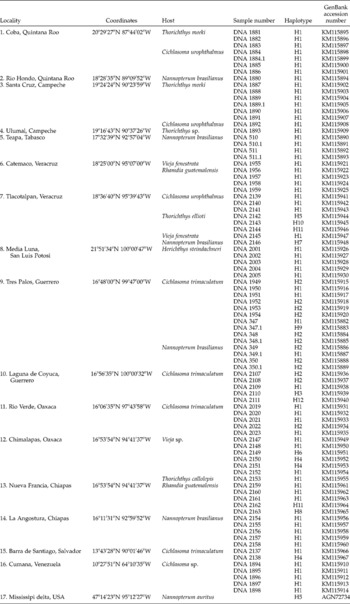
A total of 121 birds (24 double-crested cormorants, and 97 Neotropic cormorants) were collected between June 2005 and March 2014 in different localities of Mexico. However, only the Neotropic cormorant was infected with Austrodiplostomum spp. (table 1, fig. 1). Fish were captured with seine nets and electrofishing (table 1, fig. 1). Birds were kept on ice, and their intestines examined within 3 h after host capture, whereas fish were maintained alive and transported to laboratory. Individual fish were sacrificed and their eyes and cranial cavity examined immediately. Collected digeneans were preserved either in 100% ethanol, for DNA extraction, or in hot (steaming) 4% formalin, for morphology. Avian definitive hosts were identified using the field guides of Howell & Webb (Reference Howell and Webb1995) and the American Ornithologists' Union (1998). Fish were identified following Miller et al. (Reference Miller, Minckley and Norris2005).
Occurrence of metacercariae of Austrodiplostomum ostrowskiae in a variety of collecting sites, including adult worms from Nannopterum brasilianus and N. auritus; the numbers of the localities correspond with those given in fig.1.

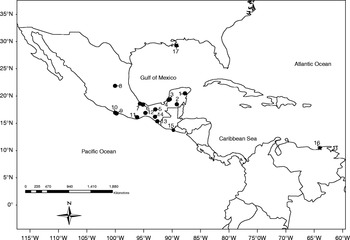
Sampling sites of specimens of Austrodiplostomum ostrowskiae Dronen Reference Dronen2009 in south-eastern Mexico ( ), El Salvador (
 ) and Venezuela (
 ). Collection sites are numbered according to table 1. The symbol
 refers to the species A. ostrowskiae from the Mississippi delta, USA.

Morphological and molecular analyses
Unflattened specimens preserved in formalin were stained with Mayer's paracarmine (Merck, Darmstadt, Germany), dehydrated in a graded ethanol series, cleared with methyl salicylate, and mounted on microscope slides in Canada balsam. Drawings were made with the aid of a drawing tube. Measurements are given in micrometres (μm) unless otherwise stated, with range followed by mean in parentheses. Voucher specimens were deposited in the Colección Nacional de Helmintos (CNHE), Instituto de Biología, Universidad Nacional Autónoma de México, Mexico City, numbers 9357–9360. The species identification was conducted following the key of Niewiadomska (Reference Niewiadomska, Gibson, Jones and Bray2002), original descriptions and the most recent review of the genus Austrodiplostomum by Dronen (Reference Dronen2009). Some adults and metacercariae were prepared for scanning electron microscopy (SEM) using standard methods, with the aim of facilitating the observation of potential morphological diagnostic characters.
Specimens of metacercariae (71) and adults (15) were placed individually in tubes and digested overnight at 56°C in a solution containing 10 mm Tris–HCl (pH 7.6), 20 mm NaCl, 100 mm Na2EDTA (pH 8.0), 1% Sarkosyl and 0.1 mg/ml proteinase K. Following digestion, DNA was extracted from the supernatant using the DNAzol reagent (Molecular Research Center, Cincinnati, Ohio, USA) according to the manufacturer's instructions. The cytochrome oxidase subunit I (cox 1) of the mitochondrial DNA was amplified using the polymerase chain reaction (PCR) with the forward primer Plant-diploCOXF, 5′-CGTTTRAATTATACGGATCC-3′ and the reverse primer Plant-diploCOXR, 5′-AGCATAGTAATMGCAGCAGC-3′ (Moszczynska et al., Reference Moszczynska, Locke, McLaughlin, Marcogliese and Crease2009). PCR reactions (25 μl) consisted of 10 μm of each primer, 2.5 μl of 10 × buffer, 2 mm MgCl2, 0.5 μl of 10 mm deoxynucleoside triphosphates (dNTPs) and 1 U of Taq DNA polymerase (Platinum Taq, Invitrogen Corporation, São Paulo, Brazil). PCR cycling conditions included denaturation at 94°C for 5 min, followed by 35 cycles of 94°C for 1 min, annealing at 50°C for 1 min, and extension at 72°C for 1 min, followed by a post-amplification incubation at 72°C for 10 min. Sequencing reactions were performed using ABI Big Dye (Applied Biosystems, Boston, Massachusetts, USA) terminator sequencing chemistry, and reaction products were separated and detected using an ABI 3730 capillary DNA sequencer. Contigs were assembled and base-calling differences resolved using Codoncode Aligner version 5.0.2 (Codoncode Corporation, Dedham, Massachusetts, USA). Sequences were deposited in GenBank (table 1). Cox 1 sequences obtained in the current research were aligned with the following species, downloaded from the GenBank dataset: Austrodiplostomum ostrowskiae (AGN72734), Diplostomum baeri Dubois 1937 (GQ292502, JX986872), D. indistinctum Guberlet 1923(GQ292483), D. pseudospathaceum Niewiadomska 1984 (JX986907), D. mergi Dubois 1932 (JX986886), D. huronense La Rue 1927 (FJ477197), Tylodelphys mashonensis Beverley-Burton 1963 (KC685343), T. scheuringi Dubois 1932 (FJ477223), T. clavata von Nordman 1932 (JX986909 and T. excavata Rudolphi 1803 (KC685344), and Posthodiplostomum sp., Dubois 1936 (FJ477221, FJ477220, FJ477219), Hysteromorpha triloba Rudolphi 1819 (FJ477203) and Ornithodiplostomum sp., Dubois 1936 (FJ477209, FJ477208) which were used as outgroups. Sequences were readily aligned based on the inferred Cox 1 protein sequences using the software Clustal W (Thompson et al., 1994). Maximum likelihood (ML) and Bayesian inference analyses (BI) were performed. The ML tree was inferred using RAxML 7.0.4. (Stamatakis, Reference Stamatakis2006). Modeltest program version 3.0 (Posada & Crandall, Reference Posada and Crandall1988) was used for inferring the best model of nucleotide substitution. Tree searches were performed using the general time reversible (GTR) model with 1000 (ML) random taxon addition heuristic searches. Clade support was assessed by bootstrap resampling with 10,000 replicates. Bayesian analyses were performed with MRBAYES version 3.1.2 (Huelsenbeck & Ronquist, Reference Huelsenbeck and Ronquist2001). Settings were two simultaneous runs of the Markov chain (MCMC) for 10 million generations, sampling every 1000 generations, a heating parameter value of 0.2 and a ‘burn-in’ of 25%. Trees were drawn using FigTree version 1.3.1 (Rambaut, Reference Rambaut2006). The genetic divergence among taxa was estimated using uncorrected ‘P’ distances with the program MEGA version 6 (Tamura et al., Reference Tamura, Stecher, Peterson, Filipski and Kumar2013).
Haplotype network construction
Gene genealogies were inferred using haplotype network construction. Median-joining networks were calculated with the program NETWORK version 4.2.0.1 (www.fluxusengineering.com) keeping the parameter ε = 0. This method starts with minimum spanning trees combined within a single network and then, to reduce tree length, median vectors (consensus sequences) are added. Such vectors can be interpreted as possibly extant unsampled sequences or extinct ancestral sequence (Bandelt et al., Reference Bandelt, Forster and Rohl1999).
Results
Morphology of the adults and metacercariae of A. ostrowskiae
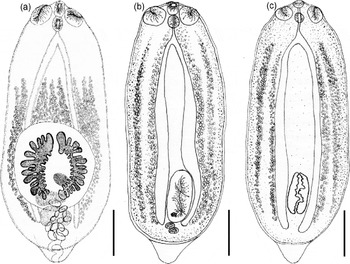
Nine adult worms identified as A. ostrowskiae obtained from N. brasilianus from la Angostura, Chiapas and Tlacotalpan Veracruz, Mexico (figs 2a) were measured and characterized morphologically as follows. Body with spatulate shape and distinctly bi-segmented, with the hind body reduced to a small conical prominence. Fore body slightly concave on the ventral surface (fig. 3a), bearing scattered papillae on the ventral surface of the tegument (fig. 3b). Total length 1200–1450 μm (1320 μm) by total width 600–870 (710). Oral sucker small, fairly muscular, subterminal, longer than wide, 100–110 (90) long by 55–90 (70) wide; ventral sucker lacking; two well-developed lateral pseudosuckers on each side of oral sucker. Prepharynx absent; relatively large pharynx, oval, 37–100 (80) long, 23–62 (50) wide; two, blind intestinal caeca, long, extending to the posterior end of fore body, reaching the posterior border of testis. Tribocytic organ well developed, elliptical, with a longitudinal slit, 330–530 (430) long by 300–500 (400) wide. Testes in tandem, ovoid, wider than long, located in the posterior third of fore body. Anterior testis 138–230 (140) long by 138–260 (160) wide; posterior testis 150–310 (170) long by 135–250 (190) wide. Ovary pretesticular, spherical 25–100 (75) by 33–120 (80), contiguous with anterior testis. Vitelline follicles in extra- and intercaecal fields, occupying the posterior two-thirds of the fore body, terminating at the level of posterior testis. Uterus extending from the ovario-testicular area posteriorly to the genital pore opening at the end of the hind body. Eggs relatively large, 70–150 (100) long by 40–50 (45) wide.
Austrodiplostomum ostrowskiae Dronen Reference Dronen2009. (a) Adult obtained from the intestine of Nannopterum brasilianus in Mexico; (b) metacercaria from the eyes of Rhamdia guatemalensis in Mexico; (c) metacercaria from the eyes of Cichlasoma sp. in Venezuela. Scale bars = 1 mm.

Scanning electron micrographs of Austrodiplostomum ostrowskiae Dronen Reference Dronen2009. (a–d) Adult: (a) entire specimen from Nannopterum brasilianus from Mexico, (b) anterior region showing pseudosuckers, (c) posterior region showing the bi-segmentation of body, (d) tegument of the ventral surface of hind body showing papillae. (e–h) Metacercariae from Rhamdia guatemalensis from Mexico: (e) entire specimen, (f) anterior region, (g) posterior region, (h) tegument. (i–l) Metacercariae from Cichlasoma sp. from Venezuela: (i) entire specimen, (j) anterior region, (k) posterior region, (l) tegument.

Metacercariae free and actively moving in the vitreous humor of their second intermediate host. The following characterization is based on five specimens obtained from Rhamdia guatemalensis from Nueva Francia, Chiapas, Mexico (figs 2b) and five from Cichlasoma sp., from Cumana, Venezuela (figs 2c). Body with spatulate shape, distinctly bi-segmented, fore body slightly concave on the ventral surface. Tegument bearing papillae on the ventral surface distributed in a scattered pattern (absent in the specimens from Venezuela). Total length 1300–1500 μm (1400 μm) by 480–610 (540) wide. Oral sucker subterminal, almost rounded, 62–82 (72) long by 50–75 (66) wide. Ventral sucker lacking; two well-developed lateral pseudosuckers on each side of oral sucker. Prepharynx absent; oval pharynx 52–75 (64) long by 42–60 wide (53); intestinal caeca long, extending nearly to the posterior end of fore body, at level of posterior border of tribocytic organ; tribocytic organ 200–300 (270) long by 100–130 (115) wide. Reproductive system poorly developed, with primordia of two oval testes, and pretesticular ovary located at the posterior end of fore body (figs 2b–c, 3e–h). Four rows of rod-shaped calcareous bodies along the body, two on each side, extracaecal.
Molecular characterization
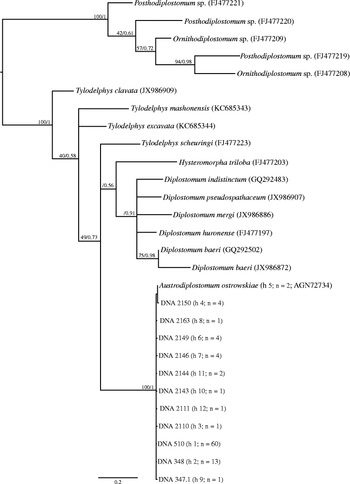
In this study, sequences of cox 1 of 86 individuals of A. ostrowskiae (71 metacercariae and 15 adults) from south-eastern Mexico, El Salvador and Venezuela, plus one isolate from USA (table 1, fig. 1) were aligned with a cox 1 dataset containing three isolates of Posthodiplostomum sp., two isolates of D. baeri, two isolates of Ornithodiplostomum sp., and one isolate of each of the following species: D. pseudospathaceum, D. mergi, D. huronense, D. indistinctum, T. mashonensis, T. scheuringi, T. clavata, T. excavata and H. triloba. The alignment consisted of 104 sequences with 478 nucleotides. The genetic divergence among genera (Austrodiplostomum, Diplostomum, Tylodelphys, Hysteromorpha, Posthodiplostomum and Ornithodiplostomum) ranged from 11 to 23%, and among species of Diplostomum (D. pseudospathaceum, D. baeri, D. mergi, D. huronense) ranged from 9 to 15%, meanwhile among species of Tylodelphys (T. mashonensis, T. scheuringi, T. clavata, T. excavata) it varied from 11 to 14%. The genetic divergence among the 86 isolates of A. ostrowskiae, including one isolated from the USA, was very low and ranged from 0 to 0.8%. Maximum likelihood (ML) analysis yielded a single tree that was identical in topology to the Bayesian inference (BI) consensus tree (fig. 4). The ML and Bayesian consensus trees showed that all the sequences of A. ostrowskiae generated in this study (15 adults and 71 metacercariae) are nested within a monophyletic clade, with strong bootstrap support and Bayesian posterior probability values (100/1.0). This clade also included the sequence of A. ostrowskiae from a double-crested cormorant from the USA (fig. 4).
Maximum likelihood (ML) tree and consensus Bayesian inference (BI) trees inferred with the cox 1 dataset. Numbers near internal nodes show ML bootstrap clade frequencies and posterior probabilities (BI). n = number of specimens analysed; h = haplotype.

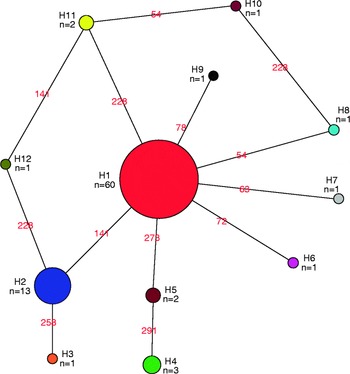
The haplotype network was built with the 86 specimens identified as A. ostrowskiae plus a single specimen from the USA. This dataset included 87 taxa with 388 characters (the alignment was trimmed to avoid inclusion of sites for which some data were missing for A. ostrowskiae from the USA). The statistical parsimony network shows 12 haplotypes. The most frequent haplotype, H1 (n= 60), is shared for populations from south-eastern Mexico, El Salvador and Venezuela (localities 1–16; see fig. 1 and table 1). Haplotype H2 (n= 13) is shared among individuals from two populations (Tres Palos, Guerrero and Laguna de Coyuca, Guerrero). The haplotypes H3, H6, H7, H8, H9, H10 and H12, are exclusive in some regions of Mexico. The haplotype H4 (n= 3) is shared among individuals from Chimalapas Oaxaca, Mexico and Barra de Santiago, El Salvador. The haplotype H5 (n= 2) is shared between two localities, Tlacotalpan, Veracruz, Mexico and Mississippi delta, USA, both on the Gulf of Mexico slope. Finally the haplotype H11 (n= 2) is shared between Tlacotalpan, Veracruz and Nueva Francia Chiapas (fig. 5).
Median-joining network of Austrodiplostomum ostrowskiae with cytochrome c oxidase subunit I (cox 1) gene sequences. Each circle represents a haplotype, with size proportional to the haplotype's frequency in the population.

Discussion
This paper demonstrates, by using morphological and molecular data, that the species of Austrodiplostomum which is found as metacercariae in the eyes of cichlid fishes (and other species of freshwater fishes) and as adults in the intestine of two species of cormorants is Austrodiplostomum ostrowskiae, and not A. mordax ( = A. compactum) as commonly conceived, in a geographical range that spans from south-eastern USA, where it was originally described by Dronen (Reference Dronen2009), southwards to Venezuela, including localities in Central America and Mexico. Apparently, this species extends its distribution area to other areas of the Caribbean and South America, including Colombia, Brazil and Argentina (see Dronen, Reference Dronen2009; Drago et al., Reference Drago, Lunaschi and Schenone2011). In South America, it seems that A. mordax and A. ostrowskiae occur in sympatry in the only species of cormorant inhabiting these areas, N. brasilianus. The inclusion of cox 1 sequences of A. mordax, the type species, in the phylogenetic analysis, obtained from localities of South America where it has been recorded, in the light of a detailed analysis of the morphological features, and observations of the ultrastructure of the body surface, is fundamental to demonstrate the validity of two congeneric species of Austrodiplostomum. If confirmed, the two congeneric species will show specificity to the definitive host, infecting two sister species of cormorants (Kennedy & Spencer, Reference Kennedy and Spencer2014) even though the double-crested cormorant is distributed in the Nearctic region, and the Neotropic cormorant possesses a wide geographical range in the Neotropical region. Both species overlap their distribution range in some areas of Mexico and southern USA. Interestingly, even though we studied 24 individuals of N. auritus from different localities, no specimens of Austrodiplostomum were obtained. In contrast, when describing A. ostrowskiae from N. auritus, Dronen (Reference Dronen2009) pointed out that he also studied specimens of N. brasilianus, and no adults of Austrodiplostomum were found. This striking result contrasts with the fact that A. ostrowskiae is found in N. brasilianus in other localities, such as Cuba, Colombia, Brazil and Argentina (Drago et al., Reference Drago, Lunaschi and Schenone2011).
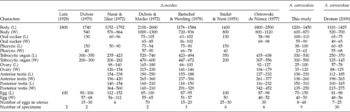
The study of morphological traits revealed that adults collected in cormorants, and metacercariae obtained from fish, in several localities across south-eastern Mexico, exhibit a body slightly concave on the ventral surface and, characteristically, the teguments possess papillae with a scattered distribution (see fig. 3). This character is found in both adults and metacercariae. In our opinion, these papillae may correspond to the spines on the tegument in the adults of A. ostrowskiae as described by Dronen (Reference Dronen2009). Overall morphology, and measurements of distinctive characters of the adults and metacercariae we collected, correspond almost entirely with those described previously for A. ostrowskiae (table 2). Our specimens are diagnosed by the lack of a ventral sucker, and by having two lateral pseudosuckers, oval pharynx, intestinal caeca extending to the posterior third of the fore body, ending at the level of the posterior testis, tribocytic organ elliptical, testes in tandem, spherical and pretesticular ovary and, finally, vitelline follicles extending from the mid-level between the tribocytic organ and the oral sucker, posteriorly to the posterior testis level. In contrast, metacercariae collected from Cichlasoma sp. in Venezuela were morphologically similar to those in the other areas analysed in this study, although SEM micrographs evidenced the lack of papillae on the tegument (see fig. 3i–l), casting doubt about the utility of this character to separate the two species of Austrodiplostomum, since the sequences of these larvae are identical to those of the other localities, corresponding with A. ostrowskiae.
Comparative morphometrics (in μm) of adult worms of Austrodiplostomum mordax and Austrodiplostomum ostrowskiae obtained in the present study with respect to those presented by other authors; length (L), width (W).

To confirm the conspecificity between metacercariae and adults across the sampled distribution range in this study, sequences of the mitochondrial gene cytochrome oxidase subunit I (cox 1) were obtained, and compared with that obtained by O'Hear et al. (Reference O'Hear, Pote, Yost, Doffitt, King and Panuska2014) from the double-crested cormorant in the Mississippi delta, and with those sequences available for other closely related diplostomatids. The genetic divergence estimated among sequences obtained from 15 adults and 71 metacercariae from south-eastern Mexico, El Salvador and Venezuela, and a single specimen of A. ostrowskiae from the USA, was very low and ranged between 0 and 0.8%. These low values of genetic divergence are similar to those found within other diplostomid species. For example, the intraspecific genetic divergence of cox 1 among isolates of Diplostomum mergi, D. pseudospathaceum and D. baeri ranged from 0 to 1.01%, and among isolates of matacercariae of Tylodelphys sp., from four infected fishes in Kenya, ranged from 0 to 1% (Georgieva et al., Reference Georgieva, Soldánová, Pérez-del-Olmo, Dangel, Sitko, Sures and Kostadinova2013; Otachi et al., Reference Otachi, Locke, Jirsa, Fellner-Frank and Marcogliese2014). In contrast, interspecific genetic divergence levels were relatively high, with 9–15% among species of the genera Diplostomum and Tylodelphys. This is also in agreement with other studies conducted with diplostomids for the same molecular marker. Blasco-Costa et al. (Reference Blasco-Costa, Faltynková, Goergieva, Skirnisson, Scholz and Kostadinova2014) estimated the species diversity of Diplostomum in sub-Artic freshwater ecosystems, and detected at least six species or lineages, which had a interspecific genetic divergence varying from 7 to 15%.
The phylogenetic reconstruction in the present study, inferred with maximum likelihood and Bayesian methods, showed that the 86 specimens identified as A. ostrowskiae plus a single specimen from USA, formed a monophyletic group with 100% ML bootstrap support and a Bayesian posterior probability of 1.0 (fig. 4). The statistical parsimony network showed 12 haplotypes. The most frequent haplotype (H1), is shared among all the populations from south-eastern Mexico, El Salvador and Venezuela, and suggests gene flow among the populations. The low level of genetic divergence found among all isolates, the evidence of gene flow among distant populations, and reciprocal monophyly in ML and Bayesian trees, in addition to morphological data of adults and metacercariae, clearly demonstrate that all these specimens belong to the same evolutionary lineage. The slight morphological variability exhibited by the metacercariae and adults of A. ostrowskiae, in terms of the body size, length of intestinal caeca and papillae (possibly spines as diagnosed by Dronen, Reference Dronen2009) on the body tegument, could be the result of phenotypic plasticity. All the evidence suggests that A. ostrowskiae has a wide range of distribution in the Americas, but the missing piece of information (sequence data of A. mordax) prevents any further discussion about host specificity. Still, great progress has been achieved, in the past years, in the analysis of the diversity of diplostomid trematodes in different areas of the world, following a DNA–taxonomy approach (Galazzo et al., Reference Galazzo, Dayanandan, Marcogliese and McLaughlin2002; Niewiadomska & Laskowski, Reference Niewiadomska and Laskowski2002; Locke et al., Reference Locke, McLaughlin, Dayanandan and Marcogliese2010a, Reference Locke, McLaughlin and Marcoglieseb; Chibwana et al., Reference Chibwana, Blasco-Costa, Georgieva, Hosea, Nkwengulila, Scholz and Kostadinova2013; Georgieva et al., Reference Georgieva, Soldánová, Pérez-del-Olmo, Dangel, Sitko, Sures and Kostadinova2013; Blasco-Costa et al., Reference Blasco-Costa, Faltynková, Goergieva, Skirnisson, Scholz and Kostadinova2014). This tool has been instrumental in determining cases of cryptic diversity and establishing a link between the larval forms (metacercariae) found in fish, and their adults in fish-eating birds. More studies are necessary from wide geographical ranges in diplostomids such as Posthodiplostomum and Tylodelphys, and an increase of the genetic library of this group of trematodes for several molecular markers represents a key element for further comprehensive analyses.
Acknowledgements
We are grateful to Jesus Hernández, Leopoldo Andrade and Eduardo Hernández for their help during field work in Mexico. We also thank Luis García Prieto for providing specimens deposited at the Colección Nacional de Helmintos. We thank Berenit Mendoza Garfias for her help obtaining the scanning electron micrographs.
Financial support
This research was supported by grants from the Programa de Apoyo a Proyectos de Investigación e Inovación Tecnológica (PAPIIT-UNAM) IN207213 and IN219904 to M.G.V. and G.P.P.L., respectively, and the Consejo Nacional de Ciencia y Tecnología (CONACYT) 83 043 and 179048 to G.P.P.L. and M.G.V., respectively. C.D.P.P. thanks the Programa de Posgrado en Ciencias Biológicas, UNAM and CONACYT for support by granting a scholarship to complete his PhD.
Conflict of interest
None.
Ethical standards
Specimens in Mexico were collected under the Cartilla Nacional de Colector Científico (FAUT 0202 and 0057) issued by the Secretaría del Medio Ambiente y Recursos Naturales (SEMARNAT), to M.G.V. and G.P.P.L., respectively.