INTRODUCTION
Fish parasites and diseases currently constitute one of the most important problems confronted by the fishery biologists (Ravichandran et al., Reference Ravichandran, Balasubramanin and Kannupandi2007). Members of the isopod family Cymothoidae are among the largest fish parasites and are highly host specific. Cymothoids are ectoparasitic isopods of marine, fresh and brackish water teleost fish. They parasitize numerous families of fish, including many of commercially important species, particularly in tropical and subtropical regions (Brusca, Reference Brusca1981; Bunkley-Williams & Williams, Reference Bunkley-Williams and Williams1998a; Lester & Roubal, Reference Lester, Roubal and Rohde2005). They belong to a group of protandrous hermaphroditic isopods with a biphasic life cycle which are unable to leave their hosts after becoming females (Bunkley-Williams, Reference Bunkley-Williams1984; Colorni et al., Reference Colorni, Trilles and Golani1997; Jones et al., Reference Jones, Miller, Grutter and Cribb2008).
These isopods cause varying degrees of harm to their hosts, ranging from minor tissue damage at the site of attachment to differential rates of mortality (Adlard, Reference Adlard1989). The adult cymothoids attach to the exterior body surface, mouth, gills and can even burrow into the flesh of fish (Bunkley-Williams & Williams, Reference Bunkley-Williams and Williams1998b; Ketmaier et al., Reference Ketmaier, Joyce, Horton and Mariani2007; Ramdane et al., Reference Ramdane, Bensouilah and Trilles2007). Females are permanently attached to host fish and they release their young from the marsupium at the free-swimming juvenile stage termed mancae or pulli, which then attach and feed on teleost fish (Lindsay & Moran, Reference Lindsay and Moran1976). The mancae first attaches to an appropriate host and may or may not undergo sex reversal (Adlard & Lester, Reference Adlard and Lester1995; Colorni et al., Reference Colorni, Trilles and Golani1997). Like most isopods, cymothoids are considered to feed principally on blood, but they may also consume the mucus, epithelial and subcutaneous tissues of their host (Lanzing & O'Connor, Reference Lanzing and O'Connor1975; Grabda, Reference Grabda and Grabda1991; Lester & Roubal, Reference Lester, Roubal and Woo1995; Bunkley-Williams & Williams, Reference Bunkley-Williams and Williams1998b).
There is a world list of 32 species of Cymothoa Fabricius, 1793 occurring on marine fish (Trilles, Reference Trilles1991), of which eight species occur in the Brazilian waters. The ninth new species of isopod parasite in the Brazilian waters was described by Thatcher et al. (Reference Thatcher, Araújo, Lima and Chellappa2007) as Cymothoa spinipalpa Thatcher, Araújo, Lima & Chellappa, Reference Thatcher, Araújo, Lima and Chellappa2007. This was described as a buccal cavity parasite of the marine fish leather jack, Oligoplites saurus, (Bloch & Schneider, 1801) (Osteichthyes: Carangidae) from the coastal waters of Rio Grande do Norte State, Brazil.
This study reports the first record of Cymothoa spinipalpa on the host Chloroscombrus chrysurus (Linnaeus, 1766) (Osteichthyes: Carangidae) in the coastal waters of the Rio Grande do Norte, Brazil, and contributes information on its prevalence and effect on its host condition.
MATERIALS AND METHODS
Study site and sampling
Individuals of Chloroscombrus chrysurus were netted from the costal waters of Rio Grande do Norte, located in north-east Brazil (05°52′30″S 35°08′00″W). Fish were captured with the help of local fisherman using a beach seine on a monthly basis from January to December 2006. To avoid artefacts of beach seine sampling (in which particularly the isopods abandon their original host, possibly crawling onto another live fish), the fish were screened for the presence of parasites immediately after their capture. Then all fish were weighed to the nearest gram and measured to the nearest millimetre (the total body size measured as the length from tip of snout to the end of the caudal peduncle).
The body surface, buccal cavity and branchial chamber of each fish were examined for isopod parasites. The parasites were removed from the branchial chamber (between the operculum and the gills) and from the buccal cavity (on the tongue) of the host. The parasites were dislodged from their host and preserved directly in 70% ethyl alcohol in a labelled tube. Male and female parasites were separated and measured to the nearest millimetre (length from the tip of head to the end of telson) and then identified following Thatcher et al. (Reference Thatcher, Araújo, Lima and Chellappa2007). The isopods were sexed based on the fact that isopod females bear a brood pouch or marsupium located on the ventral side, shielded by special plates called oostegites to carry the eggs and larvae after hatching (Varvarigos, Reference Varvarigos2003; Thatcher et al., Reference Thatcher, Araújo, Lima and Chellappa2007).
Condition factor and parasitological indices
The fish condition factor was calculated according to Fulton's equation:

and the parasitological indices were calculated following Bush et al. (Reference Bush, Lafferty, Lotz and Shostak1997).
Statistical analyses
The Chi-square (χ2) test was applied to verify significant differences in the sexual proportion between male and female isopods and their site of fixation. The Kolmogomov–Smirnov and Levene's tests were applied to verify the normality and homogeneity of variances of the data (Zar, Reference Zar1999). The Spearman's rank-correlation test (rs) was applied to verify the positive or negative correlation between total length of the hosts and their parasites. Mean weight, total length and condition factor of parasitized and non-parasitized fish were compared using a Mann–Whitney U-test. The U-test was applied too, to verify significant differences between body size of the males' and females' isopods (Morrison, Reference Morrison2002).
RESULTS
The number of Chloroscumbrus chrysurus captured was 204 of which 26 were parasitized with 30 isopods. The host C. chrysurus showed a prevalence of 12.8% by the isopod Cymothoa spinipalpa, with a mean intensity of 1.15 parasites per fish, which varied from one to two parasites per host.
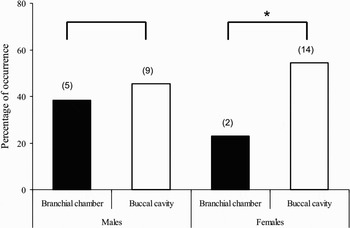
A total of seven parasites was recorded from the branchial chambers and 23 parasites on the tongue in the buccal cavity of the host. Isopods were not found on the body surface of the hosts. Degeneration of the tongue of the host and its replacement by the isopod parasite was not recorded in this study. No significant differences were found between the number of male and female isopods detected (χ2 = 0.133; P > 0.05; df = 1). No significant difference was found between the site of attachment of male isopods on their hosts (χ2 = 1.14; df = 1; P > 0.05). Whereas the female isopods showed preference to the tongue in the buccal cavity of the host (χ2 = 6.25; df = 1; P < 0.05) (Figure 1). Three pairs of isopods (one male with one female) were recorded from three different fish and each pair was attached to the tongue in the buccal cavity of the host. Another pair was found where the female isopod had settled on the tongue in the buccal cavity and male in the branchial chamber. These were the only four occasions where pairs of isopods were recorded on the host.
Sites of attachment of male and female isopod parasites, Cymothoa spinipalpa, on the host. Number of parasites is indicated within parentheses. *, significant statistical difference (P < 0.05).

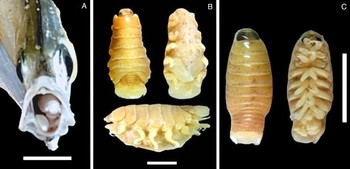
The isopod parasites were attached to the anterio-ventral portion of the branchial chamber with their heads directed towards the host's ventral side. The parasites encountered in the buccal cavities occupied the floor of the lower jaw, and were attached firmly to the tongue with their heads oriented towards the interior of the host (Figure 2).
Marine fish Chloroscombrus chrysurus parasitized by isopod Cymothoa spinipalpa. (A) Pair of Cymothoa spinipalpa in the buccal cavity of the host; (B) gravid female parasite with marsupium full of larvae (black spots); (C) dorsal and ventral view of a male specimen. Scale bars: A, 14 mm; B,C, 5 mm.

A total of 14 males and 16 females of C. spinipalpa were recorded. The mean body sizes of the isopod males and females were 8±1.8 mm (4–11 mm) and 15±1.7 mm (13–19 mm) respectively. Female isopods were significantly larger than the males (Mann–Whitney U-test; U = 192; P < 0.01).
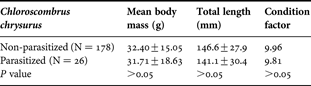
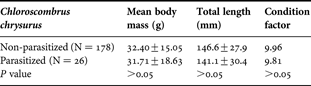
The parasitic prevalence on the host was 60% in male (N = 18) and 40% in female fish (N = 12), and this difference was found to be statistically significant (χ2 = 1.20; df = 1; P > 0.05). The presence of C. spinipalpa on Chloroscumbrus chrysurus did not cause a significant change in the body condition factor of the hosts (Table 1).
Mean body mass, total length and condition factor of non-parasitized and parasitized Chloroscombrus chrysurus.
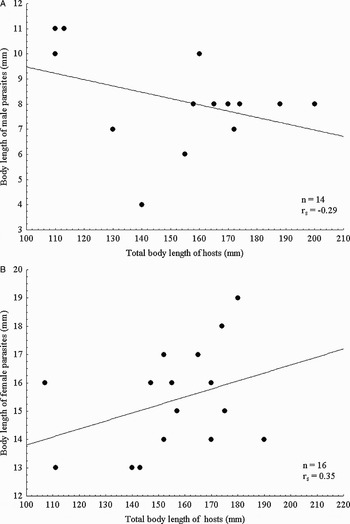
The total body lengths of male isopod parasites and that of the hosts were negatively correlated (Spearman's rank-correlation test, rs = −0.29). However, there was a positive correlation (rs = 0.35) between total body length of the female isopods and the total length of the hosts (Figure 3).
Correlation between size of (A) male and (B) female Cymothoa spinipalpa in relation to total body length of host Chloroscombrus chrysurus.

DISCUSSION
This study is the first record of parasitism by the isopod parasite Cymothoa spinipalpa on the host fish Chloroscumbrus chrysurus in the coastal waters of Brazil. A prevalence of 12.8% was recorded in this study; however, the parasitic prevalence of isopods on marine fish is rather variable in different regions. A low prevalence was more frequently reported (Sartor, Reference Sartor1986). A low prevalence of 14% and a new occurrence of isopod Cymothoa sp. have been found in Seagara Anakan Lagoon, Indonesia, by Yuniar et al. (Reference Yuniar, Palm and Walter2007). Thatcher et al. (Reference Thatcher, Silva, Jost and Souza-Conceiçao2003a) have documented the species Cymothoa catarinensis (with a prevalence of 20%) and Cymothoa excisa (with a prevalence of 13%) on the hosts Menticirrhus litoralis and Micropogonias furnieri in the Brazilian coastal waters.
In this study, both males and females of C. spinipalpa were collected from the branchial chamber and the tongue in the buccal cavity, despite the fact that it has been described as a buccal cavity parasite. Occurrence of males in the branchial chamber and on the tongue in the buccal cavity did not show any significant differences statistically, whereas the females showed a preference for the tongue in the buccal cavity. The occurrence of female isopods of the genus Cymothoa in the buccal cavity of other fish hosts has been documented (Sartor, Reference Sartor1986; Thatcher et al., Reference Thatcher, Silva, Jost and Souza-Conceiçao2003a,Reference Thatcher, Souza-Conceiçao and Jostb, Reference Thatcher, Araújo, Lima and Chellappa2007; Thatcher & Fonseca, Reference Thatcher and Fonseca2005; Bunkley-Williams et al., Reference Bunkley-Williams, Williams and Bashirullah2006; Bariche & Trilles, Reference Bariche and Trilles2008).
Many cymothoid parasites inflict large wounds, often stunt the growth and occasionally kill the host fish (Bunkley-Williams & Williams, Reference Bunkley-Williams and Williams1998b). The tongue replacement of the host by a cymothoid parasite has been recorded. Cymothoa exigua, the tongue-eating isopod causes degeneration of the tongue of its host fish, the rose snapper, Lutjanus guttatus, and it then attaches to the remaining tongue stub and floor of the fish's mouth by hook-like pereopods. In this position the isopod superficially resembles its host's missing tongue (Brusca & Gilligan, Reference Brusca and Gilligan1983).
In this work the parasitized fish did not show any obvious signs of harmful effects caused by C. spinipalpa. No significant differences were found between parasitized and non-parasitized fish in relation to their condition factor. Although some infected hosts are uniformly or proportionally stunted (with slowed growth), and this effect is not evident in simple body measurements (Romestand & Trilles, Reference Romestand and Trilles1979). Williams & Bunkley-Williams (Reference Williams and Bunkley-Williams2000) reported that the condition factor is not a very sensitive measurement of isopod impairment in many hosts. Similar results have been documented in fish parasitized by cymothoids (Romenstand & Trilles, 1979; Horton & Okamura, Reference Horton and Okamura2001; Leonardos & Trilles, Reference Leonardos and Trilles2003; Chávez-Lopez et al., Reference Chávez-López, Rocha-Ramírez, Álvarez and Wetzer2005; Lima et al., Reference Lima, Chellappa and Thatcher2005; Azevedo et al., Reference Azevedo, Silva, Bizerril, Dansa-Petretski and Lima2006).
The body length of male C. spinipalpa was correlated negatively with total body length of the hosts; on the other hand, the females showed a positive correlation. One of the constraints imposed by host body size on the evolution of parasitic isopods is the space available for parasites occupation in or on the host (Allen, Reference Allen1966; Poulin, Reference Poulin1995). Body size affects survival probabilities, reproductive output and individual output of many organisms (Twombly & Tish, Reference Twombly and Tish2000). Whether parasites evolve to be larger or smaller, or do not change in body size may depend on how much space is available at their site of living (Tsai et al., Reference Tsai, Li and Dai2001). Male cymothoid isopods of the branchial chambers are not space-limited and their length does not always correlate with their host length (Williams & Bunkley-Williams, Reference Williams and Bunkley-Williams2000). Tsai et al. (Reference Tsai, Li and Dai2001) have suggested that the smaller size of male parasitic isopods does not limit mating and fertilization success.
Female isopods must grow with the host or die quickly (Williams & Williams, Reference Williams and Williams1982). Female cymothoid isopods in the mouth or gill cavities of fish always grow quickly to fill the available space (Williams & Bunkley-Williams, Reference Williams and Bunkley-Williams2000). The synchrony of parasite and host growth seems be a natural strategy that increases its own body size and reproductive output (Azevedo et al., Reference Azevedo, Silva, Bizerril, Dansa-Petretski and Lima2006). The female isopod can also enhance host growth, increase its own body size and reproductive output. Positive correlations between the size of the female isopod and its host have been registered with other cymothoid species (Álvarez & Flores, Reference Álvarez and Flores1997; Leonardos & Trilles, Reference Leonardos and Trilles2003; Chavez-Lopez et al., 2005).
ACKNOWLEDGEMENTS
This study was supported by the National Council for Scientific and Technological Development of Brazil (CNPq) in the form of Research grants: E.F.S. Costa, grant no. 1059892005-3; M.R. Oliveira, grant no. 1059902005-1; and S. Chellappa, grant no. 307497/2006-2.