




No CrossRef data available.
When the State is Untrustworthy: Public Finance and Private Banking in Porfirian Mexico
Published online by Cambridge University Press: 31 January 2005
Abstract
All sovereign governments face a commitment problem: how can they promise to honor their own agreements? The standard solutions involve reputation or political institutions capable of tying the government's hands. Mexico's government in the 1880s used neither solution. It compensated its creditors by enabling them to extract rents from the rest of the economy. These rents came through special privileges over banking services and the right to administer federal taxes. Returns were extremely high: as long as the government refrained from confiscating all their assets (let alone repaying their debts) less than twice a decade, they would break even.
Information
- Type
- ARTICLES
- Information
- Copyright
- © 2004 The Economic History Association
There exists a commonly accepted view about why governments charter banks to serve as their exclusive financial agent. In that view, a government chooses to grant a single institution a monopoly over its borrowing because a monopolist can credibly punish defaults by denying future credit, whereas multiple creditors would be unable to sustain a boycott. The result is more credit for the government, and more security for its creditors. The Bank of England was born in such an arrangement.1
See Bulow and Rogoff, “Constant Recontracting Model”; and Weingast, “Political Foundations.”
We do not know much, however, about cases where the government makes such a deal and then reneges. Should its demand for credit rise, its time horizon fall, or new sources of credit become available, the government has incentives to borrow from third parties, or even default on its debts.2
New sources of credit, for example, or threats which shorten the sovereign's time horizon, such as war or political instability, have prompted sovereign defaults. See North and Weingast, “Constitutions and Commitment,” p. 807. Political instability also shortens the time horizons of despotic governments, making them less likely to respect their own agreements. For examples, see Olson, “Dictatorship, Democracy, and Development”; and DeLong and Shleifer, “Princes and Merchants.”
Rather than pay higher interest rates, however, the government can create arrangements that allow its creditors to compensate themselves for the risk of lending to the government by extracting rents from the rest of society, without increasing the government's incentives to default. How might such an arrangement work? Mexico provides an example. Mexico's weak central government was incapable of raising the tax revenues it needed. It could not resort to international borrowing: Mexico's previous international bond issues were in default. In order to solve this problem, in 1880 the government chartered a bank that would finance the government. Yet despite issuing illegal debts and then defaulting in 1884/85, the government succeeded in getting the very same bank to lend it new money in 1886 and underwrite its return to international credit markets in 1888.
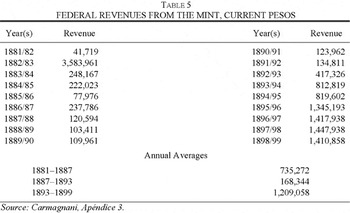
Mexico persuaded its creditors to continue to provide it loans by enabling them to extract rents from the rest of the Mexican economy. These rents came in three forms. First, Mexico's creditors, organized into the Banco Nacional de México (Banamex), were granted special privileges in the banking market. Second, they were given the keys to the mint—literally. The country's mints were turned over to the bank. Third, Banamex was given the right to administer and collect certain taxes, including customs and excise taxes. Banamex's branch network gave it an advantage over the government in collecting taxes.3
In fact, Mexico had no centralized system of tax collection until 1906. See Carmagnani, “El liberalismo,” p. 488.
Protecting Banamex's privileges in the banking market was easy even for Mexico's relatively disorganized government. All Porfirio Díaz had to do was fail to enforce the property rights and contracts of any potential competitors. Díaz's government, as a practical matter, lacked the capability to provide property rights as a public good. It could, however, selectively and differentially enforce the property rights of particular private parties. All other things being equal, the more clearly defined and better-enforced the rights to use or transfer an asset, the greater the value of that asset. Banamex, therefore, by enjoying better (if still not particularly good by the standards of, say, contemporary England) defined and enforced property rights than its competitors, could enjoy a very large competitive advantage.4
See Haber, Razo, and Maurer, Politics of Property Rights, for more on the issue of selectively enforced property rights, particularly chapter 2.
What kept the government from diluting Banamex's privileges in the private credit market or its monopoly over tax collection? Why not allow competitors more leeway in the banking market, or give other creditors the right to collect taxes and run some of the mints? The answer is twofold. First, it is not clear that the penurious and disorganized Porfirian government of the 1880s could have effectively enforced the property rights of new entrants. The result might have been a reduction in the rents Banamex earned and shared with the government, with no commensurate gains for the entrants. In fact, even had the government been able to extend Banamex's privileges to new entrants, doing so would have destroyed the monopoly rents extracted from consumers in the banking market, and reduced the total surplus available to be shared with the government. Second, the government had little incentive to dilute Banamex's monopolies over various taxes and the mint, because allowing competitors to challenge the monopoly would have reduced the available revenue by reducing Banamex's incentives to improve the efficiency of tax collection and the mint.5
In some respects, the relationship between Banamex and the Mexican government is similar to the arrangement that existed between the tax farming cartel of the Ferme Générale and the Crown in eighteenth-century France. Johnson, “Banking on the King,” provides a model of tax farming in the presence of transaction costs of collection. Johnson's model suggests that the cause of the late-seventeenth-century French transition from the competitive auctioning of tax farms to a monopoly cartel was the need to invest in specific tax-collection infrastructure and technology. Like Banamex, the Ferme Générale amounted to a tax farming monopoly that doubled as a creditor for the government. The Ferme Générale extracted revenue from the population and forwarded it to the government. The exposure to predation by the government was limited, because, in the absence of other organizations in the ready with the infrastructure, expertise, and financial resources, the Ferme Générale could not be costlessly replaced. Allowing competition with the Ferme Générale would reduce the Ferme Générale's monopoly rents, but it would also reduce the overall stream of rents shared between the farmer and the treasury by even more. For more details on tax farming in France, see White, “France's Slow Transition.”
In the long term, the result was an uncompetitive financial system and slower economic growth.6
For more on the negative long-term consequences of Mexico's uncompetitive financial system on the country's economic growth, see Haber, “Industrial Concentration”; Maurer, “Internal Consequences”; Maurer and Haber, “Institutional Change and Economic Growth”; and Maurer and Sharma, “Enforcing Property Rights.”
For evidence on the importance of railroads in Mexico's economic development, see Coatsworth, Growth Against Development.
MEXICO'S FISCAL PROBLEMS IN THE NINETEENTH CENTURY
Mexico's debt problems started at independence in 1821, when the Mexican Empire recognized 30 million dollars worth of colonial debts owed to domestic merchants. The debts were never repaid.8
For the story of the colonial debt, see Marichal, La bancarrota del virreinato.
The French government used Mexico's debt arrears as a pretext to invade in 1862 and install Archduke Maximilian in Mexico City. Facing opposition from Benito Juárez's U.S.-backed guerrilla forces, the French pulled out in 1866, and Maximilian fell within a year. Unsurprisingly, the Restored Republic under Benito Juárez refused to recognize the debts contracted under Maximilian. In addition, because the British government had supported Maximilian, the Restored Republic suspended payments on all existing British debts. By the 1870s, unpaid interest on the British debt alone had ballooned to US$120 million.9
The government tried to maintain interest payments on the loans Americans had advanced to the rebel movement, but these debts amounted to only US$5 million. Marichal, “Financial Market Reform,” pp. 95–96.

Sebastián Lerdo de Tejada succeeded Benito Juárez upon Juárez's death in 1872. Porfirio Díaz overthrew Lerdo in 1876. Díaz ceded the Presidential sash to Manuel González in 1880. (He would take it back in 1884.) Although all three governments neglected the foreign debt, they all tried to amortize some of the domestic debt. Juárez bought back a small amount of debt in 1868, for 31 percent of its face value. An 1870 report to Congress indicated that the 1850 convention bonds traded at 8 to 9 percent of their face value, whereas more recent debts could be purchased for 15 percent.10
Carmagnani, Estado y mercado, p. 231.
Secretaría de Hacienda y Crédito Público, Memoria, pp. 113–18.
Unfortunately, the government's need for credit had grown. Díaz needed to equip an army capable of facing down threats from regional challengers. He also needed to pay the army enough to keep its loyalty. His government, however, lacked the resources to effectively tax Mexico's impoverished economy. In 1877 Mexico's per capita GNP (in 2003 dollars) was only $473.12
See Coatsworth, “Obstacles to Economic Growth.” Coatsworth's estimate of $62 in 1950 dollars has been converted to 2003 dollars using the U.S. CPI.
Mexico's leaders believed that railroads would open Mexico's economy to foreign investment, increase trade and tariff revenues, and allow Mexico to repay its obligations. Mexico had no decent navigable waterways, and half of all roads were unsuitable even for beasts of burden. Mexico's first railroad did not open until 1873, and by 1877 the country enjoyed only 400 miles of track.13
Coatsworth, Growth Against Development, p. 35.
See Maurer, “Banks and Entrepreneurs.”
It does not appear too hazardous to assert that, if railroads were constructed in the center of the country, and between the principal towns … in order to have access to both oceans, the nation would receive an impulse such that its wealth would be sensibly augmented, and with it the income of the Federal Treasury, which would admit of the punctual payment of the interest on the national debt. The creditors of the country appear to have recognized the truth and force of these considerations.15
Romero, Report of the Secretary, p. 40.
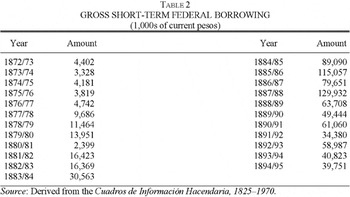
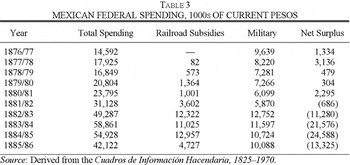
Mexico's existing sources of credit were not sufficient. A money market of sorts existed in Mexico City. The federal government issued customs certificates that entitled the bearer to physically go to a specific customhouse and collect a stated amount, and a secondary market existed for them. Gross issues of customs certificates rose precipitously between 1876 and 1882. (See Table 2.) Most funds, however, were paid back in six months, and net long-term borrowing was zero. Increases in railroad subsidies came out of the military budget, a dangerous policy in a country prone to regional revolts and military coups. In short, if the government were to build railroads quickly, it needed to borrow more than this thin market could finance. (See Table 3.)


There is no evidence that the Mexican government considered printing money to cover its deficit. There is a reason for that: inflationary finance had not been particularly successful elsewhere in Latin America. Argentina provides an example. On multiple occasions, Argentine governments filled fiscal shortfalls by printing money. None of these episodes raised revenues for more than a few years, and all were followed by painful efforts to re-establish convertibility. The mechanism behind inflationary finance in Argentina was not the issuance of government fiat money. Argentine governments (like Mexican ones) lacked the credibility to force people to accept their notes. Rather, the mechanism was to establish private banks that would issue notes redeemable in gold, and then suspend the convertibility of those notes.16
For more on Argentine inflationary finance in the nineteenth century, see Bordo, “What If Alexander Hamilton Had Been Argentinean?”
The government, therefore, decided to create a bank. Emilio Velasco, a lawyer from northern Mexico acting in the employ of the federal government, used his contacts with Gustavo G. Godowa, the Polish publisher of the Mexican publication Le Nouveau Monde, to open negotiations with the Banque Franco-Egyptienne over the establishment of a bank that would serve as the primary financial agent for the federal government.17
Ludlow, “La construcción de un banco,” p. 303.
Ludlow, “El Banco Nacional Mexicano,” p. 985; and Martínez Sobral, Estudios elementales, p. 27.
Ludlow, “La construcción de un banco,” p. 321.
The Banco Nacional Mexicano was not the only bank in Mexico. Four other formal institutions existed in 1881. One was a small bank founded by Americans in the frontier state of Chihuahua. The second was the Banco de Londres, México, y Sud-América, a British bank that had operated in Mexico since 1864.20
Labastida, Estudio histórico, p. 64.
Labastida, Estudio histórico, p. 73.
Labastida, Estudio histórico, p. 74.
The fourth bank was founded as a response to the Banco Nacional Mexicano. A group of enterprising merchants decided to found their own bank, claiming that it was their “patriotic duty” to invest in a “free” bank in order to stop Mexican capital from leaving “to increase other nations' prosperity.”23
Archivo Histórico del Banco Nacional de México [hereafter AHBNM], 29 August 1881, Actas de la fundación del Banco Mercantil Mexicano.
AHBNM, 17 September 1884, Actas de consejo, vol. 1.
AHBNM, 18 March 1882, Actas de la fundación del Banco Mercantil Mexicano.
THE COMMITMENT PROBLEM
Why would the simple act of chartering a bank aid the government in solving its credit problem? After all, the French and Mexican owners of the new bank faced the same uncertainty as other creditors. The government could as easily suspend payments on bank debt as on bond issues. Of course, foreign powers could use military force to collect their debts. In fact, President Benito Juárez's refusal to honor the debts of the previous Conservative government prompted the French invasion in 1862. That adventure, however, turned into a fiasco. By the 1880s the only power that might be capable of forcing Mexico to repay its debts was the United States, but there is no evidence that the American government had any interest in doing so.
The only recourse creditors had to induce repayment was the threat of denying future credit. Therefore, the largest penalty which they could impose upon the Mexican government was the present value of any future borrowing.26
See Eaton, Gersovitz, and Stiglitz, “Pure Theory of Country Risk.”
See Bulow and Rogoff, “Constant Recontracting Model.”
Weingast, “Political Foundations,” p. 215.
Of course, lenders are presumably alert to this sort of thing. Therefore, one would expect lenders to organize a boycott if the government began defaulting on any of its debts. Unfortunately, collective boycotts are not credible without an enforcement mechanism. This is because the government can offer extraordinarily good terms to violators. The more restrictive the boycott, the greater the government's need for credit, and the more the government can credibly offer to pay violators. The value of the punishment lenders can levy via a boycott on the government will be low, and so will be the government's credit limit.29
Mexico in the 1880s is not the only example of this phenomenon. Phillip Hoffman found that the seventeenth-century French monarchs often played various lenders off against each other, defaulting on one while borrowing from another. When lenders developed new ways to coordinate their punishments under Louis XIV, the amount the French government could borrow increased. The recent Latin American debt crises follow a similar pattern. These and other examples can be found in Weingast, “Political Foundations,” pp. 229–30.
Therefore, by concentrating its borrowing in a single institution, the government can raise the amount of pain caused by a default, because a single lender can credibly impose a credit boycott. The result, in theory, is an increase in the government's ability to borrow. The rub is that the government has no binding ex post reason to limit its borrowing. If the government's demand for credit increases, then it will happily pledge to give one creditor a monopoly over lending while surreptitiously seeking out additional creditors. That is precisely what happened after 1884.
MEXICAN DEFAULT IN THE 1880s
In 1883 and 1884 the Mexican government reneged on its agreement with the Banco Nacional Mexicano. In order to circumvent its 4 million peso debt ceiling with the bank, Manuel González's government surreptitiously borrowed from a widely dispersed group of creditors, ran up a huge debt, and finally suspended payments. This behavior should not be surprising. Many of the railroad trunk lines had been finished by 1884, and as the year drew on it became increasingly obvious that President González lacked the political support to keep himself in power. Why not borrow as much as you can, while you still can? What is surprising about this episode is not that the Mexican government defaulted, but that it managed to regain access to credit within two years. By 1888, in fact, the Banco Nacional's successor bank would underwrite Mexico's return to the international credit markets.
What prompted the default? In 1882/83, federal spending began to outpace revenues. (See Table 3.) The government began issuing customs certificates faster than it redeemed them. It also requested advances from Mexico's other banks, in contravention of its agreement with the Banco Nacional. Changes in tariff schedules kept the deficit from growing in 1883/84, but the respite was temporary. In May 1883 the Banco Nacional Mexicano lent the federal government 150,000 pesos, followed in November by an additional loan of Mx$700,000 in exchange for Mx$1,000,000 in customs certificates due six months later.30
Marichal, “Foreign Loans,” p. 348. The Mexican merchant houses involved in the deal included Bermejillo Hermanos, Benecke Sucursales, Félix Cuevas, Gutheil y Compañía, Ramón G. Guzmán, Lavie y Compañía, and Antonio de Mier y Celis. AHBNM, Contract #1, Syndicate “Ordenes del Pacífico,” Libro de Contratos Originales de Empréstitos.
The implicit interest rate on this loan was calculated as (1,000,000/700,000)2 − 1.
Secretaría de Hacienda y Crédito Público, Memoria, pp. 70–79.
Marichal, “Foreign Loans,” p. 348.
Federal deficits caused foreign railway investors to doubt that the government could cover its subsidy promises. Therefore, they ceased investing. Imports of manufactured iron and steel, used primarily in railroad building, provide a rough proxy for investment. After rising from US$1.3 million in 1880 to US$4.2m in 1882, they fell to US$3.8m in 1883, slid to US$2.4m in 1884, plunged to US$1.2m in 1885, and bottomed out at US$904,554 in 1886.34
Because they were not taxed, the decline in these imports did not directly affect the government's fiscal situation.
The fall in foreign investment occurred at a bad time, because Mexico suffered a crop failure in 1884. With the government gobbling up domestic credit, foreign capital drying up, and specie flowing out to pay for imports of basic foodstuffs, rural bankruptcies multiplied. This slowed business activity, which caused imports to drop, which lowered the government's tariff revenue. That, in turn, increased the fiscal deficit, thereby worsening the credit crunch and exacerbating the crisis. Banks ceased lending.35
AHBNM, 28 March 1883 and 4 April 1883, Libro de Actas del Banco Nacional Mexicano.
Labastida Estudio histórico, p. 76.
AHBNM, 24 January 1884, Libro de Actas del Banco Nacional Mexicano.
The solution was to engineer the merger of the Banco Nacional and the Banco Mercantil into a new bank called the Banco Nacional de México (henceforth Banamex). Edouard Noetzlin, the chief representative of the bank's French owners, arrived in Mexico in February 1884 to begin negotiations over the merger. President González placed Porfirio Díaz in charge of the government's team.38
Marichal, “Financial Market Reform,” p. 101.
The new bank, Banamex, was largely owned by Mexican residents.39
See Ludlow, “La construcción de un banco.”
This was not appreciably different from the privileges the Banco Nacional Mexicano had obstensibly enjoyed. Ludlow, “La construcción de un banco,” p. 332.
Labastida, Estudio histórico, p. 99.
AHBNM, 12 August 1884, Actas de consejo, vol. 1.
AHBNM, 1 July 1884, Actas de consejo, vol. 1.
Banamex loaned the government an additional two million pesos, at 7 percent, in October, premised upon the acceptance of the Noetzlin Contract. AHBNM, 30 September 1184 and 7 October 1884, Actas de consejo, vol. 1.
Unfortunately, the Noetzlin Contract ignited a political firestorm back in Mexico City when it was presented to Congress in October 1884. Several congressional deputies bitterly opposed the contract, objecting against the £1.3 million—roughly 20 percent—commission charged by Banamex. As Carlos Marichal has pointed out, these commissions were probably intended to cover the government's outstanding seven million peso debt to the bank. Nevertheless, before a final vote could be taken, hundreds of students took to the streets chanting, “Die, Manuel González! Die, Noetzlin!” Two people were killed and hundreds injured in the resulting riot.45
Marichal, “Foreign Loans,” pp. 351–52.
Neither González nor Noetzlin died, but the contract did. Mexico City was in the midst of bitter in-fighting over who should succeed Manuel González. Porfirio Díaz presumably had little incentive to help his protégé-cum-opponent resolve the country's credit problems. Díaz regained the presidency and informed Noetzlin that both the contract and commission were dead.46
Communication from Dublán to Noetzlin, 21 January 1885, reproduced in Castillo, Colección de leyes, pp. 54–57.
The failure of the Noetzlin contract failed to shrink the government's demand for credit. Banamex charged the government an effective interest rate of 39.4 percent on a 300,000 peso advance made to make loan payments due in New York in January 1885.47
Calculated from data in the AHBNM, 13 January 1885, Actas de consejo, vol. 2. The price of silver fell in 1884/85, causing the peso to depreciate strongly, falling from 89¢ (US) to 85¢. It would continue to fall until 1888, when it would pause at 75¢ before beginning to decline again in 1892.
AHBNM, 2 March 1885 and 4 March 1885, Actas de consejo, vol. 2.
AHBNM, 22 April 1885, Actas de consejo, vol. 2.
On 22 June 1885 Finance Secretary Manuel Dublán announced what the contemporary financial press called a “coup-d'état”: the suspension of all interest payments on short term debt.50
Marichal, “Foreign Loans,” pp. 352–53.
Marichal, “Financial Market Reform,” pp. 103–04.
AHBNM, 2 June 1885 and 19 June 1885, Actas de consejo, vol. 2.

Within a year, however, Banamex opened new credits to the federal government.53
AHBNM, 23 November 1886, vol. 2.
PROFITS
Why did the bank choose to aid the federal government? After all, Banamex had been seriously burned by the government's suspension of payments and the subsequent bank run. Why risk good money after bad?
Banamex had three reasons. First, Banamex was, in effect, empowered to collect taxes on the government's behalf. Banamex became the official financial agent of the federal government, which meant that all tax payments and disbursements passed through its hands. In addition, Banamex held all deposits made as guarantees of government contracts. The bank's directors collected a 3 percent commission on these funds.54
AHBNM, 25 July 1888, vol. 3.
AHBNM, 29 September 1885, vol. 2.
AHBNM, 25 July 1888, vol. 3.
AHBNM, “Contract #28,” Libro de Contratos Originales con el Gobierno Federal. It should be noted that this arrangement appears to have contravened a federal law which declared that, “The issue of [revenue] stamps shall be an exclusive responsibility of the federal government. No state, authority, nor corporation may issue them, nor collect taxes or fees by this means.” Carmagnani, “El liberalismo,” p. 488.
AHBNM, 21 March 1893, Actas de consejo, vol. 3, and “Contract #27,” Libro de Contratos Originales con el Gobierno Federal.
These arrangements benefited the government as well as the bank. The share of alcohol taxes in all internal taxes doubled the year Banamex took over their collection.59
From figure 4 in Carmagnani, “El liberalismo,” p. 482.
Interestingly, these tax farming-like arrangements paralleled those between the Spanish government and the Banco de España in Spain proper and the Banco Española de la Isla de Cuba in Spain's colony. See Fernández, Encumbered Cuba, pp. 34 and 101–02.

Second, the government enabled Banamex to extract rents indirectly from the rest of the Mexican economy. The Banco de Londres y México was the only bank besides Banamex permitted to branch across state lines. Banamex could enjoy economies of scale and diversify its risks in a way that the smaller banks could not. The federal government protected Banamex from new startups, authorized by state governments, by federalizing all bank chartering in 1884.61
Labastida, Estudio histórico, pp. 67–68. The same law also authorized the federal government to tax banknote issues. The government promised Banamex that it would impose a 5 percent levy on the issues of all its existing competitors, but a political outcry forced it to renege on this promise.
AHBNM, 20 January 1885 and 27 January 1885, Actas de consejo, vol. 1.
In 1888, under pressure from the state governors, the federal government granted concessions for 14 new banks. These concessions worried Banamex, although only half of the new concessions allowed their holders to issue banknotes.63
AHBNM, 26 October 1889, Actas de consejo, vol. 3.
Economista Mexicano, 14 September 1889. In 1889, Dublán handed out seven concessions in San Luis Potosí, Jalisco, Guanajuato, Puebla, Veracruz, Zacatecas, and Yucatán. Manuel Saavedra, a political ally of Dublán's, received the San Luis Potosí concession on 6 August. The Veracruz concession went to an American, George Wilson, while the others went to prominent Mexican businessmen. See Labastida, Estudio histórico, pp. 106–10. The Puebla concession went to Tómas Iglesias, who succeeded in persuading the government to both allow his bank to branch nationally and to issue mortgage bonds in overseas markets. See “Contrato celebrado entre el Sr. Lic. Manuel Dublán…y el Sr. Tómas Iglesias,” 29 August 1889, reproduced in Labastida, Estudio histórico, pp. 447–49. In 1890 Dublán handed out a concession for a banco agrícola e industrial in Coahuila. See the Economista Mexicano, 3 May 1890 and 7 June 1890.
Economista Mexicano, 14 September 1889; Labastida Estudio histórico, pp. 106–10; and the “Contrato celebrado entre el Sr. Lic. Manuel Dublán…y el Sr. Tómas Iglesias,” 29 August 1889, reproduced in Labastida, Estudio histórico, pp. 447–49.
See Haber, Razo, and Maurer, Politics of Property Rights, chapter 4.
Third, Banamex was able to use its position as the government's official financial agent to reap enormous profits from underwriting the government's debt conversions. In other words, Banamex was able to extract rents from the government's former creditors, in return for the hope (which turned out to be well founded) that the written-down debts would be repaid.
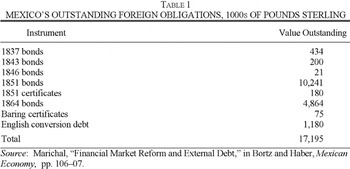
The government used Banamex as an intermediary to negotiate the conversion of its outstanding debts. In 1886, the government persuaded its British creditors to write off its outstanding interest arrears. That same year, domestic claims with a face value of 57 million pesos were converted to 3-percent bonds worth approximately 25 million pesos. In 1888 Banamex arranged a European conversion loan. The proceeds from the new loan were used to pay off the government's existing debt to Banamex and buy up Mexico's outstanding foreign obligations at 40 percent of their face value. The country's creditors wrote off 37 percent of Mexico's foreign debts, for a net saving of £8.7 million.67
Marichal, “Financial Market Reform,” pp. 105–07.
AHBNM, 21 March 1888, Actas de consejo, vol. 3.
Marichal, “Financial Market Reform,” p. 107. The first tranche of £3.7 million was purchased by the underwriting consortium at 70 percent of par and sold at 85, while the second tranche was purchased at 85 and sold at 92.
Cited in Marichal, “Financial Market Reform,” pp. 108–09.
What the Times did not understand was that the transaction was good for all the parties involved. The government reduced its outstanding debt and began rebuilding its international reputation. Banamex divested itself of the government's outstanding debt and earned high profits. Mexico's foreign creditors got to exchange moribund debts for lower debts that might be—and, ex post, were—repaid. Later conversions in 1889 and 1890, and new debt issues in 1892 and 1893, followed the same pattern. In 1892 and 1893, for example, the government found it difficult to place its bonds in Europe. Banamex underwrote the loans, buying the entire bond issue from the government, and waited a year to re-sell them on the European market.71
These loans were to finance railroad construction across the Tehuantepec isthmus and drainage works in Mexico City. Marichal, “Financial Market Reform,” p. 110.
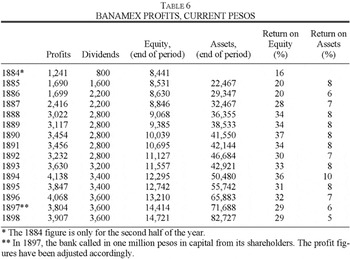
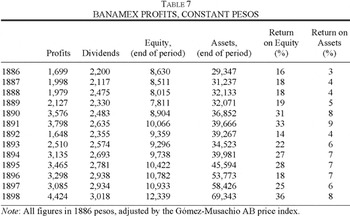
How high were Banamex's profits? The answer is: extremely high. (See Table 6 and Table 7.) The bank earned an average return on equity of 24 percent. By 1888 the bank's owners had earned back their entire eight-million peso investment. As might be expected, the bank paid out the majority of its profits in dividends, and reinvested very little.


During the 1880s Mexico was an inflationary economy as the silver peso depreciated against gold. The figures in Table 7 have therefore been adjusted by the Gómez-Musacchio price index (which begins in 1886) in order to adjust for changes in the price level. Despite inflation, profits were still very high. Real returns averaged 23 percent in 1886–1898.
CONCLUSION
Mexico faced a severe dilemma in the 1880s. The government needed to finance an army, build a railroad net, and bring political stability to the country. This required a great deal of money. Unfortunately, the government's ability to extract taxes was limited. Without taxes, the government could not pay tax collectors; without tax collectors, the government could not collect taxes.
The only way to square the circle was to borrow. Unfortunately, in order to borrow, Mexico needed to solve the commitment problem. Because the government had come to power in a military coup in 1876 and faced strong opposition, no one believed it would be long-lived. In addition, Mexico had a long history of debt defaults. The regime tried to create a credible commitment by giving one credit institution a monopoly over lending to the government. Unfortunately, the government could not implement this solution effectively. As its demand for credit grew, the government borrowed from third parties and eventually defaulted on its debt. Its need for funds remained, but it remained unable to directly extract significant rents from the economy.
The solution was to contract with an institution that would be capable of extracting such rents. The government could not issue banknotes, because with no specie reserves and a debt in default it could not convince anyone to accept them. Banamex's wealthy owners, however, had specie reserves. The government could not run the mint efficiently. Banamex, however, could. The government lacked the capital to enter the banking business. It could, however, grant lucrative special privileges to someone who did. It short, the government could sell a stream of rents to wealthy private parties in return for credit. These rents compensated Banamex for the risk of doing business with an unstable government.
The arrangement was suboptimal in some abstract economic sense.72
For more on the long-term economic cost of these financial arrangements, see Maurer, “Internal Consequences.”
We are indebted to Eduardo Engel, Stephen Haber, Knick Harley, Avner Greif, Carolyn Moehling, Steven Nafziger, Ben Polak, Tridib Sharma, Tavneet Suri, and Chris Udry for many helpful comments on what became this article. Much of the research for this article was completed while Maurer was a visitor at the Economic Growth Center at Yale University. All remaining errors are, of course, our own.
References
Archivo Histórico del Banco Nacional de México (AHBNM). México, DF.
Bordo Michael.
1998.
“What If Alexander Hamilton Had Been Argentinean? A Comparison of the Early Monetary Experiences of Argentina and the United States.”
NBER Working Paper No. w6862,
Cambridge, MA,
December
Bulow, Jeremy, and Kenneth Rogoff.
1989:
“A Constant Recontracting Model of Sovereign Debt.”
Journal of Political Economy
97, no. 1
155–78.Google Scholar
Carmagnani Marcello.
1989:
“El liberalismo, los impuesto internos y el estado federal mexicano, 1857–1911.”
Historia Mexicana
38, no. 3
471–96.Google Scholar
Carmagnani Marcello.
1994.
Estado y mercado: La economía pública del liberalismo mexicano, 1850–1911.
México, DF:
Fondo de Cultura Económica,
Castillo, Juan, ed.
1903.
Colección de leyes, decretos, reglamentos, contratos, supremas resoluciones y noticias referentes al crédito público y correspondientes a los años de 1883 a 1903, época del arreglo definitivo de la deuda nacional.
México, DF:
Coatsworth John.
1981.
Growth Against Development: The Economic Impact of Railroads in Porfirian Mexico.
Dekalb, IL:
Northern Illinois University Press,
Coatsworth John.
1978
“Obstacles to Economic Growth in Nineteenth Century Mexico.”
American Historical Review
83, no. 1
80–100Google Scholar
DeLong, Bradford, and Andrei Shleifer.
1993
“Princes and Merchants: European City Growth before the Industrial Revolution.”
Journal of Law and Economics
36, no. 2
671–702Google Scholar
Eaton, Jonathan, Mark Gersovitz, and Joseph Stiglitz.
“The Pure Theory of Country Risk,”
European Economic Review
30, no. 3:
481–513.
Economista Mexicano
[México, DF], various dates. Hermeroteca Nacional, México, DF.
Fernández, Susan.
2002.
Encumbered Cuba: Capital Markets and Revolt, 1878–1895.
Gainesville, FL:
University of Florida Press,
Johnson Noel.
2003.
“Banking on the King: The Evolution of the Royal Revenue Farms in Old Regime France”.
Mimeo, Washington University at Saint Louis,
Saint Louis, MO,
Haber, Stephen,
1991:
“Industrial Concentration and the Capital Markets,”
This JOURNAL
51, no. 3
559–80.Google Scholar
Haber, Stephen, Armando Razo, and Noel Maurer.
2003.
The Politics of Property Rights: Political Instability, Credible Commitments, and Economic Growth in Mexico, 1876–1929.
Cambridge, UK:
Cambridge University Press,
Labastida Luis.
1889.
Estudio histórico y filosófico sobre la legislación de los bancos.
México, DF:
Ludlow Leonor.
1985.
“La construcción de un banco: el Banco Nacional de México (1881–1884).” In Banca y poder en México (1800–1925),
edited by Leonor Ludlow and Carlos Marichal,
299–346.
México, DF:
Grijalbo,
Ludlow Leonor.
1990
“El Banco Nacional Mexicano y el Banco Mercantil Mexicano: radiografía social de sus primeros accionistas, 1881–1882.”
Historia Mexicana
39, no. 4
979–1028Google Scholar
Marichal, Carlos, coordinator.
1996.
Cuadros de Información Hacendaria, 1825–1970.
Mimeo, Colegio de México,
México, DF,
Marichal Carlos.
1995.
“Foreign Loans, Banks and Capital Markets in Mexico, 1880–1910.” In La deuda pública en América Latina en perspectiva histórica,
edited by Reinhard Liehr.
Madrid:
Vervuert/Iberoamericana,
Marichal Carlos.
1999.
La bancarrota del virreinato: Nueva España y las finanzas del Imperio español, 1780–1810.
México, DF:
Fondo de Cultura Económica,
Marichal Carlos.
2002.
“Financial Market Reform and External Debt.” In The Mexican Economy, 1870–1930,
edited by Jeffrey Bortz and Stephen Haber,
93–119.
Palo Alto, CA:
Stanford University Press,
Martínez Sobral, Enrique.
1911.
Estudios elementales de legislación bancaria.
México, DF:
Maurer Noel.
1999:
“Banks and Entrepreneurs in Porfirian Mexico: Inside Exploitation or Sound Business Strategy?”
Journal of Latin American Studies
31, no. 2
331–61Google Scholar
Maurer Noel.
2002.
“The Internal Consequences of External Credibility: Banking Regulation and Banking Performance in Porfirian Mexico.” In The Mexican Economy, 1870–1930,
edited by Jeffrey Bortz and Stephen Haber,
50–92.
Palo Alto, CA:
Stanford University Press,
Maurer, Noel, and Stephen Haber,
2002.
“Institutional Change and Economic Growth: Banks, Financial Markets, and Mexican Industrialization, 1878–1913,” In The Mexican Economy, 1870–1930,
edited by Jeffrey Bortz and Stephen Haber,
23–49.
Palo Alto, CA:
Stanford University Press,
Maurer, Noel, and Tridib Sharma.
2001:
“Enforcing Property Rights Through Reputation: Groups in Mexico's Early Industrialization, 1878–1913,”
This Journal
61, no. 4
950–73.Google Scholar
North, Douglass, and Barry Weingast.
1989:
“Constitutions and Commitment: The Evolution of Institutional Governing Public Choice in Seventeenth-Century England.”
This Journal
49, no. 4
803–32.Google Scholar
Olson Mancur.
1993
“Dictatorship, Democracy, and Development.”
American Political Science Review
87, no. 3
567–76Google Scholar
Romero, Matías.
1879.
Report of the Secretary of Finance of the United States of Mexico of the 15th of January 1879 on the actual condition of Mexico and the increase of commerce with the United States, rectifying the report of the Hon. John W. Foster, Minister Plenipotenciary in Mexico.
New York, NY:
Secretaría de Hacienda y Crédito Público.
Memoria 1877–1878.
México, DF.
Weingast Barry.
1997.
“The Political Foundations of Limited Government.” In The Frontiers of the New Institutional Economics,
edited by John Drobak and John Nye,
213–46.
San Diego, CA:
Academic Press,
White Eugene.
2001.
“France's Slow Transition from Privatized to Government-Administered Tax Collection: Tax Farming in the Eighteenth Century.”
Departmental Working Paper 2001–16, Rutgers University,
New Brunswick, NJ,
MEXICO'S OUTSTANDING FOREIGN OBLIGATIONS, 1000s OF POUNDS STERLING
GROSS SHORT-TERM FEDERAL BORROWING (1,000s of current pesos)
MEXICAN FEDERAL SPENDING, 1000s OF CURRENT PESOS
BANAMEX RESERVES, NOTE CIRCULATION, AND DEPOSITS IN 1885
FEDERAL REVENUES FROM THE MINT, CURRENT PESOS
BANAMEX PROFITS, CURRENT PESOS
BANAMEX PROFITS, CONSTANT PESOS
 You have
Access
- 11
- Cited by