




No CrossRef data available.
Article contents
Behavior problems in 18- to 36-month-old children of alcoholic fathers: Secure mother–infant attachment as a protective factor
Published online by Cambridge University Press: 04 May 2006
Abstract
This study examined the relationship between paternal alcoholism and toddler behavior problems from 18 to 36 months of age, as well as the potential moderating effects of 12-month infant–mother attachment security on this relationship. Children with alcoholic fathers had higher levels of internalizing and externalizing behavior than children of nonalcoholic fathers. Simple effects testing of an interaction effect of child age, group, and attachment security with mothers on externalizing behavior suggested that at 24 and 36 months of age mother–infant attachment security moderated the relationship between alcohol group status and externalizing behavior. Namely, within the alcohol group, those children with secure relationships with their mothers had significantly lower externalizing than insecure children of alcoholics. A similar pattern was noted for internalizing behavior at 36 months of age. Implications for intervention are discussed.
The authors thank the parents and infants who participated in this study and the research staff who were responsible for conducting numerous assessments with these families. This study was made possible by grants from NIAAA (1RO1 AA-10042-01A1) and NIDA (1K21DA00231-01A1).
Information
- Type
- REGULAR ARTICLE
- Information
- Copyright
- 2006 Cambridge University Press
The toddler and preschool years are a time of rapid child development. From the ages of 2 to 3 years children begin to develop inhibitory control abilities that are reflective of their temperaments and parental socialization (Emde, Biringen, Clyman, & Oppenheim, 1991; Kopp, 1982; Rothbart, 1989). There is an increasing shift from parental control to child self-control. Developmentally, it is a time for increasing autonomy and often willfulness on the part of the child. It is during these “terrible twos” that parents often begin to identify behavior problems in their children. Researchers have found that normative increases in externalizing behavior can be expected in the toddler years and then decreases from 3 to 4 years of age (Cummings, Iannotti, & Zahn-Waxler, 1989; Nagin & Tremblay, 1999; Shaw, Gilliom, Ingoldsby, & Nagin, 2003). Although some of these behaviors are developmentally appropriate, others can be viewed as the precursors to later maladaptive behavior. In fact, as early as preschool, moderate to severe behavior problems have been shown to be resistant to change and predictive of later dysfunction (Campbell, 1995). Such early behavior problems have been shown to negatively affect peer relations, a child's developing sense of self, academic and family functioning, and to have long-lasting effects on the child (Campbell, 1990, 1995). Children of alcoholics may be particularly vulnerable to such behavioral difficulties.
It is well established that children of alcoholics are at both biological and environmental risk for a myriad of social, emotional, and behavioral problems (e.g., Carbonneau et al., 1998; Clark et al., 1997; Johnson, Leonard, & Jacob, 1989; Leonard et al., 2000; Poon, Ellis, Fitzgerald, & Zucker, 2000). Whereas most of the literature focuses on older children of alcoholics, who are prone to substance abuse and antisocial behavior, recent research has called for an increased focus on the problems of early childhood. The few studies that have done so have found preschool age children of alcoholics to be at risk for temperamental difficulties and externalizing behavior problems (Puttler, Zucker, Fitzgerald, & Bingham, 1998). In addition, children with alcoholic fathers have been found to exhibit higher internalizing and externalizing behavior problems, negative emotionality, and noncompliance (boys only) as early as 18 months of age (Edwards, Eiden, & Leonard, in press; Edwards, Leonard, & Eiden, 2001; Eiden, Edwards, & Leonard, 2002; Eiden, Leonard, & Morrisey, 2001). However, although children raised in alcoholic families are at risk for developmental maladaptation, there is a considerable degree of heterogeneity in psychosocial consequences, suggesting the potential for resilience (Johnson, Sher, & Rolf, 1991). Resilience has been defined as a “dynamic process wherein individuals display positive adaptation despite experiences of significant adversity or trauma” (Luthar & Cicchetti, 2000, p. 858). In early childhood, one area of positive adaptation is the development of a secure attachment relationship with the primary caregiver. Thus, in considering such resilience in the toddler years, the mother–child attachment relationship is a crucial area of focus.
The attachment relationship that the child forms with his or her parents in the first year of life serves as a foundation for exploration and developing mastery as a toddler (Edwards, 1996; Jacobwitz, Morgan, Kretchmar, & Morgan, 1992). Secure attachment is built from a caregiving environment characterized by parental responsiveness, sensitivity, and consistency (Ainsworth & Wittig, 1969). Secure children develop a sense that the world is predictable and that their needs will be met and their anxieties soothed. Secure relationships form a mutually cooperative system between parent and child, and it is this positive reciprocal orientation that opens the child to the positive socializing influence of the parent (Maccoby, 1984; Maccoby & Martin, 1983) and to more successful parental discipline as the child ages (Grusec & Goodnow, 1994). The endurance of this positive relationship then promotes optimal psychosocial development within the context of the family system. Conversely, children with insecure attachments have been found to be at an increased risk for poor peer relationships, behavior problems, and emotional difficulties (e.g., DeVito & Hopkins, 2001; Easterbrooks, Biesecker, & Lyons-Ruth, 2000; Greenberg, Speltz, DeKlyen, & Jones, 2001; Sroufe, Carlson, & Shulman, 1993).
Children of alcoholics, theorized to be prone to behavioral dysregulation, are particularly at risk for the development of such behavior problems (Tarter, 1988). However, perhaps within the context of a secure mother–infant attachment relationship, these outcomes can be avoided. In a study of resilience in children of alcoholics, Werner (1986) found that the quality of caretaking that children received in the first years of life was associated with child outcome at age 18 in alcoholic families. Children who received more attention from caregivers in infancy, had no prolonged separations from caregivers, and whose mothers had no additional births during the first 2 years of life (all variables associated with attachment) had fewer coping problems as adolescents. Results from other studies examining parenting in alcoholic families as a possible protective factor have been mixed (Curran & Chassin, 1996; Hussong & Chassin, 1997). However, these studies examined such processes in older children, an age at which peers may be a more salient socializing force than parents. No study to date has examined parenting and resilience among children of alcoholic families as they grow from toddlerhood into the preschool years. In considering the issue of resilience among children of alcoholics, the development of a secure attachment with the nonalcoholic parent may itself be reflective of resilience. That is, children of alcoholic fathers who have successfully negotiated this salient developmental task of infancy may be viewed as being resilient in the face of multiple, nested risk factors characteristic of alcoholic families, such as increased marital conflict, parental psychopathology, and difficult child temperament. On the other hand, a secure attachment relationship with the nonalcoholic parent may also be viewed as a protective factor that may modify the negative effects of being in an alcoholic family. “A protective factor is one that modifies the effect of risk in a positive direction” (Luthar & Cicchetti, 2000, p. 858). Although it may be argued that a secure attachment relationship with a primary caregiver may have positive effects for all children, the modifying effect of a protective factor may only be apparent in the presence of adversity or risk (Rutter, 1987; Werner, 1986). In other words, children with secure attachments with mothers may display lower levels of behavior problems compared to children with insecure attachments with mothers. However, in the context of a high-risk design, both children experiencing low family risk and children experiencing high family risk but having a salient protective factor may display similar low levels of behavior problems. The main effect of being a child of an alcoholic father may thus be modified such that the association between fathers' alcoholism and child behavior problems may vary as a function of child's attachment security with the nonalcoholic parent.
In the current study, we examined attachment with mothers at 12 months of age as a potential protective factor in the development of behavior problems across time from 18 to 36 months of age in children of alcoholic fathers. We hypothesized that (a) children of alcoholic fathers will exhibit higher externalizing and internalizing behavior problems that increase with age compared to children of nonalcoholic fathers, and (b) the presence of a secure attachment relationship with mothers during infancy will moderate the effect of fathers' alcoholism on toddler behavior problems. More specifically, we hypothesized that within the alcoholic group, children with a secure infant–mother attachment pattern would have lower levels of behavior problems compared to children with an insecure infant–mother attachment pattern. Given the expectation that children in the nonalcoholic group will have generally low levels of behavior problems, we did not expect evidence of a protective effect or a significant difference between children with secure versus insecure attachments within this group. With the expected emergence of behavior problems in the toddler to preschool ages, the focus of this study was on mother reported child behavior problems at 18, 24, and 36 months of age.
Method
Participants
The participants were 176 families with 12-month-old infants (89 girls, 87 boys) who volunteered for an ongoing longitudinal study of parenting and infant development and completed attachment assessments at 12 months of infant age and had complete data at all three time periods. Families were classified as being in one of two major groups: the nonalcoholic group (n = 94), and the father alcoholic group (n = 82). The original group consisted of 191 families, 4 of these families did not participate in the 24-month assessment and 11 additional families did not participate in the 36-month assessment and thus were dropped from analyses. The majority of the mothers in the study were Caucasian (94%), 4% were African American, and 2% were Hispanic or Native American. Similarly, the majority of fathers were Caucasian (90%), 7% were African American, and 2% were Hispanic or Native American. The majority of the mothers had a post high school education such as an associate or vocational degree (31%) or were college graduates (27%). There were very few who were not high school graduates (2%). The educational level of the fathers was similar, with 33% receiving a college degree and 18% receiving some post high school education. Only 5% had not graduated from high school. All of the mothers were residing with the father of the infant in the study. Most of the parents were married to each other (88%), about 11% had never been married, and 1% had previously been married. Mothers' ages ranged from 19 to 41 (M = 30.7, SD = 4.46) and fathers' ages ranged from 21 to 58 (M = 32.95, SD = 5.94). About 62% of the mothers and 92% of the fathers were working outside the home at the time of the 12-month assessment, with very similar percentages working at the 18 month assessment (66% of mothers, 92% of fathers).
Procedures
The names and addresses of these families were obtained from New York State birth records for Erie County. These birth records were preselected to exclude families with premature (gestational age ≤ 35 weeks), or low birth weight infants (birth weight < 2500 g), maternal age of less than 19 or greater than 40 at the time of the infant's birth, plural births (e.g., twins), and infants with congenital anomalies, palsies, or drug withdrawal symptoms. Introductory letters were sent to a large number of families (n = 13,657) who met the above-mentioned basic eligibility criteria. Each letter included a form that all families were asked to complete and return. Approximately 25% of these families completed the form and, of these, 3,422 replies (96%) indicated an interest in the study. Respondents were compared to the overall population with respect to information collected on the birth records. These analyses indicated a slight tendency for infants of responders to have higher birth weight (M = 3511 vs. 3473 g). Responders were also more likely to be Caucasian (88% of total births vs. 91% of responders), have higher educational levels, and have a female infant. These differences were significant given the very large sample size, even though the effect sizes were small (effect size < .22 in all analyses).
Parents who indicated an interest in the study were screened by telephone with regard to sociodemographics and further eligibility criteria. Initial inclusion criteria consisted of both parents cohabiting since the infants' birth until the time of recruitment, the target infant being the youngest child in the family, mother was not pregnant at time of recruitment, no mother–infant separations for over a week, parents were the primary caregivers, and the infant did not have any major medical problems. These criteria were important to control because each of these has the potential to markedly alter parent–infant interactions. Additional inclusion criteria were utilized to minimize the possibility that any observed infant behaviors could be the result of prenatal exposure to drugs or heavy alcohol use. These additional criteria were that there could be no maternal drug use during pregnancy or in the past year except for mild marijuana use (no more than twice during pregnancy), mothers average daily ethanol consumption was 0.50 oz. or less and she did not engage in binge drinking (five or more drinks per occasion) during pregnancy. During the phone screen, mothers were administered the Family History Research Diagnostic Criteria (RDC) for alcoholism with regard to their partners' drinking (Andreason, Rice, Endicott, Reich, & Coryell, 1986) and mother and fathers were screened with regard to their own alcohol use, problems, and treatment.
Families meeting the basic inclusion criteria were assigned to one of two groups (nonalcoholic, father alcoholic) on the basis of parental phone screens and questionnaires administered prior to the first visit. Mothers in both groups scored below 3 on an alcohol screening measure (Chan, Welte, & Russell, 1993), were not heavy drinking (average daily ethanol consumption < 1.00 oz.), did not acknowledge binge drinking, and did not meet DSM-IV criteria for abuse or dependence. Fathers in the nonalcoholic group did not meet RDC criteria for alcoholism according to maternal report, did not acknowledge having a problem with alcohol, had never been in treatment, and had alcohol related problems in fewer than two areas in the past year and three areas in his lifetime according to responses on a screening interview based on the University of Michigan Composite Diagnostic Index (UM-CIDI; Anthony, Warner, & Kessler, 1994). Alcohol problem areas assessed include alcohol interfering with the marital relationship or parenting, causing legal problems or hazardous behavior, developing a tolerance to alcohol, or experiencing withdrawal symptoms from alcohol. A family could be classified in the father alcoholic group by meeting any one of the following three criteria: (a) the father met RDC criteria for alcoholism according to maternal report; (b) he acknowledged having a problem with alcohol or having been in treatment for alcoholism, was currently drinking, and had at least one alcohol-related problem in the past year; or (c) he indicated having alcohol-related problems in three or more areas in the past year or met DSM-IV criteria for abuse or dependence in the past year. Because we had a large pool of families potentially eligible for the nonalcoholic group, alcoholic and nonalcoholic families were matched on race/ethnicity, maternal education, child gender, parity, and marital status.
To date, families have been asked to visit the Institute at five different infant ages (12, 18, 24, and 36 months and upon entry into kindergarten) with three visits at each age. Two weeks before each visit, parents were sent a packet of questionnaires, one for each parent. Both parents were asked to complete the questionnaires independently and return them in sealed envelopes at the first visit. Extensive observational assessments with both parents were conducted at each age. Coding of observational data from subsequent visits is ongoing as are assessments at 5–6 years of child age. This paper focuses on the 12-month mother–infant attachment assessment, which has been completed and coded for the entire sample, and 18-, 24-, and 36-month questionnaire assessments.
Measures
Parental alcohol use
Although parental alcohol abuse and dependence problems were partially assessed from the screening interview, self-report versions with more detailed questions were used to enhance the alcohol data and check for consistent reporting. A self-report instrument based on the UM-CIDI (Anthony et al., 1994; Kessler et al., 1996) interview was used to assess alcohol abuse and dependence. Several questions of the instrument were reworded to inquire as to “how many times” a problem had been experienced, as opposed to whether it happened “very often.” For questions reworded in this way, subjects had to endorse three or more problems in the past year for the item to be counted in the diagnosis. DSM-IV criteria for alcohol abuse and dependence diagnoses for current alcohol problems (in the past year) were used to assign final diagnostic group status.
Child behavior
Behavior problems at 18, 24, and 36 months were assessed with the 2- to 3-year-old version of the Child Behavior Checklist (CBCL; Achenbach, 1992). The CBCL is a widely used measure of children's behavioral/emotional problems. It consists of 100 items on a 3-point response scale ranging from not true to very true, with some open-ended items designed to elicit detailed information about a particular problem behavior. The behavior ratings yield two broad-band dimensions of internalizing and externalizing behaviors. Higher scores indicate more toddler behavior problems. Although the CBCL had not yet been extended to 18-month-olds at the time of the assessments, it had demonstrated validity for 24-month-olds. Since then, an 18-month version has been developed with no significant differences from the 24-month version (Achenbach & Rescorla, 2000). The CBCL has well-established psychometric properties and allows for identification of internalizing and externalizing problem behavior syndromes (Achenbach, 1992). In the present study, internal consistencies were .80 and .84 for the internalizing and externalizing subscales. Because of concerns about the accuracy of alcoholic fathers' reports of their children, maternal reports of child behavior were used for all analyses.
Mother–infant attachment
The Ainsworth Strange Situation paradigm (Ainsworth & Wittig, 1969), a 21-min videotaped, structured laboratory separation–reunion procedure was used to examine mother–infant attachment at 12 months of infant age. The procedure consists of seven 3-min episodes that occur in a fixed order and are designed to induce increasing levels of stress in the infant so as to activate the attachment system. In each episode, the infant's behavior is rated along six dimensions using 7-point scales. The ratings are used to classify the infants into three major categories: secure, insecure-avoidant, and insecure-resistant. In addition to these three classifications, the coding scheme has been extended to include an additional pattern that is especially prevalent in high-risk infants, the disorganized (D) pattern (Main & Solomon, 1990). The D classification is considered to be an insecure pattern with behaviors representing a collapse of organized behavior in response to stress of separation, resulting from fear or apprehension in the parent's presence.
The first author and two research assistants, who were blind to group status, were responsible for coding all the Strange Situations, with consultation on difficult to code tapes provided by the second author. The second author was originally trained in coding Strange Situations by Douglas Teti, with training on D coding provided by Dante Cicchetti, with follow-up training by Alan Sroufe and Elizabeth Carlson. The first author was trained by Alan Sroufe and Elizabeth Carlson, and both authors achieved reliability on the standard test offered through the University of Minnesota. Interrater reliability was established between the first author and each research assistant on 15% of the tapes (n = 24). Individual dyads used for reliability were selected randomly and included all four classifications. The mean interrater reliability using Pearson's r was .76 on the Strange Situation rating scales and .81 for the Disorganization scale score. Interrater agreement on the four attachment classifications was 93%. Of the 94 mother–infant dyads from the nonalcoholic group who completed the Strange Situation, 70% were classified as secure, 9% were classified as avoidant, 15% as resistant, and 6% as disorganized. Of the 82 mother–infant dyads from the father alcoholic group who completed the Strange Situation, 64% were classified as secure, 13% were classified as avoidant, 13% as resistant, and 10% as disorganized. Two mother–infant attachment groups: secure (B) and insecure (A, C, and D combined) were used for all further analyses.
Results
Demographic differences
Analyses of variance were used to examine alcohol group differences on variables including family income, parental education, parental age, and the number of hours each parent worked outside the home when the infant was 12 months of age. These analyses yielded no group differences on any of the demographic variables other than fathers' education, F (1, 204) = 13.2, p < .001. Alcoholic fathers were less educated (M = 13.29, SD = 1.85) compared to those in the nonalcoholic group (M = 14.43, SD = 2.62). However, fathers' education was not associated with child behavior problems or mother–infant attachment behavior. Because of the possibility that fathers' educational level was a consequence of the developmental precursors of alcoholism and it was not related to dependent variables, we did not utilize it as a covariate in the group comparisons.
Age and alcohol group differences in behavior problems
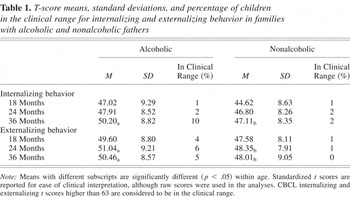
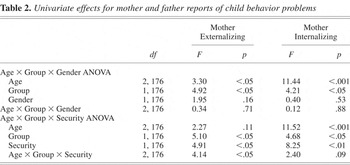
The next set of analyses tested our first hypothesis by examining age and group differences in maternal reports of child behavior problems. Means, standard deviations, and the percentage of children perceived to have clinically significant behavior problems in families with alcoholic and nonalcoholic fathers are shown in Table 1. Repeated-measures analysis of variance (ANOVA) was used to examine changes in child behavior problems over time. To examine possible gender differences in child behavior problems, child age was the within-subjects factor and alcohol group status and child gender were the between-subjects factors. Internalizing behavior problems were the dependent variables in the first ANOVA and externalizing behavior problems were the dependent variables in the second. Univariate effects for all analyses are summarized in Table 2.
T-score means, standard deviations, and percentage of children in the clinical range for internalizing and externalizing behavior in families with alcoholic and nonalcoholic fathers

Univariate effects for mother and father reports of child behavior problems

A main effect of age was found for mothers' reports of externalizing and internalizing behavior as hypothesized. Internalizing behavior was perceived to increase over time, while externalizing behavior increased from 18 to 24 months of child age and then did not change significantly from 24 to 36 months of age. In addition, as expected, a main effect of group was found for mothers' reports of child externalizing and internalizing behavior, such that children with alcoholic fathers were perceived to have more behavior problems than children of non alcoholic parents. No gender or interaction effects were found.
Moderating effects of attachment on behavior problems
Second, we hypothesized that mother–infant attachment security would moderate the relationship between fathers' alcoholism and child behavior problems, such that among children of alcoholic fathers, those with insecure mother–infant attachments would have higher problem behavior scores that increase with age than securely attached children of alcoholics. Thus, we hypothesized the presence of an interaction of child age, alcohol group status, and mother–infant attachment security (secure vs. insecure) on behavior problems.
To examine whether infant attachment security with mothers moderated the association between fathers' alcoholism and child behavior problems, a repeated-measures ANOVA was conducted with first internalizing and then externalizing behavior problems as the dependent variables, child age as the within-subjects factor, and alcohol group status and mother–infant attachment security as the between-subjects factors.
Internalizing behavior
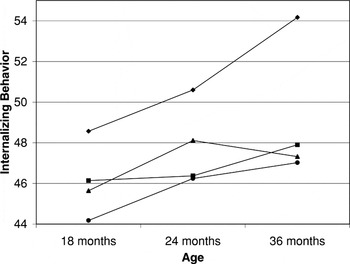
Again, significant main effects of age and group were found for mothers' reports of child internalizing behavior, such that internalizing behavior increased over time and children in the father alcoholic group were perceived to have more problems than children in the nonalcoholic group based on simple effects analyses. A significant mother–infant attachment security main effect was also found, such that internalizing behavior was reported to be higher in children with an insecure mother–infant attachment relationship than in children with secure attachments. The age by group by mother–infant attachment security interaction was only marginally significant, F (2, 176) = 2.40, p = .095, demonstrating a pattern similar to that found for externalizing behavior described below (see Figures 1 and 2). Notably, there was a sharp increase in mother reported internalizing behavior among 36-month-old children of alcoholics with insecure mother–infant attachments. Because of this increase, we examined internalizing behavior separately at 36 months of age using ANOVA. This analysis indicated that there was a significant group by mother–infant attachment security interaction at 36 months, F (2, 176) = 4.34, p < .05. Mothers of insecurely attached infants reported significantly higher child internalizing problems than mothers in the three other groups (whose scores did not differ significantly from one another) at 36 months of child age. This suggests a protective effect of 12-month mother–infant attachment security at 36 months of age in the father alcoholic group (see Figure 1).

The interaction of age, group, and mother–infant attachment security on internalizing behavior t scores; ([diams]) insecure, alcoholic group; ([squf ]) secure, alcoholic group; ([utrif ]) insecure, nonalcoholic group; ([bull ]) secure, nonalcoholic group.

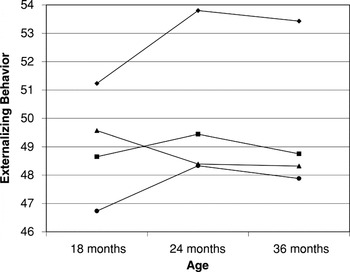
The interaction of age, group, and mother–infant attachment security on externalizing behavior t scores; ([diams]) insecure, alcoholic group; ([squf ]) secure, alcoholic group; ([utrif ]) insecure, nonalcoholic group; ([bull ]) secure, nonalcoholic group.
Externalizing behavior
Finally, we tested our hypothesis that among children of alcoholic fathers, security of attachment with mothers would serve as a protective factor against the development of externalizing behavior problems. Results from this ANOVA yielded a significant Age × Group × Mother–Infant attachment security interaction effect for child externalizing behavior problems as reported by mothers.1
It should be noted that, when this interaction was examined with fathers' ratings of children's externalizing behavior, it was also significant and showed a very similar pattern of scores, suggesting the result is more than a maternal perceptual bias.
Discussion
As expected, and consistent with previous literature, young children with alcoholic fathers had higher levels of internalizing and externalizing behavior than children of nonalcoholic fathers. In a sample slightly older than our own, Puttler et al. (1998) found that 3- to 8-year-old children of alcoholic fathers had higher levels of behavior problems than children from nonalcoholic families. Similar findings have been found for both preadolescent and adolescent children of alcoholics (Chassin, Rogosch, & Barrera, 1991; Jacob & Leonard, 1986), suggesting the presence of a possible behavior problem trajectory for these children. Thus, children with higher levels of externalizing and internalizing behavior problems at 18 months of age in the present study may be at increased risk for later, more significant psychosocial problems by school age and adolescence. Children with clinically significant levels of externalizing behavior at an early age may be particularly at risk. Such children are considered “early starters” (Patterson, Capaldi, & Bank, 1991), the name given to a developmental pattern of externalizing behavior with early onset and high continuity throughout childhood. Although these children generally start with milder forms of aggressive and noncompliant behavior, their conduct problems tend to become more serious over time (McMahon, 1994), and may lead to adolescent antisocial behavior. Few studies have specifically examined the development of internalizing behavior problems among children of alcoholics. The ability to track these children as they age from 18 months on is a strength of the current project and will add to our understanding of behavior problems in families with alcoholic fathers.
We hypothesized that infant attachment security with mothers would act as a protective factor against the risk associated with fathers' alcoholism. Results indicate that among alcoholic families, those with a secure infant–mother attachment relationship at 12 months of age had infants with fewer externalizing behavior problems at 24 and 36 months of age than those with insecure infant–mother attachments. A similar pattern was found for internalizing behavior problems at 36 months of age. Thus, mother–infant attachment appears to serve as a protective factor in alcoholic families, moderating the relationship between paternal alcoholism and child behavior. Few previous studies have examined potential protective factors among children of alcoholics, making comparisons with previous studies difficult. However, our results are generally supportive of Werner's (1986) study reporting that the association between parental alcoholism and child outcome in adolescence was moderated by the quality of caretaking that children received in the first years of life. Results were also reflective of El-Sheikh and Buckhalt's (2003) recent study of child adjustment in alcoholic families. They, too, found that mother–child attachment acted as a protective factor in alcoholic families. As in the present study, this effect was only apparent in the high-risk (alcoholic family) group, wherein mother–child attachment moderated the relationship between problem drinking and child social and behavioral functioning of 6- to 12-year-olds.
Other studies of high-risk families have also identified secure mother–infant attachment as a protective factor (Morisset, Barnard, Greenberg, Booth, & Spieker, 1990; Rutter, 1987); however, the mechanism by which mother–infant attachment security enables such resilience is unclear. The link between mother–infant attachment security and behavior problems has been hypothesized to occur via developing child self-regulation. In very young children, behavior problems are typically the result of deficits in self-control (Campbell, 2002). In toddlers, self-regulation is an evolving function of both child and parental influences formed in the context of the mother–infant attachment relationship. In secure relationships, it is theorized that negative emotions are soothed and managed by supportive caregivers' guidance and nurturance and do not become overwhelming to the children (Thompson, 1994). Thus, gradually children learn to regulate their own emotions through this example. Children of unresponsive or inconsistent parents, however, may learn to under- or overregulate their emotions, possibly leading to later internalizing and externalizing behavior problems (Sroufe, 1988). Further, Davies and Cummings' (1994) suggest that children experience less anxiety and frustration in the context of an emotionally secure family environment and are thus less prone to disruptive behavior. Maternal responsiveness and mother–infant mutual positive affect, qualities associated with attachment security, have also been found to be associated with increased toddler empathy and compliance (Kochanska, Forman, & Coy, 1999), as well as conscience development in the early school years (Kochanska & Murray, 2000). Thus, among infant children of alcoholic fathers, those with secure attachment relationships with their mothers may have increased behavioral regulation capabilities placing them at lower risk for the development of maladaptive behavior patterns.
However, it is important to note that such individual risk factors are nested within a high-risk environment (Loukas, Zucker, Fitzgerald, & Krull, 2003; Zucker, Wong, Puttler, & Fitzgerald, 2002). Alcoholic families have been characterized as being high in marital conflict, antisocial behavior, and depression, all of which have been shown to have a deleterious effect on parent–child relations and may in turn have an effect on the development of child behavior problems (Edwards et al., 2001; Eiden, Chavez, & Leonard, 1999; Eiden et al., 2002; Loukas et al., 2003; Puttler et al., 1998). However, examining additional mediators and moderators of the relationship between paternal alcoholism and child behavior problems was outside the scope of the current paper.
There are some limitations to the present study. This study utilized self-reports of paternal alcohol problems and maternal reports of child behavior problems, which could be considered a study liability. However, it should be noted that the self-report information on alcohol problems was corroborated by the spouse in the initial screening interview. Further, it has been found that parent report on childhood behavior is predictive of later objective outcomes in children and thus may be viewed as a valid means of assessment (Stanger, MacDonald, McConaughy, & Achenbach, 1996). In addition, although deriving our sample from birth records has important advantages over newspaper or clinic-based samples, it should be noted that there are also limitations. The response rate to our open letter of recruitment was slightly above 25%. This raises the possibility that respondents to our recruitment may have been a biased group. Further, it should be noted that as a community sample, levels of average daily ethanol consumption by parents in this study (range = 0.14–5.73, M = 1.43 for alcoholic group) were significantly lower than ethanol consumption reported in treated and untreated clinical samples (Babor, Kranzler, & Lauerman, 1989, M = 9.94; Jacob & Krahn, 1987, M = 6.47; York & Welte, 1994, M = 11.65). Further, child internalizing and externalizing behavior in this study were also identified at largely subclinical levels. As a consequence, we would view our assessment of the association between fathers' alcoholism and child behavior problems to be conservative.
The results of the present study underscore the increased prevalence of behavior problems in children of alcoholics compared to a matched group of children of nonalcoholics and identify secure mother–infant attachment as a protective factor for toddlers in alcoholic families. These findings are encouraging in terms of potential intervention efforts with these children. Prevention programs aimed at improving the quality of the relationship with the nonalcoholic parent may be effective at protecting the child against socioemotional maladaptation resulting from fathers' alcoholism (see Erickson & Egeland, 2004). Interventions for this population may be particularly crucial as deficits in behavioral regulation, reflective of a genetic liability, are often present in children of alcoholics (Tarter, 1988; Tarter, Kabene, Escallier, Laird, & Jacob, 1990). Such dysregulation may negatively impact the children's ease in developing secure parent–child attachments (Kochanska, 1998). Many studies have successfully demonstrated an ability to improve parenting quality and child behavior in other high-risk groups (Van den Boom, 1994, 1995; Webster-Stratton, 1994). By using these techniques with children of alcoholics, child resilience can be maximized. Further, by targeting at-risk toddlers before the emergence of significant, clinical problems, intervention is likely to be more cost effective, briefer, less intensive, and more likely to succeed than interventions conducted once disturbances crystallize in children and problems become more resistant to change (Cummings, Davies, & Campbell, 2000).
References
REFERENCES
Achenbach, T. M.
(1992).
Manual for the Child Behavior Checklist/2–3 and 1992
Profile.
Burlington, VT:
University of Vermont, Department of Psychiatry.
Achenbach, T. M., &
Rescorla, L. A.
(2000).
Manual for ASEBA Preschool Forms and Profiles.
Burlington, VT:
University of Vermont, Research Center for Children, Youth, and
Families.
Ainsworth, M. D. S., &
Wittig, B. A.
(1969).
Attachment and exploratory behavior of one year olds in a strange
situation. In
B. M. Foss (Ed.),
Determinants of infant behavior
(Vol. 4).
London:
Methuen.
Andreason, N. C.,
Rice, J.,
Endicott, J.,
Reich, T., &
Coryell, W.
(1986).
The family history approach to diagnosis.
Archives of General Psychiatry,
43,
421–429.CrossRefGoogle Scholar
Anthony, J. C.,
Warner, L. A., &
Kessler, R. C.
(1994).
Comparative epidemiology of dependence on tobacco, alcohol,
controlled substances, and inhalants: Basic findings from the National
Comorbidity Survey.
Experimental and Clinical Psychopharmacology,
2,
244–268.CrossRefGoogle Scholar
Babor, T. F.,
Kranzler, H. R., &
Lauerman, R. J.
(1989).
Early detection of harmful alcohol consumption: Comparison of
clinical, laboratory, and self-report screening procedures.
Addictive Behavior,
14,
139–157.CrossRefGoogle Scholar
Campbell, S. B.
(1990).
Behavior problems in preschool children: Clinical and developmental
issues.
New York:
Guilford Press.
Campbell, S. B.
(1995).
Behavior problems in preschool children: A review of recent
research.
Journal of Child Psychology and Psychiatry,
36,
113–149.CrossRefGoogle Scholar
Campbell, S. B.
(2002).
Behavior problems in preschool children: Clinical and developmental
issues.
New York:
Guilford Press.
Carbonneau, R.,
Tremblay, R. E.,
Vitaro, F.,
Dobkin, P. L.,
Saucier, J. F., &
Pihl, R. O.
(1998).
Paternal alcoholism, paternal absence and the development of problem
behaviors in boys from age six to twelve years.
Journal of Studies on Alcohol,
59,
387–398.CrossRefGoogle Scholar
Chan, A. W. K.,
Welte, J. W., &
Russell, M.
(1993).
Screening for heavy drinking/alcoholism by the TWEAK
test.
Alcoholism: Clinical and Experimental Research,
17,
463.Google Scholar
Chassin, L.,
Rogosch, G., &
Barrera, M.
(1991).
Substance use and symptomatology among adolescent children of
alcoholics.
Journal of Abnormal Psychology,
100,
449–463.CrossRefGoogle Scholar
Clark, D. B.,
Moss, H. B.,
Kirisci, L.,
Mezzich, A. C.,
Miles, R., &
Ott, P.
(1997).
Psychopathology in preadolescent sons of fathers with substance use
disorders.
Journal of the American Academy of Child and Adolescent
Psychiatry,
36,
495–502.CrossRefGoogle Scholar
Cummings, E. M.,
Davies, P. T., &
Campbell, S. B.
(2000).
Developmental psychopathology and family process.
New York:
Guilford Press.
Cummings, E. M.,
Iannotti, R. J., &
Zahn-Waxler, C.
(1989).
Aggression between peers in early childhood: Individual continuity
and developmental change.
Child Development,
60,
887–895.CrossRefGoogle Scholar
Curran, P. J., &
Chassin, L.
(1996).
Longitudinal study of parenting as a protective factor for children
of alcoholics.
Journal of Studies on Alcohol,
57,
305–313.CrossRefGoogle Scholar
Davies, P. T., &
Cummings, E. M.
(1994).
Marital conflict and child adjustment: A emotional security
hypothesis.
Psychological Bulletin,
116,
387–411.CrossRefGoogle Scholar
DeVito, C., &
Hopkins, J.
(2001).
Attachment, parenting, and marital dissatisfaction as predictors of
disruptive behavior in preschoolers.
Development and Psychopathology,
13,
215–231.CrossRefGoogle Scholar
Easterbrooks, M. A.,
Biesecker, G., &
Lyons-Ruth, K.
(2000).
Infancy predictors of emotional availability in middle childhood:
The roles of attachment security and maternal depressive
symptomatology.
Attachment and Human Development,
2,
170–187.CrossRefGoogle Scholar
Edwards, C. P.
(1996).
Parenting toddlers. In
M. H. Bornstein (Ed.),
Handbook of parenting: Vol. 1. Children and parenting (pp.
41–63).
Mahwah, NJ:
Erlbaum.
Edwards, E. P.,
Eiden, R. D., &
Leonard, K. E.
(in press).
Impact of fathers' alcoholism and associated risk factors on
parent–infant attachment stability from 12 to 18 months.
Journal of Infant Mental Health.
Edwards, E. P.,
Leonard, K. E., &
Eiden, R. D.
(2001).
Temperament and behavioral problems among infants in alcoholic
families.
Journal of Infant Mental Health,
22,
374–392.CrossRefGoogle Scholar
Eiden, R. D.,
Chavez, F., &
Leonard, K. E.
(1999).
Parent–infant interactions in alcoholic and control
families.
Development and Psychopathology,
11,
745–762.CrossRefGoogle Scholar
Eiden, R. D.,
Edwards, E. P., &
Leonard, K. E.
(2002).
Mother–infant and father–infant attachment among
alcoholic families.
Development and Psychopathology,
14,
253–378.Google Scholar
Eiden, R. D.,
Leonard, K. E., &
Morrisey, S.
(2001).
Paternal alcoholism and toddler noncompliance.
Alcoholism: Clinical and Experimental Research,
25,
1621–1633.CrossRefGoogle Scholar
El-Sheikh, M., &
Buckhalt, J. A.
(2003).
Parental problem drinking and children's adjustment: Attachment
and family functioning as moderators and mediators of risk.
Journal of Family Psychology,
17,
510–520.CrossRefGoogle Scholar
Emde, R. N.,
Biringen, Z.,
Clyman, R. B., &
Oppenheim, D.
(1991).
The moral self of infancy: Affective core and procedural
knowledge.
Developmental Review,
11,
251–270.CrossRefGoogle Scholar
Erickson, M. F., &
Egeland, B.
(2004).
Linking theory and research to practice: The Minnesota Longitudinal
Study of Parents and Children and the STEEP™ program.
Clinical Psychologist,
8,
5–9.CrossRefGoogle Scholar
Greenberg, M. T.,
Speltz, M. L.,
DeKlyen, M., &
Jones, K.
(2001).
Correlates of clinic referral for early conduct problems: Variable-
and person-oriented approaches.
Development and Psychopathology,
13,
255–276.CrossRefGoogle Scholar
Grusec, J. E., &
Goodnow, J. J.
(1994).
Summing up and looking to the future.
Developmental Psychology,
30,
29–31.CrossRefGoogle Scholar
Hussong, A. M., &
Chassin, L.
(1997).
Substance use initiation among adolescent children of alcoholics:
Testing protective factors.
Journal of Studies on Alcohol,
58,
272–279.CrossRefGoogle Scholar
Jacob, T., &
Krahn, G. L.
(1987).
The classification of behavioral observation codes in studies of
family interaction.
Journal of Marriage & the Family,
49,
677–687.CrossRefGoogle Scholar
Jacob, T., &
Leonard, K. E.
(1986).
Psychosocial functioning in children of alcoholic fathers, depressed
fathers, and control fathers.
Journal of Studies on Alcohol,
47,
373–380.CrossRefGoogle Scholar
Jacobwitz, D.,
Morgan, E.,
Kretchmar, M., &
Morgan, Y.
(1992).
The transmission of mother–child boundary disturbances across
three generations.
Development and Psychopathology,
3,
513–527.Google Scholar
Johnson, S.,
Leonard, K. E., &
Jacob, T.
(1989).
Drinking, drinking styles, and drug use in children of alcoholics,
depressives, and controls.
Journal of Studies on Alcohol,
50,
427–431.CrossRefGoogle Scholar
Johnson, J. L.,
Sher, K. J., &
Rolf, J. E.
(1991).
Models of vulnerability to psychopathology in children of
alcoholics: An overview.
Alcohol Health and Research World,
15,
33–42.Google Scholar
Kessler, R. C.,
Nelson, C. B.,
McGonagle, K. A.,
Edlund, M. J.,
Frank, R. G., &
Leaf, P. J.
(1996).
The epidemiology of co-occurring addictive and mental disorders:
Implications for prevention and service utilization.
Journal of Orthopsychiatry,
66,
17–31.CrossRefGoogle Scholar
Kochanska, G.
(1998).
Mother–child relationship, child fearfulness, and emerging
attachment: A short-term longitudinal study.
Developmental Psychology,
34,
480–490.CrossRefGoogle Scholar
Kochanska, G.,
Forman, D. R., &
Coy, K. C.
(1999).
Implications of the mother–child relationship in infancy
socialization in the second year of life.
Infant Behavior and Development,
22,
249–265.CrossRefGoogle Scholar
Kochanska, G., &
Murray, K. T.
(2000).
Mother–child mutually responsive orientation and conscience
development: From toddler to early school age.
Child Development,
71,
417–431.CrossRefGoogle Scholar
Kopp, C. B.
(1982).
Antecedents of self-regulation: A developmental perspective.
Developmental Psychology,
18,
199–214.CrossRefGoogle Scholar
Leonard, K. E.,
Eiden, R. D.,
Wong, M. M.,
Zucker, R. A.,
Puttler, L. I.,
Fitzgerald, H. E.,
et al.
(2000).
Developmental perspectives on risk and vulnerability in alcoholic
families.
Alcoholism: Clinical and Experimental Research,
24,
238–240.CrossRefGoogle Scholar
Loukas, A.,
Zucker, R. A.,
Fitzgerald, H. E., &
Krull, J. L.
(2003).
Developmental trajectories of disruptive behavior problems among
sons of alcoholics: Effects of parent psychopathology, family conflict,
and child undercontrol.
Journal of Abnormal Psychology,
112,
119–131.CrossRefGoogle Scholar
Luthar, S. S., &
Cicchetti, D.
(2000).
The construct of resilience: Implications for interventions and
social policies.
Development and Psychopathology,
12,
857–885.CrossRefGoogle Scholar
Maccoby, E. E.
(1984).
Socialization and developmental change.
Child Development,
55,
317–328.CrossRefGoogle Scholar
Maccoby, E., &
Martin, J.
(1983).
Socialization in contexts of the family: Parent–child
interaction. In
E. M. Hetherington (Ed.),
Handbook of child psychology: Vol. 4. Socialization, Personality,
and Social Development
(4th ed., pp.
1–101).
New York:
Wiley.
Main, M., &
Solomon, J.
(1990).
Procedures for identifying infants as disorganized/disoriented
during the Ainsworth Strange Situation. In
M. T. Greenberg &
D. Cicchetti (Eds.),
Attachment in the preschool years: Theory, research, and
intervention. The John D. and Catherine T. MacArthur Foundation series on
mental health and development (pp.
121–160).
Chicago:
University of Chicago Press.
McMahon, R.
(1994).
Diagnosis, assessment, and treatment of externalizing problems in
children: The role of longitudinal data.
Journal of Consulting and Clinical Psychology,
62,
901–917.CrossRefGoogle Scholar
Morisset, C. T.,
Barnard, K. E.,
Greenberg, M. T.,
Booth, C. L., &
Spieker, S. J.
(1990).
Environmental influence on early language development: The context
of social risk.
Development and Psychopathology,
2,
127–149.CrossRefGoogle Scholar
Nagin, D. S., &
Tremblay, R.
(1999).
Trajectories of boys' physical aggression, opposition, and
hyperactivity on the path to physically violent and non-violent juvenile
delinquency.
Child Development,
70,
1181–1196.CrossRefGoogle Scholar
Patterson, G. R.,
Capaldi, D., &
Bank, L.
(1991).
An early starter model for predicting delinquency. In
D. J. Pepler &
K. H. Rubin (Eds.),
The development and treatment of childhood aggression (pp.
139–168).
Hillsdale, NJ:
Erlbaum.
Poon, E.,
Ellis, D. A.,
Fitzgerald, H. E., &
Zucker, & R. A.
(2000).
Intellectual, cognitive, and academic performance among sons of
alcoholics during the early school years: Differences related to subtypes
of familial alcoholism.
Alcoholism: Clinical and Experimental Research,
24,
1020–1027.Google Scholar
Puttler, L. I.,
Zucker, R. A.,
Fitzgerald, H. E., &
Bingham, C. R.
(1998).
Behavioral outcomes among children of alcoholics during the early
and middle childhood years: Familial subtype variations.
Alcoholism: Clinical and Experimental Research,
22,
1962–1972.Google Scholar
Rothbart, M. K.
(1989).
Biological processes in temperament. In
G. A. Kohnstamm,
J. A. Bates, &
M. K. Rothbart (Eds.),
Temperament in childhood (pp.
77–110).
New York:
Wiley.
Rutter, M.
(1987).
Psychosocial resilience and protective mechanisms.
American Journal of Orthopsychiatry,
147,
598–611.CrossRefGoogle Scholar
Shaw, D. S.,
Gilliom, M.,
Ingoldsby, E. M., &
Nagin, D. S.
(2003).
Trajectories leading to school-age conduct problems.
Developmental Psychology,
39,
189–200.CrossRefGoogle Scholar
Sroufe, L. A.
(1988).
The role of infant attachment in development. In
J. Belsky &
T. Nezworski (Eds.),
Clinical Implications of attachment (pp.
18–38).
Hillsdale, NJ:
Erlbaum.
Sroufe, L. A.,
Carlson, E., &
Shulman, S.
(1993).
Individuals in relationships: Development from infancy through
adolescence. In
D. C. Funder &
R. D. Parke (Eds.),
Studying lives through time: Personality and development. APA
science volumes (pp.
315–342).
Washington, DC:
American Psychological Association.
Stanger, C.,
MacDonald, V. V.,
McConaughy, S. H., &
Achenbach, T. M.
(1996).
Predictors of cross-informant syndromes among children and youths
referred for mental health services.
Journal of Abnormal Child Psychology,
24,
597–614.CrossRefGoogle Scholar
Tarter, R. E.
(1988).
Are there inherited behavioral traits that predispose to substance
abuse?
Journal of Consulting and Clinical Psychology,
56,
189–196.Google Scholar
Tarter, R. E.,
Kabene, M.,
Escallier, E. A.,
Laird, S. B., &
Jacob, T.
(1990).
Temperament deviation and risk for alcoholism.
Alcohol Clinical and Experimental Research,
14,
380–382.CrossRefGoogle Scholar
Thompson, R. A.
(1994).
Emotion regulation: A theme in search of definition. In N. A. Fox
(Ed.), The development of emotion regulation: Biological and behavioral
considerations.
Monographs of the Society for Research in Child Development,
59(2–3, Serial No. 240),
25–52.Google Scholar
van den Boom, D. C.
(1994).
The influence of temperament and mothering on attachment and
exploration: An experimental manipulation of sensitive responsiveness
among lower-class mothers with irritable infants.
Child Development,
65,
1798–1816.Google Scholar
van den Boom, D. C.
(1995).
Do first-year intervention effects endure? Follow-up during
toddlerhood of a sample of Dutch irritable infants.
Child Development,
66,
1798–1816.CrossRefGoogle Scholar
Webster-Stratton, C.
(1994).
Advancing videotape parent training: A comparison study.
Journal of Consulting and Clinical Psychology,
62,
583–593.CrossRefGoogle Scholar
Werner, E. E.
(1986).
Resilient offspring of alcoholics: A longitudinal study from birth
to age 18.
Journal of Studies on Alcohol,
47,
34–40.CrossRefGoogle Scholar
York, J. L., &
Welte, J. W.
(1994).
Gender comparisons of alcohol consumption in alcoholic and
nonalcoholic populations.
Journal of Studies on Alcohol,
55,
743–750.CrossRefGoogle Scholar
Zucker, R. A.,
Wong, M. M.,
Puttler, L. I., &
Fitzgerald, H. E.
(2002).
Resilience and vulnerability among sons of alcoholics: Relationship
to developmental outcomes between early childhood and adolescence.
In
S. Luthar (Ed.),
Resilience and vulnerability: Adaptation in the context of childhood
adversities (pp.
76–103).
New York:
Cambridge University Press.
T-score means, standard deviations, and percentage of children in the clinical range for internalizing and externalizing behavior in families with alcoholic and nonalcoholic fathers
Univariate effects for mother and father reports of child behavior problems
The interaction of age, group, and mother–infant attachment security on internalizing behavior t scores; ([diams]) insecure, alcoholic group; ([squf ]) secure, alcoholic group; ([utrif ]) insecure, nonalcoholic group; ([bull ]) secure, nonalcoholic group.
The interaction of age, group, and mother–infant attachment security on externalizing behavior t scores; ([diams]) insecure, alcoholic group; ([squf ]) secure, alcoholic group; ([utrif ]) insecure, nonalcoholic group; ([bull ]) secure, nonalcoholic group.
 You have
Access
- 60
- Cited by