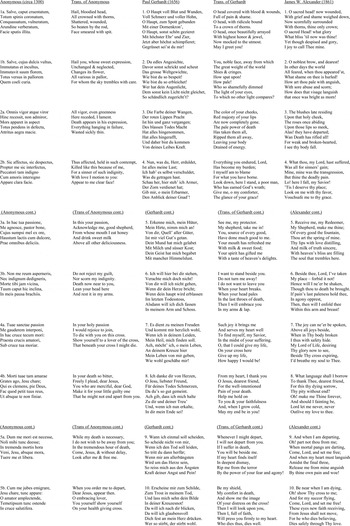
Invention is not necessity's only child. Artists often adapt preexisting material rather than create ex nihilo. Paul Simon's 1973 “American Tune” borrowed its melody from Johann Sebastian Bach's Matthäus-Passion, a fitting backdrop for lyrics with a first-person narrator who suffers, dreams of death, and experiences a sort of resurrection—the American working man as Christ figure.Footnote 1 Tom Glazer paired the same melody with words stressing the unity of humanity and the triumph of freedom over tyranny in “Because All Men Are Brothers,” which originally figured in the 1940s labor movement and was popularized by folk singers Peter, Paul, and Mary as an anti-war anthem in the 1960s.Footnote 2 Glazer chose the melody, in part, because it was used in hymns among various denominations, embodying an ecumenical spirit.Footnote 3 Bach himself was not the originator but had taken the melody and text of a popular German hymn, “O Haupt voll Blut und Wunden,” which had, in turn, taken the melody of an earlier secular love song.Footnote 4 The text of that German hymn was a translation of part of a medieval Latin poem and has been translated many times into English, including the most prevalent translation, “O Sacred Head Now Wounded.” The melody has become so closely identified with Christ's passion that it is known simply as “Passion Chorale.”Footnote 5 While the following article will analyze the different versions of the lyrics and not the melody, readers should note that the melody, too, has been part of a process of artistic recontextualization similar to that undergone by the text.
The anonymous late medieval Membra Jesu Nostri meditates on each of the wounded body parts of the crucified Christ. Seventeenth-century German Lutheran pastor and hymn writer Paul Gerhardt translated it into a series of poems. The last of these, “O Haupt voll Blut und Wunden,” attained significant popularity both at home and abroad. Nineteenth-century American Presbyterian pastor and professor James Waddel Alexander translated Gerhardt's translation into what has become the standard English version of the hymn, “O Sacred Head Now Wounded.” Out of cultural and theological necessity, defined by his denominational context, Alexander sanitized Gerhardt's hymn, omitting blood, gore, and any hint of eroticism or heresy in his translation, just as Gerhardt himself had diminished these elements in his translation of the Latin original. Even in the midst of this sanitization, the very phenomenon of Gerhardt's and Alexander's translations represents a significant compromise between the aesthetic and theological norms of their respective ecclesial communities and the texts they translated, demonstrating an impulse toward ecumenism.
I. Overflowing Blood and Eroticism in the Anonymous Membra Jesu Nostri
Membra Jesu Nostri consists of seven main parts, each treating a wounded body part of the crucified Christ: “To the Feet,” “To the Knees,” “To the Hands,” “To the Side,” “To the Chest,” “To the Heart,” and “To the Face.”Footnote 6 Once frequently attributed to Bernard of Clairvaux, the authorship of most of the text is a mystery. The author of “To the Heart” now appears to have been the late twelfth- and early thirteenth-century German Norbertine Saint Hermann Joseph, and not his contemporary, Arnulf of Leuven, the likely author of the rest of the poem.Footnote 7However erroneous, the poem's attribution to Bernard was critical in its transmission and reception, cementing its prestige in the eyes of many Protestants, as discussion of both Gerhardt's and Alexander's translations will reveal. It is irrelevant whether any of the poem's parts originally functioned as a whole; what matters is that they were part of the full Latin text which Gerhardt read and translated, and which Alexander and other English translators omitted.
All seven sections graphically depict Christ's wounds, with an abundance of blood, engaging the senses of the narrator. All seven sections likewise express an ardent emotional commitment to Christ on the part of the narrator, with erotic overtones. These are the elements that are diminished in Gerhardt's translation and absent in Alexander's. Gerhardt divorced the sections from each other, though he did translate all seven as part of a series. Alexander omitted all sections of the original other than “To the Face” and if he was familiar with the others, it may only have been through Gerhardt.
The abundance of Christ's blood overwhelms the narrator's senses. At Christ's feet, he proclaims that he wants to cleanse himself by “washing in your blood,”Footnote 8 which “was shed abundantly, flows unceasingly,”Footnote 9 and is “flowing here over everything.”Footnote 10 In embracing Christ's feet, the narrator realizes that many of Christ's wounds are scabbing over. The narrator notes the “many drops flowing down”Footnote 11 from Christ's hands, which “fill up with new roses.”Footnote 12 The color of Christ's blood is not merely red; he wears “the royal purple of blood,”Footnote 13 which the narrator drinks until it drips from him. A sinner may find refuge in the wound in Christ's side, “in which hides sweet honey [. . . and] from which gushes a fountain of blood.”Footnote 14 While sweet in taste, the blood has an odor that is both floral and foul.Footnote 15 At Christ's heart, the narrator reflects on how Christ's love resulted in him being “twisted” and “completely drained” by sorrow.Footnote 16 The physicality of Christ's flowing blood has engaged the narrator's senses of sight, smell, taste, and touch.
The sensory experience of Christ's blood has emotional consequences. Moved by his senses, the narrator pours out exclamations of love for his savior. He sees that Christ is “ready now for lovers.”Footnote 17 After drinking Christ's blood, the narrator proclaims: “O how sweet this flavor! Whoever tastes you, conquered by your sweetness, might die for love, loving you and only you.”Footnote 18 Indeed, the narrator embraces the thought of suffering and dying with and for his beloved savior. He pleads from the foot of the cross, “inscribe on my heart your ruddy wounds and piercings so deep.”Footnote 19 At Christ's knees, the narrator considers repaying his “lover” by giving up his own life.Footnote 20 There is violence in the narrator's offer of self-sacrifice, as he pleads, “force me against this cross of your bleeding [ . . . ] that I might rest!”Footnote 21 The narrator embraces Christ's love: “Your love passes through the marrow of my heart of sin and even guilt; my whole heart is seized, languid by the wound of love.”Footnote 22 Sinners wound Christ, killing him; Christ's love wounds sinners, bringing them life. The narrator's passionate love for Christ overflows in pleas for union with him, in the midst of his passion and death.
“To the Face” builds on the earlier themes of the Membra Jesu Nostri (see Figure 1). While lacking the profusion of blood present elsewhere in the poem, this section incorporates vivid descriptions of his wounds. Christ's head is “bloodied,” “shattered, [and] wounded,” and his face is “smeared with spit.”Footnote 23 Either “uncultivated” or “neglected” (incultus), Christ's face is withering and growing pale like a shriveling blossom.Footnote 24 His frame is “wasted sickly thin.”Footnote 25 The narrator laments the receding of Christ's “vigor and even greenness,”Footnote 26 representing his life energy, a motif in the writings of other medieval mystics, such as Hildegard of Bingen.Footnote 27 The dejected, despised character of Christ recalls the eschatological Man of Sorrows in chapter 53 of Isaiah.Footnote 28 Yet even in his oppressed state, Christ is the source of God's blessings to the narrator: “From [your] mouth I eat honey and drink sweet milk, greater than all other deliciousness.”Footnote 29 As with the rest of his body, Christ's face provides the narrator solace that is both sensory and sensual.
Interlinear: The Urtext and its Primary Variants, with English Translations

At Christ's face, the weight of the narrator's guilt is clear and his outpourings of love take the form of laments. He recognizes that he is the cause of Christ's death. He is the source of the ugliness now infused into the appearance of the most beautiful one. In light of Christ's sacrifice and in spite of the narrator's guilt, he appeals to Christ to make himself visibly present in his suffering form. Out of love, the narrator demands to see his suffering savior face-to-face. But this is not wholly for the narrator's benefit, as he asks Christ to “lean your head here and rest it in my arms.”Footnote 30 This intimate embrace takes place in the moment of Christ's death. But the narrator wants more: “I would rejoice to join in your holy passion, to die with you on this cross.”Footnote 31 To die together with Christ on the cross would be the utmost fulfillment of the narrator's hopes. At the very least, the narrator wants Christ, his “embracing lover,” to be with him in his own death.Footnote 32
For all its vivid blood and passion, Membra Jesu Nostri is wholly unoriginal in its themes. Even given its ambiguous authorship, the pool of likely authors is confined to the late medieval era in northern and western Europe. In light of that provenance, there is nothing out of the ordinary in the poem. Recent scholarship has pointed out that much of that context's art, architecture, literature, liturgy, and theology featured a well-developed cult of Christ's blood, depicted as something overflowing to drink and in which to bathe, consistent with the role of blood in the poem.Footnote 33 Likewise, presentations of Christ as a bridegroom and lover were common in the late medieval era, including in the thought of Francis of Assisi and Bernard of Clairvaux, to such an extent in the case of the latter that there was little reason to doubt the poem's attribution to him.Footnote 34 This highly affective, sensual strain of devotion featured prominently in piety surrounding Christ's passion in the late medieval era.Footnote 35
Both the blood cult and bridal mysticism flourished alongside complex eucharistic theology and praxis in late medieval northern Europe. In the aftermath of the eucharistic controversy of the eleventh century, theologians arrived at a consensus, if not unanimity, regarding what became known as the doctrine of transubstantiation, formalized in the promulgations of the Fourth Lateran Council and exemplified in the teachings of Thomas Aquinas.Footnote 36 By the writing of Membra Jesu Nostri, especially in the monastic setting in which the text was most likely composed, recipients of the eucharist would have understood that they were touching, tasting, and receiving it into themselves Christ's body and blood. It should be no surprise that a fascination with the physicality of Christ's body and blood developed.
The sacrament was a source of grace. Aquinas clarified in his Summa (III, 79, 3): “the sacrament does not immediately usher us in, but gives us the strength to journey to heaven.”Footnote 37 While children needed only baptism to be saved, adults needed both baptism and holy communion, though neither offered any guarantee of admission to heaven or even purgatory.Footnote 38 Because of its perceived role in salvation, late medieval Catholics could invest it with great urgency. Some of those whose circumstances permitted it received the Eucharist daily, though many of the laity received it only once per year, the minimum stipulated by Lateran IV.Footnote 39
For some, its role in abetting salvation became eclipsed by the miraculous nature of the physicality of its elements and their transformation, resulting in a variety of practices. For example, “by the thirteenth century, we find stories of people attending mass only for the moment of elevation, racing from church to church to see as many consecrations as possible,” observes Caroline Walker Bynum, citing Joseph Jungmann.Footnote 40 While Membra Jesu Nostri was most likely composed in a monastic setting, such examples of lay piety are emblematic of the broader current of fascination with physical interaction with Jesus' body and blood. Christians did not merely touch and taste Christ's body and blood; they tasted them as part of Christ's sacrifice for the nourishment of their souls.Footnote 41Membra Jesu Nostri merely depicted in poetry what Catholics believed occurred every time they received the sacrament: recipients partook of Christ's physical body and blood.
II. Sanitizing and Theologizing in Paul Gerhardt's “O Haupt voll Blut und Wunden”
The popularity of Membra Jesu Nostri, like so much else in history, had more to do with perception than with reality. Because many Christians, Protestants and Catholics alike, believed the poem's author to be Bernard, they held it in particularly high esteem. Paul Gerhardt (1607–1676) was no exception. He translated the seven parts of Membra Jesu Nostri. A poet in his own right, Gerhardt took significant liberties with the original text, adapting it to serve his own purposes.Footnote 42 Gerhardt noted in his translation of each of the parts that it was originally by Bernard. Gerhardt's respect for Bernard was likely rooted in that of Luther, who asserted that, “if ever there was a true, God-fearing and pious monk, it was St. Bernard. I have always held him in the highest esteem and I have never read or heard of his equal among all the monks and priests in the whole world.”Footnote 43 In particular, Bernard's profound personal devotion to Christ seems to have garnered him admiration in Protestant circles, thus earning praise for texts attributed to him. The sentiments expressed in Membra Jesu Nostri were as affectively engaged as Gerhardt's own original writings, in addition to being comparable to Bernard's actual writings in that regard. As an emotionally charged expression of penitential devotion, the text resonated with Gerhardt's sensibilities.
While he did translate all of Membra Jesu Nostri, Gerhardt rendered each section as an independent poem with its own meter. While their subtitles mark them as part of a series, their reception in German hymnody has separated them. Gerhardt's version of “To the Face,” “O Haupt voll Blut und Wunden,” was adapted as a hymn in Johann Crüger's 1656 Praxis Pietatis Melica.Footnote 44 The others were adapted eventually, most of them long after Gerhardt's death.Footnote 45 While there is significant continuity between the parts of the Latin original and Gerhardt's translations, the individual poems tend to sanitize the original, cleaning up a significant amount of its blood, gore, and expressions of intimacy. Moreover, Gerhardt often incorporates specifically theological terminology to describe Christ's suffering and its effects, especially highlighting the dominant theme in Lutheran theology, justification by faith alone. In this doctrine, the believer, through no effort of his own, receives God's forgiveness as the result of Christ's work and this is the primary expression of God's grace or undeserved favor toward humanity.Footnote 46
While blood is abundant in Gerhardt's translations, it is more significant as a means of salvation than as a physical substance. The narrator again interacts with Christ's body and blood: “I embrace and kiss you, your heart, your many grievous wounds and the crimson flood, your feet and nails.”Footnote 47 He borrows the image of roses for the blood flowing from Christ's hands, but Gerhardt also supplies an abstract interpretation for his readers: “the roses that I regard here are your sufferings, which are nailed to your hands.”Footnote 48 Rather than wearing the “royal purple of blood,” Christ pays “with both hands golden currency of noble red,” the emphasis on both Christ's appearance in his suffering and on the effect of that suffering: salvation.Footnote 49 Without mentioning honey, love, or the filth it cleanses, Gerhardt depicts the river of blood originating from Christ's side: “you noble fountain, from which flows the blood, with which so many wash their sins away.”Footnote 50 As before, the narrator drinks from this flow—but with the critical difference that this time the sensory experience of that act is one-dimensional. In Gerhardt's version, Christ's blood tastes and smells sweet, whereas in the original Christ's blood tasted sweet but smelled both sweet and rank, and elicited not merely a desire to drink more but a desire to die for the sake of the one bleeding and his love for the narrator.Footnote 51 Christ's heart is the source of goodness and redemption, rather than the bodily organ pumping blood. In short, Gerhardt tells his readers that there is a great quantity of blood and outlines its effects, rather than describing its physical characteristics.
The language in the series of Gerhardt's poems is intimate, but his tendency is to label Christ affectionately or to describe loving actions that Christ performs, rather than to describe emotionally motivated actions that the narrator himself undertakes. For example, while the original suggests, “may it be my first concern to seek you with a pure mind,”Footnote 52 Gerhardt offers instead, “most beautiful one, you will delight my senses.”Footnote 53 The theme of intimacy intermingled with pain reappears, but with moderation: “write the heartache of your cross upon my heart,”Footnote 54 a far cry from asking to be forced against the cross. The narrator asks Christ's presence to enter his heart, but here without calling “love” by name, without Christ cutting to the marrow, and without the narrator becoming languid: “let your flame and embers strong penetrate with all their power into my whole heart, spirit, and will.”Footnote 55 Yet elsewhere Gerhardt's language is as sensual as—if less concrete than—the original: “wound also me, oh sweet salvation, and meet my heart with your arrow, as you yourself have been wounded.”Footnote 56 Gerhardt's translation serves to nullify many of the erotic elements of the original, but also accomplishes a theological end. The narrator is not active in his affection, leaving Christ to perform the actions required by his love for sinners, such as the narrator. This is consistent with Lutheran insistence on believers' passive role in securing salvation, which was ultimately entirely the work of Christ. The only righteousness that Christians possessed, according to Luther, was “passive righteousness,” because God in Christ did all of the work.Footnote 57
In addition to removing much of the blood, gore, and intimacy of the original, and making his version implicitly consistent with Lutheran soteriology, Gerhardt inserts a significant amount of explicitly theological terminology. At Christ's feet, the narrator praises Christ as the one “who yourself atoned for that with which I grieve you.”Footnote 58 Emphasizing God-given grace, rather than self-motivation, Gerhardt's narrator asks Christ to give him strength and power, rather than stating what he will certainly do. For example, Gerhardt's narrator prays, “O give me the strength and power with which I might also set about the work that I know I must do.”Footnote 59 Contrast this with the equivalent passage of the original: “it is not work, nor will I be weighed down, but I will be relieved and made clean by your embrace.”Footnote 60 Gerhardt makes his appeal to grace more explicit elsewhere: the hole in Christ's side is a “wide gate of grace.”Footnote 61 By framing Christ's suffering overtly in terms of atonement and grace, Gerhardt augments both the themes that he has emphasized, such as Christ's role in purchasing Christians' salvation, and those already present in the Latin original, such as the role of Christ's blood in washing away sin.
These trends continue in “O Haupt voll Blut und Wunden.” Roughly twice as long as any of the other poems in Gerhardt's series of translations, every one of its stanzas corresponds to half a stanza of the original (see Figure 1). The differences between the original and Gerhardt's translation are subtle but apparent. The original first stanza mentions wounds four times, with some specifics (bloodied, shattered, wounded, beaten), while Gerhardt mentions wounds only twice, both times in referring to them generally (blood, wounds).Footnote 62 While the original preferred verbal adjectives (bloodied, crowned, shattered, wounded, beaten, smeared, unchanged, neglected) to describe Christ's head, conveying a more vivid sense of action having happened, Gerhardt opts for more static nouns that are either general (blood, wounds) or abstract (pain, shame, ridicule) to depict Christ's face.Footnote 63 There are exceptions, where Gerhardt has opted for verbal adjectives, but even in those cases, the effect is comparable; Gerhardt's version seems to render the original less vivid. For example, “smeared with spit” has become “spat upon,” removing the physical substance of the spittle itself from the image.Footnote 64 Also, that Christ's expression “changes its flower, all various in pallor,” a dynamic and multi-colored image, Gerhardt has changed to “how pale!”Footnote 65 Whereas the anonymous original offers a tumultuous action sequence, Gerhardt presents a motionless portrait. In the process, Gerhardt has eliminated any eschatological referent, with no direct linguistic parallels to the Man of Sorrows in Isaiah 53.Footnote 66
Gerhardt's description is more dynamic in his third and fourth stanzas. While the original described Christ's color as the absence of “greenness,” Gerhardt opts for the fleeing of redness from Christ's cheeks and lips, and Gerhardt juxtaposes Christ's former ruddy hue with the blanching grip of death, the reason for color's departure from Christ. While Gerhardt's color choices make sense for a seventeenth-century audience, unfamiliar with the medieval connotations of green as the color of life energy, Gerhardt still frames Christ's dying moment as one of energy draining from him. Rather than dwell on Christ's physical condition (wasted thin) or posture (hanging), Gerhardt explores the theological and personal implications of Christ's death. Christ is dying specifically for the sins of the narrator. This is consistent with the original, but Gerhardt expands this theme significantly. Christ is dying because of the burden of the narrator and his sins; and knowledge of this, in turn, has become a burden for the narrator, a poor man who has earned nothing but the wrath that Christ now suffers. In Gerhardt's version, the narrator appeals for grace, for God's unearned favor, and not only the grace of God in the form of forgiveness of sin and eternal salvation, but also the grace of a single look from Christ's face. While the original narrator did entreat Christ's face to appear, Gerhardt frames that request as an invitation for grace. Colorful and personal, Gerhardt's rendition of the poem is explicitly theological—and Lutheran in its theology. If Christ's face does glance down on the sinner, it is because of the goodness of Christ, and not as a reward for anything that the sinner has done.
Gerhardt incorporates all of the main elements of the original's third stanza in his stanzas five and six: Jesus as shepherd; his mouth as the source of metaphoric milk and sweet food or honey; the narrator's plea not to be rejected; and his desire to physically embrace Christ in his moment of death. Nonetheless, the subtle variations reveal Gerhardt's bent toward sanitizing the original and making his theology explicit. Gerhardt describes the experience of eating from the metaphorical fruit of Christ's mouth as a taste of “heaven's delights,” presenting his image in terms of salvation.Footnote 67 This clarifies the ambiguous meaning of the original, in which it is unclear to what end the nourishment from Christ's mouth serves. Gerhardt expands on Christ's imagined experience in death, anticipating the moment of the breaking of his heart. This is consistent with Gerhardt's tendency to focus on the internal realities of Christ and the narrator, whereas the original is more concerned with describing Christ's passion in visual, physical terms. Gerhardt varies the end of the passage slightly; the narrator desires to embrace Christ in his arms and lap, as opposed to with his arms only, thereby intensifying the desire for intimacy expressed by the original, but also altering its character, making it “motherly” in the words of one commentator.Footnote 68 Gerhardt's version is more overtly theological and, in this case, more intimately personal than the original.
In his stanza seven, Gerhardt does not hesitate to include the most potentially problematic portion of “To the Face,” in which the narrator offers to die with Christ on the cross. This could be problematic in the eyes of many theologians because it would seem to minimize the unique nature of Christ's sacrifice as God incarnate and excessively elevate the role of sinners in advancing salvation history. Gerhardt embraces the emphasis on the narrator's own death; even if the narrator cannot die with Christ on the cross, he prays for Christ to be spiritually present during the narrator's own inevitable physical death. The notable difference is that in Gerhardt's version the narrator does not explicitly label himself a lover, but rather calls Christ his dearest friend.
Gerhardt's version significantly intensifies and expands the source material, his text reaching the zenith of its fervor in his stanzas nine and ten, corresponding to the fifth and final stanza of the Latin original. Death is not merely tremendous; it is a terror. The narrator here does not simply plead with Christ to free him, but to rip him from death, and in his dying moment he wants to see not just Christ on his cross, but Christ's distress. In this, Gerhardt provides a climax and conclusion in the form of an intensification of the original. He borrows his closing line from Luther, who coined the phrase upon the death of his daughter.Footnote 69 Gerhardt's only significant omission here is that, once again, he has not called Christ a “lover.”
Gerhardt's tendencies to sanitize the original are apparent. This is ironic for a poet whose work and whose artistic contemporaries are generally known for being concrete and explicit. The paintings, music, and poetry of the Baroque era were emotionally expressive, characterized by an overflowing of images, many of them sensual and violent. In this, Gerhardt is a typical Baroque poet. He survived the Thirty Years' War, the continent's bloodiest conflict prior to the twentieth century, largely fought in northern Europe. This was a time of famine and plague. During the course of his long life, Gerhardt lost many of his children and, ultimately, his wife. Gerhardt composed numerous poems vividly depicting fear and the reality of death juxtaposed with hope, peace, and joy. Nonetheless, Gerhardt cleaned up a significant amount of blood, gore, and eroticism in his series of poems translating Membra Jesu Nostri. “O Haupt voll Blut und Wunden” was less full of blood and wounds than the original.Footnote 70
Theologically, Gerhardt's work also presents an ironic tension with its historical context. His description of Christ's passion is more abstract and explicitly theological than the original. Themes of grace, redemption, atonement, salvation, and heaven abound, and Gerhardt does not hesitate to call these doctrines by name in the context of his poem. While his work is more overtly theological than the original, Gerhardt was less concerned with doctrine than many of his contemporaries. Writing during the era of Lutheran Orthodoxy, with its concern for detailed theological systems, Gerhardt represents a minority voice, more concerned with personal affection for and devotion to Christ than with systematic theology. Indeed, recent works with a broader definition of Pietism tend to include Gerhardt under that label, granting that an Orthodox-Pietist dichotomy is simplistic.Footnote 71 While Gerhardt was less concerned with academic theology than was normative for his era, the poems in his version of Membra Jesu Nostri were significantly more overt in their theology than the original.
Like other contributors to a flourishing era of Lutheran hymnody, Gerhardt was concerned with cultivating his personal devotional life and those of others.Footnote 72 This priority defined, among other things, his pursuit of a wide array of sources of inspiration for his poetry. To be fair, seventeenth-century Orthodox Lutheran systematic theologians could employ a broad range of sources in supporting their theological claims. For example, Johann Gerhard (no relation), “the church father of Lutheran orthodoxy,” copiously cited Patristic sources in his expansive Loci Theologici. Footnote 73
Such ecumenical generosity had its limits, especially in ecclesiastical affairs. Paul Gerhardt was personally friendly toward non-Lutheran Christians, especially Calvinists, who settled in Brandenburg, where he lived. Nonetheless, he sought to maintain Lutheran orthodoxy, both his own and that of his parishioners. As a matter of conscience, he refused to sign a compulsory pledge issued by his prince, a recent convert to Calvinism, by which all Lutheran pastors would agree not to criticize Calvinism in their sermons, resulting in Gerhardt losing his post in Berlin in 1666.Footnote 74
The place of Christ's body and blood in Lutheran theology of the eucharist illustrates some of the basis for the consistency between the original and Gerhardt's translation, just as medieval eucharistic theology offered entrée to the substance of the original. According to the Formula of Concord, although the elements of the eucharist did not transform into Christ's body and blood, Christ's body and blood were nonetheless present, “in, with, and under the [ . . . ] bread and wine.”Footnote 75 Seventeenth-century Lutherans, such as Gerhardt, believed themselves to be receiving Christ's body and blood when they received the eucharist.
Like Catholics, Lutherans have historically maintained that partaking of the eucharist is helpful for salvation. Luther insisted that, under ordinary circumstances, partaking of the eucharist was necessary, as he asserted in his Smaller Catechism: “in the Sacrament forgiveness of sins, life, and salvation are given us through these words [of institution].”Footnote 76 Paul Gerhardt's contemporary Johann Gerhard expanded on this idea when wrote: “with even the same Son of God's own body, given in death for us, and his own blood, shed on the altar of the cross for our sins, we accept his body and blood in holy communion; from them arises everything that Christ obtained through the delivery of his body and the shedding of his blood, applied, collected, and sealed for our use in this health giving sacrament.”Footnote 77 In fact, Johann Gerhard goes on to enumerate the ends of the eucharist, which include those effected for believers by virtue of the physical presence of Christ in the eucharist; rejecting dualism, he insisted that, just as spirit and body are one, equally in need of redemption, the holy flesh of Christ has the power to nourish and heal the sinful flesh of believers, even as his spirit redeems their spirits.Footnote 78 For Lutherans, Christ remains both physically and spiritually present in the eucharist, and both are relevant for believers' salvation. It should be no surprise, then, that the physicality of Christ's blood remains a significant theme in Gerhardt's poem.
Even less surprising, the physicality of Christ's blood lost some of its vivid sensory potency for Gerhardt. Believing Lutherans lacked the certainty of Catholics as to whether they, in fact, saw and tasted Christ: the bread was not the body, nor did it become the body; the wine was not the blood, nor did it become the blood. Christ was present, but in ways that were invisible and tasteless. It was, perhaps, inevitable that a Lutheran depiction of Christ's blood would lose some of the immediacy of direct sensory contact, however physical and spiritual it remained in principle.
The role of Lutheran partakers in the eucharist also differed significantly from that of their Catholic forebears, highlighting probable reasons for the passive role of the narrator in Gerhardt's hymn. All religious praxis in Lutheranism, including partaking of the sacraments, occurs in the doctrinal context of the absolute dominance of salvation by grace alone through faith alone. Believers are saved because of the work of Christ, given as a free gift, and they receive that work by faith. Receiving the eucharist is an expression of that receptive, responsive faith. Although Lutheran partakers of the eucharist understand themselves to be interacting with the physical body and blood of Christ, they are not active takers, but rather passive recipients of God's grace in the sacrament.Footnote 79 This passivity may account for some of the diminished involvement of the narrator in Gerhardt's version of the poem.
“O Haupt voll Blut und Wunden” has been one of the most enduring hymns in the German language. Jörg Erb counts it as Gerhardt's single most famous work.Footnote 80 Fellow hymnologist Ansgar Franz ranks it as the best known of the German passion hymns.Footnote 81 Johann Sebastian Bach incorporated portions of the hymn as the text of four of the twelve chorales of his Matthäus-Passion.Footnote 82 The hymn's appeal has extended well beyond the bounds of Protestantism. Whether or not they realize that it has a Lutheran translator, many German Catholics know and love this version of the hymn. Gerhardt's hymns began appearing in Catholic hymnals beginning in the mid-eighteenth century, with “O Haupt voll Blut und Wunden” appearing most frequently.Footnote 83
The appeal of “O Haupt voll Blut und Wunden” has extended beyond the German-speaking world. The English-language translations, virtually all by non-Lutherans, further demonstrate the text's ecumenical appeal. What has changed and what remains in English translations of the hymn reveal an expansion of Gerhardt's tendency to sanitize and theologize the original. This is especially true in the case of the most popular English translation. Its popularity serves to further reveal ways in which various ecclesial communities have preferred to receive the most abstract and formal possible version of the text.Footnote 84
III. Abstraction and Formality in James Waddel Alexander's “O Sacred Head Now Wounded”
The son of a prominent Presbyterian pastor, James Waddel (alt. Waddell) Alexander (1804–1859) followed in his father's footsteps, alternating between the church pulpit and the university classroom.Footnote 85 Beginning in 1829, he taught himself to read German and soon began translating German texts into English, holding translation to be among the highest callings and translators among those most able to benefit humanity. His readings spanned literature and theology, including biographies of Erasmus, Melanchthon, and medieval German mystics. He chronicled this, along with the rest of his intellectual development, in his lifelong correspondence with fellow pastor John Hall, who published Alexander's letters to him in two bound volumes after Alexander's death.Footnote 86 By the end of 1830, Alexander had submitted for publication under a pseudonym part of his “humble attempt at a metrical version” of “O Haupt voll Blut und Wunden.” In a footnote, Alexander's correspondent notes that the editors “mutilated” his work and it was not until church historian Philip Schaff published it decades later that it received proper treatment.Footnote 87 Alexander's translation does not include any material from the Latin except what was also in Gerhardt, so it is likely that Alexander did not refer to the Latin at all. Alexander expanded his translation throughout his life, with his full translation of all ten of Gerhardt's stanzas finally appearing in a collection of translated German poems he published in 1861.Footnote 88
While the original begins by describing Christ's wounds in some detail and Gerhardt at least mentions blood, Alexander excludes blood, not mentioning it at any point in his poem. Along similar lines, there is no spit, as was present in the original and in Gerhardt's second stanza. Alexander uses general adjectives to tell his readers the state of Christ's head (wounded, gory), but he fails to use vivid, visual specifics in his description. Alexander frames what Christ endures in almost entirely abstract terms (grief, shame, scorn, bliss, glory, anguish, abuse, scorn). There are only a handful of nouns representing physical objects (head, thorns, crown, brow, visage). Even in the midst of formality and abstraction, the narrator still demonstrates intense affection for Christ, calling him his own and his dearest.Footnote 89
In other ways, too, Alexander remains faithful to Gerhardt. Apart from the absence of blood, Alexander retains every mention of color from Gerhardt's version of the text in his third stanza. Perhaps most importantly, in his fourth stanza Alexander retains the emphasis on the narrator deserving the death that Christ is dying in his place. Alexander does remove Gerhardt's language of the sinner's burden, preferring instead to speak of “sinners' gain,” a sensible change for an American Presbyterian, more concerned with embracing his sanctified future than with dwelling on his reprobate past.Footnote 90
Alexander's fifth and sixth stanzas represent the tightest parallels between him and Gerhardt, with almost line-by-line correspondence. Many things are consistent: Jesus as shepherd, as the fountain of good things, and as the one beside whom to stand throughout his sufferings and the one to embrace when he is in the pale throes of death. Despite this tight formal cohesion, Alexander has introduced some significant distinctions. Two particular details of Alexander's translation are more abstract and impersonal than Gerhardt's. Just as Gerhardt has clarified the ambiguous original, emphasizing the end of the fruit of Christ's mouth (a foretaste of heaven), Alexander defines the identity of the milk of Christ's mouth: love and truth. In Gerhardt's version, the narrator desires to embrace his dying Lord in his lap; Alexander downgrades this to a standing hug. Alexander is making even more abstract an abstract translation of a concrete original.Footnote 91
Alexander entirely omits the most theologically awkward moment in the original and in Gerhardt's translation, in which the narrator expresses the desire to die on the cross with Christ. The narrator in his seventh stanza instead desires to hide inside of Christ's body, reminiscent of “To the Side” in both Gerhardt's version and the original. Alexander diminishes his description of the narrator's future death to something like a sigh, as he breathes his soul upward. In the original and in Gerhardt's version, the narrator's death is to be an arduous event, as painful as Christ's own, for in their versions the narrator desires to die alongside Christ on the cross. For Alexander, the narrator hopes to die next to the cross, not on it, the dominant theme of both his seventh and eighth stanzas. What matters most for him are his love for Christ and his belonging to Christ, as he prays that both would last eternally. One should note that this love is more a matter of discipleship than of bride-like passion, a trend begun in Gerhardt—excepting a motherly moment—and developed even more fully here; for Alexander, too, prefers to call Christ his friend rather than his lover.Footnote 92
Alexander diminishes the severity of death, at least in comparison to Gerhardt. Though likely oblivious of the original, in his ninth and tenth stanzas Alexander reverts to language of being freed and released from death, as opposed to being ripped from it. While Alexander's “anguish” is no laughing matter, it is arguably less distressing than Gerhardt's “terror.” In any case, anguish is more ambiguous as to what emotion, precisely, it entails. In Alexander's translation, the narrator desires to see Christ's cross in the narrator's dying moment, not the person of Christ on the cross, distressed or otherwise. The cross itself is the symbol of the narrator's salvation. He does not express a desire to confront Christ's suffering body as either the object of devotion or of theological reflection.Footnote 93
This distance is consistent with Reformed, including Presbyterian, eucharistic theology. According to Reformed theologians since Zwingli, Christ's body and blood are not physically present in the bread and wine. Rather, following Calvin, they have emphasized Christ's spiritual presence in the hearts of those partaking in the otherwise symbolic meal.Footnote 94 This is perhaps clearest in the words of the 1646 Westminster Confession of Faith: “worthy receivers, outwardly partaking of the visible elements, in this sacrament, do then also, inwardly by faith, really and indeed, yet not carnally and corporally but spiritually, receive, and feed upon, Christ crucified, and all benefits of His death.”Footnote 95 Christ's physical body and blood are relevant for Presbyterians partaking of the Lord's Supper as historical referents in ancient Palestine, not as sources of nourishment in the believers' present.
Alexander's translation is bloodless and vague in its depiction of Christ's wounds. He describes Christ's emotions and his suffering in abstract terms, rather than denoting physical objects and observable experiences. There are some notable features that Alexander retains from Gerhardt. Alexander includes colorful descriptions from Gerhardt's text in his translation, but these possess no overt theological significance. Alexander, too, emphasizes that sinners deserve the wrath that Christ has suffered, though he describes this in terms of the benefit derived by sinners, rather than as an emotional burden. A few stanzas replicate, almost without exception, the material from Gerhardt's hymn. At the same time, there are some significant elements from Gerhardt's translation and the original which Alexander omits entirely, such as the narrator's offer to die with Christ on the cross. In Alexander's translation, the narrator loves Christ but is not his lover; he is his friend. This version is utterly devoid of the erotic overtones of the original, still present to some extent in Gerhardt. In short, Alexander's tendency is toward abstraction and formality, particularly in the form of greater emotional distance toward Christ.
One of the main currents of the Reformed tradition has been defined by abstraction and formality. Granted, since the tradition's beginning there has been a significant sub-tradition of Reformed spirituality emphasizing union with Christ as bridegroom and celebrating the beauty of his work.Footnote 96 However, historians and Reformed Christians alike have often ignored this sub-tradition. Against this affective strain, there has been a tendency to construe Christ in primarily theological terms, whether systematic (redeemer, mediator) or biblical (prophet, priest, king).Footnote 97 Some, such as Calvin and Jonathan Edwards, have succeeded in synthesizing the two strains.Footnote 98 Indeed, that was the professed goal of New School Presbyterianism.Footnote 99 The dynamic tension between the academic “Calvinism” of the Old School, on the one hand, and the New School's alternative defined American Presbyterianism during Alexander's lifetime.Footnote 100 That tension no doubt informed his theological formation and colored his presentation of Christ in poetry, which combined personal adoration with restraint.
What is most remarkable about Alexander's translation is that he made it at all and that it made its way relatively quickly into American Protestant hymnody. In the history of hymnody, it has not been a given that Christians of different denominations would sing one another's hymns. Beginning in the mid-eighteenth century, Methodists were the first English-speaking Protestants to produce hymnals crossing denominational lines, although their early work did not branch out past their close theological cousins, the Moravians and Anglicans. Baptists, too, produced hymnals with hymns from outside their tradition by the end of the same century.Footnote 101
Presbyterians, on the other hand, were far less generous in the breadth of their sources of worship. For a significant portion of their history, Presbyterians did not even sing Presbyterian hymns, but limited themselves to settings of the Psalms. In 1802, the General Assembly of the Presbyterian Church in the United States of America (PCUSA), the chief governing body of that denomination, approved an edition of the hymns of Isaac Watts, whose Reformed theological credentials were never in question and whose texts included a significant number of Psalm translations.Footnote 102 The General Assembly did not approve another hymnal until 1831, when it approved a collection of over five hundred psalms and hymns, nearly two hundred of which were by Watts; but one should note that this collection was not adopted in many congregations.Footnote 103 With its insistence on the Regulative Principle, the idea codified in chapter twenty-one of the Westminster Confession of Faith that Christians should worship only in ways specifically sanctioned by the Bible, the PCUSA limited the viable texts to those explicitly consistent with its interpretation of the Bible.Footnote 104 Such limitations did not make for good art. The PCUSA split in 1836 into the Old School and New School, with the former concerned with maintaining doctrinal orthodoxy and denominational purity, and the latter concerned, in the words of George Marsden, with “revivalism, moral reform, interdenominational cooperation, and evangelical piety,” which led to involvement in the Second Great Awakening.Footnote 105 Both Old School and New School Presbyterians produced a variety of hymnals, none of which made lasting contributions to English-language hymnody.Footnote 106 According to the records of the 1863 New School Assembly, that faction's congregations had adopted no less than fifteen different hymnals between them, most of them limited to Watts's hymns and the Psalms. That New School Assembly also declared any hymnal which failed to distinguish between God-inspired and human-authored lyrics to be anathema.Footnote 107
In this context of extreme reticence to adopt non-scriptural texts in a worship setting, James Waddel Alexander, a New School PCUSA pastor, composed and published his translation of a Lutheran translation of a medieval, Catholic hymn. American Protestant attitudes toward Bernard of Clairvaux in the nineteenth and early twentieth centuries were generally as positive as those of German Lutherans in the sixteenth and seventeenth centuries, due in large measure to his reputation as a man of genuine prayer and as a writer of earnest hymns.Footnote 108 By translating a work presumed to be Bernard's, Alexander contributed to mid-nineteenth-century American Protestantism's ecumenical trajectory in hymnody and its selective appreciation of its ancient and medieval roots.
Alexander's version of the hymn was first widely available for public worship in other denominations in the 1830s in the inter-denominational compilation The Christian Lyre, which included eight verses.Footnote 109 This was at a time when Alexander's fellow Presbyterians refused to permit such worship in their sanctuaries. The book followed in the footsteps of Asahel Nettleton's 1824 Village Hymns, the first significant American hymn compilation, but the newer work appealed to a significantly wider audience and was “more evangelical in style,” in the words of one hymn historian.Footnote 110 Alexander's work was not only ecumenical in its appropriation of source material but also in the audience that received it. The same inter-denominational Protestant fervor that helped spark New School Presbyterianism in America, as part of the Second Great Awakening, also helped produce an ecumenical culture of worship, in which hymnody played a significant role.Footnote 111
There have been at least ten other significant translations in English of “To the Face,” the portion of Membra Jesu Nostri concerning Christ's wounded head. While none of these has attained the enduring popularity of Alexander's, they are significant to the present discussion, for the differences between them and “O Sacred Head Now Wounded” reveal some potential reasons for its popularity. Like Alexander's, most of the alternative translations are based on Gerhardt's and not directly on the Latin original, and all fit the same melody.
The first explanation for why Alexander's translation has prevailed is simply a matter of aesthetics. Theodore Brown Hewitt, an early twentieth-century professor of German at Williams College, noted that Alexander's translation best fits the meter of the hymn.Footnote 112 By most measures, Alexander's is one of the better poems among the translations. Some feature dysfunctional rhyme pairings, such as “faithfulness” with “face” in John Gambold's 1752 translation or “ruthlessly” with “lie” in John Kelly's 1867 translation.Footnote 113 Others feature phrases likely to render Christ's death insufficiently serious, such as “here am I, blushing sinner” in J. C. Ryle's circa 1860 translation or Robert Bridges in 1899, “Can death thy blood deflower?”Footnote 114 These issues of aesthetic quality have theological implications, for approaching Christ on the cross has traditionally been a matter of reverence. Hewitt's comment on Gambold's translation could be applicable to many of the others:
[The author] has made no effort to do more than reproduce in doggerel the main ideas of the original without even attempting to gloss over the indelicate expressions which Gerhardt introduced from the Latin of Bernard. The “facie sputis illita” which in Gerhardt is modified to “Wie bist du so bespeit” [“how spat upon”] (line 12) is given [ . . . ] with extreme literalness. His style becomes often ridiculous if indeed not wholly flippant when he attempts to imitate Gerhardt's familiarity.Footnote 115
To the extent that Hewitt's attitudes, published by Yale University Press in 1918, were normative in mainline American Protestantism during his lifetime and in the two generations prior, it is not difficult to see why Alexander's work became so popular. He is neither flippant nor too familiar; his formality renders that impossible. According to Hewitt, the role of the translator is to render “indelicate” language palatable to polite modern readers. In this, Alexander has succeeded.
The presence of blood and specific wounds among the rejected alternatives would seem to confirm this. The remaining alternatives, plausibly rejected for reasons other than a lack of poetic grace, tend to be more faithful to Gerhardt's text and, thus, include more blood. Circa 1880, Samuel Macaulay Jackson offered “O Head Blood Stained and Wounded,” apparently borrowing some language from Alexander—including “what fit words shall I borrow”—but striving to be closer to Gerhardt.Footnote 116 In a similar vein, Margarete Münsterberg began her 1916 literary translation, not intended for liturgical use, “Oh, wounded head and bleeding.”Footnote 117 The standard translator of many of the English versions of Gerhardt's other hymns, Catherine Winkworth herself offered two translations of the text. In 1855, she published a fairly direct translation of Gerhardt's text, including nine of its ten stanzas—Gerhardt's stanza six, apparently the most superfluous, was the exception—and included some vivid references to blood, which she describes as “trickling,” though with no reference to spit.Footnote 118 In her 1863 translation, she removed all specific references to wounds. It was this translation that the Free Church of Scotland, a Presbyterian denomination, adopted into its hymnal. One should note that this may have less to do with the absence of wounds than with the translator being British, Winkworth's language being more palatable than the prevailing American alternative.Footnote 119
It may be that Alexander's translation was simply the first widely appreciated English translation and, thus, impossible to unseat. After all, “O Sacred Head Now Wounded” predates all of the alternatives, apart from Gambold. But formality and corresponding lack of blood are among plausible other factors in its ability to cement its prominence. Even those translators who achieved a closer translation to Gerhardt's text failed to produce a hymn that was better suited to American Protestant sensibilities.
A compelling piece of evidence confirming this is “O Sacred Head Surrounded,” the translation of Sir Henry William Baker (1821–1877). Not derived from Alexander or Gerhardt's, apart from the first line and title, the 1861 translation of this High Church Anglican has become the standard translation of “To the Face” in Catholic hymnals.Footnote 120 Though short, with only three stanzas, Baker's translation does not downplay the physical realities of the crucifixion. He describes Christ's head not as sacred but as “surrounded by crown of piercing thorn” and as “bleeding.” The effects of death, with its “cruel rigor” are clear: “the glow of life decays” before Christ is dead. As they regard Christ crucified, angels “tremble.” With its gore and emotionalism, Baker's translation provides much that Alexander's lacks, highlighting some of the significant differences between Protestant and Catholic sensibilities in nineteenth-century English-language hymnody.Footnote 121 It should also be no surprise that English-speaking Catholics would prefer a translation of a medieval text without going through a Lutheran intermediary.
At the other end of the spectrum, Robert Bridges produced a translation devoid of blood.Footnote 122 With strict rhyme and meter worthy of the English poet laureate Bridges was, it has tended to be the preferred translation of Episcopalians and Anglicans, perhaps for reasons having more to do with culture and aesthetics than with theology.Footnote 123
“O Sacred Head Now Wounded” rarely appears in hymnals in its entirety; the stanzas emphasizing the narrator's death (9, 10) are among those excluded from most hymnals, as are those that mention color (2, 3, 6) or food (5). Christ's suffering (1), sinners' sin (4), and believers' salvation (8) are the key themes of the stanzas that are included in most hymnals with Alexander's translation, since these, apparently, are the things that hymnal editors believe that congregations want or need to sing about in their corporate worship.Footnote 124
The inclusion of Alexander's translation in various hymnals offers a sense of its broad appeal. While an exhaustive survey of American hymnals is not feasible, making it difficult to chart the precise dates of the hymn's inclusion, a sampling of hymnals published between 1875 and 2004 offers compelling insights. Baptists adopted the hymn relatively early on with no alterations to Alexander's translation (typically verses 1, 4, 8, and 10).Footnote 125 From a later date, the African Methodist Episcopal Church, Mennonites, Presbyterians, the Seventh Day Adventists, the Christian Reformed Church in North America, and the Evangelical and Reformed Church also accepted his version without alteration, as have a variety of ecumenical hymnals (typically verses 1, 4, and 8).Footnote 126 The Disciples of Christ, the Evangelical Covenant Church, and the Methodists have retained Alexander's language but altered his versification, such as by making one composite verse out of the first half of Alexander's verse 1 and the second half of Alexander's verse 2.Footnote 127 Recent Moravian hymnals have included Alexander's version, sometimes together with a verse by Gambold, who was a Moravian.Footnote 128 Lutheran hymnals have demonstrated the greatest deal of freedom with Alexander's text, with some editions cobbling together four or more different translations interspersed with Alexander's, perhaps owing to a greater sense of ownership of the “original” text.Footnote 129
The English-language hymns that prominently feature blood confirm the Anglo-American bent toward abstraction evident in “O Sacred Head Now Wounded.” Such hymns are numerous: John Wesley's 1740 translation of Zinzendorf's “Jesus, Thy Blood and Righteousness”; William Cowper's 1772 “There is a Fountain”; Robert Lowry's 1876 “Nothing but the Blood”; Elisha Hoffman's 1878 “Are You Washed in the Blood?”; Lewis E. Jones's 1899 “There is Power in the Blood”; and “I Know a Fount,” by Oliver Cooke (b. 1875).Footnote 130 Superficially, blood plays a different role in these hymns than in Alexander's, for their authors call it by name. Denominationally, they tend to be written by members of the Methodist-Holiness revival tradition, more affectively engaged and free in worship than Presbyterians. However, in terms of blood's function, these hymns are not different from Alexander's; they focus on what the blood accomplishes—cleansing sinners of sin—rather than on its character as a physical substance.
Alexander's translation would seem to be part of a larger tendency in English-language hymnody toward theological abstraction compared with earlier German Lutheran hymnody and Latin devotional poetry. In spite of such tendencies, “O Sacred Head Now Wounded” possesses a significant medieval character, which Alexander has not abolished. One of the enduring legacies of Gerhardt's translation is the way that it detached the head from the rest of Christ's body; and while Gerhardt's poem was technically part of a series reflecting the original cohesive whole, none of these was received as other than a single poem. Such is the case for the English translations of Gerhardt, including Alexander's.
One ironic implication of this jettisoning of the literary context of the medieval original has been the way that these hymns of Christ's head recall medieval devotions to the head of the suffering Christ. In this practice, Christ's head in isolation from the rest of his body was the object of worship. This was epitomized in the tradition of St. Veronica's Veil or “vernicle.” According to tradition, Veronica used a piece of cloth to wipe the sweat and blood from Christ's brow as he carried his cross, only to find an image of his face superimposed on the cloth. Various relics claiming to be this cloth circulated throughout medieval Europe and images of Veronica holding her cloth alongside Christ on the cross became a staple in that era's iconography.Footnote 131 It is ironic that “O Sacred Head Now Wounded,” divorced from the context of the whole of Christ's body in the medieval original, should convey a different aspect of medieval piety not inherent in the original. Some traditions have been wary of this element in Alexander's translation, substituting “O Lamb of God” or “O Blessed Christ” for “O Sacred Head,” with Scottish Presbyterians preferring the first of these.Footnote 132
“O Sacred Head Now Wounded,” though less concrete and intimate than the original, nonetheless represents an ardent expression of devotion to the dying Christ. By the standards of his day, especially in Presbyterian circles, Alexander offered a bold testimony to the unity of the Church in worship, borrowing eagerly from Lutheran and Catholic forebears, adapting their work, and making it his own. Though Alexander's translation is less bloody and emotionally intimate than either of its antecedents, it was still significantly more vivid in its depiction of Christ's suffering and more emotionally expressive than anything in the Psalm translations to which his congregants were accustomed. These features of the original text were so strong that even the most staid of translations could not efface them without ceasing to be a translation and starting to become something altogether different.
IV. Conclusion
The text has made its way down to the present, from Latin through German to English, reflecting some of the ways that Christians are inclined to recontextualize the material of the past. Substantive changes have served to meet the aesthetic, cultural, and theological needs of new communities of worship. Gerhardt infused the passion poem with an explicit theology of grace. Alexander softened language of affection to be brotherly, rather than bride-like, toward Christ.
All of the versions of the text have been profound reflections on the passion, from the Latin original and Gerhardt's translation, to the myriad English translations that he inspired. While Alexander's version may have removed both some of the affective passion and some of the physical details of Christ's suffering, the move toward a more abstract reflection on the dying process of Christ represents a recontextualization of the original theme, to which Alexander and Gerhardt alike have been faithful: Christians must take Christ's death personally and see their own deaths in its light.
Gerhardt and Alexander both made significant changes to the text they were translating, making it more abstract, more explicitly theological, less bloody, and less passionate than the original. Nonetheless, both translators presented their readers with words that were significantly more passionate toward Christ than was the norm for their respective ecclesial contexts. Captivated by the meaning they perceived in the text they received, they modified and adapted—but did not efface—the suffering and love that they saw in the face of Christ.
Due to the power of the message of the words and, no doubt, to the power of the traditional melody, the hymn has extended beyond German and English. There are two translations in Spanish: “Cabeza ensangrentada” by nineteenth-century German Lutheran missionary to Spain Friedrich “Federico” Fliedner, son of deaconess movement founder Theodor;Footnote 133 and “Oh Rostro Ensangrentado” by Barcelona-based twentieth-century Roman Catholic priest Albert Taulé Viñas.Footnote 134 In addition to being set to Hassler's melody, both texts appear to derive from Gerhardt's translation. There is also a translation in French, “Roi couvert de blessures,” also apparently based on Gerhardt's and first printed in an eighteenth-century Moravian hymnal.Footnote 135 Further translations may exist in other languages. A variant of the hymn has also had a life beyond Protestantism and Catholicism: the Latter Day Saints' 1985 hymnal includes a passion hymn to the same tune with a text ever-so-loosely inspired by that of Alexander.Footnote 136
Membra Jesu Nostri has spawned an entire family of texts intended for worship. To speak of a singular text would be simplistic. To speak of a plurality of texts without highlighting their interrelated nature would be disingenuous. This family of texts hints at the ways in which our worship and our theologies as Christians, too, are interrelated across denominational lines.
At a superficial level, a Lutheran composed a Lutheran hymn that inspired a Presbyterian to compose a Presbyterian hymn. But that Lutheran hymn had not entirely stopped being Catholic, nor did it stop being Lutheran when it “became” Presbyterian in translation or Baptist or Mennonite in song. “O Sacred Head Now Wounded” is Catholic and Lutheran and Presbyterian, and much more.
This begs the question: Whose hymn is it? The editors of hymnals, who redact without hesitation the work of hymn writers in ways that would make any living poet cringe, have an answer. A hymn belongs to whatever people will claim it, sing it, and make it their own, perhaps even changing it, at the risk of being changed by it in the process. The family of hymns derived from Membra Jesu Nostri belongs to all Christians. That is not a piece of wishful thinking but a statement of fact, for Christians of virtually every stripe have made it their own, at least in the West.
Hymns are shaped by doctrine. This article has provided a series of case studies to demonstrate that fact. For this family of hymns, eucharistic theology, in particular, has colored the hymn writers' aesthetic approach to Christ, defined by the presence or absence of sensory perception. In its composition, each successive text has been shaped by its historical, cultural, and theological context. In turn, as readers take it to heart and as singers sing it in worship, each text has the potential to define a new ecclesial context. Just as worship is shaped by theology, the theology of individuals and communities is shaped by their worship, although a hymn's effects may lie beyond the realm of textual evidence. How this particular family of hymns may have shaped Christian communities is not so much grist for historical analysis as it is for hope in a future united, if not in doctrine, at least in song.