INTRODUCTION
There has been a dramatic resurgence of fasciolosis, due to Fasciola hepatica, in recent years which Mitchell (2002) has attributed to global warming. This is particularly significant due to the widely reported resistance to commercially available fasciolicides such as triclabendazole (Fasinex) and nitroxynil (Trodax) (Overend and Bowen, 1995; Boray, 1997; Mitchell et al. 1998; Fairweather and Boray, 1999; Moll et al. 2000; Thomas et al. 2000; Gaasenbeek et al. 2001). It has been reported that the development of resistance to benzimidazoles (of which triclabendazole (TCBZ) is a derivative) in nematodes can reduce fecundity (Maingi et al. 1990) although other authors have not found any reduction in fitness arising as a consequence of drug resistance (Kelly et al. 1978; Elard et al. 1998). This is important as if resistant strains are as fecund as those that are drug susceptible then there will be no reversion to a drug-susceptible population if the drug is withdrawn. An understanding of the changes in the epidemiology of fasciolosis in response to environmental changes (including control measures) requires a numerical understanding of the variability inherent in the successive stages of the life-cycle. Studies in France and Spain (Gasnier et al. 2000; Goumghar et al. 2001) have looked directly at fecundity of the liver fluke in the intermediate host and shown differences between populations from different locations. The differences indicate the potential for variability in local parasite-host interactions. However, these were wild-type flukes and, as such, cannot directly be compared with other studies.
Prugnolle et al. (2005) have noted the need for the development of theoretical population genetic models applicable to the complex life-cycle strategies adopted by many parasites. Using monoecious trematodes as a model, they have derived theoretical expectations for life-cycle parameters. Of particular note, the model of Prugnolle and colleagues predicts that “variance in the reproductive success between clones … can strongly affect the distribution of genetic variation in adult parasites both within and between definitive hosts”. Empirical data are required to test such models. In this study we have compared the complete life strategies of 2 isolates of the liver fluke that are well characterized with regard to anthelmintic sensitivity (Walker et al. 2004) in order to determine whether significant differences exist in their reproductive success in their mammalian and molluscan hosts. The experimental data described provide an indication of the range of variability present and basic data relating to the components of the population dynamics operating within this complex life-history. It will support the development of illustrative and ultimately predictive models incorporating environmental changes such as use of anthelmintics or climate change.
MATERIALS AND METHODS
Fluke isolates
The Oberon isolate was first identified in 1999 on a farm property in Oberon, New South Wales, Australia where resistance to triclabendazole was suspected. It has been maintained by Dr J. C. Boray since that time. The Fairhurst isolate was originally obtained from the Compton Paddock Laboratory, Newbury, Buckinghamshire, UK by Dr J. C. Boray in 1985. In a number of publications, it has been referred to as the Compton isolate (Boray and De Bono, 1989; Boray, 1990; Miller et al. 1994). This isolate has been maintained in Australia since 1985 by Dr J. C. Boray and its name has been changed to Fairhurst. The Fairhurst isolate has been shown to be susceptible to triclabendazole and the resistant status of the Oberon isolate has been confirmed (Walker et al. 2004).
Snail culture
Thirty Galba truncatula snails were collected from a site in County Fermanagh, N. Ireland and maintained on an algal culture of Oscillatoria sp. grown on mud pans with a 12-h illumination period per day at a temperature of approximately 20 °C. Snail cultures were checked daily. Egg masses were removed and hatched on damp filter paper contained within covered Petri dishes. Young snails were fed on dried baby rice flakes for the first 2 weeks, after which they were transferred to small mud pans supporting algal cultures of Oscillatoria sp. Snails were grown on to 5 weeks of age and specimens in the size range of 4–5 mm were selected for exposure to liver fluke miracidia.
Egg hatching and exposure to miracidia
Eggs (stored at 4 °C) of each isolate were incubated at 25 °C in distilled water in the dark and checked daily using a dissecting microscope until eyespots were visible inside the embryonated eggs. At the onset of eyespot development, egg trays were removed from the incubator and placed under a bright light to induce egg hatching. Two groups each of 100 snails were used for infection with the Fairhurst and Oberon isolates. Snails were placed individually into wells (2 cm diameter) of 10-well plates and covered with distilled water. Upon the commencement of hatching, a Pasteur pipette was used to place single miracidia into each well of the plates. Multi-well plates housing snails and miracidia were double-checked for single-miracidial exposures under a dissecting microscope and maintained at 20 °C for 24 h. Wells were examined after 6, 12 and 24 h exposure to determine whether the miracidium had penetrated the snail host. Treated snails from each isolate were placed onto communal mud pans of Oscillatoria sp. cultures (20 °C) where they were maintained until 35 days after exposure to miracidia. At this point, they were returned to separate wells of the multi-well plates and fed daily with approximately 1 cm2 strips of water-soaked lettuce leaf. To minimize stress-induced by a change in diet, soaked lettuce had also been available to snails on the communal mudpans from day 25 after miracidial exposure. Each snail chamber was examined daily for the presence of cercariae or metacercariae. Metacercariae were removed with a sterile wooden toothpick, counted and stored in distilled water at 4 °C for use in the next stage of this investigation. A control group of 100 snails was also set up and treated in exactly the same way, except for not being exposed to infection by miracidia.
Metacercarial excystment studies
One hundred metacercariae of each isolate, produced from snails in the previous stage of the experiment and stored for 1 month at 4 °C, were divided equally amongst 10 wells on a multi-well plate, incubated in 0·5% (w/v) pepsin in Hédon Fleig saline (pH 2·0) for 30 min at 37 °C. Each well was rinsed with Hédon-Fleig saline (pH 7·2) and checked for the presence of all 10 metacercariae. If any had been lost during the washing procedure the number was made up from a pool of treated metacercariae of each isolate. Metacercariae were immersed in 2 ml of 0·5% (w/v) pepsin in Hédon-Fleig saline (pH 2·0) for 20 min at 37 °C, followed by immersion in excystment medium (pH 8·0) containing 0·05% L-cysteine (1·2% w/v), sodium taurocholate (0·8% w/v) and incubated at 37 °C until excystment was observed.
Definitive host inoculations: times to patency and egg production in vivo
Fourteen-week-old male Sprague-Dawley rats were each infected orally with 20 metacercarial cysts of F. hepatica under light anaesthesia by means of a stomach tube. Twenty-two rats were infected with cysts of the Fairhurst isolate and 24 rats were infected with cysts of the Oberon isolate. From 5 weeks post-infection, faecal samples were collected daily from each rat and analysed for the presence of eggs using flotation in a saline solution with a specific gravity of 1·2.
Egg production in vitro
Adult flukes were removed at autopsy from the rats and placed individually into wells of a multi-well plate, each containing 2 ml of NCTC 135 culture medium. Flukes were incubated at 37 °C and egg counts were carried out at 4, 8 and 24 h using a haemocytometer. Flukes were transferred to a new well at each counting time-point and a 10 μl sample of agitated culture medium was removed for examination for the presence of eggs. Each well was sampled 3 times, at each time-interval, and the mean number of eggs per well calculated.
Calculation of ‘relative fitness’
We have followed Gasnier and colleagues in using a series of measures of population size to assess ‘fitness’ (Gasnier et al. 2000). Yamazaki has shown that this measure of net fitness correlates well with total competitive ability (Yamazaki, 1984). ‘Relative fitness’ was obtained by determining the ratio (Fairhurst[ratio ]Oberon) of population sizes for cercariae, excysted flukes, mature (bile duct) flukes and eggs. These parameters were multiplied together to give a measure of ‘cumulative fitness’ for the whole life-cycle.
RESULTS
Efficiency of intermediate host stages of the life-cycle
Time to hatching
Oberon eggs began hatching on day 12 of the incubation period compared to day 14 for those from the Fairhurst isolate. All miracidia, for both isolates, had completed hatching within 2 h of the first emergent miracidium being observed.
Cercarial production
On examination of the chambers after 24 h incubation with snails, neither free-swimming miracidia nor dead miracidia could be observed for either isolate. All miracidia appeared to have penetrated the snails. After exposure to miracidia, 58 snails exposed to the Fairhurst miracidia died before transfer to individual wells. Eight snails exposed to Oberon miracidia died at this stage of the investigation, but only 3 of the control uninfected snails died in the duration of the experiment. Miracidia from the Oberon isolate established significantly more productive infections than those from the Fairhurst isolate (82/100 compared to 23/100, P<0·0001 by Fisher's Exact test).
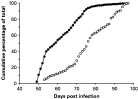
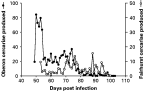
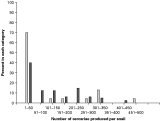
The Oberon isolate shed cercariae earlier, with some snails commencing shedding at 49 days post-miracidial exposure compared with 53 days for the Fairhurst isolate. The shedding period for the Oberon isolate was shorter, with most of the snails that were to produce cercariae having done so within 20 days, whereas the Fairhurst isolate had a more prolonged shedding period lasting over 30 days. Fig. 1 shows the cumulative production of cercariae for the 2 isolates. Total cercarial production was higher for the Oberon isolate (9735 from 82 snails vs 2172 from 23 snails for the Fairhurst isolate) with a median number per shedding snail of 94 against 9 for Fairhurst shedding snails. The pattern of shedding, shown in Fig. 2, also differed between isolates, although both were dominated by bursts of cercariae from individual snails. Oberon-infected snails began with a large burst, tailing off with the 26 surviving snails no longer shedding. The smaller number of Fairhurst-infected snails produced a smaller initial burst, but released large numbers of cercariae later in the shedding period, at 70–95 days post-infection (Fig. 2). The Fairhurst isolate showed the greatest variability in cercariae produced per snail, with the majority of these snails producing few cercariae but some producing very high numbers (Fig. 3).

Fig. 1. Cumulative production of cercariae. Key: [bull ]---[bull ], snails infected with the Oberon isolate; ○---○, snails infected with the Fairhurst isolate. The Oberon isolate produced a total of 9735 cercariae from 82 snails as compared to 2172 cercariae from 23 snails for the Fairhurst isolate.

Fig. 2. Daily production of cercariae. Key: [bull ]---[bull ], snails infected with the Oberon isolate of which a total of 82 produced cercariae; ○---○, snails infected with the Fairhurst isolate of which 23 produced cercariae. Note change of scale on y axes.

Fig. 3. Frequency distribution of cercarial production per snail. Key: light grey columns, Fairhurst isolate (N=23), dark grey columns, Oberon isolate (N=82).
Efficiency of definitive host stages of the life-cycle
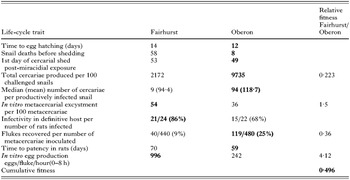
In vitro, the excystment rate was higher for the Fairhurst isolate with 54/100 excysting compared to 36/100 for the Oberon isolate (Fisher's Exact test P<0·0155). Rats, however, were more readily infected with the Oberon isolate, with both a higher proportion of rats being infected and individual rats carrying more flukes. Out of 24 rats inoculated with 20 Oberon metacercariae per rat, 21 (86%) became infected as compared to 15 (68%) out of 22 rats exposed to 20 Fairhurst metacercariae each. The rats with successful Oberon infections produced a total of 119 adult flukes with a mean of 5·67 flukes per rat. Those rats with successful Fairhurst infections produced a total of 40 flukes, giving a mean of 2·67 flukes per infected rat. The Oberon isolate was also first to patency of infection, as defined by the first day that eggs were observed in faecal samples, at 59 days post-inoculation as compared to 70 days for the Fairhurst isolate.
In vitro egg production
The egg flotation method was found to be suitable for detecting the onset of patency in adult flukes, but preliminary experiments indicated that it was not sufficiently sensitive for an accurate and reproducible assessment of daily egg production. Other workers have reported similar findings (Briskey, 2001). Consequently, an in vitro protocol was used.
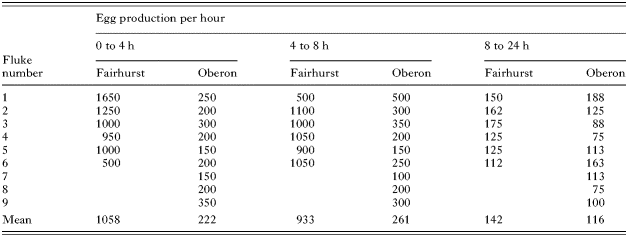
Six Fairhurst flukes monitored for egg production over a 24 h interval were calculated to have produced a mean total of 10200 eggs per fluke, at a mean rate (for the first 8 h) of 996 eggs per h. The 9 Oberon flukes examined produced a mean total of 3623 eggs per fluke at a mean rate of 242 eggs per fluke per h for the first 8 h. Comparing values from individual flukes over the 24 h period (Table 1), these results indicate that although the Fairhurst flukes had an initially higher rate of egg production, this was reduced to a rate close to that of the Oberon fluke for the final 16 h.
Table 1. Mean egg production, during a 24 h period, by flukes in vitro (Results based on a 10 μl sample (×3) from a total volume of 2 ml.)

Fitness comparison
Table 2 displays parameters contributing to fitness and gives a calculation of the relative fitness index, based on 4 population size parameters associated with transitional stages in the life-cycle. No attempt was made to measure infectivity for snails in this series of experiments. The cumulative relative fitness throughout the life-cycle of the Oberon isolate was twice that of the Fairhurst isolate.
Table 2. Summary of results contributing to relative reproductive fitness in Oberon and Fairhurst isolates at 4 stages of their life-cycle (The bold type indicates the isolate with the greater fitness.)

DISCUSSION
In the artificial, but controlled, conditions of this experiment, there were very large differences in success between 2 isolates of Fasciola at all stages of their life-cycle, with Oberon emerging twice as fit as Fairhurst. Both of the isolates were field isolates, so they must have been competent in their local environment at the time of their isolation. They were not naturally in competition, but this experiment suggests that they are adapted to different micro-environments, and the genotypes represented in these two isolates would not continue to coexist in competition. Although phenotypically distinct in response to anthelmintics, it is not possible to directly correlate the differences in fecundity that we have observed to the drug-resistant or -susceptible status of the isolates. That said, the data presented indicate that the acquisition of drug resistance by the Oberon has not caused a drastic drop in fitness by comparison with the Fairhurst isolate.
The mechanism of resistance to TCBZ operating in Fasciola hepatica is at present unclear. It is not thought to involve changes in the proposed benzimidazole binding site (Kwa et al. 1994; Robinson et al. 2004) as it has been reported that an isolate of F. hepatica with the TCBZ-resistant phenotype has an identical structure to TCBZ-susceptible isolates in this region of the β-tubulin molecule (Robinson et al. 2002). In this respect, the situation with regard to drug resistance in Fasciola spp. is akin to that seen in schistosomes, where the mechanism of resistance to praziquantel is yet to be defined. Isolates of Schistosoma mansoni that had retained their praziquantel insensitivity had compromised biological fitness in that they produced fewer cercariae (Liang et al. 2001) and the most resistant isolates produced fewer eggs and were slower to patency (Fallon et al. 1997). Six isolates of S. mansoni obtained from patients not responsive to praziquantel therapy were used by William and colleagues (William et al. 2001) to study reversion to drug sensitivity and compare the fitness of the isolates. Three of the isolates reverted to praziquantel sensitivity, those that retained drug resistance were less fit in that they produced fewer cercariae and, in one instance, fewer eggs. The TCBZ-resistant isolate of F. hepatica studied in this report was faster to hatch, faster to produce cercariae, produced more cercariae, was more infectious for rats and was faster to patency than a completely different isolate that happened to be sensitive. This suggests that in the case of the Oberon isolate the withdrawal of anthelmintic selective pressure would not result in the replacement of the drug-resistant flukes with a susceptible cohort. A recent report from the Netherlands on the lack of reversion from the TCBZ-resistant state in field isolates of fluke populations may reflect a similar situation (Borgsteede et al. 2005).
Some aspects of the life-cycle that may be pertinent to fitness could not be tested. The non-feeding miracidium must find a suitable snail host within 24 h of emergence from the egg, before its glycogen stores are exhausted (Ginetsinskaya, 1988). The miracidium uses positive phototaxis; negative geotaxis and positive chemotaxis to achieve this (Haas and Haberl, 1997), but in this work the snails were confined with a miracidium, making contact between it and the snail certain. The availability of host snails in the natural environment may be a limiting factor in natural populations, where late spring rainfall is an effective predictor of subsequent liver fluke prevalence in stock (Ollerenshaw and Smith, 1969).
Only 1 strain of molluscan host was available to the miracidia in this experiment. Development can only proceed if the miracidium infects its specific snail host and, in the case of some digenean trematodes, hosts are restricted to certain strains of snail species (Basch, 1976; Haseeb and Fried, 1997). Such specificity is due to the defence response of the intermediate host which can cause encapsulation and death of sporocysts in non-susceptible snail hosts (van der Knaap and Loker, 1990; Adema and Loker, 1997). One of the most notable effects seen in this study was the death of Fairhurst-infected snails, irrespective of cercarial shedding. This isolate killed 58 of 100 snails before any snails began shedding, compared to 8/100 deaths in those exposed to the Oberon isolate. Only half the surviving snails carrying the Fairhurst isolate produced cercariae, compared to 90% of the Oberon-infected snails. This suggests a much greater immune response against Fairhurst larvae, often causing death of the host, but also clearing parasites from some snails. Oberon miracidia also produced more cercariae, an average (median) of 118·7 (94) per shedding snail as compared to Fairhurst at 94·4 (9) cercariae per shedding snail, although both isolates produced very large releases of cercariae from a few snails. Ultimately, snail mortality was similar for both isolates, but Fairhurst-infected snails succumbed before producing cercariae. The minimal mortality of 3% in the controls indicates just how severely the parasites affected the molluscan host, and suggests a failure of co-adaptation. This is only to be expected, considering the different geographical origins of the isolates and the snails and may be comparable to the results presented by Goumghar et al. (2001), in which allopatric combinations of snails and flukes resulted in greater production of cercariae and mortality after shedding than seen with semi-sympatric combinations. The period between infection of snails and first shedding of cercariae seen in this study was comparable to that reported by Dreyfuss and colleagues (Dreyfuss et al. 1999) who also worked with G. truncatula but it was considerably longer than the 36–41 days for infections in L. viridis (Lee et al. 1995). This suggests that populations of F. hepatica may show considerable adaptation to local environmental factors. An examination of the kinetics of the response for Oberon indicates that high numbers of cercariae may be produced early in the shedding period. This would suggest that the total number of cercariae produced in an individual snail is a function of the number of daughter rediae produced by the mother sporocyst in the early stages of the infection. However, other researchers have shown that the production of cercariae in this system may be governed by multiple factors, making comparisons between the results from different experimental designs problematic (Augot et al. 1997, 1999; Augot and Rondelaud, 2001; Abrous et al. 2000).
When egg production was monitored in vitro the Fairhurst isolate appeared to compensate for its lower infectivity by producing more eggs per fluke. This may be an example of density-dependent fecundity, where crowding of Oberon fluke reduces their productivity. This phenomenon has been noted in S. mansoni infections of mice (Jones et al. 1989), but it is perhaps less important in non-rodent hosts where size constraints are less likely (de Bont et al. 2002). In sheep, egg production rates of 25000 eggs/fluke/day or 1042 eggs/fluke/h have been described (Happich and Boray, 1969). Similar rates were seen in the Fairhurst isolate (996 eggs/fluke/h) for the first 8 h of in vitro culture, but then declined, suggesting that the initial high rate of egg production had depleted the fluke of essential nutrients. Even during the final 16 h period, however, they were still producing eggs some 30% faster than the Oberon isolate, whose relatively low number of eggs produced over the 24 h in vitro culture was less than one-third of that seen with Fairhurst. If the initial high rate of production seen in Fairhurst flukes could be maintained in vivo, then this would confer a significant advantage.
Apart from productivity, rate of progression through the life-cycle is also important for two reasons. Firstly, in temperate climates, the conditions of temperature and water abundance required by snails may be limited to a few months; at other times the fluke must survive as metacercariae or within its definitive host. Secondly, the late fluke arrivals in any individual host will face an immune system already primed (van der Knaap and Loker, 1990), and also competition from established parasites. The Oberon isolate has an advantage over Fairhurst in that its miracidia can hatch from eggs 2 days prior to the emergence of their potential Fairhurst competitors under the experimental conditions used. If there is a shortage of snail hosts, this could leave the more slowly developing Fairhurst miracidia less likely to locate a suitable intermediate host. Under field conditions, parasite inter- and intra-specific competition within snail populations will also lead to reduced fecundity of isolates in terms of cercarial production (Dreyfuss et al. 1999). The Oberon isolate also started producing cercariae 4 days before Fairhurst. During the intermediate host stages of its life-cycle, the Oberon isolate both hatches and matures more quickly. Overall, it would be re-infecting its mammalian host 6 days ahead of Fairhurst, which would give Oberon a substantial advantage.
All existing fluke populations (of which Fairhurst and Oberon are examples) must have been able to progress through each stage of their life-cycle with sufficient efficiency to maintain their populations. It is possible that relative inefficiencies at one stage may be compensated for by a higher efficiency at another stage and there may be pleiotropic trade-offs between successful adaptations at different stages of the life-cycle. Working with schistosome infections of laboratory mice and snails, Webster and colleagues have shown that infectivity in snails and high rates of cercarial production are negatively correlated with infectivity in the definitive host and production of miracidia (Davies et al. 2001; Gower and Webster, 2004). A similar but not identical situation appears to be operating in the F. hepatica life-cycle.
In conclusion, we have no reason to suggest a reduction in fitness associated with drug resistance in the Oberon isolate. These results do point to a large amount of inter- and intra-population phenotypic variation in fecundity under the laboratory conditions used. The use of laboratory isolates with differing histories imposes a limitation on the extrapolation of these findings to population dynamics in the field, but it would be extremely difficult or impossible to obtain such complete data in natural conditions. The variation discovered in this experiment goes some way toward providing empirical data at every stage of the life-cycle for modelling purposes.
S.M.W. was supported by a Postgraduate studentship from the Department of Agriculture and Rural Development (Northern Ireland).