Infection with Clostridium difficile (CDI) is the most important cause of hospital-acquired diarrhea and is a growing threat to hospital safety. During the past 15 years, the incidence of CDI has tripled in the United States.Reference Lucado, Gould and Elixhauser 1 The emergence of a more virulent and transmissible C. difficile strain, Nap1/BI/027, in North America as well as other factors have contributed to the rise in the C. difficile epidemic.Reference McDonald, Killgore and Thompson 2 , Reference Loo, Poirier and Miller 3
The risk of hospital-acquired CDI increases with age, comorbidities and Charlson Comorbidity Score, length of inpatient stay, and exposure to skilled nursing facilities (SNF).Reference Kyne, Sougioultzis, McFarland and Kelly 4 , Reference Lessa, Gould and McDonald 5 The most widely recognized and modifiable risk factor is exposure to antimicrobial therapy. However, the magnitude of risk due to specific classes of antibiotics remains controversial. Clindamycin and cephalosporins are most consistently agreed upon as risk factors for CDI, yet consensus is lacking regarding risk from different generations of cephalosporins, fluoroquinolones, broad-spectrum penicillins, and other classes.Reference Stevens, Dumyati, Fine, Fisher and van Wijngaarden 6 – Reference Slimings and Riley 9 Even the medications used to treat CDI, metronidazole and orally administered (PO) vancomycin, have been implicated as risk factors.Reference Stevens, Dumyati, Fine, Fisher and van Wijngaarden 6 , Reference Pakyz, Jawahar, Wang and Harpe 8 Outpatient exposure to antibiotics before admission has not been adequately evaluated for risk for hospital-acquired CDI.
Limitations in sample size, overly inclusive antibiotic class definitions, lack of adjustment of key risk variables, and inadequate assessment of cases contribute to widely ranging estimates of risk factors.Reference Stevens, Dumyati, Fine, Fisher and van Wijngaarden 6 , Reference Pakyz, Jawahar, Wang and Harpe 8 , Reference Doernberg, Winston, Deck and Chambers 10 – Reference Baxter, Ray and Fireman 12 Furthermore, many studies have assessed CDI cases from discharge data.Reference Baxter, Ray and Fireman 12 – Reference Vesta, Wells, Gentry and Stipek 18 This is a major limitation as it has been shown that hospital-acquired CDI cases that present in the 4 weeks following discharge contribute a substantial amount to hospital-acquired case counts.Reference Kuntz and Polgreen 19 , Reference Tartof, Yu, Wei, Tseng, Jacobsen and Rieg 20
To address these gaps, we provide new robust perspectives on known and controversial risk factors for CDI, incorporating CDI data following discharge, more refined classifications of antibiotics, assessment of concurrent use of multiple antibiotic classes, and outpatient use prior to admission. In this era of increasing CDI-related threats to patient safety and cost containment, a comprehensive assessment of risks can inform well-directed allocation of resources for antibiotic stewardship programs and other infection control practices.
METHODS
Study Population
The study included members of Kaiser Permanente Southern California (KPSC) healthcare system. KPSC consists of 3.9 million members who are representative of the socioeconomic and racial diversity of the area population.Reference Koebnick, Langer-Gould and Gould 21 KPSC uses electronic health records to integrate medical information such as diagnosis, medication, and laboratory results from outpatient, emergency department, and hospital settings.
In this retrospective cohort study, all patients aged 18 years or older admitted as inpatients from January 1, 2011, through December 31, 2012, were included. Continuous membership at KPSC was required for all study members for 1 year prior to first day of hospitalization (allowing a 30-day gap in membership). Data were collected from all inpatient stays for patients who had multiple admissions during the study period. The protocol for this study was reviewed and approved by the KPSC institutional review board, which waived requirement for informed consent.
Outcomes
All incident hospital-associated CDI cases (lab identification >3 days, ie, 72 hours, following hospital admission), including healthcare facility–onset, healthcare facility–associated, as well as community-onset, healthcare facility–associated as defined by standardized surveillance category (Infectious Diseases Society of America/ Society for Healthcare Epidemiology of America/Centers for Disease Control and Prevention National Healthcare Safety Network modified case definition guidelines),Reference McDonald, Coignard and Dubberke 22 , 23 were included in the analyses. CDI cases were identified through positive polymerase chain reaction assay laboratory results from both inpatient and outpatient facilities. KPSC uses the GeneXpert Xpert C. difficile test, which detects the toxin B gene (tcdB) and is performed on the GeneXpert Dx System (both, Cepheid). Recurrent cases (>2 weeks and ≤8 weeks after most recent positive polymerase chain reaction assay) and repeat positive test cases (ie, within 2 weeks of prior positive test) were excluded from the case cohort. To validate that the outcome data represent true CDI cases (vs those with non–infection-induced stool softening and C. difficile carriage), we performed a review of 150 randomly selected CDI medical records to assess presence of diarrheal symptoms on the day of C. difficile laboratory testing.
Antibiotic Risk Factors
Exposure to all antibiotics administered during inpatient stays was assessed; antibiotic exposure was assessed prior to CDI diagnosis for CDI cases, and for non-CDI patients, antibiotic exposure was assessed through the inpatient stay(s). Antibiotics were categorized into 27 mutually exclusive classes (listed in online Appendix 1); classes administered by all routes were included. Outpatient use (intravenous, intramuscular, oral) of 10 antibiotic classes was also assessed in the 3 months prior to admission and is also listed in online Appendix 1. In order to avoid including preemptive treatment with vancomycin and metronidazole for patients with high suspicion of CDI, exposure was assessed only if taken more than 2 days prior to laboratory testing.
Additional Risk Factors
Age at inpatient admission, sex, self-identified race/ethnicity, Charlson Comorbidity ScoreReference Charlson, Pompei, Ales and MacKenzie 24 identified by International Statistical Classification of Disease, Ninth Revision, Clinical Modification, code during the year prior to any admission, previous hospitalization in the year prior to admission, transfer from an SNF or intermediate care facility (yes/no), the number of different antibiotic classes taken during hospital stay (≥1 day of treatment per class), statin use in 4 weeks prior to admission, and use of proton pump inhibitor during inpatient stay were also assessed.
Statistical Analyses
First, we described characteristics of the study population (proportions and means with SD) by CDI status. Subsequently, bivariate analyses assessed associations between individual risk factors and CDI. We used Poisson regression to derive our final adjusted estimates; model selection was based on inclusion of all covariates of interest, with an iterative process of stepwise selection removing antibiotic class covariates with P >.1. Two separate models were created, one with individual drug categories and the other with the variable for the number of different antibiotic classes. All P values represent 2-sided tests.
RESULTS
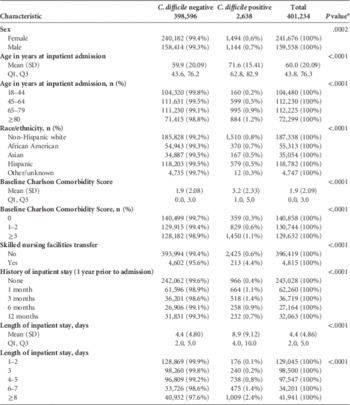
A total of 401,234 patients with at least 1 hospital admission from January 1, 2011, through December 31, 2012, were included in the study. Among these, 2,638 (0.7%) cases of incident CDI were detected. The incidence rate of hospital-acquired CDI during the study period was 14.98 (14.42–15.56) per 10,000 inpatient-days. Increasing age and increasing Charlson Comorbidity Score were associated with higher likelihood of CDI (≥80 years: 1.2% vs 18–44 years: 0.2%; Charlson ≥3: 1.1% vs Charlson 0: 0.3%), and of race/ethnicity categories, white race had the highest proportion CDI (0.8%) (Table 1). Those who transferred from an SNF were more likely to develop CDI (4.4% vs 0.6%), as were those who had a recent inpatient stay (1 month prior: 1.1% vs 12 months prior: 0.7%). Those with longer length of stay were also more likely to develop CDI (≥8 days: 2.4% vs 1–2 days: 0.1%) (Table 1).
Cohort Characteristics Among Patients With at Least 1 Hospital Admission From January 1, 2011, Through December 31, 2012, by Clostridium difficile Infection Status

a χ2 test and t test used to calculate P values for categorical and continuous variables, respectively.
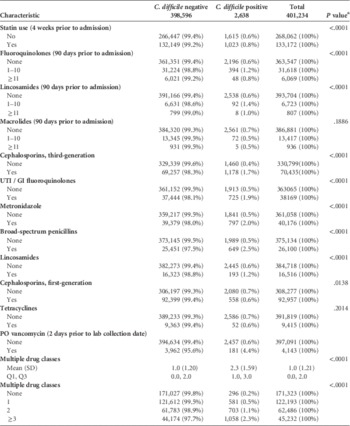
Medication exposure differed by CDI vs non-CDI inpatients as well. Those with statin use and recent outpatient fluoroquinolone and lincosamide (10 days prior) use prior to admission were more likely to develop CDI. Exposure to almost all antibiotic classes during their inpatient stay, except for first-generation cephalosporins and tetracyclines, was associated with CDI (Table 2). Increasing exposure to number of drug classes during admission increased likelihood of CDI (≥3 classes: 2.3% vs none: 0.2%).
Inpatient and Outpatient Antibiotic and Medication Use Among Patients With at Least 1 Hospital Admission From January 1, 2011, Through December 31, 2012, by Clostridium difficile Infection Status

Note. GI, gastrointestinal; PO, oral; UTI, urinary tract infection.
a P values calculated by χ2 test.
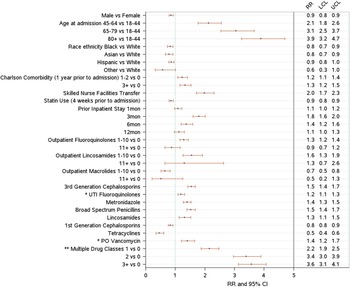
Adjusted estimates of CDI risk by covariate are shown in Figure 1. This model demonstrated statistically significant lower risk of CDI among males, African-Americans, Hispanics, and Asians (vs white), and those who used statins within 4 weeks prior to admission (Figure 1). Antibiotics that conferred statistically significant reduced risk of CDI included outpatient macrolides in the 10 days prior to admission, first-generation cephalosporins during the inpatient stay, and tetracyclines during the inpatient stay (Figure 1). Conversely, increased CDI risk was seen with increasing age, increasing Charlson Comorbidity Score, SNF transfer, and history of inpatient stay in the year prior to admission. Of the initial 27 inpatient classes, exposure to any of 8 was significantly associated with increased CDI risk; of the initial 9 outpatient antibiotic classes, exposure to either of 2 was significantly associated with increased CDI risk. Inpatient classes conferring risk included third-generation cephalosporins, urinary tract infection (UTI) fluoroquinolones, metronidazole, broad-spectrum penicillins, lincosamides, and PO vancomycin. Exposure to multiple different antibiotic classes increased CDI risk. On the outpatient side, use of fluoroquinolones and lincosamides also increased CDI risk. There was no association seen between inpatient proton pump inhibitor use and CDI (Figure 1). The direction of effect differed for statins in bivariate and multivariate analyses. Stratified analyses suggested (results not significant) that statin use increased CDI risk in younger age groups and was protective for older ages. However, an interaction term with statins and age was not significant in the final model. All other classes of antibiotics neither increased nor decreased the risk of CDI.
Adjusted odds ratios of risk factors for Clostridium difficile. * LCL, lower confidence limit; PO, oral; RR, relative risk; UCL, upper confidence limit; UTI, urinary tract infection. ** Estimate for multiple drug classes derived from a separate model adjusted by sex, age, race, Charlson Comorbidity Score, skilled nursing facility transfer, statin, history of hospitalization, outpatient fluoroquinolones, outpatient macrolides, and outpatient lincosamides.

DISCUSSION
Despite heightened attention and efforts, the CDI epidemic continues to worsen in many countries.Reference He, Miyajima and Roberts 25 In order to better direct prevention efforts we must consider the most comprehensive perspective by synthesizing estimates often reported in segregated analyses. In this study, we take advantage of a large cohort to simultaneously evaluate a large range of risk factors for CDI, including those occurring prior to admission. We are also able to leverage our integrated electronic health records system to identify hospital-associated CDI in the outpatient setting after discharge and we evaluate the broadest range of antibiotic classes to date.
Despite the recent momentum of literature focusing on antibiotic-associated risk, the factors that increase the likelihood of environmental spore acquisition should not be underestimated. Transfer from an SNF was associated with high risk, which may have an environmental risk component, but given that we could not control for antibiotic use in an SNF, this risk may have been further exacerbated by antimicrobial use in those facilities as well.Reference Nicolle, Bentley, Garibaldi, Neuhaus and Smith 26 Following spore acquisition, physical characteristics, such as age and Charlson Comorbidity Score, and physiologic changes due to antibiotic use likely contribute to spore germination and were important risk factors in our study. The risk associated with antibiotic exposure could be due to disruption of protective intestinal microbiota, corroborated by our findings that cumulative antibiotic class exposure confers the highest risk, whereas exposure to antibiotics prior to hospital admission as well as during hospital stay were also important factors in development of CDI.
Increased CDI risk with exposure to multiple antibiotic classes has been demonstrated in previous studies.Reference Stevens, Dumyati, Fine, Fisher and van Wijngaarden 6 This risk may be due to broader disruptions of indigenous microflora, where more diverse drug activity targets larger populations of organisms in the gut. Ultimately, a better understanding of what constitutes a healthy microbiome and the ways in which medications disrupt this balance may allow us to estimate the risk of new antibiotic classes on CDI risk before widescale administration.
Of note, metronidazole and PO vancomycin were associated with increased CDI risk, as has been reported as such by other investigators.Reference Stevens, Dumyati, Fine, Fisher and van Wijngaarden 6 , Reference Pakyz, Jawahar, Wang and Harpe 8 This association may be due not to the inherent risk of these drugs on CDI, but instead to influence by medical practice. In a random sample of medical charts reviewed from our data, metronidazole and PO vancomycin were used empirically to provide anti-CDI therapy before testing for CDI. For these cases, positive CDI test results may appear prior to clinical activity of the treatment or also may be due to residual positive results due to presence of genetic material following effective treatment. However, it may also be the case, as suggested by the recent finding that Clostridium subspecies (Clostridium scindens) express activity and are correlated with low risk for CDI disease, that metronidazole and possibly PO vancomycin may in fact remove risk-reducing gut flora, thus paradoxically increasing CDI risk in otherwise colonized but uninfected patients.Reference Buffie, Bucci and Stein 27 Further studies to better elucidate the potential risk of empirical treatment of CDI are critical.
Operationally, our findings have implications for antibiotic stewardship efforts and can inform empirical and culture-driven treatment approaches for common infections. For example, our data, which demonstrate increased risk of CDI with UTI fluoroquinolones, support current recommendations for trimethoprim/sulfamethoxazole and nitrofurantoin (sulfonamides and nitrofuran, respectively) as first-line empirical UTI therapy. Furthermore, while community-acquired pneumonia is commonly treated with a third-generation cephalosporin and a macrolide, our data suggest that a third-generation cephalosporin plus doxycycline (tetracycline), if equally effective, may be an option that would incur less collateral damage.Reference Doernberg, Winston, Deck and Chambers 10 Ultimately, proper prescribing should involve the synthesis of local antibiogram resistance, the specific action of antibiotics, and the risk for development of CDI.
The controversy in the literature surrounding antibiotic classes such as cephalosporins and fluoroquinolones may be due to insufficient partitioning of the classes into meaningful clinical groupings. In our study, first-generation cephalosporins conferred reduced risk of CDI, the third-generation cephalosporins conferred increased risk, and the second- and fourth-generation drugs were not associated with risk at all. Therefore, combining any of the generations of cephalosporins may lead to misleading results. Similarly, we made a distinction in our analyses between respiratory fluoroquinolones (moxifloxacin, levofloxacin) and UTI fluoroquinolones (ciprofloxacin) and found that UTI fluoroquinolones were associated with increased CDI risk whereas those used to treat respiratory infections did not increase CDI risk.
Important strengths of our study are the large size and diversity of our cohort, as well as the integrated care environment that allowed us to investigate relevant clinical care prior to admission. We found that prior recent experiences do influence future events. Outpatient antibiotic use prior to inpatient stay was significant, as was prior hospitalization. We also included hospital-acquired CDI cases presenting in the outpatient setting in the 4 weeks after discharge; these cases are critical for inclusion to avoid potential bias and underestimating CDI burden. Additionally, by including only incident cases in our study and eliminating recurrent CDI events (even when carried over from prior inpatient stays), we have attempted to minimize violation of independence assumptions, which can lead to biased risk estimates.
This study also has several potential limitations. It is possible that asymptomatic carriers were included in our case ascertainment. Our clinical laboratory uses polymerase chain reaction assay alone for CDI testing, which has lower specificity than sequential testing with additional cell cytotoxin assay.Reference Longtin, Trottier and Brochu 28 , Reference Planche, Davies and Coen 29 However, to avoid overtesting, our hospitals have CDI testing guidelines that limit testing to patients with diarrheal stool, and CDI test ordering must be separated by at least 7 days. Our validation medical record review found that of 150 CDI-positive patients, 146 (97%) had documented evidence of non–medication-related diarrheal symptoms at the time of CDI test order.
In conclusion, we provide novel perspectives of known risk factors for CDI, including a thorough analysis of 27 antibiotic classes, which allows for better identification of top priority areas for risk mitigation. Analyses such as these may have future applications such as point-of-care risk prediction models deployed through the electronic health records, which could incorporate preadmission risk factor data and current risk factors to guide treatment choice. As reimbursement for healthcare-associated infections decreases, and the number of patients at risk increases due to an aging population and improved access to health insurance, it is likely that the CDI epidemic will continue to grow. Better definition of the complex interplay between the varied CDI risks will help inform long-term mitigation efforts and improve patient safety.
ACKNOWLEDGMENTS
We thank Michael Kanter for general support.
Financial support. Department of Research and Evaluation, KPSC.
Potential conflicts of interest. All authors report no conflicts of interest relevant to this article.
SUPPLEMENTARY MATERIAL
To view supplementary material for this article, please visit http://dx.doi.org/10.1017/ice.2015.220.