Background
The Avesta language, the language of the holy book of the Zoroastrian religion, is attested solely by manuscripts. The earliest discoveries of Iranian Avestan manuscripts were made by foreign Avestan scholars conducting exploratory expeditions in Iran during the late nineteenth and early twentieth centuries. New theories regarding the transmission of Avesta and linguistic, philological, religious or cultural studies about Avesta led to the rediscovery of the importance of the Avestan manuscripts as the sole witnesses of the Avestan texts and motivated Avesta scholars to travel to India and Iran in order to find as many Avestan manuscripts as possible.
For such reasons, E. G. Browne, Niels Ludvig Westergaard, A. V. Williams Jackson and other scholars visited Iran with the aim of discovering Avestan manuscripts. However, the trips were not consistently successful and led to the assumption that there were no more Avestan manuscripts remaining in Iran.
There are only two almost complete editions of the Avestan texts that we possess, and these were published by N. L. WestergaardFootnote 1 and K. F. Geldner.Footnote 2 These editions reflect the conception of these scholars regarding the transmission history of Avestan texts. The editions represent mainly Indian manuscripts rather than Iranian manuscripts, even though the Iranian manuscripts are often more conservative and contain a considerably greater number of important phonological characteristics. The reason for the underrepresentation of the Iranian manuscripts is that many of them had not been found or were not available to the scholars at the time of preparing the text editions.
Both Geldner and Westergaard believed that the Avestan texts were originally composed at some time before the Achaemenid period and would have been orally transmitted up until the time of the first Sassanian kings. They believed that the original text of the Sassanid period had been lost, and that only a few manuscripts of this original text remained, later to be found in the regions of Yazd and Kerman.
They concluded that all extant manuscripts derived from one copy. The goal of these scholars was to reconstruct that original text, and they both used similar methods to edit the Avesta text. The results of their work were also very similar.
Humbach offered a further common hyparchetype for the ritual and exegetic manuscripts of the Videvdād.Footnote 3 Hoffmann, another German scholar, also claimed that there was only one Avestan manuscript of each Avestan text at the end of the ninth and tenth centuries: one for the Yasnā, one for the Videvdād, and one for the Visperad.Footnote 4 The theory of Hoffmann is discussed and proven to be false by CanteraFootnote 5 and Tremblay.Footnote 6
One of the most important arguments countering Hoffmann’s theory was found in the results and fresh information derived from newly discovered manuscripts and genealogical information in their colophons and Sālmargs.
In order to improve our conception about the transmission of Avesta and to develop a new edition of the Avesta text, a more direct way to access and use the manuscripts seemed to be necessary. For this reason, we began the work of locating, digitizing, and making available online as many Avestan manuscripts as possible.
After 2000, this topic of Avestan manuscripts received relatively more attention on account of the discovery of various previously unknown manuscripts in Iran. Two important articles published by Mazdapour drew the attention of Avesta researchers to the fact that there were still many yet undiscovered and unknown manuscripts in Iran that had not been used in the edition of the Avesta text.Footnote 7 In these articles, Mazdapour listed and described various manuscripts, most of them had been found in the houses of priest families or appeared for sale on the black market. This information motivated us to travel to Iran with the goal of locating, preserving, and digitizing Avestan manuscripts. Since 2011, many activities have been undertaken by both Iranian scholars as well as by members of the Avestan Digital Archive (ADA) team. During more than ten fieldwork trips, we were able to locate about ninety manuscripts. Many of them were in the possession of smugglers and collectors, while some of them were found in catastrophic conditions in the cellars of old houses.
One of these important discoveries consisted of Avestan manuscripts found in a Zoroastrian house in the Priests’ Quarter (Mahalle-ye Dastūrān) in Yazd in February 2016. The manuscripts were found in old boxes in two rooms of this old house. Two of the manuscripts, No. 7 and No. 8, were found by accident in old baggage in a cellar in the backyard of the house.
Pouladi’s Collection
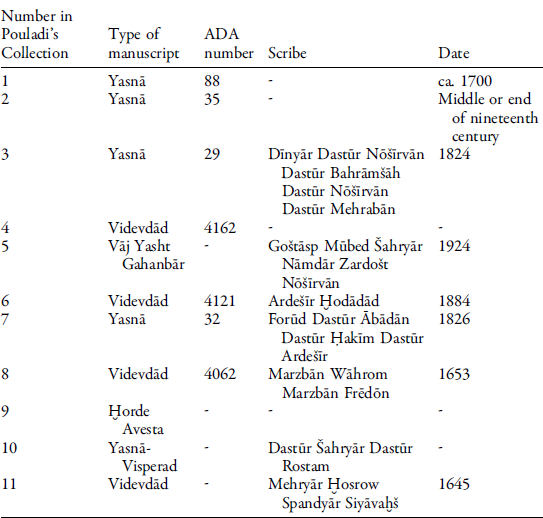
This house in which the manuscripts were found belongs today to Mehrabān Poulādī, the grandson of Arbāb Mehrabān Poulād. Mehrabān Poulādī is the vice president of the Council of Iranian Mobeds. His grandfather, Arbāb Mehrabān Poulād, was an influential Zoroastrian merchant from a priestly family. He founded the Mazdyasnā trading company and various commercial institutes across Iran. He had wide international commercial relations, for example in India and England. Arbāb Mehrabān Poulād was also involved in community affairs and played a crucial role in both the Zoroastrian and non-Zoroastrian communities during the Qajar period. He accumulated and archived his own documents as well as the documents of his father and grandfather over the course of his lifetime. A commercial letter dated 1894 gives the name of his father, Mollā Poulād Tīrandāz, who was also a merchant and lived in the Ḫolf-e Ḫān-ʽali quarter, the Priests’ Quarter. The death of Arbāb Mehrabān Poulād was very mysterious and, according to his relatives, was most probably murder. The historical, economic, and legal documents in his collection are from the eighteenth and nineteenth centuries. The earliest dated historical documents in this collection are from Nāser al-Dīn Šāh’s time (16 July 1831–1 May 1896). The latest documents are dated 1939, which is the date of the death of Arbāb Mehrabān Poulād. The historical documents include communications in the form of letters between Arbāb Mehrabān Poulād and official institutions, and administrative circulars. Most of the documents are bookkeeping record books, legal contracts dealing with sales, leases, settlements of disputes, letters, and official actions. They provide us with relevant information about the structure and work processes of various institutions and organizations during the Qajar and Pahlavi periods in Iran. Among the letters of this collection we find one partially written in Zoroastrian Dari. This text seems to be the only written evidence of Zoroastrian Dari known to us today. In addition to the historical documents, other valuable objects were discovered in this house. These include ceremonial objects, traditional Zoroastrian costumes from the Qajar period, and Avestan manuscripts. The eleven Avestan manuscripts discovered in this collection provide support for relevant developments in the history of the transmission, codicology, and genealogy of Iranian Avestan manuscripts. The discovered Avestan manuscripts are from the seventeenth and eighteenth centuries. The oldest dated Avestan manuscript in this collection is from AD 1645. Two Videvdād manuscripts of this collection are of particular significance for Avestan studies. One of them is apparently the oldest manuscript of the Videvdād discovered so far, while another one is the only illuminated manuscript from the Marzbān family, a famous scribe family of Avestan manuscripts. A list of the Avestan manuscripts in this collection is provided in Table 1.

This collection introduces us to new manuscripts that are not copied directly or indirectly from the manuscripts of the Marzbān family. They provide us with information about new scribes of Avestan manuscripts from different periods. They show special characteristics, thus serving as guides for learning how to perform the ritual correctly, and they reflect variants of both the short and long liturgy as they were celebrated at the time the manuscripts were copied.
After the announcement of the collection to Avestan scholars, some researchers worked on a number of the manuscripts of the collection and achieved important results. Martínez-Porro claimed that manuscript No. 4 of this collection appears to be a copy made by Rōstam Gōštāsp, or someone very close to him.Footnote 8 Rōstam Gōštāsp was the scribe of the well-known Yasnā Iranian manuscript 10 (Mf1). Cantera and König discussed some important issues regarding the special characteristics of Ḫorde Avesta No. 9 in this collection at “The 5th Meeting of the CORPUS AVESTICUM: Editing Avestan Texts in the 21st Century: Problems and Perspectives” held at the Institute of Iranian Studies in Berlin, 23‒24 March 2017.
The present article deals with the secondary life of Avestan manuscripts of Pouladi’s collection, focusing on colophons and marginal notes. Pouladi’s Collection made available a large number of colophons and marginal notes, regarded as of particular importance for the study of the history, culture, and religion of Zoroastrianism.
In what follows, I briefly introduce the manuscripts and offer transcription and translation of the colophons and marginal notes. After this introduction, selected relevant aspects of the colophons and marginal notes are discussed.
Yasnā (ADA No. 88)
On the first page of the manuscript, it is mentioned that this book is an Avestā-ye Yašt. The manuscript has no colophon. The Nērangs of the new part of the manuscript are written in Persian, whereas the Nērangs of the older part are in Pahlavi. The older part is probably from the Qajar period. The older part begins with page 15 and ends with page 155. On two pages of the manuscript, we find the date of death, termed the Sālmarg. Folio 51r has the Sālmarg of Rostam Dastūr Keyḫosrō Dastūr Ḫodādād Dastūr Behmard. He died on the day of Dey-be-dīn, in the month of Ḫordād, in the year 1264.Footnote 9 Folio 79r has the Sālmarg of Mūbed Ḫodābaḫš Mūbed Kayḫosrō. He died on the day of Ard (or Ardibehešt), in the month Ābān, and in the year 12?? (unlikely 1200) AY. Under this date, another one, 1223Footnote 10 (AD 1854), can be observed. It is not clear, however, whether this date is a correction of the other date or if it is from another date era. The manuscript is not illuminated.
Yasnā (ADA No. 35)
The second manuscript in this collection is a liturgical Yasnā. On the final page of the manuscript, page 473, the name of the book is mentioned as Yašt-e bozorg.
The manuscript is not illuminated. All Nērangs are in Persian. This manuscript has already been viewed by Moradiyan, who has published an article on it.Footnote 11 Page 472 of the manuscript provides the date for the completion of the work: the day of Šā Mehr Ized, the month of Ḫordād, and the year 1242 AY (AD 1873). On the final page of the manuscript, page 473, we find a number of Sālmargs and birthday dates.
Notes and dates:
Īn ketāb-e yašt-e bozorg az … Footnote 12 “this book of great Yašt belongs to … ”
Tavalod-e šāh bahrām mūbed nūšīrvān nāmdār, yōm vahman, amordād māh-e qadīm, saneye 1290 yazdgerdī
“The birth of Šāh-bahrām Mūbed Nūšīrvān Nāmdār, the day Vahman, the old month Amordād, the year 1290 AY.”
Tavalod-e ḫoršīd bānū Footnote 13 mūbed nāmdār rašīd, yōm ōrmazd, mehr māh, saneye 1289 yazdgerdī.
“The birth of Ḫoršīd Bānū Mūbed Nāmdār Rašīd, the day Ōrmazd, the month Mehr, the year 1289 AY.”
Farroḫ zende ravānšād, zarbānū … , yōm dīn, … āẕarmāh …
“blessed, alive and happy soul, Zarbānū, the day Dīn, … the month Āẕar.”
Moṭavaled šodan … farzandī ğahānbaḫš, valad-e ōrmazdyār.
“The birth of … the son of Ğahānbaḫš, the son of Ōrmazdyār.”
Tavalod-e mehrangīz, mūbed bahrām rašīd, yōm ābān, farvardīn māh, saneye 1290. Footnote 14
“The birth of Mehrangīz, Mūbed Bahrām Rašīd, the day Ābān, the month Farvardīn, the year 1290.”
Be-tārīḫ-e yōm amordād az dey māh-e qadīm, se 3 sāʽat šab mānde, ʽsad Footnote 15 ṭāleʽ mīyān, saneye 1262 yazdgerdī, moṭābeq 1231 heğrī.
“The date: the day Amordād, the old month Dey, 3 hours left to the night, in the middle of Leo,Footnote 16 the year 1262 AY, in accordance with 1231 Heğrī.”
Vafāt yāftan-e farzandī ğahānbaḫš, mūbed ōrmazdyār, ben-marḥūm mūbed ğahān[baḫš], yōm šahrīvar, māh amordād māh-e qadīm, saneye 13012 heğrīyeh.
“The death of the son of Ğahānbaḫš, Mūbed Ōrmazdyār, the son of deceased Mūbed Ğahānbaḫš, the day Šahrīvar, the old month Amordād, the year 1312 Heğrī.”
Vafāt yāftan-e farzandī šāh fereydūn, mūbed ōrmazdyār, ben-marḥūm mūbed ğahānbaḫš, yōm dey-be dīn, mehr māh, saneye 130104 heğrīyeh.
“The death of the son of Šāh Fereydūn, Mūbed Ōrmazdyār, the son of deceased Mūbed Ğahānbaḫš, the day Dey-be dīn, the month Mehr, the year 1314 Heğrī.”
Vafāt yāftan-e farzandī sorūš ōrmazdyār, yōm farvardīn, ağ Footnote 17 āẕar māh-e qadīm.
“The death of the son of Sorūš Ōrmazdyār, the day farvardīn, the old month Āẕar.”
Tavalod šodan-e mehrbānū, Footnote 18 bent-e marḥūm ğanhānbaḫš, be-tārīḫ-e yōm mehr īzad, mehr māh, saneye 1266 yazdgerdī.
“The birth of Mehrbānū, the daughter of deceased Ğanhānbaḫš, the date, the day Mehr Īzad, the month Mehr, the year 1266 AY.”
Tavalod šodan-e ḫarman, bent-e marḥūm ğahānbaḫš, be-tārīḫ-e yōm ḫordād īzad, ağ mehr māh, saneye 1217 Footnote 19 yazdgerdī.
“The birth of Ḫarman, the daughter of the deceased Ğahānbaḫš, the date, the day Ḫordād Īzad, the month Mehr, the year 1217 AY.”
Yasnā (ADA No. 29)
The third manuscript in this collection is a liturgical Yasnā. According to the Persian colophon of the manuscript, the scribe is Dīnyār Dastūr Nōširvān Dastūr Bahrāmšāh Dastūr Nōširvān Dastūr Mehrabān, and the manuscript was scribed in 1239 Hijri (AD 1824). The manuscript is not illuminated. In contrast to other manuscripts, this manuscript is written on blue paper. Traces of burning can be found on various pages of the manuscript. This shows that the manuscript has been used during the ceremony. A transcription and translation of the Persian colophon is given below:Footnote 20
Farğām yāft andar rūz-e Footnote 21 fīrūzi va farroḫī va ḫorramī rūz-e aršvānak īzad vāğ, tīr māh-e qadīm, 1239 heğrīye, az bahr-e ašā be varzīdār ḫosro, valad-e dastūr ardešīr ğannat makāni, dastūr-e zende, dastūr ğamšīd dastūr ğāmāsb, ke har kas ḫānand ayā āmuzand īšān va kamtarīn rā be yād-e ḫeyr va āmorzeš farāmūš nakonand, va har gāh sahv-e šēkaste dāšte bāšad, az rāh e loṭf va šafeqat dorost namāyand, ke īšān rā ḫodā bīyāmorzād. kāteb-ol ḥorūf, bande-ye kamtarīn, Ẕare-ye bī meqdār, dīnyār, valad-e marḥūm dastūr nūšīrvān, valad-e ravān beheštī, dastūr bahrāmšāh dastūr nūšīrvān dastūr mehrabān.
Completed in welfare, glory, and joy, on the day Aršvānak Īzad Vāğ, the old month Tir, the year 1239 Heğrī, for the purity of experienced Ḫosro,Footnote 22 the son of Dastūr Ardešīr, having paradise as his residence, the live Dastūr, Dastūr Ğamšīd Dastūr Ğāmāsb, in order that everyone who would recite [it] or teach [it], may remember them and me, the humble servant, in good desire and forgiveness. And if there would be a mistake, may he correct it with honesty and kindness. May God bless them! I [am] the scribe, the humble servant, valueless bit, Dīnyār, son of the deceased Dastūr Nūšīrvān, son of paradise soul Dastūr Bahrāmšāh, Dastūr Nūšīrvān Dastūr Mehrabān.
Videvdād (ADA No. 4162)
The manuscript has no colophon, and the last folios are missing. This manuscript includes two parts. The Nērangs of the new part are written in Persian, whereas the Nērangs of the old part of the manuscript are mostly in Pahlavi. There is a Yazišngāh on page 35. The manuscript is not illuminated. Martínez-Porro discusses this manuscript in his article and compared palaeographical, orthographical, and textual characteristics of this manuscript with the currently available Avestan manuscripts.Footnote 23 He places this manuscript in connection with other well-known Avestan copies as the important codices 4020 (Mf2), 4070 (K9) and 4161 (Vidēvdād-e Ğahānbaḫšī). According to his research, this manuscript appears to be the oldest liturgical Iranian Videvdād codex and is a copy made by Rostam Gōštāsp or else someone very close to him. Rostam Goštāsp was the scribe of the well-known Yasnā Iranian manuscript 10 (Mf1).
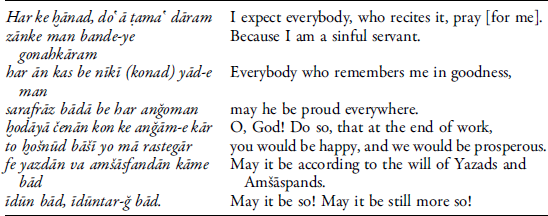
Before the beginning of the ninth Fragard, page 162r includes Sālmargs and Persian verses:
Be-nām-e ḫodā. Motevaled šodan-e mehrabān mūbed ardešīr mūbed bahrām, yōm bād īzad az mehr māh-e qadīm, šab-e ǰomʿe 10 ḥūt 23 raǰab čahār sāʿt o nīm be-ṣobh mānde. Ṭāleʿ-e mōled avāḫer-e borǰ-e mīzān va xālī az har gūne vabāl ast. Nām-e molūd mehrabān. Besyār mobārak ast.
In the name of God. The birth of Mehrabān Mūbed Ardešīr Mūbed Bahrām, the day Bād Īzad of the old month Mehr, the night of Friday 10 Ḥūt 23 of Rajab, four and a half hours left to the morning. The horoscope of the newborn is at the end of LibraFootnote 24 and far from any misfortune. The name of newborn is Mehrabān. Many congratulations.
Tavalod-e mōlūde farangīs mūbed ardešīr mūbed bahrām. yōm mehr īzad az āẔar māh-e qadīm 1295, šab-e ǰomʿe, dovom-e  ūr va dovom-e ordībehešt-e bāstānī 1305, panǰ sāʿat be ġorūb mānde, be-ṭāleʿ nīme-ye borǰ-e asad ast va besyār xoš-qadam barāye pedar o mādar.
The birth of the newborn Farangīs Mūbed Ardešīr Mūbed Bahrām. The day Mehr Īzad of the old month 1295, the night of Friday,  ūr 2nd and Ordībehešt 2nd of 1305 Bāstāni, five hours left to the night. The horoscope is in the middle of LeoFootnote 25 and is very fortunate for the father and mother.
Vafāt yāftan-e farangīs mūbed ardešīr, mūbed bahrām, yōm anārām īzad, az āẔarmāh-e qadīm, 1295 Yazdgerdī.
The death of farangīs [daughter] of mūbed ardešīr, mūbed bahrām, the day Anārām Īzad, the month ĀẔar, the old month, 1295 AY.
These birthdays and Sālmarg occur again on the back page of the manuscript. This page also contains Persian verses:
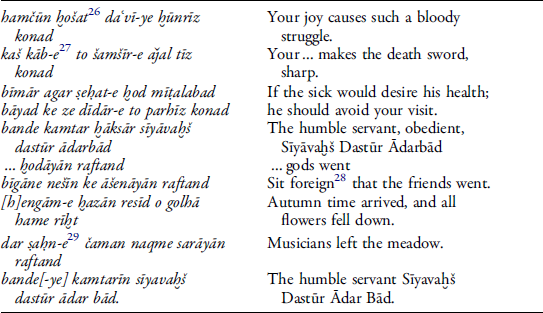
The back page of this manuscript contains the following birthdays and Sālmargs:
Tavalod šodan-e bahman mūbed ardešīr mūbed bahrām yōm aštād, ābān-māh-e qadīm, saneye 1296.
“Birth of Bahman, [the son of] Mūbed Ardešīr Mūbed Bahrām, the day Aštād, the old month Ābān, the year 1296.”
Tavalod šodan-e fereydūn mūbed ardešīr mūbed bahrām yōm ḫeyr īzad, až dey-māh-e qadīm, 1297, moṭābeq-e āsmān, ordībeheštmāh, 1297 [corrected to] 1307 šamsī. Footnote 30
“Birth of Fereydūn, [the son of] Mūbed Ardešīr Mūbed Bahrām, the day Ḫeyr Īzad, the old month Dey, [the year 1297], correspond to Āsmān, the month Ordībehešt, the year 1307.”
Vafāt-e fereydūn mūbed, ardešīr mūbed bahrām, yōm bād, až ordībehešt-māh-e qadīm, 1298, moṭābeq-e yōm-e tīr, mehr-māh 1297 [corrected to] 1307 šamsī. Footnote 31
“The death of Fereydūn Mūbed, Ardešīr Mūbed Bahrām, the day Bād of the old month Ordībehešt, 1298, correspond to the day Tīr, the month Mehr, the year 1307 Šamsī.”
Vafāt-e bahman mūbed ardešīr, mūbed bahrām, yōm aršvāng, bahman-māh-e qadīm, 1296.
“The death of Bahman Mūbed Ardešīr, Mūbed Bahrām, the day Aršvāng, the old month Bahman, 1296.”
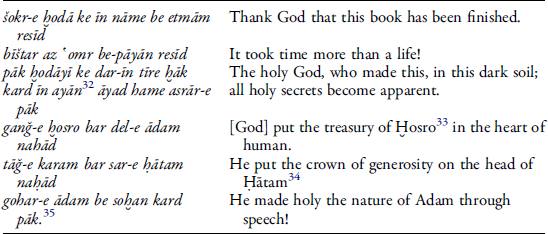
There is a verse in Persian at the end of the manuscript:
Vāğ-Yašt Gahanbār
This Vāğ-Yašt Gahanbār manuscript was scribed by Goštāsp Mūbed Šahryār Nāmdār Zardošt Nōšīrvān in 1293 AY (AD 1924). Vāğ-Yašt Gahanbār is a religious Zoroastrian ceremony that is performed by the priests six times during the Gahanbār period within a year. The manuscript begins with Vāğ-Yašt Gahanbār and continues with Vāğ-Yašt Raftūn, Dorūn Mīyazd Gūsfand, Dorūn Rūz-e Ḫordād, Fravardīn Māh, Dorūn Haft Amšāspand, and Dorūn Rāh-e Safar.
More specifically, this ceremony centers on the Yasnā ritual. However, there are many open questions regarding the process of the performance of the ritual and the selection of the Yasnā sections during this ceremony. The manuscript from our collection provides more details about the performance of the ritual and also clarifies the relationship between text and ritual. This manuscript can also help us better understand the differences between the Indian and Iranian types of the Vāğ-Yašt Gahanbār ceremony.
This manuscript is the second Vāğ-Yašt Gahanbār manuscript that we have been able to find so far. The other Vāğ-Yašt Gahanbār manuscript from Zolfaghari’s collection (36 pages) belonged to Mūbed Ormazdyār Mūbed Ğahānbaḫš. It was scribed by Bahman Mūbed Ardašīr in 1340.Footnote 36
Videvdād (ADA No. 4121)
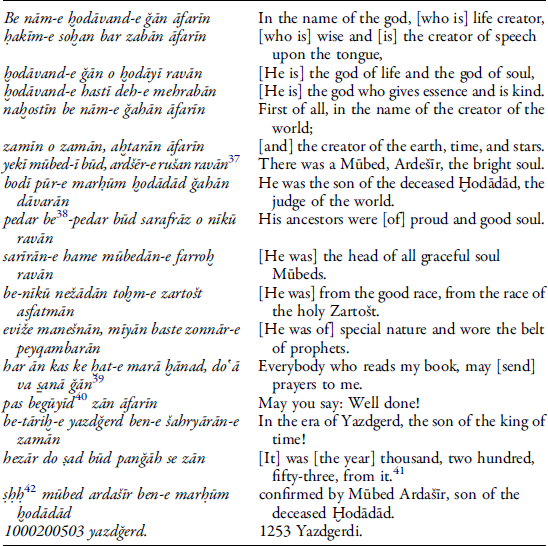
The sixth manuscript of Pouladi’s Collection is a liturgical Videvdād that is not illuminated. There is a colophon in Persian at the end of the manuscript. It was scribed by Ardešīr Ḫodādād in 1253 AY (AD 1884). The Sālmargs occur before the ninth Fragard. The transcription and translation of the colophon is given below. The colophon is in the form of verse:
At the bottom of this page, we find a Sālmarg:
Vafāt-e marḥūm mūbed mehrabān, ben-marḥūm mūbed rostam mūbed ḫodādād, dar yōm šāh mehr īzad, ağ Footnote 43 ordībehešt māh-e qadīm vafāt šod. saneye 12077. Footnote 44
“Death of the deceased Mūbed Mehrabān, son of the deceased Mūbed Rostam Mūbed Ḫodādād. On the day Šāhmehr Īzad, from the old month Ordibehešt, passed away, the year 1277.”
On the next page, we find another Persian colophon that was likely produced by the scribe of the first colophon:
In ketāb-e vandīdād, az māl-e marḥūm mūbed ḫodādād ben-marḥūm mūbed ardešīr mībāšad.
Har kas ṭamaʽ konad be-laʽnat-e ḫodā gereftār bād. Be-ḥaq-e rab-ol ʽebād. Be tārīḫ-e yōm rām īzad, ağ tīr-māh-e qadīm, saneye 1000200503 Footnote 45 yazdğerd, 10003001 heğrīyeh, ṣḥḥ, Footnote 46 mūbed ardešīr ben-marḥamat šāh-e behešti ravān ḫodādād. bē nām-e ḫodā nevešte šod dar dār-ol ʽebād-e yazd, dar makān-e marḥūm abavī-ye ḫodādād.
This Vandīdād book belongs to the deceased Mūbed Ḫodādād, the son of Mūbed Ardešīr. Everybody who would be greedy about [it], may [they] be cursed by God, Amen! The date: the day Rām Īzad, the old month Tīr, the year 1253 Yazdgerdī, 1301 Heğrī, confirmed byFootnote 47 Mūbed Ardešīr the son of the deceased, the paradise soul, king, Ḫodādād. In the name of God, it was scribed in the place of worship, Yazd, in the house of the deceased, the father of Ḫodādād.
Yasnā (ADA No. 32)
There are a number of different styles of calligraphy in this manuscript, and it appears that more than one scribe was involved in writing it. It is likely that at least two scribes added some pages to the original one. This manuscript has Nērangs both in Pahlavi and Persian and has a colophon in Persian at the end. The manuscript is not illuminated.
According to this colophon, Forūd Dastūr Ābādān Dastūr Hakīm Dastūr Ardešīr copied this manuscript by the order Ḫosraw Dastūr Ğamšīd Dastūr Rostam in 1195 AY (AD 1826). The Persian colophon follows:

Neveštam be dorūd o šādi yo farroḫeh va rāmeš-e dīn, man-e dīn bande, forūd dastūr ābādān dastūr ḥakīm dastūr ardešīr, be ḥasab ol-farmūde-ye dastūr ḫosro dastūr ğamšīd dastūr rostam, ke enšāʽollāh taʽāli, ke be tandorostī va kāmrānī va ašāye Footnote 53 va farāron manešnī kār farmāyad. Tā ṣad o panğāh sālān pas az ṣad o panğāh sālān be farzand [va] farzandzādagān tar Footnote 54 ašū be-ū sepārand. har gāh sahv-e šekaste Footnote 55 dāšte bāšad, az rāh-e loṭf va šafeqqat va mehrabānī dorost farmāyand, ke išān rā ḫodā bīyāmorzād. har kas ke ḫānand ayā ā[mūzand ayā], pačīn az-aš namāyand, man-eğ ke neveštār ham, be ašāyeh varzīdārī ham bahr konand, če īn gītī vadērēšnī hast va ğod Footnote 56 az nām-e nīk anyā Footnote 57 be man-eğ be-namāyand. Footnote 58 neveštam andar rūz-e ādar īzad va māh-e farroḫ-e mehr īzad, sāl bar yek hezār o yek- ṣad o navad o pang-e yazdğerd šāhān šāh šahryārān, sane-ye 1242 heğrīye.
I have written in welfare, joy and glory, and pleasure of the religion, I, the servant of the religion, Forūd Dastūr Ābādān Dastūr Ḥakīm Dastūr Ardešīr, with command of Dastūr Ḫosro Dastūr Ğamšīd Dastūr Rostam. In order to use it, if the great God will, in health and happiness and righteousness and may entrust it to the children and grandchildren 150 years, after 150 years through righteousness.Footnote 59 When [the manuscript] would have a mistake, may they correct it with kindness, grace, and compassion; may God bless them. Everybody who would recite or teach [it] or would make a copy from it, may participate [make participation] [with] me, I who am scribe, in good deed. Because this world is passing and besides good name, nothing remains for me.Footnote 60 I wrote on the day Ādar Īzad and the glory month Mehr Īzad, the year thousand one hundred ninety-five of the Yazdgerd, king of kings, the year 1242 Heğrī.
Following the Persian colophon some other verses are written, probably by other scribes:

Below these verses, two verses from the beginning of the Persian colophon are repeated by another scribe:

Videvdād (ADA No. 4062)
This manuscript is one of the most important Videvdāds in Iran. It was scribed by Marzbān Wahrom Marzbān Frēdōn Rustom Bundār in 1022 AY (AD 1653). It is the only illuminated manuscript from the Marzbān family. All the other illuminated Videvdād manuscripts that have been discovered to date are from Mihrabān Anōšagruwān or are copies from him. For the first time, a deer is illustrated on an illuminated Avestan manuscript. The illustration of two deers, two birds, and a plant occur at the beginning of the Videvdād, before the first Fragard. The manuscript has a long Pahlavi colophon before the ninth Fragard, which presents the date as 1653 (1022 AY). The scribe of the manuscript is Marzbān, son of Wāhrom Marzbān Frēdōn. Wāhrom Marzbān was the scribe of YiR 300, Vr 2007, V 4010, and a part of V 4025 and 4030.
The transcription and translation of this colophon follows:
frazaft pad drōd u šādih u farroxīh u rāmišn pad nēk ǰahišn (2) xub murwāg u xuǰastag rōzgār abastāg yašt wispared (3) ǰud-dew-dād abāg nērang rastag yazišnīgīhā. man dēn (4) bandag marzbān wāhrom marzbān frēdōn wāhrom rustom (5) bondār šahmardān dēn-ayār nibištom u frāz hišt az (6) pačēn pidar Footnote 64 pidar ī xwēš anōšagruwān vahištig-bahr (7) marzbān frēdōn wāhrom kē-š az bahr ī xwēšīh ī xwēš (8) u frazandān xwēš nibištag bēd Footnote 65 ō az pačēn šahrayār (9) ērdēšir ērēǰ Footnote 66 rustom kē-š az bahrīh pērōzgarīh (10) wāhrom rustom bondār šahmardān nebeštag bawēd, ke- (11) šān ruwān pad pahlom axwān rōšn u garodmān bē- (12) rasād. man pačēn az-iš kard ham pad sōg Footnote 67 [ī] dastwar span- (13) dyād anōšagruwān ādur, ke tā dastwarān u dēndārān u dastwar- (14) zādagān xwānand u hammōzand u pačēn az-iš kunand u yazišn (15) pad-iš kunand. ruwān [ī] rustom [ī] husraw, rustom zamān u mah-(16) huxtān, Footnote 68 rustom dārāb rāy hambahr kunand, tā xwadāy- (17) šān be āmurzād. ēn daftar rustom husraw zan (18) ō mah-huxtān Footnote 69 rustom az bahr ī ruwān [ī] ōy nibištan Footnote 70 (19) framud hand kē tā dastwar ōy-šān, dastwar ādur (20) anōšag-ruwān ādur u frazandān u har dastwarān u dastwar-zāda (21)gān husraw dēn-bordār pad ērīh [u] vehīh dahišnīh, yazišn (22) pad-iš kunand pad ahlāyīh kār framāyēnd, ōy-šān (23) rāy hambahr kunand tā anōšagihān Footnote 71 bē ruwān berasād, (24) pawand pad sōšāns [ī] pērozgar paywandād. har kē ēn (25) ketāb [ī] gab-dēn rāy xwānd Footnote 72 ayāb hammōzād ayāb pačēn-īg (26) az-iš kunād ayāb yazišnīg pat-iš kunād, amā rāy (27) pad nēk-nāmīh ahlaw-ruwānīh yād kunād ēg-iš gētīh (28) tan-husraw u-š pad mēnōg ruwān ahlaw bawād. har kē (29) ēn daftar Footnote 73 ī ǰud-dew-dād [ī] wafg Footnote 74 bē-frōšēd ayāb har (30) kē Footnote 75 bē-xarēd, Footnote 76 ayāb nām ī man kē nibištār hom az-iš (31) awestarēd kē awestarēd u-š gētīh tan dusraw u-š (32) pad mēnog ruwān druwand bawād, uš hamēmāl ham pad (33) dādwar ī dādār ohrmazd. pad farroxīh [u] pērōzīh, (34) rōz ī dēn ī Footnote 77 pad mihr ī pērōzgar u māh ī amōrdad, sāl bar (35) 1022 yazdgird, šāhān šāh, nāfag be ōy ī husraw ī šāh(36)ān šāh ohrmazdān pad yazdān u amahraspandān kām (37) bād. Footnote 78 ēdōn bawād, ēdōntar-iz bawād. aēuuō. p(38)aṇtā. yō. aš ahe. ēk ast rāhīh (39) ahlāyīh ǰād, Footnote 79 abārīg ān ī ǰud-rāhīh. šātō. (40) manō. Footnote 80 vahištō. uruuąnō. šād ān tan (41) ke-š warzēd ruwān [ī] xwēš. čand ahy mēnōg dastwar čihro(42)mayān wištāspān bē rasād, dēn rawāg u dēn burdā(43)rān-šān az dēn nēkīh rasād har kas pad kāmag ī (44) xwēš tuwān bawād ziwistan. nōi
 . čahmi. Footnote 81 z(45)azuua. yō. nōi. urune. zazauua. Footnote 82 nōi. č(46)ahmi. zazuša. nē-š čiš grift kē-š ne ruwān (47) grift tā nun-iz nē čiš grift kē nē ruwān girēd. (48) naēčiš. zaraθuštra. suš. yaθa. ādare (49) maškiiāka. Footnote 83 ēg-iš az dēwān sud ne bawēd spēt(50)āmān zardušt nē-z az ān ī wadag mardōm. če agar-šān (51) pad bun sud bawēd, ēg-išān sar zyān bawēd. ēdōn (52) bawād ēdōntar-iz bawād. pad yazdān u amahraspandān (53) kāmag bawād, kāmag weh-dēnān bawād.
Completed in welfare, joy and glory and pleasure, in good fate and good omen, and blessed time, Yasht of Avesta, Visperad Judēwdād with Nērangs and Ristag Yazišnihā. I, the servant of the religion, Marzbān Wāhrom Marzbān Frēdōn Wāhrom Rustom Bondār Šahmardān Dēnyār, have written and launched [it] from a copy of the father of my father, immortal soul, having paradise as his residence, Marzbān Frēdōn Wāhrom, who wrote [it] from a copy of Šahryār Ardēšīr Erēğ Rustom, which was written for his relativesFootnote 84 and children, and for the success of Wāhrom Rustom Bondār Šahmardān. May their souls reach forever that best shining world, Garōdmān. I have written it for the use of the Dastūr Spandyād Anōšagruwān Ādur, so that Dastūrs and the leaders of the religion and the children of Dastūrs, would recite it and teach it and make a copy of it and celebrate the Yazišn ceremony with it. May [they?] make participation [with] the soul of good-name Rustom, Rustom of Time, great good speech, Rustom Dārāb. May God forgive them. This manuscript was ordered by the wife of Rustom Husraw, for great good speech Rustom, for his soul, so that their Dastūrs, Dastūr Ādur Anōshagruwān Ādur and the children of Dastūrs and every Dastūr and the children of Dastūrs, and the good name bearers of the religion, would perform the Yazišn ceremony with it with humility and good omen. May they use [it] with righteousness and make them participants in that, so that immortality would reach their soul, and may they join Sōšans.
Everyone who would recite this book, the speech of the religion, and teach it or make a copy of it, or perform the Yazišn ceremony with it, and may he remember us in good name and piety of the soul, then may he have a good-famed body in this world and a pious heavenly soul in the spiritual life. If someone would sell this donated Videvdād or buy or erase my name, I who am the scribe, so that he would throw it away, may he have an ill-famed body in this world, and an ashamed soul in the spiritual world, and I would be the plaintiff in the presence of the Judge, Ohrmazd.
On the auspicious and victorious day Dīn pad Mehr, and the month Amordād of the year 1022 [of] the king of kings Yazdgird, descendant of his majesty Husraw, king of kings, son of Ohrmazd, may it be according to the will of the god and Amahraspandān. May it be so! May it be still more so! There is only one way, and that is of the righteousness. There is only one way of piety and the other one is heresy. Happiness and paradise soul, he would be glad in body, [the one] who would improve his soul. May he reach [it] as soon as possible, Dastūr of the spiritual world, Chihromayān, son of Wishtāsp! May the religion spread, and may the followers of the religion attain goodness through religion. May everyone be able to live according to his wish. He whose soul has not acquired anything, has not acquired anything and also now, [he] whose soul does not acquire anything, does not acquire anything. And, O Spitāmān Zardošt, there is no benefit from the evil men inside. Furthermore, there is no benefit from demons, O Spitāmān Zardošt and no benefit from the bad men. Because if there is benefit [for] them in the beginning, then in the end there is injury [for] them. May it be so! May it be still more so, according to the will of Amahraspandān and Ohrmazd and according to the will of Behdīnān.
The next two pages after colophon contain various Sālmarg and verses.
Sālmargs:
Tārīḫ-e vafāt-e dastūr zāde Footnote 85 eʽzām Footnote 86 ekrām Footnote 87 dastūr nūšīrvān dastūr ādar nūšīrvān ādar, dar rūz-e gōš, māh-e farvardīn-e qadīm, sane-ye 1000304.
“The death date of the son of Dastūr, the great, Dastūr Nūšīrvān Dastūr Ādar Nūšīrvān Ādar, on the day Gōš, the old month Farvardīn, the year 1034 AY (AD 1665).”
Tārīḫ-e vafāt-e rostam bahrām yazdān dar rūz-e ādar, dey-e qadīm, yaz[d]ğerdīye sane-ye 1047.
“The death date of Rostam Bahrām Yazdān, on the day Ādar, the old month Dey, the year 1047 AY (AD 1678).”
Tārīḫ-e vafāt-e marḥūm mūbed ardešīr ben-marḥūm Footnote 88 ğamšīd ḫodābaḫš, rūz-e zāmyād, va mehr māh, sane-ye 1262 yazdgerdī.
“The death date of deceased Mūbed Ardešīr, the son of deceased Ğamšīd Ḫodābaḫš, on the day Zāmyād, the month Mehr, the year 1262 AY (AD 1893).”
Tārīḫ-e vafāt-e marḥūm mūbed keyḫosro, ben-marḥūm mūbed ardešīr, yōm ḫeyr, va tīr māh-e qadīm, sane-ye 1282 Yazgerdī.
“The death date of deceased Mūbed Keyḫosro, the son of deceased Mūbed Ardešīr, on the day ḫeyr, and the old month Tīr, the year 1282 AY (AD 1913).”
Vafāt yāftan-e marḥūm mūbed ḫosro mūbed bahman, be tārīḫ-e yōm dey-be-ādar īzad, ağ ādar māh e qadīm, be rahmat-e Footnote 89 ḥaq peyvaste šode, sane-ye 1284 heğrīye.
“The death of the deceased Mūbed Ḫosro Mūbed Bahman. He passes away at the date, on the day Dey-be-Ādar Īzad, the old month Ādar, passed away, the year 1284 Heğrī (AD 1868).”
Tārīḫ-e vafāt-e siti mandkār, Footnote 90 rūz-e rām, bahman māh-e qadīm, sane-ye 177. Footnote 91
“The death date of Siti Mandkār [?], on the day Rām, the old month Bahman, the year 1077 AYFootnote 92 (AD 1708).”
Tārīḫ-e vafāt-e siti mandkār, rūz-e Rām, Bahman māh-e qadīm, sane-ye 147. Footnote 93
“The death date of Siti Mandkār [?], on the day Rām, the old month Bahman, the year 1047Footnote 94 AY (AD 1678)”Footnote 95
Verses:

Al ʾabd, bande-ye kamtarīn, ḫalq ollāh šahryār keyḫosro, Footnote 96 1198 yazdğerdīye.
“The servant, humble servant, the servant of God, Šahryār Keyḫosro, 1198 AY (AD 1829).”

Al ʾabd, bande-ye kamtarīn, ḫalq ollāh, ḫodādād behmard.
“The servant, humble servant, the servant of God, Ḫodādād Behmard.”
Other individual names on this page include:
Al ʾabd, bande-ye kamtarīn, ḫalq ollāh šahryār keyḫosro, 1197 yazdğerdīye.
“The servant, humble servant, the servant of God, Šahryār Keyḫosro, 1197 AY (1828 AD).”Footnote 99
Al ʾabd, bande-ye kamtarīn, ḫalq ollāh, ḫodādād behmard, 1233 heğrīye.
“The servant, humble servant, the servant of God, Ḫodādād Behmard, 1233 Heğrī (AD 1818).”
ʾamal-e kamtarīn, ḫalq ollāh šahryār keyḫosro, sane-ye 1223.
“Done by the servant of God, Šahryār Keyḫosro, 1223.”Footnote 100
ʾamal-e kamtarīn, ḫalq ollāh šahryār keyḫosro, sane-ye 1243 heğrīye.
“Done by the servant of God, Šahryār Keyḫosro, 1243 Heğrī (AD 1828).”
A second page contains Sālmargs, birthdays, and further notes:
Be nām-e ḫodā. tārīḫ-e āmadan-e šīrīn dastūr keyḫosro Footnote 101 dastūr ḫodādād dastūr behmard, rūz-e vahman amšāsfand, šahrīvar māh-e qadīm. ḫodā rūzegār-e ḫūb bedahad-ešān. Sane-ye 12402 Footnote 102 heğrīye.
“In the name of God. The birth date of Šīrīn Dastūr Keyḫosro Dastūr Ḫodādād Dastūr Behmard, on the day Vahman Amšāsfand, the old month Šahrīvar. May God give them good life. The year 1242 Heğrī (AD 1827).”
Tārīḫ-e vafāt-e marhūm Footnote 103 eʾzām, dastūr ašūravān dastūr ādar dastūr nūšīrvān dastūr ādar, dar rūz-e dey-be-dīn, āẕar māh-e qadīm, sane-ye 1000505. ḫodāš bīyāmorzād har kas begūyad ḫodā bīyāmorzād.
“The death date of the deceased, the great Dastūr Ašūravān Dastūr Ādar Dastūr Nūšīrvān Dastūr Ādar, on the day Dey-be-Dīn, the old month Āẕar, the year 1055. May God forgive everybody who says may God forgive.”
Tārīḫ-e vafāt-e marḥūm eʾzām, dastūr rostam dastūr ādar dastūr nūšīrvān dastūr ādar, dar rūz-e dey-be-ādar, sefandārmad māh-e qadīm, sane-ye 1000504. ḫodāš bīyāmorzād šād ašū ravān bād.
“The death date of the deceased great Dastūr Rostam Dastūr Ādar Dastūr Nūšīrvān Dastūr Ādar, on the day Dey-be-Ādar, the old month Sepandārmad, the year 1054. May God forgive him; may he be [a] happy and holy soul.”
Tārīḫ-e vafāt-e ašū ravān, mādar-e mosammāṭ zarestūn dastūr fereydūn dastūr ādar, dar rūz-e dey-be-mehr īzad, sefandārmad māh-e qadīm, sane-ye 1000504. Ḫodāš bīyāmorzād. Šād, ašū ravān bād.
“The death date of holy soul, the mother of lady Zarestūn Dastūr Fereydūn Dastūr Ādar, on the day Dey-be-Mehr Īzad, the old month Sefandārmad, the year 1054 AYFootnote 104 (AD 1685). May God forgive her. May she be [a] happy and holy soul.”
Tārīḫ-e vafāt-e mosammāt · šārbānū dastūr bahrām dastūr īzadyār, dar rūz-e anārām, bahman māh-e qadīm, sane-ye 10042.
“The death date of lady Šārbānū Dastūr Bahrām Dastūr Īzadyār, on the day Anārām, the old month Bahman, the year 1042 AYFootnote 105 (AD 1673).”
Tārīḫ-e vafāt-e šāh-soleymān, dar rūz-e āsmān, dey māh-e qadīm, sane-ye 100043. Ḫodāš bīyāmorzād. Šād ašū ravān bād.
“The death date of Šāh-Soleymān, on the day Āsmān, the old month Dey, the year 1043 AYFootnote 106 (AD 1674). May God forgive him. May he be [a] happy and holy soul.”

ṣāḥebe Footnote 107 ğamšīd ḫosro nūšīrvān ḫosro yazdī ke dar kermān sāken būd, baʽd dar kūk sāken dārad. Footnote 108 Az ḫonande Footnote 109 tavaqoh Footnote 110 dāram ke ḫodā bīyāmorz be ḫodam va pedaram, mādaram, haftād poštam, ḫodā bīyāmorz behem bedahad.
I, Ğamšīd Ḫosro Nūšīrvān Ḫosro, from Yazd, who lived in Kermān and later in KūkFootnote 111 expect the readers [of this book] [to give] “God’s forgiveness” to me, my father, my mother, and my last seven ancestors. May they give me “God’s forgiveness.”

Al ʽabd, kamtarīn-e kamtarīnān, ḫāk-e pāy-e ğamʽ-e īzadīyān. Ğamšīd ḫosro nūšīrvān ḫosro āmorzīde bād. Be tā[r]īḫ-e, sane-ye 12202, be-rūz e taštarīn va amordād-e qadīm.
The servant, the most humble of the most humble, the foot soil of all Zoroastrians. Ğamšīd Ḫosro Nūšīrvān Ḫosro. May God forgive him. On the year 1222, on the day TaštarīnFootnote 113, old [month] Amordād.
Ḫorde Avesta
The ninth manuscript of Pouladi collection is a Ḫorde Avesta, which is different from the common Ḫorde Avesta used in modern times in religious ceremonies.Footnote 114 The manuscript includes the following parts: Fravašī Yašt, Yašt-e Gāhān Bon, Ātaš Nīyāyeš Bon, Ābzūr Bon Kardan, Patet Kardan, Dorūn-e Rūz-e Ḫordād va Māh-e Farvardīn, Nērang-e Barsam Čīdan, Nērang-e Hūm Čīdan, Nērang-e Ordorām Čīdan, Nērang-e Ğām Gereftan, Nērang-e Zūr Gereftan, Nērang-e Frā Hūm Gereftan, Nērang-e Ğašn-e Nozūdī, Nērang-e Gereftan-e Dorūn, Noktehā-ye Māh, Afarīngān Dahmān, Afarīngān Gahanbār, Afarīngān Farvardīngān, Hamāzūr Panğe, Hamāzūr Dahmān, and Sirūze Yašt.
The manuscript does not have a colophon. We find only one Sālmarg on the end paper of the book:
Vafāt yāftan-e rašīd dastūr šahryār, yōm rašn, deymāh 1308, 1318 šamsī.
“The death of Rašīd Dastūr Šahryār, the day Rašn, the month Dey, the year 1308 (Yazdgerdī), 1318 Šamsī (AD 1939).”
Yasnā Vīsperad
According to the Pahlavi introduction at the beginning of the manuscript, the text is abastāg yašt visparēd, that is, a Yasnā Visperad. On the outer margin of page 41r, the following verse from Ḥāfeẓ appears:

On the outer margin of page 48r, the following notes appear:
Bande kamtarīn … “I the humble servant … ”
Goštāsb ardešīr andar r[ūz] “Goštāsb Ardešīr on [the day].”
Taštar īzad mehr māh-e q[adīm] “Tīr Īzad, the [old] month Mehr.”
Sāl bar hezār haštā[d] … “the year 108[?].”
Yazdgerdī sane-ye 1109 Footnote 119 “Yazdgerdi era, the year 1109.”
On the outer margin of page 50v, the following note appears:
Vafāt-e dastūr bahrām dastūr mehrabān be-tārīḫ-e rūz-e āẕar īzad ağ ābānmāh-e qadīm 1193.
“the death date of Dastūr, Bahrām, Dastūr Mehrabān, on the day Azar Īzad, the old month Abān, the year 1193.”

On page 109r, a birth date appears:
Motavaled šodan-e fereydūn mūbed faroḫzād Footnote 127 andar yōm-e aštād īzad ordībehešt māh 1262 yazdgerdī.
“The birth of Fereydūn Mūbed Faroḫzād, on the day Aštād Īzad, the month Ordībehešt, the year 1262 AY.”
On page 172r, the newer part of the manuscript with Nērangs in Persian, we find the following verses:

The end paper of the manuscript contains a New Persian colophon:
In ketāb yašt-e vesfaret az bahr-e ašāyeh varzīdār, dastūr dastūr māvandād valad-e dastūr bahrām dastūr mehrabān. Enšāllāh tandorostī ḫošī rā kār farmāyad. Baʽd az ṣad [o] panğāh sālān be farzandzādegān bādespārad. Footnote 130 Be-tārīḫ-e rūz-e šāh mehr īzad ağ deymāh-e qadīm va in ketāb vaqf nemūd dar mīyān-e ğamʽ-e dastūrān ke yazeš beḫānand, ḫodānegahdārī, ḫodābīyāmorzī be-ṣāḥeb-e ketāb berasānand. Har kas ke īn ketāb besetānand, yazišn beḫānand, baʽd az yek-hafte be-ṣāḥebaš beresānand. Har gāh naresānand va har gāh Footnote 131 żāyeʽ va nāmarbūt Footnote 132 negahdārand, va Footnote 133 laʽnat-e ḫodā va nefrīn-e ḫalq gereftār šavand! Va har gāh ḫūb va marbūt Footnote 134 negahdārand va rūsefīd-e donyā va sarafrāz-e āḫerat bāšand. Va qadrī az dast ḫaṭ-e al-aʽbd, bande-ye kamtarīn, ḫāk-e pāy-e ğamʽ-e mūbedān, behdīnān. Dastūr šahryār, valad-e dastūr rostam. Ḥodā bīyāmorzī be-dastūr rostam, valad-e dastūr ğāmāsb bedahand. Ḫodā bar haftād ğad-e ōlād-e Footnote 135 ensān rā bīyāmorzād.
This book of Visperad [is written] for the righteousness of Dastūr Dastūr Māvandād, the son of Dastūr Bahrām Dastūr Mehrabān. Hopefully may he use it in health and in pleasure and give it after 150 years to his grandchildren. The date, the day Šāh Mehr Īzad, the old month Dey. He dedicated this book to the Dastūrs, in order that they do Yaziš with it, and send God’s blessing and god holding to the owner of the book. Everybody who would take this book and perform Yaziš with it, should give it back to the owner after one week. If they would not, or if they would destroy it or keep it [in a] bad [manner], may they be cursed by God and people. And if they would keep it well, may they be of good fortune in this world and proud in that world. [These are] some parts of the handwriting of the servant, the humble, the soil of the foot of the whole Dastūrs, and Behdīnāns, Dastūr Šahryār the son of Dastūr Rostam. They may send God’s blessing to Dastūr Rostam, the son of Dastūr Jāmāsb. May God bless human and seventy … !
On the right side of the Persian colophon, we find this sentence:
har kas in ketāb-e yazišn beḫānand Footnote 136 ḫodāmorzī dastūr damhar valad-e dastūr ḫosro bedahand.
Everybody who recites this book of Yazišn, may (he?) send God’s blessing to Dastūr Damhar, the son of the Dastūr Ḫosro.
Videvdād
This manuscript has a Middle Persian colophon that was added later to the manuscript. The handwriting of the scribe of the colophon is completely different from the handwriting of the Avestan text. The colophon begins on page 138r. Presented below is the transcription and translation.
(1) frazaft pad drōd u šādīh [u] rāmišn u farroxīh pad nēk ǰahišn u xūb murwāg ē (2) xuǰastag rōzgār. awastāg Footnote 137 yašt wispard Footnote 138 ǰud-dew-dād abāg nērang (3) rastag yazišnihā. man dēn bandag mehryār ḫosrow Footnote 139 spandyār siyāvaxš (4) nibištom [u] frāz hištom pad frarroxīh [u] pērōzīh, rōz fravardēn māh adur-ē (5) sāl bar 1014 pas az 20 be ōy Footnote 140 ī yazdgird, šāhān šāh Šahryārān (6) nāfag be Footnote 141 ōy ī husraw šāhān šāh ohrmazdān. nibišthom az pačēn-ē (7) daftar ahlaw garōdmānīg ruwān, frēdōn marzbān frēdōn wāhrom rustom (8) bondār. man ēn daftar nibišt-hom az bahr ī xwēšī[h] [ī] hamāg pērōzgarīh (9) aspandyār adurbād wāhrom šāh ērdešēr wāhrom-šāh ērdešēr wāhrom (10) šāh. be moblaq. Footnote 142 šaš. hzār. dīnār. xridh. Footnote 143 ast kē-š (11) barxordār bād tā 150 sālān pad ahlāyīh kār framāyād u pas (12) az 150 sālān be ōy Footnote 144 ī frazandān u frazand [ī] husraw dēn-burdār abespārād. (13) har kē xwānād ayāb āmōzād ayāb pačēn az-iš kunād ayāb yazišn (14) pad-iš kunād, ōy rāy pad nēk-nāmīh ahlaw ruwānīh yād kunād, ēg-iš (15) gētīg tan husraw u pad mēnōg ahlaw garōdmānīg bād. agar nām [ī] amā (16) rāy awestarēd kē-š awestarēd u-š pad gētīh tan dusraw [u] pad mēnog (17) ruwān druwand bawād, agar ǰuddar kard bawēd, uš hamēmāl hom pad (18) dādwar ī dādār ohrmazd pad hanǰaman [ī] isadwāstar zardušdān (19) aēuuō. paṇtā. yō. ašahē. ēk ast rāhīh ahlāyīh, (20) abārīg ǰud-rāh[īh]. šātō. manō. vahištō. uruuąnō, (21) Footnote 145 šād ān tan ke-š warzīd Footnote 146 ruwān [ī] xwēš. čand ahy menōg dastwar čihromayān-ē (22) wištāspān be u Footnote 147 rasād, dēn rawāg dēn burdārān-šān az dēn nēkīh (23) rasād har kas pad kāmag ī xwēš tuwān bād ziwistan. pad yazdān kāmag (24) bād.
Completed in welfare, joy and pleasure and glory, in good fate and good omen, and fortunate time, Yašt of Avesta, Visperad Judēwdād with Nērangs and ritual series. I, the servant of the religion, Mehryār Ḫosrow Spandyār Siyāvaxš, have written and launched [it] with glory and victory, on the day Fravardīn, the month Ādur, the year 1014 after the 20th [year] of the reign of Yazdgird, the king of kings, the [great] king, descendant of Husraw, king of kings, the son of Ohrmazd. I have written [it] from a copy of the manuscript of pious heavenly soul,Footnote 148 Frēdōn Marzbān Frēdōn Wāhrom Rustom Bondār. I have written this manuscript for his own possessionFootnote 149 and [for] children, and for all victory of Aspandyār Adurbād Wāhrom-šāh Ērdešir Wāhrom-šāh Ērdešir Wāhrom-šāh.Footnote 150 He has boughtFootnote 151 it for 6,000 Dīnār. May he have it and use it for 150 years with righteousness, and may he entrust it to the children and the child of good fameFootnote 152 and bearers of the religion, after 150 years. Everybody who would recite it or teach it or make a copy of it or celebrate with it, then he may be of a good-famed body in this world and a pious heavenly soul in the spiritual life. If someone would wipe our name, so that [our name] would be wiped away, may he be of ill-famed body in this world, and of ashamed soul in the spiritual world. If he would have removed [my name], I would be accuser in the presence of the Judge, Ohrmazd, the creator, and in the presence of the assembly of Isadwāstarān of Zardušt. There is only one way, and that is of the righteousness. There is only one way of piety and the other one is heresy. Happiness and paradise soul, he would be glad in body, [he] who would improve his soul. May he reach as soon as possible, Dastūr of the spiritual world Čihromayān, son of Wištāsp! May the religion spread and may the followers of the religion attain goodness through religion. May everyone be able to live according to his desire. May it be according to the will of Yazdān.
There are also other notes after the colophon, which can be categorized as treaties and ownership contracts:
Note A
pad nām-e dādār ohrmazd Footnote 153
(1) be-tārīḫ-e rūz-e bahman amšāsfand va ābān-māh-e qadīm, saneye 1039 yazdğerdīyeh eqrār nemūd, dastūr goštāsb ebn-e dastūr (2) esfandyār adūrbād Footnote 154 kē ketāb-e ğad-dīv-dād ḫoğaste bonyād rā be-rūy-e ṣedq va ṣalāh neār Footnote 155 nemūd Footnote 156 … … va … … ḫarīd Footnote 157 yaštan Footnote 158 va (3) nozūdī Footnote 159 dastūr bahrām ādar keyḫosro va men baʽd dast o daʽvī nadārad va mālek-e ketāb-e mazbur dastūr bahrām būde ast. Footnote 160 (4) be šarṭī ke har kas az ḫīš va bīgāne az-īn daftar yazišn ḫānand ayā āmūzand ayā fağīn Footnote 161 ağ Footnote 162
-aš gīrand, nīyākān va goẕaštegān (5) dastūr goštāsb va vāled va dastūr esfandyār ādūrbād Footnote 163 rā be-doʽāy-e ḫeyr va ḫodā-bīyāmorz yād konand va vā
ğ
ebāt-e rāh-e dīn rā farāmūš nakunand va az ğānebeyn Footnote 164 (6) be-dīn-mażmūn rāżi va šākerand va ketāb-e maẕkūr māl-e dastūr bahrām ādar keyḫosrost va be-dīgarī taʽalloq nadārad. be tārīḫ-e Footnote 165 mazbūr foq …
On the date of the day Bahman Amšāsfand, the old month Ābān-māh, [the year] 1039 AY, Dastūr Goštāsb, the son of Dastūr Esfandyār Ādurbād declared that he gives the blessed book Videvdād with righteousness and interest, … for Yazišn and Nozudi ceremony of Dastūr Bahrām Āzar Kayḫosro and hereafter he has no claim and argument. And the owner of the present book has been Dastūr Bahrām, under the condition that, whoever from relatives or foreign, who would recite this book of Yazišn, or would teach [it], or make a copy from it, may remember the ancestors of Dastūr Goštāsb and his father Dastūr Esfandyār Ādurbād with God’s blessing and good prayer. May they not forget the obligations of the religion’s way and may they be satisfied and happy with this content … and the present book belongs to Dastūr Bahrām Ādar Keyḫosro and does not belong to others. In the date … following …
At the end of this text, we find three names, which are probably the names of witnesses. The first two names are MehrabānFootnote 166 Rostam Dastūr Nūšīrvān, Dastūr Faroḫzād, Dastūr Bahmanyār Faroḫzād. There is a phrase before these names that is probably āmade būd “had come.”Footnote 167
We find another name at the end of the first Persian colophon and after two personal names:
… bande goštāsb dastūr esfandyār ādūrbād “I, Goštāsb Dastūr Esfandyār Ādūrbād.”
On this page, there are some other short notes in Persian that have been added later to the Persian colophon. Their transcription and translation are given here, though many parts are not legible:
Note B
dar ānī … Footnote 168 rūz-e šahrīvar va ādar-māh-e qadīm, 1055 yazdğerd īyeh, hāżer āmad dastūr bahrām ādūr Footnote 169 … Footnote 170 dar hożūr-e Footnote 171 ğamāʽat-e Footnote 172 maẔkūr, ke ketāb-e mazbūr rā be-ṣīqe-ye toḥfe va hedye be-dastūr bahmanyār ardešīr mazbur … Footnote 173 kard va dastūr bahmanyār panğ hezār dīnār … kard haq olhadāye-ye ketāb-e meymūn maāb Footnote 174 taslīm-e dastūr bahrām-e maẔkūr nemūd.
On the day Šahrīvar, the old month Āzdar, [the year] 1055 AY, Dastūr Bahrām Ādur was present, and he gave the present book in the presence of the mentioned people, as a gift, to the present Dastūr Bahmanyār Ardešīr … Footnote 175 and Dastūr BahmanyārFootnote 176 gave 5000 Dīnars [for] the blessed book, as a gift, to Dastūr BahrāmFootnote 177
Another text follows the above-mentioned text:
Note C
har kasī dar … Footnote 178 bā dastūr bahrām va dastūr goštāsb daʽvi namāyad az Footnote 179 … Footnote 180 va ketāb … dastūr bahmanyār …
“Everybody who would argue with Dastūr Bahrām and Dastūr Goštāsb from … . and book … . Dastūr Bahmanyār … ”
Another note on the next page represents the sale contract of the manuscript, which took place in 1054 AY:
Note D
(1) Hova. forūḫt be bayʽ saḥīḥ moʽtabar-e dīnī, dastūr bahrām ādur keyḫosro, be-dastūr bahmanyār ardešīr bahrām dā[d] (2) be mablaġ-e panğ-hezār dīnār tabrīzī. Footnote 181 men baʽd bā ḫod va farzandān-e mālek dast va daʽvā nadāšte bāšand. Har (3) kas az-īn maʽni ḥarf begūyad, be-laʽnat-e ḫodā va nefrīn-e fereštegān va ḫalq-e ʽālam gereftār šavand. Peymān šekanī-ye (4) rāh-e dīn-e yazdān bāšand. Īn čand kalame ğahat-e bayʽ nevešte šod. Be tārīḫ-e rūz-e šahrīvar amšāsfand, āẔar (5) māh-e qadīm, sane-ye 1054 yazdğerdīyeh.
The name of the witnesses occurs at the bottom of the sale contract:
Be-dīn moğeb ast dastūr bahrām mazkur. Be-ḥożūr būd: dastūr keyḫosro āẔar. Be-ḥoẔur būd: dastūr ardešīr rostam behmard. Be-ḥozūr būd: dastūr ardešīr mehrabān.
The rest of the names of the witnesses are written probably by another scribe. The handwriting is clearly different from the first one:
Be-ḥozūr būd: Dastūr bahman keyḫosro. Be-ḥozūr būd: Ardešīr mūbed Footnote 182fereydūn zarīsf. Footnote 183 Be-ḥozūr būd: Dastūr faroḫzād bahmanyār. Be-ḥozūr būd: Dastūr āẔar dastūr keyḫosro.
He. It was sold, in a correct and valid religious sale [manner], by Dastūr Bahrām Ādur Keyḫosro and [he] gave [it] to Dastūr Bahmanyār Ardešīr Bahrām, in the amount of [or for the price of] five thousand of Tabrizi Dīnars. After this, they should not have any argument with him and his children and any claim [from him and his children]. Everybody who would discuss this matter, may he be damned by God and angels and [he] would be [a] traitor in the religion way of Yazdān. These some words are written for the purpose of sale. The date: on the day Šahrīvar Amšāsfand, the old month ĀẔar, the year 1054 AY.
To confirm this, there is present Dastūr Bahrām. Dastūr Keyḫosro Āzar was present. Dastūr Ardešīr Rostam Behmard was present. Dastūr Ardešīr Mehrabān was present.
DastūrFootnote 184 Bahman Keyḫosro was present. Ardešīr Mūbed Fereydūn Zarīsf was present. Dastūr Faroḫzād Bahmanyār was present. Dastūr Āzar Dastūr Keyḫosro was present.
At the bottom of this page, we find an admission regarding the possession of the manuscript:
Note E
(1) Eqrār ēʽterāf nemūd dastūr ros[tam] … (2) ke īn ketāb-e yazišn-e ğūd-dēv[dād] … (3) nošervān ḥakīm ṣolḥ nemūd va dīgar das[t] … (4) daʽvā nadārad. Īn čand kalame ğah[at-e] … (5) nāme qalamī šod, be-tārīḫ-e rūz … [māh-e] (6) qadīm, saneye 1164. bedīn moğeb ast.
Dastūr Rostam … admitted and declared, that this Videvdād book … Nošervān Ḥakīm reconciled and has no claim and argument. These few words are written because of … The letter was written in the date, the day … , the old month … , the year 1164.Footnote 185 It is because of this.
Different verses on this page represent the importance of the writing the memorial in the Avestan manuscripts:
Note F

Note G

The death dates:
Vafāt-e ašu ravān rostam dastūr nošervān ḥakīm ardešīr be-tārīḫ-e rūz-e māh īzad va ordī behešt-māh-e qadīm yazdğerdīye 1117, heğrīyeh 110601.
“The death of holy soul, Rostam Dastūr Nošervān Ḥakīm Ardešīr, in the date, on the day Māh Īzad, the old month Ordībehešt, the year 1117 AY, 1161 Heğrī (AD 1748).”
Vafāt yābtan Footnote 187 dastūr ḫodābaḫš, dastūr ḫodābaḫš, rūz-e … māh tīr māh saneye 1248
“The death of Dastūr Ḫodābaḫš, on the day … , the month Tīr, the year 1248.”Footnote 188
Vafāt-e ašū ravān laʽl dastūr ḫodābaḫš das[tūr] … be-tārīḫ-e yōm sfandār[maz], āẔar māh-e qadīm, saneye 12045.
“The death of holy soul, Laʽl, Dastūr Ḫodābaḫš Dastūr … , in the date, on the day Sfandārmaz, the old month Āzar, the year 1245.”Footnote 189
Vafāt-e ašū ravān, laʽl dastūr ḫodābaḫš, vafāt-e ašū ravān laʽl dastūr ḫodābaḫš dastūr forūd be-tārīḫ-e yōm sfandārmazd, māh … , saneye 1245. Footnote 190
“The death of holy soul, LaʽlFootnote 191 Dastūr Ḫodābaḫš, the death of holy soul, the jewel, Dastūr Ḫodābaḫš Dastūr Forūd, in the date, on the day Sfandārmazd, the month … , the year 1245.”
Be-tārīḫ-e vafāt-e ašū ravānī dastūr esfandyār dastūr bahrāmšāh, rūz-e dīn, mordād māh-e qadīm, saneye 11106.
“The death of holy soul, Dastūr Esfandyār Dastūr Bahrāmšāh, the day Dīn, the old month Mordād, the year 1116.”Footnote 192
Vafāt-e šīrīn Footnote 193 bahrām rūz-e ordībehešt, dey māh, saneye 1192. Footnote 194
“The death of Širin Bahrām, the day Ordībehešt, the month Dey, the year 1192.”
Vafāt-e dastūr ḫodābaḫš, rūz-e dey, āẔar … Footnote 195
“The death of Dastūr Ḫodābaḫš, the day Dey, [the month] Āẕar, … ”
Notes on the Colophons and Marginal Notes of this Collection
Colophons. The existence of colophons can be dated back to antiquity. For example, Zetzel describes an inscription from the second century AD, transmitted to us in humanistic manuscripts.Footnote 196 He cites the colophon from Poggio’s manuscript, a humanist from the fifteenth century (Vat. Lat. 11458): “I, Statilius Maximus, have for the second time revised the text according to Tiro, Laecanianus, Domitius and three others.”Footnote 197
Besides colophons from Western Europe, colophons also exist, for example, in Hebrew,Footnote 198 Armenian,Footnote 199 Glagolitic,Footnote 200 Persian, Middle Persian and AvestanFootnote 201 manuscripts.
Independent of the language of the manuscript, the colophons have a similar function. They are important sources both for manuscript studies and other disciplines and give us important information regarding the scribe and production of the manuscript.
Colophons are valuable palaeographical criteria and can be used as sources of information about the contexts of manuscript production and to help us reconstruct the textual transmission of the manuscripts. Colophons also give us insights into the religious, historical, political, and social contexts of manuscript production.
There are only a few works on the colophons of Avestan manuscripts, the topic of the present paper. Various colophons of Pahlavi Videvdād manuscripts have been edited and translated by Sanjana.Footnote 202 The only book on this topic is entitled Collection of Colophons of Manuscripts Bearing on Zoroastrianism in Some Libraries of Europe, by Jamshedji Maneckji Unvala, published in 1940. The author was the late secretary of the Parsi Punchayat Funds and Properties. His book is the result of his work on the manuscripts of various libraries located in Europe, such as the Bibliothèque Nationale of Paris, the British Museum Library, the India Office Library, London, and the University Library at Munich, as well as libraries in St. Petersburg, Copenhagen, and others. The author provided a transcription and translation of colophons, and he also included genealogies of Indian and Persian scribes, as well as synchronisms of the Zoroastrian, Hindu, Muslim, and Christian dates mentioned in some colophons. Other research focused on the spread and development of single colophons. For example, Cantera provides a transcription, transliteration, and translation of the central part of the Pahlavi colophon to the Avestan manuscripts Pt4 and Mf4, in which the history of manuscripts is recounted. He presents a different view of the predecessors of Pt4 and Mf4, discusses the date of the manuscript, and finally provides us with a filiation.Footnote 203 In another article, he reproduces the history of the extant manuscripts.Footnote 204
In recent years in Iran, several activities have begun that are related to the discovery of new manuscripts. Unfortunately, because of various difficulties, only a few manuscripts have been published so far. Mazdapour has published many articles about the Avestan manuscripts. She provides general information about characteristics of these manuscripts and their colophons.Footnote 205 Jahanpour published “The Videvdād of Astān e Qods” and transcribed and translated the colophons of this amnuscript.Footnote 206 Bahram Borumand Amin provides information on the “Marzbān family,” a family of scribes, and in his article he discusses how some manuscripts are copied by the members of this family.Footnote 207 However, an overview of the different types of colophons that appear in the manuscripts and their features does not seem to have been established yet.
In the following section of the study, I provide a broad overview of the different types of existing colophons focusing on the colophons of the manuscripts of Pouladi’s Collection and discuss their relevant characteristics.
Formal characteristics. This section focuses on formal aspects of the colophons, such as length, language, place, and shape. The colophons of Avestan manuscripts were written, as a rule, at the longer sections of the manuscripts. For example, in the case of the Videvdād manuscripts, the colophons were written after the eighth Fragard and/or at the end of the manuscript.
Not all details are included in every colophon, and the order of various parts is not always the same. Some colophons are very extensive. Others are brief, containing only the date of completion or the scribe’s name. The Middle Persian colophons are often long. The New Persian colophons, if they are not in the form of verse, are relatively short. A large number of Persian colophons are in verse, which shows that many of professional scribes were also familiar with poetry; they generally tried to emulate the language and style of the classical period of Persian poetry, though few achieved this goal.
There is no difference between the shape of Middle Persian colophons and the manuscript text. Only New Persian colophons sometimes demonstrate a special layout. For example, the Persian colophon of Yasnā Visperad 10 of this collection has a triangular layout, which is typical for the colophons of Persian and non-Zoroastrian manuscripts. A decorative separation line can be found between the text and Persian colophon in a number of manuscripts, for example, Y 7 of this collection.
It is rather common for the font of the colophons of Avestan manuscripts to have a size and color distinct from that of the main text. Only Avestan texts or dates in Middle Persian colophons may occur in red.
The language appearing in colophons can provide relevant linguistic data about the scribe’s language and the language used in the manuscript. If a colophon is written in the scribe’s mother tongue or dialect, it can give linguistic information about particular unexpected variants in the colophon or in the manuscript.
The language of colophons in Avestan manuscripts can be Middle Persian or New Persian. In the manuscripts copied in India, we find a number of colophons in Pāzand. Various types of evidence show that the regional dialect and mother tongue of the scribes influenced the language of the colophons, a fact that makes the study of the dialectology of the colophons particularly interesting. For example, “Zoroastrian Dari,” the local language of the scribes of Avestan manuscripts in Yazd and Kerman, influenced the language of the colophons and marginal notes. In particular, we find remnants of Zoroastrian Dari in the personal names in the colophons and Sālmargs.Footnote 208
Contextual characteristics. The contextual classification focuses on the situation in which the Avestan manuscript was produced. The evidence from the Middle Persian colophon of V 11 of this collection suggests that the scribe of a colophon is not necessarily the same as the scribe of the manuscript text. Colophons can be sometimes added by later readers, users, or owners. They can also be inserted by scribes who had contributed only parts of the manuscript text, in which case the colophon shows palaeographic differences to the manuscript text. Sometimes the colophons are written, for example, in a shaky, less skilled hand than that of the rest of the manuscript. Research on colophons shows that scribes often used a special template for Middle Persian colophons with very limited innovations. However, in the case of Persian colophons, they did not copy and adapt the format of transmitted colophons, but added their own elements and used them to express their personal experiences, feelings, and thoughts. It is also imaginable that the copyist might copy the old colophon of a manuscript without changing the name of the scribe of the original manuscript. This would cause difficulties for others to follow the transmission history of the manuscript.
There are manuscripts which, in addition to the principal colophons written by the scribe, also contain colophons written by other persons by the command of a sponsor or scribe. The scribes of these colophons confirm that they saw the manuscript and liked it, and they would thus send praise to the scribe and sponsor of the manuscript. With rare exceptions, the Middle Persian colophons provide evidence of a general uniformity of structure, style, and content. The majority of the scribes merely repeat the common phrases; only a few depart from the common pattern, whether in their forms of expression, or context and structure. On the contrary, Persian colophons do not follow a single pattern, but they are written more freely and furnish information on many other aspects, a characteristic that cannot be found in the Middle Persian colophons. They are generally more detailed in the recounting of contemporary events and in descriptions of social and historical conditions.
There is some evidence in the Persian colophon of Yasnā No. 7 to suggest that scribe of this colophon used the Middle Persian template to write the colophon in Persian. In addition to phrases and expressions, we find strong influence from Middle Persian orthography and grammar on the writing system of this colophon. For example, instead of Persian man nīz “I also,” the expression man-eǧ is used. The adverb -eǧ is the same Middle Persian form -yc (-ič, or -iz) that frequently occurs in the Middle Persian colophons. The other important characteristic in this colophon is the use of the adverbial ending yh as the Persian form, that is, instead of y. Instead of farroxī  “glorious” in Persian, the form farroxeh
 appears, and instead of šādī
 “happiness,” the form šādeh
 occurs in the text, which again shows the use of Middle Persian ending yh. The other Middle Persian form is āšāyeh
 Footnote 209 instead of āšāyī
 , which again shows the influence of Middle Persian orthography on this Persian colophon. The other Middle Persian form in this colophon is manišn
 instead of Persian maniš
 “behaviour.” The form ayā
 follows the Middle Persian form ayā(b), which is used instead of Persian yā
 “or.”
Another Middle Persian word is widērēšnī “passing” ودیرشنی (widerēšn- “to pass” + ī(h)), which is written in the Persian alphabet. The Middle Persian form ǰod “separate” is used instead of Persian form ǰoz جز. The other Middle Persian forms include neveštār, instead of nevīsande “scribe,” and nibištār ham, instead of Persian nibištār hastam or nibištār-am “I am the scribe.”
In addition to its influence within the domains of orthography and lexicon, we also find the influence of Middle Persian on the morphology and syntax of the Persian language of this colophon. The substantive occurs in the plural with a number in the expression ṣad o panǧāh sālān “150 years,” instead of ṣad o panǧāh sāl صد و پنجاه سال. In syntax, two expressions that further show the influence of Middle Persian are dīn bande “the servant of the religion,” instead of Persian bande-ye dīn, and frāron manišnī, instead of manišn-e frāron “good behaviour.”
Functional characteristics. The colophons of the Avestan manuscript document the life and history of many Zoroastrians, mostly from priest/scribe families, who used the manuscript as a diary to record important events, dates, beliefs, worship, and practices.
The scribes developed a unique and long tradition in that they recorded a wide range of historical, cultural, religious, and social kinds of information, which are of great interest to interdisciplinary research. Their colophons contain many kinds of information, such as the name of the scribe, and not only of the scribe but also of other persons who were part of the manuscript production, for example, the person who orders, as well as the reader of the manuscript.
Schiegg categorizes the colophons into four groups based on the speech acts offered by Searle:Footnote 210 (1) assertive colophons provide the contextual information about the scribe and manuscript; (2) expressive colophons demonstrate the scribe’s feelings and wishes; (3) directive colophons make the reader do something; and (4) declarative colophons do something with the reader. In the Middle Persian colophons of the Avestan manuscripts, we find all these categories in a single colophon. In my study, I use these categories as a way to discuss the different parts of the Middle Persian colophons.
Assertive part. This part provides information about the scribe, manuscript, and even the historical and political contexts. Both Middle Persian colophons of V 8 and V 11 begin with what is termed the frazaft, “completed in welfare, joy and pleasure and glory, in good fate and good omen, and fortunate time.” They contain data regarding the name of the manuscript “Yašt of Avesta, Visperad Judēwdād with Nērangs and ritual series,” the scribe and filiation, the date of copy, and the original manuscript for the copy. Both V 8 and V 11 are a copy of the manuscript of Marzbān family. V 8 is a copy of the manuscript of Frēdōn Marzbān Frēdōn Wāhrom Rustom Bondār, while V 11 is a copy of the manuscript of Marzbān Frēdōn Wāhrom, who made it from a copy of Šahryār Ardēšīr Erēğ Rustom. In V 8, we find more information regarding the person who ordered the manuscript, namely, the wife of Rustom Husraw.
The place of the copy does not occur in all manuscripts. In the second New Persian colophon of V 6, though, we find information about the place of copy: “it was scribed in the place of worship, Yazd, in the house of the deceased, the father of Ḫodādād.”
The assertive part can contain information about legal aspects, such as the address of the property. For example, in the colophon of V 11, the scribe declares that he has written the manuscript for his own possession and for children, and for all victory of Aspandyār Adurbād Wāhrom-šāh Ērdešir Wāhrom-šāh Ērdešir Wāhrom-šāh. The scribe adds that the manuscript was bought for 6,000 Dīnārs.
A comparison of the Middle Persian colophons of V 8 and V 11 reveals interesting features of contrast. The colophon of V 11 curses someone who would sell the manuscript, while in the colophon of V 11, the price of the sale of the manuscript, namely 6,000 Dīnārs, and the name of the purchaser are mentioned. This manuscript contains six notes (see Notes A‒F) that can be categorized as treaties and ownership contracts. The current colophon and Notes A‒F comprise one of the few notes, if not the only one, in which the sale and purchase of the manuscript are recorded and treated as acceptable. In most colophons, the seller and the purchaser are cursed.
In the manuscript V 11, we find various notes (Notes A‒F) as a declaration, though they are not a part of the colophon. In the Persian colophon of Y 10, the scribe mentions that the manuscript is written for the righteousness of Dastūr Dastūr Māvandād, the son of Dastūr Bahrām Dastūr Mehrabān. The scribe dedicated this book to the Dastūrs, in order that they would perform the Yaziš ceremony with it and send God’s blessing and protection to the owner of the book. Another example of a declarative statement can be found in the second New Persian colophon of V 6: “This Vandīdād book belongs to the deceased Mūbed Ḫodādād, the son of Mūbed Ardešīr.” The scribe of V 8 mentions that the manuscript is written for the success of Wāhrom Rustom Bondār and for the use of the Dastūr Spandyād Anōšagruwān Ādūr.
Sometimes we find that a phrase containing the term ṣḥḥ means it has been correted/confirmed by a certain person and followed by the name of that person: “corrected/confirmed by Mūbed Ardešīr, the son of the deceased, the paradise soul, king, Ḫodādād. In the name of God, it was scribed in the place of worship, in the house of the deceased, the father of Ḫodādād.”
Expressive part. The expressive part of Middle Persian colophons demonstrates the scribe’s feeling, wishes, curses, petitions, and requests. We can distinguish between the different feelings of the scribes that appear in the colophons: hope, sadness, malignity, expectancy, religious feelings, and rarely humor. The scribes’ wishes are of both a mundane and heavenly nature.
Both Middle Persian colophons of this collection bear good wishes for everybody who uses the manuscript, recites it, and teaches or learns their instructions and celebrates the Yazišn ceremony with it. The scribes wish the users of the manuscripts a good-famed body in this world and a pious heavenly soul in the spiritual life. The use of the manuscripts for ceremonies is an important reason for copying them. Most of the manuscripts we have found are those that have been used in the ceremonies. We thus sometimes find traces of fire and oil on their papers, and the scent of the plants, particularly of myrtle, Persian Mūrd.
It is also important for the scribes of these colophons to entrust the manuscript to the children and successors of the Zoroastrian faith so that they use them for many years, symbolized by the mention of 150 years. Another typical wish in the Middle Persian Persian colophons is “May it be according to the will of the god and Amahraspandān. May it be so! May it be still more so!” The scribes wish for the reappearance of the Dastūr of the spiritual world Čihromayān, son of Wištāsp; the spread of the religion; attainment of goodness through religion and living according to the wish for the followers of the Zoroastrian religion.
The scribes of the colophons often curse anyone who would remove the name of the scribe from the manuscript. The scribes wish anyone who would do that an ill-famed body in this world and an ashamed soul in the spiritual world. The scribe emphasizes that whoever does that would be accuser in the presence of the Judge, Ohrmazd, the creator, and in the presence of the assembly of Isadwāstarān of Zardušt. By such means, the scribe intends to prevent the removal of his name.
The expressive parts of colophons also contain advice. This part can be short or long, mostly consisting of particular Avestan phrases with Middle Persian translation. The Avestan phrases are written in red in most of the manuscripts. These phrases are presented below. It must be noted that not all of them are included in every colophon. For example, the colophon of V 11 contains only the first phrase. The following phrases are from the colophon of V 8:
aēuuō. paṇtā. yō. aš
 ahe. ēk ast rāhīh ahlāyīh ǰād abārīg ān ī ǰud-rāhīh
“There is only one way of piety and the other one is heresy.”
šātō. manō. vahištō. uruuąnō. šād ān tan ke-š warzēd ruwān [ī] xwēš.
“Happiness and paradise soul, he would be glad in body, [the one] who would improve his soul.”
nōi
. čahmi. zazuua. yō. nōi. urune. zazauua. nōi. čahmi. zazuša. nē-š čiš grift kē-š ne ruwān grift tā nun-iz nē čiš grift kē nē ruwān girēd.“He, whose soul has not acquired anything, has not acquired anything and also now, who, whose soul does not acquire anything, does not acquire anything.”
naēčiš. zaraθuštra. suš. yaθa. ādare maškiiāka. ēg-iš az dēwān sud ne bawēd spētāmān zardušt nē-z az ān ī wadag mardōm. če agar-šān pad bun sud bawēd, ēg-išān sar zyān bawēd.
“And, O Spitāmān Zardošt, there is no benefit from the evil men inside. Furthermore, there is no benefit from demons, O Spitāmān Zardošt and no benefit from the bad men. Because if there is benefit [for] them in the beginning, then in the end there is injury [for] them.”
Most of colophons ends again in this wish: “May everyone be able to live according to his desire. May it be according to the will of Yazdān.”
Directive part. Some scribes wanted their readers to do something, for example, to correct mistakes. In the New Persian colophon of Y 7, the scribe expresses that, where there is a mistake in a manuscript, he wants the readers to correct it with kindness, grace, and compassion. In the Persian colophon of V 4030, the scribe says to the reader: “I apologize to you, readers! Cover its mistake because of [my] soul! If the ink was colorless; if the paper was not good or the pen; [it] is because I was so sad during the work. Because of the sadness and grief [caused by] destiny. [Please] recite it correctly and cover its mistakes!”Footnote 211
There are frequent instances of directives to pray for the scribe. In the first Persian colophon of V 6 in this collection, the scribe wants the readers to pray for him: “Everybody who reads my book, may [send] pray to me.” In New Persian of Y 3, the scribe expresses to the reader that “If there would be a mistake, may he correct it with honesty and kindness.” There is an overlap between directives and expressives in that the scribes’ wishes can simultaneously be interpreted as instructions for the reader to do something:
Everyone who would recite this book, the speech of the religion, and teach it or make a copy of it, or perform the Yazišn ceremony with it, and may he remember us in good name and piety of the soul, then may he be of a good-famed body in this world and a pious heavenly soul in the spiritual life (V8).
Declarative part. Following Schiegg, I categorize the curses within the declarative part.Footnote 212 Book curses are very common in manuscripts. They are found not only in Avestan manuscripts but also in medieval manuscripts.Footnote 213
The curses in the colophons of all manuscripts are similar. The scribes curse their reader for adding to or removing anything from the manuscript or displacing it. Generally, any act undertaken that prevented access to the book could be anathematized: theft, sale, giving it away as a gift, forfeiting it, removing quires, pages, ornaments, or the curse itself.Footnote 214
The scribes of Avestan manuscripts frequently curse the people who do not remember them favorably and instead think badly about them. They curse those who would destroy the manuscripts, those who would exercise greed over the manuscript, the enemies of manuscripts, and also those who might search for errors in the manuscript and criticize the scribe or add evil words to the manuscript.
A further topic has to do with the question of whether the scribes of the colophons of the Avestan manuscript employed the contemporary tradition of scribing colophons, common among Muslim scribes, or whether they developed their own tradition. To answer this question, it is necessary to look at the colophons of the non-Zoroastrian manuscripts. The first serious discussions and analyses of colophons of Iranian manuscripts emerged in Afshar’s 2002 study.Footnote 215 In his article, he introduced a large number of colophons in Islamic Iranian manuscripts and investigated their function and structure. I use his study to answer this question. If we compare the colophons of Avestan manuscripts with the colophons of Islamic Iranian manuscripts, we find that there are a number of similarities that show an influence from the Islamic Iranian tradition of scribing on the colophons of the Avestan manuscript. However, this influence can be found only at the level of the lexicon.
A considerable number of the expressions that are used in the colophons and Sālmargs are Arabic terms, usually found in non-Zoroastrian manuscripts. These terms include: ǧannat makānī “having paradise as his residence” (Yasnā No. 3), marḥūm “deceased” (Yasnā No. 3, Videvdāds No. 6 and No. 8 and Sālmargs of Videvdād No. 8), kāteb-ol ḥorūf “the scribe” (Yasnā No. 3), valad “son” (Yasnā No. 3), abavī “father” (Videvdād No. 6), yōm “day” (Videvdāds No. 6 and Sālmargs of the Videvdād No. 8), sane “year” (in all Sālmargs), dār-ol ʿebād “the place of worship” meaning “city,” rab ol ʿebād “the lord of servants,” ben “son” (Videvdād No. 6), ḥasab ol-farmūde “commanded by”Footnote 216 (Yasnā No. 7), enšāllāh taʿālī “if the great God wills” (Yasnā No. 7).
The expression ṣḥḥ, occurring in V 6 of this collection, is a typical term in non-Zoroastrian manuscripts meaning “corrected/confirmed by.” The term ḥasab ol-farmūde “commanded by” in Y 7, referring to the one who orders the manuscripts, appears consistently in the colophons of Islamic Iranian manuscripts.
Another similarity found between the colophons of Avestan manuscripts and those of Islamic Iranian manuscripts is the reference to the quality of humility of the scribe. It is indicated by expressions such as bande-ye kamtarīn “the humble servant,” Ẕare-ye bīmeqdār “valueless bit” (Y 3), and al- ʾabd ol faqīr, al- ʾabd ol ża’īf “poor servant,”Footnote 217 ḫāk-e pāy-e “the soil of the foot of” (YV 10).
In terms of shape, the colophons of Avestan manuscripts are very simple, without the geometric layout typical for Islamic Iranian manuscripts. The only similarity in shape can be found in Y 7 of this collection, where the Persian colophon is separated with plant decorations. In Islamic Iranian manuscripts, the colophons, are frequently surrounded by geometric and plant motives. The Persian colophon of YV 10 has a triangle layout format, which is typical for Islamic Iranian manuscripts.
Marginalia.
Marginal notes. Avestan manuscripts have a considerable number of notes at the margin for various purposes. They may be comments, notes, or corrections usually made later by hand in the margin. It seems that for many readers, users, or owners of Avestan manuscripts, scribbling on the pages of the manuscript is a favorite recreational practice. For others, it is more of a necessity, as they wish to be remembered by future readers by means of these notes. Independent of whether they are personal notes or more serious notes of textual analysis, marginalia are fascinating to the researcher.
Marginalia in Avestan manuscripts represent two main uses: (1) “immanent” purposes, such as prayers, personal blessings, and rogations; and (2) “less immanent” purposes, such as contracts, prescriptions, and writing exercises added by later readers, users or owners. It seems that it was indeed quite common throughout the history of Avestan manuscript production for blessings, rogations and prayers to be added by readers and users, both for their own and for others’ purposes. In the following, a list of different categories of immanent and less immanent purposes is given.
“Immanent” purposes. This category has been divided into two groups. The first group contains annotations and notes that deal with liturgical use and help to better understand the text and how to celebrate a ritual.
Transcription or translation of Middle Persian words in Persian
In some manuscripts, for example in the Middle Persian colophon of V 8, the Middle Persian words are transcribed in Persian script. It is feasible that the reader of the colophon preferred to have the Middle Persian words in Persian script, probably because he was not able to read Middle Persian words easily. This happened only in the first page of the colophon, and the writer did not transcribe the other pages of the colophon.
In the same manuscript, some Middle Persian words in Nērangs have also been written in Persian. These Persian forms do not exactly represent the Middle Persian pronunciation, but they demonstrate a particular dialect, which is neither exactly Middle Persian nor Persian. Sometimes we find also the translation of Avestan words in Persian above or below the Avestan forms.
Priests’ notes
A group of marginalia seems to be written by priests who used the manuscripts in a ceremony. These notes consist of additional information helping the priest to do an act in a particular passage of the text during the celebration of a ceremony. These notes may guide the priest to recite the text correctly. In this case, we find notes such as “this part should be read,” “this part should not be read,” or “should be recited three times.” Sometimes, the notes refer to an act that should be done during the ceremony, for example, īnğā nešastan “Sit here!,” barsam nahādan “Put barsam,” dahān pāk kardan “Clean the mouth!, būy be ātaš dādan do bār “Give būyFootnote 218 to the fire, two times.” In YV 10, a number of notes have been added with pencil to the text, containing guidance for two priests, Zūd or Rāspī, for example rāsfī ḫāmūš “Rāsfī should not read” or rāsfī beḫānad “Rāsfi should read,” zūd beḫānad “Zūd should read,” zūd va rāsfī “(both) Zūd va Rāsfī (should read).”Footnote 219 Some notes are corrections of the text and are usually written above the main lines of the texts. Sometimes the priest indexes the manuscript and adds the number of Fragards or Kardes, if it has not been mentioned in the main text of the manuscript.
The second group of notes with “immanent” purposes contains notes that have no relationship to the main text of the manuscript.
Sūgnāme
I use the term Sūgnāme for the statements in verse form, written for a departed soul, usually a priest, to commemorate him. They are, in reality, poems of mourning. The departed person may have had a role during his lifetime in the production process of the manuscript. The most celebrated attribute of the dead person mentioned in a Sūgnāme is the possession of good nature, a bright and eternal soul. The scribes of the Sūgnames usually maintain that the departed person went to paradise, e.g. ke dastūr behzād šod bar behešt “Dastūr Behzād went to the paradise” and went to his ancestors: be pīš-e nīyākān-e ḫod rafte ast “[he] went to the presence of his ancestors.” Expressing the pain and sorrow of the family members of the dead person is one of the main parts of Sūgnāmes: del-e mām o bābaš be-qam gašte ast “the heart of his mother and his father became full of pain” or farāqaš ḫorad mādar-e ğān fešān “his self-devoted mother is suffering from his separation.”
Sometimes the scribe attempts to invoke the sadness of readers by including painful details of death, for example, beraftast rāhī ke nāyad degar “he went to the way that he does not come anymore.”Footnote 220
Poems regarding death
A considerable number of the poems that are found in the Avestan manuscripts are about death and philosophy dealing with death. It seems that these kinds of poems helped the writer deal with grief and loss and brought him solace and comfort. These poems sometimes refer to some of the most difficult and painful emotions and feelings associated with death and bereavement. Some examples are given here:

Giving thanks
The manuscripts contain a vast number of notes in which the scribe thanks and praises God for his support, help, and kindness:

Love poems
Various manuscripts contain a great number of love poems, written by readers mostly in the margins:

Sorrow
A number of scribes of the notes have left us with glimpses into their emotional states. Through verse, they sometimes express their unhappiness and sadness:

Curses
In addition to the colophons, we also find marginal notes in which the scribe curses anyone who does not remember him in goodness and thinks badly about him or who would destroy the manuscript. For example, the writer of marginal notes of V 8 (on p. 96r) wishes that anyone who is greedy with the manuscript would be burned by hell’s fire. In another note, the writer maintains that the enemy of the scribe of the manuscript would always be in sadness (p. 115r). Another note says that everyone who talks and thinks badly about the scribe of the manuscript would soon suffer death in this world (p. 145v).
Advice
A considerable number of notes and verses in the Avestan manuscripts consist of advice to readers. In V 8 the writer wants the readers to avoid friendship with stupid people, in order for them to be calm (p. 75r). We find considerable similarity between the types of advice given in the marginal notes of Avestan manuscripts when compared to the well-known Middle Persian Andarznāmes. After the Persian colophon of Y 7, a note maintains that we should not give heed to the world, because the world and human beings are both subject to death. Another item of advice is that the reader should not only gather property during a lifetime, but also use it.
The scribe of notes F and G of V 11 advises the readers to use the back page of the Avestan manuscript to write memorials, because the memorial, which is written by a friend, is better than any eternal property. And maybe because of this kind of note, one day, the scribe would be remembered. This wish to be remembered may be the reason that many users or owners of Avestan manuscript write notes on the manuscripts. The recurrent theme in these notes is the hope that future readers of the manuscript would not fail to remember and pray for the scribe. It seems that the writers of notes acquired the manuscript as an “indelible memorial or monument.”
Riddles
In at least one manuscript (V 8) we find a riddle (Persian čīstān). This riddle is a statement in the form of a verse, having a double meaning, given as a puzzle to be solved by the reader of the manuscript:

The answer to the riddle consists of two Persian words: šāne-be-sar “hoopoe” and kolang “pick.”
Proverbs
Proverbs in the Avestan manuscripts are often metaphorical and in the form of verse. They contain morals, wisdom, truth, and traditional Iranian views, handed down from generation to generation. The following example is from V 8 of this collection:

Verses from famous poets
The scribe of notes on the Avestan manuscripts frequently cite the work of famous poets such as ḤāfeẔ, Ferdowsi, and Bābā Ṭāher.
Prayers
In various manuscripts, we find prayers in which the writer desires help and support from Šāh Varahrām Īzad. In a great number of prayers, the scribe pleads with the reader to wish for Ḫodāmorzī “God’s forgiveness.” Ḫodāmorzī texts are normally short, but there are a few examples with long texts containing more details.
Dates
The dates include Sālmargs “death date,” Nozūdī “an Iranian mode of priestly initiation and one of the most important ceremonies for Zoroastrians,” Zādrūz “birth date,” Gahanbārs and Yašt-ḫānī ceremonies.
Summary of the content of different parts of Avesta
At least one of the Videvdād manuscripts, V 4063, contains a short summary or the topic of each fragard at the beginning.
Personal names
In marginal notes, we find a number of personal names that could be refer to the name of owners or readers of the manuscripts, as well as to the writers of marginal notes. A group of names are those of priests who perform a ceremony.
“Less immanent” purposes.
Ownership notes
Almost every manuscript contains several notes that refer to the owners of the manuscript, sometimes with further information regarding donation of the manuscript and the reason for donation, for example because of Nozūdi.
Treaties
One of the most important questions regarding the ownership of the manuscripts concerns whether or not Avestan manuscripts, as highly important religious and sacred texts, could be sold or purchased. For many of the believing and religious Zoroastrians, the concept of buying and selling Avestan manuscripts seems to be a serious sin. At least one of the Avestan manuscripts, V 11 of Pouladi’s Collection, contains relevant information that can be considered as a treaty. The notes in this manuscript provide evidence that Avestan manuscripts could be sold and purchased, although in some other manuscripts, such as V 4062, this is not allowed.
Marginal illustrations. The Safavid period saw the creation of some illuminated Avestan manuscripts. However, during all production periods, most manuscripts did not contain images. One of the most beautiful illuminated manuscripts ever found is V 8 of Pouladi’s Collection, which contains two miniatures. The first frame of the miniature is at the beginning of the first Fragrad and includes the image of two deer, two birds, and floriate patterns. The second frame is before the ninth Fragard and has a fascinating combination of trees and birds.
This section does not further discuss illuminated manuscripts in which the text is supplemented with miniature illustrations, and I therefore move on to marginal illustrations.
The term “marginal illustrations” can easily be confused with marginal illustrations as outer limits or borders in Gothic or Iranian Islamic manuscripts. But what I mean here is small images of animals including birds, horses, goats, foliate patterns, plants, as well as human beings, in red and black, which occur in the margin of Avestan manuscripts, as well as inside of or on the borders of the text.
In the case of illuminated manuscripts, it seems that the illumination was planned at the inception of the work and after the general layout of the page was decided, and there was space reserved for it. It is not clear whether or not the text and illumination were done by the same person. For marginal illustrations, the images would be added either by the scribe of the manuscript or by users of the manuscripts at a later period.
Among the manuscripts of Pouladi’s Collection, YV 10 is of particular importance for the study of marginal illustrations. Marginal illustrations in this manuscript can be divided into three main groups, as outlined in the following.
Decorative. Decorative marginal illustrations appear in the form of different animals, human beings, or even plants and inorganic things. The decorative images do not give additional explanations to the text and normally are artistically poor. These images were usually added by the users or owners of the manuscript, sometimes many years after the production of the manuscript. A number of these images are presented below:
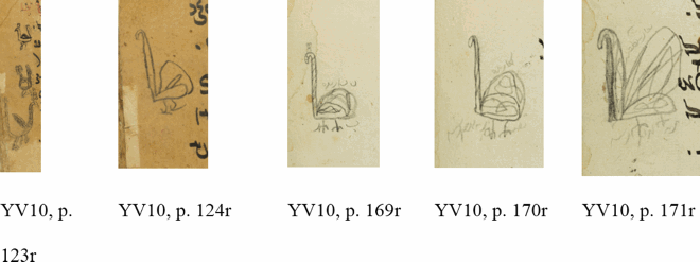
The following animal images are from V 8 (p. 165r) of this collection:
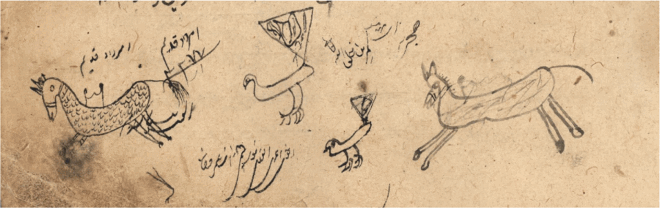
Directive. Generally, in Avestan manuscripts, there seems to be some evidence that a group of symbols or images are intended to direct the attention of the priest to particular parts. I call this type of marginal illustration a directive one. The images, mostly in the form of birds, play this type of marking role. When the priests Zūt and Rāspī perform a ritual, these markers function to lead them to particular points. The symbols send a reminder to the priests of what they should do in particular passages. In various places, images of the birds occur, particularly after Nērangs and other instructions, for example before or after tā sar goftan “recite until the end” (YV 10, p. 60v), se bār goftan hōm o urvarām koftan, hāwan škāftan “recite three times, press hoama and plant, and split mortar.”Footnote 226 bōy ōy ī ātaxš dahišn “giving fragrant plants to the fire” (YV 10, p. 34r), ēk goftan “recite once” (YV 10, p. 43v). Independent of the type of images, it seems that all these symbols have the same function of guiding the priests. Various groups of these symbols are listed below.
Circles (images from YV No. 10):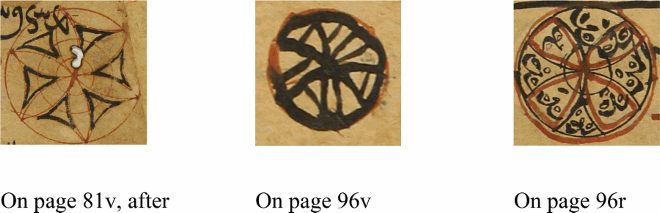
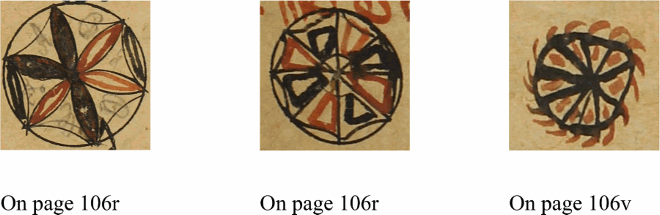
Illustrations of animals such as goats or mules (images from YV No. 10):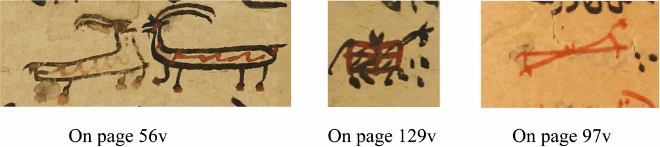
Human and animal: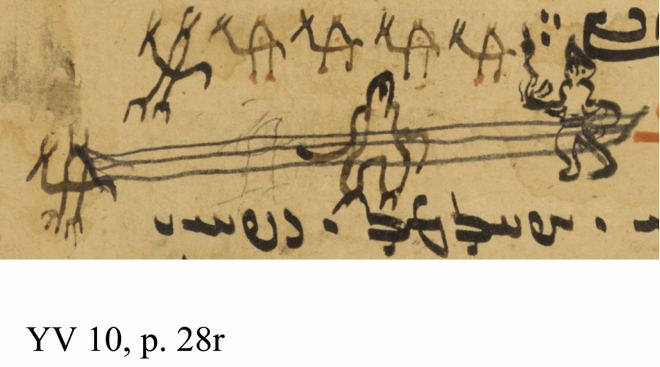
In the following image, it appears that the human image provides a textual explanation to the phrase bōy ōy ī ātaxš dahišn “giving smelling (plant)Footnote 227to the fire” (YV 10, p. 34r):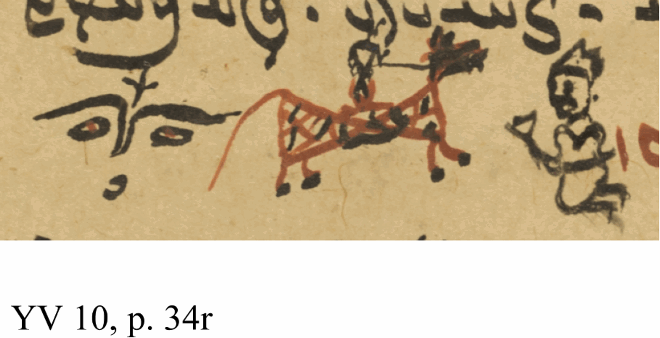
There are illustrations of various types of birds (images from YV No. 10):
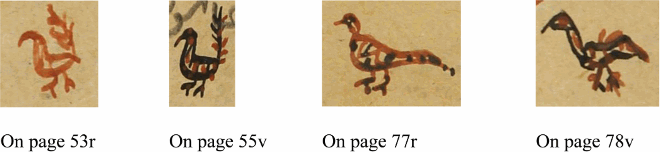
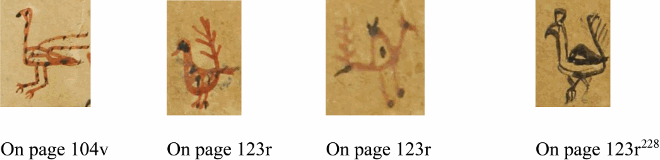
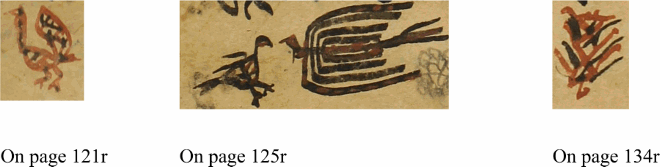
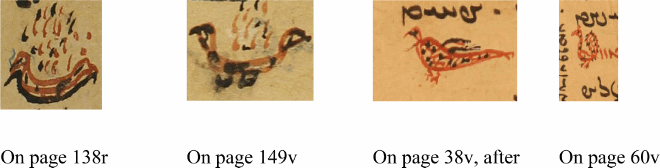
Separators. A group of marginal illustrations are used to separate parts of text. For example, in the following image, the symbols mark the parts of the humyast bon:

Separators can also occur at the beginning of a karde or fragard.
There is another group of symbols used in the main text, and these should not be confused with marginal illustrations. These symbols are punctuation marks and are of particular importance for the study of the codicology of Avestan manuscripts. A list of these symbols is given below:
Punctuation and symbols (images from YV No. 10):
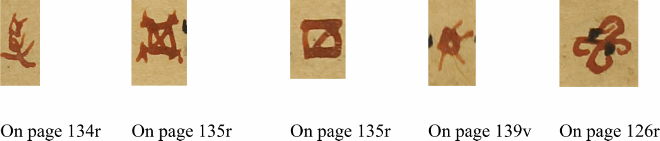
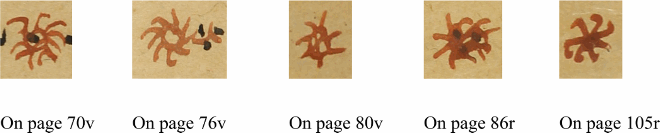
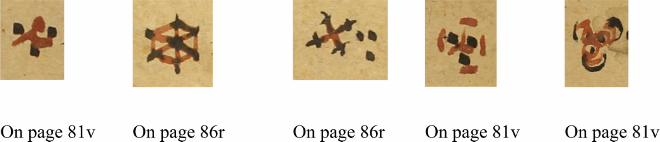
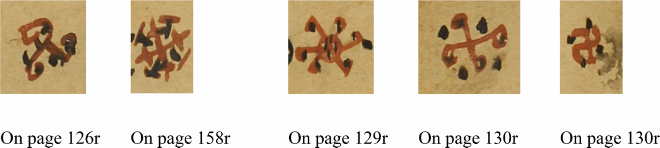
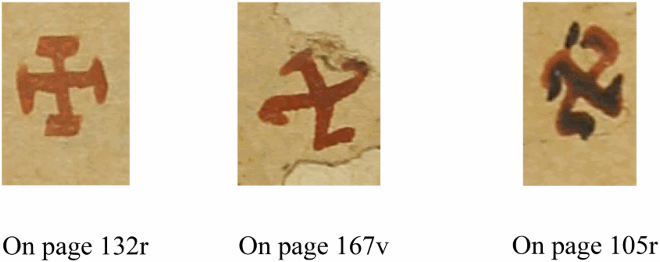
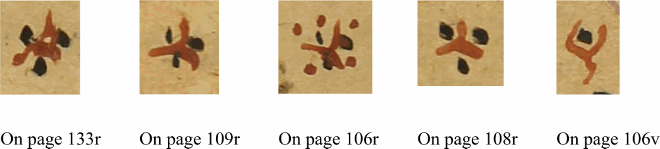
Numbers (images from YV No. 10):
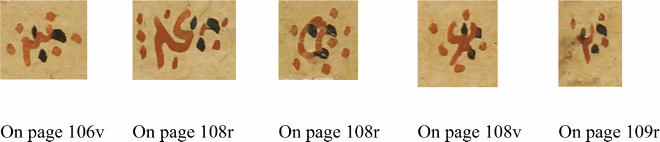
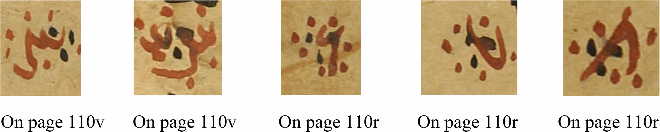
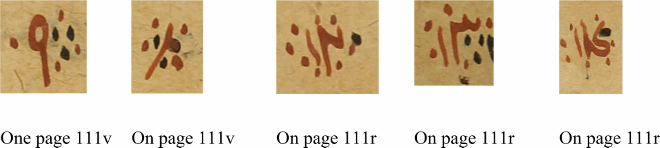
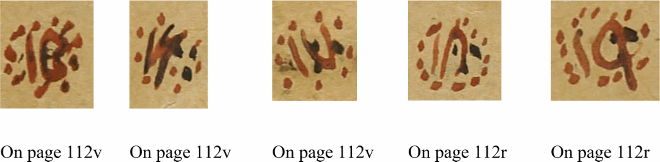
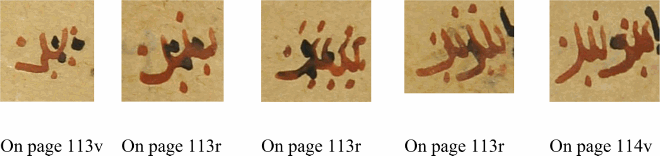
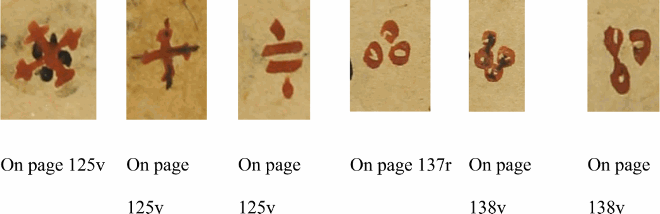
Conclusion
This paper has provided an overview of the scientific relevance and the different types of colophons, marginal notes, and marginal illustrations of the Avestan manuscripts of Pouladi’s Collection. This material gives us glimpses into the lives of scribes and provides relevant information about the manuscript, its contexts of production, its textual transmission, and its collation processes.
Colophons and marginal notes can be used as sources informing us about religious, historical, political, and social contexts as well as the scribe’s language.
Based on different types, this paper has established a more general classification of colophons and marginal notes with regard to contextual and functional characteristics. The Linguistic Speech Act Theory used by Schiegg to classify the colophons has been employed in this article to classify various parts of the colophons of Avestan manuscripts into four basic categories: (1) Assertives, as the part that provides contextual information about the scribe, the manuscript, and further religious, historical, and political contexts; (2) Expressives, as the part that demonstrates a scribe’s emotions and wishes; (3) Directives, which make the reader do something; and (4) Declaratives, which do something with the reader (such as curses). Finally, the paper has discussed two aspects of marginal notes of Avestan manuscripts, namely (a) their “characteristic features,” and (b) their reutilization for “immanent” purposes such as personal blessings, rogations, and prayers, and also for less “immanent” purposes such as prescriptions, contracts, and writing exercises added by later readers, users, or owners.

 spәṇtā gāθā° g
 uruuāin. Homenağe a Helmut Humbach en su 95 aniversario, ed.