












1 Introduction and the main results
Let
 $d\geqslant 3$
be a given integer. We denote by
 positive effectively computable constants which depend only on
 $d$
.
Let
 $K$
be a number field of degree
 $d$
. Denote by
 $\unicode[STIX]{x1D70E}_{1},\unicode[STIX]{x1D70E}_{2},\ldots ,\unicode[STIX]{x1D70E}_{d}$
the embeddings of
 $K$
into
 $\mathbb{C}$
and by
 $R$
the regulator of
 $K$
. Let
 $\unicode[STIX]{x1D6FC}\in K$
,
 $\unicode[STIX]{x1D6FC}\not =0$
, and let
 $a_{0}\in \mathbb{Z}$
,
 $a_{0}>0$
, be such that the coefficients of the polynomial
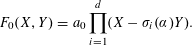
 $$\begin{eqnarray}f_{0}(X)=a_{0}\mathop{\prod }_{i=1}^{d}(X-\unicode[STIX]{x1D70E}_{i}(\unicode[STIX]{x1D6FC}))\end{eqnarray}$$
are in
 $\mathbb{Z}$
. Let
 $\unicode[STIX]{x1D710}$
be a unit in
 $K$
, not a root of unity. For
 $a\in \mathbb{Z}$
, define the polynomial
 $f_{a}(X)$
in
 $\mathbb{Z}[X]$
and the binary form
 $F_{a}(X,Y)$
in
 $\mathbb{Z}[X,Y]$
by
 $$\begin{eqnarray}f_{a}(X)=a_{0}\mathop{\prod }_{i=1}^{d}(X-\unicode[STIX]{x1D70E}_{i}(\unicode[STIX]{x1D6FC}\unicode[STIX]{x1D710}^{a}))\end{eqnarray}$$
and
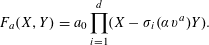
 $$\begin{eqnarray}F_{a}(X,Y)=Y^{d}f_{a}(X/Y)=a_{0}\mathop{\prod }_{i=1}^{d}(X-\unicode[STIX]{x1D70E}_{i}(\unicode[STIX]{x1D6FC}\unicode[STIX]{x1D710}^{a})Y).\end{eqnarray}$$
Define
 $$\begin{eqnarray}\unicode[STIX]{x1D706}_{0}=a_{0}\mathop{\prod }_{i=1}^{d}\max \{1,|\unicode[STIX]{x1D70E}_{i}(\unicode[STIX]{x1D6FC})|\}\quad \text{and}\quad \unicode[STIX]{x1D706}=\mathop{\prod }_{i=1}^{d}\max \{1,|\unicode[STIX]{x1D70E}_{i}(\unicode[STIX]{x1D710})|\}.\end{eqnarray}$$
Let
 $m\in \mathbb{Z}$
,
 $m>0$
. We consider the family of Diophantine inequalities
 $$\begin{eqnarray}0<|F_{a}(x,y)|\leqslant m,\end{eqnarray}$$
where the unknowns
 $(x,y,a)$
take their values in the set of elements in
 $\mathbb{Z}^{3}$
such that
 $xy\not =0$
and
 $\mathbb{Q}(\unicode[STIX]{x1D6FC}\unicode[STIX]{x1D710}^{a})=K$
. It follows from the results in [Reference Levesque and Waldschmidt4] that the set of solutions is finite. However, the proof in [Reference Levesque and Waldschmidt4] relies on Schmidt’s subspace theorem, which is not effective. Here by using lower bounds for linear forms in logarithms, we give an upper bound for
 $\max \{\log |x|,\log |y|,|a|\}$
, which is explicit in terms of
 $m$
,
 $R$
,
 $\unicode[STIX]{x1D706}_{0}$
and
 $\unicode[STIX]{x1D706}$
and which involves an effectively computable constant depending only on
 $d$
.
For
 $x\in \mathbb{R}$
,
 $x>0$
, we use the notation
 $\log ^{\ast }x$
to denote
 $\max \{1,\log x\}$
. Here is our main result.
Theorem 1. There exists an effectively computable constant  , depending only on
 $d$
, such that any solution
 $(x,y,a)\in \mathbb{Z}^{3}$
of (1), which verifies
 $xy\neq 0$
and
 $\mathbb{Q}(\unicode[STIX]{x1D6FC}\unicode[STIX]{x1D710}^{a})=K$
, satisfies

Under the assumptions of Theorem 1, with the help of the upper bound
 $$\begin{eqnarray}\text{H}(F_{a})\leqslant 2^{d}\unicode[STIX]{x1D706}_{0}\,\unicode[STIX]{x1D706}^{|a|}\end{eqnarray}$$
for the (usual) height of the form
 $F_{a}$
(namely the maximum of the absolute values of the coefficients of the form), it follows from the bound (3.2) in [Reference Bugeaud and Győry1, Theorem 3] (see also [Reference Evertse and Győry2, Theorem 9.6.2]) that

where  is an explicit constant depending only on
 $d$
. Combining this upper bound with our Theorem 1 provides an effective upper bound for
 $\max \{\log |x|,\log |y|,|a|\}$
.
Corollary 2. Under the assumptions of Theorem 1, there exists an effectively computable constant  depending only on
 $d$
such that

Our proof of Theorem 1 actually gives a much stronger estimate for
 $|a|$
; see Theorem 3 below. It involves an extra parameter
 $\unicode[STIX]{x1D707}>1$
that we now define.
For
 $i=1,\ldots ,d$
, set
 $\unicode[STIX]{x1D710}_{i}=\unicode[STIX]{x1D70E}_{i}(\unicode[STIX]{x1D710})$
and assume
 $$\begin{eqnarray}|\unicode[STIX]{x1D710}_{1}|\leqslant |\unicode[STIX]{x1D710}_{2}|\leqslant \cdots \leqslant |\unicode[STIX]{x1D710}_{d}|.\end{eqnarray}$$
Define
 $$\begin{eqnarray}\unicode[STIX]{x1D707}=\left\{\begin{array}{@{}ll@{}}\displaystyle \unicode[STIX]{x1D706}\quad & \text{if }|\unicode[STIX]{x1D710}_{1}|=|\unicode[STIX]{x1D710}_{d-1}|\text{or }|\unicode[STIX]{x1D710}_{2}|=|\unicode[STIX]{x1D710}_{d}|,\\ \displaystyle \min \biggl\{\!\frac{|\unicode[STIX]{x1D710}_{d-1}|}{|\unicode[STIX]{x1D710}_{1}|},\frac{|\unicode[STIX]{x1D710}_{d}|}{|\unicode[STIX]{x1D710}_{2}|}\!\biggr\}\quad & \text{if }|\unicode[STIX]{x1D710}_{1}|<|\unicode[STIX]{x1D710}_{2}|=|\unicode[STIX]{x1D710}_{d-1}|<|\unicode[STIX]{x1D710}_{d}|,\\ \displaystyle \frac{|\unicode[STIX]{x1D710}_{d-1}|}{|\unicode[STIX]{x1D710}_{2}|}\quad & \text{if }|\unicode[STIX]{x1D710}_{2}|<|\unicode[STIX]{x1D710}_{d-1}|.\end{array}\right.\end{eqnarray}$$
Notice that the condition
 $|\unicode[STIX]{x1D710}_{1}|=|\unicode[STIX]{x1D710}_{d-1}|$
means
 $|\unicode[STIX]{x1D710}_{1}|=|\unicode[STIX]{x1D710}_{2}|=\cdots =|\unicode[STIX]{x1D710}_{d-1}|$
and that the condition
 $|\unicode[STIX]{x1D710}_{2}|=|\unicode[STIX]{x1D710}_{d}|$
means
 $|\unicode[STIX]{x1D710}_{2}|=|\unicode[STIX]{x1D710}_{3}|=\cdots =|\unicode[STIX]{x1D710}_{d}|$
; using Lemma 12, we deduce that each of these two conditions implies that
 $d$
is odd, hence that the field
 $K$
is almost totally imaginary (namely, with a single real embedding)—compare with [Reference Levesque and Waldschmidt9].
Theorem 3. There exists a positive effectively computable constant  ,depending only on
 $d$
, with the following property. Let
 $(x,y,a)\in \mathbb{Z}^{3}$
satisfy
 $$\begin{eqnarray}xy\not =0,\quad [\mathbb{Q}(\unicode[STIX]{x1D6FC}\unicode[STIX]{x1D710}^{a}):\mathbb{Q}]=d\quad \text{and}\quad 0<|F_{a}(x,y)|\leqslant m.\end{eqnarray}$$
Then

On the one hand, using Lemma 13 (§3.6), we will prove in §5 that

which will enable us to deduce Theorem 1 from Theorem 3. On the other hand, thanks to (7), we have
 $\unicode[STIX]{x1D707}\leqslant \unicode[STIX]{x1D706}^{2}$
. Hence the largest possible value of
 $\unicode[STIX]{x1D707}$
is
 with a positive constant
 depending only on
 $d$
. For the units
 $\unicode[STIX]{x1D710}$
satisfying such an estimate, the conclusion of Theorem 3 becomes

with a positive effectively computable constant  depending only on
 $d$
. In §2, we give a few examples where this last bound is valid.
In Theorem 1, the hypothesis that
 $\unicode[STIX]{x1D710}$
is not a root of unity cannot be omitted. Here is an example with
 $\unicode[STIX]{x1D6FC}=\unicode[STIX]{x1D701}_{n}$
and
 $a_{0}=m=1$
. Let
 $\unicode[STIX]{x1D6F7}_{n}(X)$
be the cyclotomic polynomial of index
 $n$
and degree
 $\unicode[STIX]{x1D711}(n)$
(Euler totient function). Let
 $\unicode[STIX]{x1D701}_{n}$
be a primitive
 $n$
th root of unity. Set
 $f_{0}=\unicode[STIX]{x1D6F7}_{n}$
and
 $u=\unicode[STIX]{x1D701}_{n}$
. For
 $a\in \mathbb{Z}$
with
 $\gcd (a,n)=1$
, the irreducible polynomial
 $f_{a}$
of
 $\unicode[STIX]{x1D701}_{n}^{a}$
is nothing else than
 $f_{0}$
. Hence, if the equation
 $$\begin{eqnarray}F_{0}(x,y)=\pm 1\end{eqnarray}$$
has a solution
 $(x,y)\in \mathbb{Z}^{2}$
with
 $xy\not =0$
, then for infinitely many
 $a\in \mathbb{Z}$
the twisted Thue equation
 $F_{a}(x,y)=\pm 1$
has also the solution
 $(x,y)$
, since
 $F_{a}=F_{0}$
. For instance, when
 $n=12$
, we have
 $\unicode[STIX]{x1D6F7}_{12}(X)=X^{4}-X^{2}+1$
and the equation
 $$\begin{eqnarray}x^{4}-x^{2}y^{2}+y^{4}=1\end{eqnarray}$$
has the solutions
 $(1,1)$
,
 $(-1,1)$
,
 $(1,-1)$
,
 $(-1,-1)$
.
Let us compare the results of the present paper with our previous work.
The main result of [Reference Levesque and Waldschmidt5], which deals only with cubic equations which are not totally real, is a special case of Theorem 3; the “constants” in [Reference Levesque and Waldschmidt5] depend on
 $\unicode[STIX]{x1D6FC}$
and
 $\unicode[STIX]{x1D710}$
, while here they depend only on
 $d$
. The main result of [Reference Levesque and Waldschmidt6] deals with Thue equations twisted by a set of units which is not supposed to be a group of rank
 $1$
, but it involves an assumption (namely that at least two of the conjugates of
 $\unicode[STIX]{x1D710}$
have a modulus as large as a positive power of
 ) which we do not need here. Our Theorem 3 also improves the main result of [Reference Levesque and Waldschmidt7]: we remove the assumption that the unit is totally real (besides, the result of [Reference Levesque and Waldschmidt7] is not explicit in terms of the heights and regulator). We also notice that part (iii) of [Reference Levesque and Waldschmidt8, Theorem 1.1] follows from our Theorem 3. The main result of [Reference Levesque and Waldschmidt9] does not assume that the twists are done by a group of units of rank
 $1$
, but it needs a strong assumption which does not occur here, namely that the field
 $K$
has at most one real embedding.
2 Examples
The lower bound  quoted in §1 is true:
-
∙ when
 $d=3$
and the cubic field
$K$
is not totally real;
-
∙ for the Salem numbers;
-
∙ for the roots of the polynomials in the families giving the simplest fields of degree three (see [Reference Levesque and Waldschmidt8]), and also the simplest fields of degrees four and six; and
-
∙ when
$|\unicode[STIX]{x1D710}_{1}|=|\unicode[STIX]{x1D710}_{2}|$
and
$|\unicode[STIX]{x1D710}_{d-1}|=|\unicode[STIX]{x1D710}_{d}|$
with
$d\geqslant 4$
. In particular when
$-\unicode[STIX]{x1D710}$
is a Galois conjugate of
$\unicode[STIX]{x1D710}$
(which means that the irreducible polynomial of
$\unicode[STIX]{x1D710}$
is in
$\mathbb{Z}[X^{2}]$
).


Here is an example of this last situation. Let
 $\unicode[STIX]{x1D716}$
be an algebraic unit, not a root of unity, of degree
 $\ell \geqslant 2$
and conjugates
 $\unicode[STIX]{x1D716}_{1},\unicode[STIX]{x1D716}_{2},\ldots ,\unicode[STIX]{x1D716}_{\ell }$
. Let
 $h\geqslant 2$
and let
 $d=\ell h$
. For
 $a\in \mathbb{Z}$
, define
 $$\begin{eqnarray}F_{a}(X,Y)=\mathop{\prod }_{i=1}^{\ell }(X^{h}-\unicode[STIX]{x1D716}_{i}^{a}Y^{h}).\end{eqnarray}$$
Let
 $R$
be the regulator of the field
 $\mathbb{Q}(\unicode[STIX]{x1D716}^{1/h})$
. From Theorem 3 we deduce the following corollary.
Corollary 4. Let
 $m\geqslant 1$
. If the form
 $F_{a}$
in (5) is irreducible and if there exists
 $(x,y)\in \mathbb{Z}^{2}$
with
 $xy\not =0$
and
 $|F_{a}(x,y)|\leqslant m$
, then

Proof. Without loss of generality, assume
 $|\unicode[STIX]{x1D716}_{1}|\leqslant |\unicode[STIX]{x1D716}_{2}|\leqslant \ldots \leqslant |\unicode[STIX]{x1D716}_{\ell }|$
, so that
 . Let
 $\unicode[STIX]{x1D701}$
be a primitive
 $h$
th root of unity. Let
 $\unicode[STIX]{x1D710}=\unicode[STIX]{x1D716}^{1/h}$
. We apply Theorem 3 with
 $\unicode[STIX]{x1D6FC}=\unicode[STIX]{x1D701}$
,
 $a_{0}=1$
,
 $\unicode[STIX]{x1D706}_{0}=1$
,
 ,
 $F_{0}(X,Y)=(X^{h}-Y^{h})^{\ell }$
and
 $$\begin{eqnarray}\unicode[STIX]{x1D710}_{ih+j}=\unicode[STIX]{x1D701}^{j-1}\unicode[STIX]{x1D716}_{i+1}^{1/h}\quad (0\leqslant i\leqslant \ell -1,1\leqslant j\leqslant h).\end{eqnarray}$$
From
 $|\unicode[STIX]{x1D710}_{1}|=|\unicode[STIX]{x1D710}_{2}|=|\unicode[STIX]{x1D716}_{1}|^{1/h}<1$
and
 $|\unicode[STIX]{x1D710}_{d-1}|=|\unicode[STIX]{x1D710}_{d}|=|\unicode[STIX]{x1D716}_{\ell }|^{1/h}$
we deduce
 $$\begin{eqnarray}\unicode[STIX]{x1D707}=\biggl|\frac{\unicode[STIX]{x1D716}_{\ell }}{\unicode[STIX]{x1D716}_{1}}\biggr|^{1/h}=\biggl|\frac{\unicode[STIX]{x1D710}_{d}}{\unicode[STIX]{x1D710}_{1}}\biggr|\end{eqnarray}$$
and using (7) we conclude
 $$\begin{eqnarray}\hspace{108.00018pt}\log \unicode[STIX]{x1D707}\geqslant \frac{2}{d-1}\log \unicode[STIX]{x1D706}.\hspace{108.00018pt}\square\end{eqnarray}$$
A variant of this proof is to take
 $\unicode[STIX]{x1D6FC}=1$
,
 $\unicode[STIX]{x1D706}_{0}=1$
,
 $F_{0}(X,Y)=(X-Y)^{d}$
, and to use the fact that
 $\unicode[STIX]{x1D701}^{a}$
is also a primitive
 $h$
th root of unity since
 $F_{a}$
is irreducible.
Remark.
There are cases where
 $\unicode[STIX]{x1D707}$
is very small when compared to
 $\unicode[STIX]{x1D706}$
. Let
 $D$
be an integer
 ${\geqslant}2$
. Consider the algebraic number field
 $K=\mathbf{Q}(\unicode[STIX]{x1D714})$
where
 $\unicode[STIX]{x1D714}=\sqrt[d]{D^{d}-1}$
. The number
 $\unicode[STIX]{x1D710}=D-\unicode[STIX]{x1D714}$
is a Bernstein–Hasse unit of
 $K$
. When
 $d$
is fixed,
 $\unicode[STIX]{x1D706}$
is larger than
 , while
 $\unicode[STIX]{x1D707}$
is bounded above by
 . In this example, when
 $d$
is odd, the field
 $K$
is almost totally imaginary in the sense of [Reference Levesque and Waldschmidt9] and our proof yields the estimate (4). However, when
 $d$
is even, we are not able to prove the estimate (4): the estimate (3) has one extra factor
 $\log \unicode[STIX]{x1D706}$
.
3 Auxiliary results
3.1 Mahler measure, house and height
When
 $f$
is a polynomial in one variable of degree
 $d$
with coefficients in
 $\mathbb{Z}$
and leading coefficient
 $c_{0}>0$
, the Mahler measure of
 $f$
is
 $$\begin{eqnarray}\text{M}(f)=c_{0}\mathop{\prod }_{i=1}^{d}\max \{1,|\unicode[STIX]{x1D6FE}_{i}|\},\end{eqnarray}$$
where
 $\unicode[STIX]{x1D6FE}_{1},\unicode[STIX]{x1D6FE}_{2},\ldots ,\unicode[STIX]{x1D6FE}_{d}$
are the roots of
 $f$
in
 $\mathbb{C}$
.
Let us recallFootnote
1
that the logarithmic height
 $\text{h}(\unicode[STIX]{x1D6FE})$
of an algebraic number
 $\unicode[STIX]{x1D6FE}$
of degree
 $d$
is
 $(1/d)\log \text{M}(\unicode[STIX]{x1D6FE})$
where
 $\text{M}(\unicode[STIX]{x1D6FE})$
is the Mahler measure of the irreducible polynomial of
 $\unicode[STIX]{x1D6FE}$
. We have
 $$\begin{eqnarray}\text{M}(f)\leqslant \sqrt{d+1}\text{H}(f)\quad \text{and}\quad \text{H}(f)\leqslant 2^{d}\text{M}(f)\end{eqnarray}$$
(see [Reference Waldschmidt12, Annex to Ch. 3], Inequalities Between Different Heights of a Polynomial, pp. 113–114; see also [Reference Evertse and Győry2, §1.9]). The second upper bound in (6) could be replaced by the sharper one
 $$\begin{eqnarray}\text{H}(f)\leqslant \binom{d}{\lfloor d/2\rfloor }\text{M}(f),\end{eqnarray}$$
but we shall not need it.
Let
 $\unicode[STIX]{x1D710}$
be a unit of degree
 $d$
and conjugates
 $\unicode[STIX]{x1D710}_{1},\ldots ,\unicode[STIX]{x1D710}_{d}$
with
 $$\begin{eqnarray}|\unicode[STIX]{x1D710}_{1}|\leqslant |\unicode[STIX]{x1D710}_{2}|\leqslant \cdots \leqslant |\unicode[STIX]{x1D710}_{d}|,\end{eqnarray}$$
so that  . Let
 $\unicode[STIX]{x1D706}=\text{M}(\unicode[STIX]{x1D710})$
and let
 $s$
be an index in
 $\{1,\ldots ,d-1\}$
such that
 $$\begin{eqnarray}|\unicode[STIX]{x1D710}_{1}|\leqslant |\unicode[STIX]{x1D710}_{2}|\leqslant \cdots \leqslant |\unicode[STIX]{x1D710}_{s}|\leqslant 1\leqslant |\unicode[STIX]{x1D710}_{s+1}|\leqslant \cdots \leqslant |\unicode[STIX]{x1D710}_{d}|.\end{eqnarray}$$
We have
 $$\begin{eqnarray}\unicode[STIX]{x1D706}=\text{M}(\unicode[STIX]{x1D710})=|\unicode[STIX]{x1D710}_{s+1}\cdots \unicode[STIX]{x1D710}_{d}|\leqslant |\unicode[STIX]{x1D710}_{d}|^{d-s}\leqslant |\unicode[STIX]{x1D710}_{d}|^{d-1}\end{eqnarray}$$
and
 $$\begin{eqnarray}\text{M}(\unicode[STIX]{x1D710}^{-1})=|\unicode[STIX]{x1D710}_{1}\cdots \unicode[STIX]{x1D710}_{s}|^{-1}=\text{M}(\unicode[STIX]{x1D710})=\unicode[STIX]{x1D706}\end{eqnarray}$$
with
 $$\begin{eqnarray}\unicode[STIX]{x1D706}\leqslant |\unicode[STIX]{x1D710}_{1}|^{-s}\leqslant |\unicode[STIX]{x1D710}_{1}|^{-(d-1)}.\end{eqnarray}$$
Therefore we have
 $$\begin{eqnarray}\unicode[STIX]{x1D706}^{1/(d-1)}\leqslant |\unicode[STIX]{x1D710}_{d}|\leqslant \unicode[STIX]{x1D706}\quad \text{and}\quad \unicode[STIX]{x1D706}^{-1}\leqslant |\unicode[STIX]{x1D710}_{1}|\leqslant \unicode[STIX]{x1D706}^{-1/(d-1)}.\end{eqnarray}$$
3.2 An elementary result
For the convenience of the reader, we include the following elementary result—similar arguments are often used without explicit mention in the literature.
Lemma 5. Let
 $U$
and
 $V$
be positive numbers satisfying
 $\;U\leqslant V\log ^{\star }U$
. Then
 $U<2V\log ^{\star }V$
.
Proof. If
 $\log U\leqslant 1$
, the assumption is
 $U\leqslant V$
and the conclusion follows. Assume
 $\log U>1$
. Then
 $\log U\leqslant \sqrt{U}$
, hence the hypothesis of the lemma implies
 $U\leqslant V\sqrt{U}$
and therefore we have
 $U\leqslant V^{2}$
. We deduce
 $$\begin{eqnarray}\log U\leqslant 2\log V,\end{eqnarray}$$
hence
 $$\begin{eqnarray}\hspace{98.00017pt}U\leqslant V\log U\leqslant 2V\log V.\hspace{98.00017pt}\square\end{eqnarray}$$
3.3 Diophantine tool
In this section only, the positive integer
 $d$
is not restricted to
 $d\geqslant 3$
.
The main tool is the following Diophantine estimate ([Reference Levesque and Waldschmidt6, Proposition 2], [Reference Waldschmidt12, Theorem 9.1] or [Reference Evertse and Győry2, Theorem 3.2.4]), the proof of which uses transcendental number theory.
Proposition 6. Let
 $s$
and
 $D$
be two positive integers. There exists an effectively computable positive constant
 $\unicode[STIX]{x1D705}(s,D)$
, depending only upon
 $s$
and
 $D$
, with the following property. Let
 $\unicode[STIX]{x1D702}_{1},\ldots ,\unicode[STIX]{x1D702}_{s}$
be non-zero algebraic numbers generating a number field of degree
 ${\leqslant}D$
. Let
 $c_{1},\ldots ,c_{s}$
be rational integers and let
 $H_{1},\ldots ,H_{s}$
be real numbers
 ${\geqslant}1$
satisfying
 $$\begin{eqnarray}H_{i}\geqslant \text{h}(\unicode[STIX]{x1D702}_{i})\quad (1\leqslant i\leqslant s).\end{eqnarray}$$
Let
 $C$
be a real number with
 $C\geqslant 2$
. Suppose that one of the following two statements is true:
-
(i)
$C\geqslant \underset{1\leqslant j\leqslant s}{\max }|c_{j}|$

or
-
(ii)
$H_{j}\leqslant H_{s}$
for
$1\leqslant j\leqslant s$
and
$$\begin{eqnarray}C\geqslant \max _{1\leqslant j\leqslant s}\biggl\{\frac{H_{j}}{H_{s}}|c_{j}|\biggr\}.\end{eqnarray}$$


Suppose also
 $\unicode[STIX]{x1D702}_{1}^{c_{1}}\cdots \unicode[STIX]{x1D702}_{s}^{c_{s}}\not =1$
. Then
 $$\begin{eqnarray}|\unicode[STIX]{x1D702}_{1}^{c_{1}}\cdots \unicode[STIX]{x1D702}_{s}^{c_{s}}-1|>\exp \{-\unicode[STIX]{x1D705}(s,D)H_{1}\cdots H_{s}\log C\}.\end{eqnarray}$$
The statement (ii) of Proposition 6 implies the statement (i) by permuting the indices so that
 $H_{j}\leqslant H_{s}$
for
 $1\leqslant j\leqslant s$
; however, we find it more convenient to use part (i) so that we can use the estimate without permuting the indices.
We will use Proposition 6 several times. Here is a first consequence.
Corollary 7. Let
 $d\geqslant 1$
. There exists an effectively computable constant
 , which depends only on
 $d$
, with the following property. Let
 $K$
be a number field of degree
 $d$
. Let
 $\unicode[STIX]{x1D6FC}_{1}$
,
 $\unicode[STIX]{x1D6FC}_{2}$
,
 $\unicode[STIX]{x1D710}_{1}$
,
 $\unicode[STIX]{x1D710}_{2}$
be non-zero elements in
 $K$
and let
 $a$
be a non-zero integer. Set
 $\unicode[STIX]{x1D6FE}_{1}=\unicode[STIX]{x1D6FC}_{1}\unicode[STIX]{x1D710}_{1}^{a}$
and
 $\unicode[STIX]{x1D6FE}_{2}=\unicode[STIX]{x1D6FC}_{2}\unicode[STIX]{x1D710}_{2}^{a}$
. Let
 $\unicode[STIX]{x1D706}_{0}$
and
 $\unicode[STIX]{x1D706}$
satisfy
 $$\begin{eqnarray}\max \{\text{h}(\unicode[STIX]{x1D6FC}_{1}),\text{h}(\unicode[STIX]{x1D6FC}_{2})\}\leqslant \log \unicode[STIX]{x1D706}_{0},\qquad \max \{\text{h}(\unicode[STIX]{x1D710}_{1}),\text{h}(\unicode[STIX]{x1D710}_{2})\}\leqslant \log \unicode[STIX]{x1D706}\end{eqnarray}$$
and assume
 $\unicode[STIX]{x1D6FE}_{1}\not =\unicode[STIX]{x1D6FE}_{2}$
. Define
 $$\begin{eqnarray}\unicode[STIX]{x1D712}=(\log ^{\star }\unicode[STIX]{x1D706}_{0})(\log ^{\star }\unicode[STIX]{x1D706})\log ^{\star }\biggl(|a|\min \biggl\{1,\frac{\log ^{\star }\unicode[STIX]{x1D706}}{\log ^{\star }\unicode[STIX]{x1D706}_{0}}\biggr\}\biggr).\end{eqnarray}$$
Then

Proof. By symmetry, without loss of generality, we may assume
 $|\unicode[STIX]{x1D6FE}_{2}|\geqslant |\unicode[STIX]{x1D6FE}_{1}|$
. Set
 $$\begin{eqnarray}\displaystyle & \displaystyle s=2,\qquad \unicode[STIX]{x1D702}_{1}=\frac{\unicode[STIX]{x1D710}_{1}}{\unicode[STIX]{x1D710}_{2}},\qquad \unicode[STIX]{x1D702}_{2}=\frac{\unicode[STIX]{x1D6FC}_{1}}{\unicode[STIX]{x1D6FC}_{2}},\qquad c_{1}=a,\qquad c_{2}=1, & \displaystyle \nonumber\\ \displaystyle & \displaystyle H_{1}=2\log ^{\star }\unicode[STIX]{x1D706},\qquad H_{2}=2\log ^{\star }\unicode[STIX]{x1D706}_{0},\qquad C=\max \biggl\{2,|a|\min \biggl\{1,\frac{H_{1}}{H_{2}}\biggr\}\biggr\}. & \displaystyle \nonumber\end{eqnarray}$$
The conclusion of Corollary 7 follows from Proposition 6 (via part (i) if
 $H_{1}\geqslant H_{2}$
, via part (ii) otherwise), thanks to the relation
 $$\begin{eqnarray}\hspace{90.00014pt}|\unicode[STIX]{x1D702}_{1}^{c_{1}}\unicode[STIX]{x1D702}_{2}^{c_{2}}-1|=|\unicode[STIX]{x1D6FE}_{2}|^{-1}|\unicode[STIX]{x1D6FE}_{1}-\unicode[STIX]{x1D6FE}_{2}|.\hspace{90.00014pt}\square\end{eqnarray}$$
3.4 Lower bound for the height and the regulator
For the record, we quote Kronecker’s theorem and its effective improvement.
Lemma 8.
-
(a) If a non-zero algebraic integer
$\unicode[STIX]{x1D6FC}$
has all its conjugates in the closed unit disc
$\{z\in \mathbb{C}\mid |z|\leqslant 1\}$
, then
$\unicode[STIX]{x1D6FC}$
is a root of unity. -
(b) More precisely, given
$d\geqslant 1$
, there exists an effectively computable positive constant , depending only on
$d$
, such that, if
$\unicode[STIX]{x1D6FC}$
is a non-zero algebraic integer of degree
$d$
satisfying , then
$\unicode[STIX]{x1D6FC}$
is a root of unity.


 , depending only on


 , then

Proof. Voutier (1996) refined an earlier estimate due to Dobrowolski (1979) by proving that the conclusion of part (b) in Lemma 8 holds with

See for instance [Reference Evertse and Győry2, Proposition 3.2.9] and [Reference Waldschmidt12, §3.6]. ◻
Lemma 9. There exists an explicit absolute constant  such that the regulator
 $R$
of any number field of degree
 ${\geqslant}2$
satisfies
 .
Proof. According to a result of Friedman (1989—see [Reference Evertse and Győry2, (1.5.3)]) the conclusion of Lemma 9 holds with  .◻
3.5 A basis of units of an algebraic number field
Let us quote Lemma 1 of [Reference Bugeaud and Győry1]. See also [Reference Evertse and Győry2, Proposition 4.3.9]. The result is essentially due to Siegel [Reference Siegel11].
Proposition 10. Let
 $d$
be a positive integer with
 $d\geqslant 3$
. There exist effectively computable constants
 depending only on
 $d$
, with the following property. Let
 $K$
be a number field of degree
 $d$
, with unit group of rank
 $r$
. Let
 $R$
be the regulator of this field. Denote by
 $\unicode[STIX]{x1D711}_{1},\unicode[STIX]{x1D711}_{2},\ldots ,\unicode[STIX]{x1D711}_{r}$
a set of
 $r$
embeddings of
 $K$
into
 $\mathbb{C}$
containing the real embeddings and no pair of conjugate embeddings. Then there exists a fundamental system of units
 $\{\unicode[STIX]{x1D716}_{1},\unicode[STIX]{x1D716}_{2},\ldots ,\unicode[STIX]{x1D716}_{r}\}$
of
 $K$
which satisfies the following:
-
(i)
; -
(ii)
; -
(iii) the absolute values of the entries of the inverse matrix of
do not exceed
$$\begin{eqnarray}(\log |\unicode[STIX]{x1D711}_{j}(\unicode[STIX]{x1D716}_{i})|)_{1\leqslant i,j\leqslant r}\end{eqnarray}$$
.
 ;
 ;

 .
The next result is [Reference Shorey and Tijdeman10, Lemma A.15].
Lemma 11. Let
 $\unicode[STIX]{x1D716}_{1},\unicode[STIX]{x1D716}_{2},\ldots ,\unicode[STIX]{x1D716}_{r}$
be an independent system of units for
 $K$
satisfying the condition (ii) of Proposition 10. Let
 $\unicode[STIX]{x1D6FD}\in \mathbb{Z}_{K}$
with
 $\text{N}_{K/\mathbb{Q}}(\unicode[STIX]{x1D6FD})=m\not =0$
. Then there exist
 $b_{1},b_{2},\ldots ,b_{r}$
in
 $\mathbb{Z}$
and
 $\tilde{\unicode[STIX]{x1D6FD}}\in \mathbb{Z}_{K}$
with conjugates
 $\tilde{\unicode[STIX]{x1D6FD}}_{1},\tilde{\unicode[STIX]{x1D6FD}}_{2},\ldots ,\tilde{\unicode[STIX]{x1D6FD}}_{d}$
, satisfying
 $$\begin{eqnarray}\unicode[STIX]{x1D6FD}=\tilde{\unicode[STIX]{x1D6FD}}\unicode[STIX]{x1D716}_{1}^{b_{1}}\unicode[STIX]{x1D716}_{2}^{b_{2}}\cdots \unicode[STIX]{x1D716}_{r}^{b_{r}}\end{eqnarray}$$
and

The conclusion of Lemma 11 can be written

3.6 Estimates for the conjugates
Lemma 12. Let
 $\unicode[STIX]{x1D6FE}$
be an algebraic number of degree
 $d\geqslant 3$
. Let
 $\unicode[STIX]{x1D6FE}_{1}$
,
 $\unicode[STIX]{x1D6FE}_{2}$
,
 $\ldots \,$
,
 $\unicode[STIX]{x1D6FE}_{d}$
be the conjugates of
 $\unicode[STIX]{x1D6FE}$
with
 $|\unicode[STIX]{x1D6FE}_{1}|\leqslant |\unicode[STIX]{x1D6FE}_{2}|\leqslant \cdots \leqslant |\unicode[STIX]{x1D6FE}_{d}|$
.
-
(a) If
$|\unicode[STIX]{x1D6FE}_{1}|<|\unicode[STIX]{x1D6FE}_{2}|$
and
$\unicode[STIX]{x1D6FE}_{2}\in \mathbb{R}$
, then
$|\unicode[STIX]{x1D6FE}_{2}|<|\unicode[STIX]{x1D6FE}_{3}|$
. -
(b) If
$|\unicode[STIX]{x1D6FE}_{d-1}|<|\unicode[STIX]{x1D6FE}_{d}|$
and
$\unicode[STIX]{x1D6FE}_{d-1}\in \mathbb{R}$
, then
$|\unicode[STIX]{x1D6FE}_{d-2}|<|\unicode[STIX]{x1D6FE}_{d-1}|$
.


Proof. (a) The conditions
 $|\unicode[STIX]{x1D6FE}_{1}|<|\unicode[STIX]{x1D6FE}_{2}|\leqslant |\unicode[STIX]{x1D6FE}_{i}|$
for
 $3\leqslant i\leqslant d$
imply that
 $\unicode[STIX]{x1D6FE}_{1}$
is real and that
 $-\unicode[STIX]{x1D6FE}_{1}$
is not a conjugate of
 $\unicode[STIX]{x1D6FE}_{1}$
. Hence the minimal polynomial of
 $\unicode[STIX]{x1D6FE}$
is not a polynomial in
 $X^{2}$
. Assume
 $|\unicode[STIX]{x1D6FE}_{2}|=|\unicode[STIX]{x1D6FE}_{3}|$
. Since
 $-\unicode[STIX]{x1D6FE}_{2}$
is not a conjugate of
 $\unicode[STIX]{x1D6FE}_{2}$
, we deduce
 $\unicode[STIX]{x1D6FE}_{3}\not \in \mathbb{R}$
, hence
 $d\geqslant 4$
. We may assume
 $\unicode[STIX]{x1D6FE}_{4}=\overline{\unicode[STIX]{x1D6FE}_{3}}$
. Let
 $\unicode[STIX]{x1D70E}$
be an automorphism of
 $\overline{\mathbb{Q}}$
which maps
 $\unicode[STIX]{x1D6FE}_{2}$
to
 $\unicode[STIX]{x1D6FE}_{1}$
; via
 $\unicode[STIX]{x1D70E}$
, let
 $\unicode[STIX]{x1D6FE}_{j}$
be the image of
 $\unicode[STIX]{x1D6FE}_{3}$
and
 $\unicode[STIX]{x1D6FE}_{k}$
the image of
 $\unicode[STIX]{x1D6FE}_{4}$
. From
 $$\begin{eqnarray}\unicode[STIX]{x1D6FE}_{2}^{2}=\unicode[STIX]{x1D6FE}_{3}\unicode[STIX]{x1D6FE}_{4}\end{eqnarray}$$
we deduce
 $\unicode[STIX]{x1D6FE}_{1}^{2}=\unicode[STIX]{x1D6FE}_{j}\unicode[STIX]{x1D6FE}_{k}$
and
 $|\unicode[STIX]{x1D6FE}_{1}|^{2}=|\unicode[STIX]{x1D6FE}_{j}\unicode[STIX]{x1D6FE}_{k}|$
. This is not possible since
 $|\unicode[STIX]{x1D6FE}_{j}|>|\unicode[STIX]{x1D6FE}_{1}|$
and
 $|\unicode[STIX]{x1D6FE}_{k}|>|\unicode[STIX]{x1D6FE}_{1}|$
.
(b) We deduce (b) from (a), by using
 $\unicode[STIX]{x1D6FE}\mapsto 1/\unicode[STIX]{x1D6FE}$
(or by repeating the proof, mutatis mutandis).◻
Remark.
Here is an example showing that the assumptions of Lemma 12 are sharp. The polynomial
 $X^{4}-4X^{2}+1$
is irreducible, its roots are
 $$\begin{eqnarray}\unicode[STIX]{x1D710}_{1}=\sqrt{2-\sqrt{3}},\qquad \unicode[STIX]{x1D710}_{2}=-\unicode[STIX]{x1D710}_{1},\qquad \unicode[STIX]{x1D710}_{3}=1/\unicode[STIX]{x1D710}_{1}=\sqrt{2+\sqrt{3}},\qquad \unicode[STIX]{x1D710}_{4}=-\unicode[STIX]{x1D710}_{3}\end{eqnarray}$$
with
 $$\begin{eqnarray}\unicode[STIX]{x1D710}_{1}=|\unicode[STIX]{x1D710}_{2}|<\unicode[STIX]{x1D710}_{3}=|\unicode[STIX]{x1D710}_{4}|.\end{eqnarray}$$
More generally, if
 $h\geqslant 2$
is a positive integer and
 $\unicode[STIX]{x1D716}$
is a quadratic unit with Galois conjugate
 $\unicode[STIX]{x1D716}^{\prime }$
and if
 $\unicode[STIX]{x1D716}^{1/h}$
has degree
 $2h$
, then it has
 $h$
conjugates of absolute value
 $|\unicode[STIX]{x1D716}|^{1/h}$
and
 $h$
conjugates of absolute value
 $|\unicode[STIX]{x1D716}^{\prime }|^{1/h}$
. See also §2.
Lemma 13. Let
 $\unicode[STIX]{x1D710}$
be an algebraic unit of degree
 $d\geqslant 3$
. Set
 $\unicode[STIX]{x1D706}=\text{M}(\unicode[STIX]{x1D710})$
. Let
 $\unicode[STIX]{x1D710}^{\prime }$
and
 $\unicode[STIX]{x1D710}^{\prime \prime }$
be two conjugates of
 $\unicode[STIX]{x1D710}$
with
 $|\unicode[STIX]{x1D710}^{\prime }|<|\unicode[STIX]{x1D710}^{\prime \prime }|$
. Then

We will deduce Lemma 13 from [Reference Gourdon and Salvy3, Theorem 1] whichFootnote 2 states the following.
Lemma 14 (Gourdon and Salvy [Reference Gourdon and Salvy3]).
Let
 $P$
be a polynomial of degree
 $d\geqslant 2$
with integer coefficients and with Mahler measure
 $\text{M}(P)$
. If
 $\unicode[STIX]{x1D6FC}^{\prime }$
and
 $\unicode[STIX]{x1D6FC}^{\prime \prime }$
are two roots of
 $P$
with
 $|\unicode[STIX]{x1D6FC}^{\prime }|<|\unicode[STIX]{x1D6FC}^{\prime \prime }|$
, then

with

Proof of Lemma 13.
We apply Lemma 14 to the minimal polynomial of
 $\unicode[STIX]{x1D710}$
. To conclude the proof of Lemma 13, we use the bounds
 $|\unicode[STIX]{x1D710}^{\prime }|\leqslant \unicode[STIX]{x1D706}$
and
 $$\begin{eqnarray}\hspace{45.00006pt}\log (1+x)\geqslant \frac{x}{2}\quad \text{for }0\leqslant x\leqslant 1\text{ with }x=\frac{|\unicode[STIX]{x1D710}^{\prime \prime }|}{|\unicode[STIX]{x1D710}^{\prime }|}-1.\hspace{45.00006pt}\square\end{eqnarray}$$
4 Proof of Theorem 3
In order to prove Theorem 3 with the assumption
 $|F_{a}(x,y)|\leqslant m$
, it suffices to consider the equation
 $F_{a}(x,y)=m$
with
 $m\neq 0$
.
Let
 $(a,x,y,m)\in \mathbb{Z}^{4}$
satisfy
 $m\not =0$
,
 $xy\not =0$
,
 $[\mathbb{Q}(\unicode[STIX]{x1D6FC}\unicode[STIX]{x1D710}^{a}):\mathbb{Q}]=d$
and
 $$\begin{eqnarray}F_{a}(x,y)=m.\end{eqnarray}$$
Without loss of generality, we may restrict
 $(a,y)$
to
 $a\geqslant 0$
(otherwise, replace
 $\unicode[STIX]{x1D710}$
by
 $\unicode[STIX]{x1D710}^{-1}$
) and to
 $y>0$
(otherwise replace
 $F_{a}(X,Y)$
by
 $F_{a}(X,-Y)$
).
The form
 $\tilde{F}_{a}(X,Y)=a_{0}^{d-1}F_{a}(X,Y)$
has coefficients in
 $\mathbb{Z}$
, and if we set
 $\tilde{x}=a_{0}x$
,
 ${\tilde{y}}=y$
,
 $\tilde{m}=a_{0}^{d-1}m$
we have
 $\tilde{F}_{a}(\tilde{x},{\tilde{y}})=\tilde{m}$
with
 $(\tilde{x},{\tilde{y}})\in \mathbb{Z}^{2}$
. Therefore, there is no loss of generality to assume
 $a_{0}=1$
.
Theorem 3 includes the assumption that
 $\unicode[STIX]{x1D710}$
is not a root of unity, hence
 $\unicode[STIX]{x1D706}>1$
. More precisely, it follows from part (b) of Lemma 8 that

In particular, we have

an inequality which can be written

with an effectively computable constant  .
From Lemma 9, we deduce that  . Therefore, there is no loss of generality to assume that, for a sufficiently large constant
 , we have

This hypothesis will frequently be used, sometimes without explicit mention.
By assumption,
 $\mathbb{Q}(\unicode[STIX]{x1D6FC}\unicode[STIX]{x1D710}^{a})=K$
. If some conjugate
 $\unicode[STIX]{x1D70E}_{j}(\unicode[STIX]{x1D6FC}\unicode[STIX]{x1D710}^{a})$
of
 $\unicode[STIX]{x1D6FC}\unicode[STIX]{x1D710}^{a}$
is real, then it follows that
 $\unicode[STIX]{x1D70E}_{j}(K)\subset \mathbb{R}$
, hence the embedding
 $\unicode[STIX]{x1D70E}_{j}$
is real, and
 $\unicode[STIX]{x1D6FC}_{j}$
and
 $\unicode[STIX]{x1D710}_{j}$
are both real. We also notice that if
 $\unicode[STIX]{x1D70E}_{j}(\unicode[STIX]{x1D710})=-\unicode[STIX]{x1D70E}_{i}(\unicode[STIX]{x1D710})$
with
 $i\not =j$
, then it follows that
 $\unicode[STIX]{x1D710}$
and
 $-\unicode[STIX]{x1D710}$
are conjugate, hence the irreducible polynomial of
 $\unicode[STIX]{x1D710}$
belongs to
 $\mathbb{Z}[X^{2}]$
.
Recall that
 $\unicode[STIX]{x1D710}_{i}=\unicode[STIX]{x1D70E}_{i}(\unicode[STIX]{x1D710})$
(
 $i=1,\ldots ,d$
) and that
 $$\begin{eqnarray}|\unicode[STIX]{x1D710}_{1}|\leqslant |\unicode[STIX]{x1D710}_{2}|\leqslant \cdots \leqslant |\unicode[STIX]{x1D710}_{d}|.\end{eqnarray}$$
Let us write
 $\unicode[STIX]{x1D6FC}_{i}$
for
 $\unicode[STIX]{x1D70E}_{i}(\unicode[STIX]{x1D6FC})$
(
 $i=1,\ldots ,d$
). Let
 $$\begin{eqnarray}\unicode[STIX]{x1D6FE}=\unicode[STIX]{x1D6FC}\unicode[STIX]{x1D710}^{a}\qquad \text{and}\qquad \unicode[STIX]{x1D6FD}=x-\unicode[STIX]{x1D6FE}y.\end{eqnarray}$$
Since
 $a_{0}=1$
, it follows that
 $\unicode[STIX]{x1D6FC}$
,
 $\unicode[STIX]{x1D6FD}$
and
 $\unicode[STIX]{x1D6FE}$
are algebraic integers in
 $K$
. For
 $j=1,2,\ldots ,d$
, define
 $\unicode[STIX]{x1D6FE}_{j}$
and
 $\unicode[STIX]{x1D6FD}_{j}$
by
 $$\begin{eqnarray}\unicode[STIX]{x1D6FE}_{j}=\unicode[STIX]{x1D70E}_{j}(\unicode[STIX]{x1D6FE})=\unicode[STIX]{x1D6FC}_{j}\unicode[STIX]{x1D710}_{j}^{a},\qquad \unicode[STIX]{x1D6FD}_{j}=\unicode[STIX]{x1D70E}_{j}(\unicode[STIX]{x1D6FD})=x-\unicode[STIX]{x1D6FC}_{j}\unicode[STIX]{x1D710}_{j}^{a}y=x-\unicode[STIX]{x1D6FE}_{j}y.\end{eqnarray}$$
The assumption
 $F_{a}(x,y)=m$
yields
 $\unicode[STIX]{x1D6FD}_{1}\unicode[STIX]{x1D6FD}_{2}\ldots \unicode[STIX]{x1D6FD}_{d}=m$
. Let
 $i_{0}\in \{1,2,\ldots ,d\}$
be an index such that
 $$\begin{eqnarray}|\unicode[STIX]{x1D6FD}_{i_{0}}|=\min _{1\leqslant i\leqslant d}|\unicode[STIX]{x1D6FD}_{i}|.\end{eqnarray}$$
We define
 $\unicode[STIX]{x1D6F9}_{1},\unicode[STIX]{x1D6F9}_{2},\ldots ,\unicode[STIX]{x1D6F9}_{d}$
by the following conditions:
 $$\begin{eqnarray}\unicode[STIX]{x1D6FD}_{i}=\left\{\begin{array}{@{}ll@{}}\unicode[STIX]{x1D6FE}_{i_{0}}y\unicode[STIX]{x1D6F9}_{i}\quad & \text{for }1\leqslant i<i_{0},\\ \unicode[STIX]{x1D6FE}_{i}y\unicode[STIX]{x1D6F9}_{i}\quad & \text{for }i_{0}<i\leqslant d,\end{array}\right.\end{eqnarray}$$
and
 $$\begin{eqnarray}\unicode[STIX]{x1D6FD}_{i_{0}}=\frac{m}{y^{d-1}}\cdot \frac{\unicode[STIX]{x1D6FE}_{1}\unicode[STIX]{x1D6FE}_{2}\cdots \unicode[STIX]{x1D6FE}_{i_{0}-1}}{\unicode[STIX]{x1D6FE}_{i_{0}}^{i_{0}-2}}\unicode[STIX]{x1D6F9}_{i_{0}}.\end{eqnarray}$$
We split the proof into several steps.
Step 1. We start by proving that
 $$\begin{eqnarray}|x|\leqslant 2\unicode[STIX]{x1D706}_{0}\unicode[STIX]{x1D706}^{a}y\end{eqnarray}$$
and that there exists an effectively computable positive constant  depending only on
 $d$
such that

with
 $$\begin{eqnarray}\unicode[STIX]{x1D712}=(\log ^{\star }\unicode[STIX]{x1D706}_{0})(\log \unicode[STIX]{x1D706})\log \biggl(a\min \biggl\{1,\frac{\log \unicode[STIX]{x1D706}}{\log ^{\star }\unicode[STIX]{x1D706}_{0}}\biggr\}\biggr).\end{eqnarray}$$
From the estimate (11) we will deduce
 $$\begin{eqnarray}|\unicode[STIX]{x1D6FD}_{i_{0}}|<|\unicode[STIX]{x1D6FD}_{i}|\end{eqnarray}$$
for
 $i\not =i_{0}$
, which implies
 $\unicode[STIX]{x1D6FC}_{i_{0}}\in \mathbb{R}$
and
 $\unicode[STIX]{x1D710}_{i_{0}}\in \mathbb{R}$
.


Proof of (10) and (11).
We have
 $$\begin{eqnarray}|x|=|\unicode[STIX]{x1D6FD}_{i_{0}}+\unicode[STIX]{x1D6FE}_{i_{0}}y|\leqslant |\unicode[STIX]{x1D6FD}_{i_{0}}|+|\unicode[STIX]{x1D6FE}_{i_{0}}|y.\end{eqnarray}$$
From
 $|\unicode[STIX]{x1D6FD}_{i_{0}}|\leqslant |\unicode[STIX]{x1D6FD}_{i}|$
for
 $i=1,2,\ldots ,d$
and
 $\unicode[STIX]{x1D6FD}_{1}\cdots \unicode[STIX]{x1D6FD}_{d}=m$
, we deduce
 $|\unicode[STIX]{x1D6FD}_{i_{0}}|\leqslant |m|^{1/d}$
, hence
 $$\begin{eqnarray}|x|\leqslant |m|^{1/d}+|\unicode[STIX]{x1D6FE}_{i_{0}}|y\leqslant |m|^{1/d}+\unicode[STIX]{x1D706}_{0}\unicode[STIX]{x1D706}^{a}y.\end{eqnarray}$$
Using the assumption (9), we check
 $|m|^{1/d}\leqslant \unicode[STIX]{x1D706}_{0}\unicode[STIX]{x1D706}^{a}y$
, whereupon the inequality (10) is secured.
We also have
 $$\begin{eqnarray}|\unicode[STIX]{x1D6FD}_{i_{0}}|^{d-1}\max _{1\leqslant i\leqslant d}|\unicode[STIX]{x1D6FD}_{i}|\leqslant |m|.\end{eqnarray}$$
For
 $i=1,2,\ldots ,d$
, we write
 $$\begin{eqnarray}\unicode[STIX]{x1D6FD}_{i}=\unicode[STIX]{x1D6FD}_{i_{0}}+y(\unicode[STIX]{x1D6FE}_{i_{0}}-\unicode[STIX]{x1D6FE}_{i}).\end{eqnarray}$$
We have
 $$\begin{eqnarray}|\unicode[STIX]{x1D6FC}_{1}\unicode[STIX]{x1D6FC}_{2}\cdots \unicode[STIX]{x1D6FC}_{d}|\geqslant 1\end{eqnarray}$$
(recall
 $a_{0}=1$
), hence
 $$\begin{eqnarray}\frac{1}{\unicode[STIX]{x1D706}_{0}}\leqslant |\unicode[STIX]{x1D6FC}_{i}|\leqslant \unicode[STIX]{x1D706}_{0}\quad \text{for }i=1,2,\ldots ,d.\end{eqnarray}$$
We choose an index
 $j_{0}\not =i_{0}$
as follows.
-
∙ If
$|\unicode[STIX]{x1D710}_{i_{0}}|\leqslant \unicode[STIX]{x1D706}^{1/(2(d-1))}$
, we take
$j_{0}=d$
so that, with the help of (7), we have
$|\unicode[STIX]{x1D710}_{j_{0}}|\geqslant \unicode[STIX]{x1D706}^{1/(d-1)}$
, whereupon with the help of (9) we obtain
$$\begin{eqnarray}\biggl|\frac{\unicode[STIX]{x1D6FE}_{i_{0}}}{\unicode[STIX]{x1D6FE}_{j_{0}}}\biggr|<\frac{1}{2}.\end{eqnarray}$$
-
∙ If
$|\unicode[STIX]{x1D710}_{i_{0}}|>\unicode[STIX]{x1D706}^{1/(2(d-1))}$
, we take
$j_{0}=1$
so that, again with the help of (7), we have
$|\unicode[STIX]{x1D710}_{j_{0}}|\leqslant \unicode[STIX]{x1D706}^{-1/(d-1)}$
, whereupon with the help of (9) we obtain
$$\begin{eqnarray}\biggl|\frac{\unicode[STIX]{x1D6FE}_{j_{0}}}{\unicode[STIX]{x1D6FE}_{i_{0}}}\biggr|<\frac{1}{2}.\end{eqnarray}$$


In both cases, we deduce
 $$\begin{eqnarray}|\unicode[STIX]{x1D6FE}_{j_{0}}-\unicode[STIX]{x1D6FE}_{i_{0}}|\geqslant \frac{1}{2}\max \{|\unicode[STIX]{x1D6FE}_{j_{0}}|,|\unicode[STIX]{x1D6FE}_{i_{0}}|\}\geqslant \frac{\unicode[STIX]{x1D706}^{a/(2(d-1))}}{2\unicode[STIX]{x1D706}_{0}}\end{eqnarray}$$
and therefore, using (9) again together with (13) and (14), we obtain
 $$\begin{eqnarray}|\unicode[STIX]{x1D6FD}_{j_{0}}|\geqslant |\unicode[STIX]{x1D6FE}_{j_{0}}-\unicode[STIX]{x1D6FE}_{i_{0}}|y-|\unicode[STIX]{x1D6FD}_{i_{0}}|\geqslant \frac{\unicode[STIX]{x1D706}^{a/(2(d-1))}y}{2\unicode[STIX]{x1D706}_{0}}-|m|^{1/d}\geqslant \unicode[STIX]{x1D706}^{a/(2d)}y.\end{eqnarray}$$
Since
 $\max _{1\leqslant i\leqslant d}|\unicode[STIX]{x1D6FD}_{i}|\geqslant \unicode[STIX]{x1D706}^{a/(2d)}y$
, from (13) we deduce
 $$\begin{eqnarray}|\unicode[STIX]{x1D6FD}_{i_{0}}|\leqslant \biggl(\frac{|m|}{y\unicode[STIX]{x1D706}^{a/(2d)}}\biggr)^{1/(d-1)}.\end{eqnarray}$$
In particular, thanks to (9), we have
 $$\begin{eqnarray}|\unicode[STIX]{x1D6FD}_{i_{0}}|\leqslant {\textstyle \frac{1}{2}}.\end{eqnarray}$$
Using the assumption
 $|x|\geqslant 1$
together with (12), we deduce
 $$\begin{eqnarray}\frac{|x|}{2}\leqslant |\unicode[STIX]{x1D6FE}_{i_{0}}|y\leqslant |x|+|\unicode[STIX]{x1D6FD}_{i_{0}}|\leqslant \frac{3|x|}{2}.\end{eqnarray}$$
Let
 $i\not =i_{0}$
. The upper bound
 $$\begin{eqnarray}|\unicode[STIX]{x1D6FE}_{i}-\unicode[STIX]{x1D6FE}_{i_{0}}|\leqslant 2\max \{|\unicode[STIX]{x1D6FE}_{i_{0}}|,|\unicode[STIX]{x1D6FE}_{i}|\}\end{eqnarray}$$
is trivial, while the lower bound

follows from (8) and from Corollary 7. We first use the lower bound

Using (17), we obtain

with  . Using the contrapositive of Lemma 5 with

we deduce from (9) that

Recall that  is sufficiently large, hence
 is sufficiently small. Now from (15), the inequality
 and (19) we deduce

Therefore, for
 $i\not =i_{0}$
, using (14), we deduce
 $$\begin{eqnarray}{\textstyle \frac{1}{2}}y|\unicode[STIX]{x1D6FE}_{i}-\unicode[STIX]{x1D6FE}_{i_{0}}|\leqslant |\unicode[STIX]{x1D6FD}_{i}|\leqslant {\textstyle \frac{3}{2}}y|\unicode[STIX]{x1D6FE}_{i}-\unicode[STIX]{x1D6FE}_{i_{0}}|.\end{eqnarray}$$
Using once more (18), we obtain (11) for
 $i\not =i_{0}$
. We also deduce
 $$\begin{eqnarray}|\unicode[STIX]{x1D6FD}_{i}|>\unicode[STIX]{x1D706}^{-a/(2d)}\quad \text{for }i\not =i_{0}.\end{eqnarray}$$
Recall
 $$\begin{eqnarray}\displaystyle \text{N}(\unicode[STIX]{x1D6FE})=\unicode[STIX]{x1D6FE}_{1}\unicode[STIX]{x1D6FE}_{2}\cdots \unicode[STIX]{x1D6FE}_{d}=\text{N}(\unicode[STIX]{x1D6FC})\text{N}(\unicode[STIX]{x1D710})^{a}=\pm \text{N}(\unicode[STIX]{x1D6FC}) & & \displaystyle \nonumber\end{eqnarray}$$
and
 $$\begin{eqnarray}\displaystyle \text{N}(\unicode[STIX]{x1D6FD})=\unicode[STIX]{x1D6FD}_{1}\unicode[STIX]{x1D6FD}_{2}\cdots \unicode[STIX]{x1D6FD}_{d}=m. & & \displaystyle \nonumber\end{eqnarray}$$
The estimate (11) for
 $i=i_{0}$
follows from the relations
 $$\begin{eqnarray}\displaystyle & \displaystyle \unicode[STIX]{x1D6F9}_{1}\unicode[STIX]{x1D6F9}_{2}\cdots \unicode[STIX]{x1D6F9}_{d}\text{N}(\unicode[STIX]{x1D6FE})=1, & \displaystyle \nonumber\\ \displaystyle & \displaystyle \frac{m}{\unicode[STIX]{x1D6FD}_{i_{0}}}=\mathop{\prod }_{i\not =i_{0}}\unicode[STIX]{x1D6FD}_{i}=y^{d-1}\unicode[STIX]{x1D6FE}_{i_{0}}^{i_{0}-1}\unicode[STIX]{x1D6FE}_{i_{0}+1}\cdots \unicode[STIX]{x1D6FE}_{d}\mathop{\prod }_{i\not =i_{0}}\unicode[STIX]{x1D6F9}_{i} & \displaystyle \nonumber\end{eqnarray}$$
and
 $$\begin{eqnarray}\frac{\text{N}(\unicode[STIX]{x1D6FE})}{\unicode[STIX]{x1D6FE}_{i_{0}}^{i_{0}-1}\unicode[STIX]{x1D6FE}_{i_{0}+1}\cdots \unicode[STIX]{x1D6FE}_{d}}=\frac{\unicode[STIX]{x1D6FE}_{1}\cdots \unicode[STIX]{x1D6FE}_{i_{0}-1}}{\unicode[STIX]{x1D6FE}_{i_{0}}^{i_{0}-2}}.\end{eqnarray}$$

hence from (20) we infer
 $|\unicode[STIX]{x1D6FD}_{i_{0}}|<|\unicode[STIX]{x1D6FD}_{i}|$
for
 $i\not =i_{0}$
. It follows that
 $\unicode[STIX]{x1D6FD}_{i_{0}}$
is real, and therefore
 $\unicode[STIX]{x1D6FE}_{i_{0}}$
,
 $\unicode[STIX]{x1D6FC}_{i_{0}}$
and
 $\unicode[STIX]{x1D710}_{i_{0}}$
also.◻
Step 2. Let
 $\unicode[STIX]{x1D716}_{1},\unicode[STIX]{x1D716}_{2},\ldots ,\unicode[STIX]{x1D716}_{r}$
be a basis of the group of units of
 $K$
given by Proposition 10. From Lemma 11, it follows that there exists
 $\tilde{\unicode[STIX]{x1D6FD}}\in \mathbb{Z}_{K}$
and
 $b_{1},b_{2},\ldots ,b_{r}$
in
 $\mathbb{Z}$
with
 $$\begin{eqnarray}\unicode[STIX]{x1D6FD}=\tilde{\unicode[STIX]{x1D6FD}}\unicode[STIX]{x1D716}_{1}^{b_{1}}\unicode[STIX]{x1D716}_{2}^{b_{2}}\cdots \unicode[STIX]{x1D716}_{r}^{b_{r}}\end{eqnarray}$$
and

We set

with a sufficiently large constant  .We want to prove that
 $$\begin{eqnarray}\max _{1\leqslant i\leqslant r}|b_{i}|\leqslant B.\end{eqnarray}$$
Proof. We consider the system of
 $d$
linear forms in
 $r$
variables with real coefficients
 $$\begin{eqnarray}L_{i}(X_{1},X_{2},\ldots ,X_{r})=\mathop{\sum }_{j=1}^{r}X_{j}\log |\unicode[STIX]{x1D70E}_{i}(\unicode[STIX]{x1D716}_{j})|,\quad (i=1,2,\ldots ,d).\end{eqnarray}$$
The rank is
 $r$
. By Proposition 10(ii),

For
 $i=1,2,\ldots ,d$
, define
 $e_{i}=L_{i}(b_{1},b_{2},\ldots ,b_{r})$
. We have
 $$\begin{eqnarray}e_{i}=\log |\unicode[STIX]{x1D70E}_{i}(\unicode[STIX]{x1D6FD}/\tilde{\unicode[STIX]{x1D6FD}})|=\log |\unicode[STIX]{x1D6FD}_{i}/\tilde{\unicode[STIX]{x1D6FD}}_{i}|,\end{eqnarray}$$
hence, using the inequality  and (11), we deduce

Computing
 $b_{1},b_{2},\ldots ,b_{r}$
by means of the system of linear equations
 $$\begin{eqnarray}L_{i}(b_{1},b_{2},\ldots ,b_{r})=e_{i}\quad (i=1,2,\ldots ,d)\end{eqnarray}$$
and using Proposition 10(iii), we deduce

Step 3. From the inequality (3.2) in [Reference Bugeaud and Győry1, Theorem 3] (see also [Reference Evertse and Győry2, Theorem 9.6.2]), thanks to (9), we deduce the following upper bound for
 $|x|$
and
 $|y|$
in terms of
 $a$
,
 $\unicode[STIX]{x1D706}$
,
 $\unicode[STIX]{x1D706}_{0}$
,
 $m$
and
 $R$
: there exists a positive effectively computable constant
 depending only on
 $d$
such that

Step 4. Assume
 $c\unicode[STIX]{x1D6FE}_{i}\unicode[STIX]{x1D6FD}_{j}\neq \unicode[STIX]{x1D6FE}_{k}\unicode[STIX]{x1D6FD}_{\ell }$
for some indices
 $i,j,k,\ell$
in
 $\{1,\ldots ,d\}$
and some
 $c\in \{1,-1\}$
. Then there exists
 such that
 $$\begin{eqnarray}\displaystyle \biggl|c\frac{\unicode[STIX]{x1D6FE}_{i}\unicode[STIX]{x1D6FD}_{j}}{\unicode[STIX]{x1D6FE}_{k}\unicode[STIX]{x1D6FD}_{\ell }}-1\biggr| & {\geqslant} & \displaystyle \exp \{\!-\text{}\text{}\unicode[STIX]{x1D705}_{\text{32}}\text{}(\log \unicode[STIX]{x1D706})(R+\log |m|+\log \unicode[STIX]{x1D706}_{0}+\log \unicode[STIX]{x1D706})R\nonumber\\ \displaystyle & & \displaystyle \times \,\log \biggl(\frac{Ra\log \unicode[STIX]{x1D706}}{R+\log |m|+\log \unicode[STIX]{x1D706}_{0}+\log \unicode[STIX]{x1D706}}\biggr)\!\}.\nonumber\end{eqnarray}$$
Proof. This lower bound follows from Proposition 6(ii) with
 $$\begin{eqnarray}\frac{c\unicode[STIX]{x1D6FE}_{i}\unicode[STIX]{x1D6FD}_{j}}{\unicode[STIX]{x1D6FE}_{k}\unicode[STIX]{x1D6FD}_{\ell }}=\unicode[STIX]{x1D702}_{1}^{c_{1}}\unicode[STIX]{x1D702}_{2}^{c_{2}}\cdots \unicode[STIX]{x1D702}_{s}^{c_{s}},\end{eqnarray}$$
where
 $s=r+2$
and
 $$\begin{eqnarray}\displaystyle & \displaystyle \unicode[STIX]{x1D702}_{t}=\frac{\unicode[STIX]{x1D70E}_{j}(\unicode[STIX]{x1D716}_{t})}{\unicode[STIX]{x1D70E}_{\ell }(\unicode[STIX]{x1D716}_{t})}\;(1\leqslant t\leqslant r),\qquad \unicode[STIX]{x1D702}_{r+1}=\frac{\unicode[STIX]{x1D70E}_{i}(\unicode[STIX]{x1D710})}{\unicode[STIX]{x1D70E}_{k}(\unicode[STIX]{x1D710})},\qquad \unicode[STIX]{x1D702}_{r+2}=\frac{c\unicode[STIX]{x1D70E}_{j}(\tilde{\unicode[STIX]{x1D6FD}})\unicode[STIX]{x1D70E}_{i}(\unicode[STIX]{x1D6FC})}{\unicode[STIX]{x1D70E}_{\ell }(\tilde{\unicode[STIX]{x1D6FD}})\unicode[STIX]{x1D70E}_{k}(\unicode[STIX]{x1D6FC})}, & \displaystyle \nonumber\\ \displaystyle & \displaystyle c_{t}=b_{t}\;(1\leqslant t\leqslant r),\qquad c_{r+1}=a,\qquad c_{r+2}=1, & \displaystyle \nonumber\\ \displaystyle & \displaystyle H_{t}=\max \{1,2\text{h}(\unicode[STIX]{x1D716}_{t})\}\;(1\leqslant t\leqslant r), & \displaystyle \nonumber\\ \displaystyle & \displaystyle H_{r+1}=\max \{1,2\log \unicode[STIX]{x1D706}\},\qquad H_{r+2}=\text{}\text{}\unicode[STIX]{x1D705}_{\text{33}}\text{}(R+\log |m|+\log \unicode[STIX]{x1D706}_{0}+\log \unicode[STIX]{x1D706}), & \displaystyle \nonumber\\ \displaystyle & \displaystyle C=2+\frac{2a\log \unicode[STIX]{x1D706}+RB}{H_{r+2}}. & \displaystyle \nonumber\end{eqnarray}$$
Using Proposition 10(i) together with part (b) of Lemma 8, we deduce

Finally we deduce from the steps 2 and 3 that

and this secures the lower bound for
 $|c(\unicode[STIX]{x1D6FE}_{i}\unicode[STIX]{x1D6FD}_{j}/\unicode[STIX]{x1D6FE}_{k}\unicode[STIX]{x1D6FD}_{l})\,-1|$
announced above.◻
Step 5. We will prove Theorem 3 by assuming
 $$\begin{eqnarray}\max _{1\leqslant i\leqslant d}\max \{|\unicode[STIX]{x1D6F9}_{i}|,|\unicode[STIX]{x1D6F9}_{i}|^{-1}\}>\unicode[STIX]{x1D707}^{a/4}.\end{eqnarray}$$
Using (11), we deduce from our assumption

hence

With

we have
 $U\leqslant V\log ^{\star }U$
, and we conclude that we can use Lemma 5 to deduce

and the conclusion of Theorem 3 follows.
In the rest of the paper, we assume
 $$\begin{eqnarray}\max _{1\leqslant i\leqslant d}\max \{|\unicode[STIX]{x1D6F9}_{i}|,|\unicode[STIX]{x1D6F9}_{i}|^{-1}\}\leqslant \unicode[STIX]{x1D707}^{a/4}.\end{eqnarray}$$
Step 6. Our next goal is to prove the following results.
(a) Assume
 $1\leqslant i_{0}\leqslant d-2$
and
 $$\begin{eqnarray}\frac{|\unicode[STIX]{x1D710}_{d-1}|}{|\unicode[STIX]{x1D710}_{i_{0}}|}\geqslant \sqrt{\unicode[STIX]{x1D707}}.\end{eqnarray}$$
Then
 $$\begin{eqnarray}0<\biggl|\frac{\unicode[STIX]{x1D6FE}_{d-1}\unicode[STIX]{x1D6FD}_{d}}{\unicode[STIX]{x1D6FE}_{d}\unicode[STIX]{x1D6FD}_{d-1}}-1\biggr|\leqslant 4\unicode[STIX]{x1D706}_{0}^{2}\unicode[STIX]{x1D707}^{-a/4}.\end{eqnarray}$$
(b) Assume
 $3\leqslant i_{0}\leqslant d$
and
 $$\begin{eqnarray}\frac{|\unicode[STIX]{x1D710}_{i_{0}}|}{|\unicode[STIX]{x1D710}_{2}|}\geqslant \sqrt{\unicode[STIX]{x1D707}}.\end{eqnarray}$$
Then
 $$\begin{eqnarray}0<\biggl|\frac{\unicode[STIX]{x1D6FD}_{1}}{\unicode[STIX]{x1D6FD}_{2}}-1\biggr|\leqslant 2\unicode[STIX]{x1D706}_{0}^{2}\unicode[STIX]{x1D707}^{-a/4}.\end{eqnarray}$$
(c) Assume
 $2\leqslant i_{0}\leqslant d-1$
and
 $$\begin{eqnarray}\min \biggl\{\frac{|\unicode[STIX]{x1D710}_{i_{0}}|}{|\unicode[STIX]{x1D710}_{1}|},\frac{|\unicode[STIX]{x1D710}_{d}|}{|\unicode[STIX]{x1D710}_{i_{0}}|}\biggr\}\geqslant \unicode[STIX]{x1D707}.\end{eqnarray}$$
Then
 $$\begin{eqnarray}\biggl|\frac{\unicode[STIX]{x1D6FE}_{i_{0}}\unicode[STIX]{x1D6FD}_{d}}{\unicode[STIX]{x1D6FE}_{d}\unicode[STIX]{x1D6FD}_{1}}+1\biggr|\leqslant 4|m|\unicode[STIX]{x1D706}_{0}^{4}\unicode[STIX]{x1D707}^{-a/2}.\end{eqnarray}$$
Proof. (a) We approximate
 $\unicode[STIX]{x1D6FD}_{d}$
by
 $-\unicode[STIX]{x1D6FE}_{d}y$
,
 $\unicode[STIX]{x1D6FD}_{d-1}$
by
 $-\unicode[STIX]{x1D6FE}_{d-1}y$
and we eliminate
 $y$
. Since
 $\unicode[STIX]{x1D6FE}$
has degree
 $d$
, we have
 $$\begin{eqnarray}\unicode[STIX]{x1D6FD}_{d}\unicode[STIX]{x1D6FE}_{d-1}-\unicode[STIX]{x1D6FD}_{d-1}\unicode[STIX]{x1D6FE}_{d}=x(\unicode[STIX]{x1D6FE}_{d-1}-\unicode[STIX]{x1D6FE}_{d})\not =0.\end{eqnarray}$$
From (17) we deduce
 $|x|\leqslant 2|\unicode[STIX]{x1D6FE}_{i_{0}}y|$
and
 $$\begin{eqnarray}|\unicode[STIX]{x1D6FD}_{d}\unicode[STIX]{x1D6FE}_{d-1}-\unicode[STIX]{x1D6FD}_{d-1}\unicode[STIX]{x1D6FE}_{d}|\leqslant 2|\unicode[STIX]{x1D6FE}_{i_{0}}|(|\unicode[STIX]{x1D6FE}_{d}|+|\unicode[STIX]{x1D6FE}_{d-1}|)y.\end{eqnarray}$$
Using
 $\unicode[STIX]{x1D6FD}_{d-1}=\unicode[STIX]{x1D6FE}_{d-1}y\unicode[STIX]{x1D6F9}_{d-1}$
together with the assumption
 $$\begin{eqnarray}|\unicode[STIX]{x1D710}_{d}|\geqslant |\unicode[STIX]{x1D710}_{d-1}|\geqslant \sqrt{\unicode[STIX]{x1D707}}|\unicode[STIX]{x1D710}_{i_{0}}|,\end{eqnarray}$$
we deduce
 $$\begin{eqnarray}\biggl|\frac{\unicode[STIX]{x1D6FE}_{d-1}\unicode[STIX]{x1D6FD}_{d}}{\unicode[STIX]{x1D6FE}_{d}\unicode[STIX]{x1D6FD}_{d-1}}-1\biggr|\leqslant \frac{2|\unicode[STIX]{x1D6FE}_{i_{0}}|(|\unicode[STIX]{x1D6FE}_{d-1}|+|\unicode[STIX]{x1D6FE}_{d}|)}{|\unicode[STIX]{x1D6FE}_{d-1}\unicode[STIX]{x1D6FE}_{d}|}|\unicode[STIX]{x1D6F9}_{d-1}|^{-1}\leqslant 4\unicode[STIX]{x1D706}_{0}^{2}\unicode[STIX]{x1D707}^{-a/2}|\unicode[STIX]{x1D6F9}_{d-1}|^{-1}.\end{eqnarray}$$
The conclusion of (a) follows from (23).
(b) We approximate
 $\unicode[STIX]{x1D6FD}_{1}$
and
 $\unicode[STIX]{x1D6FD}_{2}$
by
 $x$
and we eliminate
 $x$
. Since
 $\unicode[STIX]{x1D6FE}_{1}\not =\unicode[STIX]{x1D6FE}_{2}$
, we have
 $$\begin{eqnarray}|\unicode[STIX]{x1D6FD}_{1}-\unicode[STIX]{x1D6FD}_{2}|=|(\unicode[STIX]{x1D6FE}_{2}-\unicode[STIX]{x1D6FE}_{1})y|\not =0.\end{eqnarray}$$
From
 $\unicode[STIX]{x1D6FD}_{2}=\unicode[STIX]{x1D6FE}_{i_{0}}y\unicode[STIX]{x1D6F9}_{2}$
and the assumption
 $$\begin{eqnarray}|\unicode[STIX]{x1D710}_{1}|\leqslant |\unicode[STIX]{x1D710}_{2}|\leqslant \unicode[STIX]{x1D707}^{-1/2}|\unicode[STIX]{x1D710}_{i_{0}}|,\end{eqnarray}$$
we deduce
 $$\begin{eqnarray}\biggl|\frac{\unicode[STIX]{x1D6FD}_{1}}{\unicode[STIX]{x1D6FD}_{2}}-1\biggr|\leqslant \frac{|\unicode[STIX]{x1D6FE}_{2}|+|\unicode[STIX]{x1D6FE}_{1}|}{|\unicode[STIX]{x1D6FE}_{i_{0}}|}|\unicode[STIX]{x1D6F9}_{2}|^{-1}\leqslant 2\unicode[STIX]{x1D706}_{0}^{2}\unicode[STIX]{x1D707}^{-a/2}|\unicode[STIX]{x1D6F9}_{2}|^{-1}.\end{eqnarray}$$
Again, the conclusion of (b) follows from (23).
(c) We approximate
 $\unicode[STIX]{x1D6FD}_{1}$
by
 $x$
,
 $\unicode[STIX]{x1D6FD}_{d}$
by
 $-y\unicode[STIX]{x1D6FE}_{d}$
and
 $x$
by
 $y\unicode[STIX]{x1D6FE}_{i_{0}}$
, then we eliminate
 $x$
and
 $y$
. More precisely we have
 $$\begin{eqnarray}\unicode[STIX]{x1D6FD}_{1}\unicode[STIX]{x1D6FE}_{d}+\unicode[STIX]{x1D6FD}_{d}\unicode[STIX]{x1D6FE}_{i_{0}}=(\unicode[STIX]{x1D6FE}_{d}+\unicode[STIX]{x1D6FE}_{i_{0}})\unicode[STIX]{x1D6FD}_{i_{0}}+\unicode[STIX]{x1D6FE}_{i_{0}}^{2}y-\unicode[STIX]{x1D6FE}_{1}\unicode[STIX]{x1D6FE}_{d}y.\end{eqnarray}$$
Hence
 $$\begin{eqnarray}\frac{\unicode[STIX]{x1D6FE}_{i_{0}}\unicode[STIX]{x1D6FD}_{d}}{\unicode[STIX]{x1D6FE}_{d}\unicode[STIX]{x1D6FD}_{1}}+1=\frac{(\unicode[STIX]{x1D6FE}_{d}+\unicode[STIX]{x1D6FE}_{i_{0}})\unicode[STIX]{x1D6FD}_{i_{0}}}{\unicode[STIX]{x1D6FE}_{d}\unicode[STIX]{x1D6FD}_{1}}+\frac{\unicode[STIX]{x1D6FE}_{i_{0}}^{2}y}{\unicode[STIX]{x1D6FE}_{d}\unicode[STIX]{x1D6FD}_{1}}-\frac{\unicode[STIX]{x1D6FE}_{1}y}{\unicode[STIX]{x1D6FD}_{1}}.\end{eqnarray}$$
We have
 $\unicode[STIX]{x1D6FD}_{1}=\unicode[STIX]{x1D6FE}_{i_{0}}y\unicode[STIX]{x1D6F9}_{1}$
. Therefore we have
 $$\begin{eqnarray}\frac{|\unicode[STIX]{x1D6FE}_{i_{0}}|^{2}y}{|\unicode[STIX]{x1D6FE}_{d}\unicode[STIX]{x1D6FD}_{1}|}=\frac{|\unicode[STIX]{x1D6FE}_{i_{0}}|}{|\unicode[STIX]{x1D6FE}_{d}|}|\unicode[STIX]{x1D6F9}_{1}|^{-1}\leqslant \unicode[STIX]{x1D706}_{0}^{2}\biggl|\frac{\unicode[STIX]{x1D710}_{i_{0}}}{\unicode[STIX]{x1D710}_{d}}\biggr|^{a}|\unicode[STIX]{x1D6F9}_{1}|^{-1}\end{eqnarray}$$
and
 $$\begin{eqnarray}\frac{|\unicode[STIX]{x1D6FE}_{1}|y}{|\unicode[STIX]{x1D6FD}_{1}|}=\frac{|\unicode[STIX]{x1D6FE}_{1}|}{|\unicode[STIX]{x1D6FE}_{i_{0}}|}|\unicode[STIX]{x1D6F9}_{1}|^{-1}\leqslant \unicode[STIX]{x1D706}_{0}^{2}\biggl|\frac{\unicode[STIX]{x1D710}_{1}}{\unicode[STIX]{x1D710}_{i_{0}}}\biggr|^{a}|\unicode[STIX]{x1D6F9}_{1}|^{-1}.\end{eqnarray}$$
Finally, from
 $$\begin{eqnarray}|\unicode[STIX]{x1D6FD}_{i_{0}}|\leqslant \frac{|m|}{y^{d-1}}|\unicode[STIX]{x1D6FE}_{1}\unicode[STIX]{x1D6F9}_{i_{0}}|\end{eqnarray}$$
we deduce
 $$\begin{eqnarray}\displaystyle \frac{(|\unicode[STIX]{x1D6FE}_{d}|+|\unicode[STIX]{x1D6FE}_{i_{0}}|)|\unicode[STIX]{x1D6FD}_{i_{0}}|}{|\unicode[STIX]{x1D6FE}_{d}\unicode[STIX]{x1D6FD}_{1}|} & {\leqslant} & \displaystyle (1+\unicode[STIX]{x1D706}_{0}^{2})\biggl|\frac{\unicode[STIX]{x1D6FD}_{i_{0}}}{\unicode[STIX]{x1D6FD}_{1}}\biggr|\leqslant (1+\unicode[STIX]{x1D706}_{0}^{2})\frac{|m|}{y^{d}}\frac{|\unicode[STIX]{x1D6FE}_{1}\unicode[STIX]{x1D6F9}_{i_{0}}|}{|\unicode[STIX]{x1D6FE}_{i_{0}}\unicode[STIX]{x1D6F9}_{1}|}\nonumber\\ \displaystyle & {\leqslant} & \displaystyle \unicode[STIX]{x1D706}_{0}^{2}(1+\unicode[STIX]{x1D706}_{0}^{2})\frac{|m|}{y^{d}}\biggl|\frac{\unicode[STIX]{x1D710}_{1}}{\unicode[STIX]{x1D710}_{i_{0}}}\biggr|^{a}\frac{|\unicode[STIX]{x1D6F9}_{i_{0}}|}{|\unicode[STIX]{x1D6F9}_{1}|}.\nonumber\end{eqnarray}$$
Hence from the assumptions
 $$\begin{eqnarray}|\unicode[STIX]{x1D710}_{1}|\leqslant \unicode[STIX]{x1D707}^{-1}|\unicode[STIX]{x1D710}_{i_{0}}|\quad \text{and}\quad |\unicode[STIX]{x1D710}_{i_{0}}|\leqslant \unicode[STIX]{x1D707}^{-1}|\unicode[STIX]{x1D710}_{d}|,\end{eqnarray}$$
we deduce
 $$\begin{eqnarray}\biggl|\frac{\unicode[STIX]{x1D6FE}_{i_{0}}\unicode[STIX]{x1D6FD}_{d}}{\unicode[STIX]{x1D6FE}_{d}\unicode[STIX]{x1D6FD}_{1}}+1\biggr|\leqslant 4|m|\unicode[STIX]{x1D706}_{0}^{4}\unicode[STIX]{x1D707}^{-a}\frac{|\unicode[STIX]{x1D6F9}_{i_{0}}|}{|\unicode[STIX]{x1D6F9}_{1}|}.\end{eqnarray}$$
The conclusion of (c) follows from (23). ◻
Step 7. (a) Assume
 $|\unicode[STIX]{x1D710}_{i_{0}}|=|\unicode[STIX]{x1D710}_{1}|$
. Since
 $\unicode[STIX]{x1D710}_{i_{0}}\in \mathbb{R}$
, we deduce from Lemma 12 that
 $$\begin{eqnarray}|\unicode[STIX]{x1D710}_{1}|<|\unicode[STIX]{x1D710}_{d-1}|.\end{eqnarray}$$
If
 $|\unicode[STIX]{x1D710}_{2}|<|\unicode[STIX]{x1D710}_{d-1}|$
, then
 $$\begin{eqnarray}\frac{|\unicode[STIX]{x1D710}_{d-1}|}{|\unicode[STIX]{x1D710}_{i_{0}}|}\geqslant \frac{|\unicode[STIX]{x1D710}_{d-1}|}{|\unicode[STIX]{x1D710}_{2}|}=\unicode[STIX]{x1D707}\end{eqnarray}$$
and we are in case (a) of step 6.
If
 $|\unicode[STIX]{x1D710}_{2}|=|\unicode[STIX]{x1D710}_{d-1}|$
, then
 $i_{0}=1$
, we have
 $$\begin{eqnarray}\frac{|\unicode[STIX]{x1D710}_{d-1}|}{|\unicode[STIX]{x1D710}_{1}|}\geqslant \unicode[STIX]{x1D707}\end{eqnarray}$$
and again we are in case (a) of step 6.
(b) Assume
 $|\unicode[STIX]{x1D710}_{i_{0}}|=|\unicode[STIX]{x1D710}_{d}|$
. Using Lemma 12, we deduce
 $$\begin{eqnarray}|\unicode[STIX]{x1D710}_{d}|>|\unicode[STIX]{x1D710}_{2}|.\end{eqnarray}$$
If
 $|\unicode[STIX]{x1D710}_{2}|<|\unicode[STIX]{x1D710}_{d-1}|$
, then
 $$\begin{eqnarray}\frac{|\unicode[STIX]{x1D710}_{i_{0}}|}{|\unicode[STIX]{x1D710}_{1}|}\geqslant \frac{|\unicode[STIX]{x1D710}_{d-1}|}{|\unicode[STIX]{x1D710}_{2}|}=\unicode[STIX]{x1D707}\end{eqnarray}$$
and we are in case (b) of step 6.
If
 $|\unicode[STIX]{x1D710}_{2}|=|\unicode[STIX]{x1D710}_{d-1}|$
, then
 $i_{0}=d$
, we have
 $$\begin{eqnarray}\frac{|\unicode[STIX]{x1D710}_{d}|}{|\unicode[STIX]{x1D710}_{2}|}\geqslant \unicode[STIX]{x1D707}\end{eqnarray}$$
and again we are in case (b) of step 6.
(c) Assume finally
 $|\unicode[STIX]{x1D710}_{1}|<|\unicode[STIX]{x1D710}_{i_{0}}|<|\unicode[STIX]{x1D710}_{d}|$
. In particular we have
 $2\leqslant i_{0}\leqslant d-1$
. Assume that we are neither in case (a) nor in case (b) of step 6. From
 $$\begin{eqnarray}\frac{|\unicode[STIX]{x1D710}_{d-1}|}{|\unicode[STIX]{x1D710}_{i_{0}}|}<\sqrt{\unicode[STIX]{x1D707}}\quad \text{and}\quad \frac{|\unicode[STIX]{x1D710}_{i_{0}}|}{|\unicode[STIX]{x1D710}_{2}|}<\sqrt{\unicode[STIX]{x1D707}}\end{eqnarray}$$
we deduce
 $$\begin{eqnarray}\frac{|\unicode[STIX]{x1D710}_{d-1}|}{|\unicode[STIX]{x1D710}_{2}|}<\unicode[STIX]{x1D707}.\end{eqnarray}$$
Given the definition of
 $\unicode[STIX]{x1D707}$
, it follows that we have
 $|\unicode[STIX]{x1D710}_{2}|=|\unicode[STIX]{x1D710}_{d-1}|$
. Since
 $\unicode[STIX]{x1D710}_{i_{0}}$
is real, Lemma 12 implies
 $d=3$
and therefore
 $i_{0}=2$
,
 $|\unicode[STIX]{x1D710}_{1}|<|\unicode[STIX]{x1D710}_{2}|<|\unicode[STIX]{x1D710}_{3}|$
and
 $$\begin{eqnarray}\unicode[STIX]{x1D707}=\min \biggl\{\!\frac{|\unicode[STIX]{x1D710}_{3}|}{|\unicode[STIX]{x1D710}_{2}|},\frac{|\unicode[STIX]{x1D710}_{2}|}{|\unicode[STIX]{x1D710}_{1}|}\!\biggr\}.\end{eqnarray}$$
From
 $$\begin{eqnarray}|\unicode[STIX]{x1D6FE}_{1}|\leqslant \unicode[STIX]{x1D706}_{0}|\unicode[STIX]{x1D710}_{1}|^{a}\leqslant \unicode[STIX]{x1D706}_{0}\unicode[STIX]{x1D706}^{-a/2}<1,\qquad |\unicode[STIX]{x1D6FD}_{2}|=|\unicode[STIX]{x1D6FD}_{i_{0}}|<1\end{eqnarray}$$
and
 $$\begin{eqnarray}|\unicode[STIX]{x1D6FE}_{2}\unicode[STIX]{x1D6FD}_{3}|=|\unicode[STIX]{x1D6FE}_{2}\unicode[STIX]{x1D6FE}_{3}\unicode[STIX]{x1D6F9}_{3}|y\geqslant \frac{y|\unicode[STIX]{x1D6F9}_{3}|}{|\unicode[STIX]{x1D6FE}_{1}|}\geqslant \unicode[STIX]{x1D706}_{0}^{-1}\unicode[STIX]{x1D706}^{a/2}|\unicode[STIX]{x1D6F9}_{3}|>1,\end{eqnarray}$$
we deduce
 $|\unicode[STIX]{x1D6FE}_{1}\unicode[STIX]{x1D6FD}_{2}|<1<|\unicode[STIX]{x1D6FE}_{2}\unicode[STIX]{x1D6FD}_{3}|$
, hence
 $$\begin{eqnarray}\unicode[STIX]{x1D6FE}_{1}\unicode[STIX]{x1D6FD}_{2}+\unicode[STIX]{x1D6FE}_{2}\unicode[STIX]{x1D6FD}_{3}\not =0.\end{eqnarray}$$
There is an element of the Galois group of the Galois closure of the cubic field
 $\mathbb{Q}(\unicode[STIX]{x1D710})$
which maps
 $\unicode[STIX]{x1D710}_{1}$
to
 $\unicode[STIX]{x1D710}_{2}$
,
 $\unicode[STIX]{x1D710}_{2}$
to
 $\unicode[STIX]{x1D710}_{3}$
,
 $\unicode[STIX]{x1D710}_{3}$
to
 $\unicode[STIX]{x1D710}_{1}$
. Therefore,
 $$\begin{eqnarray}\unicode[STIX]{x1D6FE}_{2}\unicode[STIX]{x1D6FD}_{3}+\unicode[STIX]{x1D6FE}_{3}\unicode[STIX]{x1D6FD}_{1}\not =0.\end{eqnarray}$$
From part (c) of step 6 we deduce
 $$\begin{eqnarray}0<\biggl|\frac{\unicode[STIX]{x1D6FE}_{2}\unicode[STIX]{x1D6FD}_{3}}{\unicode[STIX]{x1D6FE}_{3}\unicode[STIX]{x1D6FD}_{1}}+1\biggr|\leqslant 4m\unicode[STIX]{x1D706}_{0}^{4}\unicode[STIX]{x1D707}^{-a/2}.\end{eqnarray}$$
Step 8. Combining steps 6 and 7 with step 4 where we choose
 $$\begin{eqnarray}\left\{\begin{array}{@{}ll@{}}i=\ell =d-1,j=k=d,c=1\quad & \text{in case (a)},\\ i=k=i_{0},j=1,\ell =d,c=1\quad & \text{in case (b)},\\ i=i_{0},j=k=d,\ell =1,c=-1\quad & \text{in case (c)},\end{array}\right.\end{eqnarray}$$
we deduce
 $$\begin{eqnarray}\displaystyle a\log \unicode[STIX]{x1D707} & {\leqslant} & \displaystyle \text{}\text{}\unicode[STIX]{x1D705}_{\text{36}}\text{}R(R+\log |m|+\log \unicode[STIX]{x1D706}_{0}+\log \unicode[STIX]{x1D706})(\log \unicode[STIX]{x1D706})\nonumber\\ \displaystyle & & \displaystyle \times \,\log \biggl(\frac{Ra\log \unicode[STIX]{x1D706}}{R+\log |m|+\log \unicode[STIX]{x1D706}_{0}+\log \unicode[STIX]{x1D706}}\biggr).\nonumber\end{eqnarray}$$
For

we have
 $U\leqslant V\log ^{\star }U$
. Therefore we use Lemma 5 to obtain the conclusion of Theorem 3.


Acknowledgements
This research project was initiated in June 2016 at the research institute AIMS M’BOUR (Africa) and the authors are grateful to the director, professor Aissa Wade, for her invitation to give lectures at the centre. The authors are also thankful to Paul Voutier for his remarks. The first author benefitted from a grant from NSERC.



