Elliot and McGregor (Reference Elliot and McGregor2001) conceive of achievement goals in terms of two dimensions: how competence is defined (mastery vs. performance) and its valence (approach vs. avoidance). Their 2x2 achievement goal framework is comprised of four goals: mastery-approach (positive and intrapersonal), mastery-avoidance (negative and intrapersonal), performance-approach (positive and normative), and performance-avoidance (negative and normative).
A sizable body of evidence has shown an association between mastery-approach goals and variables of positive valence, such as an elevated drive to achieve, intrinsic motivation, and being interested or engrossed in one’s task. Performance-approach goals, on the other hand, have been linked to high scores on variables of both positive (competence, high achievement) and negative valence (anxiety, worry, negative affect, tense relations) (Elliot & McGregor, Reference Elliot and McGregor2001; Harackiewicz, Barron, Pintrich, Elliot, & Thrash, Reference Harackiewicz, Barron, Pintrich, Elliot and Thrash2002; Van Yperen, Reference Van Yperen2006). Performance-avoidance goals are tied to unfavorable consequences, like negative affect, anxiety, and low interest or involvement in the task. Finally, mastery-avoidance goals follow a more negative pattern of outcomes than mastery-approach goals, but more positive than performance-avoidance goals (Elliot & McGregor, Reference Elliot and McGregor2001).
A second theoretical framework that has been used profusely to explore motivation is Self-determination Theory (SDT; Ryan & Deci, Reference Ryan, Deci, Deci and Ryan2002), which distinguishes among autonomous motivation (AM), controlled motivation (CM), and amotivation (A). AM encompasses intrinsic motivation (IM, motivation derived from inherent enjoyment of the activity itself), integrated regulation (the activity is consistent with personal goals and values), and identified regulation (motivation that reflects a personal stake in the activity’s outcome). When autonomously motivated, people experience volition and self-recognition during their activities. CM involves regulation that is reflective of lower perceived autonomy, including introjected regulation (motivation rooted in internal pressures like contingent self-esteem, guilt, shame, and feelings of approval) and extrinsic motivation (striving in the service of external pressures or rewards). When people experience CM, they feel pressured to think, feel, or behave in a certain way. Finally, amotivation is the state of lacking the intention to act.
Since people can adopt multi-goal perspectives, examining the effect of one goal independently may not capture the full picture of achievement goals (Wang et al., Reference Wang, Lim, Aplin, Chia, McNeill and Tan2008). In that sense, by analyzing goal profiles, researchers can examine the psychological traits and variables associated with 2x2 goals (e.g., Méndez-Giménez, Fernández-Río, Cecchini, & González, Reference Méndez-Giménez, Fernández-Río, Cecchini and González2013; Moreno, González-Cutre, & Sicilia, Reference Moreno, González-Cutre and Sicilia2008; Wang, Biddle, & Elliot, Reference Wang, Biddle and Elliot2007; in the Physical Education context), and gain a more holistic view of goal interaction.
There is evidence that the most adaptive profiles fall into clusters combining either high levels of both mastery and performance goals, or a high level of mastery and low level of performance goals (Moreno, Hellín, Hellín, Cervelló, & Sicilia, Reference Moreno, González-Cutre and Sicilia2008). Wang et al. (Reference Wang, Biddle and Elliot2007) reported four clusters among young students in Singapore. The most adaptive of those clusters was high achievement goals (high scores on all four goal types). That profile was linked to high scores on self-determined motivation, competence, perceived effort, social relatedness, participation, and enjoyment, and to low amotivation and boredom scores – all during Physical Education. The second most adaptive cluster, labeled mastery goals (high scores on mastery and low scores on performance goals), exhibited similar levels of self-determination, social relatedness, enjoyment, and intention to exercise as the first cluster. However, people in this cluster had lower levels of effort and perceived competence.
A study by Wang et al. (Reference Wang, Lim, Aplin, Chia, McNeill and Tan2008) yielded three clusters. One group, characterized by high scores on all 2x2 achievement goals, was associated with the most positive set of traits and results: high levels of perceived mastery and performance climate, perceiving their teachers positively, enjoyment, intention to exercise in the future, and perceived competence. Meanwhile, Méndez-Giménez et al. (Reference Méndez-Giménez, Fernández-Río, Cecchini and González2013) found four motivational profiles in a sample of Spanish students. The high achievement goal and mastery goal clusters had the most positive results in terms of relatedness, perceived competence, effort, and intention to exercise in the future. The first exhibited higher levels of self-determined motivation as well as amotivation. The authors suggested high scores on mastery goals corresponded to adaptive motivational behavior. Nevertheless, performance goals, which are tied to high levels of mastery, also produced positive outcomes.
It is important to emphasize that the theoretically optimal motivational profile (high approach and low avoidance) has surfaced in no study to date (Garn & Sun, Reference Garn and Sun2009). Hypothetically, it would be a more adaptive goal profile because striving for competence is a stronger motivator than avoiding incompetence. Processes involving wishfulness encourage individuals’ full commitment and task involvement. Avoidance-based goals, in contrast, emphasize failure, and regulation seeks merely to distance oneself from negative possibilities (Pekrun, Elliot, & Maier, Reference Pekrun, Elliot and Maier2009). That being said, the results of studies by Méndez-Giménez et al. (Reference Méndez-Giménez, Fernández-Río, Cecchini and González2013) and Wang et al. (Reference Wang, Biddle and Elliot2007) support the idea that adopting mastery goals and performance goals in combination, both approach goals (and both avoidance goals), is the optimal motivational profile for Physical Education contexts. While that might seem to contradict the existing body of theory, explanations have been proposed, and hypotheses made, that shed light on this dilemma. The buffering hypothesis, for one, holds that personal mastery goals, and classroom contexts emphasizing mastery, can attenuate the negative effects of performance-approach goals, or of working in a performance-driven context (Linnebrick, Reference Linnenbrink2005).
A theoretical framework proposed recently may enhance our understanding of intraindividual and interindividual differences in motivation: achievement goal dominance (AGD). Van Yperen (Reference Van Yperen2006) studied idiographic goal profiles in four different AGD groups, finding that most people (85%) possess some AGD, and identifying distinct profiles for each AGD. AGD has been tested in an array of achievement contexts, from college academics (Van Yperen, Reference Van Yperen2006), to sports (Van Yperen, Hamstra, & van der Klauw, 2011), to Physical Education (Méndez-Giménez, Fernández-Río, & Cecchini, in press).
To date, no study simultaneously employed motivational profiles and AGD to analyze intraindividual differences in participants’ achievement goals and self-determination levels. Our main objective was to identify and compare idiographic AGD profiles and motivational profiles created using 2x2 achievement goals in order to better understand how the four achievement goals combine and relate to one another, to ascertain their effects in the Physical Education context, and to determine the discriminant power of each approach (AGD and 2x2 achievement goals).
Method
Participants
A total of 351 students from three secondary schools (two public, one charter) participated. They hailed from two cities in northern Spain and ranged in age from 12 to 17 years-old (males, n = 203, M = 14.28 ± 1.35 years; females, n = 148, M = 14.25 ± 1.50 years).
Instruments
2x2 Achievement Goals
The Spanish version of the Achievement Goal Questionnaire-Physical Education (AGQ-PE; Guan, Xiang, McBride, & Bruene, Reference Guan, Xiang, McBride and Bruene2006) was utilized; this version was validated by Moreno, González-Cutre et al. (Reference Moreno, González-Cutre and Sicilia2008). It consists of 12 items, 3 for each achievement goal: mastery-approach (e.g., En mis clases de Educación Física… quiero dominar completamente la materia presentada [I desire to completely master the material presented in Physical Education class]), performance-approach (e.g., Es importante para mí hacerlo bien comparado con los demás [It is important for me to do well compared to others in Physical Education class]), performance-avoidance (e.g., Mi meta es evitar hacerlo mal [my goal in Physical Education class is to avoid performing poorly]), and mastery-avoidance (e.g., A menudo me preocupa no poder aprender todo lo que hay que aprender [I am often concerned that I may not learn all that there is to learn in Physical Education class]). Our analysis of internal consistency yielded Cronbach’s alpha values of .70 for performance-approach, .71 for mastery-approach, .67 for performance-avoidance, and .72 for mastery-avoidance. This 7-point scale is anchored by 1 = totalmente en desacuerdo (not at all true of me) and 7 = totalmente de acuerdo (very true of me).
Motivational Regulation
We utilized a version of the Perceived Locus of Causality (PLOC; Goudas, Biddle, & Fox, Reference Goudas, Biddle and Fox1994) that was translated into Spanish and validated for use in Physical Education by Moreno, González-Cutre, and Chillon (Reference Moreno, González-Cutre and Chillón2009). The Cronbach’s alpha coefficients of each subscale used in this study were the following: .81 for amotivation, .77 for extrinsic regulation, .70 for introjected regulation, .86 for identified regulation, and.85 for intrinsic motivation, meeting standards for acceptable internal consistency. This 7-point scale ranges from 1 = totalmente en desacuerdo (strongly disagree) to 7 = totalmente de acuerdo (strongly agree).The present study yielded acceptable Cronbach’s alpha coefficients on all subscales (Table 1).
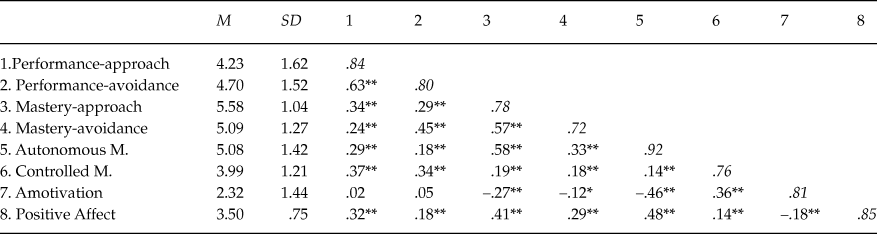
Means, Standard Deviations, and Bivariate Correlations. Cronbach’s Alpha Values Appear on the Diagonal

Note: M. = Motivation. *p < .05; **p < .01.
Positive Affect (PAF)
The Positive Affect subscale of the Positive and Negative Affect Schedule (PANAS) was utilized, which was previously validated for use in Spanish populations (PANASN; Sandín, Reference Sandín2003). The scale consists of 10 items (e.g., me intereso por la gente o las cosas [interested]) beginning with the stem “Indicate to what extent you generally feel this way, that is, how you feel in Physical Education class on the average.” Sandín (Reference Sandín2003) reported Cronbach’s alpha values of .73 and .72 for men and women, respectively. A 5-point Likert scale was employed, ranging from 1 = muy en desacuerdo (very slightly or not at all) to 5 = muy de acuerdo (extremely).
Achievement Goal Dominance (AGD)
Van Yperen’s (Reference Van Yperen2006) 6-item, multiple-choice measure was employed. A Spanish translation by Reference Méndez-Giménez, Fernández-Río and CecchiniMéndez-Giménez et al. (in press) was used. It compares each 2x2 achievement goal, in pairs, with the three remaining goals. If the respondent chooses the same achievement goal in all three comparisons, that goal is said to be dominant.
Procedure
First, we obtained permission from schools and parental consent for all participants. Students completed the questionnaires anonymously, which took approximately 25 minutes. The researchers assured them that their responses would not affect their grades, and that they could withdraw at any time. All data were analyzed using the program IBM-SPSS, 19.0.
Results
Analysis of Descriptive Data
Means, standard deviations, and correlations appear in Table 1. Of the participants (N = 302), 86.6% displayed achievement goal dominance. The distribution, by percentage, was the following: mastery-approach = 62.9% (n = 190); performance-approach = 14.2% (n = 43); performance-avoidance = 6.6% (n = 20); and mastery-avoidance = 16.2% (n = 49).
Idiographic Goal Profiles
A one-way MANOVA was carried out with 2x2 achievement goals, motivational regulations, and positive affect as dependent variables, and AGD as the independent variable. This revealed a statistically significant, multivariate effect, Wilks’ lambda = .609, F(24, 298) = 7.96, p < .001, η2 = .15. The following univariate analyses showed significant differences on all variables: performance-approach, F(3, 298) = 29.77, p < .001, η2 = .23; performance-avoidance, F(3, 298) = 7.96, p < .001, η2 = .07; mastery-approach, F(3, 298) = 11.72, p < .001, η2 = .11; mastery-avoidance, F(3, 298) = 4.20, p < .01, η2 = .04; AM, F(3, 298) = 15.66, p < .001, η2 = .14; CM, F(3, 298) = 7.30, p < .001, η2 = .07; A, F(3, 298) = 6.39, p < .001, η2 = .06; and PAF, F(3, 298) = 9.46, p < .001, η2 = .09. Since the groups were not equivalent and Levene’s test of equality of variances indicated they had dissimilar variances, the Games-Howell test was used to conduct post hoc comparisons.
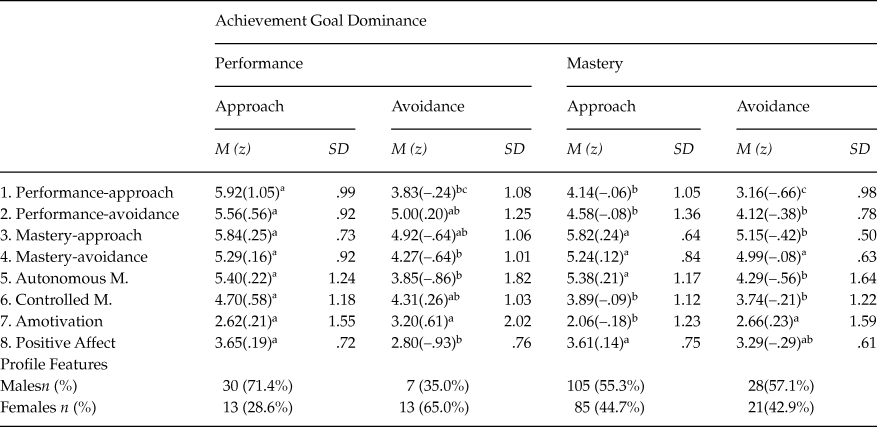
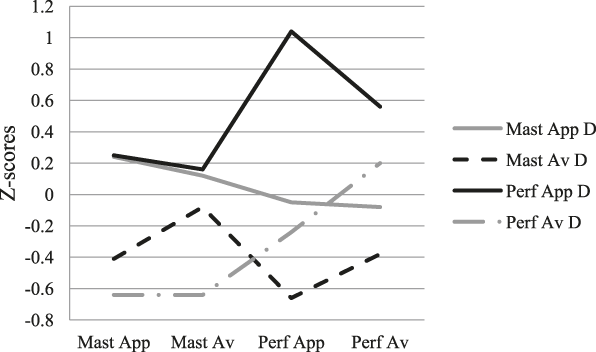
Table 2 displays participants’ idiographic achievement goal profiles. Individuals with performance-approach dominance scored the highest on all 2x2 achievement goals; they did not differ significantly from the mastery-approach dominance profile in terms of mastery goals. However, people with the other three profiles scored relatively low on performance-approach from the 2x2 scale (z-scores from –.06 to –.66). The results also suggest individuals with performance-approach dominance scored high on performance-approach and mastery-approach goals alike. As stated above, that pattern is considered a model for optimal motivation. Nevertheless, in line with Yperen’s (2006) results, participants with performance-approach dominance also scored high on the two avoidance scales, with certain, specific goals highly predominant and high scores on the other goal types as well. We observed, therefore, that for every goal dominance (except mastery-avoidance dominance), the dominant achievement goal had the highest statistical value. Furthermore, people scored higher on approach than avoidance goals on almost every variable studied (Figure 1 and Table 2).
One-way MANOVA with 2x2 Achievement Goals, Motivational Regulation, and Positive Affect as Dependent Variables, and AGD as the Independent Variable

Note: M.=Motivation. Superscript is used here to highlight the difference in mean after applying the Games-Howell statistic. In each row, means with different superscript differ at least to the level of p < .05.
Idiographic Profiles of Achievement Goal Dominance.
Note: Mast App = mastery-approach; Mast Av = mastery-avoidance; Perf App = performance approach; Perf Av = performance avoidance; D = dominance. In the figure, each variable’s mean is expressed as a z-score.

Mastery-approach dominance was positively associated with variables of positive valence (AM and PAF). The opposite was true of adolescents with performance-avoidance dominance. The predicted pattern was also observed in individuals with performance-approach dominance; they scored relatively high on variables of both positive (AM and PAF) and negative valence (CM, A). Participants with mastery-avoidance dominance, meanwhile, obtained moderate to low scores (CM, AM, A).
Motivational Profiles
To examine motivational profiles, the four 2x2 achievement goal factors were utilized as predictor variables. Following Aldenderfer and Blashfield (Reference Aldenderfer and Blashfield1984), a cross-validation was carried out to test whether or not the same cluster solution would apply to different population samples. The total sample was randomly divided into two groups (N 1 = 175, N 2 = 176) and hierarchical clustering analysis was applied to the first. Since this analysis was exploratory, the results had to be confirmed in an independent sample. Toward that end, k-means clustering was applied to the second subgroup, but first all variables were standardized (Z). Ward’s method was used to minimize within-cluster variance and avoid having to conduct along series of observations.We confirmed that a single, four-cluster solution boosted coefficients the most (10.9), indicating that different clusters were merging. Therefore, we deemed the four-cluster solution to be best. Likewise, k-means clustering analysis in the second subgroup also identified four clusters. Ultimately, k-means clustering was applied to the sample as a whole.
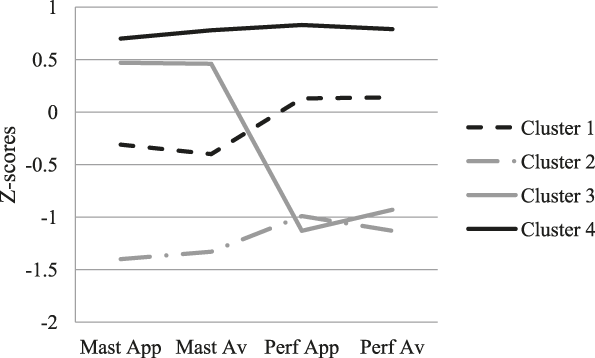
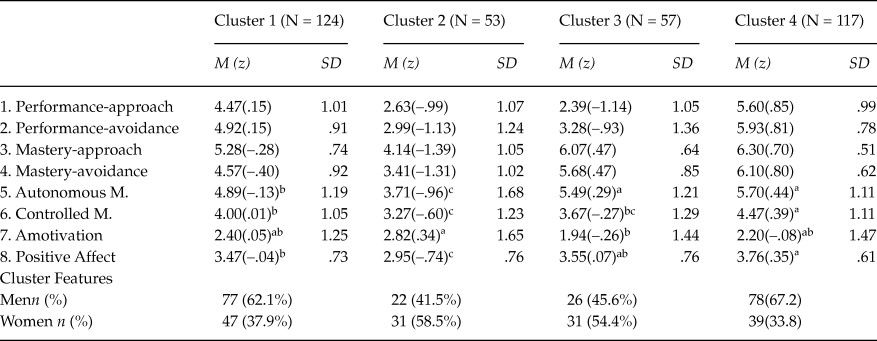
Figure 2 depicts the four profiles identified. Cluster 1 (“moderate achievement goals”) was characterized by intermediate scores on performance goals and somewhat low scores on mastery goals. Students in Cluster 2 (“low achievement goals”) scored low on all achievement goals. Those in Cluster 3 (“mastery goals”) scored fairly high on mastery goals and low on performance goals. The last cluster (“high achievement goals”) followed a pattern of high scores on all achievement goals.
Motivational Profiles Per the Four-cluster Solution Identified.
Note: Mast App = mastery-approach; Mast Av = mastery-avoidance; Perf App = performance-approach; Perf Av = performance-avoidance.In the figure, each variable’s mean is expressed as a z-score.

To determine the clusters’ actual discriminant power, a one-way MANOVA was conducted with motivational regulations and PAF as dependent variables, and cluster as the independent variable. This revealed a significant, multivariate effect, Wilks’ Lambda = .678, F(12, 910) = 12.01, p < .001, η2 = .12. The following univariate analyses yielded significant differences on all variables: AM, F(3, 347) = 33.34, p < .001, η2 = .22; CM, F(3, 347) = 15.47, p < .001, η2 = .12; A, F(3, 347) = 3.86, p < .01, η2 = .03; and PAF, F(3, 347) = 16.54, p < .001, η2 = .12. Since the groups were not equivalent and Levene’s test of equality of variances showed that the two groups exhibited dissimilar variances, post hoc comparisons were conducted using the Games-Howell test. Cluster 1 showed intermediate values on almost every variable. Cluster 2 scored less adaptively on all variables. Cluster 3 was associated only with variables of positive valence. Cluster 4 was linked to variables of positive as well as negative valence (Table 3).
K-means Cluster Analysis

Note: M. = Motivation. Superscript is used here to highlight the difference in mean after applying the Games-Howell statistic. In each row, means with different superscript differ at least to the level of p < .05.
Relationship between Idiographic and Motivational Profiles
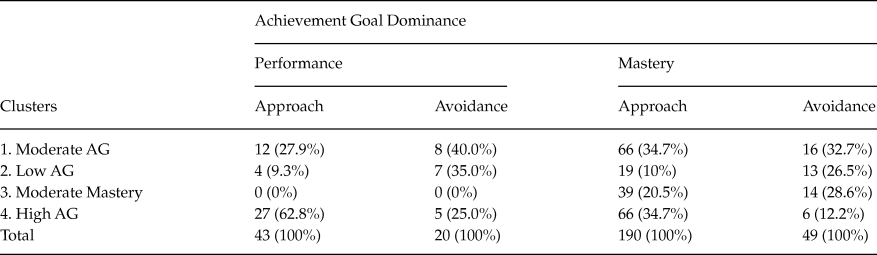
The following table of contingencies (Table 4) was created to compare individuals’ distribution into motivational clusters, to their distribution according to AGD. The results indicated participants were not distributed homogeneously, χ2 = 48.93, p < .001, but rather into related groups. For example, Cluster 4 held the majority of participants with performance-approach AGD. Cluster 3 was associated with mastery AGD (both approach and avoidance) to such an extent that not a single individual exhibited performance goals. Cluster 2 was linked to performance-avoidance AGD, and Cluster 1 to both performance-avoidance and mastery AGD.
Participants’ Distribution into Four Clusters According to AGD (Frequency and Percentage)

Discussion
The results corroborated Van Yperen’s (Reference Van Yperen2006) theoretical framework in that 86.6% of the sample (N = 302) exhibited some AGD. In this sample, individuals with mastery-approach AGD were the most common. These data are consistent with those reported by Van Yperen (Reference Van Yperen2006) and Reference Méndez-Giménez, Fernández-Río and CecchiniMéndez-Giménez et al. (in press). However, they stand in contrast to what Van Yperen et al. (2011) reported; in that study, mastery-avoidance was predominant among college students.
We confirmed that goal dominance is not necessarily exclusive (Van Yperen, Reference Van Yperen2006). Participants with AGD exhibited other achievement goals, too. Interestingly, performance-approach dominance was associated with high scores on all three other achievement goals. Participants with mastery-approach dominance scored just as high on mastery-avoidance and to a lesser extent, performance goals. Participants dominant on the two avoidance goals also showed low levels of approach goals. In almost every case (except mastery-avoidance), and bearing in mind the inconsistency observed in Van Yperen’s (Reference Van Yperen2006) study, our analysis revealed that each AGD group scored higher on its corresponding 2x2 achievement goal subscale than on the other subscales, reinforcing the theoretical framework and lending coherence to the results.
Our analysis of idiographic goal profiles elucidated rather similar patterns to those described by Van Yperen (Reference Van Yperen2006) between each AGD and variable studied. First of all, mastery-approach dominance was correlated with positive variables such as AM and positive affect, which is consistent with the literature (Harackiewicz et al., Reference Harackiewicz, Barron, Pintrich, Elliot and Thrash2002). Second, individuals with performance-approach dominance scored high on both positive (AM and positive affect) and negative variables (CM and A). This could be explained by those participants’ high scores on mastery-approach, which may have lessened the negative impact of performance-approach. Third, performance-avoidance dominance was negatively correlated with the positive variables examined. Finally, individuals with mastery-avoidance dominance showed a vague tendency toward positive regulation, which is typical of such indifferent participants (Van Yperen, Reference Van Yperen2006).
Our analysis of motivational profiles yielded clusters very similar to those reported in earlier studies (Méndez-Giménez et al., Reference Méndez-Giménez, Fernández-Río, Cecchini and González2013; Wang et al., Reference Wang, Biddle and Elliot2007). Of the four, the “mastery goals” and “high achievement goals” clusters were found to be most adaptive, and in that order. Meanwhile, the least adaptive profile was “low achievement goals.”
This was the first time a study examined the relationship between idiographic goal dominance profiles, and motivational profiles per the 2x2 theoretical framework. Participants’ distribution according to AGD was not homogeneous, but interconnected. Despite that finding, by forming these different goal clusters, we could more precisely characterize participants. The “high achievement goals” cluster was comprised almost entirely of individuals with approach goal dominance. The “mastery” cluster was made up exclusively of participants for whom the two mastery goal types dominated. Accounting for much of the “low achievement goals” cluster were participants with performance-avoidance dominance. Meanwhile, the “moderate achievement goals” cluster consisted of participants of every dominance, particularly performance-avoidance and the two mastery goals, given their respective percentages.
Jointly analyzing motivational and idiographic profiles elucidated that the “high achievement goals” cluster closely resembled the hypothetical, ideal profile some theoreticians hope to find (Garn & Sun, Reference Garn and Sun2009) (high on approach goals, low on avoidance). Notice that most participants in that cluster belonged to one of the two approach AGD groups. As a profile, however, that cluster behaved slightly less adaptively than the mastery cluster, supporting the perspective defended by Midgley, Kaplan, and Middleton (Reference Midgley, Kaplan and Middleton2001).The matter of that mastery cluster, its composition, and its more adaptive results should be addressed in future research. The fact that it was largely made up of participants with mastery-avoidance AGD leads us to believe those goals’ negative effects were counteracted by the positive effects of mastery-approach. If that is the case, the effect is congruous with the buffering hypothesis (Linnenbrink, Reference Linnenbrink2005), here applied to the approach-avoidance distinction rather than mastery-performance. Future studies should explore this possibility.
Another underlying issue is: how could participants with the same AGD have been grouped into different goal profiles? We believe this may have occurred due to differences in the intensity of goal striving. Motivational intensity refers to how much effort one applies toward goal attainment (Cecchini, Echevarría, & Méndez-Giménez, Reference Cecchini, Echevarría and Méndez-Giménez2003). It would be interesting to see how much effort students are willing to put forth to achieve their dominant goals, and how that intensity relates to multiple-goal adaptability. We would like to point out certain limitations to the present study, specifically, how the sample was selected and its cross-sectional design. Convenience sampling was used, but the sample’s representativeness of the population could have been enhanced by increasing the number of schools. Furthermore, a longitudinal design including more variables would help determine in greater depth what profiles to expect based on goal dominance.