Introduction
Children growth and growth rate are the characteristics of physical, psychological, biological, and sociological natural events. Reference Stull1 Growth changes are essential for keeping track of a child’s health. Assessment of the anthropometric measurement of children is one of the best indications of children’s overall well-being and health. Abnormal growth could suggest the presence of an underlying health problem. Reference Haymond, Kappelgaard and Czernichow2 According to several previous studies, children who have normal trajectories have better health outcomes than those who have abnormal trajectories of growth. Reference Stull1,Reference Haymond, Kappelgaard and Czernichow2 Height growth is a relevant biological indicator of living standard that reflects both existing and prospective health disparities in populations. Reference Steckel3 As a result, comparing changes in height over time between countries may reveal important information about differences in childhood living situations. Reference Gausman, Mejía-Guevara, Subramanian and Razak4
Human physical height is a common anthropometric quantitative characteristic that has been the subject of comprehensive study in several fields of science. Reference Jelenkovic, Sund and Hur5 Pediatricians, for instance, study the anthropometric trajectories in children to understand the growth rate, periods of deceleration and acceleration, and determinants of growth changes. Reference Bollen and Curran6 Hence, human physical growth can be used as an indicator of early life experiences and can provide information about the standard of living in a country. Reference Peck and Lundberg7 While height is primarily determined by genetics, it is also influenced by the environment in which children grow up. Reference Cavelaars, Kunst and Geurts8 As a result, research into differences in height growth over time and across countries can aid in identifying differences in childhood standards of living. Several studies examined differences in children’s height growth as a function of socioeconomic status. Reference Natale and Rajagopalan9–Reference Howe, Tilling, Galobardes, Smith, Gunnell and Lawlor12
Numerous factors influence body height, including nutrition, and genetic and environmental factors during fetal life, childhood, and adolescence. Reference Silventoinen13–Reference Silventoinen, Bartels and Posthuma16 Furthermore, it is widely accepted that height growth differs between genders. Reference Zheng, Suzuki and Yokomichi17,Reference Wake, Zewotir and Muluneh18 Male and female height gains differed significantly in childhood Reference Wake, Zewotir and Muluneh18 and pubertal growth spurt. Reference Sheehy, Gasser and Molinari19,Reference Živičnjak, Narančić and Szirovicza20 Age at height take-off and at peak height velocity is later in males than in females.Reference Hauspie, Cameron and Molinari21 Apart from birth cohort disparities, socioeconomic inequalities in body height are significant; those in better socioeconomic positions tend to be taller than those in lower socioeconomic positions. Reference Silventoinen13,Reference Bann, Johnson, Li, Kuh and Hardy22,Reference Patel, Tilling and Lawlor23 According to Marmot, Reference Singh, Danaei and Farzadfar24 the average male and female body height at the lowest position was around 5 cm lower than in the highest position.
Furthermore, investigations of differences in height growth between countries and between subgroups within one country may aid in finding differences in childhood living conditions. Reference Cavelaars, Kunst and Geurts8 De Groot et al. Reference De Groot and Sette25 studied the heights of individuals born between 1913 and 1918 in 19 places across Europe and reported that the tallest people were from northern Europe. And also the previous study conducted in four low- and middle-income countries reported that there were considerable disparities in growth changes among children. Reference Wake, Zewotir and Muluneh26
The growth trajectory in height offer information on the growth change process. However, the change process of physical growth is not observed directly, rather it is observed indirectly through repeated measures. Reference Bollen and Curran6 In such cases, the mixed-effects model is not flexible enough to model a growth process. As a result, advanced statistical models capable of accounting for latent variables in latent growth are required. Hence, a latent growth model is a common approach for analyzing latent variables within the framework of structural equation modeling. Reference Preacher, Wichman and MacCallum27 The aim of this study was to investigate the growth speed in height of children and its determinants.
Method
Data source
The longitudinal height data were obtained from the Young Lives prospective cohort study carried out in Ethiopia, India, Peru, and Vietnam from 2002 to 2016. The Young Lives study is a 15 years longitudinal cohort study that looked at how childhood poverty changed over time in Ethiopia, India, Peru, and Vietnam. It employed multistage sampling techniques with the first stage involving a selection of sentinel locations from each country. Sentinel site monitoring is a public health concept that entails a purposive sampling of a small number of settings that are thought to reflect a specific population or area, and then being studied uniformly at relatively wide ranges. Following that, 20 sentinel sites were selected at nonrandom in each country. Following the selection of 20 sentinel sites, households with children in the appropriate age groups were chosen at random. Then, 2000 infants (ages 6 to 18 months) were selected at random and they considered as a younger cohort. Reference Humphries, Dearden and Crookston28 Details regarding sampling and participant recruitment in the Young Lives study have been discussed in previously published works. Reference Wake, Zewotir and Muluneh18,Reference Wake, Zewotir and Muluneh26,Reference Humphries, Dearden and Crookston28–Reference Astatkie35
The Young Lives prospective cohort study gathered data in five rounds. The first survey round was carried out in 2002 when the children were on average one year of age, the second survey was carried out in 2006, the third was in 2009, the fourth was in 2013, and the fifth was carried out in 2016. 36 Data were collected from children (8 years and older) and their primary caregivers in each round using interviewer-administered questionnaires. A child’s height, on the other hand, was measured in centimeters from the age of 1 to 15 years. Reference Astatkie35 A total of 3401 males and 3200 females with measured height five times from ages 1 to 15 years were included in this study. Data were analyzed using SAS version 9.4.
Statistical analysis
Latent growth curve model
A latent growth curve is a special case of longitudinal structural equation model that examines growth change in longitudinal data. It includes two types of variables: latent and observed variables. Observed variables are measured variables, but latent variables are not measured directly and are used to predict observed variables. Reference Bollen and Curran6 The random intercept and slope(s) in a latent model permit, respectively, individuals to have unique initial growth and unique growth of change over time. The growth process is latent in which it is not observed directly, but its existence will infer from the observed repeated measures. Reference Felt, Depaoli and Tiemensma37
A latent growth curve model under different functional forms is modeled in different expressions. For instance, equations (1) and (2) represents the standard polynomial and fractional polynomial models, respectively.
 $$ y_{it}=\alpha _{i}+\sum _{j=1}^{p}\beta _{ij}{\Lambda ^{p}}_{t}+\varepsilon _{it}$$
 $$ y_{it}=\alpha _{i}+\sum _{j=1}^{p}\beta _{ij}{\Lambda ^{m}}_{t}+\varepsilon _{it}$$
The growth intercept α i represents the individual expected value of height (y it ) at baseline (when t equals 0), the path coefficients β ij represent the rate of change and the speed of change in growth for i-th individual, Λ t represents the factor loading that determines the functional form of the growth trajectories, and ϵ it is the disturbance for i-th individual at time t. The individual trajectories are expressed in terms of mean trajectory and variance around the mean trajectory that provide insight into between-individual variations. By allowing between-individual variation at intercept and slopes, the latent factors can be expressed in terms of average and variance as:
 $$\left( {\matrix{ {{\alpha _i}} \cr {{\beta _{1i}}} \cr {\matrix{ {{\beta _{2i}}} \cr {\matrix{ \vdots \cr {{\beta _{pi}}} \cr } } \cr } } \cr } } \right) = \left( {\matrix{ {{\mu _\alpha }} \cr {{\mu _{\beta 1}}} \cr {\matrix{ {{\mu _{\beta 2}}} \cr {\matrix{ \vdots \cr {{\mu _{\beta p}}} \cr } } \cr } } \cr } } \right) + \left( {\matrix{ {{e_\alpha }} \cr {{e_{\beta 1}}} \cr {\matrix{ {{e_{\beta 2}}} \cr {\matrix{ \vdots \cr {{e_{\beta p}}} \cr } } \cr } } \cr } } \right)$$
where μ α and μ βp are the population mean intercept and slope, respectively, and e α and e βp are, respectively, the intercept and slope disturbances represent the extent to which the individual intercept and slope values deviate from the mean intercept and slope. The disturbances of e α and e βp are distributed with means of zero and variances of ψ αα and ψ βpβp and covariance of ψ αβp .
Conventional polynomial functions are restricted in modeling nonlinear changes. Reference Royston and Altman38 Alternatively, a fractional polynomial which is an extension of conventional polynomials provides a variety of curve shapes for exploring characteristics of nonlinear trajectories. In this model, the m power terms in equation(2) can be chosen from m = (−2, −1, −0.5, 0, 0.5, 1, 2, 3), a combination function with the lowest deviance will be the best fit function. Reference Royston and Altman38
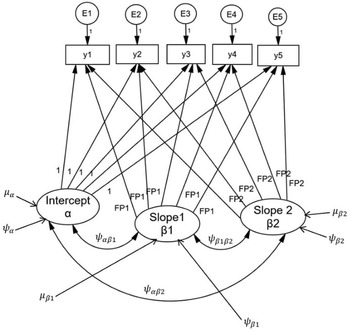
A path diagram presented in Fig. 1 permits a latent growth model to be expressed graphically. In this diagram, the rectangle symbols denote the observed variables and the circle symbols denote latent variables. The observed variables are the individual measures of child height and α, β 1, and β 2 are the latent variables. Each line in the path diagram stands for the trajectory of the individual from which the latent variables are estimated. Paths with single-headed arrows at the end connect unobserved and observed variables. The causal relationship and the covariance between variables are explained by single- and double-headed arrows, respectively. The variable at the arrow tail is an exogenous variable and the variable at the arrowhead is an endogenous variable. As shown in Fig. 1, there is one latent intercept, α, with one-factor loadings and two latent slopes, β 1 and β 2, with first-order polynomial (FP1) and second-order polynomial (FP2) factor loadings, respectively. The factor loadings on the latent slopes are used to determine whether the trajectory is linear or nonlinear. The coding and location of the baseline of time scores have a significant impact on the estimation and interpretation of the growth parameter. Reference Anumendem, de Fraine and Onghena39,Reference Biesanz, Deeb-Sossa and Papadakis40
Path diagram of a five-wave polynomial latent growth curve model.

Different fit indexes were assessed to evaluate the modelsʼ goodness of fit. These include the comparative fit index (CFI), the Tucker-Lewis index (TLI), the root mean square error of approximation (RMSEA), and the standardized root mean square (SRMS). The higher values closed to 1 for CFI and TLI reflecting a better fit, while the lower values closed to zero for RMSEA and SRMS reflecting a better fit. Reference Felt, Depaoli and Tiemensma37,Reference Bentler41
Results
Sample description
The study considered a total of 6601 children: 3401 (51.5%) males and 3200 (48.5%) females. The distribution characteristics and mean height of children in four study countries are displayed in Table 1. The average height increased and varied with age in both genders. This indicates that a linear model may not be applicable to model the growth trajectories. Thus, we compared different latent growth models to identify the model that best represents the growth trajectory. The results are presented in Tables 2 and 3.
Distribution characteristics and mean height of children in four study countries from 2002 to 2016

The fit statistics of quadratic models under different time coding schemes for height growth

Estimates of an unconditional fractional polynomial model under different time coding schemes for height growth

***p < 0.0001, **p > 0.05.
Results of linear latent growth model
To investigate variations in height growth at each measurement occasion, linear latent growth models with different origins of time were performed. For instance, to estimate mean height at age 1, we set the origin of time at age 1 by coding time = (age–1). Following that, we are also interested in examining growth variability at each measurement occasion by placing the origin of time scores at ages 5, 8, 12, and 15 by coding time = (age–5), time = (age–8), time = (age–12), and time = (age–15), respectively. These would provide the following loading matrices, Λ:
 $$\matrix{
{{\Lambda _1} = \left[ {\matrix{
1 \hfill & 0 \hfill\cr
1 \hfill & 4 \hfill\cr
1 \hfill & 7 \hfill\cr
1 \hfill & {11} \hfill\cr
1 \hfill & {14} \hfill\cr
} } \right],{\Lambda _5} = \left[ {\matrix{
1 \hfill & { - 4} \hfill\cr
1 \hfill & 0 \hfill\cr
1 \hfill & 3 \hfill\cr
1 \hfill & 7 \hfill\cr
1 \hfill & {10} \hfill\cr
} } \right]{\Lambda _8} = \left[ {\matrix{
1 \hfill & { - 7} \hfill\cr
1 \hfill & { - 3} \hfill\cr
1 \hfill & 0 \hfill\cr
1 \hfill & 4 \hfill\cr
1 \hfill & 7 \hfill\cr
} } \right],} \hfill\cr
{{\Lambda _{12}} = \left[ {\matrix{
1 \hfill & { - 11} \hfill\cr
1 \hfill & { - 7} \hfill\cr
1 \hfill & { - 4} \hfill\cr
1 \hfill & 0 \hfill\cr
1 \hfill & 3 \hfill\cr
} } \right],{\Lambda _{15}} = \left[ {\matrix{
1 \hfill & { - 14} \hfill\cr
1 \hfill & { - 10} \hfill\cr
1 \hfill & { - 7} \hfill\cr
1 \hfill & { - 3} \hfill\cr
1 \hfill & 0 \hfill\cr
} } \right]} \hfill\cr
} $$
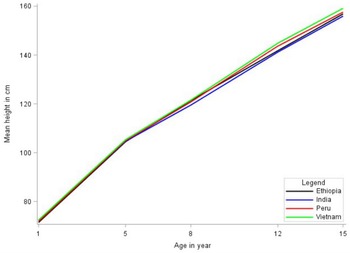
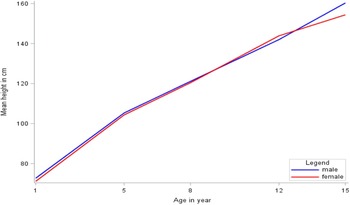
The first and the second column of the Λ matrices represent the intercept and the linear components, respectively. The fit statistics of this model showed that linear models are inconsistent with the height data, provided TLI = 0.141, CFI = 0.141, RMSEA = 0.482, and AIC = 15392.023. As shown in Fig. 2, the trajectory is not linear. Additionally, Fig. 3 exhibited that there appears to be a variation in growth trajectories of height between males and females. Under such conditions, nonlinear growth models are appropriate to analyze the trajectories.
Path diagram of a five-wave linear growth curve model.

Growth trajectory differences in four countries.

Results of quadratic latent growth model
Nonlinear latent growth models permit for the flexibility of time scores being related with the slope of linear latent factor. Accordingly, for a quadratic model, equation(1) can be written as:
 $$ y_{it}=\alpha _{i}+\beta _{1i}\Lambda _{t}+\beta _{2i}{\Lambda ^{2}}_{t}+\varepsilon _{it} $$
The latent intercept and linear components are a child’s height and the instantaneous rate of growth when time equals 0, respectively. Likewise, the quadratic component represents acceleration in height growth. To estimate the growth parameters that define means and variability in height growth at each measurement occasion, we originate the time scores at ages 1, 5, 8, 12, and 15 years as previous. Consequently, the quadratic latent models’ loading matrices Λ are as follows:
 $$\matrix{
{{\Lambda _1} = \left[ {\matrix{
1 \hfill & 0 \hfill & 0 \hfill\cr
1 \hfill & 4 \hfill & {16} \hfill\cr
1 \hfill & 7 \hfill & {49} \hfill\cr
1 \hfill & {11} \hfill & {121} \hfill\cr
1 \hfill & {14} \hfill & {196} \hfill\cr
} } \right],{\Lambda _5} = \left[ {\matrix{
1 \hfill & { - 4} \hfill & {16} \hfill\cr
1 \hfill & 0 \hfill & 0 \hfill\cr
1 \hfill & 3 \hfill & 9 \hfill\cr
1 \hfill & 7 \hfill & {49} \hfill\cr
1 \hfill & {10} \hfill & {100} \hfill\cr
} } \right],} \hfill\cr
{{\Lambda _8} = \left[ {\matrix{
1 \hfill & { - 7} \hfill & {49} \hfill\cr
1 \hfill & { - 3} \hfill & 9 \hfill\cr
1 \hfill & 0 \hfill & 0 \hfill\cr
1 \hfill & 4 \hfill & {16} \hfill\cr
1 \hfill & 7 \hfill & {49} \hfill\cr
} } \right],{\Lambda _{12}} = \left[ {\matrix{
1 \hfill & { - 11} \hfill & {121} \hfill\cr
1 \hfill & { - 7} \hfill & {49} \hfill\cr
1 \hfill & { - 4} \hfill & {16} \hfill\cr
1 \hfill & 0 \hfill & 0 \hfill\cr
1 \hfill & 3 \hfill & 9 \hfill\cr
} } \right]} \hfill\cr
{\quad \quad \quad \quad {\Lambda _{15}} = \left[ {\matrix{
1 \hfill & { - 14} \hfill & {196} \hfill\cr
1 \hfill & { - 10} \hfill & {100} \hfill\cr
1 \hfill & { - 7} \hfill & {49} \hfill\cr
1 \hfill & { - 3} \hfill & 9 \hfill\cr
1 \hfill & 0 \hfill & 0 \hfill\cr
} } \right]} \hfill\cr
} ,$$
The fits statistics for these quadratic latent models are presented in Table 2. These models improved the fit statistics over the linear one, provided TLI = 0.522, CFI = 0.713, RMSEA = 0.360, and AIC = 5166.37. However, these models are also inconsistent with the height data. Subsequently, we should extend conventional polynomials to fractional polynomials using Equation (2).
Results of fractional polynomial latent growth model
Wake and colleagues Reference Wake, Zewotir and Muluneh31 identified that the growth trajectory of children from aged 1 to 15 years was nonlinear. Thus, for the current study, we used nonlinear transformation of the loading matrix to extend conventional polynomial function to fractional polynomial functions, which are more flexible and useful in modeling nonlinear trajectories. Reference Long and Ryoo42 A fractional polynomial was formulated by introducing single and combinations of various forms of time scores function to models. Accordingly, a second-order fractional polynomial function with p = −1 and q = 1 power terms was found to be the best-fitting model.
The time coding was chosen as Λt = 1, 5, 8, 12, 15 with its linear inverse transformation, Λ−1 t = 1, 0.2, 0.125, 0.083, 0.067. The reason why the first time coding begins with 1 is that the linear inverse of 0 is undefined. Thus, by scaling (Λt −1) and (Λ−1 t −1), we placed the origin of time at age 1, estimating a child’s mean height at age 1. Similarly, to demonstrate the growth variability at ages 5, 8, 12, and 15, models with varying centering points were fitted to the data. As shown in Table 3, these models substantially improved the fit statistics over the linear and quadratic models (TLI = 0.942, CFI = 0.977, RMSEA = 0.125, AIC = 451.064). Therefore, fractional polynomial models were chosen as the best-fitting models to analyze nonlinear trajectories in height growth.
Fractional polynomial latent growth models with time-invariant covariates
Gender and country effects on children’s physical growth were assessed. The inclusion of these covariates improved the models’ fit. For the sake of simplicity only Λ1 model was considered in this analysis. As given in Table 4, the estimated mean intercept of 72.14 reflects the mean height of children at the initial measurement. The estimated values for the linear and its reciprocal were 5.19 and −15.07, respectively. The growth speed is the first derivative of the latent growth curve equation. The latent growth curve equation is therefore expressed as 72.14 + 5.19time − 15.07time−1. The linear coefficient (5.19, p < 0.001) represents the instantaneous rate of change when time is zero. The significant and negative value of time inverse coefficient (−15.07, p < 0.001) suggests that the growth speed of children decreased with age.
Parameter estimates of latent growth curve model with time-invariant covariates

Note: β1 is the coefficient of linear time and β2 is the coefficient of time inverse.
There was a significant negative gender difference in height growth at all components of latent factors. This implies that females had lower mean intercept, linear slope, and linear inverse slope (α = − 1.65, β 1 = − 0.37, β 2 = − 3.06) than males. When compared to Ethiopian children, children in India (α = 0.836, p < 0.001), Peru (α = 0.478, p = 0.004), and Vietnam (α = 1.102, p < 0.001) had positive and significant baseline measurements. Likewise, the linear slope for children in Peru (β 1 = 0.110, p < 0.001) and Vietnam (β 1 = 0.231, p < 0.001) were significantly positive, indicate that children in these two countries had a higher instantaneous rate of change than that of children in Ethiopia. However, a negative and significant linear slope was observed for children in India (β 1 = −0.067, p = 0.001). This implies that Indian children had a lower instantaneous rate of change than Ethiopian children. The growth acceleration for children in India (β 2 = 1.189, p < 0.001), Peru (β 2 = 1.088, p < 0.001), and Vietnam (β 2 = 1.945, p < 0.001) was significantly positive. This suggests that children in India, Peru, and Vietnam grew at lower decrement with age when compared to children in Ethiopia.
The variance-covariance of the model components examined the variation in growth between individuals. The significant variances indicate that individuals begin their growth progression at distinct values and growing at different rates. The significant negative covariance of ψ αβ1 indicates that children who were taller at baseline tended to grow at a lower rate. The significant positive covariance of ψ β1β2 suggests that children who had a higher rate of growth tended to be growing at a faster acceleration.
Discussion
The growth trajectories of children aged 1 to 15 years were studied using linear and nonlinear latent growth models. The study revealed that the functional relationship between physical height growth and a child’s age is nonlinear. Similar data were examined using a latent basis model, and it was shown that the functional changes in children’s height are not linear. Reference Wake, Zewotir and Muluneh31 As a result, a nonlinear latent growth model was chosen to depict the growth trajectories. Thereafter, among the families of nonlinear polynomial functions, the quadratic and fractional polynomials were examined for the trajectories. Lastly, a second-order fractional polynomial was found to be the best-fitting model.
The analysis of the data and application of the model indicates that gender was significantly associated with the growth parameters. In contrast to our study, Faye et al. Reference Faye, Fonn and Levin43 found gender differences in linear growth, with females growing at a higher rate than males. Reference Faye, Fonn and Levin43 The study also identified that the growth acceleration of children in four low- and middle-income counties decreased with age. This is consistent with the previous study of Haymond et al. Reference Haymond, Kappelgaard and Czernichow2 noted that the maximum rate of growth occurs at birth and gradually slows until the pubertal growth spurt. Reference Haymond, Kappelgaard and Czernichow2 Regarding the country’s effect on child growth, there were significant differences in growth change and individuals showed substantial variation in their particular latent components. In addition, the findings of the study show that inequalities of height growth were observed in all four countries, with high values for children in Peru and Vietnam. This could be due to socioeconomic differences among countries. Children of higher socioeconomic status were taller than those of lower socioeconomic status. Reference Natale and Rajagopalan9,Reference Silva, van Rossem and Jansen44 The well-living condition may lead to improvements in childhood health, social conditions, and a reduction in negative environmental effects. Reference Li, Manor and Power10,Reference Patel, Tilling and Lawlor23
Furthermore, it was found out that all the path coefficients of latent components were positive and significant except for children in India was negative and significant at linear component. This indicates that children in India showed a lower change in growth compared to children in Ethiopia. The intercept and linear component of the model had variability between children, while the linear inverse component had no variability between children, suggesting that the curvature of the linear inverse was identical for all children. This finding is consistent with the findings of a previous study comparing height across geographic regions, which found that environmental effect was highest during the first years of life and decreased throughout childhood and adolescence. Reference Jelenkovic, Sund and Hur5 Socioeconomic variations in height growth were present at birth and widened through infancy and early childhood. Reference Howe, Tilling, Galobardes, Smith, Gunnell and Lawlor12
The key strength of this study is the long-term follow-up of children’s height measures that give insight into the longitudinal variations in height trends in four low and middle-income countries. The study has also its own limitations. It was restricted to four low- and middle-income countries, which may not be representative of all low- and middle-income countries. Furthermore, potential factors which can influence the height growth are not considered in this study. As a result, further study is needed to address these limitations.
Conclusion
Understanding and enhancing the health of children require not only their perspective but also understanding the ecological nature of their health and the interdependence of the biological, physical, and socioeconomic background is also important. Therefore, studying the growth of children plays a significant role in determining and eventually improving their health status. The results of this study may help to inform better policy for children to ensure that every child has the best possible start in life and that those who are at risk of being left behind have access to interventions and support to maximize their opportunities and well-being.
A clear understanding of these country growth variations is important for finding key possibilities to promote healthy growth in early life of children. We believe that our findings point to an underlying relationship between children’s physical growth and their biological and socioeconomic backgrounds. In addition, further study is needed to identify age-specific growth variations and the direct and indirect effects of potential covariates on children’s growth trajectories.
Acknowledgments
We thank the Young Lives study for giving us access to the data files.
Financial support
This research received no specific grant from any funding agency, commercial, or not-for-profit sectors.
Conflicts of interest
None.
Ethical standards
The authors assert that all procedures contributing to this work comply with the ethical standards of the relevant national guidelines on human experimentation (national and institutional guidelines: Ethical Conduct for Research Involving Humans) and with the Helsinki Declaration of 1975, as revised in 2008. This study was based on publicly available, anonymized data and therefore did not require approval by an institutional committee.