Introduction
Photocatalytic reactions have been studied extensively in recent years from the viewpoint of environmental accountability and energy conversion. For environmental purposes, TiO2 with anatase and rutile crystal structures has been predominantly used because of its superior material and economic properties (e.g., chemical stability, non-toxicity, cost-effectiveness).Reference Hoffmann, Martin, Choi and Bahnemann1, Reference Fujishima, Rao and Tryk2 In recent research, modified TiO2 such as N-doped TiO2 has been examined in order to extend the absorption edge into the visible light region.Reference Asahi, Morikawa, Ohwaki, Aoki and Taga3 In application to energy conversion, where research was initially triggered by the potential of TiO2-based photoelectrochemical (PEC) reactions for the decomposition of water into H2 and O2,Reference Fujishima and Honda4 a range of materials has been examined as powder photocatalysts. These materials include transition metal oxides containing metal ions of Ti4+, Zr4+, Nb5+, Ta5+, or W6+ with d 0 electronic configuration and typical metal oxides having metal ions of Ga3+, In3+, Ge4+, Sn4+, or Sb5+ with d 10 electronic configuration.Reference Domen, Kondo, Hara and Takata5–Reference Inoue9 Thus, the group of successful photocatalysts for overall water splitting is comprised solely of metal oxide-based systems. Although some non-oxide materials such as CdS and CdSe have been examined, particularly for visible-light catalysis, successful photocatalytic systems have yet to be achieved, primarily due to the lack of oxygen productivity and inherent instability of the materials, which are derived from oxidative self-decomposition of the materials.Reference Williams10, Reference Ellis, Kaiser, Bolts and Wrighton11
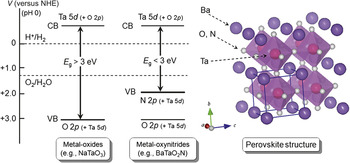
The two major obstacles to the development of powder photocatalysts are the discovery of new stable photocatalytic materials and the construction of a suitable visible light-driven photocatalytic system. The application of metal oxides for photocatalysis in the visible-light region is complicated by the deep valence band positions (O 2p orbitals) of these materials, resulting in a bandgap that is too large to harvest visible light.Reference Scaife12 Since the N 2p orbital has a higher potential energy than the O 2p orbital, using a metal nitride or metal oxynitride as a photocatalyst has promise. Figure 1 shows the schematic band structures of a metal oxide (NaTaO3) and oxynitride (BaTaO2N), both of which have the same perovskite structure. The top of the valence band (i.e., highest occupied molecular orbital, HOMO) for the metal oxide consists of O 2p orbitals. When N atoms are partially or fully substituted for O atoms in a metal oxide, the HOMO of the material is expected to be shifted higher compared to the corresponding metal oxide without affecting the level of the bottom of the conduction band (i.e., lowest unoccupied molecular orbital, LUMO). As expected, density functional theory (DFT) calculations for BaTaO2N indicated that the HOMO consists of hybridized N 2p and O 2p orbitals, whereas the LUMO is mainly composed of empty Ta 5d orbitals.Reference Maeda and Domen6 The potential of the HOMO for the oxynitride is located at higher potential energy than that for the corresponding oxide due to the contribution of N 2p orbitals, making the bandgap energy sufficiently small to respond to visible light (<3 eV). In this article, oxynitrides are presented as non-oxide-type materials for photocatalytic water splitting under visible light.
Schematic band structures of a metal oxide (NaTaO3) and metal oxynitride (BaTaO2N) with perovskite structure. The top of the valence band of BaTaO2N lies at a position less positive than that of NaTaO3, while the conduction band position changes little. CB, conduction band; VB, valence band; E g, bandgap energy; NHE, normal hydrogen electrode; V, potential.

Oxynitrides with d 0 electronic configuration
Preparation and photocatalytic activity
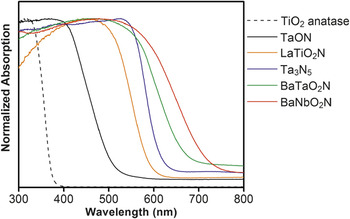
Some particulate oxynitrides containing early transition-metal cations are stable and non-toxic materials and can be readily obtained by nitriding a corresponding metal oxide powder.Reference Hitoki, Takata, Kondo, Hara, Kobayashi and Domen13–Reference Mishima, Matsuda and Miyake35 Some metal oxynitrides have recently attracted attention as non-toxic inorganic pigments alternating with chalcogenides-based pigments such as the CdS–CdSe system. For example, a series of LaTaON2–CaTaO2N solid solutions has been reported to vary in color from yellow to red.Reference Jansen and Letschert31 In addition, these materials are chemically stable, except in very strong acids, for example, aqua regia and hot concentrated sulfuric acid. Note that this type of material differs from materials doped with nitrogen, because nitrogen is included as a constituent element in oxynitrides. Figure 2 shows the UV-visible diffuse reflectance spectra for certain oxynitrides containing transition-metal cations of Ti4+, Nb5+, and Ta5+ with d 0 electronic configuration. It is clear that these oxynitrides possess absorption bands at 500–750 nm, corresponding to bandgap energies of 1.7–2.5 eV that are estimated from the onset wavelengths of the absorption spectra. As expected from DFT calculations, these oxynitrides have band-edge potentials suitable for overall water splitting, as revealed by UV photoelectron spectroscopy and PEC analysis.Reference Chun, Ishikawa, Fujisawa, Takata, Kondo, Hara, Kawai, Matsumoto and Domen17 For example, it has been revealed that the tops of the valence bands are shifted to higher potential energies in the order Ta2O5 < TaON < Ta3N5, whereas the potentials of the bottoms of the conduction bands are almost the same.
UV-visible diffuse reflectance spectra for oxynitrides containing Ti4+, Nb5+, and Ta5+. It is clear that the oxynitrides have a distinct absorption band in the visible light region.

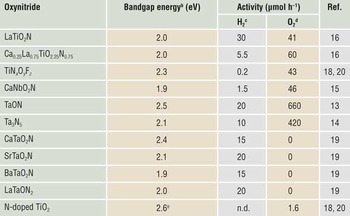
As overall water splitting is generally difficult to achieve due to the uphill nature of the reaction, photocatalytic activities of a number of oxynitrides for water reduction or oxidation has been examined in the presence of methanol or silver nitrate as a sacrificial reagent. The reactions using sacrificial reagents are not “overall” water splitting reactions, but are often carried out as test reactions for overall water splitting.Reference Maeda and Domen6, Reference Kudo and Miseki8Table I lists the photocatalytic activities of d 0-oxynitrides for H2 or O2 evolution in the presence of sacrificial reagents. These oxynitrides exhibited relatively high photocatalytic activity for water oxidation to form molecular oxygen under visible irradiation (λ > 420 nm), with some exceptions, such as ATaO2N (A = Ca, Sr, Ba) and LaTaON2. In contrast, nitrogen-doped TiO2 displayed negligible activity for this reaction under the same reaction conditions (Table I). Oxynitrides also produced H2 from an aqueous methanol solution upon visible irradiation when loaded with nanoparticulate Pt as a co-catalyst for H2 evolution. In most cases, a low level of N2 evolution accompanied the initial stage of photocatalytic reactions over these catalysts, indicating that the oxynitride is partially decomposed by the photogenerated holes (instead of water oxidation) according to the reaction:
![$$2{\rm {N}}^{3 - } + 6{\rm {h}}]^ + \to {\rm {N}}_2 .$$](https://static.cambridge.org/binary/version/id/urn:cambridge.org:id:binary:20151026074458510-0109:S0883769410000047_eqn1.gif?pub-status=live)
Photocatalytic activities of oxynitrides with d 0 electronic configuration for H2 or O2 evolution in the presence of sacrificial reagents under visible light (λ > 420 nm).Footnote a

a Reaction conditions: 0.2–0.4 g of catalyst, 200 mL aqueous solution containing sacrificial reagents, 300 W xenon lamp light source, Pyrex top irradiation-type reaction vessel with cutoff filter.
b Estimated from onset wavelength of diffuse reflectance spectra.
c Loaded with nanoparticulate Pt as a co-catalyst, reacted in the presence of methanol (10 vol%), sacrificial reagent.
d Sacrificial reagent: silver nitrate (0.01 M).
e Energy gap estimated from a shoulder peak (400–500 nm).n.d., not detected.
However, the production of N2 was completely suppressed as the reaction progressed, and no change in the x-ray diffraction pattern of the oxynitrides as a result of the reaction has been detected. It thus appears that oxynitride photocatalysts are essentially stable in the individual water reduction and oxidation reactions.
Improvement of water reduction activity
The activities for H2 production are about an order of magnitude lower than for O2 evolution, although the photocatalytic performance for H2 evolution is stable. In this context, several new modifications to enhance the H2 evolution rate of oxynitrides have been pursued. Here we introduce such an attempt to reduce the particle size of Ta3N5. It is believed that the smaller particle size results in a shorter diffusion length for photogenerated electron–hole-pairs in a given photocatalyst, reducing the recombination between electrons and holes and enhancing photocatalytic activity. We first attempted to increase the photocatalytic activity of TaON for H2 evolution under visible light by reducing the particle size.Reference Maeda, Terashima, Kase and Domen21 However, it was difficult to suppress the generation of defects during the nitridation process, because TaON is an intermediate phase between Ta2O5 and Ta3N5.Reference Hitoki, Ishikawa, Takata, Kondo, Hara and Domen14 As a result, the as-obtained TaON did not show an appreciable increase in photocatalytic activity, despite a relatively small particle size (50–80 nm). In contrast to TaON, preparation of Ta3N5 is relatively easy because Ta3N5 is the final phase produced by the nitridation of Ta2O5.Reference Marchand, Tessiera and DiSalvob32, Reference Zhang and Gao33
Nanoparticulate Ta3N5 can be readily prepared from a nanoparticulate Ta2O5 precursor that is synthesized through a precipitation method in advance.Reference Maeda, Nishimura and Domen22 Compared to the conventional bulk-type Ta3N5 particles (300–500 nm), nanoparticulate Ta3N5 with a smaller particle size of 30–50 nm exhibited enhanced photocatalytic activity for H2 evolution from aqueous solution containing methanol as an electron donor under visible light. Diffuse reflectance spectroscopy and PEC measurements suggested that the enhancement was due to the promotion of the water reduction process originating from the lower defect density of the material.
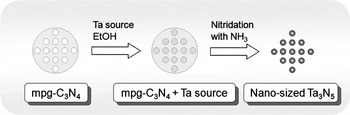
It is also possible to prepare nano-sized Ta3N5 particles through a template approach using a mesoporous graphitic carbon nitride (mpg-C3N4),Reference Yuliati, Yang, Wang, Maeda, Takata, Antonietti and Domen23 which has a potential to reduce or oxidize water with visible light as well.Reference Wang, Maeda, Thomas, Takanabe, Xin, Carlsson, Domen and Antonietti36, Reference Wang, Maeda, Chen, Takanabe, Domen, Hou, Fu and Antonietti37Figure 3 shows a schematic illustration of the preparation of Ta3N5 nanoparticles using mpg-C3N4 as a template. Having different pore sizes (7, 12, and 24 nm), mpg-C3N4 were prepared by a method similar to one previously reported using colloidal silicas with different particle sizes.Reference Goettmann, Fischer, Antonietti and Thomas38 The pore space of the as-prepared mpg-C3N4 was then filled with a tantalum source such as TaCl5, followed by nitridation under a flow of NH3 gas. This procedure allows one to prepare Ta3N5 nanoparticles with a primary particle size that, in principle, reflects the pore size of mpg-C3N4. Interestingly, all Ta3N5 nanoparticles thus-obtained showed a much higher activity than the reference bulk sample, and Ta3N5, having the smallest particle size that was prepared from mpg-C3N4 with a pore size of 7 nm, showed approximately one order of magnitude higher activity than bulk Ta3N5. In addition to the small particle size and high surface area, the low density of defect sites would also result in an improvement of the activity, since fewer defect sites would be favorable for electron migration from the Ta3N5 bulk to the surface and/or electron transfer from the conduction band of Ta3N5 to the loaded Pt.Reference Maeda, Nishimura and Domen22 This template method may be applicable to other oxynitrides, and this possibility is currently under investigation.
Preparation of Ta3N5 nanoparticles using mesoporous graphitic carbon nitride (mpg-C3N4) as a template. The pores of mpg-C3N4 are filled with Ta source-ethanol (EtOH) solution, followed by nitridation with dry NH3, yielding Ta3N5 nanoparticles.

As mentioned earlier, it seems difficult to control the crystallinity of TaON by adjustment of preparation parameters alone because TaON is an intermediate phase between Ta2O5 and Ta3N5.Reference Hitoki, Ishikawa, Takata, Kondo, Hara and Domen14 Although the calcination of solid photocatalysts after preparation has been demonstrated to be an effective approach for reducing the density of defects,Reference Sayama, Arakawa and Domen39, Reference Kominami, Murakami, Kera and Ohtani40 such post-calcination appears to be disadvantageous for TaON due to its low thermal stability. In fact, post-calcination of TaON under O2 or N2 results in a decrease in activity.Reference Abe, Takata, Sugihara and Domen41 The elimination of defects in TaON therefore remains a challenge.
Recently, we have developed a new strategy to reduce surface defects on TaON using ZrO2 as a “protector” through a surface modification technique.Reference Maeda, Terashima, Kase, Higashi, Tabata and Domen24, Reference Maeda, Higashi, Lu, Abe and Domen25 Specifically, monoclinic ZrO2 nanoparticles are dispersed on the surface of a Ta2O5 precursor before nitridation, thereby protecting Ta5+ cations in the TaON surface from being reduced by H2 (derived from disassociation of NH3 at high temperatures) during nitridation. As has been observed for other oxynitrides such as LaTiO2N16 and TiNxOyFz,Reference Maeda, Shimodaira, Lee, Teramura, Lu, Kobayashi and Domen20 the reduction of Ta5+ cations in TaON during nitridation generates reduced tantalum species, which can act as recombination centers between photogenerated electrons and holes. On the other hand, when ZrO2 is loaded on the surface of Ta2O5, tantalum cations at the interface between Ta2O5 (and/or TaON) and the loaded ZrO2 are expected to interact with ZrO2 and thereby become more cationic. As a result, the formation of reduced tantalum species on the TaON surface is effectively suppressed by prior loading with nanoparticulate ZrO2. As expected, the as-prepared ZrO2-modified TaON (represented as ZrO2/TaON) exhibited enhanced water reduction behavior compared to unmodified TaON. This enhancement of activity is attributed to the reduced density of defects in ZrO2/TaON, which contributes to a lower probability of undesirable electron–hole recombination in ZrO2/TaON than in TaON.
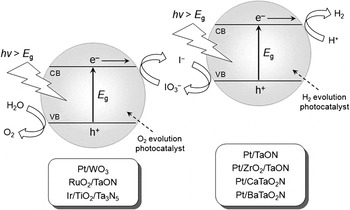
Despite the efforts mentioned previously, overall water splitting using these d 0-oxynitrides has yet to be achieved. One plausible explanation for this is that they still have a high density of defect sites that can work as recombination centers for photogenerated electrons and holes. Nevertheless, z-scheme overall water splitting under visible light has been achieved using several combinations of oxynitrides in the presence of an IO3–/I–shuttle redox mediator, as schematically illustrated in Figure 4.Reference Maeda, Terashima, Kase, Higashi, Tabata and Domen24–Reference Tabata, Maeda, Higashi, Lu, Takata, Abe and Domen29 The use of Pt-loaded BaTaO2N allows one to utilize visible photons up to 660 nm for H2 evolution when combined with Pt-loaded WO3, which has an absorption edge at around 450 nm, as an O2 evolution photocatalyst.Reference Higashi, Abe, Teramura, Takata, Ohtani and Domen27 The absorption wavelength available for O2 evolution was then increased to 500 nm using RuO2-loaded TaONReference Higashi, Abe, Ishikawa, Takata, Ohtani and Domen28 and to 600 nm using Ir-loaded nanoparticulate TiO2 (rutile)/bulk Ta3N5 composite.Reference Tabata, Maeda, Higashi, Lu, Takata, Abe and Domen29 Thus, the absorption wavelength available for the individual H2 and O2 evolution has been increased. The next challenges remain in the promotion of electron transfer between two semiconductors and in the suppression of backward reactions involving shuttle redox mediators.
A schematic illustration of a two-step water-splitting system based on oxynitrides in the presence of an iodate/iodide shuttle redox mediator. Water reduction occurs on a H2 evolution photocatalyst, while an O2 evolution photocatalyst plays a role in oxidizing water. Electron transfer between the two photocatalysts is mediated by an IO3–/I– shuttle redox mediator. CB, conduction band; VB, valence band; h, Planck’s constant; ν, frequency; E g, bandgap energy.

Another application has been reported for d 0-oxynitrides working as anode materials for photoelectrochemical water splitting under visible light.Reference Abe, Takata, Sugihara and Domen41–Reference Abe, Higashi and Domen44 In this approach, not only light energy but also electric energy can be put into the system for operation, resulting in a relatively high incident photon-to-current conversion efficiency (IPCE), with stoichiometric H2 and O2 evolution.Reference Abe, Higashi and Domen44 However, suppressing the oxidative self-decomposition by the valence band holes (Reaction 1) to stabilize the system during photoelectrolysis still remains a challenge.
Oxynitrides with d 10 electronic configuration
Difference in electronic band structure between d 0- and d 10-based photocatalysts
Until 2005, oxynitride photocatalysts having the ability to reduce and/or oxidize water under visible light had been composed of transition-metal cations of Ti4+, Nb5+, or Ta5+ with d 0 electronic configuration.Reference Hitoki, Takata, Kondo, Hara, Kobayashi and Domen13–Reference Yamasita, Takata, Hara, Kondo and Domen19 From the viewpoint of the electronic band structure, however, d 10-based semiconducting materials are advantageous over the d 0 configurations as a photocatalyst in that while the top of the valence band consists of O 2p orbitals, the bottom of the conduction band is composed of hybridized sp orbitals of typical metals.Reference Inoue9 The hybridized sp orbitals possess large dispersion, leading to increased mobility of photogenerated electrons in the conduction band and thus high photocatalytic activity. This has stimulated study on oxynitrides, with the d 10 electronic configuration as a photocatalyst for overall water splitting.
Oxynitrides with a d 10 electronic configuration are therefore of interest as potentially efficient photocatalysts for overall water splitting. In evaluating such d 10-compounds according to this hypothesis, it was found that β-Ge3N4 loaded with RuO2 nanoparticles functions as a photocatalyst for overall water splitting.Reference Sato, Saito, Yamada, Maeda, Takata, Kondo, Hara, Kobayashi, Domen and Inoue45–Reference Maeda, Saito, Inoue and Domen48 This was the first case involving a non-oxide photocatalyst for the cleavage of pure water. Since this discovery, the photocatalytic properties and effects of post-treatment to enhance the activity of Ge3N4 have been examined in detail.Reference Lee, Watanabe, Takata, Hara, Yoshimura and Domen46, Reference Maeda, Saito, Lu, Inoue and Domen47 The relationship between the structural characteristics and the photocatalytic performance of Ge3N4 has also been investigated.Reference Maeda, Saito, Inoue and Domen48 Unfortunately, the bandgap of β-Ge3N4 is about 3.8 eV, which is responsive only to ultraviolet light.Reference Sato, Saito, Yamada, Maeda, Takata, Kondo, Hara, Kobayashi, Domen and Inoue45, Reference Maeda, Saito, Lu, Inoue and Domen47 This forced us to search for a new d 10 compound that can function under visible light.
GaN–ZnO solid solution
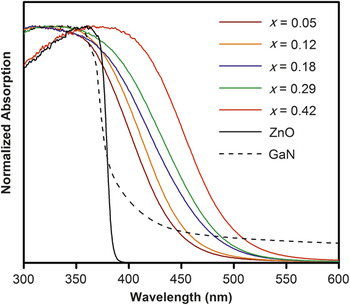
To devise a new oxynitride with d 10 electronic configuration that can decompose water under visible light, the solid solution of GaN and ZnO (Ga1–xZnx)(N1–xOx) was examined.Reference Maeda, Takata, Hara, Saito, Inoue, Kobayashi and Domen49, Reference Maeda, Teramura, Takata, Hara, Saito, Toda, Inoue, Kobayashi and Domen50 The detailed concept for designing the material as a visible-light-driven photocatalyst has been described elsewhere.Reference Maeda and Domen51 The (Ga1–xZnx)(N1–xOx) solid solution is typically synthesized by nitriding a mixture of Ga2O3 and ZnO. Elemental analyses by inductively coupled plasma optical emission spectroscopy (ICP-OES) revealed that the ratios of Ga to N and Zn to O in the as-prepared material are close to unity, and N and O concentrations increase with the Ga and Zn concentrations, respectively.Reference Maeda, Takata, Hara, Saito, Inoue, Kobayashi and Domen49 The atomic composition is controllable by changing the nitridation conditions.Reference Maeda and Domen51 X-ray diffraction and neutron powder diffraction analyses showed that the prepared samples are solid solutions of GaN and ZnO with no interstitial sites and no large disorder in the material.Reference Maeda, Takata, Hara, Saito, Inoue, Kobayashi and Domen49, Reference Maeda, Teramura, Takata, Hara, Saito, Toda, Inoue, Kobayashi and Domen50, Reference Yashima, Maeda, Teramura, Takata and Domen52 While GaN and ZnO both have bandgap energies greater than 3 eV and thus do not absorb visible light, the (Ga1–xZnx)(N1–xOx) solid solution has absorption edges in the visible region. Figure 5 shows the UV-visible diffuse reflectance spectra for several samples. The absorption edge of (Ga1–xZnx)(N1–xOx) lies at a wavelength longer than those of GaN and ZnO and shifts to longer wavelengths with increasing Zn and O concentration (x) in (Ga1–xZnx)(N1–xOx). The bandgap energies of the solid solutions are estimated to be 2.4–2.8 eV based on the diffuse reflectance spectra. It is thus clear that the visible-light-response of (Ga1–xZnx)(N1–xOx) originates from the presence of ZnO in the crystal. The photoluminescence and photoluminescence excitation spectra of (Ga1–xZnx)(N1–xOx) with compositions of x = 0.05–0.20 (i.e., GaN-rich) measured at 10 K suggested that the visible light absorption of this material occurs via Zn-related acceptor levels.Reference Hirai, Maeda, Yoshida, Kubota, Ikeda, Matsumura and Domen53 This idea, however, contradicts our early DFT calculations, which indicate that the bottom of the conduction band for (Ga1–xZnx)(N1–xOx) is mainly composed of 4s and 4p orbitals of Ga, while the top of the valence band consists of N 2p orbitals followed by Zn 3d and O 2p orbitals.Reference Maeda, Takata, Hara, Saito, Inoue, Kobayashi and Domen49, Reference Maeda, Teramura, Takata, Hara, Saito, Toda, Inoue, Kobayashi and Domen50 This idea remains valid for the solid solution with stoichiometric unit cells. For a dilute solid solution, however, it is natural to consider the local inhomogeneity of the Zn and O atom densities. In such circumstances, empty impurity levels appear just above the valence band, and/or filled impurity levels appear just below the conduction band. These impurity levels may explain the present experimental results and were characterized by DFT calculations with nonstoichiometric unit cells. Very recently, Muckerman et al. and Huang et al. have studied the same material using theoretical calculations.Reference Jensen, Muckerman and Newton54, Reference Wei, Dai, Yang, Guo and Huang55 Their results are essentially identical to those obtained in our previous study.
UV-visible diffuse reflectance spectra for various (Ga1–xZnx)(N1–xOx) solid solutions. The position of the absorption edge of (Ga1–xZnx)(N1–xOx) is located at a wavelength longer than that of GaN and ZnO and is shifted to longer wavelengths with increasing Zn and O concentration.

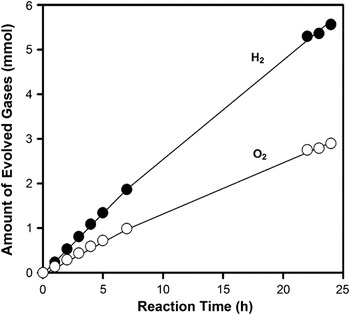
The as-prepared (Ga1–xZnx)(N1–xOx) exhibited little photocatalytic activity for water decomposition even under UV irradiation. However, modification by surface deposition of metal oxide nanoparticles (so-called co-catalysts), such as H2 evolution sites, resulted in clearly observable H2 and O2 evolution. The activity was strongly dependent on the loaded co-catalyst, and a mixed-oxide of Rh and Cr (Rh2–yCryO3) is the most effective (Ga1–xZnx)(N1–xOx) among the co-catalyst materials examined.Reference Maeda, Teramura, Lu, Takata, Saito, Inoue and Domen56, Reference Maeda, Teramura, Saito, Inoue and Domen57Figure 6 displays a typical time course of visible-light-driven overall water splitting over Rh2–yCryO3-loaded (Ga1–xZnx)(N1–xOx). As can be seen, this photocatalyst produced both H2 and O2 in the stoichiometric ratio (H2/O2 = 2) without noticeable degradation. The photocatalytic performance was also dependent on the pH of the reactant solution.Reference Maeda, Teramura, Masuda, Takata, Saito, Inoue and Domen58 The photocatalyst exhibited stable and high photocatalytic activity in an aqueous solution at pH 4.5 for as long as three days. The photocatalytic performance at pH 3.0 and pH 6.2 was much lower, attributable to corrosion of the co-catalyst and hydrolysis of the catalyst. It has also been confirmed by x-ray diffraction, x-ray photoelectron spectroscopy, and x-ray absorption fine structure that the crystal structure of the catalyst and the valence state of both the surface and bulk do not change even after reaction for three days at optimal pH (4.5). These results offer useful guidelines for further research using other oxynitrides.
A typical time course of overall water splitting under visible irradiation (wavelength, λ > 400 nm) over Rh2–yCryO3-loaded (Ga1–xZnx)(N1–xOx) (1.0 wt% Rh and 1.5 wt% Cr). Here it is clear that the photocatalyst catalyzes stoichiometric water splitting into H2 and O2 with visible light. Catalyst (0.3 g); reactant solution, aqueous H2SO4 solution (370 mL, pH 4.5); light source, high-pressure mercury lamp (450 W) with an aqueous NaNO2 solution (2 M) filter; inner-irradiation-type Pyrex reaction vessel.

ZnGeN2–ZnO solid solution
A solid solution of ZnGeN2 and ZnO, (Zn1+xGe)(N2Ox), which is a similar material to (Ga1–xZnx)(N1–xOx) in terms of crystal structure and optical absorption, has also been found to be an active and stable photocatalyst for overall water splitting under visible light.Reference Lee, Terashima, Shimodaira, Teramura, Hara, Kobayashi, Domen and Yashima59, Reference Lee, Teramura, Hara and Domen60 Both ZnGeN2 and ZnO are wide-gap semiconductors with bandgaps larger than 3 eV, although the bandgap of ZnGeN2 is dependent on the crystal structure and composition.Reference Misaki, Wu, Wakahara and Yoshida61 The (Zn1+xGe)(N2Ox) solid solutions can be prepared in a method similar to (Ga1–xZnx)(N1–xOx), but with a mixture of ZnO and GeO2 as the starting material. The crystal structure of the synthesized sample was confirmed by both Rietveld analysis and neutron powder diffraction to be wurtzite with space group P63mc.Reference Lee, Terashima, Shimodaira, Teramura, Hara, Kobayashi, Domen and Yashima59 In the solid solution between ZnGeN2 and ZnO, the oxygen atoms are replaced with nitrogen sites. The bandgap of the material is estimated to be 2.5–2.7 eV based on the absorption edges, which is smaller than the bandgaps of β-Ge3N4 (ca. 3.8 eV), ZnGeN2 (ca. 3.3 eV), and ZnO (ca. 3.2 eV). The visible-light response of the material originates from the wide valence bands consisting of N 2p, O 2p, and Zn 3d atomic orbitals and p–d repulsion between Zn 3d and N 2p and O 2p electrons in the upper part of the valence bands. Therefore, the absorption edge of (Zn1+xGe)(N2Ox) tends to be located at longer wavelengths with increasing ZnO content.
Neither ZnGeN2 nor ZnO alone exhibited photocatalytic activity for overall water splitting under UV irradiation. However, (Zn1+xGe)(N2Ox) became photocatalytically active under visible irradiation when loaded with a proper co-catalyst. Overall water splitting on a modified (Zn1+xGe)(N2Ox) proceeded by bandgap photoexcitation from the valence band formed by N 2p, O 2p, and Zn 3d atomic orbitals to the conduction band consisting of Ge 4s,4p hybridized atomic orbitals. As demonstrated in the (Ga1–xZnx)(N1–xOx) section earlier, the photocatalytic activity of the transition metal-loaded catalysts was improved markedly by co-loading Cr oxide.Reference Lee, Teramura, Hara and Domen60 The largest improvement in activity was obtained by loading the base catalysts with both 3 wt% Rh and 0.2 wt% Cr. It was confirmed that catalytic gas evolution of Rh2–yCryO3-loaded (Zn1+xGe)(N2Ox) is stable for as long as 60 h.
Summary
A range of oxynitride materials for photocatalytic overall water splitting has been developed. Oxynitrides have been found to function as stable photocatalysts for water reduction and oxidation under visible irradiation, and the (Ga1–xZnx)(N1–xOx) and (Zn1+xGe)(N2Ox) solid solutions with d 10 electronic configuration have been shown to achieve overall water splitting under visible light without noticeable degradation. Some of d 0-type oxynitrides are applicable to a two-step water splitting system that can harvest a wide range of visible photons. Although the quantum yield of photocatalytic water splitting still remains ~5–6% in this research field, further research on materials chemistry in oxynitrides is expected to improve the performance.
Acknowledgments
The research described herein was supported by the 21st Century Center of Excellence (COE) and the Research and Development in a New Interdisciplinary Field Based on Nanotechnology and Materials Science programs of the Ministry of Education, Culture, Sports, Science and Technology (MEXT) of Japan. Acknowledgment is also extended to the KAITEKI Institute, Inc. for financial support. Acknowledgment is also extended to the Global Center of Excellence (GCOE) Program for Chemistry Innovation through Cooperation of Science and Engineering and Nippon Sheet Glass Foundation for Materials Science and Engineering.