INTRODUCTION
The population structure of mangrove crabs has been analysed mainly with regard to the distribution of individuals by size-classes, comparing the body size of males and females, age distribution, proportion of males and females, recruitment and the reproductive period (Díaz & Conde, Reference Díaz and Conde1989; Castiglioni et al., Reference Castiglioni, Negreiros-Fransozo and Mortari2006; Nicolau & Oshiro, Reference Nicolau and Oshiro2007; Silva et al., Reference Silva, Hirose and Negreiros-Fransozo2007; Hirose & Negreiros-Fransozo, Reference Hirose and Negreiros-Fransozo2008; Costa & Soares-Gomes, Reference Costa and Soares-Gomes2009; Gregati & Negreiros-Fransozo, Reference Gregati and Negreiros-Fransozo2009). This information about populations adds to the knowledge of the ecological stability of species in a given habitat, and leads to greater understanding of their biology.
Decapod crustaceans play an important role in nutrient cycling and energy flow in the mangrove ecosystem, not only because of their position in trophic webs, but they also churn the mud sediment by digging burrows where they shelter and store food, bringing organic matter from lower layers to the surface (Macintosh, Reference Macintosh1988). Among the Decapoda, brachyuran crabs of the families Gecarcinidae, Grapsidae, Portunidae, Panopeidae, Xanthidae and Ocypodidae are the most prominent in estuarine areas in Brazil (Melo, Reference Melo1996).
Grapsoid crabs can be found throughout the tropics and temperate zones. Members of the genus Sesarma Say, 1817 are the most common representatives of this group in mangrove areas worldwide, and Sesarma rectum Randall, 1840 is one of the most abundant species of mangroves in Brazil. This species is distributed in the western Atlantic from Venezuela and Guyana to Brazil (from Amapá to Santa Catarina) (Melo, Reference Melo1996). Because S. rectum feeds on shoots of vascular plants, it influences the rate of regeneration (Jones, Reference Jones, Por and Dor1984) and also ecosystem dynamics through the export of particulate organic matter and nutrients to the adjacent estuarine areas (Robertson, Reference Robertson1991).
Most of the studies on S. rectum have treated population and reproductive aspects, but all have been carried out on populations in south-eastern Brazil (Mantelatto & Fransozo, Reference Mantelatto and Fransozo1999; Leme, Reference Leme2002, Reference Leme2004, Reference Leme2005; Silva & Chacur, Reference Silva and Chacur2002; Silva et al., Reference Silva, Hirose and Negreiros-Fransozo2007). In view of the ecological importance of S. rectum in the mangrove ecosystem and also because of the lack of studies on this crab in north-eastern Brazil, we designed this study to provide information on its population ecology in mangroves of the Ariquindá River mangrove, Tamandaré, State of Pernambuco, Brazil. Population and reproductive aspects, including the size-class frequency distribution of carapace width (CW), mean body size (CW) of males and females, morphological sexual maturity, sex-ratio, reproductive period and recruitment were treated in detail.
MATERIALS AND METHODS
The crabs were collected in the Ariquindá River mangrove, Tamandaré, State of Pernambuco, Brazil (8°41′27.91″S and 35°06′04.59″W) monthly from April 2008 through to March 2009. Each month, one person collected crabs for 30 minutes during low tide. The crabs were placed in plastic bags and taken to the laboratory, where each individual was sexed and measured (with a precision calliper to the nearest 0.01 mm) for carapace width (CW), right propodus length of males (PL), and abdomen width of females (width corresponding to the fifth abdominal somite) (AW). The ovigerous condition of females was also noted.
The air and burrow temperatures and river and burrow-water salinity were monitored monthly with three replicates. Then, a comparison was performed among seasons in each environmental factor and between air and burrow temperatures in each season and between river and burrow-water salinity in each season (α = 0.05; Zar, Reference Zar1996).
The determination of morphological sexual maturity was based on the relationship between the structures PL versus CW for males and AW versus CW for females. These relationships were selected for analysis because of the importance of the dependent variables (PL and AW) in the reproductive processes of males and females, respectively. Males and females were classified to each group using a K-means clustering analysis (non-hierarchical classification procedure). This method is based on the establishment of predetermined groups (juveniles and adults), assigning the crabs to one of the groups by means of an iterative process that minimizes the variance within groups and maximizes the variance between groups. Using the results of this classification, a further bivariate discriminant analysis can be applied allowing a reclassification of these groups by separating the crabs into juveniles (immatures) and adults (matures). This statistical method was based on the works of Sampedro et al. (Reference Sampedro, González-Gurriarán, Freire and Muiño1999) and Corgos & Freire (Reference Corgos and Freire2006), which used a similar procedure. After the separation of the groups, in cases of overlap, each age category was divided into size-classes (2.0 mm CW) and the proportion of juveniles to adults in each size-class of CW was calculated. The proportion of adults was fitted to a logistic equation (y = a/(1 + be−cx)). Subsequently, an interpolation was performed to determine the size at which 50% of the males and females were mature (adult) (Corgos & Freire, Reference Corgos and Freire2006). Following the correct division of the groups, the transformed data (log10) in each category were submitted to analysis of covariance (ANCOVA) to test the angular and linear coefficients between groups (juveniles and adults) (α = 0.05) (Zar, Reference Zar1996).
For the analyses of population structure, the animals were grouped by demographic category (males and females) and were arranged in 15 size-classes based on CW, each class of 2.0 mm. The number of classes was obtained by the Sturges formula (Conde et al., Reference Conde, Rull and Vegas1986). The frequency distribution of the male and female crabs sampled during the one-year period was tested for normality using the Shapiro–Wilk test (α = 0.05) (Zar, Reference Zar1996).
The median size, based on the carapace width, was compared among males and females by the Mann–Whitney test (α = 0.05) (Zar, Reference Zar1996).
The sex-ratio was determined for the total number of crabs and for each month, season and CW size-class. We used the test of goodness of fit (Chi-square) to verify if the sex-ratio found for S. rectum followed the expected 1:1 proportion (α = 0.05) (Zar, Reference Zar1996).
To determine the reproductive period of S. rectum, the frequency of ovigerous females in relation to adult females was calculated for each season. These proportions were then compared using the multinomial proportions test (MANAP) (α = 0.05) (Curi & Moraes, Reference Curi and Moraes1981). The association between frequency of ovigerous females with air temperature and burrow temperature were assessed through Pearson's linear correlation coefficient (Zar, Reference Zar1996).
In the analysis of recruitment, juveniles were considered to be males less than 15.7 mm CW and females less than 16.7 mm CW. The recruitment period was determined by the proportion of juveniles in relation to all crabs collected in each season, and was compared using the multinomial proportions test (MANAP; α = 0.05) (Curi & Moraes, Reference Curi and Moraes1981).
RESULTS
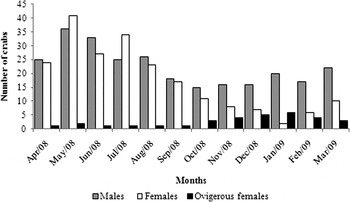
A total of 511 crabs were collected, including 269 males (132 juveniles and 137 adults) and 242 females (171 juveniles and 71 adults). In the entire study period, only 32 ovigerous females were recorded. Figure 1 shows the number of crabs of each sex sampled each month over the period of one year in the Ariquindá mangrove.
Number of males, females and ovigerous females of Sesarma rectum sampled in each month during the course of one year in the Ariquindá River mangrove.

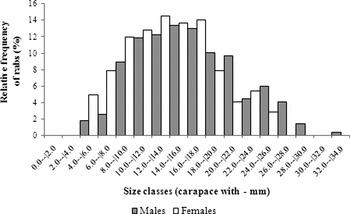
The size-class frequency distribution of CW of males and females of S. rectum did not show a normal distribution (males W = 0.9663; females W = 0.9618; P < 0.05), but was unimodal for both males and females (Figure 2).
Total size-class frequency distribution of carapace width (CW) of males and females of Sesarma rectum sampled in the Ariquindá River mangrove.

The CW of male crabs ranged from 8.6 to 32.3 mm (mean ± SD: 16.3 ± 0.34 mm), and that of females from 6.2 to 25.7 mm (13.9 ± 0.32 mm). Males had a significantly larger median size than females (males: 16.15 mm; females: 13.82 mm; U = 24908.50; P < 0.05).
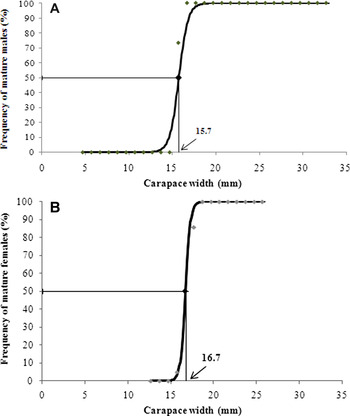
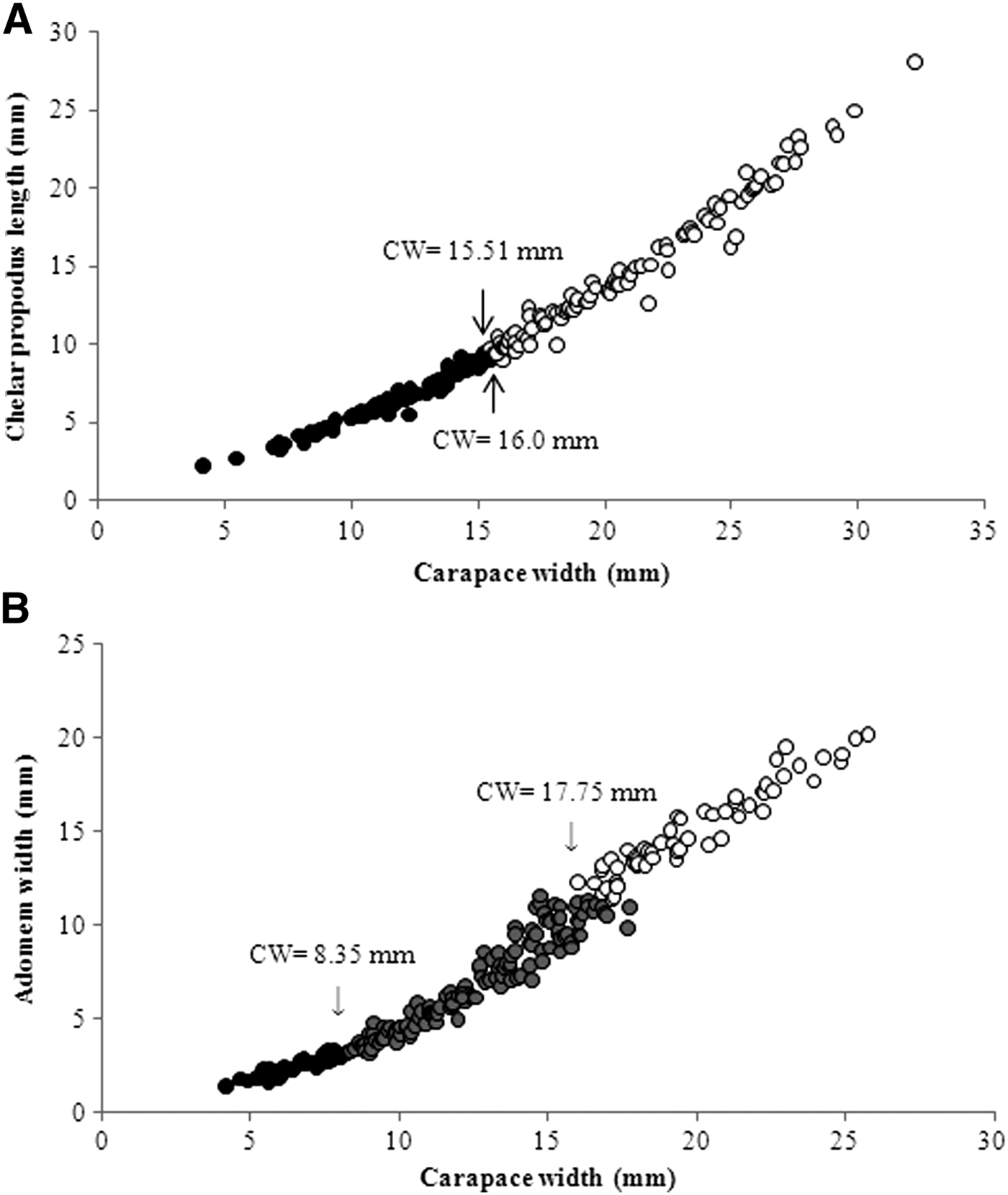
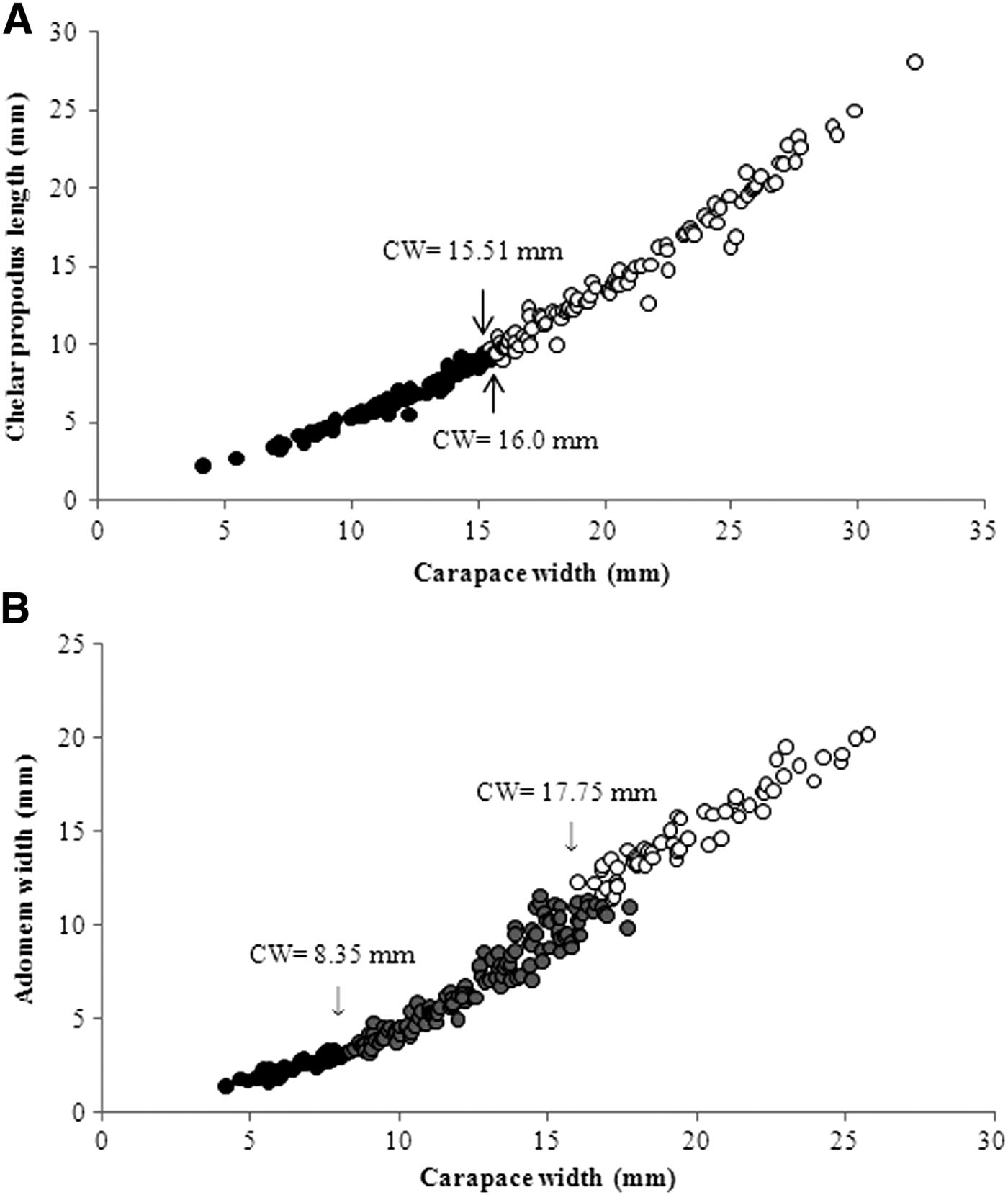
In this study on S. rectum, only the morphological sexual maturity was estimated. The size at sexual maturity of males and females, defined as the CW at which 50% of the crabs are morphologically mature, was estimated by logistic equation based on the previous classification into juvenile and adult groups using the K-means clustering analysis. Thus, 50% of males were morphologically mature at 15.7 mm (Figure 3A), being 15.51 mm of CW the smallest mature male and 16.0 mm of CW the largest immature (Figure 4A). The slopes and intercepts of allometric relationship PL versus CW differed between juveniles (PL = 0.3332CW1.2029, r2 = 0.97) and adults (PL = 0.1693CW1.4652, r2 = 0.97), thus indicating contrasting growth patterns (slope F = 61.33; intercept F = 19.75; P < 0.05). For females, the size at which 50% were mature was 16.7 mm of CW (Figure 3B), being observed three distinct groups (<8.2 mm; 8.35 ≤ CW < 17.75; 16.02 ≤ CW < 25.75). Thus, for females, the transitional phase (8.35 to 17.75 mm) indicates a size-range where it is possible to find mature and immature individuals (Figure 4B). The regression equations obtained for the age groups (juveniles AW = 0.2602CW1.1974, r2 = 0.84; transitional AW = 0.0757CW1.7754, r2 = 0.93; adults AW = 0.4662CW1.1612, r2 = 0.9107) were submitted to ANCOVA, which verified that the pattern of growth differed between groups (P < 0.05) (juvenile versus transitional—slope F = 30.87 and intercept F = 8.38; transitional versus adult—slope F = 4.71 and intercept F = 1.59).
Morphological sexual maturity of males (A) and females (B) of Sesarma rectum sampled in the Ariquindá River mangrove. The arrows indicate the size at which 50% of the population is morphologically mature.

Dispersion points for the relationships propodus length of males versus carapace width (CW) for males (A) and abdomen width of females versus CW for females (B) of Sesarma rectum sampled in the Ariquindá River mangrove.
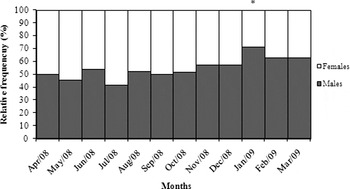
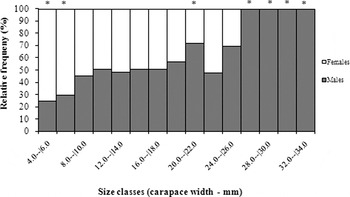
In January 2009, males were significantly more abundant than females (χ2 = 5.14; P < 0.05) (Figure 5). However, the overall sex-ratio for the total of crabs examined was 1.11 males:1.00 females, not significantly different from unity (χ2 = 1.43; P > 0.05). The sex-ratio in the different size-classes differed in the larger classes, favouring the males, as shown in Figure 6 (P < 0.05).
Monthly sex-ratio of Sesarma rectum sampled in the Ariquindá River mangrove. *indicates a significant difference in the proportion of males and females (P < 0.05).

Sex-ratio by size-class of carapace width of Sesarma rectum sampled in the Ariquindá River mangrove. * indicates a significant difference in the proportion of males and females (P < 0.05).

The mean air and burrow temperatures of Ariquindá River mangrove during the sampling period were 29.9 ± 2.2°C and 28.0 ± 1.8°C, respectively, not presenting a greater variation throughout the year (Table 1). The mean salinity of the river water was 22.2 ± 5.7 psu and the mean burrow-water salinity was 24.9 ± 6.3 psu (Table 1). The air temperature was similar among seasons (P > 0.05; Table 1). The burrow temperature was similar among seasons, except for summer when the mean temperature was significantly greater than autumn and winter (P < 0.05; Table 1). There was no significant difference between air and burrow temperature for all seasons (P > 0.05), although the air temperature was higher than the burrow temperature (Table 1). The mean salinity of the river water was similar among season, except for summer when the mean salinity was significantly greater than autumn (P < 0.05; Table 1). However, the burrow-water salinity of S. rectum was significantly lower in autumn when compared with the other seasons (P < 0.05; Table 1). The mean salinity of the burrow water was similar to the mean river salinity for all seasons (P > 0.05; Table 1).
Means of the air and burrow temperatures, and of river and burrow-water salinity of the Ariquindá River mangrove.

Notes: lower case letters correspond to comparisons within the same environmental factor among seasons of the year; upper case letters correspond to comparisons between air and burrow temperatures in each season and between river and burrow-water salinity in each season. Values with at least one letter in common did not differ statistically (analysis of variance; P > 0.05). Autumn, April, May and June; winter, July, August and September; spring, October, November and December; summer, January, February and March.
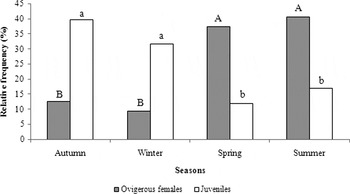
We found 32 ovigerous females, throughout the year (33% of the total adult females collected), indicating a continuous reproductive period (Table 1), but with a higher intensity in spring (41.4%) and summer (61.9%) (Figure 7). The monthly frequency of ovigerous females was positively correlated with air temperature (r = 0.69; P < 0.05) and burrow temperature (r = 0.97; P < 0.05).
Relative frequency (%) of ovigerous females and juveniles of Sesarma rectum during the sampling period in the Ariquindá River mangrove. Upper case letters correspond to the comparisons among the ovigerous females; lower case letters correspond to the comparisons of juveniles. Values with at least one letter in common did not differ significantly (P > 0.05). Autumn, April, May and June; winter, July, August and September; spring, October, November and December; summer, January, February and March.

The percentage of juveniles of S. rectum during the months of the study indicated that recruitment was continuous, with higher frequency in the autumn (63.16%) and winter (65.75%) (Figure 7).
DISCUSSION
The size-class frequency distribution of a population is a dynamic characteristic that can vary throughout the year, as a result of rapid reproduction and recruitment of larvae (Thurman II, Reference Thurman II1985). The size-class frequency distribution of CW of males and females of S. rectum was unimodal, probably because of continuous reproduction and recruitment in the Ariquindá River mangrove. The unimodality may indicate that the population of S. rectum in this area is stable, with continuous recruitment and constant mortality rates over the life cycle (Díaz & Conde, Reference Díaz and Conde1989; Hartnoll & Bryant, Reference Hartnoll and Bryant1990). Similar observations were reported by Silva et al. (Reference Silva, Hirose and Negreiros-Fransozo2007) for a population of S. rectum from a mangrove area at Paraty, State of Rio de Janeiro, and for other species of mangrove Grapsoidea (Díaz & Conde, Reference Díaz and Conde1989; Leme & Negreiros-Fransozo, Reference Leme and Negreiros-Fransozo1998; Nicolau & Oshiro, Reference Nicolau and Oshiro2007; Gregati & Negreiros-Fransozo, Reference Gregati and Negreiros-Fransozo2009).
Males had a significantly larger mean size than females. Sexual dimorphism in the mean size of crabs, where the males reached larger dimensions than the females, was also observed by Leme (Reference Leme2002) and Silva et al. (Reference Silva, Hirose and Negreiros-Fransozo2007) for the same species from mangrove areas in Ubatuba, State of São Paulo and Paraty, State of Rio de Janeiro, respectively. The size difference between the sexes in brachyurans probably results from the greater energy expenditure by females for reproductive purposes, whereas males have a faster growth rate or a period of greater growth (Warner, Reference Warner1967; Díaz & Conde, Reference Díaz and Conde1989; Hartnoll, Reference Hartnoll2006). The sexual dimorphism was also observed for several other species of mangrove crabs (Benetti & Negreiros-Fransozo, Reference Benetti and Negreiros-Fransozo2003; Litulo, Reference Litulo2005; Hirose & Negreiros-Fransozo, Reference Hirose and Negreiros-Fransozo2008; Mokhtari et al., Reference Mokhtari, Savari, Rezai, Kochanian and Bitaab2008), being males bigger than females.
Determination of sexual maturity is important, because this information is used to estimate the reproductive capacity of a species (Hines, Reference Hines1982). The size at first maturity in brachyurans can be evaluated based on comparative studies of physiology (degree of gonadal development) and external morphology (shape and size of body structures), as discussed by López et al. (Reference López, Stella and Rodríguez1997), Castiglioni & Santos (Reference Castiglioni and Santos2000) and Silva et al. (Reference Silva, Hirose and Negreiros-Fransozo2007). However, in this study on S. rectum, only the morphological sexual maturity was estimated, which indicated that 50% of males and females were morphologically mature at 15.7 mm and 16.7 mm CW, respectively. Silva et al. (Reference Silva, Hirose and Negreiros-Fransozo2007), studying the same species, found that morphological sexual maturity was reached at 14.7 mm in males, and between 13.2 and 18.5 mm in females, and that physiological sexual maturity was reached at 18.5 mm in males and 17.5 mm in females. Leme (Reference Leme2005) found that 50% of females of S. rectum are morphologically mature at 17.4 mm CW. As also observed for several other species of mangrove crabs, the biological aspects exhibit a latitudinal pattern, with smaller individuals at low latitudes and large crabs at high latitudes (Masunari & Swiech-Ayoub, Reference Masunari and Swiech-Ayoub2003; Masunari et al., Reference Masunari, Dissenha and Falcão2005). It has been suggested that temperature and the temperature–photoperiod interaction can produce latitudinal clines in metabolic rates, growth, and size, resulting in slower growth, older individuals, and reduced maturation rates in high latitudes (Giese, Reference Giese1959; Jones & Simons, Reference Jones and Simons1983; Hines, Reference Hines1989). A similar cline is observed in S. rectum, comparing the results of this study with data for populations in south-eastern Brazil (Leme, Reference Leme2005; Silva et al., Reference Silva, Hirose and Negreiros-Fransozo2007).
In the case of females of S. rectum, the relationship AW versus CW follows a distinct pattern from that found for other crabs, i.e. there is a need for having more than two growth phases. The first phase of growth is compounded only by immature crabs (smaller than 8.25 mm CW), and the last one only by mature crabs (larger than 16.02 mm CW). The middle phase, here named ‘transitional’, is evident from 8.35 to 17.75 mm CW, where we can find either immature or mature crabs. This abdomen pattern growth was observed for other populations of S. rectum (Leme, Reference Leme2005; Silva et al., Reference Silva, Hirose and Negreiros-Fransozo2007), and other species of mangrove crabs, such as Uca thayeri Rathbun, 1900 (Negreiros-Fransozo et al., Reference Negreiros-Fransozo, Colpo and Costa2003) and Uca maracoani Latreille, 1802–1803 (Hirose & Negreiros-Fransozo, Reference Hirose and Negreiros-Fransozo2007). According to Negreiros-Fransozo et al. (Reference Negreiros-Fransozo, Colpo and Costa2003), the first group of adult females could be represented by primiparous females, but further studies are necessary to confirm such a hypothesis.
The overall sex-ratio of S. rectum did not differ significantly from the expected 1:1 ratio. However, Silva et al. (Reference Silva, Hirose and Negreiros-Fransozo2007) observed that males of S. rectum were more frequent than females in a population at Paraty (State of Rio de Janeiro). According to Johnson (Reference Johnson2003), differences between the sexes in growth rate, spatial–temporal distribution, gamete production and mortality can influence the sex-ratio. Significant deviations were observed in several mangroves crabs species in Brazil such as Uca thayeri (Costa & Negreiros-Fransozo, Reference Costa and Negreiros-Fransozo2003), U. rapax (Smith, 1870) (Castiglioni et al., Reference Castiglioni, Negreiros-Fransozo and Mortari2006), U. burgersi Holthuis, 1967 (Benetti et al., Reference Benetti, Negreiros-Fransozo and Costa2007) and U. rapax (Costa & Soares-Gomes, Reference Costa and Soares-Gomes2009).
The sex-ratio of S. rectum in the different size-classes showed a standard pattern, as also described by Wenner (Reference Wenner1972): the ratio differed in the larger classes, favouring a sex (males). This may be associated with a higher energy requirement for reproduction, because while the females are incubating eggs, the events of somatic growth, which are antagonistic to reproductive events, cease, thus slowing their growth (Adiyodi & Adiyodi, Reference Adiyodi and Adiyodi1970). A similar pattern has been observed in this same species by Silva et al. (Reference Silva, Hirose and Negreiros-Fransozo2007), in Uca maracoani by Hirose & Negreiros-Fransozo (Reference Hirose and Negreiros-Fransozo2008) and in U. burgersi by Benetti et al. (Reference Benetti, Negreiros-Fransozo and Costa2007).
Temperature and salinity variations are two great problems faced by crabs that live in intertidal estuarine areas. The habitat surface can attain 44°C, which is 1–3°C above the lethal limit for fiddler crabs (Edney Reference Edney1961; Macintosh Reference Macintosh, Gopal, Turner, Wetzel and Whighma1982). Species of mangrove crabs visit their burrows more often to compensate for the high temperatures, because the burrow water cools their body temperature by evaporation (Smith & Miller, Reference Smith and Miller1973). In this study, the environmental and burrow temperatures did not differ, perhaps because the crabs were sampled in exposed areas with sparse vegetation cover which reduced the incidence of solar rays directly on the substratum.
Although the proportions of ovigerous females did not exceed 33% (32 ovigerous females), they were found in all seasons in Ariquindá River mangrove, which indicates a continuous reproductive period, but with more intensity in the spring and summer. The finding of only 32 ovigerous females during the entire study period suggests that ovigerous females remain in their burrows while they are incubating their eggs, or may seek more protected sites in the mangroves. Silva et al. (Reference Silva, Hirose and Negreiros-Fransozo2007) also observed continuous reproduction, but more intensity in spring and summer, in a population of S. rectum in a degraded mangrove area in Paraty (State of Rio de Janeiro). The beginning and duration of the reproductive period depend on the occurrence of favourable environmental conditions; latitude, temperature, and intertidal zonation seem to exert the most influence on reproduction (Thorson, Reference Thorson1950; Giese, Reference Giese1959; Sastry, Reference Sastry, Vernberg and Vernberg1983). The availability of food for maintenance, growth, and reproduction of adults, and for the development, growth, and survival of larval stages and/or juveniles may be one of the most important factors in the coordination and synchronization of reproductive activities in a given habitat, and also in the evolution of life-history and reproductive strategies (Sastry, Reference Sastry, Vernberg and Vernberg1983). Most tropical species either reproduce continuously throughout the year, or have a longer breeding season than species at high latitudes (Emmerson, Reference Emmerson1994). Continuous reproductive activity, as observed in S. rectum, occurs in other species of mangrove crabs along the Brazilian coast (Leme & Negreiros-Fransozo, Reference Leme and Negreiros-Fransozo1998; Cobo & Fransozo, Reference Cobo, Fransozo, von Klein and Schram2000; Hirose & Negreiros-Fransozo, Reference Hirose and Negreiros-Fransozo2008; Costa & Soares-Gomes, Reference Costa and Soares-Gomes2009; Gregati & Negreiros-Fransozo, Reference Gregati and Negreiros-Fransozo2009).
The percentage of juveniles of S. rectum during the months of the study indicated that recruitment was continuous, with higher frequency in the autumn and winter, and probably results from higher reproductive intensity in the warmer months, as also observed by Leme (Reference Leme2002), and Silva et al. (Reference Silva, Hirose and Negreiros-Fransozo2007) for this species in Ubatuba (State of São Paulo) and Paraty (State of Rio de Janeiro), respectively.
The results of this study indicate that the dynamics of this population of S. rectum are similar to other populations along the Brazilian coast. The single exception is body size, which is smaller than in other populations of this species from higher latitudes. The population of S. rectum in the Ariquindá River mangrove seems to be stable. The males grow larger than the females, and reproduction and recruitment were continuous throughout the months of sampling.
ACKNOWLEDGEMENTS
The authors are grateful to the Fundação de Amparo à Ciência e Tecnologia do Estado de Pernambuco (FACEPE), for financial support for fieldwork to D.S.C. (APQ 0108-2.04/07), and to CNPq for a fellowship to D.S.C.; to Mr Adriano Martins for his help in the fieldwork; and to Dr. Janet W. Reid for assistance with the English text. All sampling in this study was conducted in compliance with current applicable state and federal laws (ICMBio 14340-1).