Development is a dynamic process in which very early perturbations can alter the psychobiological systems responsible for temperament and personality (Gartstein & Skinner, Reference Gartstein and Skinner2017; Krzeczkowski & Van Lieshout, Reference Krzeczkowski and Van Lieshout2018). Developmental programming hypotheses posit that individuals who are exposed to prenatal and early postnatal stressors may have altered maturation of central and peripheral physiological systems responsible for the regulation of stress, such as the prefrontal cortex, amygdala, and hypothalamic–pituitary–adrenal (HPA) axis (Gluckman, Hanson, & Buklijas, Reference Gluckman, Hanson and Buklijas2010; Harris & Seckl, Reference Harris and Seckl2011). These biological changes are thought to be adaptive in that they increase the fetus’ immediate survival within a stressful prenatal environment (Bateson, Gluckman, & Hanson, Reference Bateson, Gluckman and Hanson2014; Van Den Bergh, Reference Van Den Bergh2011). However, when the postnatal context is not comparably harsh and threatening as the prenatal environment, the individual manifests long-term programmed changes in the ability to handle stress and a predisposition to stress-reactivity and threat sensitivity (e.g., Bolten et al., Reference Bolten, Nast, Skrundz, Stadler, Hellhammer and Meinlschmidt2013; Davis et al., Reference Davis, Glynn, Schetter, Hobel, Chicz-Demet and Sandman2007; DiPietro, Hodgson, Costigan, & Johnson, Reference DiPietro, Hodgson, Costigan and Johnson1996; Pesonen et al., Reference Pesonen, Räikkönen, Kajantie, Heinonen, Strandberg and Järvenpää2006; Werner et al., Reference Werner, Myers, Fifer, Cheng, Fang, Allen and Monk2007; see also Gartstein & Skinner, Reference Gartstein and Skinner2017, for a review).
While emerging work has highlighted general behavioral domains impacted by early exposure to stressors, we know relatively little about specific temperaments or personalities that may be developmentally programmed. Some work has found that prenatal stress and administration of glucocorticoids in utero have resulted in fearful behaviors in response to novelty in rodent models (Dickerson, Lally, Gunnel, Birkle, & Salm, Reference Dickerson, Lally, Gunnel, Birkle and Salm2005, Van den Hove et al., Reference Van den Hove, Blanco, Aendekerk, Desbonnet, Bruschettini, Steinbusch and Steinbusch2005, Weinstock, Reference Weinstock2005) and among nonhuman primates (Schneider, Reference Schneider1992; Schneider, Coe, & Lubach, Reference Schneider, Coe and Lubach1992). These behavioral manifestations are comparable to behavioral inhibition in humans (Garcia-Coll, Kagan, & Reznick, Reference Garcia-Coll, Kagan and Reznick1984). Limited work in humans has likewise found that early exposure to glucocorticoids can predict cortisol dysregulation, behavioral inhibition, fearfulness, and anxiety in offspring (Davis et al., Reference Davis, Townsend, Gunnar, Georgieff, Guiang, Ciffuentes and Lussky2004; de Weerth, van Hees, & Buitelaay, Reference de Weerth, van Hees and Buitelaar2003; Trautman, Meyer-Bahlburg, Postelnek, & New, Reference Trautman, Meyer-Bahlburg, Postelnek and New1995). Collectively, these data suggest that prenatal exposure to glucocorticoids may result in programmed changes in the infant with one of the main behavioral outcomes being inhibition and fear in response to novelty (early developmental precursors of shyness). Therefore, we hypothesized that one ubiquitous temperamental characteristic that may be particularly relevant to study in the context of developmental programming is shyness.
Shyness is a trait characterized by fear and inhibition in response to social novelty and/or situations of perceived social evaluation (Melchior & Cheek, Reference Melchior and Cheek1990). Shyness is associated with physiological and behavioral stress reactivity (e.g., Kagan, Reznick, & Snidman Reference Kagan, Reznick and Snidman1987, Reference Kagan, Reznick and Snidman1988; Poole & Schmidt, Reference Poole and Schmidt2018; Schmidt, Reference Schmidt1999; Schmidt & Fox, Reference Schmidt and Fox1994; Schmidt et al., Reference Schmidt, Fox, Rubin, Sternberg, Gold, Smith and Schulkin1997; Schmidt, Fox, Schulkin, & Gold, Reference Schmidt, Fox, Schulkin and Gold1999) as well as increased detection of threat-related stimuli (LoBue & Pérez-Edgar, Reference LoBue and Pérez-Edgar2014; Pérez-Edgar et al., Reference Perez-Edgar, Bar-Haim, McDermott, Chronis-Tuscano, Pine and Fox2010, Reference Perez-Edgar, Reeb-Sutherland, McDermott, White, Henderson, Degnan and Fox2011). Likewise, exposure to prenatal adversity, including glucocorticoids, can result in altered development of neural systems, including limbic regions and prefrontal cortex, involved in fear regulation as well as increase the sensitivity of the HPA axis (see Bock, Rether, Gröger, Xie, & Braun, Reference Bock, Rether, Gröger, Xie and Braun2014; McEwen et al., Reference McEwen, Bowles, Gray, Hill, Hunter, Karatsoreos and Nasca2015, for a review). Thus, it is possible that the experience of early adversity may result in alterations of stress response systems and the expression of negative affect, behavioral inhibition, and hypervigilance, which could lay the developmental foundation for prospective shyness (Gartstein & Skinner, Reference Gartstein and Skinner2017).
Some cross-sectional work has examined the influence of prenatal stressors on the development of shyness or closely related constructs. These studies found evidence that lower birth weight (Pesonen et al., Reference Pesonen, Räikkönen, Lano, Peltoniemi, Hallman and Kari2009) and prenatal corticosteroid exposure (dexamethasone; Trautman et al., Reference Trautman, Meyer-Bahlburg, Postelnek and New1995) were correlated with more shyness and avoidance at 2 years of age. Additional work has found that prematurity (Tessier, Nadeau, Boivin, & Tremblay, Reference Tessier, Nadeau and Boivin1997) and prenatal corticosteroid exposure (betamethasone; Erni, Shaqiri, La Marca, Zimmermann, & Ehlert, Reference Erni, Shaqiri, La Marca, Zimmermann and Ehlert2012) are correlated with more social withdrawal and social-evaluative stress, respectively, in childhood (age 10–12 years). Still other studies have found that lower birth weight was associated with higher levels of introversion (Allin et al., Reference Allin, Rooney, Cuddy, Wyatt, Walshe, Rifkin and Murray2006; Hertz, Mathiasen, Hansen, Mortensen, & Greisen, Reference Hertz, Mathiasen, Hansen, Mortensen and Greisen2013; Pesonen et al., Reference Pesonen, Räikkönen, Heinonen, Andersson, Hovi, Järvenpää and Kajantie2008), behavioral inhibition (Pyhälä et al., Reference Pyhälä, Räikkönen, Pesonen, Heinonen, Hovi, Eriksson and Kajantie2009), social withdrawal (Eryigit-Madzwamuse, Strauss, Baumann, Bartmannm, & Wolke, Reference Eryigit-Madzwamuse, Strauss, Baumann, Bartmann and Wolke2015; Hack et al., Reference Hack, Youngstrom, Cartar, Schluchter, Taylor, Flannery and Borawski2004) and shyness in young adulthood (early 20s; Schmidt, Miskovic, Boyle, & Saigal, Reference Schmidt, Miskovic, Boyle and Saigal2008) and adulthood (early 30s; Waxman, Van Lieshout, Saigal, Boyle, & Schmidt, Reference Waxman, Van Lieshout, Saigal, Boyle and Schmidt2013; Xu Poole, Van Lieshout, Saigal, & Schmidt, Reference Xu, Poole, Van Lieshout, Saigal and Schmidt2018), as well as harm avoidance in later adulthood (age 60 years; Lahti et al., Reference Lahti, Raiikkonen, Heinonen, Pesonen, Kajantie, Forsen and Ericksson2008).
Although individuals exposed to early stressors may display behavioral profiles characterized by shyness in cross-sectional studies, considerably less is known about prospective longitudinal development of shyness from childhood to adulthood. The reason for this is that existing studies generally measure or analyze shyness or related behavior during single developmental periods and employ cross-sectional analyses. While such approaches are important, they do not reveal whether these phenotypes exhibit stability or change across development. It is important to have information on development starting in childhood and measured across repeated assessments, as this allows a valuable opportunity to examine trajectories of personality and information on the emergence of specific traits and the generation of hypotheses around factors involved in altering these trajectories. This is particularly relevant in the study of shyness, as previous work has illustrated heterogeneity in the developmental onset of shyness, including both early and later developing subtypes (Booth-LaForce & Oxford, Reference Booth-LaForce and Oxford2008; Oh et al., Reference Oh, Rubin, Bowker, Booth-LaForce, Rose-Krasnor and Laursen2008; Tang et al., Reference Tang, Van Lieshout, Lahat, Duku, Boyle, Saigal and Schmidt2017), which may have different underlying biological origins, different contextual influences, and different developmental outcomes (see Poole, Tang, & Schmidt, Reference Poole, Tang, Schmidt, Perez-Edgar and Fox2018, for a review). Thus, studying early developmental influences on prospectively and longitudinally measured shyness has implications for understanding heterogeneity in its developmental onset and course.
An additional gap in the context of developmental programming is that it remains unclear if the relative number of prenatal exposures may influence personality development. There is some evidence of possible cumulative effects of early adversity on levels of social-evaluative stress in a cross-sectional study of children (Erni et al., Reference Erni, Shaqiri, La Marca, Zimmermann and Ehlert2012). However, to our knowledge, no work has tested this within a longitudinal framework. Doing so may reveal whether multiple prenatal exposures can result in cumulative effects of early adversity that contribute to differing long-term effects on the development, stability, or change in shyness across time (Gartstein & Skinner, Reference Gartstein and Skinner2017).
It appears that independent exposure to prematurity or prenatal corticosteroids may result in shyness, and thus it is plausible that individuals who experience both of these exposures may be particularly susceptible to experience developmental programming effects. Infants born at extremely low birth weight (ELBW; <1000 g) are the tiniest and most at-risk babies and are susceptible to a number of stress-related problems across development (see Mathewson et al., Reference Mathewson, Chow, Dobson, Pope, Schmidt and Van Lieshout2017, for a review), and also exhibit physiological correlates of stress-vulnerability (Krzeczkowski, Schmidt, Savoy, Saigal, & Van Lieshout, Reference Krzeczkowski, Schmidt, Savoy, Saigal and Van Lieshout2018; Schmidt, Miskovic, Boyle, & Saigal, Reference Schmidt, Miskovic, Boyle and Saigal2010). In addition, some individuals born at ELBW are also exposed prenatally to exogenous corticosteroids, which are given to women at risk for preterm labor (Waffrin & Davis, Reference Waffarn and Davis2012). Although these synthetic corticosteroids are an effective and important therapy for reducing infant mortality, exposure to these steroids prenatally can alter the developing brain and stress regulation systems (Davis, Waffran, & Sandman, Reference Davis, Waffarn and Sandman2011; Savoy, Ferro, Schmidt, Saigal, & Van Lieshout, Reference Savoy, Ferro, Schmidt, Saigal and Van Lieshout2016; see Welberg & Seckl, Reference Welberg and Seckl2001, for an exhaustive review). For example, exposure to glucocorticoids can influence developing neural systems involved in fear regulation and detection (see Bock et al., Reference Bock, Rether, Gröger, Xie and Braun2014; McEwen et al., Reference McEwen, Bowles, Gray, Hill, Hunter, Karatsoreos and Nasca2015, for a review). The reason is that while approximately 80% of maternal cortisol is metabolized prior to entering fetal circulation, synthetic corticosteroids such as those administered for preterm labor are not metabolized (Waffrin & Davis, Reference Waffarn and Davis2012). Consequently, the developing fetus brain is exposed to abnormally high levels of synthetic cortisol, which can lead to HPA axis dysregulation (Moisiadis & Matthews, Reference Moisiadis and Matthews2014). There exists some work suggesting that ELBW infants who are also exposed prenatally to corticosteroids may exhibit greater stress-vulnerability relative to those who were not exposed, as indicated by greater relative right frontal brain activity (Krzeczkowski et al., Reference Krzeczkowski, Schmidt, Savoy, Saigal and Van Lieshout2018) and increased risk for anxiety disorders (Savoy et al., Reference Savoy, Ferro, Schmidt, Saigal and Van Lieshout2016; Van Lieshout, Boyle, Saigal, Morrison, & Schmidt, Reference Van Lieshout, Boyle, Saigal, Morrison and Schmidt2015); these are also physiological and psychological correlates of shyness.
The Present Study
We conducted a longitudinal, prospective study spanning four decades to test whether increasing levels of perinatal adversity, specifically extreme prematurity and prenatal exposure to exogenous corticosteroids, were associated with the developmental onset and developmental course of shyness from childhood to adulthood. To this end, we used multilevel modeling to delineate the trajectory of shyness from age 8 to age 32 in three groups with varying degrees of exposure to prenatal adversity. From the highest to lowest levels of prenatal adversity, these groups included ELBW survivors who were also prenatally exposed to exogenous corticosteroids (ELBW+S); ELBW survivors who were not prenatally exposed to exogenous corticosteroids (ELBW+NS), and normal birth weight (NBW; >2500 g) controls.
We tested three hypotheses. First, because ELBW+S individuals had ostensibly more stressful early exposures relative to the other groups, we hypothesized they would manifest high levels of shyness in childhood that remain stable into adulthood, resulting from a predisposition to experience heightened postnatal stress-reactivity, threat sensitivity, and emotion dysregulation (Gartstein & Skinner, Reference Gartstein and Skinner2017). Second, we hypothesized that ELBW+NS individuals would display moderate, stable levels of shyness given their intermediate level of early stress exposure. Third, we hypothesized that NBW controls would display low, stable levels of shyness, or decreases in shyness across development in line with previous work in typically developing individuals (Dennissen, Asendorpf, & Van Aken, Reference Dennissen, Asendorpf and Van Aken2008).
Method
Sample overview
The ELBW sample was recruited at birth and comprised 397 predominantly Caucasian infants born at less than 1000 g between 1977 and 1982 to residents of central-west and has been prospectively followed since birth. Of these, 179/397 (45%) survived to hospital discharge. In the present study, all participants with neurosensory impairment (NSI; n = 51), defined as the presence of at least one of cerebral palsy, blindness, deafness, intellectual disability, or microcephaly diagnosed in childhood by a neonatologist or developmental pediatrician, were excluded because they have unique challenges that are not generalizable to the majority of those born preterm.
Follow-up assessments on this group have been conducted during childhood (8 years), adolescence (12 to 16 years), young adulthood (22 to 26 years), and adulthood (30 to 35 years). We will use the developmental period to describe each assessment for the remainder of the paper. At the childhood assessment, 108 (84.4%) ELBW survivors had complete shyness data; at the adolescent assessment, 102 (80.0%) ELBW survivors had complete shyness data; at the young adulthood assessment, 109 (85.2%) ELBW survivors had complete shyness data; and at the adulthood assessment, 71 (55.4%) ELBW survivors had complete shyness data. Participants who had shyness data for at least one visit (n = 112) were included in the analyses. Of these ELBW participants, a total of 56 (50%) mothers received prenatal administration of betamethasone (ELBW+S), whereas 56 (50%) mothers did not receive prenatal administration of betamethasone (ELBW+NS).
Participants in the NBW control group were recruited when they and the ELBW survivors were 8 years old. These 145 children were selected from a random sample of students in the Hamilton Public School System (Ontario) who were born at full term and matched with the ELBW participants on age, sex, and family socioeconomic status (SES) at the childhood assessment. Subsequent assessments have occurred at the same ages as the ELBW cohort. At the childhood assessment, 139 (95.9%) NBW children had complete shyness data; at the adolescent assessment, 120 (82.8%) NBW adolescents had complete shyness data; at the young adulthood assessment, 129 (90.0%) NBW participants had complete shyness data; and at the adulthood assessment, 85 (58.6%) NBW controls had complete shyness data. Participants who had shyness data for at least one visit (n = 142) were included in the analyses.
Procedures
Study assessments were conducted at McMaster Children's Hospital for the childhood and adolescent assessment, and at the Child Emotion Laboratory at McMaster University for both adulthood assessments. After a complete description of the study was provided, written informed consent was obtained from the parents of all participants during the childhood and adolescent assessments, and by the participants themselves during the adult assessments. The Hamilton Health Sciences Research Ethics Board approved all study procedures.
Shyness measure
Childhood assessment
Shyness was measured in childhood using seven items from the parent-report Child Behavior Checklist (Achenbach & Edelbrock, Reference Achenbach and Edelbrock1983). Sample items included “Child is shy or timid” and “Child is self-conscious or easily embarrassed,” and parents rate how characteristic each item is on a 3-point Likert scale (0 = not true, 1 = sometimes or somewhat true, 2 = very true or often true). This scale demonstrated acceptable internal reliability in our sample (α = 0.63).
Adolescent assessment
Shyness was measured in adolescence using five items from the parent-reported Ontario Child Health Study—Revised (Boyle et al., Reference Boyle, Offord, Hofmann, Catlin, Byles, Cadman and Szatmari1987) Questionnaire. Sample items from this included “Adolescent is self-conscious/easily embarrassed” and “Adolescent is withdrawn,” and parents rate how characteristic each item is on a 3-point Likert scale (0 = not true, 1 = sometimes or somewhat true, 2 = very true or often true). This scale demonstrated acceptable internal reliability in our sample (α = 0.66).
Young adulthood and adulthood assessments
At both adult visits, participants completed the Young Adult Self-Report (YASR; Achenbach, Reference Achenbach1997), and the seven items that comprised the shyness scale. Sample items included “I am too shy or timid” and “I am self-conscious or easily embarrassed,” and participants rate how characteristic each item is on a 3-point Likert scale (0 = not true, 1 = sometimes or somewhat true, 2 = very true or often true). The scale demonstrated good internal reliability at both visits (age 22–26: α = 0.77; age 30–35: α = 0.78). This shyness scale demonstrated concurrent validity with the Cheek and Buss Shyness Scale (CBSS; Cheek, Reference Cheek1983; Cheek & Buss, Reference Cheek and Buss1981) that was administered at each adult visit (age 22–26: r = .60, p < .001; age 30–35: r = .68, p < .001).Footnote 1
Prenatal corticosteroid exposure
ELBW survivors were identified as being exposed to steroids prenatally if they were born to mothers who received one or two doses (12 mg/dose) of betamethasone administered intramuscularly in a single 24-hr period. Mothers were administered betamethasone at the discretion of their attending physician if they were at risk for preterm delivery. Information regarding the dose and exposure was obtained from medical records.
Covariates
We considered a number of covariates in our analyses that may alter socioemotional development, including participant sex, intellectual quotient (IQ), and SES.
Sex
Data on the biological sex of the participants were drawn from the ELBW participants’ medical charts and were reported by parents of NBW participants at age 8.
IQ
IQ was assessed by using the Wechsler Intelligence Scale for Children—Revised, which was administered at age 8. The Wechsler Intelligence Scale for Children—Revised consists of 10 subtests and combining these subtests creates a performance IQ scale (i.e., assessment of fluid intelligence) and a verbal IQ scale (i.e., assessment of reading, verbal, and language abilities). Together, these two subscales are combined to reflect an overall IQ, estimating overall intelligence, which was used in the present study (Wechsler, Reference Wechsler1974).
SES
SES was modeled as a time-varying covariate, meaning that we accounted for changes in SES across each of the four visits. At the childhood and adolescent assessments, parental SES was assessed via parental reports using the Hollingshead two-factor index that uses educational attainment and occupational prestige as indicators of social position (Hollingshead, Reference Hollingshead1969). This index has five levels, and for comparison with our adult measures of SES, we recoded SES such that 1 indicated the lowest SES level and 5 indicated the highest SES level. In order to attempt to remain as consistent as possible, for both adulthood assessments we used educational attainment and household income as our primary indicators of SES. Educational attainment was self-reported and calculated by summing the years of education completed at the time of testing, and mean household income was self-reported. These two indices of SES were averaged and combined into a composite measure at each adult visit. To ensure consistency across measures, indicators of SES at each assessment were z-scored and included as a time-varying covariate.
Statistical analyses
Sample characteristics between groups (i.e., ELBW+S, ELBW+NS, and NBW) were examined using analyses of variance for continuous measures, and chi-squared tests for categorical variables. Pearson's correlations assessed the relation of shyness scores across visits.
Shyness trajectories from childhood to adulthood were delineated using multilevel modeling in which repeated measures (i.e., shyness) are regressed on the timing of these assessments (i.e., participant age) to estimate rates of change at an individual level. Growth curve analysis provides estimates pertaining to variability in baseline shyness (i.e., intercept variance) as well as the possibility that individuals’ shyness changes at different rates (i.e., slope variance; DeLucia & Pitts, Reference DeLucia and Pitts2005). Because the items comprising the measures of shyness varied slightly across some visits, z scores were computed and used as the dependent measure.
We examined whether prenatal exposure status (i.e., ELBW+S, ELBW+NS, and NBW) affected the initial status (i.e., shyness at childhood) and the rate of change of shyness across assessments (i.e., trajectory of shyness from childhood to adulthood). The reference category for this analysis was the ELBW+NS group. Maximum likelihood was used to account for missing data in the growth models to present unbiased estimates. We examined two models including an unadjusted model, and a fully adjusted model controlling for covariates (i.e., sex, IQ, and SES).
Results
Descriptive statistics
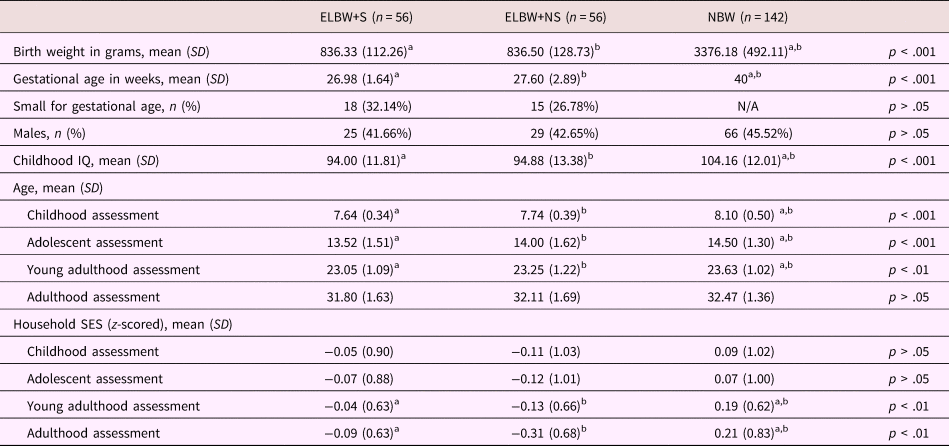
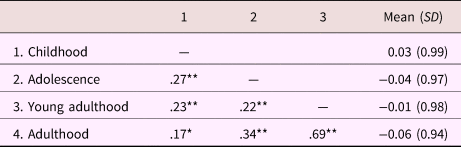
Sample characteristics are presented in Table 1. Pearson's correlations and mean levels of shyness scores across each of the four visits are presented in Table 2. Shyness scores at each visit were normally distributed.
Sample characteristics

Note: Identical superscripts denote significant group differences. ELBW+S, extremely low birth weight and prenatal steroid exposure. ELBW+NS, extremely low birth weight and no prenatal steroid exposure. IQ, intellectual quotient. NBW, normal birth weight. SES, socioeconomic status.
Descriptive statistics and correlations for shyness across assessments from childhood to adulthood

Shyness scores are z-scored. *p < .05. **p < .001.
Trajectories of shyness
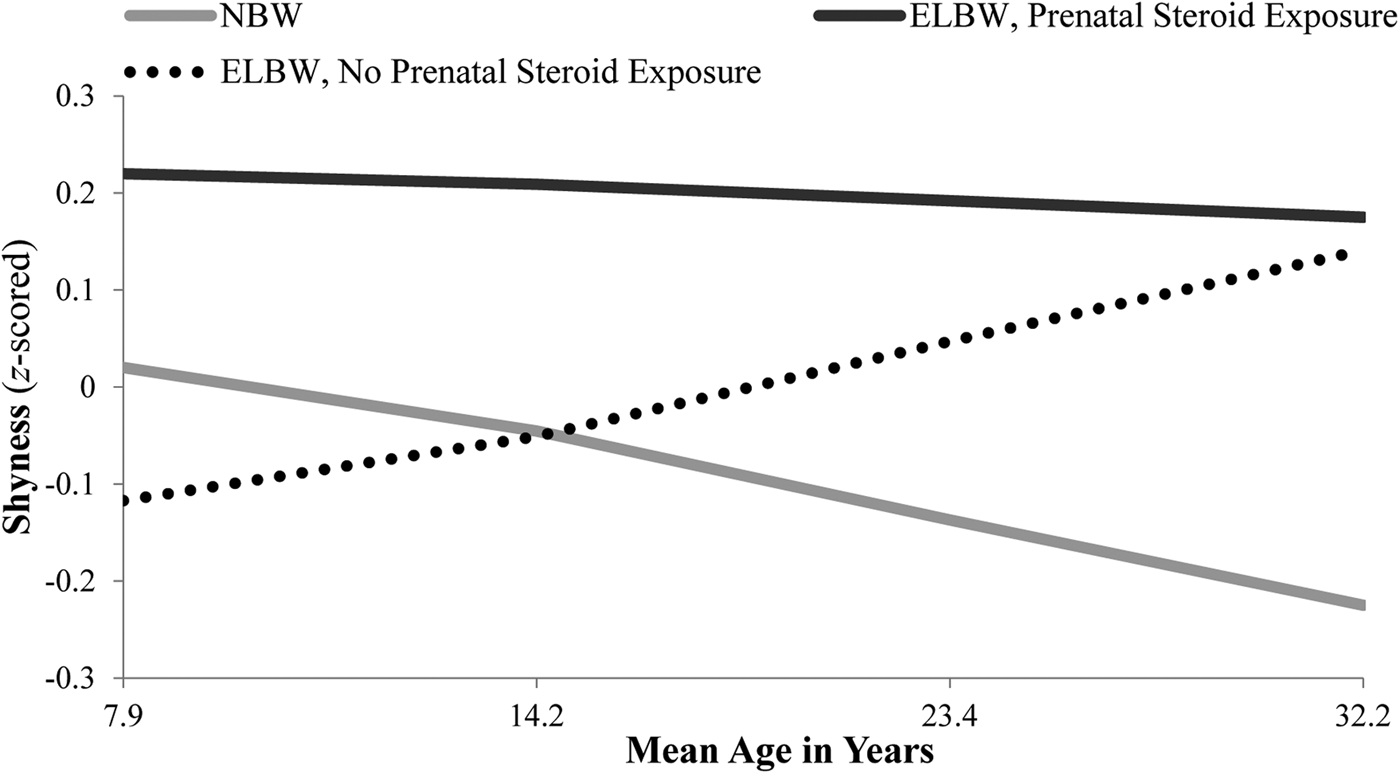
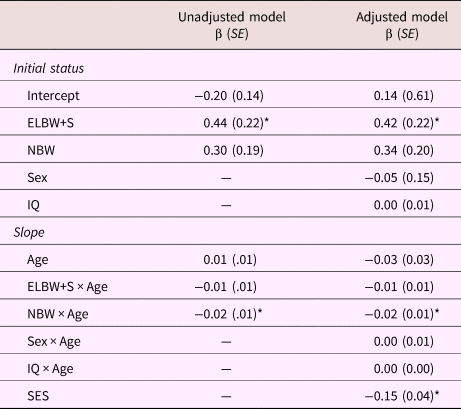
The parameter estimates for the unadjusted and adjusted growth curve models are shown in Table 3. Results indicated that ELBW+S participants had significantly higher levels of shyness in childhood relative to the ELBW+NS participants (β = 0.42; p < .05), with a stable trajectory into adulthood (as indicated by a nonsignificant slope: β = –0.01; p = ns). The NBW and ELBW+NS participants did not significantly differ on childhood shyness (β = 0.34; p = ns), but there was divergence in shyness levels from childhood to adulthood in the ELBW+NS and NBW participants. As illustrated in Figure 1, the NBW participants demonstrated decreases in shyness into adulthood relative to the ELBW+NS participants (β = –0.02; p < .05), who displayed relative increases, with levels comparable to the ELBW+S participants by adulthood.Footnote 2
The mean developmental trajectory of shyness from childhood to adulthood based on birth weight status and prenatal corticosteroid exposure. ELBW, extremely low birth weight. NBW, normal birth weight. Estimates from the growth curve analysis are plotted. N = 254.

Growth curve models of shyness predicted by birth weight status and prenatal corticosteroid exposure

Note: ELBW+S, extremely low birth weight and prenatal steroid exposure. IQ, intellectual quotient. NBW, normal birth weight. SES, socioeconomic status. ELBW+NS, extremely low birth weight and no prenatal steroid exposure, is the reference category. N = 254. *p < .05.
Discussion
Previous theoretical frameworks have posited that in utero exposure to adversity and stressful environments can exert long-term influences on behavior and socioemotional development (Gartstein & Skinner, Reference Gartstein and Skinner2017; Gluckman et al., Reference Gluckman, Hanson and Buklijas2010). Our findings converge with this notion and suggest that the relative severity of early prenatal stressors may influence the emergence and trajectory of shyness across different developmental periods. Using a prospective, longitudinal study, we found that individuals who were born at ELBW and exposed prenatally to corticosteroids exhibited the highest levels of shyness in childhood that remained stable into their early 30s. We further report that ELBW survivors who were not exposed prenatally to corticosteroids had comparably low levels of childhood shyness relative to the NBW controls; however, whereas the NBW controls displayed decreases in shyness from childhood to adulthood, the ELBW+NS individuals experienced patterns of increasing shyness into their 30s.
The origins of shyness are multifaceted, with both biological and contextual influences affecting its developmental course (e.g., Poole, Tang, et al., Reference Poole, Tang, Schmidt, Perez-Edgar and Fox2018; Schmidt, Polak, & Spooner, Reference Schmidt, Polak, Spooner, Crozier and Alden2005; Stevenson-Hinde, Reference Stevenson-Hinde, Zuckerman, Lieberman and Fox2002). One line of evidence argues that some typically developing infants enter the world with a biological predisposition to become physiologically and behaviorally aroused in response to novelty (i.e., behaviorally inhibited; Garcia-Coll et al., Reference Garcia-Coll, Kagan and Reznick1984). As these individuals undergo further sociocognitive development across early childhood, this inhibition can become particularly salient in novel social contexts for some children (i.e., shyness), resulting in the perception of social situations as threatening in nature. The typical biological modifications (e.g., increased HPA axis and amygdala activity) accompanying stressful prenatal environments are similar to those biological systems implicated in shyness and social threat processing (Beaton et al., Reference Beaton, Schmidt, Schulkin, Antony, Swinson and Hall2008; Kagan et al., Reference Kagan, Reznick and Snidman1987, Reference Kagan, Reznick and Snidman1988; Schmidt et al., Reference Schmidt, Fox, Rubin, Sternberg, Gold, Smith and Schulkin1997; Tang et al., Reference Tang, Beaton, Tatham, Schulkin, Hall and Schmidt2016), and we speculate that these developmental antecedents of shyness may be programmed in utero in response to prenatal stressors.
The pattern of shyness among the ELBW+S individuals likely reflects an early emerging shyness that is stable across development. It has been proposed that prenatal alterations that occur in order to increase postnatal survival can occur at the expense of physiological and behavioral flexibility (i.e., ability to change across development), and consequently may lead to behavioral phenotypes that are less likely to change across time (Duckworth, Reference Duckworth2015). The selection of a stable system during a stressful prenatal period is viewed as adaptive as this allows the individual to optimize survival in an equally threatening postnatal environment through the programming of traits such as hypervigilance, threat-sensitivity, and stress-reactivity—key features of shyness. Being born at ELBW is a significant early stressor resulting in programmed changes in the central and physiological systems responsible for the stress response (Gluckman et al., Reference Gluckman, Hanson and Buklijas2010; Harris & Seckl, Reference Harris and Seckl2011). Likewise, administration of prenatal synthetic steroids stimulates the fetal HPA axis and mimics the effects of a natural occurring stressor (Benediktsson, Lindsay, Noble, Seckl, & Edwards, Reference Benediktsson, Lindsay, Noble, Seckl and Edwards1993). Thus, exposure to synthetic glucocorticoids in addition to the stresses of being born at ELBW may result in a cumulative effect by which set points in the brain and body are programmed during sensitive periods of early development, and lead to stability in shyness across development. Given that these hypothesized mechanisms were not directly measured in the present study, it will be informative to systematically test these speculated mechanisms in future longitudinal work.
Our findings also illustrate the concept of equifinality, which is the notion that individuals may have different initial starting points but have similar later outcomes (Cicchetti & Rogosch, Reference Cicchetti and Rogosch1996). The ELBW+S and ELBW+NS groups had different initial starting points of steroid exposure versus no exposure and levels of childhood shyness, but the ELBW+NS group had patterns of increasing shyness with levels similar to the ELBW+S group by adulthood. We further find that the ELBW+NS and NBW groups had similarly low levels of childhood shyness, but there was divergence in shyness between the ELBW+NS and NBW groups around adolescence, such that the ELBW+NS individuals demonstrated patterns of increasing shyness into adulthood, while the NBW controls showed decreases in shyness. It is possible that this divergence in shyness occurs due to differences in developmental circumstances and processes between the groups (Cicchetti & Rogosch, Reference Cicchetti and Rogosch1996).
Beyond biological influences on the development of shyness, additional developmental models of shyness highlight the important role of social influences and context (Coplan, Arbeau, & Armer, Reference Coplan, Arbeau and Armer2008; Gazelle & Ladd, Reference Gazelle and Ladd2003; Hastings, Nuselovici, Rubin, & Cheah, Reference Hastings, Nuselovici, Rubin, Cheah, Rubin and Coplan2010; Rubin, Bowker, & Gazelle, Reference Rubin, Bowker, Gazelle, Rubin and Coplan2010; Schmidt et al., Reference Schmidt, Polak, Spooner, Crozier and Alden2005; Stevenson-Hinde, Reference Stevenson-Hinde, Zuckerman, Lieberman and Fox2002). Previous work has shown that those born prematurely are more prone to be the recipient of overprotective parenting (e.g., Indredavik, Vik, Heyerdahl, Romundstad, & Brubakk, Reference Indredavik, Vik, Heyerdahl, Romundstad and Brubakk2005; Jaekel, Wolke, & Chernova, Reference Jaekel, Wolke and Chernova2012; Wightman et al. Reference Wightman, Schluchter, Drotar, Andreias, Taylor, Klein and Hack2007), victims of bullying, peer victimization, and social exclusion (see Day, Van Lieshout, Vaillancourt, & Schmidt, Reference Day, Van Lieshout, Vaillancourt and Schmidt2015, for a recent review), and have lower social competence and social skills (Dahl et al., Reference Dahl, Kaaresen, Tunby, Handegård, Kvernmo and Rønning2006; Hoy et al., Reference Hoy, Sykes, Bill, Halliday, McClure and Reid1992; Ross, Lipper, & Auld, Reference Ross, Lipper and Auld1990) relative to their typically developing peers. These are key social influences that play a role in later developing or increasing patterns of shyness (Booth-LaForce & Oxford, Reference Booth-LaForce and Oxford2008; Hastings et al., Reference Hastings, Nuselovici, Rubin, Cheah, Rubin and Coplan2010; Karevold, Ystrom, Coplan, Sanson, & Mathiesen, Reference Karevold, Ystrom, Coplan, Sanson and Mathiesen2012; Oh et al., Reference Oh, Rubin, Bowker, Booth-LaForce, Rose-Krasnor and Laursen2008; Poole, Tang, et al., Reference Poole, Tang, Schmidt, Perez-Edgar and Fox2018; Rubin et al., Reference Rubin, Bowker, Gazelle, Rubin and Coplan2010, Tang et al., Reference Tang, Van Lieshout, Lahat, Duku, Boyle, Saigal and Schmidt2017). These social factors may be particularly influential during adolescence as this coincides with the onset of puberty, increases in sociocognitive development, and an increased reliance on peers and need for social acceptance (Cheek, Carpentieri, Smith, Rierdran, & Koff, Reference Cheek, Carpentieri, Smith, Rierdan, Koff, Jones, Cheek and Briggs1986). These hormonal, neural, and social changes can affect the development, expression, and regulation of emotions (Del Piero, Saxbe, & Margolin, Reference Del Piero, Saxbe and Margolin2016), and some work has found that shyness and social fears may increase during adolescence due to these factors (Cheek et al., Reference Cheek, Carpentieri, Smith, Rierdan, Koff, Jones, Cheek and Briggs1986; Cheek & Krasnoperova, Reference Cheek, Krasnoperova, Schmidt and Schulkin1999; Tang et al., Reference Tang, Van Lieshout, Lahat, Duku, Boyle, Saigal and Schmidt2017; Westenberg, Drewes, Goedhart, Siebelink, & Treffers, Reference Westenberg, Drewes, Goedhart, Siebelink and Treffers2004). Taken together, we predict that social influences may place ELBW+NS individuals on a path toward increasing shyness beginning in adolescence that reflects a later developing shyness that is influenced by postnatal context. Although we suspect that these social experiences are also present for ELBW+S individuals, these factors may play a role in the maintenance of shyness as opposed to increasing patterns given the relatively high initial childhood shyness of the ELBW+S group, likely resulting in ceiling effects.
Our findings also shed light on the relative trajectory of shyness from childhood to adulthood in typically developing samples (i.e., those born at NBW). Although the findings should be interpreted with appropriate caution as the trajectories are relative to the ELBW survivors, they nonetheless provide information on how shyness develops in typically developing individuals. This is important given that there exists relatively little work examining the mean-level developmental course of shyness from childhood to adulthood. One longitudinal study found decreasing patterns of shyness from age 4 to 23 years among “resilient” children (Dennissen et al., Reference Dennissen, Asendorpf and Van Aken2008), which is similar to what we found for the NBW group from age 8 to 32 years. As individuals enter developmental periods of stability and achieve important milestones (e.g., establish romantic relationships, obtain a career, and start a family), they may become more socially dominant and emotionally stable (Neyer & Asendorpf, Reference Neyer and Asendorpf2001; Roberts, Walton, & Viechtbauer, Reference Roberts, Walton and Viechtbauer2006; Robins, Fraley, Roberts, & Trzesniewski, Reference Robins, Fraley, Roberts and Trzesniewski2001). Relative to individuals who were born at ELBW, NBW individuals are more likely to obtain these milestones (Saigal et al., Reference Saigal, Day, Van Lieshout, Schmidt, Morrison and Boyle2016), and this may be one mechanism underlying their relative decreases in shyness into adulthood.
Although it appears that survivors of ELBW exposed to synthetic glucocorticoids may be on a path toward the development of shyness and some work has shown that shyness is predictive of psychopathology and maladaptive outcomes (e.g., Clauss & Blackford, Reference Clauss and Blackford2012), it is important to point out that shyness is not always inherently maladaptive. Other research has reported adaptive aspects of some shyness subtypes (e.g., Colonnesi, Napoleone, & Bögels, Reference Colonnesi, Napoleone and Bögels2014; Poole & Schmidt, Reference Poole and Schmidt2019, Schmidt & Poole, Reference Schmidt and Poole2018). Likewise, although we hypothesize that the development of shyness may result from programmed changes in the physiological systems underlying hypervigilant and fearful reactions due to early stressors, we further reiterate that these changes are not necessarily pathological, but are thought to be functional adaptations that may promote resilience in the faces of future environmental challenges and stressors (Del Giudice, Ellis, & Shirtcliff, Reference Del Giudice, Ellis and Shirtcliff2010; Gluckman, Hanson, & Pinal, Reference Gluckman, Hanson and Pinal2005).
Limitations
There were several limitations of the present study that should be acknowledged. First, shyness was assessed using different informants during the different developmental periods (i.e., parent vs. self-report). Although this is an inherent methodological challenge to long-term developmental research (Biesanz, West, & Kwok, Reference Biesanz, West and Kwok2003; Caspi, Roberts, & Shiner, Reference Caspi, Roberts and Shiner2005), and while we standardized measures for consistency, it nonetheless is prone to possible informant discrepancies across assessments and issues of measurement variance. Second, although this work provides valuable information on the development of shyness from childhood to adulthood, we do not have data pertaining to earlier developmental periods such as toddlerhood and so we cannot directly assess the early developmental precursors of shyness (e.g., behavioral inhibition) that may have influenced the trajectories. Third, we relied on questionnaire-based indices of shyness, and thus future work could aim to integrate observational measures of shyness, notwithstanding the challenges associated with accurately assessing the same phenotype across development given differences in the expression, experience, and overt behaviors of shyness depending on age. Fourth, although Cronbach's alphas were acceptable, they were somewhat low during the childhood and adolescent assessments; however, this is not uncommon for scales with fewer than 10 items, as internal consistency tends to be an underestimate in scales with fewer items (Taber, Reference Taber2018). Fifth, we acknowledge that there were likely additional unmeasured influences on the development of shyness beyond those investigated in the present study including parental traits such as social anxiety, which likely exerts both biological (i.e., genetic) and environmental (i.e., social modeling) influences on the expression of shyness in offspring (Bögels, Stevens, & Majdandžić, Reference Bögels, Stevens and Majdandžić2011; Lieb et al., Reference Lieb, Wittchen, Höfler, Fuetsch, Stein and Merikangas2000; Poole, Van Lieshout, McHolm, Cunningham, & Schmidt, Reference Poole, Van Lieshout, McHolm, Cunningham and Schmidt2018; Smith et al., Reference Smith, Rhee, Corley, Friedman, Hewitt and Robinson2012), as well as additional early stressors aside from prematurity and prenatal steroid exposure. Sixth, given the cohort study design, women were not randomized to receive corticosteroids (i.e., NBW babies were not prenatally exposed to corticosteroids), and thus it is possible that there were unmeasured confounding factors influencing our findings. Finally, it is important to replicate our findings in contemporary samples to ensure generalizability to more recent birth cohorts given advancements in neonatal care and increased survival rates among individuals who are born extremely prematurely.
Implications and conclusions
The present study highlights the importance of employing a longitudinal framework when testing developmental programming hypotheses as this allows for identification of how prenatal stressors may result in the prospective emergence of personality traits during different developmental periods. Our findings inform developmental models of shyness, and illustrate that while biological susceptibility may influence the development of shyness, postnatal contextual influences may also impact the development of shyness for some individuals. This study provides evidence for heterogeneity in the developmental origins, onset, and course of shyness. We recommend that future studies continue to investigate how early life experiences may influence the manifestation of shyness in particular, and personality styles in general across development, and how this may be related to the development of psychopathology.
Financial support
This research was supported by a doctoral award from the Canadian Institutes of Health Research (CIHR; awarded to K.L.P.), CIHR Team Grant TMH-103145 (to L.A.S.), and CIHR MOP42536 (to S.S.), and National Institute of Child Health and Human Development Grant 1-R01HD40219 (to S.S.).
Acknowledgments
We wish to thank the many research staff members who have assisted with data collection over the last four decades. Finally, we thank the many participants and their families for their continued participation in the study.