

Implications
Our future livestock systems will have to produce more in the future, whereas reducing their environmental footprint and respecting the demands from the society. Is it possible and what would be the interests of preserving animal health and providing good welfare conditions in the sustainability of these future systems?
Introduction
Sustainability of the livestock systems, which produce part of the food that we need, is one of the major questions that animal science has to explore and to solve before the middle of this century. Associated with a continuous decrease in the number of starving people, studies looking at future trends predict an increase of the world population over the next 30 years. These demographic changes are related to an increase in their buying power, essentially in emerging countries such as China, Brazil, India, Indonesia and to a lesser extent Africa. The increased population of and above middle class with increased economic conditions will provoke a dramatic increase in animal product consumption (meat, milk, eggs and fish) in these emerging countries. At the same time, industrial countries will probably reduce their meat consumption per capita for a variety of reasons, including stagnation of their population growth (Paillard et al., Reference Pellerin, Bamière, Angers, Béline, Benoît, Butault, Chenu, Colnenne-David, De Cara, Delame, Doreau, Dupraz, Faverdin, Garcia-Launay, Hassouna, Hénault, Jeuffroy, Klumpp, Metay, Moran, Recous, Samson, Savini and Pardon2011; Ronzon et al., Reference Rutherford, Baxter, D'Eath, Turner, Arnott, Roehe, Ask, Sandoe, Moustsen, Thorup, Edwards, Berg and Lawrence2011; Searchinger et al., Reference Sevi, Massa, Annicchiarico, Dell’Aquila and Muscio2013).
The majority of the livestock systems will be largely challenged because of not being sustainable in the context of reduction of the environmental footprint and in the perspective of an increase of the human population, which will probably be close to 9.5 billions in 2050. Simultaneously, in Europe especially but probably soon in the rest of the world, two other constraints emerge and must be considered in the perspective of developing sustainable livestock systems. The first constraint is animal health ‘a state of complete physical, mental and social well-being and not merely the absence of disease or infirmity’ (World Health Organization (WHO) definition, 1946): (i) because we already know that around two out of three emerging diseases in humans are transmitted from animals, (ii) because non-zoonotic diseases producing mortality and/or morbidity are among the major factors limiting the economic profitability of farms and, finally, (iii) because sanitary outbreaks are one of the major factors altering trade between countries. The second one is animal welfare, originally defined by the Farm Animal Welfare Council (1992) and which definition was refined in many other occasions (Duncan, Reference Duncan2005; Blokhuis et al., Reference Blokhuis, Miele, Veissier and Jones2013) is the freedom (a) from hunger, thirst and malnutrition, (b) from pain, injury and disease, (c) from physical and thermal discomfort, (d) to express natural behaviours and (e) from fear and distress (Blokhuis et al., Reference Blokhuis, Miele, Veissier and Jones2013). For animal welfare, the situation could be seen as more complex because of the variations between human societies in what they value as good welfare for farm animals. In that field, Europe has taken the leadership of exploring what could be and should be the different dimensions of farm animal welfare and European authorities have transformed them into rules which have to be applied in European farms, as well as in non-European ones which want to export to the European market (Blokhuis et al., Reference Blokhuis, Miele, Veissier and Jones2013).
Thus, there is no doubt that animal health and welfare are two essential components of the future of livestock systems, but to which extent will they play a role in their sustainability? This question is addressed in the present paper.
The different dimensions of animal health and of animal welfare in livestock systems
Concerning animal health, three dimensions have to be taken into account: (a) the existence of a health and disease status which allows to describe the situation in which an animal and/or a herd or flock is situated, (b) the active management of both preventive and curative health and (c) the control of parasites, either internal or external. Animal health is a ‘public good’ which is the property of all actors, that is the farmers, the consumers and all citizens in general, which means that it cannot be privatized by any one of these actors and fully eliminating the risk of related problems as well as its regulation falls under the responsibility of public authorities. The definition of what is animal health and what is the best strategy to control the different diseases differ among countries and continents, but the fact that most diseases could be easily transported from one country to another forces the international health community to better coordinate in the World Organization for Animal Health.
As animal health, animal welfare is also a public good, which cannot be privatized but on the opposite is thought by being owned by all citizens, even though they are neither farmers nor always consumers. This is an area where the international consensus has not reached the same level as for animal health. This might be due particularly to the relatively low number of scientific publications dealing with animal behaviour and welfare compared with that on animal health. In addition, the values attributed to animal welfare and the perception of what is good animal welfare vary between people.
Declination of the three pillars of sustainability for livestock systems
The first one is the economic pillar: livestock systems should be viable which means that not only the price of products should be sufficient to ensure a correct income to farmers, but that the expenses have to be controlled at the farm level itself. This is a short-term pillar, not any farm can survive if not profitable on a short-term basis, but also a long-term pillar as not any one can survive with an excessive level of debt. This economic pillar is nowadays generally associated with a high technical specialization: most farms of the most intensive livestock systems, that is dairy cattle, pig, poultry farms of the industrialized world are highly specialized. This is probably the consequence of scale savings provided by these intensive systems. And, finally, this economic pillar is also depending on the financial autonomy of the farms.
The second pillar of sustainability of livestock systems is the environmental pillar. This concept is especially important in Europe where the environmental footprint of livestock farming systems, negative or positive, is now obvious, at either a global (essentially via greenhouse gases emissions or carbon storage in soil pastures), a regional (ammonia in the air) or at a local scale (water acidification and eutrophication due to nitrates and phosphorus in water, manure odours or biodiversity) (Peyraud et al., Reference Ray, Zhao and Knowlton2014). The value of the environment has also increased, as it is perceived as a source of positive values, for example, remembering the good old times when parents lived in the countryside, and because it provides recreational and aesthetic benefits to urban or rural citizens. In this context, citizens are increasingly aware of the negative impacts of livestock farming systems such as water pollution, decrease of biodiversity or degradation of air quality. In recent years, the perspectives of climate change have become more pronounced and the expected local consequences of these changes in zones of high human density could be extremely severe. This can be assessed from the observed or expected increase in the frequency of abnormal local climatic events, increase in green algae proliferation at the seashore and biodiversity losses in many anthropogenized ecosystems. These consequences that anyone can observe directly reinforce the impression of an impact of animal production systems on climate change. This is a medium to long-term pillar, depending on the geographical level where it is observed: the smaller the geographical scale the shorter the term is.
The third pillar of sustainability is the societal pillar of our livestock systems; it is linked to the appreciation of the society for our animal production systems. This appreciation from the citizen could be different from that of the consumer. Simultaneously to what has occurred in the previously two pillars, the demand for animal products with high nutritional, organoleptic and ‘ethic’ qualities has increased all over the world and especially in Europe. This ethic quality is a new concept coming from Europe and is related to livestock production in specific areas where the conditions of production, such as use of local feeds of known origin, respect of animal welfare (Larrère, Reference Larrère2007), reduced use of antibiotics, etc., are considered to be a significant part of product quality, which adds, rather than substitutes, to their organoleptic and nutritional values. In that field, animal husbandry from housing to slaughtering conditions, which alter animal welfare is especially important. Even though the consumers are still more sensitive to the price of animal products rather than to the conditions in which they were produced, the citizens, very often the same individuals, are concerned by it. The societal pillar also embarks the working conditions of farmers, an essential component. Finally, as a whole, the image that the society has of the farmers is also part of this pillar. In industrialized countries, green lobbies play a role in criticizing livestock production systems, asking consideration of farm animals as ‘animal beings’ and denouncing (in some cases for good ethic reason) welfare conditions on farms and slaughtering conditions. These criticisms are reinforced by the distance between citizens and farm animals, as more than half of the worldwide population now lives in cities, in which relationships with animal are mainly focussed to pets, at least in industrialized countries.
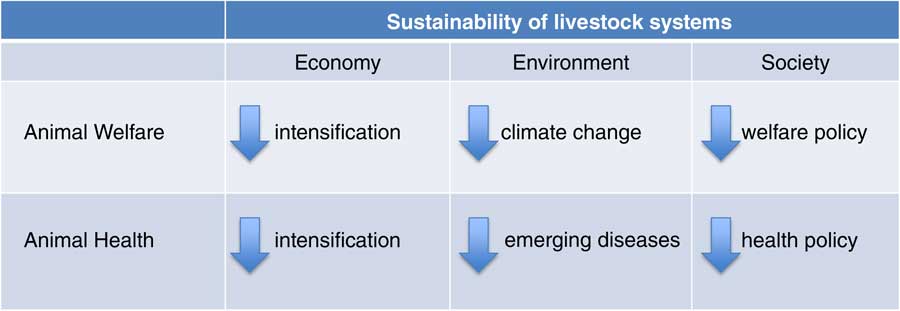
Economy, environment and society modify animal health and welfare (Figure 1)
Economy, environment and society modify animal welfare and health. Schematic representation of the ways by which the three pillars of sustainability, economy, environment and society, may modify animal welfare and animal health (e.g. in the two first cells: Economy Acts on Animal Welfare and on Animal Health via intensification).
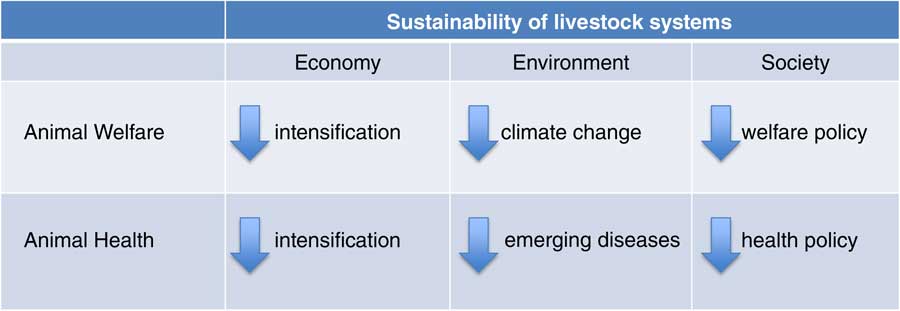
We already know that the economic pressure, by continuously increasing intensification is able to modify animal health and welfare: increasing density of animals in broiler and/or laying hen farms also increases mortality and among animal contaminations and also increases body damages due to aggressive behaviours (Arnould et al., Reference Arnould, Michel and Le Bihan-Duval2011). Highly producing dairy cows selected and managed to obtain high milk yield, have a low fertility rates provoking a high culling rate and impairs the self-replacement of the herd (Dohoo et al., Reference Dohoo, DesCoteaux, Leslie, Fredeen, Shewfelt, Preston and Dowling2003). Continuous selection of sows for high prolificacy has led to produce supernumerary piglets compared with the number of teats conducing to higher piglet mortality (Rutherford et al., Reference Schmidt, Mulder, Musk, Aminov, Lewis, Stokes, Bailey, Prosser, Gill, Pluske and Kelly2013). Examples of livestock systems in which the economic pressure has led to an increase of productivity are numerous creating the basis for furnishing animal products of standard quality at a reasonable price to consumers. However, the most intensive systems appear to have reached their limits in terms of animal health and welfare.
The environment may also modify animal health and welfare. Emerging or re-emerging diseases are linked to global changes in the environment: the very recent European outbreak of Blue Tongue disease in farm ruminants, a disease until recently only present in the tropics and subtropics, is linked to the presence of insect vectors which transmit the virus (Mehlhorn et al., Reference Mehlhorn, Walldorf, Klimpel and Schmahl2008), and this presence is associated with the global warming. Even though the phenomenon is difficult to describe objectively (Lancelot, Reference Lancelot2015), veterinary scientists and authorities are expecting the same problem for other emerging diseases present only in subtropical or tropical areas until now. Climate change can also affect animal welfare by producing more frequently episodes of high temperatures or/and of severe droughts in summer. High temperatures are deleterious for housed animals such as poultry and pigs and may affect their welfare. Likewise, severe droughts may produce shortage in gross forage for ruminants.
Finally, the human society acts on animal health and welfare essentially via two channels. The first one through different policies which are developed either at the European or national level to prevent the emergence and spreading of a disease and to control the conditions of housing, transportation and slaughtering of farm animals. Since the last 50 years, tremendous progresses have been made in these policies for basing them on scientifically sound results and applying them adequately to preserve the economic competitiveness of our European farms. The second channel is by direct interactions between consumers and citizens and farmers and their representative non-governmental organizations (NGOs). In all European countries, NGOs act in the area of animal welfare, some of them aiming to finally abolish consumption of animal products and some other ones, more reformist, to build with producers more welfare-friendly livestock systems.
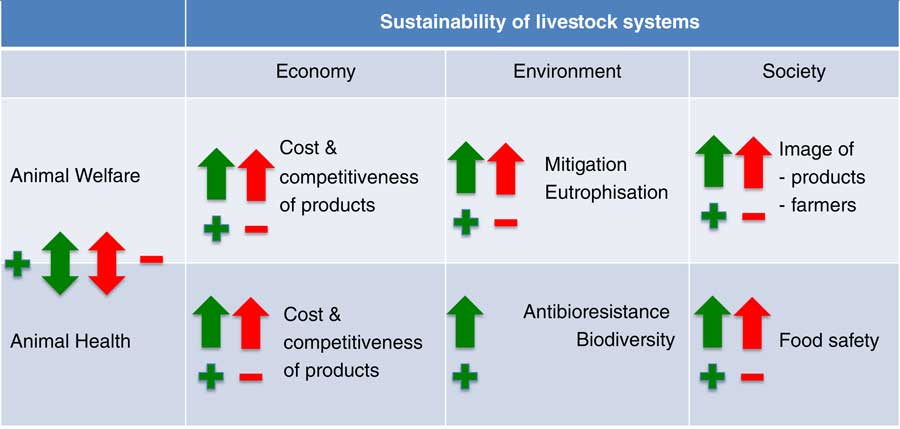
Animal welfare may change sustainability of livestock systems (Figure 2)
Are animal welfare and health important for sustainability of livestock systems? Schematic representation of the importance of animal welfare and of animal health in the stability of the three pillars of sustainability of livestock systems and of interactions between them. Positive effects are indicated in green and negative effects in red (e.g. in the two first cells: animal welfare acts positively and negatively on economy via costs and competitiveness of products, and on environment via mitigation and eutrophication).
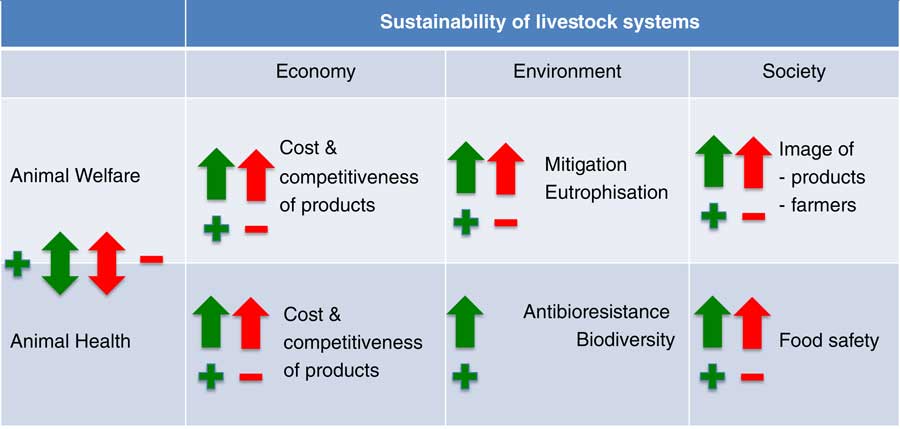
Regarding the economic pillar of sustainability, animal welfare has been described as able to increase profitability of farms by reducing losses. For instance, a better housing of dairy cows increases daily milk production by >1 kg of milk (Bony, Reference Bony2000), friendliness towards veal improves meat quality and carcass price (Lensink et al., Reference Lensink, Fernandez, Boivin, Pradel, Le Neindre and Veissier2000; Terlouw et al., Reference Toma, March, Stott and Roberts2007), maintaining early social links between fattening bulls reduces aggressive interactions and increase the growth rate (Mounier et al., Reference Mounier, Veissier and Boissy2005) and including animal welfare constraints into organic specifications (see ‘Agriculture Biologique’ in the list of references) contributes to increase the profitability. Likewise stressed sheep tend to have lower milk yield and nutrient content in milk (Sevi et al., Reference Terlouw, Arnould, Auperin, Bern, Le Bihan-Duval, Lefevre, Lensink and Mounier1999; Caroprese et al., Reference Caroprese, Albenzio, Marzano, Schena, Annicchiarico and Sevi2010), as well as reduced fertility and impaired maternal behaviour (Dwyer and Bornett, Reference Dwyer and Bornett2004). By contrast, in some other examples improving animal welfare reduces profitability by increasing costs. Outdoor breeding increases by 44% the cost of egg production compared with cages (Magdelaine and Mirabito, Reference Magdelaine and Mirabito2003) and housing of sows without tying them increases piglet mortality (Nieuwamerongen et al., Reference Paillard, Treyer and Dorin2015).
Likewise, animal welfare was able to modify the environmental pillar of sustainability. Mainly due to economic reasons, the increase in dairy cows’ welfare associated with access to pastures has a positive effect on the environment compared with maize silage, essentially because the first system provides a better re-use of nitrates (Peyraud et al., Reference Ray, Zhao and Knowlton2014) and a better carbon storage in soils (Pellerin et al., Reference Peyraud, Cellier, Aarts, Béline, Bockstaller, Bourblanc, Delaby, Dourmad, Dupraz, Durand, Faverdin, Fiorelli, Gaigné, Kuikman, Langlais, Le Goffe, Lescoat, Morvan, Nicourt, Parnaudeau, Rochette, Vertès, Veysset, Réchauchère and Donnars2013). In the same way, a lower use of drugs in organic and/or conventional farms, essentially with the aim of improving animal welfare, decrease bacterial resistance to these drugs and reduce drug spreading in the environment (Ray et al., Reference Ronzon, Treyer, Dorin, Caron, Chemineau and Guyomard2013). At reverse, improving welfare conditions, which may reduce productivity, increases the environmental footprint per kg of animal product. ‘Red label’ broilers and/or organic pigs, because they require more time to reach their slaughter weight, need more feed to produce 1 kg of meat than classical broilers and pigs (Dourmad et al., Reference Dourmad, Ryschawy, Trousson, Bonneau, Gonzàlez, Houwers, Hviid, Zimmer, Nguyen and Morgensen2014). Because of their generally lower milk yield per head, dairy cows of organic farms generally produce more enteric methane per kg of milk than conventional dairy cows (Kiefer et al., Reference Kiefer, Menzel and Bahrs2014).
For the societal pillar of sustainability, there are obvious results indicating that animal welfare is able to act directly on this pillar. It may act positively because the good image of farmers and of animal products may depend of animal welfare (Blokhuis et al., Reference Blokhuis, Miele, Veissier and Jones2013). Nowadays, in many European countries, the status of animals in terms of welfare in their farms is directly used by retailers as a label to advertise for the products (see ‘Freedom food scheme’ in the list of references). Animal welfare is controlled in the farms from which the products are coming from and, in some cases, directly used on the product itself when it is marketed. Short circuit concepts and organic farms also generally use animal welfare to advertise their products. In the farms themselves, the application of a good standard for animal welfare is able to provide better working conditions to the farmers thanks to a reducing of workload and a better satisfaction. Likewise, farmers provide to consumers and citizens a better image of themselves to the society. In situations where animal welfare is not respected, this could have a detrimental effect within society, and there are some examples in the past where a low animal welfare has severely affected livestock systems: bad management conditions for milk-veal production in France has led in the 1970s to a very severe decrease in veal meat consumption and a complete re-organization of the production, very intensive poultry systems have given a very negative image among citizens due to the poor welfare conditions in which the animals are bred (Arnould et al., Reference Arnould, Michel and Le Bihan-Duval2011).
Thus, as a whole, we can stress that animal welfare, especially in Europe now but maybe soon in the rest of the world, has profound effects on the sustainability of our livestock systems, and which may act positively and/or negatively on it via the three pillars of this sustainability. This indicates that it is necessary simultaneously (i) to take into account animal welfare in the planning of new and sustainable livestock systems and in the evolution of the existing ones considering sustainability, (ii) to develop a scientific approach in order to better understand what are the behavioural requirements and emotional experiences of our farm animals in link with their welfare in farm conditions (Veissier et al., Reference Veissier, Baumont and Levy2007; Blokhuis et al., Reference Blokhuis, Miele, Veissier and Jones2013; Boissy and Lee, Reference Boissy and Lee2014), (iii) to develop on-farm tools to produce standards and to objectively assess what are the limits of acceptable and unacceptable welfare conditions (see EC project Welfare Quality 2016; Veissier et al., Reference Veissier, Blokhuis, Geers, Jones and Miele2005; Blokhuis et al., Reference Blokhuis, Miele, Veissier and Jones2013), especially when labels using welfare are built by retailers and (iv) to better explain to citizens and consumers that we can breed farm animals in good welfare conditions and slaughter them in appropriate conditions when suitable for meat or at the end of their productive life for milk. However, this is not so simple as we know that there are multiple interactions among pillars: good welfare conditions may, at the same time, be positive for economy and negative for environment, forcing us to reach an optimal trade-off among these conditions and thus to reach a diverse and multifactorial equilibrium allowing sustainability of future livestock systems.
Animal health may also change sustainability of livestock systems (Figure 2)
Regarding the economic pillar of sustainability, animal health has been described as able to increase profitability of farms by reducing losses. Many examples exist which demonstrate that vaccination of young farm animals in meat production is decreasing mortality and thus increasing numerical productivity per mother, which is the most important parameter of farmer income (for sheep breeding: Benoît and Laignel Reference Benoît and Laignel2011). In dairy farms, the control of mastitis, which is the major disease in dairy cattle herds and in dairy sheep and goat flocks, increases milk quantity per female and also milk quality allowing a better payment per litre thus leading to a much higher income for the farmers and for the whole national dairy sector (Geary et al., Reference Geary, Lopez-Villalobos, O’Brien, Garrick and Shalloo2013). At a larger scale, for example at the national level, a good status of animal health allows the farmers to export their products and/or animals. At reverse, the maintenance of a good animal health status at the farm level is generally costly and profitability decreases when costs increase. At a larger scale, animal health management could be expensive at the national level when, for example, the public sanitary authorities develop and apply a plan for controlling some specific diseases.
The same observations were done to assess if animal health was able to modify the environmental pillar of sustainability. Animal health is able to decrease the environmental footprint by reducing the number of unhealthy cows raised in the farm thus reducing the number of cows, which emit greenhouse gases, and still producing the same amount of animal products (Toma et al., Reference van Asselt, van Bussel, van Horne, van der Voet, van der Heijden and van der Fels-Klerx2013). A good animal health status provided by an adequate plan of disease prevention, associated or not, with a correct vaccination scheme, leads to a decrease in drug use and, consequently, of drug output in manure and in water. This is the case for antibiotics and/or anthelmintic drugs, which may be reduced by adequate preventive treatments or adapted pasture management (Guo et al., Reference Guo, Liu, Liu, Zhang and Ren2015). Differently from positive effects of animal health on the environment, it is impossible to illustrate negative ones, which probably indicates that controlling animal health has only positive effects on the environment.
For the societal pillar of sustainability, there are numerous results indicating that animal health is able to act directly on this pillar. It may act positively, for example, on the sanitary quality of the animal products, which is generally strongly dependant from animal health. The presence of Salmonella in eggs or delicatessen is generally dependant of the animal health status of the farms from which these products are coming from: the better this status, the lowest the contamination of products (Andres and Davies, Reference Andres and Davies2015). The same example could be taken for the presence of Staphylococcus in milk when raw milk or cheese are marketed directly as fresh products: the lowest the frequency of mastitis in the herd or flock, the lowest the presence of Listeria in milk and cheese (Keane et al., Reference Keane, Budd, Flynn and McCoy2013). Many examples also exist of a negative effect of bad animal health on the societal pillar of sustainability. This is the case for the very severe stamping out of domestic ungulates during foot and mouth outbreaks, which not only destroy the herds and flocks, but also are extremely detrimental for the image of livestock systems in citizen opinion. Severe fall of consumption of animal products are more caused by the announcement of a possible future epidemic rather than the epidemic itself, that is when an influenza crisis is announced abroad, consumption of poultry products falls before the disease appears on the national territory (Huang et al., Reference Huang, Goh and Mohaidin2014). The example of emergence of antibiotic resistance in zoonotic bacteria could also be given as a negative effect of a bad management of animal health in farms, which may have severe negative consequences on human health. Last but not least, a bad animal health regarding zoonotic diseases may have severe consequences on farmer’s health: this is the case for the major zoonotic diseases which are still present in some regions such as Brucellosis or some minor ones which present at a lower frequency such as Q Fever and Chlamydiosis.
As for animal welfare, we can state that animal health has profound effects of the sustainability of our livestock systems, acting positively and/or negatively on it via the three pillars of sustainability. This also indicates that the investment in animal health is crucial for the future of animal production and that is necessary simultaneously (i) to continue the scientific programmes aiming at a better knowledge of the pathogens and of their interactions with hosts, (ii) to develop an holistic approach for preventing the diseases to appear acting at the same time for a better control of health status in farms, for a better early detection of diseases and for a better vaccination strategy allowing animals to be protected against infections, (iii) to continue the development of efficient tools for detection of small quantities of pathogens and for their control, (iv) to better inform citizens and consumers of the reduced risks they face with while consuming animal products. Compared with animal welfare, the situation may be simpler regarding interactions among pillars for animal health: in all situations a better health appears to be positive for the three pillars of sustainability, if the solutions which are developed to control it are not too costly allowing at the same time the farmer to get a positive margin.
Synergic effects of animal welfare and animal health interactions for a sustainable animal production
It is well known that animal welfare and animal health interact in many ways (Nicks and Vandenheede Reference Nicks and Vandenheede2014), and in some environments and for some scientists, these two elements are strongly associated in the perspective of raising sustainable livestock systems. We have many examples where animal welfare improves animal health and the reverse. Outdoor pigs had better respiratory and gut health and less feet problems than indoor pigs (Guy et al., Reference Guy, Rowlinson, Chadwick and Ellis2002; KilBride et al., Reference KilBride, Gillman and Green2009; Schmidt et al., Reference Searchinger, Hanson, Ranganathan, Lipinski, Waite, Winterbottom, Dinshaw and Heimlich2011). Turkeys housed in an enriched environment (platform, banister, hanging objects, straw crib) have less injury (Mirabito and Brunel Reference Mirabito and Brunel2004). A reduced density in beef cattle feedlots reduces the incidence of pneumonia, diarrhoea and of lameness compared with high-density feedlots (Madsen, Reference Madsen1987). Mastitis increases pain and reduces milk production in dairy cows (Lescourret and Coulon Reference Lescourret and Coulon1994). Chronically stressed sheep may also respond poorly to pathogen challenges (Sevi et al., 1999; Caroprese et al., Reference Caroprese, Albenzio, Marzano, Schena, Annicchiarico and Sevi2010). But there are also some examples where the opposite effects may occur: outdoor finishing pigs have a higher mortality than indoor pigs.
Conclusion
All examples given above play in favour of the fact that animal health and animal welfare are essential components of sustainability in livestock systems because they have an impact on the three pillars of this sustainability. A more extensive review of the literature would be interesting in order to verify that these different examples may be generalized and constitute the basis for a simultaneous combination of these different elements to provide a win–win–win situation in sustainable livestock systems. Indeed, the situation is rather complex because of the very numerous interactions existing in all directions, which requires a holistic approach at the farm level. This requires a scientific approach, developing a multicriteria evaluation and modelling positive and negative effects of both animal health and welfare on sustainability of livestock systems, as it was started to be done for pigs by Bonneau et al. (Reference Bonneau, de Greef, Brinkman, Cinar, Dourmad, Edge, Fàbrega, Gonzàlez, Houwers, Hviid, Ilari-Antoine, Klauke, Phatsara, Rydhmer, van der Oever, Zimmer and Edwards2014a and Reference Bonneau, Klauke, Gonzàlez, Rydhmer, Ilari-Antoine, Dourmad, de Greef, Houwers, Cinar, Fàbrega, Zimmer, Hviid, van der Oever and Edwards2014b) and for laying hens by van Asselt et al., Reference van Nieuwamerongen, Soede, van der Peet-Schwering, Kemp and Bolhuis2015). However, the perfect system using a perfect equilibrium among the different components at their maximum positive effect probably does not exist so far. There will need to trade-off among variables to find the best win–win–win solutions (farmer–animal–society) allowing reaching sustainable systems. It probably exists local optima in various livestock systems in Europe rather than a global optimum due to differences in local/regional husbandry situations and in differences among cultures in the appreciation of the definitions and limits of animal welfare and of animal health. This situation plays in favour of the exploration of various solutions coordinated at the European and international levels rather than national approaches.
Acknowledgements
The author thanks Dr Isabelle Veissier, Dr Christine Leterrier, Dr Armelle Prunier, Dr Alain Boissy, Dr Thierry Pineau, Dr Henri Seegers and Dr Etienne Zundel for their help in the reflexion, furniture of materials and for preparing this text, and Dr Andrea Rosati for his help in preparing this manuscript.