Introduction
Effective long-term control of noxious weeds such as red rice (Oryza sativa L.) represents a formidable challenge to the economic viability of the U.S. southern rice industry and other rice growing regions (Delouche et al. Reference Delouche, Burgos, Gealy, Zorrilla and Labrada2007). Certain biotypes of red rice can infest commercial fields to cause substantial reductions in grain yield (Smith Reference Smith1988), and conventional herbicides are generally not effective in these situations because red rice and commercial varieties are the same species (Zhang et al. Reference Zhang, Linscombe, Webster, Tan and Oard2006). Clearfield® rice was first developed in 2002 to control red rice and other weeds (Tan et al. Reference Tan, Evans, Dahmer, Singh and Shaner2005). Mutations in the gene encoding for the acetohydroxyacid synthase (AHAS), also known as acetolactate synthase, confer resistance to imidazolinone herbicides in Clearfield® cultivars (Croughan Reference Croughan2015).
Clearfield® technology has been successfully adopted in the United States. During the 2018 growing season, approximatively 59% of rice planted in the southern United States consisted of Clearfield® inbred varieties and hybrids (Harrell Reference Harrell2018). Despite its successful adoption, natural outcrossing between Clearfield® cultivars and red rice has resulted in the development of red rice that is resistant to the imidazolinone herbicides and a subsequent reduction in the effectiveness of the Clearfield® technology (Burgos et al. Reference Burgos, Norsworthy, Scott and Smith2008; Shivrain et al. Reference Shivrain, Burgos, Anders, Rajguru, Moore and Sales2007; Zhang et al. Reference Zhang, Linscombe, Webster, Tan and Oard2006).
Practical farm guidelines to extend the use of imidazolinone-resistant rice in the southern U.S. have been developed, among which are the avoidance of planting Clearfield® rice in consecutive seasons and rotation with other crops such as soybeans (BASF 2017a). Alternatively, BASF recently launched Provisia™ rice as a control measure for grass weeds and as a complement to the Clearfield® technology (BASF 2017b). This platform of this rice is based on a nonsynonymous, single base pair (bp) mutation in the gene encoding acetyl coenzyme-A carboxylase (ACCase), which confers resistance to the ACCase herbicide quizalofop-p-ethyl (QPE; Mankin et al. Reference Mankin, Schofl, Hong, Wenck, Neuteboom, Whitt and Carlson2014) formulated as Provisia™ herbicide (BASF 2017c).
“PVL01” is a long-grain variety recently released by the Louisiana State University (LSU) Agricultural Center (Linscombe Reference Linscombe2017) that is resistant to a 2× field rate (240 g ai ha−1) of QPE. Because Provisia™ and Newpath® herbicides differ in their modes of action, rotation of both chemistries constitutes a strategy to reduce or eliminate the occurrence of weedy rice that is resistant to these weed control technologies. To facilitate development of new Provisia™ rice inbred and hybrid varieties, the objective of our research was to determine the inheritance of resistance to QPE in different genetic populations of rice evaluated under U.S. field conditions, and to evaluate the performance of Provisia™ inbred lines to various rates of QPE herbicide.
Materials and Methods
Plant Varieties, Lines, and Populations
Eleven QPE-resistant lines used in this study (BASF 1-1, BASF 1-2, BASF 1-5, BASF 1-6, BASF 1-8, BASF 1-10, BASF 1-13, BASF 1-14, BASF 1-15, BASF 2-21, and BASF 2-26) were provided by BASF Corporation. The lines were derived from individual plants of QPE-resistant OsHPH12 (ATTC PTA-10267), a product of tissue culture mutagenesis. For the inheritance studies, 12 F2 populations listed in Table 1 were developed by crossing BASF lines to the following QPE-susceptible varieties and lines: Catahoula (Blanche et al. Reference Blanche, Linscombe, Sha, Bearb, Groth, White and Harrell2009), Cheniere (Linscombe et al. Reference Linscombe, Sha, Bearb, Chu, Groth, White, Dunand and Bollich2006), Cypress (Linscombe et al. Reference Linscombe, Jodari, McKenzie, Bollich, White, Groth and Dunand1993), Mermentau (Oard et al. Reference Oard, Harrell, Groth, Bearb, White and Linscombe2014a), and two breeding lines with pedigrees “Cheniere/3/Newbonnet/Katy//9902207X2” and “Cheniere//Cocodrie/Jefferson”. Additional inheritance studies were carried out with five F3 populations that were derived from four to five randomly selected F2 plants from each cross (Table 2). These F2 plants were applied with QPE herbicide (240 g ai ha−1) at the 2- to 3-leaf stage and therefore no susceptible plants were carried forward to the F3 generation.
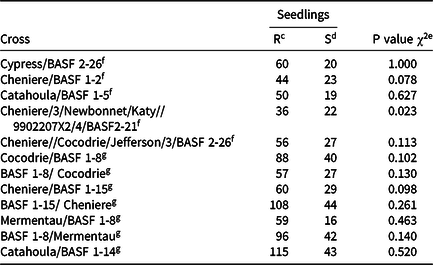
Segregation and chi-square tests of QPE seedling resistance for six single and six reciprocal F2 populations in Crowley, LA, in 2014 and 2015.a, b

a Abbreviations: DAT, days after treatment; QPE, quizalofop-p-ethyl; R, resistant; RRS, Rice Research Station, in Crowley, LA; S, susceptible.
b QPE treatment of 240 g ai ha−1 applied at the 2- to 3-leaf stage.
c Resistant: normal seedling development, percent injury = 0 at 10 DAT.
d Susceptible: dead seedlings 10 DAT.
e P value for 3R:1S χ2 ratio.
f F2 population evaluated at RRS in 2014.
g F2 population evaluated at RRS in 2015.
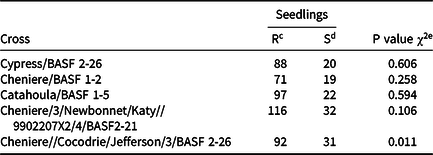
Segregation and chi-square tests of QPE seedling resistance in five F3 populations in Crowley, LA, in 2015.a, b

a Abbreviations: DAT, days after treatment; QPE, quizalofop-p-ethyl; R, resistant; RRS, Rice Research Station, in Crowley, LA; S, susceptible.
b QPE treatment of 240 g ai ha−1 applied at the 2- to 3-leaf stage.
c Resistant: normal seedling development, percent injury = 0 at 10 DAT.
d Susceptible: dead seedlings 10 DAT.
e P value for 5R:1S χ2 ratio; four to five randomly selected F2 plants were bulked to produce five F3 populations. Because susceptible F2 plants had been killed by QPE herbicide application (240 g ai ha−1), the expected ratio is 5R:1S.
The two herbicide response trials were conducted in 2017 with the following material: susceptible variety Cheniere, resistant donor OsHPH12, and the following seven QPE-resistant lines: PVL013 (Cypress/BASF 1-13), PVL01 (Cheniere/BASF 1-5), PVL024B (Cheniere/BASF 1-5), PLV038 (Trenasse/BASF 1-10), PLV080 (Cheniere/BASF 1-2), PVL081 (Cheniere/BASF 1-2), and PVL108 (Cheniere/BASF 1-6). These lines were developed at the LSU Agricultural Center H. Rouse Caffey Rice Research Station, in Crowley, LA (30.241913, −92.347683; hereafter referred to as RRS).
Inheritance Studies
Parents and the F1 plants (n = 2–12) of each one of the F2 populations shown in Table 1 were treated with a 2× field rate of QPE (240 g ha−1) at the 2- to 3-leaf stage in 2013 RRS field trials (unpublished results) or at the greenhouse level as reported by Camacho et al (Reference Camacho, Linscombe, Sanabria, Mosquera and Oard2019). Five F2 populations (n = 58–158) shown in Table 1 and corresponding parents were planted in March 2014 at the RRS. At the 2- to 3-leaf stage, a solution containing QPE (106 EC formulation) at 2× field rate of 240 g ha−1 was applied with a CO2-pressurized backpack sprayer calibrated to deliver 140 L ha−1 at 190 kPa. The spray boom consisted of 5 flat-fan 110015 nozzles (Flat Fan AirMix Venturi Nozzle, Greenleaf Technologies, Covington, LA 70434) at 38-cm spacing. The adjuvant Invade RST (Innvictis Crop Care, Loveland, CO) was added at 1% vol/vol. A permanent flood was applied at the 4- to 5-leaf stage. Response to QPE was recorded 10 days after treatment (DAT) using a visual injury scale of 0% to 100% where 0 = no injury and 100 = complete plant death. Injury ratings were based on slight chlorosis and minimal necrosis.
A different set of six reciprocal and one single F2 populations shown in Table 1 was planted in 2015 at the RRS and treated with the 2× field rate at the 2- to 3-leaf stage. The five F3 populations derived from the five F2 populations shown in Table 2 were planted in March 2015 at the RRS and treated at the 2× field rate as described above. Standard agronomic practices for fertilizer and insecticides were carried out at each trial to maximize grain yield and minimize pest injury. Grain from each plot was harvested by hand and dried to ~12% moisture. Segregation frequencies for the breeding material were calculated using chi-square analyses using the PROC FREQ procedure in SAS 9.4.
QPE Response Studies
Three herbicide response trials were conducted in 2017 at the RRS and at the LSU Agricultural Center Northeast Research Station, in St. Joseph, LA (31.946656, −91.232286). Material for the first trial at the RRS consisted of the original donor OsHPH12; susceptible variety Cheniere; and the six QPE-resistant lines PVL013, PVL01, PLV038, PLV080, PVL081, and PVL108. This trial was planted in March 2017 at the RRS in a random complete block design (RCBD) with four replications. Seeding rate of each plot was ~90 kg ha−1. Each seven-row plot measured 4.88 m long, 1.78 m wide and 0.25 m between rows. At the 3- to 4-leaf stage in the first trial, QPE treatment levels were 0 and 120 ai ha−1. Herbicide treatments were applied with a CO2-pressurized backpack sprayer calibrated to deliver 140 L ha−1 at 190 kPa. The spray boom consisted of five flat-fan 110015 nozzles (Flat Fan AirMix Venturi Nozzle) at 38-cm spacing. A crop oil concentrate (Agri-Dex® label, Helena Chemical Company, Collierville, TN) at 1% vol/vol was included in the mixture. Response to QPE at 7, 21, and 33 DAT was recorded using the visual injury scale described above for the field inheritance studies. At physiological maturity, plots were harvested at approximately 18% to 20% moisture and subsequently dried to ~12% moisture. A Fisher’s protected LSD (P < 0.05) was calculated using the PROC ANOVA procedure in SAS 9.4.
Two additional herbicide trials were planted at the RRS and at St. Joseph. Due to limited seed supply, only the QPE-resistant genotypes OsHPH12, PVL01, and PLV024B were planted in March 2017 in an RCBD with four replications as in the first herbicide trial and treated at the 3- to 4-leaf stage with 0, 120, and 240 g ai QPE ha−1. Herbicide treatments were applied with a CO2-pressurized backpack sprayer calibrated to deliver 140 L ha−1 at 190 kPa. The spray boom consisted of five flat-fan 110015 nozzles (Flat Fan AirMix Venturi Nozzle) at 38-cm spacing. A crop oil concentrate (Agri-Dex®) at 1% v v−1 was included in the mixture. Response to QPE was recorded for percent injury at 7, 21, and 33 DAT. Grain from each plot was harvested at approximately 18% to 20% moisture with a combine and dried for storage at ~12% moisture. A Fisher’s protected LSD (P < 0.05) was calculated using the PROC ANOVA procedure in SAS 9.4.
SNP Genotyping for QPE Resistance in F2 Populations
Genotyping of the causal SNP mutation in the gene encoding chloroplastic ACCase (Délye et al. Reference Délye, Zhang, Michel, Matéjicek and Powles2005) in the five F2 populations shown in Table 3 was carried out using the primers reported by Camacho et al (Reference Camacho, Linscombe, Sanabria, Mosquera and Oard2019): OsACCp1A forward sequence for susceptible/wild type allele: 5′-CAAGGAAGATGGACTTGGTGTGGAGAAAA-3′, reverse primer sequence 5′-TAGAAACGCCTTCAAGGTCATCTGAAACAG-3′; primer OsACCp1B forward sequence for resistant/mutant allele: 5′-CTGGCAATAGCAGCACTTCCATGTGA-3′, reverse primer sequence 5′-AAATGATATTACGTTCAGAGCTGGATCATTTGG-3′. Extraction of genomic DNA was carried out with the MATAB method described by Romero et al (Reference Romero, Lozano, Garavito, Carabali, Triana, Villareal, Reyes, Duque, Martinez, Calvert and Lorieux2014). Polymerase chain reaction and electrophoresis were completed following standard procedures as described by Camacho et al (Reference Camacho, Linscombe, Sanabria, Mosquera and Oard2019). The five field-grown F2 populations were first applied with a 2× QPE rate (240 g ha−1), then leaf samples were collected from the surviving resistant plants. In total, 25–29 samples were evaluated from each F2 population. The 2:1 heterozygous to homozygous dominant ratio was tested by chi-square analyses using SAS 9.4.
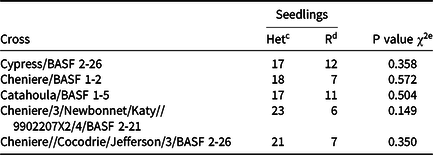
Segregation and chi-square tests of PCR-amplified fragments for resistance or susceptibility to QPE in five F2 populations in Crowley, LA, in 2014.a, b

a Abbreviations: bp, base pairs; DAT, days after treatment; Het, resistant heterozygous; PCR, polymerase chain reaction; QPE, quizalofop-p-ethyl; R, resistant.
b QPE treatment of 240 g ai ha−1 applied at the 2- to 3-leaf stage.
c One fragment (360 bp) detected for the resistant allele and one fragment (320 bp) for the susceptible allele.
d Resistant: only one fragment (360 bp size) observed for both resistant alleles.
e P value for 2Het:1R χ2 ratio.
Results and Discussion
Inheritance of Resistance to QPE in F1, F2, and F3 Populations
In preliminary studies at the RRS, four QPE-resistant BASF parents (BASF 1-2, BASF 1-5, BASF 2-21, and BASF 2-26) were crossed with five susceptible elite breeding lines (Catahoula, Cheniere, Cypress, Cheniere/3/Newbonnet/Katy//9902207X2, and Cheniere//Cocodrie/Jefferson). All four BASF parents and 50 F1 plants treated in 2013 at the 2- to 3-leaf stage with 2× QPE at the RRS were rated with 0% injury at 33 DAT. These plants grew normally and produced viable seeds, whereas all five susceptible parents were dead in the same study at 21 DAT. These results are consistent with our previous greenhouse studies that evaluated five BASF parents (BASF 1-8, BASF 1-12, BASF 1-14, BASF 1-15, and BASF 2-31), seven susceptible genotypes (Catahoula, Cheniere, Cocodrie [Linscombe et al. Reference Linscombe, Jodari, Bollich, Groth, White, Chu, Dunand and Sanders2000], Mermentau, CL111 [Oard et al. Reference Oard, Harrell, Groth, Bearb, White and Linscombe2014b], CL152 [Oard et al. Reference Oard, Harrell, Groth, Bearb, White and Linscombe2014c], and R609) and 16 F1 crosses (61 plants), seven of which were advanced to produce the second set of F2 populations presented in Table 1. In these studies, all BASF lines (23 plants) and all 61 F1 plants showed 0% injury at 15 DAT and produced viable seeds, whereas all seven susceptible genotypes (31 plants) were dead at 15 DAT (Camacho et al. Reference Camacho, Linscombe, Sanabria, Mosquera and Oard2019).
Table 1 shows segregation and chi-square tests of QPE seedling resistance for the six single F2 populations evaluated at Crowley in 2014 and 2015, and the six reciprocal and one single F2 populations screened at the same location in 2015. For 11 of the 12 populations, the 3R:1S (R indicates resistance, S indicates susceptible) segregation ratios indicated QPE resistance was governed by a single dominant gene in six QPE-resistant lines (BASF 1-2, BASF 1-5, BASF 1-8, BASF 1-14, BASF 1-15, and BASF 2-26). The sole exception that did not fit a 3:1 or other known ratio was the cross Cheniere/3/Newbonnet/Katy//9902207X2/4/BASF2-21 evaluated in 2014. Sampling error among the relatively small number of 58 individuals was the simplest explanation for this exception. Segregation analysis of a larger sample size in the succeeding F3 generation, shown in Table 2, supported this conclusion. Finally, consistent results for the three pairs of reciprocal crosses screened in 2015 demonstrated the absence of observable maternal effects for this material.
Table 2 shows segregation and chi-square tests of QPE seedling resistance in five F3 populations at the Crowley location in 2015. These F3 populations were derived from four to five randomly selected F2 plants for each cross. Similar to the F2 populations, segregation ratios of the five F3 populations confirmed they could be traced to a single dominant Mendelian model for resistance to the QPE herbicide. For these F3 populations a 5R:1S was expected because susceptible F2 plants had been killed by a QPE herbicide application. The F3 population derived from the cross Cheniere//Cocodrie/Jefferson/3/BASF 2-26 did not follow the expected 5R:1S, which may be explained by sampling error. Overall, results from these field studies are consistent with our previous laboratory and greenhouse research (Camacho et al. Reference Camacho, Linscombe, Sanabria, Mosquera and Oard2019) that showed QPE resistance in Provisia™ rice is governed by a single dominant gene without observable maternal effects.
Table 3 shows segregation and chi-square tests of PCR-amplified fragments for resistance or susceptibility to QPE in five F2 populations evaluated at the Crowley location in 2014. Segregation of the two PCR allele fragments within each population fitted a 2Het: 1 R χ2 ratio, suggesting single gene Mendelian control. No analysis of plants susceptible to QPE treatment was carried out in this case because leaf samples for PCR assays were collected after the susceptible plants had died.
Response of Provisia™ Lines to QPE Herbicide at Two Louisiana Locations
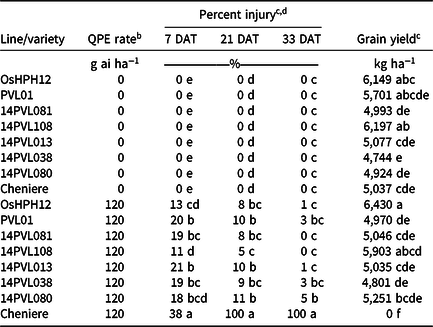
For the first herbicide response trial at the RRS location in 2017, greater injury was observed at 7 and 21 DAT for the original donor OsHPH12 and each of the six QPE-resistant lines at 120 (1× field rate) vs. 0 g ha−1 (Table 4). Susceptible variety Cheniere sustained a high injury level at 7 DAT and was dead at 21 DAT. At the 1× field rate, differences in injury were observed among the seven lines at 7 and 21 DAT. However, a trend of reduced injury from 7 through 33 DAT was observed for all QPE-resistant material. At 33 DAT, no differences at 0 vs. 120 g ha−1 treatment were found for any line, except 14PVL080, which exhibited low (5%) injury. At harvest maturity, no differences in grain yield were observed with any QPE-resistant line at the 0 vs. 120 g ha−1 treatment levels.
Percent injury and grain yield of seven QPE-resistant breeding lines and susceptible variety Cheniere after 0 and 120 g QPE ha−1 in Crowley, LA, in 2017.a

a Abbreviations: DAT, days after treatment; Het, resistant heterozygous; QPE, quizalofop-p-ethyl.
b QPE treatments were applied at the 3- to 4-leaf stage.
c Means with the same letter in a column for each location are not significantly different based on LSD (P < 0.05) test.
d Percent injury based on visual rating of 0% to 100% where 0 = no injury and 100 = complete plant death. Injury generally characterized by transient pale green to yellow chlorosis and/or slight brown necrosis.
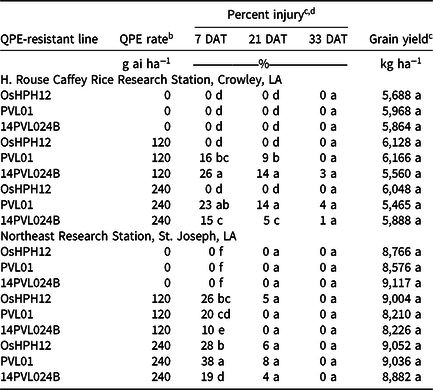
In the second and third herbicide response trials at the Crowley and St. Joseph locations in 2017, three QPE-resistant lines were treated with 0 g ha−1, 120 g ha−1 (1×), and 240 g ha−1 (2×) QPE (Table 5). Greater injury was observed at 7 and 21 DAT in the second experiment at Crowley for both 1× and 2× rates vs. no QPE treatment. The exception was the original donor line, OsHPH12, with no injury observed from 7 to 33 DAT. No difference in injury at 1× vs. 2× rates was recorded for PVL01, but unexpectedly, greater injury at the 1× rate vs. the 2× rate was found for 14PVL24B. Similar to the first experiment, a trend of reduced percent injury from 7 through 33 DAT was observed for PVL01 and 14PVL024B. At the end of the second experiment at RRS, no differences in grain yield were found for any line across the different herbicide treatment levels.
Percent injury and grain yield of three QPE-resistant lines after 0, 120, and 240 g QPE ha−1 treatment at two locations in 2017.a

a Abbreviations: DAT, days after treatment; QPE, quizalofop-p-ethyl.
b QPE treatments were applied at the 3- to 4-leaf stage.
c Means with the same letter in a column for each location are not significantly different based on LSD (P < 0.05) test.
d Percent injury based on visual rating of 0% to 100% where 0 = no injury and 100 = complete plant death. Injury generally characterized by transient pale green to yellow chlorosis and/or slight brown necrosis.
For the third experiment at St. Joseph, greater injury was observed at 7 DAT for all QPE-resistant lines including OsHPH12 for both 1× and 2× rates vs. no QPE treatment (Table 5). Greater injury at 7 DAT was recorded at 2× vs. 1× rates for PVL01 and 14PVL024B. At 33 DAT no leaf injury was found for any QPE-resistant line and, similar to the first and second experiments described above, no difference in grain yield was detected in any line at the three QPE treatments levels. Due to limited seed supply, only the original donor OsHPH12 and line PVL01 were common across the three experiments. Nevertheless, both lines showed similar response across years and locations in terms of percent injury and potential yield reduction after QPE treatment. Overall results from the three field experiments suggest that 2× QPE treatment will have minimal or no impact on yield from breeding lines derived from the donor OsHPH12, but studies with additional breeding material will be required.
Our previous greenhouse and laboratory studies suggested that resistance to QPE treatment in certain Provisia™ lines was governed by simple genetic control in a Mendelian fashion (Camacho et al. Reference Camacho, Linscombe, Sanabria, Mosquera and Oard2019). However, results of inheritance studies are environment and line specific. So, there was no certainty that the outcome from our greenhouse study would be similar to field trials over different years and locations. Results from our field studies, consistent with the greenhouse research, show that QPE resistance under U.S. conditions is governed by a single gene that follows Mendelian inheritance. Testing of reciprocal crosses indicated that maternal effects would have minimal or no effect on expression of herbicide resistance.
Field evaluation of QPE-resistant inbred lines showed transient leaf injury at 1× or 2× field rates at 7 and 21 DAT, but complete recovery for all material was observed from 7 through 33 DAT. Importantly, no differences in grain yield were found for any QPE-resistant line at 0 vs. 1× or 2× QPE field rates, indicating that minimal injury in the vegetative stage had no effect on yield potential of the QPE-resistant lines. Results from this study provide new information on gene control of QPE resistance under field conditions and response of elite breeding lines to commercial application rates of this herbicide. Information obtained from this research will also assist rice breeders develop the most efficient strategies to incorporate QPE resistance into new improved varieties. Finally, this study provides useful information of QPE response and inheritance as part of a combined Provisia™ and Clearfield® strategy to control current weedy rice imidazolinone-resistant populations and to prevent future development of QPE-resistant weeds.
Acknowledgments
This research was supported in part by the Louisiana Rice Research Board. This research was also received partial funding from the U.S. Department of Agriculture–National Institute of Food and Agriculture under the Hatch Project: Development of Hybrid and Disease-Resistant Rice Germplasm for Louisiana.
Conflict of Interest
The authors declare no conflicts of interest.