Implications
Coccidiosis reduces broiler performance and increases the physiological cost of maintaining the immune system because of the effect of the parasite on intestinal health. Treatment with the blend of functional oils potentiated the host immunity against Eimeria, reducing the excretion of oocysts like ionophores; however, it reduced weight gain. Increased inflammatory response was essential for immune protection of the birds, albeit there was a smaller variation in weight gain after 2 weeks. These results demonstrated that the blend of functional oils mediated a slower recovery of the animals, but was as effective as treatment with ionophores.
Introduction
Coccidiosis usually occurs sub-clinically in birds, which makes it difficult to diagnose the disease in a timely manner and begin treatment before loss of performance occurs (Cornelissen et al., Reference Cornelissen, Swinkels, Boersma and Rebel2009). Studies with the major species of Eimeria have revealed that innate and cell-mediated immunity have a fundamental action against the pathogen, both by the production of cytokines and by the direct cytotoxic attack of affected cells (Lillehoj and Choi, Reference Lillehoj and Choi1998; Laurent et al., Reference Laurent, Mancassola, Lacroix, Menezes and Naciri2001). The primary proinflammatory cytokines, such as interleukin 1 (IL-1), IL-6 and tumor necrosis factor-α (TNF-α), are responsible for the acute-phase results that are associated to systemic and metabolic changes, including decreased appetite, increased basal metabolic rate, skeletal muscle degradation and acute-phase hepatic protein synthesis (Kogut and Klasing, Reference Kogut and Klasing2009). Jiang et al. (Reference Jiang, Schatzmayr, Mohnl and Applegate2010) conducted lipopolysaccharide (LPS) challenge on animals and concluded that only 59% of performance loss was because of the reduction in feed intake, while 41% was because of other factors, likely associated with the immune response. Anticoccidial drugs are included in the animal diet as a preventative and continuous measure to minimize problems with coccidiosis. Monensin is an ionophore widely used in poultry production; however, many Eimeria spp. strains resistant to ionophores have been identified (Chapman et al., Reference Chapman, Jeffers and Williams2010). Furthermore, the initiative to reduce the use of antibiotics as growth promoters has stimulated research to develop alternative methods to simultaneously reduce the impact of parasites and act as growth promoters.
Phytogenic additives may act as antimicrobial and anti-inflammatory agents with similar effects as drugs used in animal production, because generally, they are composed of a complex blend of volatile substances, such as terpene hydrocarbons, simple alcohols and aldehydes, among other pharmacologically active compounds (Applegate et al., Reference Applegate, Klose, Steiner, Ganner and Schatzmayr2010). Among phytogenic additives, functional oils are defined as those that have an action beyond nutritional value (Murakami et al., Reference Murakami, Eyng and Torrent2014). An example is the blend of cashew nut shell liquid and castor oil (CNSL–castor oil). Evaluating this blend in the diet of broilers challenged with coccidiosis, Murakami et al. (Reference Murakami, Eyng and Torrent2014) observed increased weight gain and improved feed conversion, as well as a gain of 100 kcal of metabolizable energy in the diet compared to the control treatment group. According to Bess et al. (Reference Bess, Favero, Vieira and Torrent2012), this increase in energy availability may be associated with the antimicrobial and anti-inflammatory effects of functional oils. However, there are currently no in vivo studies that demonstrate the anti-inflammatory effect of these functional oils.
This study was developed to test the hypothesis that the commercial blend of cashew shell liquid and castor oil in the diet beneficially modulates the immune response of chickens challenged with coccidiosis.
Material and methods
Animals, diets and experimental design
A total of 864 one-day-old male chicks (Cobb 500) were obtained from a commercial hatchery and housed in two identical experimental rooms composed of 48 pens (8 pens/treatment and 18 birds/pens). The nutritional program consisted of three diets, pre-initial (days 1–7), initial (days 8–21) and growth (days 22–28), based on the levels of nutritional requirements recommended by the Brazilian Tables of Poultry and Swine (Rostagno et al., Reference Rostagno, Ferreira, Barreto and Euclides2011). The nutritional composition of each treatment group was the same, varying only the additive used in the diet. Metabolizable energy and crude protein in the three diets were 3000 kcal/kg and 22.2%, 3050 kcal/kg and 21% and 3150 kcal/kg and 19.69%, respectively.
The experimental design was completely randomized in a three-by-two factorial design with three additives: control (non-additive), 100 ppm of monensin or 0.15% CNSL–castor oil, to birds that were unchallenged or challenged with coccidiosis. Both additives, CNSL–castor oil and sodium monensin, were incorporated into the diets by replacing inert (kaolin) in the basal diet. We denoted the treatment group that was unchallenged and fed no additives as the negative control and the group that was challenged as the positive control.
Health challenge
At 14 days of age, sporulated oocysts of Eimeria tenella (10×103), Eimeria acervulina (200×103) and Eimeria maxima (80×103) were inoculated into challenged chickens by gavage. The oocysts were obtained from the Laboratório de Biologia Molecular de Coccídias (University of São Paulo, Brazil). Unchallenged chickens were inoculated with saline solution.
Sampling and data collection
Weight gain and feed intake were measured 7 and 14 days after challenging the health status of chickens when they were 21 and 28 days of age, respectively. We derived equations to study the relation between feed intake and weight gain. For this purpose, the performance responses of challenged birds in each treatment group were normalized to respective unchallenged control birds in each treatment group and expressed as a percentage of variation (Δ), according to the equation proposed by Pastorelli et al. (Reference Pastorelli, van Milgen, Lovatto and Montagne2012). Relative data were used to generate equations that estimated the relationship between the variation in weight gain (ΔG) and the variation in feed intake (ΔFI).
At 21 days of age (7 days post-challenge), three birds per experimental replicate were euthanized by cervical dislocation and samples (1 cm) of the duodenum (the final portion), jejunum (before the Meckel’s diverticulum) and cecal tonsils were aseptically collected. Samples were washed in cold phosphate buffered saline, minced, immediately frozen in liquid nitrogen and stored at −80°C until gene expression analysis.
In addition, from these three birds, one was randomly selected to collect samples (5 cm) of the duodenum (the final portion), jejunum (before Meckel’s diverticulum) and ileum (before cecum entry) to evaluate intestinal health. Before euthanasia, blood from the ulnar vein of one bird per experimental replicate was collected to perform a leukogram.
Oocyst count
At days 7 and 14 post-challenge, samples were collected from birds from five different entry points, forming a pool of samples per pen. The number of oocysts was determined as described by Costa and Paiva (Reference Costa and Paiva2009), using a McMaster chamber and the formula: total oocysts/pen=(oocysts counted × dilution factor × [sample volume/counting chamber volume]/2).
Intestinal health index – ‘I See Inside’
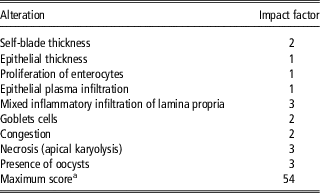
The ‘I See Inside’ (ISI) methodology (INPI BR 1020150036019) is an intestinal health index developed by Kraieski et al. (Reference Kraieski, Hayashi, Sanches, Almeida and Santin2016) that uses the following formula: ISI= Σ (EL × FI), where Σ represents the sum, EL is the lesion score (0–3, where 3 is the most severe) determined by observed histological changes, and FI is the pre-established Impact Factor (1–3, where 3 is the most severe) determined by the effect on organ function. Details of the ISI method are presented in Table 1.
Intestinal health index classification table in broilers

a Maximum score represents the score obtained if all alterations were rated the maximum individual score of 3 (Adapted from Kraieski et al., Reference Kraieski, Hayashi, Sanches, Almeida and Santin2016).
Samples were fixed in buffered 10% formalin solution, and then prepared in paraffin blocks. Hematoxylin and eosin (HE) staining was conducted with Alcian Blue. Intestinal samples were evaluated by analyzing five villi per bird, using a Leica DM1000 LED optical microscope.
Gene expression
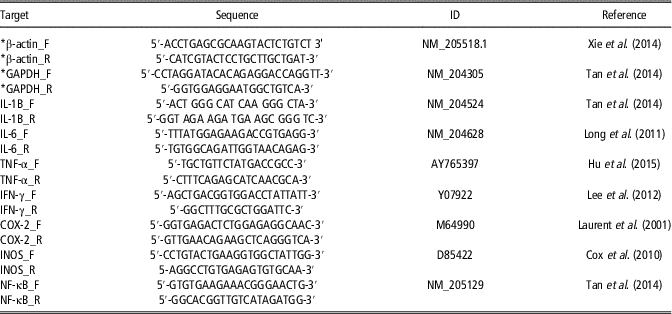
Total RNA was extracted from the pool of samples (20 mg) of duodenum, jejunum and cecal tonsils using the Invitrap® Spin Tissue RNA kit (Stratec, Berlin, DE), according to the manufacturer’s instructions. RNA was eluted by washing the column membrane twice with RNase-free water (25 μL). The total concentration of RNA was determined by Qubit (Qubit 3.0 Fluorometer, Waltham, MA) and RNA purity was determined by measuring the ratio of optical density (OD) at 260 and 280 nm (NanoDrop-1000, Thermo Fisher Scientific, Waltham, MA, USA). Reverse transcription was performed using the high-throughput cDNA transcription kit QuantiTec Kit (Qiagen, Hilden, DE, Germany), following the manufacturer’s protocol. cDNA was stored at −20°C. A Step One Plus (Applied Biosystems, Foster City, USA) was used for quantitative reverse transcription-polymerase chain reaction (qRT-PCR).
cDNA was diluted (1:100) in nuclease-free water and added to PCR mix (10 μL) containing 10 × PCR buffer (2.0 μL), of 50 mM MgCl2 (1.6 μL), 10 μM of each primer (0.5 μL), 5 mM dNTP (0.2 μL), Syber green (2.0 μL) and Platinum® Taq DNA polymerase (0.05 μL). The conditions for qRT-PCR were 94°C for 5 min, 35 cycles at 94°C for 30 s, annealing temperature specific for each primer set (Table 2) for 30 s, and 72°C for 30 s. The specificity of PCR products was evaluated by analyzing dissociation curves. In addition, the size of amplicons was verified by gel electrophoresis. The values obtained for each gene were normalized and gene expression was calculated relative to the control group of unchallenged birds fed no additives, as described by Livak and Schmittgen (Reference Livak and Schmittgen2001).
Target genes and primers used for the analysis of mRNA expression in broilers

F=forward; R=reverse; ID: GenBank access number; *Housekeeping genes.
GAPDH=glyceraldehyde 3-phosphate dehydrogenase; IL-1B=interleukin 1 beta; IL-6=interleukin 6; TNF-α=tumor necrosis factor alpha; IFN-γ=interferon gamma; COX-2=cyclooxygenase 2; INOS=nitric oxide synthase; NF-κB=nuclear factor kappa beta.
Statistical analysis
Pearson’s correlation coefficient was determined as a measure of the linear correlation between weight gain variation (ΔBWG) and feed intake variation (ΔFI) between the negative control group and individual treatment groups. The relationship between ΔFI and ΔBWG was analyzed using linear regression, where ΔBWG=α+β×ΔFI, as described by Pastrorelli et al. (Reference Pastorelli, van Milgen, Lovatto and Montagne2012). Analysis was conducted using the ‘REG’ function in SAS. The intercept (α) represents the reduction of BWG related to changes in maintenance requirements, independent of changes in FI. The slope (β) represents the extent of BWG change associated with the reduction of feed efficiency in challenged birds.
The factorial design was analyzed by ANOVA and included the effects of the additives, health challenge, and their interactions for all variables. The ‘LSmeans’ function was used to compare the means when statistically significant differences were calculated. The GLM procedure in SAS version 9.2 (SAS Institute, 2002) was used.
Results
Growth performance
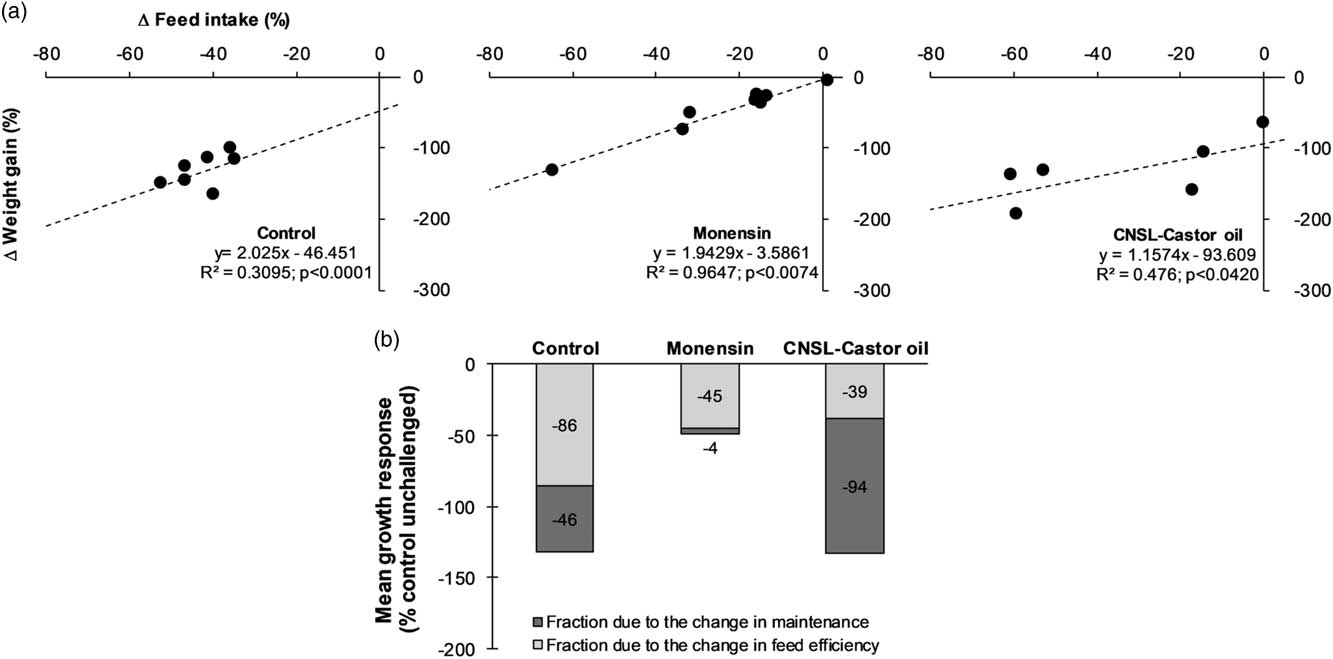
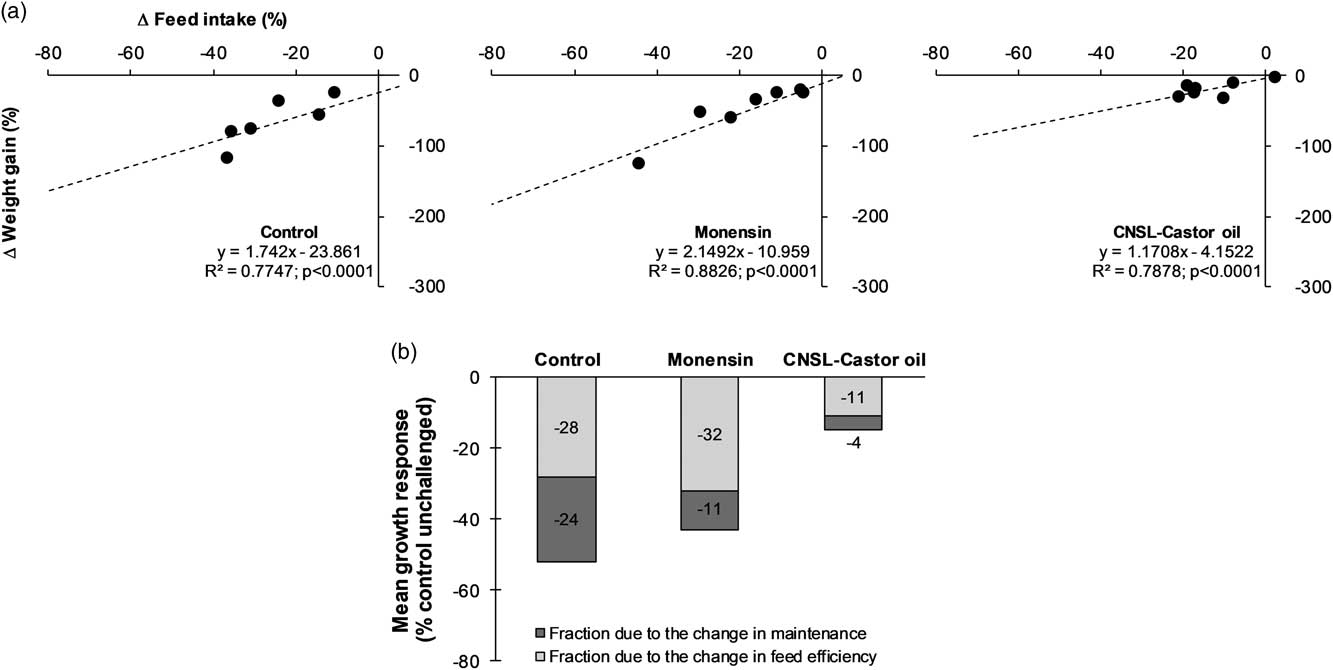
We determined that the relationship between ΔBWG and ΔFI fit a linear regression (Figures 1 and 2). However, the ΔBWG was lower for all treatment groups in the second week compared to the first week, demonstrating that coccidiosis had the greatest impact within the first week of infection. In addition, the intercept values of the linear equations calculated from each treatment group at both time points were negative, suggesting that changes in maintenance requirements contributed to the reduction of ΔBWG, independent of variation in feed intake.
(a) Relationship between the change in body weight gain (ΔBWG) and the change in feed intake (ΔFI) of broiler chicks at 14–21 days of age challenged with Eimeria spp. and supplemented with non-additive (control), CNSL–castor oil or monensin in the diet. Data were normalized to the negative control group. (b) Partitioning of the reduction in ΔBWG into two factors: the change in maintenance ( not associated with ΔFI) or the change in feed intake (
 . associated with ΔFI). CNSL=cashew nut shell liquid.

(a) Relationship between the change in body weight gain (ΔBWG) and the change in feed intake (ΔFI) of broiler chicks at 21–28 days of age challenged with Eimeria spp. and supplemented with non-additive (control), CNSL–castor oil or monensin (M) in the diet. Data were normalized to the negative control group. (b) Partitioning of the reduction in ΔBWG into two factors: the change in maintenance (. not associated with ΔFI) or the change in feed intake (. associated with ΔFI). CNSL=cashew nut shell liquid.

The ΔBWG observed in the treatment groups with challenged birds was due to decreased feed efficiency. However, the ΔBWG of the treatment group that was fed a diet with CNSL–castor oil was not affected by feed efficiency in the first week. In the CNSL–castor oil treatment group, the maintenance-related fraction was two-fold greater than that of the positive control group and 24-fold higher than the monensin treatment group, which had the lowest ΔBWG. Groups fed diets containing CNSL–castor oil exhibited lower ΔBWG, resulting from changes in maintenance requirements (4%) and feed efficiency (11%), in the second week.
Oocyst count
The total oocyst counts of birds fed diets with monensin or CNSL–castor oil decreased in comparison to those of birds in the positive control group (P<0.05) (Table 3). As expected, no oocysts were detected in unchallenged chickens.
Excretion of oocysts in chickens challenged with coccidiosis at 7 and 14 days post-infection

CNSL=cashew nut shell liquid.
Statistical significance was denoted by different lowercase letters, according to the LSMEANS function in SAS (P<0.05). N=8 per treatment.
Blood analysis and ISI score
We determined that the percentage of heterophils and the heterophil/lymphocyte ratio were affected by treatment with additives (P<0.05). There were no statistically significant differences detected between the treatment groups of unchallenged birds (P>0.05), whereas the positive control group of challenged birds and the CNSL–castor oil treatment group exhibited higher percentages of heterophils and heterophil/lymphocyte ratios compared to those of the monensin treatment group (Table 4). Moreover, both unchallenged and challenged birds receiving monensin had similar percentages of heterophils and heterophil/lymphocyte ratios. The change in total number of leukocytes and percentage of eosinophils between the treatment groups were not statistically significant. However, the percentages of lymphocytes and monocytes significantly differed between unchallenged and challenged birds (P<0.05); unchallenged birds had higher percentages of lymphocytes and lower percentages of monocytes compared to challenged birds (data not shown).
Percentage of heterophils and heterophil/lymphocyte ratio in broilers unchallenged or challenged with coccidiosis

1 Challenged (CH) or unchallenged with pool Eimeria spp. at 14 days age of broilers.
Cont=Control without additives; Mon=Monensin 0.025 ppm; CN_CO=Commercial blend of cashew nut shell liquid and castor oil; Ad=Additives.
a,b,cMeans with different superscript letters within a row represent significant differences (P<0.05), 8 broilers per treatment.
Table 5 presents the mean scores obtained from the ISI morphometric index. Independent of whether the birds were unchallenged or challenged, CNSL–castor oil treatment resulted in higher ISI scores in treated birds, whereas monensin treatment did not affect ISI scores compared to the control group. The ISI scores are detailed in Supplementary Tables S1, S2 and S3.
Intestinal Health IndexFootnote * of broilers at 21 days of age receiving different additives

* Methodology ‘I See Inside’.
Cont=Control without additives; Mon=Monensin; CN_CO=Commercial blend of cashew nut shell liquid and castor oil; Ad=Additives.
a,b,cMeans with different superscript letters within a row represent significant differences (P<0.05), 8 broilers per treatment.
1 Challenged (CH) or unchallenged with pool Eimeria spp. at 14 days age of broilers.
Gene expression
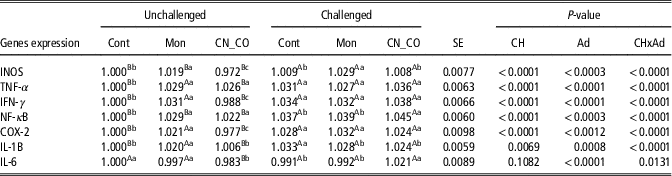
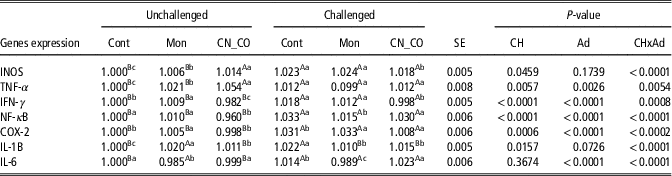
mRNA expression of genes in samples of the duodenum and jejunum 7 days post-challenge (21 days of age) were quantified in Tables 6 and 7. mRNA expression of genes in samples of cecal tonsils did not exhibit any change. On the other hand, gene expression in samples of the duodenum and jejunum significantly increased in challenged birds (P<0.05). In addition, mRNA expression of inducible nitric oxide synthase (INOS) was specifically affected by the additive fed to each treatment group (P<0.05) (data not shown).
mRNA expression of various interleukin genes in the duodenum of broilers challenged (CH) or unchallenged (Un) with coccidiosis

Gene expression was calculated relative to the negative control group. Data were presented as log 10.
Cont=Control without additives (Ad); Mon=Monensin; CN_CO=commercial blend of cashew nut shell liquid and castor oil; INOS=nitric oxide synthase; TNF-α=tumor necrosis factor alpha; IFN-γ=interferon gamma; NF-κB=nuclear factor kappa beta; COX-2=cyclooxygenase 2; IL-1B=interleukin 1 beta; IL-6=interleukin 6.
A,B,CMeans with different superscript letters within a row represent significant differences for challenge status.
a,b,cMeans with different superscript letters within a row represent significant differences for additive used (P<0.05).
mRNA expression of various interleukin genes in the jejunum of broilers challenged (CH) or unchallenged (Un) with coccidiosis

Gene expression was calculated relative to the negative control group. Data were presented as log 10.
Cont=Control without additives (Ad); Mon=Monensin; CN_CO=commercial blend of cashew nut shell liquid and castor oil; INOS=nitric oxide synthase; TNF-α=tumor necrosis factor alpha; IFN-γ=interferon gamma; NF-κB= nuclear factor kappa beta; COX-2=cyclooxygenase 2; IL-1B=interleukin 1 beta; IL-6=interleukin 6
A,B,CMeans with different superscript letters within a row represent significant differences for challenge status.
a,b,cMeans with different superscript letters within a row represent significant differences for additive used (P<0.05).
Challenged birds that received CNSL–castor oil in their diet exhibited lower INOS gene expression and higher nuclear factor kappa B (NF-κB) and IL-6 gene expression than birds receiving monensin (P<0.05). Monensin treatment upregulated expression of interferon (IFN) and tumor necrosis factor (TNF) in the jejunum compared to the positive control group (P<0.05). In the positive control group, the expression levels of IL-1 and cyclooxygenase (COX) were upregulated compared to levels in the monensin and CNSL–castor oil treatment groups. There were no statistically significant differences for either genes between the CNSL–castor oil and monensin treatment groups (P>0.05). Challenged birds that did not receive CNSL–castor oil exhibited lower expression of the genes evaluated in this study compared to the other treatment groups (P<0.05), except for TNF expression, which did not change in the jejunum (P>0.05) but decreased in the duodenum (P<0.05). Treatment with monensin increased expression of IFN, COX and IL-1 to levels higher than those measured in the other treatment groups (P<0.01).
Discussion
The CNSL–castor oil additive stimulated the inflammatory response of birds by mediating an immune response against the parasite within a week after infection. Our results demonstrated that CNSL–castor oil treatment increased gene expression of proinflammatory interleukins, such as IFN, TNF and IL-6, heterophil/lymphocyte ratio in the blood, ISI scores and maintenance expenditure compared to the control group. However, birds treated with CNSL–castor oil excreted the same number of oocysts as birds treated with monensin. In the positive control group, challenged birds receiving no additives in the diet exhibited decreased inflammatory response and increased excretion of oocysts, showing that the parasite proliferated more successfully in the absence of treatment.
Overall, as expected, birds challenged with coccidiosis had more severe ISI scores, increased heterophil/lymphocyte ratio and increased expression of INOS, TNF, IFN, NF-κB, COX, IL-1 and IL-6 within the first week of infection, according to analysis of intestinal samples, which was characteristic of an ongoing inflammatory response against the pathogen (Laurent et al., Reference Laurent, Mancassola, Lacroix, Menezes and Naciri2001; Cox et al., Reference Cox, Sumners, Kim, McElroy, Bedford and Dalloul2010; Zhou et al., Reference Zhou, Hu, Wang, Guo, Qin and Nie2014; Chen et al., Reference Chen, Zhang and Applegate2016; Zhang et al., Reference Zhang, Chen, Eicher, Ajuwon and Applegate2016). According to Klasing (Reference Klasing2004) and Kogut and Klasing (Reference Kogut and Klasing2009), the acute phase response is the first defense mechanism of the immune response that facilitates systemic and metabolic alterations.
The immune response against the coccidiosis parasite is complex and many associated mechanisms are not fully understood. Both the innate and cell-mediated immune system have a fundamental action in response to a pathogen. The immune system does not prevent invasion of sporozoites into enterocytes, rather it inhibits their development (Allen and Fetterer, Reference Allen and Fetterer2002). Innate immunity recognizes a pathogen through toll-like receptors that use the myeloid differentiation primary response 88 (MYD88) adapter protein to activate gene expression of four primary pro-inflammatory proteins, IL-1, IL-6, TNF-α and IFN-γ (Tizard, Reference Tizard2009). These cytokines play important regulatory roles modulating the course of the immune response during infection (Allen and Fetterer, Reference Allen and Fetterer2002). We demonstrated that CNSL–castor oil modulated the immune system by increasing gene expression of TNF-α, IL-6 and IFN-γ and reducing expression of IL-1 and COX-2, compared to the positive control group. The efficacy of the CNSL–castor oil additive was observed by the reduction of oocysts in birds in the treatment group.
CNSL–castor oil treatment effectively reduced excretion of oocysts by increasing expression of IFN-γ. Upregulated IFN-γ expression stimulates cell-mediated immunity, which has been reported to be crucial in the immune response against Eimeria (Lillehoj and Choi, Reference Lillehoj and Choi1998). IFN-γ protein expressed mainly by CD4+ cells can directly inhibit sporozoite development by increasing the cytotoxic activity of CD8+ cells and activating macrophages (Allen and Fetterer, Reference Allen and Fetterer2002). Lee et al. (Reference Lee, Lillehoj, Lillehoj, Cho, Park, Hong, Chun and Park2008) demonstrated that the use of a phytogenic additive composed of Prunus salicina in animal feed increased expression of IFN-γ, mediating protective immunity against coccidiosis, indicated by a reduction in oocyst excretion and weight loss 10 days after infection. The results obtained in this study presented similar conclusions to this previous report.
TNF-α and IL-6 are inflammatory response markers stimulated by macrophages and NF-κB (Kim et al., Reference Kim, Park, Yun, Cho, Park and Lee2008), and in the present study, the heterophil/lymphocyte ratio increased in challenged birds, reflecting the severity of ISI scores in challenged birds. According to Kraieski et al. (Reference Kraieski, Hayashi, Sanches, Almeida and Santin2016), increased ISI scores are associated with increased infiltration of lymphocytes in the lamina propria, epithelial thickness, goblet cells, congestion and enterocyte proliferation or infiltration of inflammatory cells.
Our results demonstrated that there was a relationship between feed intake and weight gain, especially in terms of the partitioning of the observed variations. For example, although the ΔBWG was similar (−132%) in the positive control group and CNSL–castor oil treatment group, the partitioning of the ΔBWG differed between the groups. In the positive control group, the ΔBWG was more significantly attributed to changes associated with feed efficiency (−86%), such as a reduction in feed consumption, whereas the ΔBWG in the CNSL–castor oil treatment group was more likely caused by changes associated with maintenance and not ΔFI (−94%). Zhang et al. (Reference Zhang, Chen, Eicher, Ajuwon and Applegate2016) reported that the ΔBWG in broilers challenged with coccidiosis was attributed to changes in maintenance requirements. The nutrient requirements for maintenance of birds were reported to increase when challenged with coccidiosis within the first week of infection (Laurent et al., Reference Laurent, Mancassola, Lacroix, Menezes and Naciri2001; Cornelissen et al., Reference Cornelissen, Swinkels, Boersma and Rebel2009; Cox et al., Reference Cox, Sumners, Kim, McElroy, Bedford and Dalloul2010). Several reported maintenance requirements include increased metabolic costs for repairing damaged tissues, immune system stimuli and reduced capacity to utilize and convert nutrients into energy (Chen et al., Reference Chen, Zhang and Applegate2016; Grenier et al., Reference Grenier, Dohnal, Shanmugasundaram, Eicher, Selvaraj, Schatzmayr and Applegate2016). The innate immune system may cause additional collateral damage to the body, such as fever and inflammatory reactions, that consumes resources, reducing nutrient reserves and increasing catabolism (Klasing and Iseri, Reference Klasing and Iseri2013; Iseri and Klasing, Reference Iseri and Klasing2014). Owing to these costly consequences, inflammation is a highly undesirable phenomenon in animal production. However, the increased inflammatory response observed within a week of infection in challenged birds treated with CNSL–castor oil additive was necessary to transform the immune system to effectively fight against coccidiosis and other pathogenic bacteria to prevent intestinal dysbiosis.
In fact, 2 weeks after infection, the CNSL–castor oil treatment group exhibited reduced populations of Clostridium perfringens and Staphylococcus aureus, which are opportunistic and potentially harmful bacteria (Moraes et al., 2017). Therefore, we hypothesized that the mechanism of action of CNSL–castor oil additive was like a vaccine, potentiating the host immune system against additional pathogens while simultaneously modulating the target pathogen. The monensin treatment group exhibited decreased inflammatory response, characterized by downregulated expression of TNF, IFN, NF-κB, COX, IL-1 and IL-6, in at least one of the intestinal samples analyzed per bird. This may be because of the fact that monensin was a more effective anticoccidial additive, targeting the parasite when it was outside the host cells in the form of merozoites, before any inflammatory response could peak (Laurent et al., Reference Laurent, Mancassola, Lacroix, Menezes and Naciri2001; Chapman et al., Reference Chapman, Jeffers and Williams2010; Cox et al., Reference Cox, Sumners, Kim, McElroy, Bedford and Dalloul2010).
In unchallenged birds, CNSL–castor oil treatment decreased gene expression of most of the ILs, whereas monensin treatment increased expression of IFN-γ, COX-2 and IL-1. This may have resulted because of the more balanced microbiota of birds in the CNSL–castor oil treatment group. After analysis of microbiota of birds at 28 days of age, we confirmed that there was a larger population of Lactobacillus spp. in the CNSL–castor oil treatment group (Moraes et al., unpublished). These bacteria can modulate the gene expression of cytokines, toll-like receptors and T cells (Brisbin et al., Reference Brisbin, Gong, Orouji, Esufali, Mallick, Parvizi, Shewen and Sharif2011).
The commercial blend of CNSL and castor oil modulated the inflammatory response of birds challenged with coccidiosis against Eimeria spp. In the absence of the parasite, inclusion of the additive in the diet did not unnecessarily stimulate expression of genes involved in the inflammatory response, demonstrating that the blend was an effective tool in modulating the immune system with high specificity.
Acknowledgments
The authors acknowledge Joan Torrent (Oligo Basics) for providing the cashew nut shell oil and castor oil blend commercial. Part of this work was previously presented at the 106th Poultry Science Association Annual Meeting conference 2017.
Declaration of interest
The authors declare that there is no conflict of interest.
Ethics statement
The Institutional Animal Care and Use Committee at Federal University of Rio Grande do Sul reviewed and approved the protocol used in the present study (register number 29814).
Software and data repository resources
The authors declare that data are not deposited in an official repository.
Supplementary material
To view supplementary material for this article, please visit https://doi.org/10.1017/S1751731119000600