Variationist approaches based on social meaning posit indexical links between linguistic and social structures that allow speakers to convey information through their linguistic choices and to thereby perform social work such as constructing identities and displaying stances. Work in this tradition, described by Eckert (Reference Eckert2005) as the third wave of variation, has documented correlations between variation and flexible, locally bound meanings that cannot be adequately explained by appeal to broadly defined demographic categories (e.g., Eckert, Reference Eckert2000; Mendoza-Denton, Reference Mendoza-Denton2008). This work brings with it a new perspective on the ongoing debate regarding the nature of the sociolinguistic variable (Labov, Reference Labov1978; Lavandera, Reference Lavandera1978; Romaine, Reference Romaine1981; Winford, Reference Winford1996; Wolfram, Reference Wolfram1991). Whereas previous theoretical treatments have characterized the variable as a methodological tool without implying real-world status, social meaning–based approaches (e.g., Eckert, Reference Eckert2000; Podesva, Reference Podesva2007; Zhang, Reference Zhang2005) have positioned the variable as an object in the social world. These approaches contend that speakers/hearers mentally link linguistic structures to social information, a contention that has been supported by social evaluation studies (Campbell-Kibler, Reference Campbell-Kibler2008; Fridland, Bartlett, & Kreuz, Reference Fridland, Bartlett and Kreuz2004; Plichta & Preston, Reference Plichta, Preston, Kristiansen, Coupland and Garrett2005) as well as other sociophonetic work (Hay & Drager, Reference Hay and Drager2010; Niedzielski, Reference Niedzielski1999; Strand, Reference Strand, Milroy and Preston1999).
Based in the methodological tradition of variation, third-wave work has typically used the variable as the unit of linguistic structure indexing social meaning (e.g., Campbell-Kibler, Reference Campbell-Kibler2009; Eckert, Reference Eckert2008), implying that the variable forms a unit in both linguistic and social mental representations. However, this claim has remained largely implicit due to the relatively low level of engagement with cognitive questions in third-wave work. This paper reports on a sociolinguistic perception study of the English variable (ING), the alternation at the end of multisyllabic words between word-final [in] or [ən], here referred to as -in, on the one hand, and [iŋ], here called -ing, on the other. The experiment tested the hypothesis that the regional accent of a speaker shapes listener expectations of (ING) use, which in turn influence patterns of social evaluation by changing which variant is socially redundant with the other available sociolinguistic information. This hypothesis was not supported, and the results instead raise questions about the treatment of the variable as a construct in third-wave work.
THE SOCIOLINGUISTIC VARIABLE
Labov's (Reference Labov1972) principle of accountability proposed that a rigorous study of variation must not only examine instances of marked, intriguing, or nonstandard linguistic forms. To properly assess the degree to which a given speaker exhibits a particular linguistic behavior in a given linguistic and social context, we must compare its occurrences with instances in which it could have appeared but did not. The aptly named principle of accountability functions to keep variationists honest, similar to the way that control groups function in many experimental paradigms. In addition, however, it has had profound effects on the theoretical development on the field, placing the paradigmatic relationship of the variable at the heart of the variationist enterprise. As with foundational constructs in many fields, the variable has proven difficult to define. Any definition of the variable must grapple with both what makes the variants distinct enough to be separate variants and what makes them similar enough to belong to the same variable.
Early definitions of the variable were presented in relatively formal terms, for example a “class of variants which are ordered along a continuous dimension and whose position is determined by an independent linguistic or extra-linguistic variable” (Labov, Reference Labov1966a:15). This definition is highly specific on the elements of difference, in particular the role of correlation with other factors, the bread and butter of variation work. The sameness is captured in the notion of a single dimension, along which the variants are aligned. The notion of the variable rule (Cedergren & Sankoff, Reference Cedergren and Sankoff1974) provides the strongest and most explicit formulation of the variable, proposing that variants are connected by virtue of one resulting from the application of generative rules to another, these rules differing from the linguistic rules of other theories of the time only in being stochastically, rather than deterministically, applied. For various reasons, including field-internal challenges and changes to theory in other domains, the variable rule is no longer used as a primary construct (see Fasold, Reference Fasold1991). The definition of the sociolinguistic variable has in consequence loosened, now most commonly defined as multiple ways of linguistically “doing or saying the same thing” (Chambers & Trudgill, Reference Chambers and Trudgill1980:50, among many others). This definition completely abandons the task of defining difference and offers two possible rationales for sameness: referential equivalence (“saying the same thing”) or functional equivalence (“doing the same thing”).
The requirement of referential equivalence forms the core of Lavandera's (Reference Lavandera1978) well-known critique of the idea of syntactic variables; she argued that only sound-based variables could leave referential meaning untouched, whereas lexical and syntactic variation will necessarily involve referential differences. Dines (Reference Dines1980) proposed that functional equivalence, specifically discourse function, could effectively substitute for referential equivalence. If speakers seemed to be accomplishing similar discursive goals with the various forms, they could be linked as a single variable. Little work has been done operationalizing these definitions, however, and we have developed little in the way of methodologies for diagnosing sets of variants as “true” variables as opposed to some other set of differing forms. Wolfram (Reference Wolfram1991) defined the variable as a “convenient construct employed to unite a class of fluctuating variants within some specified language set” (p. 23), emphasizing the ad hoc nature of the variable as a benefit. Wolfram argued that the variable's flexibility allows us to focus on discovering the areas in which social and linguistic factors interact in structurally patterned ways, without attempting to shoehorn those patterns into the theoretical frameworks of other fields.
Wolfram's argument depends on one of the other key debates over the sociolinguistic variable: Is it merely an analyst's device, helping us think about how variation works? Or does it correspond to an actual object in the world? As a methodological device, the variable's flexibility may well be an asset, but as a theoretical claim about sociolinguistic behavior, a clearer view of its relationship to other linguistic structures is desirable. Labov's (Reference Labov1978) response to Lavandera emphasized a view of the variable as merely a “heuristic device” (p. 1), a view that has persisted, despite Romaine's (Reference Romaine1981) argument that an analytical tool that is fundamental to a field cannot help being a theoretical concept, by virtue of its effect on the questions and answers the field produces. The development of what Eckert (Reference Eckert2005) called the “third wave” of variation studies, however, has significantly shifted the role of the variable in sociolinguistic theory.
The third wave of variation focuses on the construction of sociolinguistic styles, viewing linguistic variation as tied to social categories, practices, and beliefs. Indeed, uses of linguistic forms are seen in this tradition as social practices themselves, fundamentally similar to nonlinguistic social practices such as the wearing of particular clothes or the adoption of particular recreational pursuits. Such practices can index social categories as well as situation-based meanings such as stances, activities, and speech acts (Ochs, Reference Ochs, Duranti and Goodwin1992; Silverstein, Reference Silverstein, Basso and Selby1976, Reference Silverstein2003). Through constantly repeated acts of indexing, agents build their social selves and the societal structures they inhabit. At the same time, this iteration of use builds and maintains the indexical connections themselves.
This view of variation is inherently intersubjective, investigating the interactive processes through which people inhabit and create their social worlds. It is also inherently cognitive, locating the link between the linguistic and the social in the mind as well as interactional behavior. Sociophonetic work has supported the mental reality of sociolinguistic connections and their influence on social and linguistic processing (Hay, Nolan, & Drager, Reference Hay, Nolan and Drager2006; Niedzielski, Reference Niedzielski1999; Strand, Reference Strand, Milroy and Preston1999). Even though both the intersubjective and the cognitive elements are crucial to sociolinguistic practice, I will be concentrating in the current discussion on the latter. It is this cognitive relationship that has the most profound impact on the role of the sociolinguistic variable, by treating the variable as the linguistic structure tied to social content. This positioning shifts the variable from an analyst's tool to an empirical object, but one that has not been adequately supported. The necessary question may be framed as: What linguistic elements are stored in sociolinguistic representations, and does the current concept of the variable capture them adequately? One subpart of this question is whether social meanings are indexed by variables or by (possibly independent) variants.
This latter question is difficult to unravel using the typical variationist tools, because every token of a given variable is by definition one that could have appeared as a different variant, forcing an analysis of the variable as a coherent package. Perceptual methods provide a different path, allowing a view into how a given linguistic form adds to a hearer's social impression of a speaker. To date, matched guised studies of individual variables have only compared variants to one another (Campbell-Kibler, Reference Campbell-Kibler2007; Fridland et al., Reference Fridland, Bartlett and Kreuz2004; Plichta & Preston, Reference Plichta, Preston, Kristiansen, Coupland and Garrett2005). The current study uses a social evaluation task to contrast listener reactions to not only the variants of a variable, but to matched utterances whose tokens are obscured by noise, to see how individual variants contribute meaning in contrast, not only to each other, but to the same utterances lacking either one.
METHODS
The English variable (ING) (Hazen, Reference Hazen and Brown2005) has been well discussed in the variation literature and provides an excellent opportunity for considering the relationship of the variable and its component variants to social meanings. Discussions of (ING) in the literature have assumed shared meaning for the two variants, with each at opposing ends of a continuum, typically standard/vernacular or formal/informal (Campbell-Kibler, Reference Campbell-Kibler2009; Eckert, Reference Eckert2000, Reference Eckert2008).
(ING) has been linked in studies of speaker use and metalinguistic commentary to socioeconomic status (Labov, Reference Labov1966b; Trudgill, Reference Trudgill1974), situational formality (Labov, Reference Labov1966b; Trudgill, Reference Trudgill1974), race (Labov, Reference Labov1966b), intimacy (Wald & Shopen, Reference Wald, Shopen, Clark, Escholtz and Rosa1985), and various forms of masculinity (Fischer, Reference Fischer1958; Kiesling, Reference Kiesling1998). Perceptual studies have in recent years supported many of these correlations from the hearer's point of view, showing that increased use of the -in form as opposed to the -ing form makes speakers sound less educated and intelligent and less likely to be gay, among other effects (Campbell-Kibler, Reference Campbell-Kibler2007, Reference Campbell-Kibler2008) and decreases perceived adequacy as a newscaster (Labov, Ash, Baranowski, Nagy, Ravindranath, & Weldon, Reference Labov, Ash, Baranowski, Nagy, Ravindranath, Weldon, Friesner and Ravindranath2006).
Campbell-Kibler (Reference Campbell-Kibler2007) showed that one of the factors shaping (ING)'s effect on the social perception of speakers was regional accent, specifically contrasting Southern-accented speakers with Californian speakers who were described by listeners as accent-free. Listeners in the open response portion of the study reported expectations that the former would generally say -in more often and the latter -ing, and that these expectations shaped their assessments. Based on these results, it was hypothesized that listener expectations would impact social evaluation behavior. The -in use of the Southerners and the -ing use of the non-Southerners would be, in effect, redundant with other information and thus be socially identical to evaluations that would have been made without the contribution of the (ING) variable. To test this hypothesis, a third guise was needed that lacked either variant. Reworded stimuli were rejected due to the strong impact that message content and lexical choice have on perceptions (Campbell-Kibler, Reference Campbell-Kibler2008; Cargile & Giles, Reference Cargile and Giles1998) in addition to the risk that different phrasing might also showcase phonetic variation differently, leading to further confounds. Instead, a third guise was developed in which the (ING) tokens were obscured using bursts of white noise positioned over the relevant portions to sound like recording defects. In order to avoid confounds from the evaluative effect of the interference itself (Ryan & Laurie, Reference Ryan and Laurie1990; Sebastian, Ryan, Keogh, & Schmidt, Reference Sebastian, Ryan, Keogh, Schmidt, Giles, Robinson and Smith1980), a matching number of bursts were added to the other guises in different places from the neutral guise.
The stimuli were based on recordings of interview speech from informal hour-long interviews with eight university students from California and North Carolina. After each interview, speakers were asked to produce alternate -in and -ing tokens, which were altered to match intensity, pitch, and duration, then spliced into copies of the original interview speech using Praat (Boersma & Weenink, Reference Boersma and Weenink2008). A total of four pairs, one with only tokens of -in and one with only tokens of -ing, were created for each speaker, ranging from 10 to 20 seconds in length and containing between two and six (ING) tokens. The topics addressed ranged widely both within and across speakers, with the inclusion of multiple stimuli for each speaker mitigating the confound between speaker and content to some extent. The tokens were piloted for naturalness and identifiability after manipulation.Footnote 1
For the current study, a final manipulation was introduced using the software Audacity.Footnote 2 To create the neutral guise, the audio wave at each (ING) token was zeroed out to eliminate all cues to the variant. The zeroed portions were then covered by white noise, to create the effect of a sudden burst of static in the recording. Such bursts were also added in one or two other spots to each excerpt, in order to obscure their purpose. The -in and -ing guises had the same number of bursts added, positioned so as never to obscure an (ING) token. Some of these occurred during pauses, and others interrupted other portions of speech, always at identical points for both the -in and -ing guises. A hum of white noise was added throughout the recordings, low enough not to interfere with comprehensibility, in order to make the sudden bursts sound believable as recording defects. Including the disruptive bursts of sound for the -in and -ing guises provided a control against effects due to frustration with the interference (Sebastian et al., Reference Sebastian, Ryan, Keogh, Schmidt, Giles, Robinson and Smith1980). Although these bursts occasionally obscured other linguistic material, the matching of the burst positions ensured that effects of the lost portions applied equally to both guises. The manipulations thus yielded 32 matched trios, consisting of one guise in which all (ING) tokens were realized as -in, one in which all were -ing and one in which no (ING) tokens were audible.
Listener responses to these stimuli were collected over the Web, with participants solicited via a social networking site. The welcome page for the experiment contained a sample sound (containing no (ING) tokens) and participants were requested to ensure that they could hear the sample before proceeding to the study. Incentives of either a raffle for an iTunes gift certificate or a donation to charity were offered, a choice that had the unexpected benefit of serving as a distraction, with quite a few of the subjects believing that this choice was the focus of the study.
A total of 105 women and 71 men completed the study, ranging in age from 18 to 68 years, with a mean age of 32 years. The majority (71) had lived in multiple regions throughout the United States, 34 of these including a Southern state. Forty-two had lived some or all of their lives outside the United States, and the remaining participants lived all their lives in the Midwest (11), Northeast (29), South (7), or West (11). The participants identified themselves as White (154), Asian American (9), Latino/a (8), and Black (3). An additional 56 participants began the study but did not complete it, and their responses were removed from the analysis, out of concern that they may not have fully attended to the task.
The first portion of the experiment asked participants to give demographic information (age; gender; regional background; and racial, ethnic, or religious identities) and to complete the Brief Mood Introspection Scale (BMIS) (Mayer & Gaschke, Reference Mayer and Gaschke1988). Earlier work had suggested that overall positive or negative orientations to a given speaker might influence the impact of (ING) on the evaluations (Campbell-Kibler, Reference Campbell-Kibler2008). Given the well-known impact of mood on social evaluations of people (Forgas & Bower, Reference Forgas and Bower1987) as well as other attitude objects (Forgas & Moylan, Reference Forgas and Moylan1988), it was hypothesized that participant mood might have an impact on (ING)-related reactions. The BMIS is a scale designed to measure two dimensions of mood: pleasant/unpleasant and calm/aroused, by having participants rate a series of adjectives (e.g., lively, content, gloomy, jittery) for how effectively each word describes their mood at the moment of evaluation.
After the demographic and mood questions, participants heard a series of eight clips, one from each speaker. For each clip, participants were asked to complete a questionnaire evaluating the speaker on a range of social attributes (see Appendix for the full list of questions). Participants were able to listen to the recording as many times as they wished for each speaker, but could not return to the page once they completed it. The (ING) guises were mixed such that each participant heard a few speakers in an -in guise, a few in an -ing guise, and a few in the neutral guise. To avoid revealing the study's interest in (ING), no listener heard more than one clip of a given speaker, and ratings of guises were compared across listeners. A final page explained the study's focus on (ING) and asked participants to recall or guess which variant each speaker had used.
The results were analyzed with the statistical software language R. It is usual to submit data of this kind to factor analysis, but due to the structure of the data, with each listener rating multiple speakers, the assumption of factor analysis that each observation be independent was not met. Accordingly, factor analysis was carried out on the entire data set but also on responses to individual speakers. Only two pairs of responses consistently loaded onto factors together: intelligent and educated, on the one hand, and willingness to be friends and neighbors with the speaker, on the other. These two pairs were combined to create new response variables, while all other responses were analyzed individually. Responses were analyzed with mixed-effects regression, linear for the ratings responses and logistic for the checkboxes, using the function lmer in package lme4 (Bates & Sarkar, Reference Bates and Sarkar2007). The p-values provided are based on Markov Chain Monte Carlo (MCMC) simulations from the R function pvals.fnc in package LanguageR (Baayen, Reference Baayen2008). Listener characteristics of age, gender, mood, and region were all collected and analyzed, but only mood had an impact on the (ING)-related results.
RESULTS
The study was designed to test the claim that each speaker has an expected (ING) value based on his or her regional accent and further that this expectation would shape the social evaluations of the two variants relative to the neutral guise. This hypothesis was based on earlier findings that in open-ended interviews, participants reported expecting perceptually Southern speakers to use -in and perceptually accent-free speakers to use -ing. Strictly speaking, one would predict that every speaker/listener pair might have a different default (ING) value and also that other cues, such as word choice, voice quality, or linguistic context of (ING) would influence these defaults as well. The study, as designed, was unlikely to detect such fine-grained differences, but the previous research suggests that region has a strong, detectable influence. The results supported the association between region and expected (ING) use, but not their influence on social perceptions.
Expectations
After hearing all eight speakers, participants were asked to recall which guise they had heard from each in a forced choice between -in and -ing. The speaker's name and a few words describing their topic were provided to assist listeners. Due to a technical error, very few responses to this task were collected for the speaker Ivan and he was removed from these analyses.
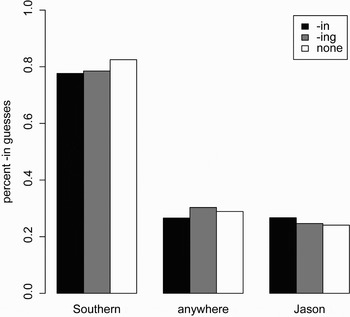
Figure 1 shows that, as predicted, actual (ING) guise had no effect on this choice. Listeners were quite reasonably unable to recall the linguistic details of the recordings they heard a few minutes previously. Speaker did have a large impact, also as predicted. The Southern-soundingFootnote 3 speakers were significantly more likely to be remembered as having said -in than the others (p < 0.001), suggesting that these listeners have the predicted association between speaker region and (ING). If such an association does indeed lead to speaker-specific default (ING) values, they should therefore be expected to emerge for this set of speakers.
Percent -in responses for memory task, by (ING) guise, speaker, and speaker-perceived region.

However, this pattern does not emerge. Indeed, perceived speaker region does not interact with (ING) in any way, the grouping of responses depending instead on the social dimension under evaluation: -ing shows significantly different ratings than -in and neutral on intelligence/education and articulateness, whereas -in guises are rated significantly differently than -ing and neutral on the casual/formal dimension. Similar patterns emerge with respect to less central associations of (ING) as well, namely perceived student status and sexual orientation, but first I will present the results for the “core meaning” candidates.
Core effects
Two of (ING)'s best documented correlations are speaker socioeconomic status, including education, and situational formality. This section discusses the effects of the three (ING) guises on these qualities, and the following section deals with less established effects. In the current study, competence/status effects were primarily represented by the ratings “intelligent” and “educated” and by the checkbox “articulate.” With respect to these dimensions and to formality, -ing guises were rated more highly than -in guises. They differed, however, in the positioning of the neutral guise, suggesting that the two full guises contribute different meanings: -ing indexing intelligence/education and -in indexing informality.
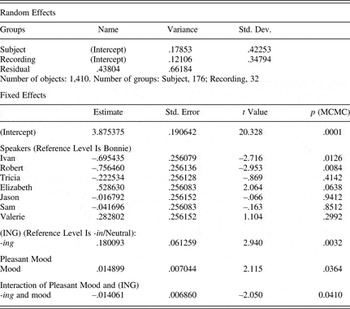
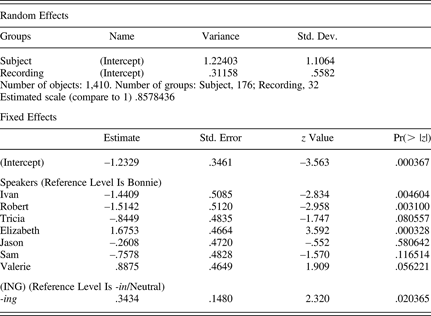
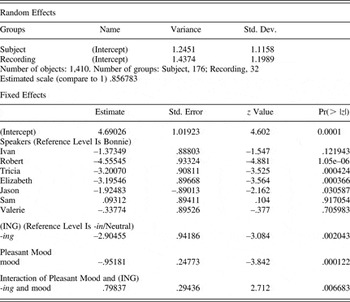
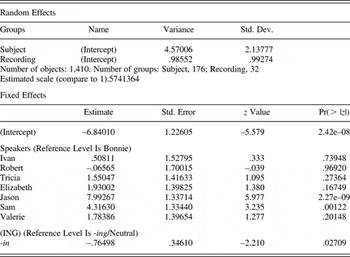
Tables 1 and 2 give the models for intelligent/educated and articulate, respectively. The results were analyzed using linear or logistic mixed-effects models. The column labeled “Estimate” gives an estimate of the coefficient for each effect. For most of the factors, this is the amount on the six-point rating scale (or the logit of the difference in probability of selection) that must be added to the intercept to obtain the expected mean rating (or probability of selection) for that factor level.Footnote 4 The exception is the one continuous factor, mood, for which the estimate indicates the effect on the ratings or probability of increasing one unit on the mood scale.Footnote 5 The random effects, listed at the top of each table, are the participant providing the response and the recording (one of the four from each speaker) to which they were responding. Directly below the random effects, the table indicates the total number of observations or data points and the number of different values for each of the random effects. Both also include speaker as a fixed effect to account for the fact that each speaker (beyond the differences in the content of their utterances) is heard differently. Elizabeth, for example, is rated as easily the most intelligent/educated and articulate of the eight. Some of these differences are predictable based on existing knowledge: for example, the fact that the Southern (Bonnie, Ivan, Robert, and Tricia) speakers are rated as less intelligent than the non-Southern speakers (Elizabeth, Jason, Sam, and Valerie). Others, however, are more difficult to interpret and may depend on voice quality, sociolinguistic variation, or aspects of message content that extend across all sampled utterances. Space precludes a full treatment of interspeaker differences here, but see Campbell-Kibler (Reference Campbell-Kibler2007) for relevant discussions.
Regression model for intelligent/educated responses

Regression model for articulate responses
The inclusion of speaker as a fixed rather than random effect is somewhat unusual here, in that talkers are often included as random effects, treated as sampled from a pool of possible talkers. I have instead included speaker as a fixed effect, due to the central role that speaker idiosyncrasy plays in the social evaluations. The speakers differ in not only their regional classification, but also in the details of their regional accents, other sociolinguistic markers, voice quality, prosodic features, and more, including their topics. These differences (as well as the similarities between them) undoubtedly had an impact on the results, an impact that cannot be experimentally eliminated or controlled but can be both mitigated and better understood by the inclusion of multiple speakers from a given region and multiple recordings from each speaker (Campbell-Kibler, Reference Campbell-Kibler2005). The results regarding (ING) presented in Table 1 and throughout the paper are not dependent on this analytical decision; the (ING)-related effects reported here remain whether speaker is included as a fixed effect or a random effect, no interaction between (ING) and speaker is observed in any of the models and allowing (ING) effects to differ across speakers as an additional random effect does not remove the results reported.
In perceptual terms, Campbell-Kibler (Reference Campbell-Kibler2009) showed that speakers were reliably perceived as more intelligent/educated and articulate when they used -ing than when they used -in, although the former effect was driven by reactions to speakers perceived as working class and not Southern. This effect was replicated in the current study. As Table 1 shows, -ing guises were rated as more intelligent/educated (3.94 on a 1-to-6 scaleFootnote 6) and more often described as articulate (30%) than -in (3.90; 27%) and neutral (3.85; 26%). More importantly, the -in guise and the neutral guise do not differ significantly from one another; the divide between the two does not improve the regression model and has been removed.
Table 1 also shows that the effect of (ING) interacts with the listener's mood, as measured by the BMIS at the beginning of the experiment. Speakers in -in and neutral guises are subject to a “hit” from listeners in an unpleasant mood, who rate them as less intelligent/educated than do those in a positive mood, a general effect well demonstrated elsewhere (e.g., Forgas & Bower, Reference Forgas and Bower1987; Forgas & Moylan, Reference Forgas and Moylan1988; Isen & Shalker, Reference Isen and Shalker1982). In the data here, however, speakers using -ing are exempted from this effect. In assessments of intelligence/education and articulateness, then, -ing makes a positive contribution, while -in is socially redundant, prompting the same ratings as the neutral guise. When compared directly against -ing, the use of -in does count against speakers on these scales, but it does so merely by depriving them of the boost associated with -ing use.
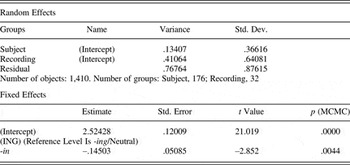
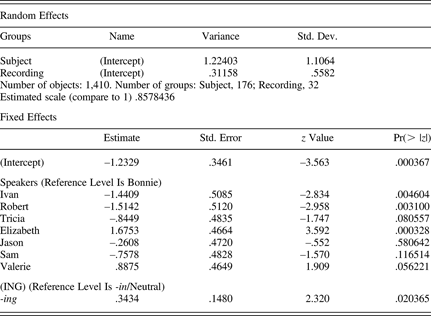
This relationship is inverted when the other central association of (ING) is considered, the casual/formal dimension. Participant ratings of formality group -ing (2.51) with neutral (2.51), leaving -in to stand out as the variant that caused speakers to sound more casual (2.40), as shown in Table 3. When evaluating formality, using -in makes a speaker sound more casual, but -ing is redundant, matching the ratings of the neutral guise. No effect of mood or of speaker was observed.
Regression model for perceived formality

These results alone suggest that speaking of the social meaning of (ING) as a unit mischaracterizes the ways in which listeners incorporate (ING) use into their social view of speakers. -ing makes these speakers sound more articulate, intelligent, and educated, but -in makes them sound more casual. By themselves, these statements reflect long-known associations of (ING). What is surprising, though, is that -in does not make them sound less articulate, intelligent, and educated, and -ing does not make them sound less casual. When -in users sound less intelligent/educated and -ing users sound more formal, they are not distinguishable from those whose (ING) use is unintelligible. Despite their intimate linguistic relationship, these two forms appear to be socially distinct entities.
Of course, individual instances of variation (variant or variable) are not tied to single, static meanings. Meanings are known to be multiple and complex and shift based on a variety of speaker and contextual factors (Campbell-Kibler, Reference Campbell-Kibler2009; Eckert, Reference Eckert2008; Johnstone & Kiesling, Reference Johnstone and Kiesling2008). In these data, as elsewhere, the manipulation of (ING) triggered social reactions beyond the three frequently documented meanings presented in this section. Next, I present results showing a similar set of asymmetries in the frequency of listener assessments of the speakers as students and as gay.
Other effects
All of the speakers recorded for the stimuli of this study were university students, but the participants in the study were drawn from a wider population. Perhaps as a result, these participants showed a more negative view of the category “student,” one that showed an inverse pattern to that of intelligent/educated, as shown in Table 4. Speakers were less likely to be described as students in their -ing guises (44%) than the other two (48%), and this resulted from a reduction of the effect of mood on reactions to -ing guises. Participants in unpleasant moods were more likely to select “student” to describe -in and neutral guises than were participants in more pleasant moods, a relationship that was reduced for -ing guises. Despite this similarity to the intelligent/educated pattern, there does not seem to be a direct relationship between these two reactions, suggesting that the pattern for student is not directly related to competence, but by some other aspect of the social type.
Regression model for selections of student

Lastly, (ING) influenced how likely listeners were to describe speakers as gay (Table 5), as observed in Campbell-Kibler (Reference Campbell-Kibler2007). In this case, as in assessments of formality, it was the -in variant that provided information, making speakers seem significantly less likely to be gay (selected 9% of the time), in contrast to the -ing (13%) and neutral (13%) guises. Not all the speakers were considered equally likely to be gay, indeed only the two West Coast males were described as gay more than 5% of the time: Jason, by far the most frequent at 60%, and Sam with 17%. The impact of (ING) on perceptions of sexuality did not differ statistically across speakers, however.
Regression model for selections of gay

The responses along these two more idiosyncratic dimensions reinforce the pattern shown by the more central associations. The two variants differ from the neutral guise along distinct social dimensions, rather than in response to the speakers' regional accents. This independence suggests that previous discussions of the meanings of (ING) are combining two distinct phenomena that need to be considered independently. The two variants of (ING) appear to have different meanings, not merely in the simple sense of representing opposing poles such as educated/uneducated or formal/informal, but in the sense of operating along different continua. This independence raises the question of where a social meaning–based theory of variation places the variable as a construct.
CONCLUSIONS
The results presented suggest that (ING)'s variants function independently as social markers. Each variant is tied to a particular set of meanings, socially related to but distinct from those of its alternate. This independence is difficult or even impossible to detect through methods that contrast one variant against the other because the binary choice creates the illusion that the two variants are social flip sides of the same coin. When compared against a neutral alternative, however, we are able to see the two variants influencing different dimensions of social perception.
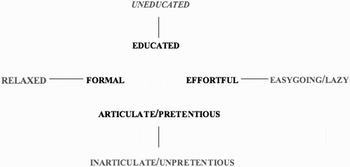
Previous work has suggested that (ING) inhabits an indexical field of meanings, as shown in Figure 2 (Campbell-Kibler, Reference Campbell-Kibler2009; Eckert, Reference Eckert2008). The multiplicity of meanings is supported by these results, as the manipulation of (ING) changes evaluations on a range of dimensions. They further suggest, however, that the two variants may be less tied to one another within the indexical field than previously assumed. Instead, it seems that each variant occupies its own position in the same or related indexical fields, a finding that suggests a number of possibilities. First, it may be that this phenomenon is something specific to (ING), perhaps a result of its linguistic history, having derived from independent morphemes (Houston, Reference Houston1985). If this is the case, it suggests that under the third-wave approach of analyzing variation, we need a more rigorous operational definition of the variable that distinguishes it from other linguistic structures that index social meaning. Alternatively, this finding may reflect the issues at the heart of Lavandera's original objection, and the disconnect between (ING) variants may stem from its status as a morphological variable. If -in and -ing are indeed distinct morphemes, it is perhaps less surprising that they carry independent social content. In this case, we might expect similar patterns for morphological, lexical, syntactic, and discourse variables, while phonological and phonetic variables show closer relationships. Finally, we might expect a divide, not with respect to linguistic level but between continuous and categorical divides. (ING) is generally analyzed as consisting of categorically distinct variants, in contrast to continuous variables such as speech rate or formant values. This may be an important distinction, with social meaning attaching either to defined variants such as -in or -ing or to dimensions of continuous variation, like the duration of a /t/ release.
Hypothesized indexical field for (ING), from Eckert (Reference Eckert2008:466), used with permission.

Fully understanding the mental processing of indexical relationships between linguistic cues and social structures will require a clearer picture of sociolinguistic cognition, informed by current work in phonetics and psycholinguistics as well as social cognition. Linguistic theory has shown increasing interest in exemplar theories of language processing (Bybee, Reference Bybee2006; Goldinger, Reference Goldinger1998; Pierrehumbert, Reference Pierrehumbert, Bybee and Hopper2001), and sociolinguists and sociophoneticians have been drawn by the theory's ability to incorporate nonlinguistic information into learned linguistic structures (e.g., Hay et al., Reference Hay, Nolan and Drager2006; Johnson, Reference Johnson2006). Exemplar theory's emphasis on the details of individual linguistic tokens makes it straightforward to link social information to extremely specific linguistic units and it is a compelling framework for further exploration of the linguistic character of sociolinguistic connections.
Similarly useful developments have emerged in social cognition. Social perceptions, like many other cognitive tasks, are believed to operate on at least two levels: one rapid and automatic, relying heavily on salient cues and generalizations across groups, and the other controlled and deliberative, involving the careful weighing of individual pieces of information and analysis of their relationships (Fiske & Taylor, Reference Fiske and Taylor2007; Wyer, Reference Wyer and Robert2004). Despite common beliefs regarding the primacy of conscious, deliberative thought in social interactions, it has become clear that many if not most social cognitive processes can happen at a relatively automatic level, including the formation of impressions of others and the pursuit of goals (Bargh & Chartrand, Reference Bargh and Chartrand1999; Chartrand & Bargh, Reference Chartrand and Bargh1996). Variationists have paid little attention to this body of research, but it may be that, for example, the results presented here relate only to relatively rapid processing and that a more deliberative process, or one in which participants were more consciously considering the effect of (ING), would take alternate possible variants into account.
In sum, the strategic deployment and interpretation of linguistic cues to index social content is fundamental to the third-wave approach to variation. By positing such indexical relationships, third-wave theories invest the sociolinguistic variable with a social and cognitive reality that is at odds with Labov's (Reference Labov1972) characterization of the variable as a heuristic device. Such a move opens empirical questions regarding what forms of linguistic structure are capable of indexing social content and suggests that a more rigorous operational definition of the variable would be valuable.
APPENDIX
Survey instrument
This is a sample survey page.