


The 9/11 terrorist attacks caused a rippling fear of vulnerability among liberal societies everywhere. Countries around the globe unhesitatingly adopted policies to enhance their governments' capacities to prevent terrorism. Almost without exception, these policies increased governmental power at the expense of individuals' civil liberties (Ackerman Reference Ackerman2006; Hardin Reference Hardin2004; Holmes Reference Holmes2007; Posner Reference Posner2006a). The right to privacy took the hardest hit, with liberal societies relaxing or eliminating restrictions on their governments' surveillance powers. Within months of the attacks, not only the United States, but also France, Germany, and the United Kingdom relaxed various privacy protections by, for example, allowing warrantless interception of private communication and the retention of private data (Alexander Reference Alexander2006; Ramraj, Hor, and Roach Reference Ramraj, Hor and Roach2005).
Almost everyone—citizens, policy makers, political pundits, and scholars—approaches the formulation of counterterrorism policies as a balancing act between the allegedly competing values of privacy and security (Waldron Reference Waldron2003). Intuitively, this would seem to be the right way to evaluate policies designed to increase national security from terrorism. In the face of a potential large-scale terrorist attack, after all, it is unthinkable that citizens would dismiss security concerns and thus forbid all government surveillance directed at potential terrorists, just as it is unthinkable that they would dismiss all privacy concerns and give the government unlimited surveillance powers. Other than in the case of these two extremes, democratic societies and their governments face inevitable trade-offs.
The critical and widely accepted assumption underlying ongoing scholarly debates and recently instituted governmental policies is that reducing privacy protections increases national security from terrorism. However, neither scholars nor practitioners have addressed the validity of this assumption by seriously scrutinizing the mechanism through which reducing privacy presumably translates into more security from terrorism.
In this article, I develop a game-theoretic model of an interaction between an antiterrorist agency and a terrorist organization to analyze how the probability of a terrorist attack varies when the level of privacy protections changes. I use this framework to assess the security rationale for reducing privacy and derive two implications that are missing from the public debate. First, privacy and security from terrorism need not be in conflict: when accounting for strategic interactions, reducing privacy protections does not necessarily increase security from terrorism. Second, and more important, the antiterrorist agency always wants less privacy. The very agency whose expertise affords it disproportionate influence on policy making prefers a reduction in privacy protections even when that reduction reduces security from terrorism.
Within the context of terrorism prevention, the analysis also applies to civil liberties other than privacy. Free speech immediately comes to mind. Many liberal societies have banned radical speech and the glorification of terrorism as a means to discourage the spread of extremist groups and their ideologies.Footnote 1 My analysis suggests that governmental enforcement agencies will seek to restrict radical speech, regardless of whether the restriction increases security from terrorism.
The result regarding the strategic bias of the executive agencies in charge of terrorism prevention contributes to a general understanding of the relationship between government powers and civil liberties in times of emergencies (Ackerman Reference Ackerman2004; Ferejohn and Pasquino Reference Ferejohn and Pasquino2004; Gross and Aoláin Reference Gross and Aoláin2006; Manin Reference Manin, Baume and Fontana2008; Posner and Vermeule Reference Posner and Vermeule2007; Rehnquist Reference Rehnquist1998; Rossiter 1948). The very definition of emergency powers implies that when the emergency subsides, and a serious threat no longer exists, the powers will be terminated and rights will be restored. However, the analysis shows that governmental enforcement agencies lack incentive to relinquish their newly acquired powers once the emergency diminishes. To the contrary, because they are always worse off when civil liberties are expanded and better off when they are reduced, agencies seek to make the emergency reductions in civil liberties permanent.
The article also makes two theoretical contributions. First, it contributes to and expands the political economy literature on law enforcement. This research ranges from Becker (Reference Becker1968), whose seminal paper on crime and punishment argued that people respond to the deterring incentives created by criminal law, to Tsebelis (Reference Tsebelis1989, Reference Tsebelis1990), who developed a game-theoretic model to show that increasing the penalty for crime has no effect on criminal behavior, a result that challenged the deterrence hypothesis and drew an extensive scholarly debate (Bianco, Ordeshook, and Tsebelis Reference Bianco, Ordeshook and Tsebelis1990; Cox Reference Cox1994; Hirshleifer and Rasmussen Reference Hirshleifer and Rasmussen1992). Note that this research focuses on situations where the enforcement agency's task is to enforce the law and impose penalties after a crime is committed. In other words, the enforcement agency acts ex post, after a crime is committed, and the enforcement agency can only affect the likelihood of a crime indirectly, by influencing the ex ante cost–benefit calculus of criminals. My research focuses on situations where the antiterrorist agency acts ex ante, before a terrorist attack occurs, and the agency takes preemptive actions—intelligence efforts aimed at detecting terrorist activity—that directly affect the probability of a terrorist attack. This difference in the timing of law enforcement actions, reflecting the underlying difference between criminal deterrence and terrorism prevention, sets up a novel strategic problem from both conceptual and modeling perspectives.
Second, the article contributes to the political economy literature on terrorism. This literature has addressed several critical questions about fighting terrorism, including the optimal (or suboptimal) domestic or international counterterrorism policy (Bueno de Mesquita Reference Bueno de Mesquita2005, Reference Bueno de Mesquita2007; Powell Reference Powell2007a, Reference Powell2007b; Rosendorff and Sandler Reference Rosendorff and Sandler2004), radical mobilization (Bueno de Mesquita and Dickson Reference Bueno de Mesquita and Dickson2007), terrorism recruitment and support (Bueno de Mesquita Reference Bueno de Mesquita2005; Siqueira and Sandler Reference Siqueira and Sandler2006), and strategies to fight terrorism (Kydd and Walter Reference Kydd and Walter2006), among other topics. However, researchers have yet to determine whether reducing civil liberties increases the effectiveness of terrorism prevention, even though nearly all prominent counterterrorism policies following 9/11 assume it does.
THE SECURITY RATIONALE FOR REDUCING PRIVACY
In the aftermath of 9/11, in response to the threat of catastrophic terrorism, the public policy shifted from punishment after a terrorist attack occurs to preventing it from occurring (Jacobson Reference Jacobson2006). Traditional law enforcement is mostly a reactive enterprise. Law enforcement organizations take actions after a crime is committed; the aim of a criminal investigation is to identify and punish those who broke the law. In contrast, terrorism prevention is a preemptive enterprise. Antiterrorist agencies take actions when the individuals or organizations planning an attack have not necessarily committed any prosecutable criminal offenses; the aim of terrorist investigations is to detect threats before they matured into terrorist attacks (Posner Reference Posner2006a). To this end, antiterrorist agencies need to access and collect information in order to identify individuals or groups that might be planning attacks. At its core, terrorism prevention is an explorative activity that entails gathering and analyzing data about a large number of individuals and organizations, most of whom are unlikely to pose any threat of terrorist activity (Posner Reference Posner2006a).
Richard Posner elegantly points out the difference between terrorism prevention and criminal deterrence: “The goal of national security intelligence is to prevent a terrorist attack, not just punish the attacker after it occurs, and the information that enables the detection of an impending attack may be scattered around the world in tiny bits. A much wider, finer-meshed net must be cast than when investigating a specific crime. Many of the relevant bits may be in the e-mails, phone conversations or banking records of U.S. citizens, some innocent, some not so innocent. The government is entitled to those data, but just for the limited purpose of protecting national security.”Footnote 2
The turn toward prevention is not surprising, given that terrorist attacks can be very destructive. However, legal requirements that constrain the initiation of criminal investigations are perceived to be in conflict with domestic intelligence powers necessary for terrorism prevention (Heymann Reference Heymann2003; Posner Reference Posner2006a). To this end, the antiterrorism laws passed in the aftermath of 9/11 relaxed or eliminated restrictions on domestic (antiterrorism) surveillance powers. The rationale underlying these privacy-reducing measures is that, in an era of nuclear, radiological, biological, and chemical weapons, the potentially horrific costs of failing to stop another large-scale terrorist attack are too high; therefore, nations cannot afford to use the calculus they use when enforcing criminal law (Dershowitz Reference Dershowitz2002; Posner Reference Posner2006a). Citizens need to accept fewer privacy protections, so the argument goes, because preventing large-scale terrorist attacks requires broader and more intrusive government surveillance powers than criminal investigations.
The policy justification for reducing privacy protections is that such a reduction increases security from terrorism. Two intertwined and simultaneously occurring processes presumably serve as the means by which reduced privacy helps terrorism prevention and leads to increased security from terrorism. First, reducing privacy protections reduces the number of obstacles that antiterrorist agencies face when conducting domestic intelligence activities to foil a terrorist attack. Second, reducing privacy protections makes it more difficult for terrorist groups to undertake activities necessary for an attack.
I next discuss each component of the security rationale for reducing privacy. My intention, to be clear, is not to argue that the security thesis is inherently good or normatively appealing. I merely want to lay out the security argument in order to analyze the mechanism through which reducing privacy presumably translates into more security from terrorism.
The first component of the security argument states that reducing traditional privacy protections reduces the constraints on antiterrorist agencies' domestic intelligence activities. To prevent terrorist attacks, governmental agencies must be able to detect the slightest traces of terrorist activity, and detection becomes more likely as their intelligence efforts increase. Privacy protections—taking the form of restrictions on the interceptions of communication, on data retention and data mining, as well as on government's access to such third-party information as financial records and transactions—constrain how governmental agencies can collect information and thus conduct their (counterterrorist) intelligence operations. Thus, when these privacy protections are reduced, antiterrorist agencies can more readily gain access to and collect information related to terrorism prevention, and they can also engage in more intelligence activities for the same, fixed amount of resources.
According to the second component of the security argument, reducing privacy protections creates a more hostile environment within which terrorist groups must operate. Some scholars note that terrorist organizations find liberal democracies to be suitable environments for them to grow and transmit their messages, because they can exploit the civil liberties and democratic freedoms on which liberal societies are built (Schmid Reference Schmid, Schmid and Crelinsten1993). Policy makers share this view. David Blanket, the British Home Secretary, observes that “our democracy and freedoms . . . . are deliberately exploited” (Home Department 2004). Along the same lines, John Ashcroft, the Secretary of Justice, said in reference to two suspected individuals indicted of terrorist charges that they “took advantage of the freedoms of an open society to foster and finance acts of terror” (Justice Department 2004).
Reducing privacy protections, so goes the argument, has a chilling effect on terrorism-related activities. Reducing privacy protections might not deter true fanatics such as suicide bombers, but it does deter donors, fundraisers, facilitators, recruiters, and foot soldiers. That is, it raises the perceived costs of being associated with a terrorist group for individuals who would otherwise willingly provide various kinds of support. In turn, the terrorist support and logistical infrastructure is negatively affected: there are fewer supporters to disseminate propaganda, recruit operatives, raise money, and, if the terrorist organization wants to plan an attack, facilitate immigration, procure supplies, transfer money, forge false identities, facilitate travel, and provide safe houses. Support and logistical networks are essential for terrorist organizations to plan and execute large-scale attacks (Gunaratna Reference Gunaratna2004). Reducing the level of privacy protections thus increases the terrorist organization's costs for terrorist activities.
In a liberal democracy, the tactical advantage is seemingly conceded to terrorists, who are free to exploit privacy protections, whereas the authorities are constrained in their efforts to prevent terrorist attacks by those very privacy protections. Consequently, the intuition behind the security rationale for reducing privacy protections seems simple. Because reducing privacy protections decreases the antiterrorist agencies' cost of counterterrorism intelligence efforts and increases the terrorist organization's cost of terrorist activities, reducing privacy protections increases security from terrorism. However, even if we accept the premises of the security rationale, I argue that when the antiterrorist agency and terrorist organizations act strategically, reducing privacy protections can lead to less security from terrorism, whereas the antiterrorism agency prefers reducing privacy even if such a reduction leads to less security from terrorism.
A SIMPLE EXAMPLE
In this section, I present a simple example to show what happens if we reduce privacy protections when terrorism prevention is an equilibrium outcome arising from the strategic interactions between an antiterrorist agency and a terrorist organization. The example is intentionally set up as minimally as possible. The purpose is to show the strategic mechanisms at work using simple numbers, rather than constructing “realistic” numbers descriptive of any particular situation.
There are two players, an antiterrorist agency and a terrorist organization, and they get utility from a binary outcome: a terrorist attack occurs or it does not. The antiterrorist agency gets a payoff of 100 if a terrorist attack is prevented and a payoff of 0 otherwise. The terrorist organization gets a payoff of 100 if a terrorist attack occurs and a payoff of 0 otherwise. These payoffs are grossed of the players' respective costs described as follows.
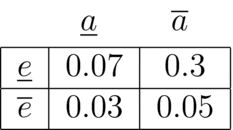
The terrorist organization chooses a level of terrorist activities a; it chooses between a low level of terrorist activities a, and a high level of terrorist activities a. The antiterrorist agency chooses a level of counterterrorism intelligence effort e aimed at detecting terrorist activity; it chooses between a low level of effort e, and a high level of effort e. The probability of a successful terrorist attack, i.e., π(e, a), decreases in the level of counterterrorism intelligence effort e and increases in the level of terrorist activities a. The players' actions translate into the probability of a successful attack, i.e., π(e, a), shown in Figure 1.
Probability of a Terrorist Attack

Note that the counterterrorism intelligence effort is more effective at higher levels of terrorist activity, an assumption that states the well-established view in the terrorism scholarship that terrorist groups cannot increase the level of their operations without jeopardizing their anonymity and thus their chances of going undetected by enforcement agencies.
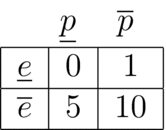
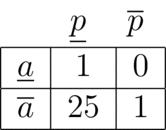
The level of privacy protections p can take two values: “low” privacy protections p, or “high” privacy protections p. The level of privacy protections constrains the antiterrorist agency's cost cl(e, p) and the terrorist organization's cost ct(a, p) as follows: a higher p increases the antiterrorist agency's cost and decreases the terrorist organization's cost. Thus, if p = p, then the terrorist organization's cost is 0 if it chooses a and 1 if it chooses a, and the antiterrorist agency's cost is 1 if it chooses e and 10 if it chooses e. If p = p, then the terrorist organization's cost is 1 if it chooses a and 25 if it chooses a, and the antiterrorist agency's cost is 0 if it chooses e and 5 if it chooses e. Figures 2 and 3 show the antiterrorist agency's and the terrorist organization's cost as a function of p.
The Cost cl(e, p)

The Cost ct(e, p)

In summary, the antiterrorist agency's expected payoff is

and the terrorist organization's expected payoff is

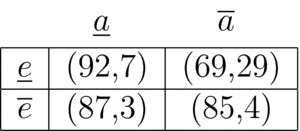
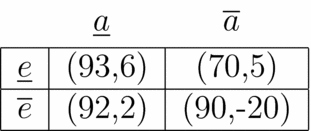
We want to compare the equilibrium probability of a terrorist attack and the antiterrorist agency's equilibrium expected payoff in the game with low privacy versus the game with high privacy. First, when p is high, Figure 4 gives the payoff matrix for the antiterrorist agency and the terrorist organization.
Payoff Matrix if Privacy Protections Are High

The terrorist organization has a dominant strategy: a. The antiterrorist agency's best response to this action is e. Thus, the unique Nash equilibrium is for both players to choose their high-level actions, i.e., (e, a). In this equilibrium, the probability of a terrorist attack is .05, and the antiterrorist agency's expected payoff is 85.
Second, when p is low, Figure 5 gives the payoff matrix for the antiterrorist agency and the terrorist organization.
Payoff Matrix if Privacy Protections Are Low

The terrorist organization has a dominant strategy: a. The antiterrorist agency's best response to this action is e. The unique Nash equilibrium is for both players to choose their low-level actions, i.e., (e, a). In this equilibrium, the probability of a terrorist attack is .07, and the antiterrorist agency's expected payoff is 93. Reducing p induces the terrorist organization to decrease a because its cost increases. However, reducing p lowers the antiterrorist agency's cost. But because the terrorist organization's optimal action is a, the antiterrorist agency strategically anticipates that the terrorist threat is lower and, as a result, its optimal action is e.
In this example, the antiterrorist agency's equilibrium expected payoff is higher in the low privacy game, even though the equilibrium probability of a terrorist attack is higher (as compared to the high privacy game). Therefore, the antiterrorist agency prefers the low privacy environment even if it harms security from terrorism. In the next sections, I show that the preceding results hold in a general model of terrorism prevention.
A MODEL OF TERRORISM PREVENTION
There are two players: an antiterrorist agency and a terrorist organization. The terrorist organization chooses a level of terrorist activities, a ∈ R +. The agency chooses a level of counterterrorism intelligence effort aimed at detecting terrorist activity, e ∈ R +. In the context of terrorism prevention, neither the antiterrorist agency nor the terrorist organization observes the other party's choice, and, therefore, the players make their choices simultaneously.
The outcome of the game is binary, and it is captured by a variable T that takes the value 0 or 1, where T = 1 denotes a successful terrorist attack and T = 0 denotes failure or absence of a terrorist attack. The actions of the antiterrorist agency and the terrorist organization translate into a probability of a successful terrorist attack, given by the function Prob(T = 1) ≡ π(e, a). This probability decreases in e, and it is convex in e (i.e., there are decreasing marginal returns to terrorism prevention in e:  ). Also, the probability increases in a, and it is concave in a (i.e., there are decreasing marginal returns to terrorism occurrence in a:
 ).
I assume that the cross-partial derivative  . The established view in the terrorism scholarship is that terrorism is an asymmetric form of warfare in which the weaker opponent, the terrorist organization, has an advantage by remaining unknown and plotting in secrecy. A higher level of terrorist activities jeopardizes the terrorists' chances of going undetected by enforcement agencies, and thus the counterterrorism intelligence effort is more effective if the terrorist organization increases the magnitude of its activities. The assumption on the cross-partial essentially formalizes this substantive view (Siqueira and Sandler Reference Siqueira and Sandler2006; White Reference White2003).
The level of privacy protections p ∈ R + affects the agency's cost of counterterrorism intelligence effort and also the terrorist organization's cost of terrorist activities. For one, the agency incurs a cost cl(e, p). This cost increases in e, i.e.,  , and the cost is convex in e, i.e.,
 . I assume that
 and that
 .Footnote 3 Also, the cost increases in p, i.e.,
 , and the marginal cost increases in p, i.e.,
 .
The terrorist organization also incurs a cost ct(a, p). The terrorist organization's cost increases in a, i.e.,  , and it is convex in a, i.e.,
 . I assume that
 and that
 . Also, the cost decreases in p, i.e.,
 , and the marginal cost of terrorist activities decreases in p, i.e.,
 .
The antiterrorist agency and the terrorist organization get certain utility if the outcome of the game is no terrorist attack, and terrorist attack, respectively. Let Ul(T) be the antiterrorist agency's payoff if the outcome is T. I assume that Ul(1) < Ul(0) (i.e., the antiterrorist agency prefers that no terrorist attack occurs). Denote the difference by Δl ≡ Ul(0) − Ul(1). Also, I assume that Ut(1) > Ut(0) (i.e., the terrorist organization prefers that a terrorist attack occurs). Denote the difference by Δt ≡ Ut(1) − Ut(0).
Given these assumptions, the antiterrorist agency's expected utility is

Also, the terrorist organization's expected utility is

ANALYSIS
I solve for the Nash equilibrium of the game. Maximizing the antiterrorist agency's objective function, Equation (3) implies that its optimal action is the solution of the first-order condition

The optimization problem is strictly concave in e because the second derivative is  . Thus, there is a unique optimal e.
Maximizing the terrorist organization's objective function Equation (4) implies that its optimal action is the solution of the first-order condition

The optimization problem is strictly concave in a because the second derivative is  . Thus, there is a unique optimal a.
The equilibrium of the game is the solution to the system of equations given by Equations (5) and (6). To show that there is a unique equilibrium, I solve for the antiterrorist agency's and the terrorist organization's best response functions. The antiterrorist agency's optimization problem [Equation (5)] is strictly concave in e, and there is a unique optimal e for any given a. As a consequence, the antiterrorist agency has a well-defined best response function. Moreover, because Equation (5) is continuous in a, the antiterrorist agency's best response function is continuous, and we can apply the implicit function theorem to Equation (5) to find the slope

The preceding expression is strictly positive, which implies that the antiterrorist agency's best response function e(a) strictly increases in a. The result is intuitive: if the terrorist organization increases its level of terrorist activities, in response, the antiterrorist agency increases its level of counterterrorism intelligence effort.
The terrorist organization's optimization problem [Equation (6)] is strictly concave in a, and there is a unique a for any given e. As a consequence, the terrorist organization has a well-defined best response function. Moreover, because Equation (6) is continuous in e, the terrorist organization's best response function is continuous in e, and we can apply the implicit function theorem to Equation (6) to find the slope

The preceding expression is negative, which implies that the terrorist organization's best response function a(e) strictly decreases in e. The result is intuitive as well: if the antiterrorist agency increases its level of counterterrorism intelligence effort, in response, the terrorist organization decreases its level of terrorist activities.
Because the antiterrorist agency's reaction function e(a) is strictly increasing in a and the terrorist organization's reaction function a(e) is strictly decreasing in e, we have the following proposition.
Proposition 1. The terrorism prevention game has a unique pure strategy Nash equilibrium.
Proof. In Text.
Proposition 1 shows that the game has a unique pure strategy Nash equilibrium. As a result, we can do comparative statics on how changes in privacy protections affect the players' equilibrium actions, the players' equilibrium payoffs, and the equilibrium probability of a terrorist attack. Changing privacy protections has two effects on both the antiterrorist agency's and the terrorist organization's equilibrium actions. First, it has a direct (nonstrategic) effect on each player's equilibrium action because it affects their costs. Second, it has an indirect (strategic) effect on each player's equilibrium action, effect that comes through how each player changes its equilibrium action in response to changes in the other player's cost. How the equilibrium actions vary with the level of privacy protections depends on how the two effects work.
In the case of the terrorist organization's equilibrium action, both the direct (nonstrategic) and the indirect (strategic) effects work in the same direction. Ignoring strategic effects, as privacy goes up, the terrorist organization increases the level of terrorist activities because its marginal cost decreases. Now think about strategic considerations. The terrorist organization anticipates that the antiterrorist agency's cost increases as privacy goes up, which induces the terrorist organization to increase its level of terrorist activities. The comparative static is clear: the terrorist organization increases its equilibrium level of terrorist activities if privacy increases.
In the case of the antiterrorist agency's equilibrium action, the strategic (indirect) and the nonstrategic (direct) effects work in opposite directions. Ignoring strategic effects, as privacy goes up, the antiterrorist agency decreases its level of effort because its marginal cost increases. Now think about strategic considerations. The agency anticipates that the terrorist organization's cost decreases as privacy goes up, which induces the agency to increase its level of effort. Hence, the two effects pull in opposite directions. The following expression, evaluated at the equilibrium values a* and e*, shows when the strategic effect dominates the nonstrategic effect:

Intuitively, the left-hand side of Equation (9) represents the nonstrategic effect of increased privacy: an increase in the agency's marginal cost. The right-hand side of Equation (9) represents the strategic effect of increased privacy: the terrorist organization's marginal cost decreases, and the antiterrorist agency anticipates this increased incentive for terrorist activity through its reaction function. If the strategic effect dominates the nonstrategic effect, then the antiterrorist agency's equilibrium level of counterterrorism intelligence effort increases when privacy increases. Thus, we have the following proposition.
Proposition 2. Increasing the level of privacy protections increases the terrorist organization's equilibrium level of terrorist activities. Increasing the level of privacy protections increases the antiterrorist agency's equilibrium level of counterterrorism intelligence effort if Equation (9) holds and (weakly) decreases the antiterrorist agency's equilibrium level of counterterrorism intelligence effort otherwise.
Proof. See Appendix.
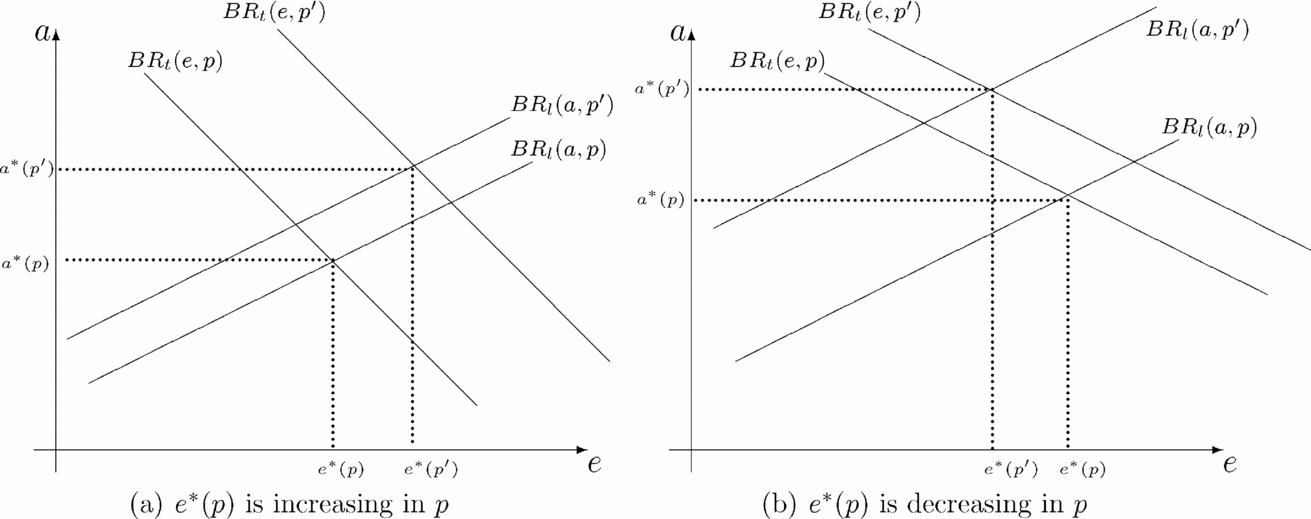
Figure 6 shows graphically the results of Proposition 2 for a situation in which the level of privacy changes from p to p′ (with p < p′). Holding a fixed, the change in e* in response to an increase in p has the same sign as  , and thus, in Figure 6, the law enforcement's best response function shifts to the left with an increase in p. Also, holding e fixed, the change in a* in response to an increase in p has the same sign as
 , and thus, in Figure 6, the terrorist organization's best response function shifts up with an increase in p. In Figure 6, a*(p) is always increasing in p, but e*(p) can go either way. In Figure 6(a), the strategic effect of changing p is large relative to the nonstrategic effect (i.e., the terrorist organization's best response shifts a lot compared to that of the law enforcement agency), so e*(p) increases when p increases. In Figure 6(b), the strategic effect of changing p is small relative to the nonstrategic effect (i.e., the terrorist organization's best response shifts very little compared to that of the law enforcement agency), so e*(p) decreases when p increases.
Reaction Functions and Equilibrium if Level of Privacy Protections Decreases

Proposition 2 translates fairly directly into a result of the effect of decreased p on the equilibrium probability of a terrorist attack, i.e., π(e*(p), a*(p)). A decrease in p (always) decreases a*(p). And, if condition (9) holds, a decrease in p also decreases e*(p). In this situation, whether the equilibrium probability of a terrorist attack increases or decreases depends on whether decreased a* or decreased e* dominates. The key point is that there are situations in which decreased privacy actually decreases security from terrorism by decreasing incentives for counterterrorism intelligence efforts. Whether this is the case, of course, depends on the parameter values and on the curvatures of the marginal probability of a terrorist attack and the marginal cost functions. We have the following result.
Proposition 3. Reducing the level of privacy protections can increase or decrease the equilibrium probability of a terrorist attack.
Proof. See Appendix.
Also, we can analyze how changing the level of privacy protections affects the antiterrorist agency's equilibrium expected payoff. The antiterrorist agency's equilibrium expected payoff is

Changing the level of privacy protections affects the antiterrorist agency's equilibrium expected payoff through three different channels: it changes its cost cl(⋅, p), it changes the equilibrium level of counterterrorism intelligence effort e*(p), and it also changes the equilibrium level of terrorist activities a*(p).
The effect of the changes in e*(p) on the agency's expected payoff is negligible because the antiterrorist agency is at an optimal action, and, as a result, the changes in p that work through changing e*(p) have a zero first-order effect on the equilibrium expected payoff. Because cl(⋅, p) and a*(p) decrease with a decrease in p, reducing p increases the antiterrorist agency's equilibrium expected payoff.Footnote 4 Thus, we have the following result.
Proposition 4. Reducing the level of privacy protections (always) increases the antiterrorist agency's equilibrium expected payoff.
Proof. See Appendix.
Propositions 3 and 4 suggest that the antiterrorist agency prefers reducing privacy protections regardless of its effects on security from terrorism. One way to think about the result intuitively is this. For any given level of privacy protections, the antiterrorist agency will do its best in terms of counterterrorism intelligence effort. Because its action is already optimal given the environment (the level of privacy and the equilibrium level of terrorist activities), the agency further improves its expected payoff, for example, by reducing privacy protections and making the environment more hostile to terrorist activities. In this context, the agency's preference to (always) reduce privacy arises because the agency is strategically involved in terrorism prevention.
Equilibrium Probability of a Terrorist Attack as a Function of Privacy

A PARAMETRIC MODEL
Proposition 3 shows that situations exist in which decreased privacy actually reduces security from terrorism. Whether this is the case, of course, depends on the relative effect of reduced privacy on the equilibrium actions. To say more about the conditions when the reduced privacy increases the equilibrium probability of a terrorist attack, we need to derive closed-form solutions for the equilibrium actions a*(p) and e*(p). To this end, I analyze a parametric model.
For this analysis, the cost functions are quadratic in a player's action, i.e.,  , and the probability of a terrorist attack is π(e, a) = a(1 − e). Also, let e, a, Δl, Δt ∈ R + and p ∈ (0, 1).Footnote 5 Note that (0, 1) represent the full range of the distribution of privacy protections for this analysis. We need p ∈ (0, 1) in order for the cost functions to be positive; we need p > 0 so that cl(⋅) > 0, and we need p < 1 so that ct(⋅) > 0.
The antiterrorist agency's maximization problem is

And the terrorist organization's maximization problem is

The equilibrium level of e and a can be found by solving the system of equations given by the first-order conditions:


The equilibrium actions are  and
 . Therefore, the equilibrium probability of a terrorist attack is
 .
We can analyze how the equilibrium probability of a terrorist attack changes with changes in p. We have the following result.
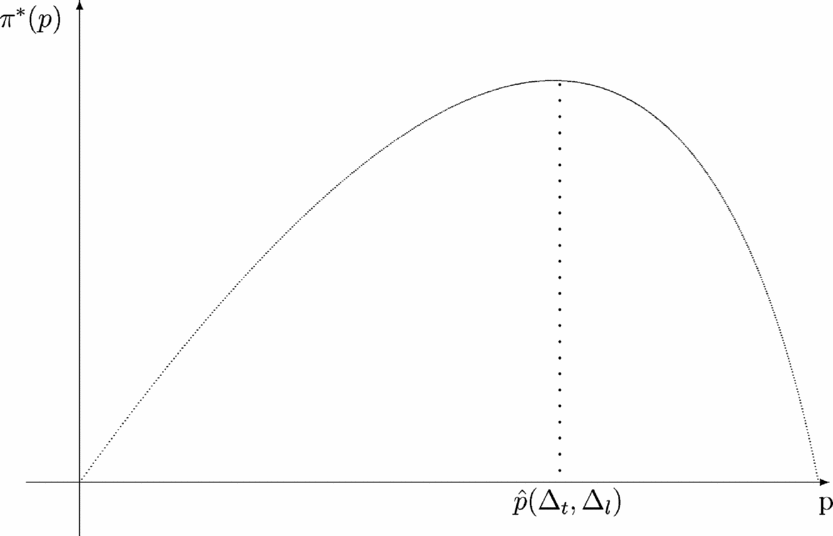
Proposition 5. There is a threshold  (Δt, Δl) such that π*(p) increases in p for p ∈(0, (Δt, Δl)) and decreases in p for p ∈((Δt, Δl), 1). The threshold (Δt, Δl) decreases in both Δt and Δl.
Proof. See Appendix.
Figure 7 illustrates this relationship.Footnote 6
Recall Proposition 3, which states that reducing the level of privacy protections can increase or decrease the equilibrium probability of a terrorist attack. One possible criticism of it might be that, regardless of the functional forms, a reduction in privacy will not increase the probability of a terrorist attack when privacy protections are already at high levels. If this intuition were true, my analysis, although theoretically sound, would not necessarily apply to Western liberal societies, which rank highest of all countries with respect to civil liberty protections. Indeed, some scholars have argued that liberal societies were protecting civil liberties too much while they were too stringent in their limits on government surveillance powers. For example, William Stunz writes, “Secret government snooping sounds Orwellian. But Orwell guessed wrong about some things. Today, the danger that American democracy faces is not that rulers will know too much about those they rule, nor that too many decisions will be made without public scrutiny. Another danger looms larger: that effective, active government—government that innovates, that protects people who need protecting, that acts aggressively when action is needed—is dying. Privacy and transparency are the diseases. We need to find a vaccine, and soon.”Footnote 7
However, Figure 7 shows that this type of criticism is not valid. In the context of this parametric model, the probability of a terrorist attack increases in the level of privacy when privacy is at low levels and decreases in the level of privacy when privacy is at high levels. The equilibrium probability of a terrorist attack is most likely to increase when societies with high levels of existing privacy protections reduce them.
Also, the threshold (Δt, Δl) decreases in both Δt and Δl. In other words, whenever either Δt or Δl increase, the range of values of p for which the equilibrium probability of a terrorist attack increases with a reduction in privacy expands. Recall that Δl represents the antiterrorist agency's utility gain if a terrorist attack is prevented; therefore, we can think of Δl as the antiterrorist agency's stake for terrorism prevention. Also, Δt represents the terrorist organization's utility gain if a terrorist attack occurs; therefore, we can think of Δt as the terrorist organization's stake for terrorism occurrence.
This latter result also speaks to the conditions under which reducing privacy increases the terrorist threat. In general, the threat of terrorism extends across a wide spectrum, from attacks causing little in the way of injury or damage, to large-scale incidents. Undoubtedly, the antiterrorist agency's stakes in terrorism prevention and the terrorist organization's stakes in terrorism occurrence are highest in the case of large-scale terrorist attacks. Because these type of attacks cause national-scale outcomes, governments have focused their efforts on seeking to prevent them in the aftermath of 9/11. To this end, privacy protections were reduced precisely to minimize the threat of catastrophic terrorism. The preceding result shows that the probability of a terrorist attack is more likely to increase when societies reduce privacy for the purpose of preventing catastrophic terrorist attacks.
THE PUBLIC INTEREST
Proposition 4 shows that the antiterrorist agency prefers diminished privacy, including when such reduction harms security from terrorism. It suggests that there can be a conflict between the agency's interests and the objective of national safety from terrorism. In this section, I argue more generally that diminished privacy (in the context of terrorism prevention) is not necessarily in the public's interest.
This task requires specifying how the agency's utility function differs from that of the public. The primary reason that the utility functions of agencies and citizens differ arises from the importance that citizens place on restrictions of government surveillance powers. Like enforcement agencies, ordinary people consider security from terrorism a crucially important social objective, but one that must be balanced with the right to privacy from government intrusion, a foundational right that underpins other civil rights and liberties on which liberal societies are founded (Regan Reference Regan1995; Solove Reference Solove2008). Justice Brandeis noted the value of privacy when he wrote that the framers of the Constitution “sought to protect Americans in their beliefs, their thoughts, their emotions and their sensations. They conferred, as against the Government, the right to be let alone—the most comprehensive of rights and the right most valued by civilized man.”Footnote 8 With legal restrictions on surveillance powers comes a public expectation that government must not cross some admittedly ill-defined boundary, a private space where individuals are free to think, make personal choices, and exercise their individual and democratic rights.
The proper functioning of a democracy depends above all on a vibrant civil society: citizens who are free to formulate and express their own beliefs and engage in civic activity without fear of governmental scrutiny (Holmes Reference Holmes1995). Legislation that reduces traditional privacy protections represents a threat to civil society because it places at risk values that citizens in liberal societies deem essential, such as freedom of speech, freedom to dissent, and the like (Donohue Reference Donohue2008). Expanding the circumstances under which the government can invade citizens' protected spheres without probable cause can have a chilling effect on freedom of speech and freedom of association. It can threaten people's willingness to express themselves openly and explore new ideas with others, including “questionable” others. Most fundamentally, perhaps, reducing privacy can stifle political dissent, because citizens fear reprisal by government actors.
Additional differences between the agency's and the public's utility functions can arise when we consider the various activities in which the agency engages. Many of the nonterrorist activities in which bureaucrats inevitably participate will appear as superfluous to ordinary citizens. Because within-organization diversity creates conflicts of interest, bureaucrats spend valuable time and resources trying to gain power and influence within their agency (Pfeffer Reference Pfeffer1993; Wilson Reference Wilson1989). For example, individuals lobby for pay increases, promotions, and job assignments, and whole units lobby for more resources, acceptance of their policy proposals, continuation of their programs, and abandonment of projects harmful to their interests. Milgrom and Roberts (Reference Milgrom and Roberts1988, Reference Milgrom, Roberts, Alt and Shepsle1990) argue that such influence activities are endemic to hierarchical organizations where some individuals have discretion over decisions with distributive consequences.
Antiterrorist agencies might be particularly prone to influence activities because they are, in the words of James Q. Wilson (Reference Wilson1989), “coping organizations,” organizations where outputs are not easily measurable and where individual effort for producing intelligence is unobservable (Posner Reference Posner2005). Exacerbating the problem, terrorism prevention requires spending most of the time and resources on null results. As a Federal Bureau of Investigation (FBI) agent puts it, “a lot of time we are chasing shadows.” For example, the New York Times reports that the FBI 21-member threat squad, known as Counterterrorism 6, followed 5,500 leads between 2004 and 2009, none of which foiled a specific terrorist plot.Footnote 9 And for antiterrorist agencies to foil a terrorist attack, a rare event, such outcome requires the coordination and concerted effort of many individuals and organizations. Because individual performance of intelligence work is difficult if not impossible to objectively evaluate, subjective evaluations are inevitable, inducing agents to put valuable effort into influencing their superiors' perceptions of their work (Garicano and Posner Reference Garicano and Posner2005).
Internal competition represents only one dimension of influence activities. Bureaucratic agencies also spend valuable time and resources on across-agency power struggles that pervade the corridors of government (Rourke Reference Rourke1984). These struggles take a variety of forms, including competing for resources, jurisdiction, and political access to elected officials. To this point, the turf battles among U.S. counterterrorism bureaucracies have constantly made the headlinesFootnote 10 and have been highlighted in governmental reports as a possible cause of intelligence failures. For example, the 9/11 Commission Report (National Commission 2004) and the WMD Commission report (The Commission on the Intelligence 2005) both document the turf battles between the FBI and the CIA before and after 9/11.
More generally, an extensive literature on bureaucracy discusses agency costs inherent in managing the public bureaucracy (Breton and Wintrobe Reference Breton and Wintrobe1982; Downs Reference Downs1967; Moe Reference Moe1984; Niskanen Reference Niskanen1971). In Przeworski's (Reference Przeworski2003) words, “the objectives of the bureaucrats need not be the same as those of the citizens.” In the context of terrorism prevention, scholars and governmental reports have documented numerous agency problems and the resulting bureaucratic inefficiencies in intelligence operations: collecting data of questionable quality, lack of coordination among collection efforts, insufficient investment in the quality of intelligence analysis, bureaucratic culture rewarding quantity over quality, a focus on short-term at the expense of long-term strategic analysis, inability to connect the dots and combine pieces of intelligence into a coherent story, and a breakdown of information sharing within and across agencies (The Commission on the Intelligence 2005; Garicano and Posner Reference Garicano and Posner2005; National Commission 2004; Posner Reference Posner2005, Reference Posner2006b; Treverton Reference Treverton2008).Footnote 11 The Washington Post has conducted a two-year long investigation into the national security buildup in the United States that followed the 9/11 terrorist attacks. Their report suggests that many counterterrorism resources have been extensively used for nonvaluable activities. This investigation extensively documents how the increase of counterterrorism resources has actually increased bureaucratic inefficiency, empire building, unnecessary overlap, and redundancies.Footnote 12
Additional distorted incentives can arise when the antiterrorist agency works on multiple issues that vary with respect to how adequately performance can be measured. In such an organization, individuals have incentives to shift their effort away from activities that may be not only more valuable to the public, but also more difficult to measure than activities where performance is easier to gauge (Holmstrom and Milgrom Reference Holmstrom and Milgrom1991; Milgrom and Roberts Reference Milgrom, Roberts, Alt and Shepsle1990). The combination of criminal-investigation and security intelligence functions in the same agency can create such perverse incentives (Garicano and Posner Reference Garicano and Posner2005; Posner Reference Posner2006b). For example, scholars and political pundits have noted the FBI's incentive to focus on criminal investigations at the expense of national security intelligence.Footnote 13 Related evidence suggests that when police are mobilized to deal with a terrorist threat, the police allocate some of these resources to fight ordinary crime. For example, Gould and Stecklov (Reference Gould and Stecklov2009) show that increased police presence on streets in the aftermath of a terrorist attack leads to a higher arrest rate for (nonterrorism-related) public crimes, such as trespassing.
Moreover, the bureaucratic literature suggests that it is difficult for an established agency to change its organizational culture and refocus its priorities (Wilson Reference Wilson1989). As a result, the preferences of the enforcement agencies and the public for what (valuable) activities ought to be pursued are not necessarily in sync when the public suddenly wants an increased focus on a new threat. Many scholars have highlighted this issue in the context of terrorism prevention (Garicano and Posner Reference Garicano and Posner2005; Hewitt Reference Hewitt2008; Zegart Reference Zegart2007). For example, Richard Posner (Reference Posner2006c) points out the difficulties of changing the FBI's traditional law enforcement culture: “No one will deny that the FBI has a distinctive culture too—and it happens to be one inimical to intelligence gathering . . . FBI agents don't like being asked to chase down clues . . . because 99 out of 100 (probably even a higher percentage) turn out to lead nowhere. That is not what they are accustomed to when they conduct criminal investigations. The agents think that they have better things to do with their time.” Likewise, Steven Hewitt (Reference Hewitt2008) notes the challenges of refocusing the MI6 from fighting IRA terrorism to fighting Al-Qaeda: “Careers have been established and resources have been pumped into countering the IRA. Suddenly shifting to concentrate on a new target was not an easy matter. There was a familiarity that came with battling Irish republicanism for more than a century. The same cannot be said for international terrorism.”
Because of the agency problems discussed previously, the antiterrorist agency's (opportunity) cost for terrorism prevention is generally higher than that of the public. Given these differences, suppose that the public's utility (evaluated at the equilibrium actions) is

where cS(⋅) represents the public's (opportunity) cost for terrorism preventionFootnote 14 and BS(p) represents the social benefits associated with privacy protections.Footnote 15 If we compare Equation (10) with Equation (15), we can see that the public's and the agency's optimal levels of privacy protections differ. Because privacy protections have social benefits, there are situations in which diminished privacy (in the context of terrorism prevention) is not in the public's interest. Moreover, when e*(p) increases in p, the preference divergence (over the level of privacy protections) increases. This is the case because changes in the level of privacy protections that work through changing the agency's equilibrium action have (negative) effects on the public's utility.Footnote 16
OTHER APPLICATIONS
Within the context of terrorism prevention, the analysis applies to civil liberties other than privacy. For example, liberal democracies have imposed new restrictions or tightened existing restrictions on (terrorism-related) radical speech.Footnote 17 The rationale for these policies is to criminalize what almost everyone believes to be a root cause of terrorism: hate speech that asserts that killing is morally justified to further a religious, political, or ethnic cause.Footnote 18 In other words, the indoctrination resulting from terrorist speech helps transform radicalized individuals into active terrorists and thus provokes terrorist violence. For example, in the UK, the Terrorism Act of 2006 introduced a number of new offenses, including “direct or indirect encouragement or other inducement” of terrorism.
The game-theoretic analysis suggests that restricting radical (terrorism-related) speech might not achieve the intended security benefits, even though enforcement agencies prefer such restrictions. The simplest way to analyze the effect of restricting (terrorism-related) speech in the context of the previous game is to assume that the level of radical (terrorism-related) speech, f(r), depends on the level of (legal) restrictions on radical speech, r, in the following way: more restrictions decrease the level of terrorist speech. In turn, the level of terrorist speech affects potential terrorists' preference for terrorist occurrence, i.e., Δt(f(r)); thus, more restrictions on terrorist speech decrease the potential terrorists' preference for terrorism occurrence. Given these changes, the game-theoretic analysis and the results are exactly the same as presented previously: the probability of a terrorist attack can increase if we put more restrictions on terrorist speech, and the enforcement agencies prefer more restrictions on radical speech even if such restrictions harm security from terrorism.
The same logic applies to imposing restrictions on freedom of association in order to deter terrorist activity, such as laws prohibiting material support for terrorism and terrorist organizations. For example, sections of the Patriot Act increased penalties and expanded the definition of material support for terrorism to include providing expert advice and assistance.Footnote 19
The analysis applies to preventing other crimes that may share similarities with terrorism, such as, for example, hate crime or organized crime. In fact, the game-theoretic results can be obtained in a more general model of harm prevention. Suppose we are interested in achieving a social objective O(e, a) (a level of security from a certain harm). The level of the desired social outcome increases if governmental agencies increase their level of intelligence effort e aimed at detecting crime planning activity and decreases if the criminal organizations increase their level of crime planning activities a.Footnote 20 The enforcement agency's utility function, Ul(O(e, a), p), increases in O(⋅), and the criminal organization's utility function, Uc(O(e, a), p), decreases in O(⋅). If we can manipulate a variable p that negatively affects the criminals' incentives,Footnote 21 then we obtain the results from the previous analysis: (1) the equilibrium outcome, O(e*(p),a*(p)), can increase or decrease with such a change in p; and (2) the enforcement agency prefers changing p even when it harms O(e*(p),a*(p)).
DISCUSSION AND CONCLUSIONS
The dominant paradigm that shapes how we think about antiterrorism policies posits a fundamental trade-off between civil liberties and security from terrorism. In this framework, reducing privacy protections is necessary to reduce terrorism. This paradigm presumes that reducing privacy is effective in reducing terrorism, and the only remaining question is whether privacy interests outweigh security gains. Yet, starting the debate on these grounds tilts the balance in favor of security measures from the outset and places the burden of proof on opponents of privacy-reducing policies who must show high social benefits of maintaining privacy protections. Simultaneously, the assumption that reduced privacy increases security from terrorism advantages the executive, who can rhetorically couch antiterrorism measures in terms of patriotism. Because no one wants to be considered responsible for the failure to stop a future attack, especially given the possible use of nuclear or biological weapons, privacy-reducing policies pass through legislature with little or no opposition in the aftermath of a terrorist attack.
The analysis presented in this article shows that reducing privacy does not necessarily increase security from terrorism. Accounting for strategic interactions reveals that there could be situations in which decreasing privacy reduces security from terrorism. This possibility questions the policy rationale for reducing privacy protections on its own terms. At minimum, the analysis suggests that, before discussing how to balance privacy protections and security from terrorism, scholars and practitioners need to analyze whether the reduction in civil liberties achieves the intended security benefit and, perhaps, whether such a benefit can be achieved in a way that does not infringe on civil liberties.Footnote 22
Moreover, reducing privacy protections renders it difficult to assess whether such measures actually worked to prevent terrorist attacks. The absence of a terrorist attack does not logically imply effective measures. At minimum, reliable data on the number of foiled terrorist plots would be necessary. However, because executive agencies have an interest in exaggerating their successes, accurate statistics on the number of prevented attacks might not be forthcoming. And even with such reliable information, it would be folly to conclude that reduced privacy protections actually foiled the plots. To analyze the causal relationship between privacy protections and the likelihood of a terrorist attack would require a comparison of two worlds, one with reduced privacy and one without. Of course, such a comparison is extremely difficult; at any point in time, a country has or has not reduced privacy. And even if somehow we have reliable cross-country observational data on foiled terrorist plots, this comparison would pose further difficulties because countries alter a score of policies in the aftermath of terrorist attacks, not just the level of privacy protections. For example, liberal societies have adopted various terror prevention policies: counterterrorism budgets have been increased, the counterterrorism bureaucracy has been reorganized, and new antiterrorist agencies have been created, to name but a few policy changes enacted simultaneously with changes in privacy protections.
The empirical difficulty of assessing whether reducing privacy is effective in preventing large-scale terrorist attacks serves the policy interests of executive officials: if a terrorist attack is absent, then they can argue that privacy-reducing measures are effective, and if a terrorist attack occurs, then they can argue that their surveillance powers were not sufficient to prevent the attack and ask for new powers. In this context, a game-theoretic analysis has further relevance because it facilitates analyzing how the probability of a terrorist attack varies when the level of privacy protections changes, keeping everything else constant.
More important, the analysis shows that the executive agencies in charge of terrorism prevention prefer to reduce privacy protections even when such a reduction reduces security from terrorism. The presence of this strategic bias, currently absent from public debate, raises three crucial matters. First, it suggests that it may not be desirable to allow those executive officials responsible for terrorism prevention to also craft antiterrorism legislation. Exacerbating the problem, situations of emergency, such as the aftermath of a terrorist attack, afford executive agencies opportunities to draft measures and pass policies that were not attainable in normal times. For example, Congress rejected the inclusion of roving wiretaps in the 1996 Anti-terrorism and Effective Penalty Act; however, the roving wiretaps were included in the 2001 Patriot Act. Similarly, the FBI introduced delayed notice search warrants into antidrug bills and also attached them to a bankruptcy bill before 9/11, but Congress rejected these efforts (Donohue Reference Donohue2008). In striking contrast, the 2001 Patriot Act legalized the use of delayed notice search warrants.
Second, the assumption underlying emergency measures is that once the threat passes, civil liberties restrictions will be undone. However, the executive's strategic bias creates an institutional interest to maintain them on the books after the perceived threat diminishes. Anecdotal evidence supports this implication. For example, in the UK, the Terrorist Act of 1974 was enacted as a temporary measure in response to the IRA bombing campaigns of the early 1970s.Footnote 23 The act was rewritten in 1976 and 1984, and then again in 1989, but always as emergency “temporary” powers (Walker Reference Walker1992). The Terrorism Prevention Act of 2000 made them permanent.
Finally, legal scholars often argue that there should be a high level of judicial deference to the executive on matters of security policy in times of emergency. Judge Richard Posner (Reference Posner2006a) asserts that judges should give the executive branch considerable deference when it comes to assessing the security measures it proposes. Likewise, Eric Posner and Adrian Vermeule (2007) write, “The executive branch, not Congress or the judicial branch, should make the tradeoff between security and liberty.” However, the result here shows that enforcement agencies have incentive to push for decreased privacy protections even when such a shift diminishes security from terrorism. The presence of this strategic bias suggests that judges should perhaps be less deferential to the expertise of the executive on terrorism matters.
APPENDIX
Proof of Proposition 2. The unique pure strategy equilibrium (e*, a*) is the solution to the following system of equations:


The Inada conditions on the cost functions ensure that the equilibrium actions are interior. Because both Equations (16) and (17) are continuous in p, the antiterrorist agency's and the terrorist organization's best response functions are continuous in p, and we can apply the implicit function theorem to see how the equilibrium actions vary with an increase in p. The dependence of (e*(p), a*(p)) on p is found by totally differentiating Equations (16) and (17) with respect to p, which yields the following system of equations:


We can write the above system of equation in matrix form:

Denote  and
 . The determinant of the above coefficient matrix is nonsingular because
 . Thus, we can invert the coefficient matrix and solve for
 and
 explicitly to obtain

Solving the preceding matrix and replacing M and N with the original values, we get

The denominator is positive. The numerator is positive if  , which is condition (9) in the text.
Also, we have

The denominator and numerator are both positive, and, as a result, the equilibrium level of a (always) increases with an increase in p.
Proof of Proposition 3. The equilibrium probability of a terrorist attack is π(e*(p),a*(p)). How a decrease in p affects the probability of a terrorist attack is given by the sign of the following expression:

The first term of Equation (24) is always positive, whereas the second term is either positive or negative depending on whether e*(p) increases or decreases with a decrease in p. As a result, the effect of a decrease in p on π(e*(p),a*(p)) is ambiguous.
Proof of Proposition 4. The antiterrorist agency's equilibrium payoff is

Using the envelope theorem, the effect of a decrease in p on the antiterrorist agency's equilibrium expected payoff is given by the sign of the following expression:

The sign of right-hand side of Equation (26) is negative because both  and
 . As a result, the antiterrorist agency's equilibrium expected payoff strictly increases with a decrease in p.
Proof of Proposition 5. Let

Denote the maximizer of π by p*. The maximizer of π(p) is the same as the maximizer of ln(π(p)). Therefore, differentiating ln(π(p)) with respect to p gives

as the condition that determines p*. Equation (28) is equivalent to

Because p 2(1 − p) > 0, (2 − 3p)ΔtΔl < 0, which implies that p* > 2/3. Also, the second-order condition is −3ΔtΔl + 2p − 3p 2 < 0 for p < 2/3. Therefore, p* is a maximum. Applying the implicit function theorem to Equation (29) gives

Both the numerator and the denominator are negative for p < 2/3, which implies that  and
 , as claimed.
 . Then, the threshold is
 for the same level of e. A specific implementation is cS(e, p) = α cl(e, p) where α ∈ (0, 1); that is, the public's cost is a fraction of the agency's cost.
 .
 , then the term
 when e*(p) > 0.
 .
 .



Comments
No Comments have been published for this article.