INTRODUCTION
There is increasing evidence that a combination of climatic factors and human-induced change within the marine environment is increasing the prominence of jellyfish abundances from a number of locations worldwide (Mills, Reference Mills2001; Hays et al., Reference Hays, Richardson and Robinson2005). For example, in the Bering Sea the biomass of jellyfish increased more than 10-fold during the 1990s (Brodeur et al., Reference Brodeur, Sugisaki and Hunt2002), although a subsequent reversal has occurred since 2000 despite further climatic warming (Purcell, Reference Purcell2005), whilst in the Benguela upwelling system jellyfish biomass (12.2 million tonnes) now exceeds the abundance of once-abundant fish (3.6 million tonnes) (Lynam et al., Reference Lynam, Gibbons, Axelsen, Sparks, Coetzee, Heywood and Brierley2006). Jellyfish populations may be increasing in biomass at existing sites, undergoing range expansions into new areas and in addition non-native invasive species may proliferate, with all these processes contributing to overall increases in jellyfish prevalence (Mills, Reference Mills2001). However, identifying these various scenarios is often hampered by inadequate information on spatial patterns of abundance and in particular the absence of historic data. Often old reports of jellyfish blooms are scattered in the literature and, as a result, the ecological importance of jellyfish within particular environments is often grossly underestimated (Mills, Reference Mills2001).
Recent studies in the Irish Sea have used a variety of approaches to assess patterns of jellyfish abundance, including visual surveys from ships of opportunity (Doyle et al., Reference Doyle, Houghton, Buckley, Hays and Davenport2007), shoreline strandings (Houghton et al., Reference Houghton, Doyle, Lilley, Wilson, Davenport and Hays2007) and aerial surveys (Houghton et al., Reference Houghton, Doyle, Davenport and Hays2006a), (see also Purcell et al., Reference Purcell, Brown, Stokesbury, Haldorson and Shirley2000; Graham et al., Reference Graham, Martin, Felder, Asper and Perry2003). These methods have revealed species-specific patterns of distribution (Doyle et al., Reference Doyle, Houghton, Buckley, Hays and Davenport2007). For example, within the Irish Sea the lions mane jellyfish (Cyanea capillata) appears to dominate cold northern waters, whilst the barrel jellyfish Rhizostoma octopus was found in massive numbers in large shallow embayments (Houghton et al., Reference Houghton, Doyle, Davenport and Hays2006a, Reference Houghton, Doyle, Wilson, Davenport and Haysb; Doyle et al., Reference Doyle, Houghton, Buckley, Hays and Davenport2007). The large size of Rhizostoma (individuals up to 30 kg wet weight) and extent of the blooms identified in the Irish Sea (millions of individuals) suggest that this species has a large impact on the ecosystem, yet information on its wider distribution is fragmented. By drawing together data from peer-reviewed and broader public literature (dating back to 1838) we consider both temporal and spatial variations of the abundance of this species across western Europe and explore whether the high levels of abundance seen in selected sites in the Irish Sea, reflect a broader occurrence of hotspots. Further, we examine the first empirical evidence for the extent of inter-annual variability in the size of blooms and hence provide a starting point for assessing climate change impacts on this species. Finally we review the diet of this species and hence help to clarify its wider ecosystem role.
MATERIALS AND METHODS
Compiling historical reports of Rhizostoma spp. in European waters
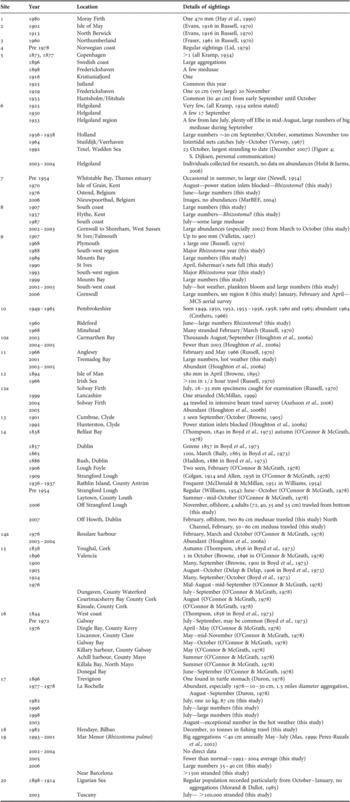
We collated historical reports of Rhizostoma spp. Local and national newspaper archives (Table 1), wildlife trust records and personal accounts supplemented peer-reviewed records from the scientific literature. The nature of many of these reports could not enable definitive abundances to be estimated for each location, but it was possible to build up a picture of the known locations for large aggregations. Rhizostoma octopus (Linnaeus) and R. pulmo (Macri) (Scyphozoa: Rhizostomeae) are closely related and frequently misidentified, with the sole difference being the number of marginal lappets around the bell, generally 8 per octant in R. pulmo and 10 in R. octopus, but up to 16 have been recorded. A possible third species, R. luteum, has also been described (Russell, Reference Russell1970) but no records were found during our investigations and the recognition of three species was questioned by Holst et al. (Reference Holst, Sötje, Tiemann and Jarms2007). Misidentification, renaming of species and genus only reports across the 180 year timescale were alleviated by pooling the two Rhizostoma species.
The recording frequency of species, such as Rhizostoma spp., is highly dependant on their effect on regional economies. The resulting data were treated at face-value as sightings, which we were unable to correct for effort, and may therefore have regional biases. Very few of the sightings, aside from recent peer-reviewed papers, should be regarded as providing any evidence for the absence of Rhizostoma spp.
Assessing inter-annual variability using aerial survey data
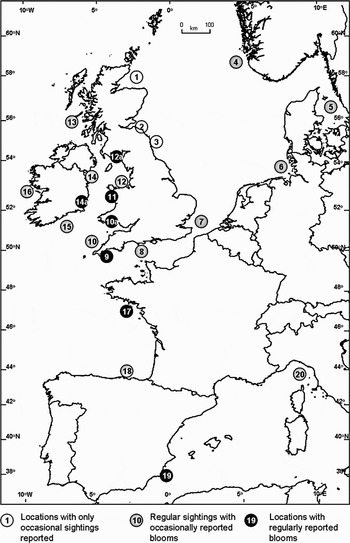
Between 2003–2005 aerial surveys of jellyfish distribution were conducted for the entire Irish Sea (Houghton et al., Reference Houghton, Doyle, Davenport and Hays2006a). Firstly, random transects were conducted across coastal and open-water areas, then once jellyfish aggregations had been identified, repeated line transects were employed over several months to assess the consistency of these features in space and time. Estimates of abundance were made using a simple visual count system with data expressed as number of individuals observed every 5 minutes. The five minute time frames translated to 7710 m2 at a constant flying speed of 185 km hr−1 and survey height of 152 m above sea level. Data were converted to abundances per 1000 m2 with standard errors calculated from these. Four key hotspots for Rhizostoma octopus were identified: (1) Carmarthen Bay (number of 1000 m2 survey points per year 2003–05 respectively = 83, 63 and 22); (2) Tremadoc Bay (N = 31, 59 and 48); (3) Rosslare harbour (N = 28, 51 and 0); and (4) Solway Firth (Figure 1; locations 10a, 11, 14a and 12a respectively); although data for the site 4 was only collected during a single year (Houghton et al., Reference Houghton, Doyle, Davenport and Hays2006a, Reference Houghton, Doyle, Wilson, Davenport and Haysb). Two-sample t-tests compared the inter-annual variance in abundance of R. octopus over three consecutive years for each of sites 1–3.
Reported occurrences of Rhizostoma spp. jellyfish in southern and western Europe from 1838–2007. Regions of rare sightings (white background), common sightings with occasional aggregations (grey), and regular aggregations (black) are highlighted.

Prey items for Rhizostoma spp
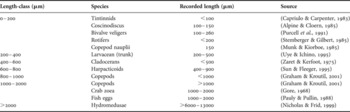
We considered gut content data from a range of previous studies. Prey size and dietary percentage was considered for five scyphozoan species: Cotylorhiza tuberculata and Rhizostoma pulmo (data obtained from Perez-Ruzafa et al., Reference Perez-Ruzafa, Gilabert, Gutierrez, Fernández, Marcos and Sabah2002); Chrysaora quinquecirrha (Purcell, Reference Purcell1992); Aurelia aurita (Hamner et al., Reference Hamner, Gilmer and Hamner1982; Sullivan et al., Reference Sullivan, Garcia and Klein-MacPhee1994; Graham & Kroutil, Reference Graham and Kroutil2001; Ishii & Tanaka, Reference Ishii and Tanaka2001; Barz & Hirche, Reference Barz and Hirche2005) and Cyanea capillata (Fancett, Reference Fancett1988; Brewer, Reference Brewer1989; Purcell, Reference Purcell2003). Dietary compositions in each study were predominantly recorded as prey abundance consumed per medusa. These values were converted to proportion of diet for each study and then averaged by species where more than one study was referred to. Prey species were commonly identified by name rather than size-class requiring establishment of size-ranges from published sources (Table 2). In the absence of definitive prey sizes, data were classified into 200 µm prey length bins up to 1000 µm to reduce errors, with larger bins for species greater than 1000 µm.
RESULTS
Historical reports of Rhizostoma spp. in European waters
Spatial and temporal records of Rhizostoma spp. reveal both irregular sightings of individual medusae and reports of large aggregations or blooms (Figure 1). Treating these two groupings separately and chronologically, individual reports from the 19th and early 20th Centuries suggest a broad, but sporadic, distribution across European waters. Pre-1900 Rhizostoma had been reported as widely as Copenhagen, the Irish Sea, around the coast of west, south and eastern Ireland and in the Bay of Biscay (see Russell, Reference Russell1970 for examples). The sole Mediterranean Sea recording, from the Ligurian Sea off north-western Italy, was reported annually particularly in autumn and winter from 1898 until 1914 (Morand & Dallot, Reference Morand and Dallot1985). Apart from this Ligurian population, the early 1900s were fairly sparsely populated with reports of Rhizostoma. Notably this period included the first couple of reports from eastern Scotland and one from western Scotland, but the reduction in frequency of records in the formerly richly recorded Irish waters may represent an overall reduction in the production of Rhizostoma spp. or may simply reflect a reduced sighting effort during this period. The 1930s saw a resurgence of reports, predominantly in the Helgoland and Kattegat regions (Kramp, Reference Kramp1934) with frequent observations from south-west Ireland in 1937–1938 (McDonald & McMillan, 1951 in Williams, Reference Williams1954). A complete absence of reports during the Second World War was followed by the first report from the Thames estuary and almost annual observations from the field station at Dale Fort in Pembrokeshire (Crothers, Reference Crothers1966). The 1960s and 1970s saw a series of observations from Ireland, a few from south-west England, the only report from Norway and the first since 1896 in the Bay of Biscay (see Table 1). Reports obtained for the last two decades of the 20th Century were predominantly focused on southern England and the Bay of Biscay with many reports of blooms rather than individuals. This pattern has continued into the 21st Century with a considerable number of reports already in the first seven years, the furthest north of these within the Irish Sea (Houghton et al., Reference Houghton, Doyle, Wilson, Davenport and Hays2006b).

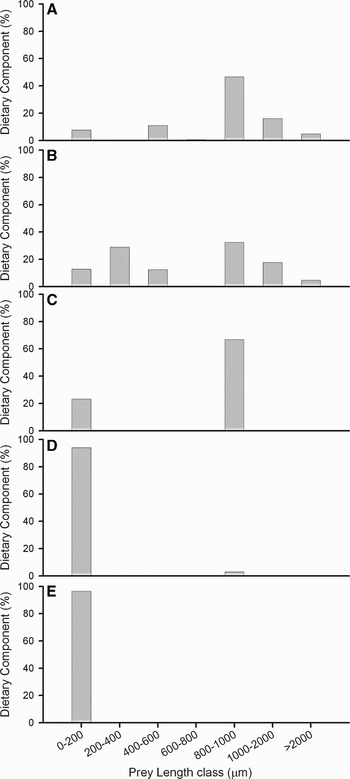
Length-class of scyphozoan prey items (Figure 3), recorded length and published source.

Taking European waters as a whole we categorized the frequency of years with large aggregations in the reporting of Rhizostoma. Table 1 summarizes these findings. Chronologically, prior to the First World War there had only been mass aggregations reported from Dublin in 1865, off the Swedish coast in 1896, south-west Ireland in 1900, and the south coast of England in 1907. Inter-war, south-west Ireland experienced a second aggregation in 1924 and the Helgoland/Jutland region of the North Sea saw blooms in 1925 and from 1936–1938, with the 1937 aggregation also spotted on the English coast. An absence of reported blooms during the 1940s and 1950s was broken in 1960 and 1968 by strandings on the south-west England peninsular and a large haul of Rhizostoma fished from the Irish Sea during 1966 (Russell, Reference Russell1970). Two records exist of European Rhizostoma blocking power stations cooling water inlets—on the Isle of Grain, Thames estuary, in 1970 and Hunterston, south-west Scotland, in 1992—illustrating the magnitude of the associated blooms and the bulk of the medusae. A report of a bloom from Belgium in 1976 was more than matched by a huge abundance that was reported spreading clockwise around the Irish coasts (O'Connor & McGrath, Reference O'Connor and McGrath1978). The following year aggregations were reported from the Bay of Biscay for the first time with further reports in 1978 and 1982 (twenty tonnes caught by a fisherman), but there was an absence of blooms further north during this period. Since the late 1980s frequent clustered reports from the English Channel have been interspersed with Bay of Biscay reports in 1996, 1998 and 2003. Of these only that in 2003 appears to have been mimicked across northern Europe with three Irish Sea embayments (Carmarthen, Tremadog and Rosslare (Houghton et al., Reference Houghton, Doyle, Davenport and Hays2006a, b)), the English Channel and the Bay of Biscay involved. In the Mediterranean, the lagoon habitat of Mar Menor saw annual blooms from 1993–2001 and again in 2006, with open sea blooms reported in 2003 (Tuscany) and 2006 (Barcelona). These reports would appear to suggest that the frequency of bloom formations has increased, especially in the late 20th Century, however an obvious absence of data during the World Wars gives some indication of the sporadic nature of sighting reports.
Assessing inter-annual variability using aerial survey data
Aerial surveys across the Irish Sea during 2003–2005 revealed four hotspot locations for Rhizostoma spp (Houghton et al., Reference Houghton, Doyle, Davenport and Hays2006a): (1) Carmarthen Bay; (2) Tremadoc Bay; (3) the Solway Firth; and (4) Rosslare harbour (Figure 1; 10a, 11, 12a and 14a). Site 3 was only identified during 2005 and was therefore excluded from inter-annual estimates.
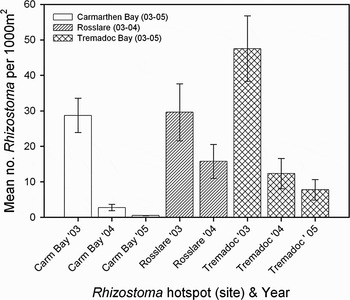
Kruskal–Wallis analysis revealed significant higher abundances during 2003 compared to other years (H1,2 = 19.32, P < 0.001 data adjusted for ties). Mann–Whitney U-tests revealed significant reductions in abundance of Rhizostoma between 2003–2004 and 2003–2005 (Figure 2) (P < 0.001 in each case) while no difference was found overall between 2004 and 2005 (P > 0.05). Within sites Kruskal–Wallis tests confirmed difference between years for Site 1 (H1,2 = 7.03, P = 0.03) and Site 2 (H1,2 = 17.63, P < 0.001), but not Site 4 (H1,2 = 3.13, P = 0.07 all results adjusted for ties). Pair-wise Mann–Whitney U-test comparisons at Site 1 found a significant reduction between 2003 and 2004 (P = 0.011) but no difference between 2005 and either year. Pair-wise comparisons at Site 2 found significant reductions from 2003 to 2004 and 2005 (P = 0.002 and 0.001 respectively) but not between the later years. In short there were significant interannual variations in R. octopus abundances with higher numbers in 2003 compared to other years.
Mean Rhizostoma octopus densities (ind/1000 m2) and associated standard errors for the three ‘hotspots’ identified in Houghton et al. (2006a). Data for three years are shown for Carmarthen Bay and Tremadoc Bay and two years (2003–2004) for Rosslare harbour. Estimates are based only on survey effort within the three bays.

Prey items for Rhizostoma spp
The two species present in the coastal lagoon of Mar Menor in Región de Murcia, Spain, R. pulmo and Cotylorhiza tuberculata, consume distinctly different size prey compared to other commonly studied scyphozoan species. In Mar Menor the predominant species preyed upon were the diatoms Asterionella and Coscinodiscus (Perez-Ruzafa et al., Reference Perez-Ruzafa, Gilabert, Gutierrez, Fernández, Marcos and Sabah2002), <200 µm size-class (Figure 3), with tintinnids and veligers also forming significant components. Copepods made up 0.5% and 3.17% of the diets respectively. Aurelia aurita, C. quinquecirrha and C. capillata were all found to consume a diverse mix of larvaceans (200–400 µm trunk length), copepods (800–1000 µm and 1000–2000 µm), cladocerans species such as Bosmina (400–600 µm) and fish eggs (1000–2000 µm) among other prey.
Prey length and dietary percentage for five scyphozoan jellyfish extracted from published gut contents studies. Data for Aurelia aurita (a), Cyanea capillata (b) and Chrysaora quinquecirrha (c) were averaged from published data. Cotylorhiza tuberculata (d) and Rhizostoma pulmo (e) data were reproduced from Perez-Ruzafa et al. (Reference Perez-Ruzafa, Gilabert, Gutierrez, Fernández, Marcos and Sabah2002); Chrysaora quinquecirrha data were averaged from populations described in Purcell (Reference Purcell1992); Aurelia aurita data were averaged from Sullivan et al. (Reference Sullivan, Garcia and Klein-MacPhee1994), Graham & Kroutil (Reference Graham and Kroutil2001), Ishii & Tanaka (Reference Ishii and Tanaka2001), Barz & Hirche (Reference Barz and Hirche2005) and Hamner et al. (Reference Hamner, Gilmer and Hamner1982); and Cyanea capillata data from Brewer (Reference Brewer1989), Fancett (Reference Fancett1988) and Purcell (Reference Purcell2003).

DISCUSSION
Compiling historical reports of Rhizostoma spp. in European waters
Our assessment suggests that blooms of Rhizostoma are widespread across Europe. Clearly our work draws heavily on the use of data from the grey literature, which is necessitated due to absence of large scale systematic surveys of jellyfish abundance across the area of interest. The use of the grey literature can be defended here since Rhizostoma is an easy to identify genus, and due to its large size the sightings of individuals might often be a newsworthy observation. However, despite this the recording frequency will depend heavily on the effect of the medusae on regional economies, in particular fisheries and tourism, with consequential variation between seasons, regions and popularity of locations for observers. Clearly not all occurrences of Rhizostoma will be reported and so this material provides essentially information on the minimum possible occurrence of bloom locations. Similarly while the large aggregations around the Helgoland region of The Netherlands spilling into the Kattegat in 1933–1934 (Kramp, Reference Kramp1934) and encircling Ireland during 1976 (O'Connor & McGrath, Reference O'Connor and McGrath1978) were reported in the peer-reviewed literature, the scarce reports from these areas in other years, might simply reflect a lack of scientific study rather than an absence of the jellyfish themselves.
We have previously used aerial surveys to show that bloom locations for Rhizostoma are consistent from one year to another (Houghton et al., Reference Houghton, Doyle, Wilson, Davenport and Hays2006b). Based on this regional evidence we would suggest that sites across Europe where occasional blooms have been reported, most probably reflect hotspots for blooms, to varying degrees, every year but with only sporadic reporting of these events (Figure 4). This suggestion could clearly be tested by focused surveys at those sites (e.g. the north-western Mediterranean and off the Elbe estuary at Helgoland, Holland) which would be straightforward to perform using established methodologies (Purcell et al., Reference Purcell, Brown, Stokesbury, Haldorson and Shirley2000; Graham et al., Reference Graham, Martin, Felder, Asper and Perry2003; Houghton et al., Reference Houghton, Doyle, Davenport and Hays2006a).
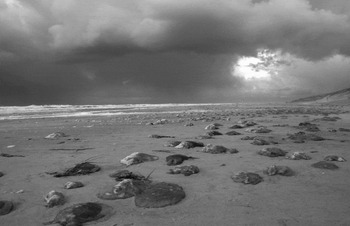
A mass stranding of Rhizostoma octopus near Paal 12, Texel, Dutch Wadden Sea on 23 October 1992. This large stranding went otherwise unrecorded (Sytske Dijksen/Foto Fitis).

Our compilation of historic records show that the recent blooms of Rhizostoma recorded in the Irish Sea reflect a broader occurrence of blooms, with hotspots also being found around La Rochelle in the Bay of Biscay, and Mar Menor, Spain. The particular conditions within these areas that are conducive to blooms of Rhizostoma are still not clear, but all these areas are semi-enclosed bay areas that receive appreciable freshwater and nutrient input from rivers. In the case of Mar Menor, the freshwater regime significantly increased post-dredging of the entrances, but is still low compared to other Mediterranean lagoons, suggesting controls such as nutrient loads may have more of an effect than hydrographic or trophic variables (Pérez-Ruzafa et al., Reference Pérez-Ruzafa, Fernández, Marcos, Quispe and García-Charton2005). Further analysis is clearly needed to pin-point the underlying reasons for why blooms occur in these areas and such work might also point the way to where other, as yet unreported blooms of Rhizostoma are to be expected.
While targeted studies have shown the Rhizostoma spp. hotspots may be consistent year-after-year, there is clearly a large degree of variability in the extent of blooms. For example, across our aerial survey data there were approximately three and nine times more R. octopus in 2003 than 2004 and 2005 respectively. However, Carmarthen Bay alone had a 478 times difference between 2003 and 2005. The processes driving this inter-annual variability are obscure. However, inter-annual variability in the abundance of jellyfish has been noted elsewhere. For example Purcell et al. (Reference Purcell, Brown, Stokesbury, Haldorson and Shirley2000) showed that the abundance of Aurelia labiata in Alaska varied by two-fold between years. Similarly a 17-year times-series of jellyfish abundance for the northern North Sea derived from fish trawl data showed that inter-annual variability in the abundance of Aurelia aurita, Cyanea capillata and C. lamarckii was correlated to the winter North Atlantic Oscillation Index (NAOI) (Lynam et al., Reference Lynam, Hay and Brierley2004, Reference Lynam, Hay and Brierley2005). Our aerial records of R. octopus revealed a matching pattern of reduced abundance between 2003 and 2005 in bays over 100 km apart. Furthermore there were reports of Rhizostoma spp. aggregations and strandings across Europe in the public press during 2003. Rhizostoma pulmo was stranded in hundreds of thousands on the shore of Tuscany, Italy (10 July 2003, Neue Zuercher Zeitung, Zurich) and ‘exceptional numbers’ in western France near La Rochelle (15 August 2003, Sud Ouest, Bordeaux) in addition to the annual abundances in Mar Menor. The implication is that broad-scale processes were affecting levels of abundance rather than site-specific processes. This finding is consistent with the proposed broad-scale changes in jellyfish and other zooplankton abundance reported by Moline et al. (Reference Moline, Claustre, Frazer, Schofield and Vernet2004), Hay (Reference Hay2006) and Lynam et al. (Reference Lynam, Gibbons, Axelsen, Sparks, Coetzee, Heywood and Brierley2006). Of interest is the fact that across Europe, 2003 was an exceptionally hot year with temperatures attaining levels predicted by climatic models for the late 21st Century (Beniston, Reference Beniston2004; Luterbacher et al., Reference Luterbacher, Dietrich, Xoplaki, Grosjean and Wanner2004; Schär & Jendritzky, Reference Schär and Jendritzky2004; Ciais et al., Reference Ciais, Reichstein, Viovy, Granier, Ogee, Allard, Aubinet, Buchmann, Bernhofer and Carrara2005) with widespread implications for species distributions (e.g. Battisti et al., Reference Battisti, Stastny, Buffo and Larsson2006; Jiguet et al., Reference Jiguet, Julliard, Thomas, Dehorter, Newson and Couvet2006; Mouthon & Daufresne, Reference Mouthon and Daufresne2006). With high abundances of Rhizostoma spp. correlating with the high temperatures in Europe we speculate that warmer summers will lead to increasing Rhizostoma blooms.
The lifecycle of R. octopus was published by Holst et al. (Reference Holst, Sötje, Tiemann and Jarms2007) from cultures maintained within the laboratory providing, for the first time, clear images of the 2 mm size of the polyps. The authors specified a decrease in temperature from 15°C to 10°C or rises from 5–10°C or 10–15°C was required to stimulate strobilation of the polyps. For R. octopus these temperatures would provide a reproductive range across northern Europe. However, for the predominantly southern European species R. pulmo, if water temperature is the key stimuli to strobilation as hypothesized by Pérez-Ruzafa (Reference Perez-Ruzafa1997 cited in Kingsford et al., Reference Kingsford, Pitt and Gillanders2000) the temperatures at which strobilation is stimulated are likely to be higher. A further study utilized ephyrae to settle on the undersides of substrates and a preference for plastic compared to other natural and anthropogenic materials tested (Holst & Jarms, Reference Holst and Jarms2006). However, neither of these studies identified locations or typical substrates where the polyp stages could be found in the natural environment. This lack of information on the polyp stage of free-living individuals remains a key stumbling block to explain spatio-temporal patterns of occurrence for Rhizostoma.
Prey items for Rhizostoma spp
Gelatinous zooplankton aggregations form predominantly mono-species aggregations (Mills, Reference Mills2001) resulting from the variability of prey and the conditions required for population increases. Most species of jellyfish employ banks of nematocysts in tentacles for capturing planktonic prey. The scyphozoan Rhizostoma spp., by contrast, does not possess long trailing tentacles, but filters prey through a mass of eight oral arms hanging below the bell. Perez-Ruzafa et al. (Reference Perez-Ruzafa, Gilabert, Gutierrez, Fernández, Marcos and Sabah2002) provided gut contents measurements for R. pulmo in Mar Menor, Spain. Their data would indicate a predominantly small-size phytoplanktonic diet, contrasting with the zooplankton dominated diet of A. aurita, C. quinquecirrha and C. capillata (Figure 3). The jellyfish abundance of Mar Menor correlated well with increased diatom abundances and nitrate levels (Perez-Ruzafa et al., Reference Perez-Ruzafa, Gilabert, Gutierrez, Fernández, Marcos and Sabah2002) from 1993–2006 (few R. pulmo were present during 2005; Table 1).
Perez Ruzafa et al. (2002) also highlighted the regular location of R. pulmo aggregations in the south-western part of the lagoon closest to the freshwater (and nutrient) inflows. The phytoplankton standing stock, varied by season, was particularly dominated by diatoms (Cyclotella, Chaetoceros and Nitzschia spp.) between spring and autumn, thereby apparently forming a large part of the medusa's diet. It is this standing stock caused by the regular nutrient input and warm shallow waters (Gilabert, Reference Gilabert2001) that is most likely to be the driving factor behind the regular abundances of Rhizostoma in Mar Menor. The dietary consumption of species is important for calculating the impact of gelatinous zooplankton on the ecosystem as a whole. Studies have suggested that jellyfish may be an important conduit for energy flow through marine systems (Lucas et al., Reference Lucas, Hirst and Williams1997). Ultimately the ecosystem role of jellyfish may be better understood by parameterizing jellyfish within ecosystem models. This parameterization will require information on levels of abundance but also jellyfish prey and rate processes such as ingestion.
ACKNOWLEDGEMENTS
M.K.S.L. was supported by a studentship from the Natural Environment Research Council of the UK (NERC). J.D.R.H. and G.C.H. were supported by a NERC Urgency grant. Thanks also to two anonymous referees for their constructive criticism in improving the final manuscript.