Introduction
Chinese citrus fly, Bactrocera minax (Enderlein) (Diptera: Tephritidae), is a destructive herbivorous insect of citrus, Citrus L. (Rutaceae). The host range is mostly restricted to wild and cultivated species of citrus (Allwood et al. Reference Allwood, Chinajariyawong, Drew, Hamacek, Hancock and Hengsawad1999). Geographically restricted to Asia, citrus fly is a quarantine pest in many countries around the world (Wang and Luo Reference Wallin and Ekbom1995; Ladaniya Reference Hall and Hadfield2008). In spite of the importance of the pest, its basic biology (Zhang Reference Yang, Carey and Dowell1989; Yang et al. Reference Wikelski, Moskowitz, Adelman, Cochran, Wilcove and May1994; Wang and Luo Reference Wallin and Ekbom1995) is poorly known and control methods are relatively ineffective (Wang et al. Reference Wang and Zhang1990; Wang and Zhang Reference Wang and Luo1993; Drew et al. Reference Drew, Dorji, Romig and Loday2005).

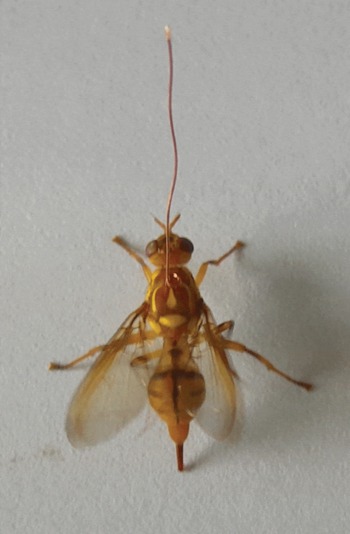
The adult is a relatively large fruit fly with a body length of 10–13.2 mm and a wing span of 20–24 mm (Chen and Xie Reference Chen and Xie1955) with a univoltine life-cycle (van Schoubroeck 1999; Dorji et al. Reference Dorji, Clarke, Drew, Fletcher, Loday and Mahat2006). Adults emerge in early May and eggs are laid in citrus fruit in July. Maggots feed on fruit causing the fruit to ripen prematurely and drop to the soil where the flies pupate (van Schoubroeck 1999). Fruit loss commonly reaches 20%–30% and may reach 70%–100% (Zhang and Zhang Reference Zhang2005). Chinese citrus flies can walk and start feeding on the 1st or 2nd day after emergence and can fly on the 2nd or 3rd day. Adults apparently do not feed in citrus orchards but must walk or fly to low-growing shrubs or trees near the orchards where they probably feed on aphid honeydew (Wang and Luo Reference Wallin and Ekbom1995). Mated females (Lu et al. Reference Ladaniya1997) fly repeatedly within and between citrus orchards (Wang and Luo Reference Wallin and Ekbom1995) to lay their eggs.
Traditional visual sampling and tracking methods have provided a very limited understanding of the pest's dispersal ecology and behaviour. Newly developed radar tracking and telemetric methods (Riley and Smith Reference Reynolds, Smith, Reynolds, Carreck and Osborne2002; Colpitts and Boiteau Reference Colpitts and Boiteau2004) are proving useful to study foraging of invertebrates and other organisms and have provided new insights on the dispersal of various species (Reynolds et al. Reference Ovaskainen, Smith, Osborne, Reynolds, Carreck and Martin2007; Ovaskainen et al. Reference O'Neal, Landis, Rothwell, Kempel and Reinhard2008; Niitepold et al. Reference Mascanzoni and Wallin2009; Gui et al. Reference Gui, Boiteau, Colpitts, MacKinley and McCarthy2011). Harmonic radar tracking could be useful for measuring the dispersal of Chinese citrus fly within and between host plants, especially during the first few days after emergence, when adults must travel to low-growing shrubs or trees near the orchards.
Harmonic radar systems track insects by using a high power microwave source aimed at the insect to energize a dipole antenna (tag) attached to its body and recapture the second harmonic of the incidental signal reradiated from the tag (Colpitts and Boiteau Reference Colpitts and Boiteau2004). The movements of the insect can be tracked through this exchange of signals between the microwave source and the tagged insect. Various systems have been developed, but all require the attachment of tags to individual insects (Riley and Smith Reference Reynolds, Smith, Reynolds, Carreck and Osborne2002). Tags must be very small and lightweight (Boiteau et al. Reference Boiteau, Vincent, Meloche, Leskey and Colpitts2010) so that they do not alter normal flying or walking movements of insects (Riley et al. Reference Riley and Smith1996; O'Neal et al. Reference Niitepold, Smith, Osborne, Reynolds, Carreck and Martin2004; Boiteau et al. Reference Boiteau, Vincent, Meloche, Leskey and Colpitts2011a, Reference Boiteau, Vincent, Meloche, Leskey and Colpitts2011b).
As with any other method, quality of collected data depends on maximal efficacy of the harmonic radar technology and minimal impact of it on parameters being measured. Therefore it is important to measure impact of tag loads and attachment methods on the activities of target insects before committing to the use of the technology. The objective of this study was to determine, before committing to operational implementation of the method, if currently available tracking tags have a detrimental effect upon walking, flight, and life-sustaining activities (such as feeding) of Chinese citrus fly.
We carried out a series of tests to determine the suitability of dipole tags of the type used by Colpitts and Boiteau (Reference Colpitts and Boiteau2004). Weight of individual flies was determined because the suitability of tracking tags is often related to the weight of the insect and tags might have to be adapted to weight differences between sexes. Tag retention time and mortality of tagged flies were assessed to determine if insects remained tagged and survived over a sufficiently long period of time for operational tracking. Tag retention times can vary among species (Boiteau et al. Reference Boiteau, Meloche, Vincent and Leskey2009; Hall and Hadfield Reference Hagler and Jackson2009), and adhesives used to mount tags on insects could have toxic effects (Boiteau et al. Reference Boiteau, Meloche, Vincent and Leskey2009). The possible negative effect of the additional weight and structure (nuisance factor) on basic life activities was tested by comparing the feeding times of tagged and untagged flies. Finally, the possible impact of tags on fly mobility was assessed by comparing flight takeoff frequency and climbing ability of male and female flies of different ages with and without tags.
Materials and methods
Insects
The tests were conducted in June 2010 using adult B. minax originating from overwintered pupae collected from orchards at Yichang, Hubei, China (approximately 30°41′N, 111°17′E), on 15 May 2010. Pupae and adults were kept in a growth chamber at 25°C (day) and 20°C (night), 65% RH, and 14L:10D. Adults were provided with 2 cm × 2 cm filter papers dipped in 10% honey water as a source of food and water. Insects were housed in cages (35 cm × 35 cm × 35 cm) covered with white nylon gauze (2 mm mesh size) kept moist with a gentle water spray three or four times each day. Adults were sexed at emergence and kept thereafter in separate cages following Chen and Xie (Reference Chen and Xie1955).
Electronic tags
Tags, similar to those of Colpitts and Boiteau (Reference Colpitts and Boiteau2004), were custom made in the laboratory from a length of AWG #34 copper wire wound around a mandrel to yield a 1.0 mm diameter loop. Each wire was cut to form a 2 mm proximal pole and a 13, 16, or 18 mm distal pole on opposite sides of the loop. The tags weighed 2.7, 3.2, and 3.5 mg, respectively. The weight of the diodes (<0.1 mg), normally welded to the loop, was considered negligible and, to reduce experiment costs, diodes were not added to the tags.
The lightest tag was only used in the tag retention test. The other two tag weights were used in all tests except for the climbing tests where only the heaviest tag was used. Tags are referred to by their weight throughout the manuscript although it is recognized that tag length varied with weight and may itself have had an impact on behaviour (Boiteau et al. Reference Boiteau, Vincent, Meloche and Leskey2010). The proximal end of each tag was attached vertically to the pronotum of a fly using 0.3 mg of Instant Krazy Glue (>70% ethyl-2-cyanoacrylate by weight, Elmer's Product Canada, Scarborough, Ontario). To compare effects of adhesives, in one test some tags were attached to flies with a similar amount of Loctite 495 (>60% methyl-2-cyanoacrylate by weight, Henkel Loctite Co. Ltd., Shenzhen, Guangdong, China).
Adult flies were anaesthetized individually by gently placing each in a 2.5 cm × 20 cm closed glass vial containing a cotton swab treated with 1 or 2 drops of absolute ethyl ether (AR, Sinopharm Chemical Reagent Co. Ltd., Beijing). Flies were taken out of the vials after 1 min and tags were then attached according to the treatments. Flies awakened in 15 min or less after anesthesia and were used in experiments or returned to the growth chamber in white nylon gauze cages depending on the test.
Body weight
Adult overall body weight and change in weight over time were determined in the laboratory (25°C and 65% RH) using two groups of Chinese citrus flies (20 males and 26 females; 29 males and 29 females; respectively). Flies were collected from the greenhouse colony within 24 h of emergence and brought to the laboratory in individual preweighed glass vials. Insects were kept without water for 1 h before weighing. All insects were weighed between 0900 and 1000 and returned to the greenhouse where they were kept in four separate cages. Measurements were stopped on day 15 when mortality was approaching 50% (44% and 45% for tests 1 and 2, respectively). The number of living flies did not drop below 11 in any group on any given day. A one-way multiple-factor analysis of variance (ANOVA) corrected for age (by using age as a random factor in the regression analysis) was used to compare the mean body weight of male and female flies (SAS Institute Inc. Reference Riley, Smith, Reynolds, Edwards, Osborne and Williams2001).
Tag retention and fly survival
Resilience of tag attachment and potential for adhesive-related mortality of flies were assessed by recording tag retention of tagged fruit flies daily (0800–0900) and survival over a period of 5 days. There were eight treatments made up of two factors (4 tag weights (3.8, 3.5, 3.0, and 0 mg (no tag, no glue)) × 2 types of glue). Each treatment was applied to 10 male and 10 female 3-day-old citrus flies. We recorded the percentage of radar tags that had become detached after 1 day and 5 days, and the percentage of flies surviving a period of 5 days. There were three replicates for a total of 480 adult flies tested. Data for sexes were pooled and the percentage calculated out of 20 flies per cell. Percentage data were transformed by arcsine of the square root and subjected to ANOVA using the model: y = tag weight + glue type + tag×glue + error (SAS Institute Inc. Reference Riley, Smith, Reynolds, Edwards, Osborne and Williams2001). Means were compared using Tukey's test.
Interference of tag with feeding
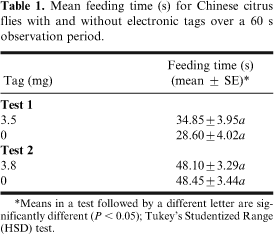
Possible interference of tags with the ability of Chinese citrus flies to feed freely was studied in the laboratory. Two tests (with 3.5 and 3.8 mg tags, respectively) compared feeding time of 10 tagged and 10 untagged 3-day-old flies of each sex (total of 40 flies). Tests were conducted in the laboratory at 25°C and 65% RH and under natural light. Flies were starved for 24 h and then released individually in wide-mouth transparent plastic bottles laid horizontally on a table. A filter paper (2 cm × 2 cm) dipped in 10% honey water was placed at the centre of each bottle; flies were released at the edge of the filter paper. Each fly was observed for 60 s; total feeding time was recorded with a stopwatch. Feeding time was defined as the time during which fly mouthparts were touching the filter paper. A two-way ANOVA (tag weight, sex) was applied to the feeding time of each test and means were compared with Tukey's test (SAS Institute Inc. Reference Riley, Smith, Reynolds, Edwards, Osborne and Williams2001).
Impact of tag weight on vertical movement
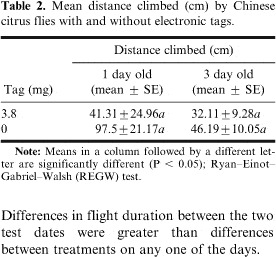
Potential impact of tag weights on mobility of Chinese citrus flies walking on vertical surfaces was assessed in the laboratory. There were two tag treatments (one weight and one control; 3.8–0.0 mg) for each of 1- and 3-day-old flies of each sex for a total of eight treatments. One-day-old citrus flies are just acquiring the ability to walk; whereas, 3-day-old flies have acquired full walking ability. The treatments were replicated 10 times for a total of 80 flies. All tests were conducted within the same day in the laboratory at 25°C and 65% RH and under natural light.
Flies were released individually in a wide-mouth transparent plastic bottle (8.0 cm diameter, 14.0 cm height) with marks every 2 cm along the vertical axis. A small hole in the bottle bottom provided aeration. The bottle was inverted on the table and the fly shaken down to the surface. Most flies started climbing almost immediately and total vertical distance traveled (upward and downward) was recorded. Flies were released at intervals of 5 min. If an individual had not started climbing 1 min after release, the bottle was rocked gently for a few seconds to encourage movement but otherwise was left undisturbed. Bottles were washed between each use with anhydrous alcohol. The effect of age (2), tag (2), and sex (2) on vertical travel by adults over the 5 min period was analyzed using the GLM procedure with interactions among factors (SAS Institute Inc. Reference Riley, Smith, Reynolds, Edwards, Osborne and Williams2001). The Ryan–Einot–Gabriel–Walsh test was used to compare means.
Impact of tag weight on flight takeoff
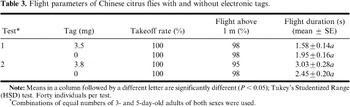
Potential impact of tag weights on frequency of flight takeoff by Chinese citrus flies was assessed in a greenhouse. Two tests (with 3.5 and 3.8 mg tags, respectively) compared flight takeoff frequency, flight duration, and height of flight of 10 tagged and 10 untagged 3-day and 5-day-old flies of each sex (total of 80 flies). Three-day-old citrus flies have just acquired the ability to fly and 5-day-old flies have full flight capacity. The tests were conducted in natural light in a large screened cage (length 3 m, width 2 m, height 2 m) at 25°C and 65% RH. The greenhouse floor consisted of an uneven soil surface with a light cover of weeds.
Flies were placed individually at the top of a vertical (3 cm × 3 cm × 100 cm) wood pole and their flight takeoff observed. Each fly was tested only once. Flies were observed until takeoff; time spent in flight between the pole and a landing point anywhere in the cage was measured with a stopwatch. Height of the landing location below or above the 1 m release point was also recorded. Three flies that had not moved after 1 min were gently touched with an artist paint brush to encourage flight. A multiple-factor analysis of variance was applied to the mean flight time and landing height after square-root transformation (SAS Institute Inc. Reference Riley, Smith, Reynolds, Edwards, Osborne and Williams2001). Means were compared using Tukey's test.
Results
Body weight
Results showed that average daily weight (± SE) of unmated female Chinese citrus flies (49.98 ± 1.06 mg, n = 15) was significantly larger (F = 19.68, df = 1,28, P = 0.0001) than that of males (43.86 ± 0.87 mg, n = 15). Mean weight of females (r = 0.290, df = 13, P >0.05) and males (r = 0.460, df = 13, P > 0.05) did not change with age.
Tag retention and fly survival
Retention time of tags mounted with Krazy Glue was significantly longer than that of tags mounted with Loctite. After 1 day, all tags attached with Krazy Glue remained in place but 27.22% ± 5.47% of those attached with Loctite had fallen off (F = 69.21, df = 1,12, P < 0.001). After 5 days, only 14.44% ± 5.28% of tags attached with Krazy Glue had fallen off but 52.78% ± 11.56% of those attached with Loctite had fallen off (F = 38.17, df = 1,12, P = 0.004).
Tag weight did not affect the percentage of tags that had fallen off after 5 days whether attached with Loctite (41.67% ± 8.82%, 50.00% ± 16.07%, and 61.67% ± 4.41% for 3.0, 3.5, and 3.8 mg tags, respectively; F = 0.136, df = 2,12, P = 0.876) or Krazy Glue (13.33% ± 7.26%, 13.33% ± 6.01%, and 16.67% ± 4.41% for 3.0, 3.5, and 3.8 mg tags, respectively; F = 0.398, df = 2,12, P = 0.654).
Fly survival after 5 days was high and similar for Loctite and Krazy Glue (94.16% ± 1.20% and 94.58% ± 1.14 %, respectively; F = 0.155, df = 1,24, P = 0.708). Among those treated with Loctite, the survival of flies with 3.0 and 3.5 mg tags (91.67% ± 3.33% each) was lower than that of flies with 3.8 mg or no tags (95.00% ± 0.00% and 98.33% ± 1.67%, respectively), but there was no similar effect among Krazy Glue treated flies.
Interference of tag with feeding
Feeding duration was not affected by sex of flies in either test (3.5 mg, F = 0.050, df = 1,36, P = 0.824; 3.8 mg, F = 0.066, df = 1,36, P = 0.800). Similarly, presence of 3.5 or 3.8 mg tags had no effect on feeding duration (F = 1.257, df = 1,36, P = 0.270; F = 0.006, df = 1,36, P = 0.938) (Table 1).
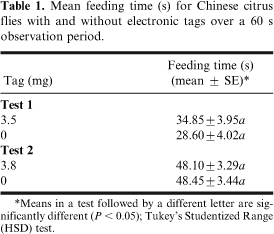
* Means in a test followed by a different letter are significantly different (P < 0.05); Tukey's Studentized Range (HSD) test.
Impact of tag weight on vertical movement
All tested flies easily climbed bottle walls (Table 2). The distance climbed was not affected by sex (F = 0.334, df = 1,72, P = 0.565) or by tag and age (F = 2.668, df = 3,72, P = 0.54) (Table 2).

Note: Means in a column followed by a different letter are significantly different (P < 0.05); Ryan–Einot–Gabriel–Walsh (REGW) test.
Impact of tag weight on flight takeoff
All tested flies, with and without tags, took off from the release post (Table 3). Only 3 of 80 tagged flies and 2 of 80 untagged flies landed below the height of the release point. Time spent in flight was similar for 3- and 5-day-old flies (F = 0.749, df = 1,114, P = 0.388) and males and females (F = 1.048, df = 1,114, P = 0.308). Average time spent in flight by tagged flies, regardless of age or sex, did not differ significantly from that of flies without tags (3.5 mg, F = 3.29, df = 1,72, P = 0.057; 3.8 mg, F = 2.714, df = 1,72, P = 0.104). Differences in flight duration between the two test dates were greater than differences between treatments on any one of the days.

Note: Means in a column followed by a different letter are significantly different (P < 0.05); Tukey's Studentized Range (HSD) test. Forty individuals per test.
* Combinations of equal numbers of 3- and 5-day-old adults of both sexes were used.
Discussion
Although cyanoacrylate glues have been used successfully to mount tags on a range of insects including Coleoptera such as Carabidae (Mascanzoni and Wallin Reference Lu, He, Yuan and Mou1986; Wallin and Ekbom Reference van Schoubroeck1988), Coccinellidae (Boiteau and Colpitts Reference Boiteau and Colpitts2004), and Curculionidae (Brazee et al. Reference Brazee, Miller, Reding, Klein, Nudd and Zhu2005; Boiteau et al. Reference Boiteau, Meloche, Vincent and Leskey2009), and Odonata (Wikelski et al. Reference Wang, Zhao, Li, Lou, Liu and Kang2006), Boiteau et al. (Reference Boiteau, Meloche, Vincent and Leskey2009) reported a high level of mortality when cyanoacrylate glues were used to attach radar tags to two species of corn rootworms, Diabrotica Chevrolat (Coleoptera: Chrysomelidae). A softer cuticle in comparison to other species was suggested as a possible cause (Boiteau et al. Reference Boiteau, Meloche, Vincent and Leskey2009). Fortunately, survival of Chinese citrus fly was high with both glues tested. However, tag retention was significantly longer with Krazy Glue than with Loctite. Using Krazy Glue, more than 80% of released flies should be expected to remain alive and tagged for harmonic radar tracking over periods of at least 5 days.
Based on our insect weight measurements (the first reported for this species, to our knowledge), electronic tags available for use (Colpitts and Boiteau Reference Colpitts and Boiteau2004) would represent up to 8.8% of average body weight of Chinese citrus flies. This is slightly above the informal “5% rule” (Hall and Hadfield Reference Hagler and Jackson2009) for a tag: bodyweight ratio that has no adverse effects on study organisms. However, data suggest that the rule is not an accurate guide and that suitable ratios should be determined independently for each species. For example, Boiteau et al. (Reference Boiteau, Vincent, Meloche and Leskey2010) observed that tags representing 14.7% of average body weight of plum curculios, Conotrachelus nenuphar (Herbst) (Coleoptera: Curculionidae), did not significantly reduce mean walking speed, but that tags representing 2.2% of the average body weight of Colorado potato beetles, Leptinotarsa decemlineata (Say) (Coleoptera: Chrysomelidae), significantly reduced mean walking speed. Tag length could also have had an impact on results but this effect is difficult to separate from that of tag weight (e.g., Boiteau et al. Reference Boiteau, Vincent, Meloche and Leskey2010).
The similar feeding time duration of tagged and untagged Chinese citrus flies suggests that the presence of tags is unlikely to affect normal behaviour of this species. The similar ability of tagged and untagged Chinese citrus flies to climb vertical structures, initiate flight, and fly upwards from (and land at or above) a release point, suggests little or no impact of up to 8.8% additional weight on their dispersal. Therefore, tags should be suitable for operational tracking of Chinese citrus flies climbing trunks and branches of shrubs or walking on horizontal surfaces.
In operational use, tag length may become an important factor because increasing length may increase opportunities for entanglement of tags in vegetation. Fortunately, tests with other species indicate that tag length is simply a nuisance factor and dispersal time lost to tag entanglement may be relatively small compared with overall time lost during normal navigation through vegetation (Boiteau et al. Reference Boiteau, Vincent, Meloche, Leskey and Colpitts2011b).
Males were about 12% lighter than female citrus flies, but this did not limit their ability to carry extra weight. Specimens of both sexes displayed similar takeoff frequency, height of flight, and ability to climb surfaces with and without tags. Therefore, it should be possible to use tags of similar length and weight to track both sexes.
In summary, the results of this laboratory study demonstrated that electronic tags were sufficiently light to allow unimpeded flight takeoff and sustained flight and can be safely mounted on Chinese citrus flies and retained for tracking periods of at least 5 days. Thus, the tags meet the properties for an ideal insect marker (Hagler and Jackson (Reference Gui, Boiteau, Colpitts, MacKinley and McCarthy2001): they are durable, inexpensive, nontoxic, and easily applied, and have no effects on normal behaviour. In operational use, entanglement in vegetation remains a possible limitation that needs to be assessed (O'Neal et al. Reference Niitepold, Smith, Osborne, Reynolds, Carreck and Martin2004). However, successful detection and recovery of similarly tagged plum curculios in an apple orchard (Boiteau et al. Reference Boiteau, Vincent, Meloche, Leskey and Colpitts2011a, Reference Boiteau, Vincent, Meloche, Leskey and Colpitts2011b) indicates a promising future for field application of this method for monitoring of Chinese citrus flies.
Acknowledgments
We acknowledge the contribution of W. Fu-Lian to the project. This study was supported by grants from Public-benefit Industry Special Foundation No.03047-3, 2009 for the Ministry of Agriculture of the People's Republic of China.