Introduction
There has been a steady increase in the number of children entering and remaining in out-of-home care over the last decade (AIHW, 2012). The majority of children who are removed from their homes and placed in care have experienced maltreatment. Maltreatment can be broadly defined as ‘all types of physical and/or emotional ill-treatment, sexual abuse, neglect, negligence and commercial or other exploitation, which results in actual or potential harm to the child's health, survival, development or dignity in the context of a relationship of responsibility, trust or power’ (World Health Organisation, 2010). The definition of maltreatment, describes the lived experiences of many children in care. Children in care continue to experience ongoing adversity in the form of placement instability and poor/unreliable access to education.
The longer term outcomes for maltreated children who enter the care system are worrying. Developmental, social and behavioural problems are prevalent in children before, during, and after leaving care (Cashmore & Paxman, Reference Cashmore and Paxman1996; Fernandez, Reference Fernandez2008). Difficulties include conduct problems and defiance, anxiety difficulties, attention disorders and attachment disturbances (The Royal Australian and New Zealand College of Psychiatrists, 2008). Approximately one quarter of care leavers report mental health difficulties at one year after leaving care (Dixon, Reference Dixon2008). Young people leaving care are less likely to be in training or education after the age of 16 (Courtney & Dworsky, Reference Courtney and Dworsky2006), to complete tertiary education (Martin & Jackson, Reference Martin and Jackson2002), and are at increased risk of entering the criminal justice system (Ryan & Testa, Reference Ryan and Testa2005). Arguably, interventions aimed at enhancing the ability of maltreated children to engage with, and benefit from, education would improve outcomes for this population (Wise, Pollock, Mitchell, Argus, & Farquhar, Reference Wise, Pollock, Mitchell, Argus and Farquhar2010).
Maltreated children consistently demonstrate lower academic attainment, are more likely to require special educational assistance, and are significantly less likely to achieve a university degree than their peers (Gilbert et al., Reference Gilbert, Widom, Browne, Fergusson, Webb and Janson2009). There are a range of factors that contribute to poor educational outcomes for children in care, including missed periods of schooling due to placement moves (Powers & Stotland, Reference Powers and Stotland2002), teacher attitudes (Vacca, Reference Vacca2007), and low caregiver educational expectations (Cheung, Lwin, & Jenkins, Reference Cheung, Lwin and Jenkins2012). Children in care may also have difficulties accessing extra-curricular activities, due to the extra financial burden these activities incur and difficulties obtaining consent from carers (Create, 2004). The educational outcomes of children in care are cause for concern.
Maximising educational opportunities is a critical intervention. Neuropsychological research can contribute to our understanding of how to support children in care. This article outlines the neuroimaging and neurocognitive research that can contribute to our understanding of the learning profiles of maltreated children. Importantly, neurocognitive and neuroimaging research can provide practitioners with a focus for strategies to ameliorate negative outcomes for children. Addressing the impaired cognitive and learning profiles of maltreated children may allow this group of vulnerable children to more easily engage with, and access, educational opportunities, which, in turn may lead to more positive outcomes for these children.
Learning profiles of maltreated children in care
Emerging research suggests that the learning profiles of children in care may contribute to poor educational engagement and outcomes. Maltreated children have significantly poorer overall global cognitive functioning (Trickett, Noll & Putnam, Reference Trickett, Noll and Putnam2011) as well as specific cognitive deficits. In particular, maltreated children are impaired on measures of executive functioning (Carrion, Garrett, Menon, Weems & Reiss, Reference Carrion, Garrett, Menon, Weems and Reiss2008; Mezzacappa, Kindlon & Earls, Reference Mezzacappa, Kindlon and Earls2001; Webster, Hackett & Joubert, Reference Webster, Hackett and Joubert2009). Executive functioning (EF) refers to a range of complex cognitive processes and their sub-processes (Elliot, Reference Elliott2003). Examples of EF include the ability to inhibit behaviour, plan ahead, monitor work, switch from task to task, and engage in cause and effect thinking (understanding the link between actions and consequences). EF abilities are also important in the classroom setting. Intact EF enables the child to ‘task switch’ (move between two different learning tasks), to plan and be goal directed, to problem solve, and to break a task into small steps. EF abilities are also needed to inhibit inappropriate behaviour (e.g. being able to wait to put their hand up to speak). A range of research has demonstrated EF deficits amongst children in care (DeBellis, Hooper, Spratt & Woolley, Reference De Bellis, Hooper, Spratt and Woolley2009; Mueller et al., Reference Mueller, Maheu, Dozier, Peloso, Mandell and Leibenluft2010; Nolin & Ethier, Reference Nolin and Ethier2007). Recent Australian research has also indicated that EF deficits mediate reactive aggression (Dileo, Reference Dileo2012). Children who have been abused or neglected can also have significant memory problems. Working memory, recognition and narrative memory is all impaired relative to peers (Cicchetti, Rogosch, Howell & Toth, Reference Cicchetti, Rogosch, Howe and Toth2010; DeBellis et al., Reference De Bellis, Hooper, Spratt and Woolley2009; DePrince, Weinzierl & Combs, Reference DePrince, Weinzierl and Combs2009). Maltreated children have also been found to be impaired on multiple types of attention including selective attention, sustained attention and impulsivity (DeBellis et al., Reference De Bellis, Hooper, Spratt and Woolley2009; DePrince et al., Reference DePrince, Weinzierl and Combs2009; Nolin & Ethier, Reference Nolin and Ethier2007; Webster et al., Reference Webster, Hackett and Joubert2009). Problems with memory and attention can impact negatively on capacity to manage educational settings as well as children's capacity to negotiate social relationships with their teachers, carers and peers.
EF deficits have been linked to a range of educational issues. Amongst children diagnosed with ADHD, EF is predictive of poorer academic achievement and an increased likelihood of repeating a school year (Biederman et al., Reference Biederman, Monuteaux, Doyle, Seidman, Wilens, Ferrero, Morgan and Faraone2004). EF abilities can affect a child's educational progress from the early years. Amongst preschool children, components of EF such as inhibitory control and attention shifting are predictive of maths and literacy attainment (Blair & Razza, Reference Blair and Razza2007). EF abilities are heavily relied upon in an educational setting. Children with better inhibitory control receive fewer teacher reports of behavioural problems (Riggs, Blair & Greenberg, Reference Riggs, Blair and Greenberg2004). In addition to poorer academic performance, EF impairment also impacts on children's social relationships, including cooperative play, responsibility for self and sensitivity to others (Clark, Prior & Kinsella, Reference Clark, Prior and Kinsella2002). Amongst children who are placed in care, intact attentional and executive functioning are also associated with more favourable outcomes after placement in foster care (Healey & Fisher, Reference Healey and Fisher2011). Research into EF abilities in children consistently supports the notion that cognitive abilities, such as executive functioning, are a vital prerequisite for success in educational and care settings (Barkley & Murphy, Reference Barkley and Murphy2010; Biederman et al., Reference Biederman, Monuteaux, Doyle, Seidman, Wilens, Ferrero, Morgan and Faraone2004; Blair & Razza, Reference Blair and Razza2007; Bull, Andrews Espy & Wiebe, Reference Bull, Andrews Epsy and Wiebe2009; Diamantopoulou, Rydell, Thorell & Bohlin, Reference Diamantopoulou, Rydell, Thorell and Bohlin2007; Healey & Fisher, Reference Healey and Fisher2011; Loe & Feldmam, Reference Loe and Feldman2007).
Numerous other factors affect children's cognitive functioning. For example, low socioeconomic status (SES) has been linked to poorer neurocognitive outcomes, particularly language, memory and executive functioning (Farah et al., Reference Farah, Shera, Savage, Betancourt, Gianetta, Brodsky, Malmund and Hurt2006; Noble, Norman & Farah, Reference Noble, Norman and Farah2005). Maltreated children entering the care system commonly have histories of multiple types of deprivation, including poverty, poor housing and poor nutrition, reduced access to quality schooling and community facilities. Wider social influences such as poverty are argued to have an influence on the brain development of children raised in these environments, e.g. through poor nutrition (Farah et al., Reference Farah, Shera, Savage, Betancourt, Gianetta, Brodsky, Malmund and Hurt2006) and lack of opportunity and access to environmental enrichment. It has also been argued that EF and language systems may be more susceptible to the environmental consequences of low SES due to these areas requiring prolonged maturation or requiring different environmental inputs than other neurocognitive systems (Noble et al., Reference Noble, Norman and Farah2005). However, the environment of maltreated children is also likely to be significantly less nurturing than for those children who experience poverty alone. Therefore it is likely that the effects of poverty on neurocognitive development represent only part of the picture for these children.
‘Brain research’: Beyond the behaviour
Neuroimaging research can tell us what changes to the brain underlie the neurocognitive vulnerabilities seen in maltreated children. The corpus callosum, a part of the brain which connects the two hemispheres of the brain, which is involved in the sharing of information between the hemispheres, and in maintaining and sustaining attention, is smaller in the brains of maltreated children (Bloom & Hynd, Reference Bloom and Hynd2005; Giedd et al., Reference Giedd, Castellanos, Casey and Kozuch1994; Teicher, Reference Teicher2000). The orbitofrontal cortex (OFC), part of the brain involved in decision making, and the processing of emotions and reward, is also reduced in children who have experienced physical abuse (Hanson et al., Reference Hanson, Chung, Avants, Shirtcliff, Gee, Davidson and Pollak2010). The OFC forms part of what has been dubbed the ‘social’ part of the brain. Prefrontal cortical matter is also reduced in maltreated children with PTSD (DeBellis et al., Reference De Bellis, Keshavan, Shifflett, Iyengar, Beers, Hall and Moritz2002). Damage in the frontal system is implicated in EF deficits, including reduced cognitive control, and poor working memory. Furthermore, EEG abnormalities have been found in the left frontal region of sexually abused children (Ito et al., Reference Ito, Teicher, Glod, Harper, Magnus and Gelbard1993). Overall, neuroimaging ‘brain research’ suggests that it is underlying deficits in the structure of the brains of maltreated children that may be underlying their functional deficits.
Retrospective research on adults suggests that changes to brain development may well be abuse specific. Different areas of the brain appear to be affected by different types of maltreatment. In adults who had experienced child sexual abuse there was an 18.1% reduction in the visual cortex, in combination with poorer visual memory and performance on the go-no/go task, a measure of cognitive control (Tomoda, Navalta, Polcari, Sadato & Teicher, Reference Tomoda, Navalta, Polcari, Sadato and Teicher2009a). In adults who had experienced childhood verbal abuse there was a 14.1% increase in the superior temporal gyrus, an area related to language and speech (Tomoda et al., Reference Tomoda, Sheu, Rabi, Suzuki, Navalta, Polcari and Teicher2011). Tomoda and colleagues hypothesise that this is because the neural process of synaptic pruning is disrupted due to lack of appropriate inputs (verbal abuse) and that this causes delayed development in these individuals. This research group also found that harsh corporal punishment resulted in a 19.1% reduction in the medial prefrontal cortex (Tomoda et al., Reference Tomoda, Suzuki, Rabi, Sheu, Polcari and Teicher2009b), an area implicated in cognitive control and self-monitoring (Ridderinkhof, van den Wildenberg, Segalowitz & Carter, Reference Ridderinkhof, van den Wildenberg, Segalowitz and Carter2004).
Neurobiology and Psychiatry: mechanisms of maltreatment on the brain
Neuroimaging research alone does not tell us about the mechanism between child maltreatment, structural deficits, and the ensuing functional consequences. The consequences of childhood maltreatment on the developing brain have been delineated by numerous neuroscientists, psychiatrists and developmental theorists (e.g. Perry, Pollard, Blakley & Vigilante, Reference Perry, Pollard, Blakley and Vigilante1995; Perry, Reference Perry, Schetky and Benedek2001; Teicher et al., Reference Teicher, Andersen, Polcari, Anderson, Navalta and Kim2003) According to Perry and colleagues (Reference Perry, Pollard, Blakley and Vigilante1995, Reference Perry, Schetky and Benedek2001) brain structure and brain functions (such as executive functioning, memory and attention) develop as a result of sensory input.
As the brain develops in a hierarchal fashion, that is, from the brainstem upwards during development, the developing brain of children is still susceptible to major structural and functional change from external experiences. Infants are most susceptible to the effects of maltreatment on brain development and impairments in lower level brain structures will prevent maturation and development of higher order capabilities (e.g. executive functioning). These neurocognitive changes occur as a result of a lack of appropriate stimulation during development which disrupts neural processes (e.g. cortical organisation) necessary for these neurocognitive abilities to develop (Perry et al., Reference Perry, Pollard, Blakley and Vigilante1995). Neurodevelopmental processes, for example, myelination and synaptogenesis may also be altered by prolonged exposure to the stress hormone cortisol (Teicher et al., Reference Teicher, Andersen, Polcari, Anderson, Navalta and Kim2003).
Poor caregiving, a lack of appropriate stimulatory and regulatory inputs can lead children to be chronically sensitised to stress (Van Voorhees & Scarpa, Reference Van Voorhees and Scarpa2004). This persistent sensitisation of the stress system manifests itself behaviourally in children who are acutely attuned to the presence of threats in their environment. A neurodevelopmental conceptualisation of childhood trauma and maltreatment helps to explain why children who have been maltreated develop difficulties with neurocognitive abilities, such as EF, and may explain why they experience poorer outcomes.
Maltreated children in care: where can we start?
Neurocognitive research can tell us which areas of the brain are affected by maltreatment. In combination with neuroimaging research about the functions of specific areas of the brain and how these brain areas are important in everyday life, we can gain a greater understanding of how and why children behave, and learn, like they do. A comparison of neurocognitive research indicates that some of the neurocognitive or behavioural deficits noted in maltreated children mirror that seen in children with other neurodevelopmental insult, such as Foetal Alcohol Spectrum Disorders (FASD). Children who have been exposed to alcohol prenatally have been noted to have deficits in EF, working memory and attention (Rasmussen & Bisanz, Reference Rasmussen and Bisanz2009; Rasmussen, Soleimani & Pei, Reference Rasmussen, Soleimani and Pei2011). The crossover between these populations is notable. Children who have been exposed to alcohol prenatally may also be from an environment where they are at increased risk of maltreatment. In addition to the neurocognitive effects of prenatal alcohol exposure these children may be susceptible to neurocognitive vulnerabilities (e.g. ADHD) through the effect of maternal alcohol addiction or poor mental health on caregiving and the provision of a nurturing environment (Banejeree, Middleton, & Farone, Reference Banerjee, Middleton and Farone2007; Coggins, Timler & Olswang, Reference Coggins, Timler and Olswang2007). Consistent with a crossover between these populations, the incidence of FASD in the care system has been reported at between 10 and 15% higher than the general population (Astley, Stachowiak, Clarren & Clausen, Reference Astley, Stachowiak, Clarren and Clausen2002).
Despite notably different aetiologies and pathways to impairment the overlap between the functional neurocognitive deficits seen in disorders such as FASD can allow practitioners to look to promising interventions. Compared to research on children exposed to alcohol in utero, there has been much less attention paid to the neurocognitive deficits amongst maltreated children. The need for attention and thorough assessment of the neurocognitive deficits of maltreated children is increasingly being recognised (Delima & Vimpani, Reference Delima and Vimpani2011). The functional impairments and the consequences of these warrant attention towards the mobilisation of research and clinical interventions that may be useful for this population.
Strategies for change: guiding principles
Perry's (Reference Perry and Webb2006) neurodevelopmental model provides a framework for the development of interventions for this population of children. Brain development is thought to occur sequentially from the brainstem through to frontal regions (Perry & Marcellus, Reference Perry and Marcellus2004). Different regions of the brain will be vulnerable to impairments at different stages. The specific systems or regions of the brain that are impaired are related to how difficulties in maltreated children manifest themselves. If there has been neurodevelopmental compromise during the development of more ‘primitive’ areas of the brain such as the brainstem, responsible for emotional regulation, children will be unable to benefit from specific learning interventions or language rich therapies (e.g. CBT, trauma focused CBT). According to Perry (Reference Perry and Webb2006), emotional brain areas (i.e. limbic) need to be soothed before areas such as the frontal region are able to work to capacity. This argues for the crucial role of thoughtful assessment before engaging maltreated children in cognitive or language rich interventions. This type of assessment (Neurosequential Model of Therapeutics; NMT) has not yet been fully developed (Perry & Hambrick, Reference Perry and Hambrick2008) to an extent where it can be routinely applied to the children in the education or care system. Nonetheless, assessments like NMT allows us to consider how interventions directed at executive functioning may need to be augmented.
Perry's work on the sequential nature of brain development implicates a number of fundamental principles that can guide intervention with maltreated children. Interventions should incorporate consistency, repetition, nurturing and predictability (Perry & Marcellus, Reference Perry and Marcellus2004). Other principles include tailoring intervention to specific need and ensuring the intervention can be incorporated into everyday activities (Grayson, Reference Grayson2006).
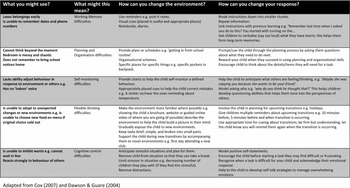
While Perry's work argues for a need to address underlying emotional regulation before implementing cognition heavy strategies, environmental adaptations may also be useful. Adaptions to the environment can scaffold the child's developing skills and provide the child with the executive capabilities that they otherwise lack. An overview of promising strategies for those who support children with EF difficulties is presented in Box 1. These ‘meta-cognitive’ strategies are argued to promote the development of adaptive skills in the child (Marlowe, Reference Marlowe2000). Environmental modifications have been applied in interventions for a range of clinical disorders, in which EF is also compromised, such as FASD and ADHD (Dawson & Guare, Reference Dawson and Guare2004; McCloskey, Perkins & Van Divner, Reference MCloseky, Perkins and Van Divner2008). In keeping with the principles outlined by Grayson (Reference Grayson2006) and Perry and Marcellus (Reference Perry and Marcellus2004) these strategies should form part of daily interactions between teachers and children. When used repeatedly and consistently, they can form a scaffold on which the child can build their cognitive skills.
Strategies for those who support children with executive function difficulties

More targeted interventions also exist that enhance development of executive functioning. The PATHS (Promoting Alternative Thinking Strategies; Riggs, Greenberg, Kusché & Pentz, Reference Riggs, Greenberg, Kusché and Pentz2006), the Tools of the Mind program (Diamond, Barnett, Thomas & Munro, Reference Diamond, Barnett, Thomas and Munro2007), Mindfulness in the form of Mindful Aware Practices (Flook et al., Reference Flook and Smalley2010), measured amounts of moderate-to-vigorous physical activity (Gapin & Etnier, Reference Gapin and Etnier2010), and computerised training packages (e.g. Thorell, Lindqvist, Bergman, Bohlin & Klingberg, Reference Thorell, Lindqvist, Bergman, Bohlin and Klingberg2008) have all been shown to improve EF amongst non-care populations (for a detailed review of these interventions see Diamond & Lee, Reference Diamond and Lee2011).
Summary
Difficulties in sustaining attention, in self-regulation, in executive functioning, and in moving seamlessly from task to task make the negotiation of social relationships and educational environments challenging for children. The assessment of neurocognitive difficulties can be complex. The neurocognitive difficulties can require administration of multiple tests (e.g. Spreen & Strauss, Reference Spreen and Strauss1998) and reference to developmental norms. Assessment is not easy to accommodate within the large caseloads and workload demands by practitioners working in the care system. Despite this, the critical importance of neurocognitive functioning to educational outcomes suggests that assessment of a child's neurocognitive profile should form a vital part of case planning and intervention. The development of neurocognitive screening commensurate with the demands and pressures of the child protection sector needs to be a priority for future research.
At present, there does not appear to be a brief, evidence informed approach to the assessment and treatment of neuropsychological difficulties children in care. However, this article has outlined some of the ways in which people supporting children in care may be able to support the child with EF difficulties. Many key adults who support children in care may recognise the unique learning styles displayed by maltreated children and already be implementing strategies for change (e.g. helping to break tasks into small chunks for children who seem to struggle with memory). This may go some way to improving educational outcomes for maltreated children, helping them to make the most of their educational opportunities.
In summary, a broad body of literature documents the structural and cognitive profiles of children who have been abused or neglected. The promising results of interventions targeted at children's executive functioning interventions, particularly with children with lower executive functioning abilities (Diamond & Lee, Reference Diamond and Lee2011) offer every reason to be optimistic, and further research directed towards effective interventions is warranted.