Introduction
Recent pension reforms throughout Europe confine possibilities of early retirement (Hofäcker and Unt Reference Hofäcker and Unt2013). Older workers, frequently defined as those aged 50 and above (e.g. Canduela et al. Reference Canduela, Dutton, Johnson, Lindsay and Raeside2012; Karpinska et al. Reference Karpinska, Henkens, Schippers and Wang2015; Van Dalen, Henkens and Wang Reference Van Dalen, Henkens and Wang2015), are increasingly expected to work longer. This raises the question how working lives can be extended, especially in a knowledge-based economy where older workers’ skills are prone to become obsolete (cq. Henkens Reference Henkens2005). In this context, training opportunities – to update and upgrade knowledge – become relevant for both workers and employers. Prior studies showed that participation in training was associated with increased employability, productivity and labour market participation of older workers (Barrett and O'Connell Reference Barrett and O'Connell2001; Bartel Reference Bartel1995; Belloni and Villosio Reference Belloni and Villosio2015; Groot and Maassen van den Brink Reference Groot and Maassen van den Brink2000; Picchio and Van Ours Reference Picchio and Van Ours2013). During their career, employer-provided training was the most important source for individuals’ training (Hansson Reference Hansson2008). Workers’ skills were important assets to organisations and investing in up-to-date knowledge could provide competitive advantage (Torraco Reference Torraco2000). However, several recent studies reported that employers were hesitant to provide training to older workers (e.g. Canduela et al. Reference Canduela, Dutton, Johnson, Lindsay and Raeside2012; Karpinska et al. Reference Karpinska, Henkens, Schippers and Wang2015; Picchio and Van Ours Reference Picchio and Van Ours2013). Thus, the question persists of how employers determine who receives training and who does not.
Prior literature suggested that the low participation of older workers in training might at least partly be attributed to employers’ limited concern and involvement (Taylor and Urwin Reference Taylor and Urwin2001; Van Dalen, Henkens and Wang Reference Van Dalen, Henkens and Wang2015); or, employers’ reluctance to provide training to older workers could be explained by persistent age-stereotypes (Brooke and Taylor Reference Brooke and Taylor2005). Several studies showed that employers tended to believe that older workers were, for example, less productive than their younger counterparts (e.g. Canduela et al. Reference Canduela, Dutton, Johnson, Lindsay and Raeside2012; Chui et al. Reference Chui, Chan, Snape and Redman2001; Van Dalen, Henkens and Schippers Reference Van Dalen, Henkens and Schippers2010).
We feel it is a critical omission that comparatively little is known about ways in which workers and the government can affect employers’ provision of training to older workers. The current study contributes to the literature by examining how these two actors – the government and workers themselves – may affect employers’ decisions regarding the training opportunities for older workers. By doing so, we aim to provide a better understanding of employers’ considerations and the conditions for employability investments in older workers.
We use data from the Netherlands to test our expectations regarding employers’ provision of training. In comparison to other European countries, the training situation of older workers in the Netherlands can be summarised as above average: the Netherlands lags behind the Scandinavian countries, but precedes many Central and Eastern European countries. In the 28 member states of the European Union (EU-28 average), on average only 6 per cent of the population aged 55–64 participated in education and training in Europe in 2015 (Eurostat 2015). This percentage is about 12 per cent in the Netherlands – comparable to the United Kingdom (UK), Norway and France. The other Scandinavian countries and Switzerland have a higher training participation; there, between 16 and 25 per cent of the population aged 55–64 participated in training in 2015 (Eurostat 2015). With regard to workplace training specifically, Bassanini et al. (Reference Bassanini, Booth, Brunello, De Paola and Leuven2005) show in their country comparison based on data from the Continuing Vocational Training Survey, that the share of workers who receive employer-sponsored training is highest in the Scandinavian countries as well as the UK and France, where just about or above 50 per cent of the training is sponsored by employers. This percentage is lowest in the Southern (<30%) and Eastern European countries (<20%). The same authors report that in the Netherlands more than 40 per cent of the workers receive employer-sponsored training; a rank in the upper middle with Belgium, the Czech Republic and Ireland (Bassanini et al. Reference Bassanini, Booth, Brunello, De Paola and Leuven2005). To summarise, the training situation of older workers in the Netherlands is similar to many other Central European countries but the Scandinavian countries clearly lead this ranking.
We conducted a vignette study to investigate what affects employers’ considerations to provide training to older workers in the Netherlands. A vignette study is a semi-experiment where respondents read a short description of a hypothetical situation. In our case, a training situation is described and the characteristics of the worker and training are randomly varied. A vignette design benefits our research in two aspects. First, this semi-experiment eliminates omitted variable bias. Thus, effects found in these studies cannot be confounded and can be interpreted as causal inferences (Auspurg and Hinz Reference Auspurg and Hinz2015). Second, it (largely) eliminates the social desirability bias related to studies on employer-provided training (Alexander and Becker Reference Alexander and Becker1978; Wallander Reference Wallander2009). This methodology is, therefore, expected to provide a more accurate picture of conditions affecting employers’ willingness to provide training compared to standard surveys.
Employer-provided training: costs, benefits and social exchange
Employers are considered rational actors who weigh the costs and benefits associated with training investments when it comes to deciding to whom workplace training should be provided (Gazier Reference Gazier, Weinert, Baukens, Bollérot, Pineschi-Gapènne and Walwei2001; Kalleberg et al. Reference Kalleberg, Knoke, Marsden and Spaeth1996). Ultimately, investments are made in situations and for those workers where the highest benefits of training are expected.
Different theoretical mechanisms provide insights into employers’ considerations. Employers might decide to train their existing staff because up-to-date knowledge benefits the organisation and provides a competitive advantage: better trained workers are reported to be more productive (Barrett and O'Connell Reference Barrett and O'Connell2001; Bartel Reference Bartel1995; Belloni and Villosio Reference Belloni and Villosio2015; Groot and Maassen van den Brink Reference Groot and Maassen van den Brink2000; Picchio and Van Ours Reference Picchio and Van Ours2013) and investments in personnel increase the attractiveness of the organisation for new employees (De Vries, Gründemann and Van Vuuren Reference De Vries, Gründemann and Van Vuuren2001). Employers might also offer workplace training as part of a social exchange relation where workers’ commitment to the organisation and organisational support are exchanged (Cropanzano and Mitchell Reference Cropanzano and Mitchell2005). In this case, employers provide training to reward workers and increase their attachment to the organisation.
Research has repeatedly shown that workplace training is unequally distributed across workers’ age as older workers are reported to be less likely to receive employer-provided training (e.g. Bassanini et al. Reference Bassanini, Booth, Brunello, De Paola and Leuven2005; Canduela et al. Reference Canduela, Dutton, Johnson, Lindsay and Raeside2012; Chui et al. Reference Chui, Chan, Snape and Redman2001; Karpinska et al. Reference Karpinska, Henkens, Schippers and Wang2015; Picchio and Van Ours Reference Picchio and Van Ours2013; Taylor and Walker Reference Taylor and Walker1994, Reference Taylor and Walker1998; De Vries, Gründemann and Van Vuuren Reference De Vries, Gründemann and Van Vuuren2001). This finding could be explained by human capital theory (Becker Reference Becker1964). A rational employer, who is conscious of the costs and benefits associated with training investments, recognises that an advancing retirement decreases the possible (accumulated) benefits from training (Bassanini et al. Reference Bassanini, Booth, Brunello, De Paola and Leuven2005; Becker Reference Becker1964; Canduela et al. Reference Canduela, Dutton, Johnson, Lindsay and Raeside2012; Posthuma and Campion Reference Posthuma and Campion2009). The period that employers benefit from a training investment is shorter for older workers and might discourage employers from investing.
Next to workers’ age, contextual conditions might affect the provision of workplace training. For example, the size of the organisation (Bishop Reference Bishop1996; Knoke and Kalleberg Reference Knoke and Kalleberg1994), the composition of the organisation's workforce (Bassanini et al. Reference Bassanini, Booth, Brunello, De Paola and Leuven2005; Canduela et al. Reference Canduela, Dutton, Johnson, Lindsay and Raeside2012; Van Dalen, Henkens and Wang Reference Van Dalen, Henkens and Wang2015) or the organisation's economic situation (Bishop Reference Bishop1996; Karpinska et al. Reference Karpinska, Henkens, Schippers and Wang2015) are reported to be relevant factors for employers’ training decisions. In the current study, we consider that the government may exert influence on employers’ willingness to provide training and that employers might be guided by workers’ interest in training and commitment to the organisation.
Prior research on the government's influence on (employer-provided) training is sparse. To our knowledge, there are only two studies that report findings related to the presumed relationship. Billett et al. (Reference Billett, Dymock, Johnson and Martin2011) expected that employers would respond to government reimbursements that encouraged them to retain older workers or to invest in their competence. Their results, referring to the Australian labour market, did not support the expectation. Another study – executed in the Netherlands – showed that older workers were more willing to participate in training when they were told that subsidiary training vouchers were offered through employers, rather than through the government (Borghans, Fouarge and de Grip Reference Borghans, Fouarge and de Grip2011). These results, however, refer to workers’ willingness to attend training, rather than employers’ willingness to provide training. By conducting this research, we aim to contribute to the limited knowledge about the governments’ possible role with respect to employers’ provision of training.
Second, we investigate whether a possible social exchange relation between workers and their organisation might explain employers’ training provision. As previous literature argues, employers are confident that workers’ interest in receiving training signals higher productivity, and more bonding with and commitment to the organisation (Karpinska Reference Karpinska2013; Mathieu and Zajac Reference Mathieu and Zajac1990). Borghans, Fouarge and de Grip (Reference Borghans, Fouarge and de Grip2011) showed that intrinsically motivated workers were more likely to participate in training. In addition, other studies reported that employers appeared to be affected by workers’ motivation when it came to retaining or training decisions (Greenhalgh and Mavrotas Reference Greenhalgh and Mavrotas1994; Henkens, van Solinge and Cozijnsen Reference Henkens, van Solinge and Cozijnsen2009; Karpinska Reference Karpinska2013). To follow up on prior research, we investigate whether employers’ considerations to provide training is dependent on individuals’ interest or motivation to pursue training.
Direct effects on employer-provided training
We commence our expectations with the general hypothesis that employers take rational training decisions. The costs associated with employer-provided training comprise direct and indirect training costs. Direct costs refer to the course fee paid by employers and indirect costs concern the length of the training during which workers are absent from work. Higher direct or indirect costs will discourage rational employers from investing in a worker. Hence, we expect that employers’ willingness to provide training decreases with increasing costs of the training (Hypothesis 1) and increasing duration of the training (Hypothesis 2).
In line with human capital theory, rational employers can be expected to abstain from investing in older workers because older workers’ forthcoming retirement shortens the period in which training investments pay off. Thus, employers’ benefits to providing workplace training – and, therefore, plausibly also their willingness to make this investment – declines with the age of the worker. We hypothesise that employers’ willingness to provide training decreases with increasing age of the worker (Hypothesis 3).
The government has an interest in workplace training being offered because life-long learning and the development of knowledge and skills are thought to be possibilities for extending older persons’ work life (e.g. Hancock Reference Hancock2006; Schilling and Larsen Reference Schilling, Larsen, Blossfeld, Buchholz and Kurz2011). Governments can stimulate the provision of workplace training through reimbursements that reduce employers’ direct training costs. Additionally, government's contributions to training might act as a normative incentive for employers to offer training. Based on this reasoning, we hypothesise that employers’ willingness to provide training is higher if the government reimburses part of the training costs (Hypothesis 4).
Following social exchange theory, workers’ commitment to the organisation and employers’ organisational support may be exchanged (Cropanzano and Mitchell Reference Cropanzano and Mitchell2005). Employers might, for example, reward workers’ commitment to the organisation, expressed as workers’ explicit interest in attaining training, by providing them with training. To investigate the social exchange relation we hypothesise that employers’ willingness to provide training is higher if workers specifically indicate their interest in training (Hypothesis 5).
Moderating effects on the relation between workers’ age and employer-provided training
Based on the theoretical notions introduced above, we expected that workers’ age operated as a disincentive for employers to provide training. We explained that the period in which employers could reap the benefits of training investments shortened as older workers approached retirement. The negative relation between workers’ age and employers’ willingness to provide training is well-established in empirical research (Bassanini et al. Reference Bassanini, Booth, Brunello, De Paola and Leuven2005; Picchio and Van Ours Reference Picchio and Van Ours2013). We argue that two factors relating to employers’ investment decisions might moderate this association.
First, by decreasing employers’ direct training costs, governmental reimbursements might mitigate the negative relation between workers’ age and employers’ provision of training. Particularly when training is provided to older workers, these reimbursements might contribute to decrease employers’ uncertainty with regard to the pay-offs from training investments. As older workers are more prone to leave the labour market, for example due to ill-health, the prospect of having training costs (partly) reimbursed might counterbalance employers’ greater uncertainty and decrease the reservations against investing in training for older workers. Hence, employers might be especially responsive to government reimbursements if training is considered for older workers.
Second, workers’ motivation to participate in training might weaken the negative effect of their age on employers’ willingness to provide training. As laid out above, workers’ motivation and interest in participating in training signal commitment to the organisation. Especially when older workers express their interest to participate in training, it might suggest that they plan to remain active in the labour market. In terms of employers’ costs and benefits of training, this implies that the training investment is more likely to pay off. Hence, workers’ motivation might be more relevant for employers’ willingness to provide training if they are older.
To summarise, we argue that the negative relation between workers’ age and employers’ willingness to provide training does not sustain in every situation and hypothesise that although employers’ willingness to provide training decreases with increasing age of the worker, this association is less negative if the government reimburses part of the costs (Hypothesis 6a) and if workers show interest in training (Hypothesis 6b).
Data and methods
We conducted a vignette study (also called factorial design) to investigate employers’ willingness to provide training. This method is frequently used to study human judgements (Alexander and Becker Reference Alexander and Becker1978; Ganong and Coleman Reference Ganong and Coleman2006; Wallander Reference Wallander2009). In a vignette study, respondents, in our case employers, read a short description of a hypothetical situation or person. The researchers can randomly vary the characteristics they include in the description of the vignette. In our study, respondents were provided with two descriptions of a worker/training situation and asked for each how willing they were to offer the training.
To study employer-provided training, a vignette design has several advantages over general survey questionnaires. First, through vignette studies the social desirability related to sensitive questions is reduced. For example, when employers are asked directly about their attitudes towards older workers, they might hide their stereotypes because age-stereotypes are frequently socially unaccepted. In the vignettes, respondents judge a person with several characteristics (among them is the ‘treatment’, e.g. the age of the worker). Due to the combination of characteristics, respondents are not attentive to the treatment and provide answers that are less prone to social desirability (Alexander and Becker Reference Alexander and Becker1978; Auspurg and Hinz Reference Auspurg and Hinz2015; Wallander Reference Wallander2009). Second, in survey research respondents who are asked to indicate their willingness to invest in workers’ training might base their answer on different considerations. In a vignette study, in contrast, only the described hypothetical scenario guides respondents’ decisions (Alexander and Becker Reference Alexander and Becker1978). This methodology is, therefore, expected to provide a more accurate picture of employers’ willingness to provide training compared to a standard survey. Last, the vignette study has an experimental design, i.e. the characteristics of the described person/situation are randomly assigned. Compared to regular survey data, this prevents omitted variable bias and allows conclusions about causal relations to be drawn (Auspurg and Hinz Reference Auspurg and Hinz2015).
Respondents
The data collection for the vignette study took place as part of a larger company survey conducted in the Netherlands between April and June 2012. For more information regarding the sampling and data collection, see Fleischmann, Koster and Schippers (Reference Fleischmann, Koster and Schippers2015). Due to the generally very low response rate in corporate studies, we sampled 8,000 organisations with ten or more employees. We over-sampled large companies to guarantee sufficient responses from large organisations.
Respondents had two possibilities to complete the questionnaire: they could use the paper questionnaire sent with the first post mail or fill in an online questionnaire. If respondents chose the online version of the questionnaire, they received two additional questions, which comprised the two vignettes analysed in this study. In total – paper and online version together – we received N = 983 completed questionnaires. This reflected a response rate of about 12 per cent. As expected, our response rate was lower than in individual surveys, but it was comparable to other corporate studies conducted in the United States of America and Europe (Kalleberg et al. Reference Kalleberg, Knoke, Marsden and Spaeth1996; Van Dalen et al. Reference Van Dalen, Henkens, Henderikse and Schippers2006). Of all completed questionnaires, about half of the respondents (N = 477) chose the online version and provided valid answers to the vignette questions.
The questionnaires were sent to companies’ human resources departments to ensure that a person familiar with the human resource practices of the organisation completed it. This, however, meant that persons with very different positions in the human resources department completed the questionnaire: for example, these could be owners of companies as well as administrative staff members. In this study on employer-provided training, we decided to use only a sub-sample of respondents – those who could be identified as being responsible for training decisions. We selected respondents fulfilling one of the following four positions within the organisation (N = 296): chief executive officer, owner of the company, board member/director or branch manager. Moreover, we excluded respondents who indicated that they did not supervise staff or this information was missing (N = 71). Finally, three respondents were excluded from the analyses because they did not disclose all relevant information: one is lost because his/her age is unknown and two did not provide the size of their company. Our final selection refers to 94 chief executive officers, 74 owners of the company, 40 board members/directors and 14 branch managers. In the following we refer to the respondents as ‘employers’, because they can be considered to be involved in personnel decisions, such as workplace training. Given that each respondent answered two vignettes, our analyses draw on a sample of 444 vignettes nested in 222 respondents.
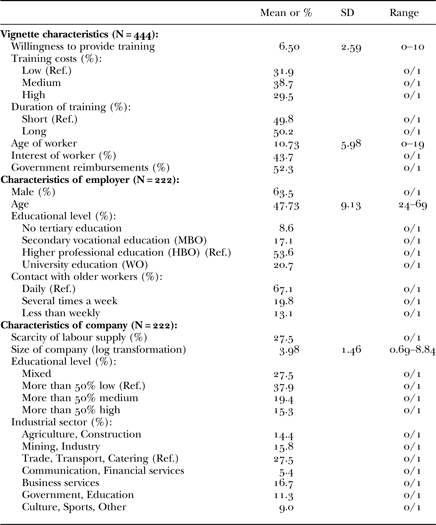
With regard to the background characteristics of the employer and the company, we can describe the sample as follows. Respondents’ average age was close to 48 years and more than 60 per cent of them were men. About 54 per cent of the respondents attained a higher professional education, and about 20 per cent a university-level education. Furthermore, more than two-thirds of them reported having daily contact with older workers. Regarding the characteristics of the company, about one out of four companies were from the sector ‘Trade, Transport, Catering’, and about one out of five each from ‘Business services’ (16.7%) and ‘Mining, Industry’ (15.8%). For further information on the descriptive characteristics of the sample, see Table 1.
Descriptive statistics of vignette, employer and company characteristics

Notes: SD: standard deviation. Ref.: reference category. MBO: middelbaar beroepsonderwijs. HBO: hoger beroepsonderwijs. WO: Wetenschappelijk onderwijs.
Study design
Figure 1 shows an example vignette. The vignette starts by setting the context: ‘It is often noticed that training is important for the employability of workers. Below you find two descriptions of workers. Could you indicate for each of these persons whether you would offer them training?’
Example vignette provided to Dutch employers (translated from Dutch).

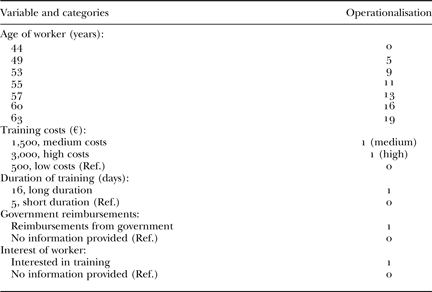
This introduction is followed by the vignette, i.e. the description of the worker and workplace situation. The possible characteristics included in the vignettes are summarised in Table 2. The vignette includes the age of the fictitious worker with seven possibilities ranging between 44 and 63 years. We tested several ways to include age in the analyses: in three categories, with a linear term alone, and with a linear and quadratic term. We decided against categorising age, because this would imply losing relevant information. Ultimately, we chose to include a linear and quadratic term for age because the likelihood-ratio test revealed that this model fitted the data better (likelihood-ratio χ2(1) = 13.58, p < 0.001) than a model with only a linear specification of age. Next, three categories of direct costs of the training were provided in the vignettes: €500, €1,500 and €3,000. In the analyses, we included the training costs as two dummy variables. Medium costs (€1,500) and high costs (€3,000) were compared to the reference category of low costs (€500). To tackle the indirect costs of training, we provided information on the length of the training, which was either ‘five consecutive working days’ (short; reference category) or ‘four months, one day a week’ (long). To investigate whether reimbursements by the government affected employers’ considerations and whether workers’ commitment was exchanged for employer-provided training, we included two attributes in the vignette description. First, whether the government would reimburse part to the training costs (government = 1) or whether this was not mentioned (reference category). Second, whether the worker was interested in receiving training (interest = 1) or, again, whether this was not mentioned in the vignette (reference category).
Characteristics included in the vignette study

Note: Ref.: reference category.
After respondents read the hypothetical description, we assessed their willingness to provide training by asking: ‘Would you offer training to this person?’ Respondents indicated their willingness on a scale, with higher values indicating greater willingness to provide training. The 11-point scale ranges from 0 (‘very unlikely’) to 10 (‘very likely’) and is used as the dependent variable. In our study, the mean willingness to provide training is 6.50 (see Table 1) and is somewhat left skewed (median = 7, modus = 8).
The possible unique combinations of characteristics included in the vignette description constitute the vignette universe. Based on the characteristics included in our vignette (seven possible ages; three cost categories; etc.), we have a total of 168 (7 × 3 × 2 × 2 ×2) unique possible combinations of characteristics. Compared to a factorial design where all combinations of characteristics are implemented in the data collection, a vignette study regards a selection of the possible combinations as sufficient (Wallander Reference Wallander2009). Instead of using all 168 possible combinations, we formulated 60 different vignettes in which the characteristics are randomly varied. We made sure that each possible characteristic was included about the same number of times in the vignettes. Each respondent received two vignettes that were randomly assigned.
In the analyses, we control for background characteristics of the respondent and the organisation. Those background characteristics are retrieved from the accompanying company survey. By including these background characteristics, we assess whether the willingness to provide employer-provided training is dependent on company or respondent characteristics. For the descriptive information on the variables that are included in the analyses, see Table 1.
Control variables
Prior research relying on survey results has shown that employer-provided training is dependent on the background characteristics of employers and organisations (e.g. Henkens, van Solinge and Cozijnsen Reference Henkens, van Solinge and Cozijnsen2009). We include the following information as control variables in our analyses. Regarding employers, we consider the gender, age and educational level of respondents. Respondents’ educational level is measured with a categorical variable distinguishing ‘no tertiary education’, ‘secondary vocational education’ (Dutch: middelbaar beroepsonderwijs, MBO), ‘higher professional education’ (Dutch: hoger beroepsonderwijs, HBO) (reference category) and ‘university education’ (Dutch: Wetenschappelijk onderwijs, WO). Moreover, we include a control variable for the frequency the respondent has contact with older workers in the organisation. We did so, because inter-group contact can be expected to decrease stereotypes (Pettigrew and Tropp Reference Pettigrew and Tropp2006). Contact with older workers was operationalised with the question: ‘Due to your work, how often do you have contact with older workers inside and/or outside your organisation?’ Respondents could answer (1) ‘daily’, (2) ‘several times a week’, (3) ‘weekly’, (4) ‘monthly’ or (5) ‘hardly ever’. Categories 3, 4 and 5 were recoded into one category.
We control for four organisational background characteristics. We include the size of the company because employer-provided training previously appeared to be more common in larger organisations (Bassanini et al. Reference Bassanini, Booth, Brunello, De Paola and Leuven2005; Bishop Reference Bishop1996; Knoke and Kalleberg Reference Knoke and Kalleberg1994; Sutherland Reference Sutherland2016; Taylor and Urwin Reference Taylor and Urwin2001). Also, training provision might vary across economic sectors (Bassanini et al. Reference Bassanini, Booth, Brunello, De Paola and Leuven2005; Bishop Reference Bishop1996; Knoke and Kalleberg Reference Knoke and Kalleberg1994; Picchio and Van Ours Reference Picchio and Van Ours2013; Sutherland Reference Sutherland2016). Companies facing scarcity might rather decide to invest in their existing personnel than to fire and hire new workers (Knoke and Kalleberg Reference Knoke and Kalleberg1994). Also, higher-educated workers were more likely to receive training (Sutherland Reference Sutherland2016), arguably because employer-provided training is more important to create commitment in organisations with higher-educated workers (Branham Reference Branham2001).
Method
The dependent variable willingness to provide training is measured on an 11-point scale and allows us to apply linear regression models. In vignette studies, the level of analysis is the vignette (consisting of the random conditions) and not the respondent as is usual in survey research (Ganong and Coleman Reference Ganong and Coleman2006; Wallander Reference Wallander2009). To account for the nested nature of our data, we estimate multi-level regression models. With this method we account for the hierarchical structure of our data, with two observations being nested within one respondent.
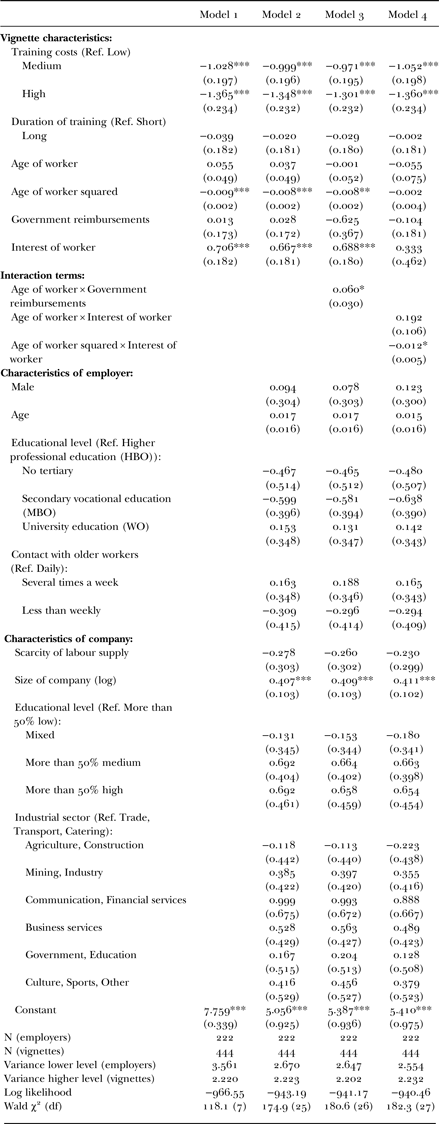
In Table 3, we present four regression models. In the first model we only include the vignette variables. In the second model we include the background characteristics to account for possible differences across respondents and companies. In the third and fourth models we include the interaction effects to test Hypotheses 6a and 6b.
Multi-level linear regressions predicting employers’ willingness to provide training

Notes: Standard errors are given in parentheses. Ref.: reference category. MBO: middelbaar beroepsonderwijs. HBO: hoger beroepsonderwijs. WO: Wetenschappelijk onderwijs. df: degrees of freedom.
Significance levels: * p < 0.05, ** p < 0.01, *** p < 0.001.
Results
The results are shown in Table 3. As apparent when comparing Model 1 to Model 2, none of the relations found for the vignette characteristics changed after adjusting for the characteristics of the employer and the characteristics of the company. Moreover, only one background characteristic of employers – the size of their organisation – was significantly related to their willingness to provide training. It appeared that the larger the organisation was, the more willing employers were to provide training.
Our results for the vignette characteristics (Models 1 and 2) showed that training costs were negatively related to employers’ willingness to provide training. When the costs for training were medium (€1,500) or high (€3,000), employers’ willingness to provide training was significantly lower compared to low training costs of €500. This supported Hypothesis 1. We did not find a significant association between the duration of training and employer-provided training. We, thus, could not corroborate Hypothesis 2. Next, the models showed a significant, squared and negative coefficient for the age of the hypothetical worker. This implied that, as hypothesised in Hypothesis 3, employers’ willingness to provide training decreased with increasing age of the worker. The squared relationship indicated that the decrease in employers’ willingness to provide training was accelerating with workers’ increasing age. We also studied how possible government reimbursements affected employer-provided training. Our analyses implied that reimbursement offered by the government did not directly affect employers’ decisions. Hence, Hypothesis 4 was not supported. Last, our results revealed that workers’ interest in training was relevant for employers’ willingness to provide training: employers were more willing to provide training if workers specifically stated their interest in receiving training. This finding corroborated Hypothesis 5.
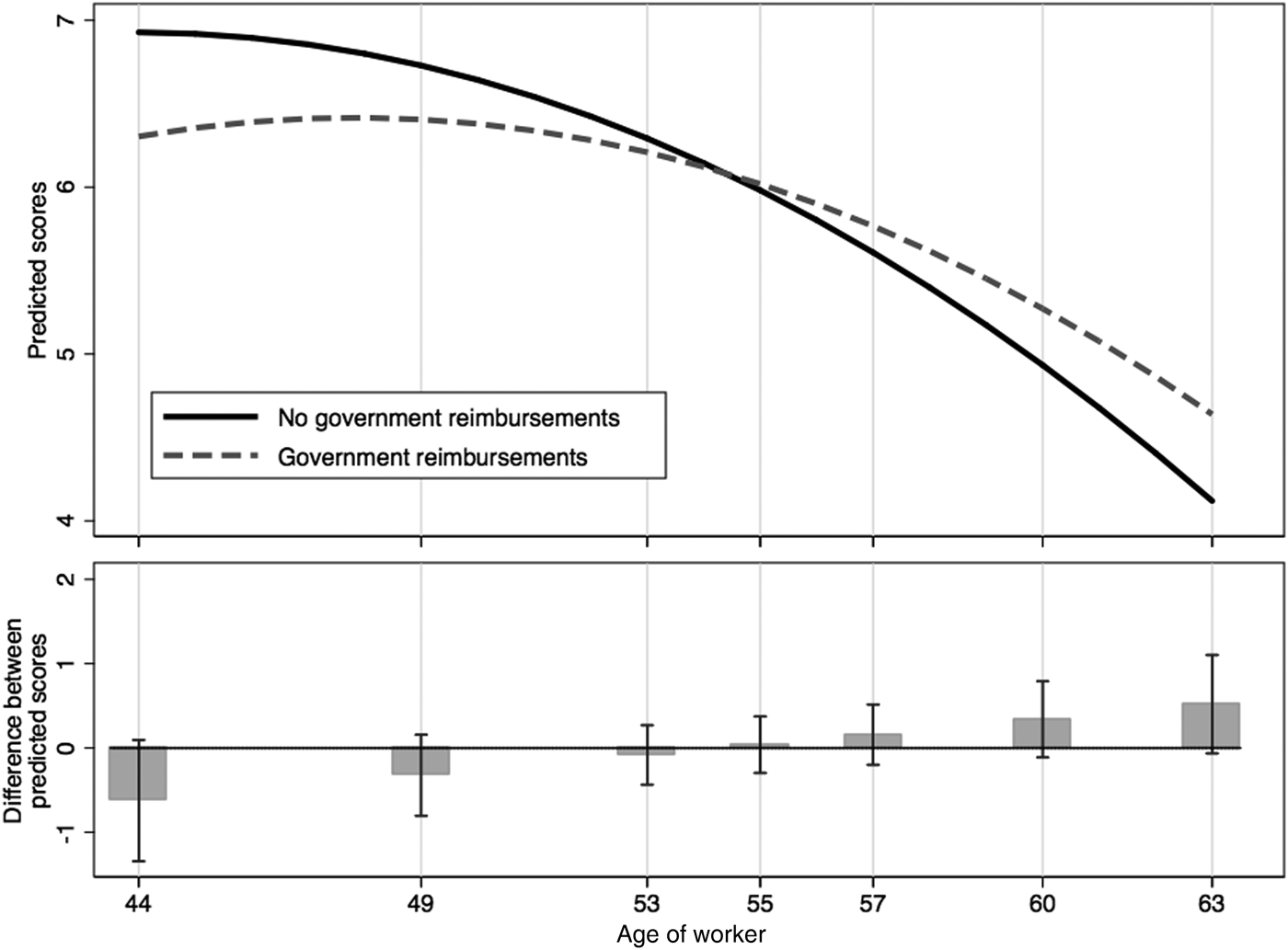
Next to the direct effect of workers’ age on employers’ willingness to provide training, we argued that this relation was moderated by the government's reimbursement practices (Hypothesis 6a) and workers’ interest (Hypothesis 6b). We tested these assumptions in Models 3 and 4, respectively. In Model 3, we saw that the negative relation between workers’ age and employers’ willingness to provide training was significantly moderated by government reimbursements of training costs. More specifically, we found the following (see Figure 2). While employers’ willingness to provide training generally declined with workers’ increasing age (see Figure 2, upper plot), the decline was rather pronounced if government reimbursements were not provided (solid line) and more flat in the case where government reimbursements were offered (dotted line). The total decrease of employers’ willingness to provide training between the ages of 44 and 63 amounted to 1.7 if government reimbursements were provided, and to 2.8 if government reimbursements were not provided, both on a scale from 0 to 10. An additional test showed that this decline was significantly less strong in the case where government reimbursements were provided compared to the condition where governments did not reimburse training costs (b = −1.144, p < 0.05). We now turn towards the lower plot of Figure 2. At each age included in the vignettes (44, 49, 53, etc.), the bars display the difference between the two lines from the upper plot, reflecting the predicted scores of employers’ willingness to provide training under the condition that government reimbursements were (dotted line) or were not (solid line) provided. The 95 per cent confidence intervals, which all overlap zero, indicate that employers’ willingness to train did not significantly differ with and without government reimbursements at any age during workers’ career. In sum, we found that government reimbursements buffered the negative relation between workers’ age and employers’ willingness to provide training. All in all, this supports Hypothesis 6a.
Predicted scores for the relation between workers’ age and employers’ willingness to provide training, moderated by the provision of government reimbursements (upper plot). Bars with 95 per cent confidence intervals (95% CI) indicate the difference between the two predicted lines (lower plot; 95% CI overlapping zero indicate non-significant differences).
Notes: The predictions refer to male employers; further, all employers’ and organisations’ background characteristics are held constant at their reference category (for categorical variables) or their mean (see Table 1). The vignette characteristics are held constant at medium costs, short length and interest in training not provided.

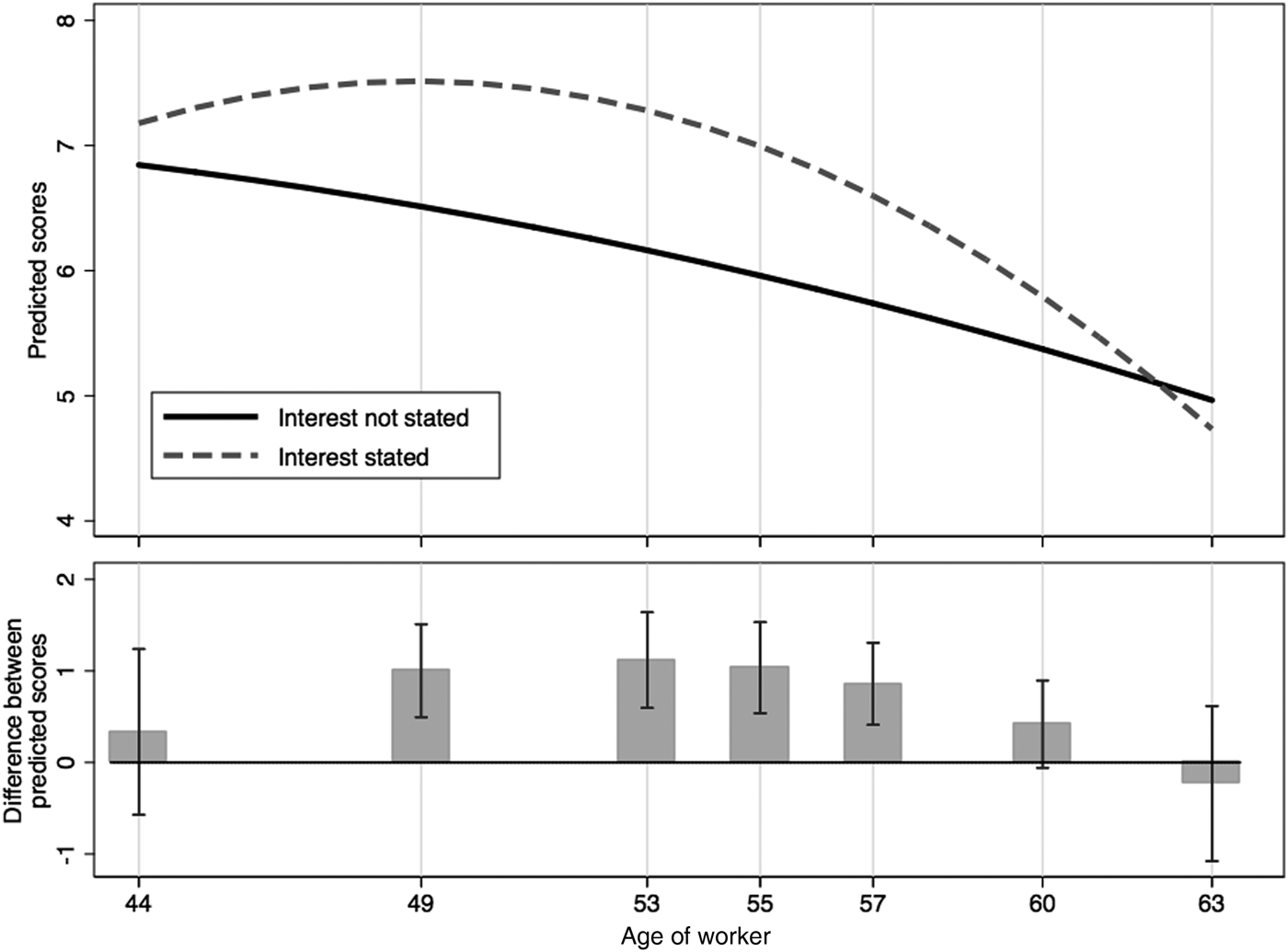
In Model 4 we tested whether workers’ interest in receiving training moderated the negative relation between workers’ age and employers’ willingness to provide training. While employers were generally less willing to provide training as workers get older, this relation depended on workers’ interest in training. We depict the moderation effect in Figure 3.
Predicted scores for the relation between workers’ age and employers’ willingness to provide training, moderated by workers’ interest in training (upper plot). Bars with 95 per cent confidence intervals (95% CI) indicate the difference between the two predicted lines (lower plot; 95% CI overlapping zero indicate non-significant differences).
Notes: The predictions refer to male employers; further, all employers’ and organisations’ background characteristics are held constant at their reference category (for categorical variables) or their mean (see Table 1). The vignette characteristics are held constant at medium costs, short length, and government reimbursements not provided.

The upper plot of Figure 3 shows that employers’ willingness to provide training decreased steadily with workers’ increasing age in the case where workers did not explicitly state their interest in training (solid line). A different picture appears for workers who indicated that they were interested in receiving training (dotted line): for this group, employers’ willingness to provide training was rather stable up to approximately age 55. Beyond age 55, however, employers’ willingness to provide training steeply declined, while at age 63, employers were about equally likely (or unlikely) to provide training to those who did and did not state interest in receiving training. The total decrease of employers’ willingness to provide training between the ages of 44 and 63 amounted to 2.4 if workers were interested in training, and to 1.9 if workers did not mention their interest in training, both on a scale from 0 to 10. An additional test revealed that the decrease did not significantly differ between the two groups (b = −0.564, p > 0.05). As the lower plot of Figure 3 shows, it paid off for workers to have stated their interest in training: for ages 49–57, the confidence intervals around the bar graphs did not overlap with zero, indicating that employers were significantly more willing to provide training if workers stated their interest compared to when they did not. In sum, the relation between workers’ age and employers’ willingness to provide training was moderated by workers’ interest in training. We clearly detected that workers’ motivation delayed the negative impact of workers’ age for employers’ willingness to provide training. These results corroborate Hypothesis 6b.
Conclusion and discussion
Workplace training is said to be unequally distributed with regard to workers’ age. In this article, we set out to investigate two ways in which workers and governments can affect the training decisions of employers. We conducted a vignette study, a semi-experimental design, to study the provision of workplace training to workers aged 44–63.
Generally, our results indicated that several conditions operated as disincentives for employers to provide training costs. First, employers were less willing to provide training if the direct costs of the training were higher. Moreover, employers tended to be less willing to provide training to older workers and this decline appeared to accelerate with increasing age of workers.
Next to these disincentives, other factors were found to contribute to employers’ training provision. With regard to government reimbursements, our results did not show a direct relation with employers’ willingness to provide training, but a buffering effect: employers’ willingness to provide training decreased less steeply with workers’ increasing age when there were government reimbursements involved compared to when there were not.
The lack of identifying a direct effect of government reimbursements on employers’ willingness to provide training corresponded to findings of other studies (Billett et al. Reference Billett, Dymock, Johnson and Martin2011; Borghans, Fouarge and de Grip Reference Borghans, Fouarge and de Grip2011). A possible explanation might be found in the Dutch context. Van Dalen, Henkens and Schippers (Reference Van Dalen, Henkens and Schippers2009) presented figures that indicated that only 2 per cent of the employers in the Netherlands thought that the government was responsible for investments in lifelong learning. The same study reported that this percentage was 46 per cent in the UK, 31 per cent in Greece and 25 per cent in Spain. It seemed that Dutch employers regarded employers and workers to be responsible for training investments (Van Dalen, Henkens and Schippers Reference Van Dalen, Henkens and Schippers2009), rather than the government. Further research is required to assess how and under which circumstances government reimbursements can be effective. Rather than having immoderate expectations of the possible returns to government reimbursements, we recommend thinking about possible strategies that governments can apply to support employers’ training practices.
Moreover, we tackled the question of whether employers’ training decisions were dependent on workers’ interest in training. Our results corroborated both a direct relation of workers’ interest for employers’ training provision and a moderating effect. We found that if workers explicitly stated their interest in training, employers’ willingness to provide training remained rather stable up to age 55, but decreased steeply afterwards (compare Figure 3). In contrast, if workers did not explicitly state their interest in training, employers’ willingness to provide training decreased steadily with workers’ increasing age. Moreover, employers were significantly more willing to provide training to workers who did, compared to those who did not, state their interest until workers reached age 60. Taken together, these findings indicated that workers’ motivation appeared to delay the decrease of employer-provided training with workers’ age.
The findings regarding the moderating effect of government reimbursements and workers’ interest are relevant in at least two aspects. First, employers’ training considerations can be affected by the context. Our study indicates that active individual or government commitment to workplace training increases employers’ willingness to provide training. Ultimately, this might result in higher actual training provisions. Second, on the one hand, the moderating effects imply that employers are less reluctant to provide training than frequently suggested, but on the other hand, that employers might decide to restrict training to specific circumstances (e.g. if government reimbursements are offered) or to specific (groups of) workers (e.g. the motivated ones). It may be valuable for governments to direct their campaigns towards a universal access to training, e.g. under the headline of life-long learning and sustained employability of workers.
Our study has some limitations. First, the response rate of our survey was rather low. This is frequently the case in corporate surveys (Kalleberg et al. Reference Kalleberg, Knoke, Marsden and Spaeth1996; Van Dalen et al. Reference Van Dalen, Henkens, Henderikse and Schippers2006). It might imply that the participating organisations are not a random selection of Dutch organisations and one has to be cautious when generalising our results to the general population.
Second, due to priming we might have over-estimated respondents’ willingness to provide training. In our vignette, employers’ average willingness to provide training amounted to 6.50 on a scale from 0 to 10. Other vignette studies reported lower scores when comparable topics were investigated, such as employers likelihood to train or retain older workers or to hire early retirees (e.g. Henkens, van Solinge and Cozijnsen Reference Henkens, van Solinge and Cozijnsen2009; Karpinska, Henkens and Schippers Reference Karpinska, Henkens and Schippers2011; Karpinska et al. Reference Karpinska, Henkens, Schippers and Wang2015). Also the rather low percentage (12%) of the Dutch population aged 55–64 that participated in education or training in 2014 (Eurostat 2015) might suggest we over-estimated employers’ willingness to train. We suspect out introductory sentence to our vignette, stating that ‘…training is important for the employability of workers’, may have triggered the priming. Despite this limitation, it is unlikely that the reported relationships between the vignette characteristics and employers’ willingness to provide training are biased. This is because the same priming condition was used for every respondent and independent of the characteristics included in the vignette description. Thus, if priming applies, the introductory sentence would have affected all provided vignettes to the same extent.
Third, in this study we cannot and do not draw conclusions about employers’ decisions on whether or not to offer training. We estimated how willing employers were to train the hypothetical person and solely indicated employers’ inclination to offer training on a scale from 0 to 10. We do not know whether there is a cut-off point that separates no training provision from training provision, and where this is. Future research might want to investigate employers’ explicit training choice. These so-called (forced) discrete choice experiments bring along their own advantages and limitations (e.g. Amaya-Amaya, Gerard and Ryan Reference Amaya-Amaya, Gerard, Ryan, Ryan, Gerard and Amaya-Amaya2008; Veldwijk et al. Reference Veldwijk, Lambooij, de Bekker-Grob, Smit and de Wit2014).
Last, we investigated the provision of workplace training for hypothetical workers aged 44–63. Prior literature did not define a common age standard to categorise someone as an ‘older worker’. Eurostat implicitly defined older workers as those aged 55 and above. Most authors referred to ‘older workers’ from age 50 onwards (e.g. Canduela et al. Reference Canduela, Dutton, Johnson, Lindsay and Raeside2012; Karpinska et al. Reference Karpinska, Henkens, Schippers and Wang2015; Van Dalen, Henkens and Wang Reference Van Dalen, Henkens and Wang2015). Again others already regarded those from age 45 onwards as older workers (Billett et al. Reference Billett, Dymock, Johnson and Martin2011). Our focus on workers aged 44–63 implies that we only reflect on employers’ willingness to provide training for a selected group of middle-aged and older workers. Our analyses do not allow the drawing of conclusions about when in a worker's career employer-provided training is highest and from which age on it decreases. Recent analyses using British data show that both the chance of receiving training and the length of the training significantly decline after age 40 (Sutherland Reference Sutherland2016). A study of Borghans, Fouarge and de Grip (Reference Borghans, Fouarge and de Grip2011) in the Netherlands suggests a similar decline of training participation beyond age 45. Moreover, descriptive results based on the Netherlands Working Conditions Survey (NEA) indicate that work-related participation in training decreases after age 35 (TNO Monitor arbeid 2016). With regard to our study, this might suggest that the provision of workplace training is already at a lower level for the youngest workers – those aged 44 – compared to the expected level for even younger workers. If this were the case, we would under-estimate older workers’ disadvantage in receiving training in this study.
Our study contributes to prior research by providing evidence that a focus on workers’ age and training costs does not entirely cover employers’ considerations. We show that government reimbursements and workers’ motivation might also be relevant factors affecting employers’ training decisions, especially if it comes to older workers. Interpreted from the social exchange perspective introduced above, employers and workers seem to enter a relationship where workers exchange their motivation with employers’ provision of training. However, whether this effect evolves solely due to social exchange between the two parties or whether different underlying mechanisms are at play cannot be said with certainty. Future research, for example using qualitative interviews with employers, might wish to focus on other possible explanations for employers’ training investments. What can be concluded from our study is that, in order to enhance the training situation for older workers, workers, governments and employers will have to co-operate to find suitable practices. This might ultimately also contribute to an increase in workers’ employability and their labour market participation.
Acknowledgements
Financial support came from the Netherlands Organization for Scientific Research TOP grant ‘Sustaining Employability’ (NWO, 407-13-021). Moreover, funding came from the project ‘Productive in Multiple Ways: In Search for Activating Institutions’ (Instituut Gak, SZ2025).