Introduction
Responding to the California Supreme Court’s decision and its related legal obligations in Tarasoff v. Regents of Univ. of California over 30 years ago has become a standard part of mental health practice. This case influenced legal requirements governing therapists’ duty to protect third parties in nearly every state in the country. The final ruling in Tarasoff emphasized that therapists have a duty to protect individuals who are being threatened with bodily harm by their patient. 1 This article provides a brief overview and update on duty to protect legal requirements. Clinical guidelines for addressing threats and the duty to protect will be discussed, along with risk management approaches. The article will conclude with a vignette that illustrates these principles.
Tarasoff—A Duty to Protect
Confusion may persist surrounding the meaning and proper use of the terms duty to warn vs. duty to protect, and this may in part be due to the fact that there were 2 Tarasoff decisions. The first Tarasoff decision in 1974 created a duty to warn in California, and was based on the special relationship between therapist and patient. 2 This first decision was not only unprecedented, but also upsetting to therapists due to its controversial expectation that therapists violate patient confidentiality. One of the most familiar quotes from “Tarasoff I” clarified that the Court was concerned with social policy: “The protective privilege ends where the public peril begins.”
The California Supreme Court reheard the case, and in its 1976 ruling replaced “duty to warn” with a “duty to protect.” 1 The famous quote from “Tarasoff II,” which was adapted by many states across the country, appeared to make the change clear: “When a therapist determines, or should determine, that his patient presents a serious danger of violence to another, he incurs an obligation to use reasonable care to protect the intended victim from danger.” Initially, there was significant concern that this exception to confidentiality would have disastrous effects on psychiatric practice, despite the fact that most therapists had embraced such a duty before the Tarasoff ruling.Reference Slovenko 3 Over time, it became clear that the concerns about the potential loss of confidentiality did not have an adverse impact on psychiatric practice.Reference Buckner and Firestone 4 Instead, Tarasoff stimulated “greater awareness of the violent patient’s potential for acting out such behavior, encouraging closer scrutiny and better documentation of the therapist’s examination of this issue.” 5 More recently, after decades of misunderstanding, California passed legislation in 2013 that unambiguously established a sole duty to protect. 5 This recent California statute removed all references to duty to warn, and provides “definitive clarification.”Reference Weinstock, Bonnici, Seroussi and Leong 6
Tarasoff Expansion and Contraction
Although Tarasoff applied only in California because it was a State Supreme Court decision, the ruling “reverberated nationally.”Reference Weinstock, Bonnici, Seroussi and Leong 6 The duty to protect articulated in Tarasoff was subsequently interpreted more broadly by other courts throughout the U.S. One of the broadest interpretations appears in a Nebraska federal district court’s decision in the 1980 case of Lipari v. Sears, Roebuck & Co. 7 This case involved a VA patient who shot strangers in a crowded nightclub, without ever threatening a specific person, and 1 month after terminating psychiatric treatment. The court rejected the Tarasoff limitation to an identified victim, imposing not only a duty on therapists to predict dangerousness, but also a duty to protect unidentified victims in the general public.
The duty was given a remarkable temporal extension in the case of the Naidu v. Laird. 8 This case involved a patient with schizophrenia who killed another man in a motor vehicle crash. The patient’s psychiatric history included violent behavior, ramming a police car with his automobile, and driving off the road at high speed. The Supreme Court of Delaware held that 5 and 1/2 months after a hospital discharge was not too long a period to support a finding of negligence when a psychiatrist was found liable for failing to foresee a patient’s potential to act violently. Despite the lengthy time since the patient’s discharge, the Court stressed the “foreseeability” of harm rather than the passage of time.
The duty was extended to property in the Vermont case of Peck v. Counseling Service of Addison County. 9 In Peck, a counselor was told by a patient that he intended to burn down another person’s barn. The court’s opinion suggested that both counselors and psychiatrists had a duty to protect not only threatened victims, but their property as well. These and similar cases in the wake of Tarasoff led to significant discomfort among therapists who objected to apparent legal expectations that they foresee all dangerous situations and protect the public at large. Indeed, given psychiatry’s limitations with respect to predicting violence, ethical arguments have been raised about accepting the premise of foreseeing patient violence.Reference Mossman 10
Two decades after Tarasoff, state legislatures around the country began to reflect ambivalence about the extension of the duty to protect. As a result of therapists’ success in convincing legislatures that their state courts’ rulings created unreasonable expectations, state legislatures created statutes requiring that the threat be clearly foreseeable, and that the duty extended only to reasonably foreseeable victims—not to the general public. These statutes became known as “Tarasoff-limiting statutes,” laying out specific criteria that typically include a credible threat made against an identifiable victim. At present, Tarasoff-limiting statutes have been passed in 39 states.Reference Soulier, Maislen and Beck 11
Some states may lack clear duty to protect statutes, leaving the psychiatrist with little guidance. In such cases, it is helpful to consult with hospital legal counsel and/or one’s malpractice insurance carrier. In those states without a clear statutory legal duty to protect, psychiatrists are often advised by legal counsel to follow the basic Tarasoff rationale and practice as though there was a legal duty. There are compelling reasons for doing so, primarily that acting in accordance with the duty to protect contributes to and improves care of one’s patient.
Duty to Protect—Approach
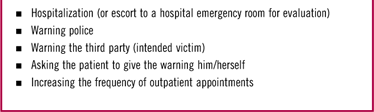
Psychiatrists should become familiar with the specific Tarasoff duty in their locale, as well as any evolving case law that may create nuances in how the duty is properly carried out. States with duty to protect statutes contain language that can often be distilled down to 2 criteria: (1) an explicit, credible threat that the patient intends and is able to carry out (2) against an identifiable person.Reference Mossman 12 If these 2 criteria are met, the psychiatrist then has a number of intervention options to consider, depending upon the clinical context. The options most often include those listed in Table 1.
Duty to protect options

Although danger to third parties can, in some cases, justify a breach of the therapist’s duty to maintain confidentiality,Reference Appelbaum and Gutheil 13 breaching confidentiality should be viewed as a last option, after all other therapeutic options have been exhausted. In essence, confidentiality should be breached only if reasonable clinical efforts seem unlikely to provide adequate protection and resolution. When all reasonable options are untenable, it should be remembered that “trust,” and not absolute confidentiality, is the foundation of the therapeutic alliance. Providing necessary protection “where self-control breaks down is not a breach of trust when it is not deceptive.”Reference Slovenko 14 Therefore, if circumstances permit, the psychiatrist should inform the patient about the decision to breach confidentiality.
The psychiatrist’s clinical and moral duty in such situations can be viewed as transcending mere legal duty in that one must do what one can “to save our fellow human beings from danger.”Reference Mossman 12 Psychiatrists should take some comfort in knowing that they have little basis “to fear being sued successfully for a bad outcome if the clinical practice has been reasonable.”Reference Soulier, Maislen and Beck 11 This is particularly the case when it is clear that the psychiatrist’s actions flowed from concerns about the welfare of the patient and threatened third parties.
The psychiatrist should consider an array of options, including hospitalization, warnings, more frequent therapy sessions, starting or increasing medication, and various forms of closer monitoring. The clinical approach can be thought of as similar to the management of an acutely suicidal patient, in so far as addressing the risk of a patient acting on dangerous plans. In the performance of the clinical risk assessment, the psychiatrist should consider contacting collateral sources, such as relatives who may be able to provide important information regarding the patient’s dangerousness.
Past medical records, where applicable, should be reviewed. At the very least, efforts to obtain records should be made and documented. Obtaining and reviewing medical records was at issue in the 1983 case of Jablonski v. United States. 15 In Jablonski, the duty to protect was extended to include a therapist–patient relationship limited to the emergency room setting. Mr. Jablonski was a violent man who was brought to a VA hospital by his girlfriend after he attempted to rape her mother. The psychiatrist concluded that the patient was a danger to others, but could not be committed under California’s involuntary commitment statute. Jablonski’s medical records revealed that he had a long history of antisocial and violent behavior; however, these records were not requested at the time of his presentation. The girlfriend was warned by emergency room psychiatrists to stay away from him if she feared him. Not long after his discharge from the ER, Jablonski killed the girlfriend. The 9th Circuit Court of Appeals concluded that the hospital had failed to obtain important prior records and to adequately warn the victim.
Finally, past therapists and referral sources should be queried where appropriate, and consultations may be sought.Reference Buckner and Firestone 4 Consultation with a psychiatric colleague, as well as hospital legal counsel, should be routine in difficult cases. If this type of careful, reasonable approach is taken (including documentation of the assessment of the pertinent issues and treatment plan), liability becomes unlikely even if harm should occur to a third party.
Evaluation of Credible Threats in Tarasoff Situations
The clinical process of violence risk assessment is beyond the scope of this article, and psychiatrists are encouraged to review the literature on this subject.Reference Buchanan, Binder, Norko and Swartz 16 , Reference Monahan and Skeem 17 A “threat” may be defined as a declaration of intent to harm. Reference Turner and Gelles 18 While threats are common, most are not carried out.Reference Borum, Fein, Vossekuil and Berglund 19 , Reference Hinman and Cook 20 In contrast to a clinical risk assessment done by a treating psychiatrist, a threat assessment is ideally done by an expert with special training and experience in the field of threat assessment who has familiarity with the current literature, research, and actuarial instruments. A treating psychiatrist would not reasonably be expected to perform a formal threat assessment. When a patient makes a credible threat that he can and intends to carry out, a duty to protect his target has arisen, and the psychiatrist should undertake a thoughtful assessment to address the risk of harm.
There is only a weak association between threats and violence; nevertheless, there is an association. In a study of clinic patients who made threats to kill, assaults were made by over 20% over a 12-month assessment period.Reference Warren, Mullen and Ogloff 21 Factors found to contribute to violence risk were substance abuse, prior violence, limited education, and untreated mental disorders. The combination of history of substance abuse, not receiving mental healthcare, having minimal education, and history of violent behavior predicted violence by threateners.
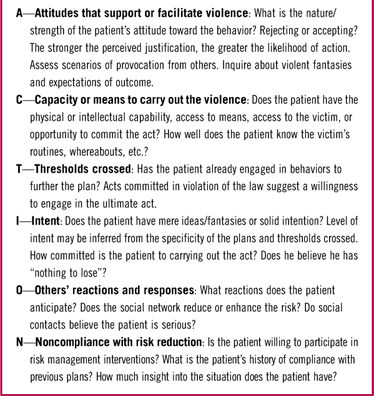
It is important to first address the threat toward third persons as a therapeutic issue in alliance with the patient. For example, the psychiatrist may explore with the patient what it would mean for the patient if the threat were to be acted upon. This approach will not only produce valuable risk assessment data, but will also appropriately address relevant clinical issues. The psychiatrist may find it helpful to consider the topics of questioning listed in Table 2, which can be recalled by the mnemonic “ACTION,” or Attitudes, Capacity, Thresholds, Intent, Others’ reactions, Noncompliance.Reference Borum and Reddy 22
Lines of inquiry in Tarasoff situationsReference Borum and Reddy 22

When evaluating whether the patient has already crossed a “threshold” in terms of threat-related behaviors, it may be helpful to ask the patient what steps he has taken so far in furtherance of his intentions. The threat assessment literature refers to such acts as “warning behaviors,” which are defined as dynamic, acute behaviors suggestive of impending violence.Reference Meloy and O’Toole 23 For example, preparatory actions, such as purchasing a gun or rehearsing plans for an attack, are highly concerning warning behaviors that push violent ideation across a threshold into physical reality.
The psychiatrist should also be aware that warnings (to police or third parties) alone may ultimately provide no protection, because they do not address the cause of the threat.Reference Weinstock, Bonnici, Seroussi and Leong 6 In fact, it is possible that a warning made in haste may actually increase the risk of violence. This phenomenon has been called “the intervention dilemma,” which posits that taking certain courses of action in response to a threat may actually increase the risk of violence, and in some cases, no direct action may be preferable.Reference White and Cawood 24 In some cases, certain responses may actually enflame a threatening patient by challenging or humiliating him. For this reason, there is no single best approach to risk management. Rather, risk management approaches must consider the significance of individual-specific nuances in the totality of the circumstances of each case.
If it is ultimately decided that a warning must be made to intended victims or police, it should be as discreet as possible to protect the patient’s confidentiality, and remain consistent with the requirements of the law in one’s state. Warnings may include statements made by the patient that are necessary to convey the serious intent of the threat to the victim. 25 Upon deciding to notify police, the psychiatrist should call the police in the precinct nearest to the patient. In addition, it is helpful to ask for and document the name and badge number of the person taking the report. It is preferable to give oral rather than written warnings due to the fact that the psychiatrist has determined the threat to be imminent, and an oral warning is likely to be received by the police and/or the intended victim sooner than a written warning.
Documentation
The standard of care does not require the psychiatrist to predict violence or prevent all tragic outcomes. Rather, the standard of care requires the psychiatrist to “exercise the skill, knowledge, and care normally possessed and exercised by other members of their profession.”Reference Dobbs 26 Documentation showing that the psychiatrist (1) performed a reasonable assessment of risk and then (2) provided a rationale for implementing a reasonable risk management plan will be very likely to provide sufficient evidence that the standard of care was met.
The importance of good clinical documentation cannot be overstated. It is the central piece of evidence in every malpractice trial, and good documentation has stopped many malpractice cases from even proceeding to trial. Documentation serves many purposes. It informs patient treatment and management, and communicates these important data to other relevant staff for future consideration when they are tasked with the patient’s care. This article focuses on how documentation can reduce liability risk. In real world clinical practice, it is simply not possible to “document everything,” and there must necessarily be limits to the amount of documentation. Nevertheless, the psychiatrist should strive to document important clinical matters contemporaneously. When the psychiatrist does not document his reasoning, there will be no evidence to show that he was thoughtful, prudent, and used reasonable professional judgment.
When documenting, one should abide by the rule of austerity. Document the important facts and conclusions in an objective tone. It is important to avoid waging battles of professional disagreement in the progress notes, as this will be seized upon by plaintiff’s counsel and portrayed in a manner damaging to the defendant psychiatrist’s case.
When noting an action taken in furtherance of a risk management plan (eg, committing or not committing an individual, increased frequency of appointments, etc), it is essential to include a statement, however brief, of the rationale for the action. For example, the psychiatrist should document that she considered the option of civil commitment and the clinical basis for rejecting or proceeding with that option. Whenever the clinical situation requires the involvement of family members, the psychiatrist should document instructions and information given to both the patient and the family. Consider noting whether they agree with the treatment decisions, as well as noncompliance with treatment recommendations. Unrecorded instructions or conversations with family members will likely become points of contention after a suit is filed.
The issue of how much documentation is appropriate may be a source of confusion to busy psychiatrists. It has been suggested that within appropriate bounds, the more pertinent objective findings the documentation contains, the better the portrayal of competent care will be.Reference Mossman 27 However, this raises concerns about appropriate use of the psychiatrist’s time, as well as associated issues with excessive documentation. Certain elements should always be present in the documentation; however, the psychiatrist should attempt to document smarter, not longer. Documentation should be succinct and thoughtful, yet not excessive.
The psychiatrist should document as though each note will be an exhibit in court. Indeed, in the event of a lawsuit, this is precisely what will occur. In many cases, the relevant notes are enlarged and printed out on poster board for viewing by a jury. Thus, the psychiatrist should see herself as documenting a court exhibit as opposed to a note that only she will view. To the extent possible, the psychiatrist should include direct quotes from the patient. Documented quotes such as “I haven’t had any thoughts of harming (the victim)” or “I no longer have any guns in my house” convey critical clinical and risk management information. In malpractice trials, patient quotes are considered powerful evidence, as the very words/thoughts of the patient appear preserved, and must be taken at face value unless proven unreliable. It is also helpful in complex cases to document evidence that the patient is reasonably competent to handle responsibilities such as considering and weighing treatment advice, seeking emergency attention, and employing coping skills in the face of stress. This information may be necessary to counteract jurors’ inclination to believe that all psychiatric patients are either incompetent or otherwise completely controlled by aberrant thoughts.Reference Mossman 27
The use of check boxes and various template forms have become more widely used, likely due to psychiatrist time constraints and increasing use of electronic health records (EHR). These types of documentation may carry unforeseen liability risks. Check box forms are necessarily limited to the predetermined items. Thus, they may encourage psychiatrists not to “think outside the box,” should the form not address areas that the psychiatrist ought to consider and document. Another type of form sometimes seen is part check box and part note. However, the space left for note taking is typically scant, while the check box section overwhelms the page. A systematic violence risk assessment remains a necessity, and the process cannot be abdicated in favor of risk assessment forms.Reference Simon 28
Mechanical completion of forms or “checklists” may engender a false sense of security about the patient’s risk of violence, as well as preclude a more thoughtful analysis of the patient’s clinical risk.Reference Simon 29 Another problem with check box notes involves how the note will be viewed if a box is ever left unchecked. For example, if a box is left blank, this may be portrayed by plaintiff’s counsel as neglected or incomplete care. Related to the liability risks of mechanical or mindless documentation is the tendency for doctors using modern EHRs to cut and paste, instead of crafting an appropriate and contemporaneous narrative. Often done for time saving reasons, this practice may cause the psychiatrist to neglect important nuances of the clinical encounter in the documentation.
In difficult cases, appropriate consultation should be sought and documented. It will be difficult for a plaintiff’s attorney to prove that “no reasonably prudent psychiatrist” would have made a decision at issue, when there are 2 psychiatrists arriving at the same conclusion. Another key documentation principle in cases of potential third party danger is the importance of not leaving “loose ends” in the notes. Whenever issues of risk are raised in the notes, they should be addressed—preferably with a risk management plan as described in the next section. A risk management plan should be crafted immediately after the clinical risk assessment has been completed. It may be necessary to obtain collateral data from mental health records, family members, or other social contacts. Keep in mind that in the case of a psychiatric emergency (eg, risk of violence or suicide), the need to preserve life supersedes the need to obtain consent from the patient. In most circumstances, this will mean that obtaining the patient’s consent to contact family is not necessary, but this exception to consent should be documented contemporaneously.
The Risk Management Plan
From a legal standpoint, psychiatric malpractice cases involving harm to third parties often hinge on the issue of foreseeability. Further, the law considers 2 basic types of error when considering the issue of foreseeability and whether or not the psychiatrist exercised professional judgment: (1) errors of fact and (2) errors of judgment. An error of fact is considered to be a “mistake about a fact that is material to a transaction.”Reference Black 30 For example, an error of fact occurs when the psychiatrist bases a clinical judgment on erroneous or untrue beliefs, such as might occur when the psychiatrist fails to review a patient’s history or lab results prior to making a substantive clinical decision. Psychiatrists are likely to be found negligent for errors of fact.
In contrast, an error of judgment occurs when the psychiatrist makes an informed clinical decision in good faith that turns out to have been a mistake. The psychiatrist is unlikely to be held liable for mere error in professional judgment. 31 This is sometimes referred to as judgmental immunity or the “error of judgment rule,” which states, “A professional is not liable to a client for advice or an opinion given in good faith and with an honest belief the advice was in the client’s best interests, but that was based on a mistake either in judgment or in analyzing an unsettled area of the professional’s business.”Reference Black 30 Contemporaneous documentation provides the most believable evidence that the psychiatrist was diligent in gathering facts prior to exercising clinical judgment.
The psychiatrist should document that the option of involuntary hospitalization has been considered, and the clinical basis for rejecting, or proceeding with that option. In addition, there should be documentation of actions taken (and why) and those rejected (and why). The risk assessment documentation should include some form of analysis of risk factors, and a general estimate of overall risk level (low, moderate, or high). This should be followed by a treatment plan (or risk management plan—see below) that directly addresses the relevant dynamic risk factors.
The basic principle behind the risk management plan is to identify all those risk factors that are amenable to treatment interventions (dynamic risk factors) and to target them with reasonable treatment interventions.Reference Mills, Kroner and Morgan 32 , Reference Knoll 33 The following section consists of a clinical vignette and sample violence risk management plan in the case of Mr. A. Note how each dynamic risk factor is targeted with interventions that are reasonable and appropriate to the patient’s clinical situation.
Clinical Vignette—The Case of Mr. A
Synopsis
Mr. A was a 40-year-old man with bipolar disorder and substance abuse who was admitted to an inpatient unit after attempting suicide by shooting himself in the head. He had been compliant with lithium, yet had also been abusing alcohol and Oxycontin. After becoming severely depressed, he developed a plan to kill himself, but also believed he should kill his 19-year-old son to spare the son the misery and fallout from his suicide.
He traveled to see his son with the intent to shoot his son and then himself. At the last minute, Mr. A decided he could not bring himself to shoot his son, and instead went to an isolated location and shot himself in the head. By chance, a passerby saw Mr. A and called 911. Miraculously, the bullet did not take a fatal course, nor did it penetrate his brain. He initially required neurosurgical intervention, and was then transferred to the psychiatry inpatient unit.
Mr. A had no past history of violent behavior, and had never owned a firearm until he purchased one to commit suicide. Mr. A had significant stressors in his life consisting of marital problems and prescription opioid abuse, which had resulted in the loss of his last job. After a 3-week inpatient stay, his psychiatric medications were augmented, and he responded very well to treatment. He reported wanting to find a new job, enter substance use treatment, and rebuild his marriage. His mood was stable, and he reported no further suicidal or homicidal ideas. His inpatient team held several meetings with his wife in attendance to discuss his future plans and to address the issue of his suicide attempt. In particular, the issue of his plan to kill his son was addressed. His inpatient team was concerned that they might have a duty to warn Mr. A’s son prior to discharging him.
Mr. A was adamant that he did not want his son to be told about his former plans for committing a homicide-suicide, as he believed it would cause serious damage to their relationship. Mr. A added that he now felt embarrassed about his former plans, and that he was not thinking clearly when he made them. He emphatically stated to his team that there was a “0% chance” he would harm his son, or anyone else.
When the treatment team persisted in discussing this issue, Mr. A became moderately upset, and said he would retain an attorney should the team go forward with its plans to warn his son. His treatment team requested a consult to address, among other things, Mr. A’s clinical violence risk and their duty to warn his son. The procedure of performing clinical violence risk assessment and identifying relevant risk factors is beyond the scope of this article, and readers are encouraged to consult the evidenced-based literature on this subject.Reference Mills, Kroner and Morgan 32 , Reference Douglas, Hart, Webster and Belfrage 34 , Reference Webster, Haque and Hucker 35
Risk factors
Mr. A was found to have the following factors that increased his risk of violence:
Static
-
1. Previous homicide-suicide plan (associated with severe depression, suicidal ideas, professional crisis, ego-dystonic; approached victim but ultimately aborted homicide plan)
-
2. Male gender
Dynamic
-
3. Bipolar disorder
-
4. Substance misuse—opioids, alcohol
-
5. Marital problems
-
6. Uncertain employment status
Mr. A was found to have the following factors that reduced his risk of violence:
-
1. Absence of current violent ideas or fantasies, and his own estimation of a “0%” chance he will harm someone
-
2. Absence of suicidal ideas that were associated with his past homicidal ideas
-
3. Current stable mood—absence of significant mood symptoms, and reported feeling hopeful about his future
-
4. Future-oriented thinking with various life plans
-
5. Willingness to accept and continue with treatment
Risk Management Plan
Mr. A was found to have an overall low to low-moderate risk of violence, with dynamic factors that could easily be addressed. After 3 weeks of treatment, the treatment team concluded that a warning was not the best clinical approach to averting the danger. Instead, since Mr. A’s clinical status no longer represented a current Tarasoff duty (ie, specific threat against an identifiable party), more treatment was the best course. The following plan was crafted by Mr. A’s team. He expressed a willingness to follow the plans, and his wife expressed her willingness to assist him.
-
1. Bipolar mood disorder: Mr. A’s symptoms are in remission, and he no longer meets criteria for inpatient care. He should remain adherent to his psychiatric treatment and medication regimen and follow up with his psychiatrist.
-
2. Statistically significant risk period (immediate post inpatient period): Mr. A was to enter a partial hospitalization program to provide continuity of care and transition to the community.
-
3. Past substance misuse: Mr. A should continue to avoid misuse of substances. He agreed to enter a substance recovery program after his partial hospitalization.
-
4. Access to lethal means: Mr. A and his social network were informed that he must not have access to firearms or other lethal means. Specifically, his family members confirmed to the treatment team that they removed firearms from the home. Both the instruction to the family and their confirmation were documented.
-
5. Mr. A agreed to be involved in psychotherapy designed to help him increase his awareness of mood symptoms, and how to effectively and safely cope with life stressors.
-
6. Mr. A and his wife agreed to be involved in marital therapy.
-
7. Mr. A agreed to work with an employment specialist to review his prospects for part-time work after discharge from partial hospitalization.
Outcome
With Mr. A’s consent, the clinical risk assessment and management plans were communicated to his outpatient providers and his partial hospitalization program. Specifically, they were made aware that Mr. A, when acutely ill, had plans to kill both himself and his son. Mr. A was told by his treatment team that communication of this information to his outpatient providers was necessary to ensure a good continuum of care. Mr. A understood this rationale, and gave his consent. Mr. A was discharged to the partial hospitalization program and did well. After several months, he was discharged to outpatient care in his community. He began marital counseling with his wife. Mr. A’s son was never informed by psychiatrists about Mr. A’s former homicide-suicide plans. Through an employment specialist, Mr. A was able to find a part-time job in his field. He remained adherent to treatment and required no further inpatient hospitalizations.
Conclusions
Psychiatrists’ duty to protect in the context of a patient’s realistic threats toward identifiable third parties is a well-established exception to patient confidentiality. The psychiatrist should be familiar with the duty to protect laws in his or her state. When a potential duty to protect scenario arises, it should be first addressed as a clinical issue, and an array of options should be considered prior to breaching confidentiality. Indeed, it is quite possible that clinical interventions may eliminate the need to violate confidentiality entirely.
The protection from harm for both the patient and the threatened third party should be the primary guide for interventions. Careful clinical evaluation, consultation, and implementation of a risk management plan should be documented. Even in the event of a tragic outcome and lawsuit, “Judges and juries are likely to be more impressed by psychiatrists trying to do the most protective thing for patients as opposed to merely protecting themselves.”Reference Weinstock, Bonnici, Seroussi and Leong 6
Disclosures
The author has nothing to disclose.