Introduction
Mass gatherings such as music festivals, sports, and religious events result in large crowds in areas restricted by fencing. Outdoor music festivals (OMFs) are frequent and are often attended by tens of thousands of young people staying at temporary camping sites for an extended period. Due to consumption of alcohol and recreational drugs, suboptimal hygiene, and environmental challenges (such as rain, warm, or cold weather), acute and/or chronic medical conditions are at-risk of getting worse.Reference Arbon1
Thus, local health care facilities may need to be scaled up in order to be prepared for the sudden increase in population, and consequently, the increase in need for medical assistance. Research in OMFs are characterized by retrospective data collection or descriptions of single events.Reference Arbon1, Reference Arbon2 Considering the many OMFs that are organized every year, published data on illness and injury patterns, including organizational set-up, are rare. In order to dynamically develop and predict health care needs at mass gatherings, a frame for collection of reliable data on illness and injury patterns, including organizational set-up, has been suggested.Reference Ranse and Hutton3, Reference Turris and Lund4 Although prospective studies reporting injury patterns have appeared recently,Reference Stagelund, Jans and Nielsen5, Reference Friedman, Plocki and Likourezos6 detailed data on medication use at OMFs have never been reported. Availability of medication to a Medical Health Care Organization (MHCO) have been suggested to be a vital part of logistics in the event chain of survival in the context of music festivals,Reference Lund and Turris7 including management of major illnesses and injuries. However, attendees with minor illnesses and injuries will also be likely to benefit from availability of both prescription and over-the-counter medications. Availability of on-site medication is also likely to improve compliance of attendees following contact to the MHCO.
The aim of this study was to describe the total usage of medication at an OMF, both by the MHCO and the on-site pharmacy, using data from the Roskilde (Denmark) Festival 2015, and assess pharmacological use in the context of the injury pattern.
Methods
The study is a prospective, observational study at a large OMF describing the frequency of administering, dispensing, and prescribing pharmaceuticals in 15,133 treated attendees. Data from the MHCO and the on-site pharmacy were prospectively collected during the festival period of the Roskilde Festival 2015 (June 27 – July 4). Treatment of attendees with illnesses and injuries requiring evaluation by a doctor were recorded on a standardized medical record. The medical records had pre-printed individual reference numbers. The individual reference numbers prevented duplicate entry in the database. Illnesses or injuries treated by first aid staff or nurses without consulting a doctor (“minor illnesses and injuries”) were registered in simple tables. In order to minimize lack of data, volunteers (doctors, nurses, and first aid personnel) in the MHCO were instructed how to fill in medical records and simple tables, and follow-up was carried out during the festival. Data on illnesses and injuries evaluated by a doctor were collected daily and classified by doctors and medical students in a database according to categories from the existing literature.Reference Arbon1, Reference Arbon2, Reference Stagelund, Jans and Nielsen5 All doctors and medical students entering data in the database were educated and trained in the database and categories in order to ensure correct entry of data. The categories are aggregated, and therefore do not distinguish between different levels of severity in the individual categories. After the Roskilde Festival 2015, the MHCO provided a count of medication used during the festival period. The on-site pharmacy provided anonymized information on the sale of prescription and over-the-counter medication. Data on the prescriptions redeemed at the on-site pharmacy were extracted by one of the authors manually evaluating every single prescription. A unit of medication was defined as a tablet or an ampoule.
Medication used by the MHCO and medication sold at the on-site pharmacy are quantified by simple number count. Data are presented in whole numbers (integers) and percentages. No statistic comparisons are performed as the study is purely descriptive.
The regional ethical committee waived notification to the committee, considering the study a quality study, based on the prospective non-interventional design. Registration of health care data was approved by the Danish Data Protection Agency (Copenhagen, Denmark; no. 2008-58-0020). The Danish Health Authority (Copenhagen, Denmark) declined follow-up by collecting data from prehospital medical records or hospital medical records on attendees referred to a hospital for diagnostics and or treatment.
The Roskilde Festival 2015 music area covered 162,000m2 with an adjourning camping area of 770,000m2. The mean age of guests was 24 years and 34 years for volunteers.8 The MHCO at the Roskilde Festival has previously been described in detail.Reference Stagelund, Jans and Nielsen5
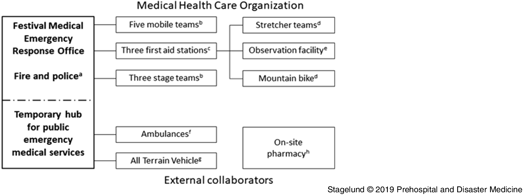
The MHCO at the Roskilde Festival 2015 (Figure 1) intended to provide attendees with a high-level of health care service. The MHCO provided care to meet the needs from minor illnesses and injuries, which typically would be handled in a normal household, up to highly advanced stabilizing treatment of critical medical conditions, including psychological aspects. As part of the service for attendees, the MHCO co-operated with a privately-owned on-site pharmacy. The on-site pharmacy had two sales locations. The MHCO’s geographical area of responsibility comprised of the fenced area marking the boundaries of the Roskilde Festival, including the camping area.
Organization of the Medical Health Care Service at the Roskilde Festival 2015.

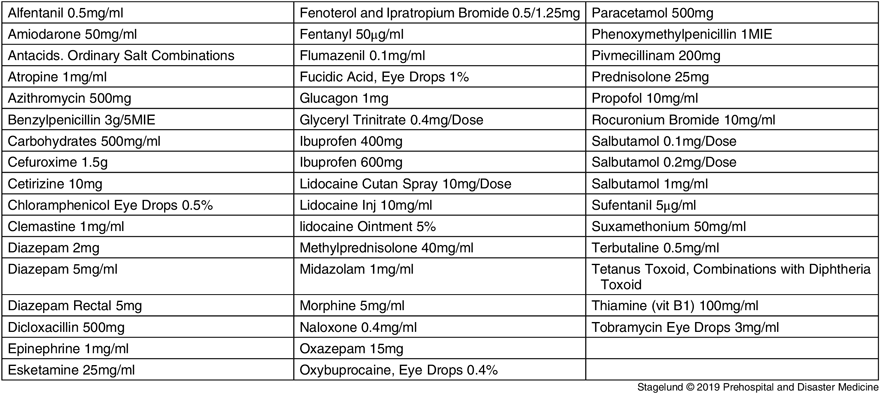
The MHCO formulary (Table 1) was available to the MHCO staff at the first aid stations, the stage teams, and the mobile teams. Medication and prescriptions were administered or handed out at the discretion of the doctor on-duty. The prescriptions could be redeemed at any pharmacy in Denmark, including the on-site pharmacy at the Roskilde Festival. At the on-site pharmacy, attendees could buy any type of prescription and over-the-counter medication available in Denmark. Distance from the gates at the outer boundaries of the festival area to the nearest other pharmacy was >2.3km.
The Medical Health Care Organization’s Formulary at the Roskilde Festival 2015

Results
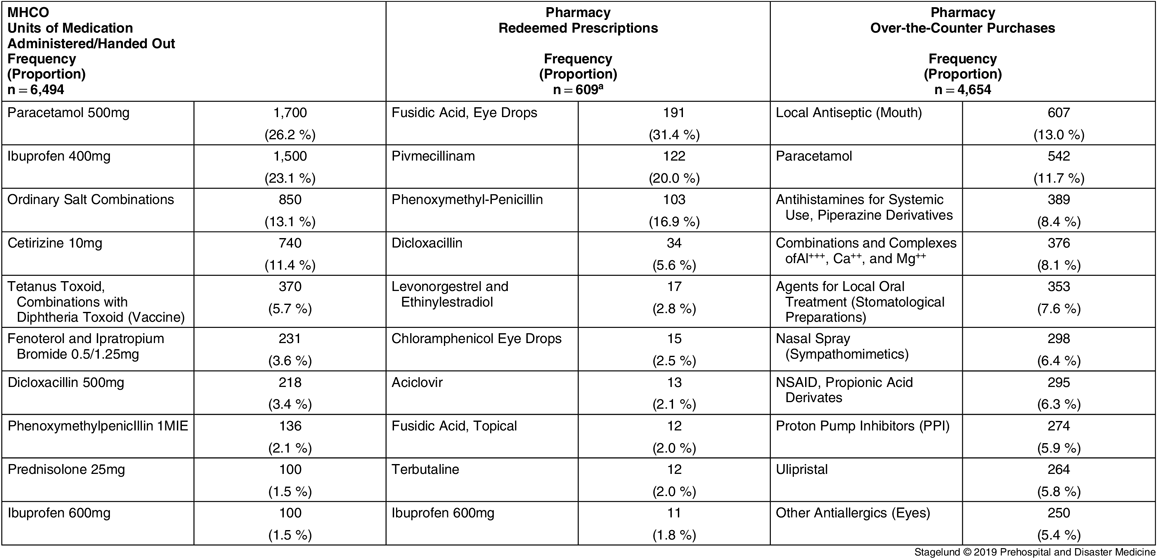
Approximately 130,000 attendees (guests and volunteers) participated in the Roskilde Festival 2015.8 In total, the MHCO administered and/or handed out 6,494 units of medication, including medication administered and/or handed out to attendees with minor illnesses and injuries (Table 2). Numerically, analgesics for mild to moderate pain relief were the type of medication most frequently administered and/or handed out by the MHCO, representing nearly 51% of the total number of units administered and/or handed out (Table 2). Thus, the MHCO administered/handed out 1,700 units of paracetamol 500mg and 1,500 units of ibuprofen 400mg (Table 2), translating to potentially 2,350 attendees (15.5%) receiving analgesics, considering the standard single dose (1,000mg of paracetamol and 400mg of ibuprofen). The MHCO used a total of 370 tetanus toxoid in combination with diphtheria toxoid vaccine (Table 2), while 115 vaccines were registered as administered to attendees (equivalent to 2.85 vaccines per 1.000 attendees).
The 10 Most Used Medications in the Medical Health Care Organization or Bought at the Pharmacy, Including Prescriptions Redeemed, at the Roskilde Festival 2015

a The MHCO issued 562 attendees with a prescription.
Overall, prescriptions on antibiotics represented more than 78% of the 609 prescriptions redeemed at the on-site pharmacy (Table 2). The 10 most frequent sold over-the-counter products at the pharmacy represented 78.6% of the total (4,654) over-the-counter purchases (Table 2). The most purchased product groups were antiseptics, analgesics, and antihistamines (Table 2).
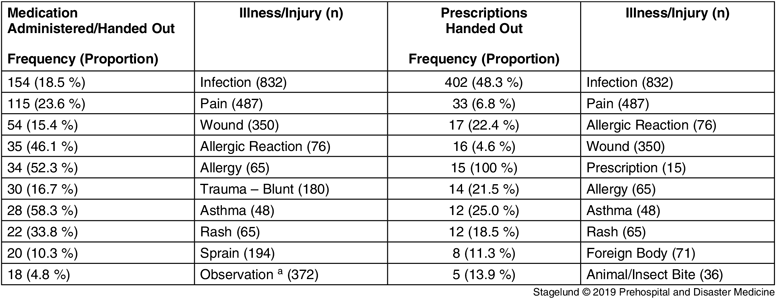
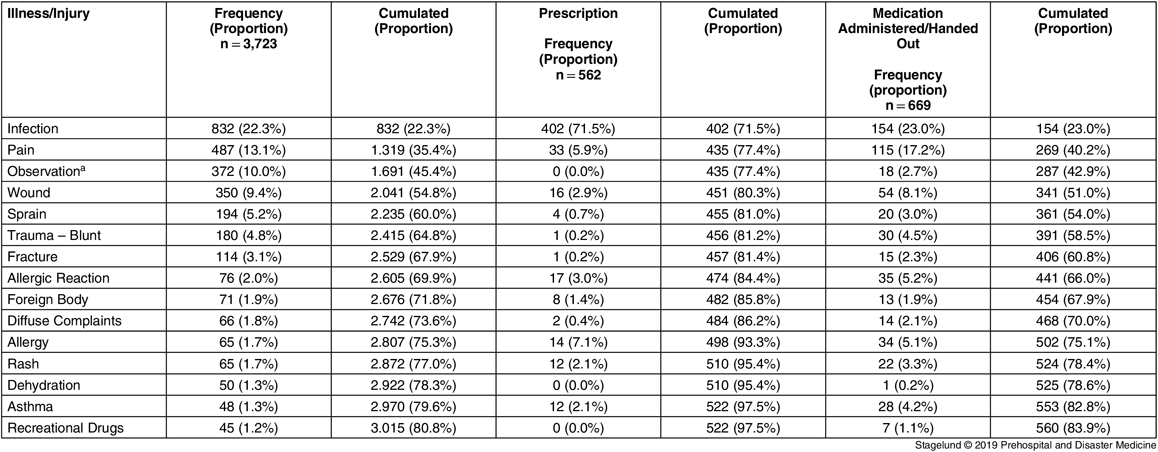
The four categories of illnesses and injuries evaluated by a doctor with the highest proportion of medication administered/handed out were asthma (58.3% of 48), allergy (52.3% of 65), allergic reaction (46.1% of 76), and rash (33.8% of 65; Table 3). Prescriptions were most frequently issued for infection (48.3% of 832), asthma (25% of 48), allergic reaction (22.4% of 76), and allergy (21.5% of 65; Table 3).
The 10 Highest Frequencies of Medication and/or Prescription Administered/ Handed Out for a Specific Illness or Injury Evaluated by a Doctor at the Roskilde Festival 2015

a Triaged to one of three observation areas because of reduced consciousness/evaluated as not to be able to take care of themselves.
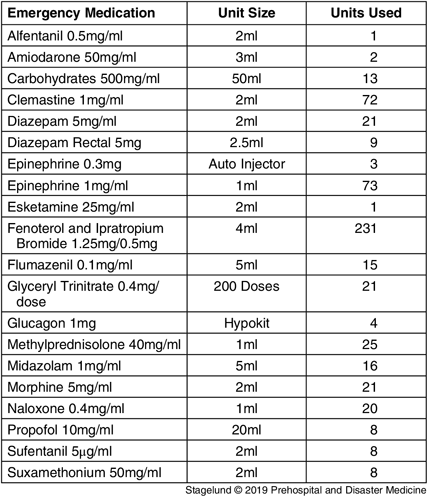
Of the 372 attendees admitted to one of the three observation facilities, 18 (4.8%) received pharmaceutical treatment (Table 3). A total of 231 units of fenoterol and ipratropium bromide 1.25mg/0.5mg were used by the MHCO during the festival (Table 4), equivalent to 1.78 units per 1.000 attendees. A total of four units of glucagon and 13 units of carbohydrates 500mg/ml were used during the festival (Table 4).
Units of Emergency Medication Useda in the Medical Health Care Organization at the Roskilde Festival 2015

a Used is defined as being administered to an attendee for medical treatment or prepared for use.
The total number of attendees contacting the MHCO was 15,133, of which 3,723 (Table 5) presented with illnesses or injuries needing evaluation, treatment, and/or observation by a doctor. Minor illnesses and injuries befell 11,410 attendees and were treated by first aid staff with different levels of training,Reference Stagelund, Jans and Nielsen 5 or nurses, without consulting a doctor.
The Top 15 Illnesses and Injuries at the Roskilde Festival 2015 Evaluated by a Doctor, Frequency, Proportion, and Attendees Requiring Pharmacological Treatment

a Triaged to one of three observation areas because of reduced consciousness/evaluated as not to be able to take care of themselves.
Of the 3,723 attendees with illnesses or injuries evaluated by a doctor, 562 received a prescription (Table 5), while 609 prescriptions were redeemed at the on-site pharmacy (Table 2). Furthermore, 669 of the 3,723 attendees evaluated by a doctor received medication during the consultation (Table 5), of which 65 (9.7%) also were given a prescription from the MHCO.
In the group of attendees evaluated by a doctor, infection, pain, need of observation, and wounds accounted for 80.3% of the prescriptions. These four categories also accounted for 51.0% of the medication administered/handed out by the MHCO and represented 54.8% of the total number of illnesses or injuries evaluated by a doctor (Table 5).
Discussion
This is the first study which describes the pharmaceutical profile at a major OMF. Prospective data from the Roskilde Festival 2015, one of the largest OMFs in Northern Europe, were used. Data include the use of medication and prescriptions issued by the MHCO and sales of over-the-counter medication from the on-site pharmacy. The primary finding is that analgesics were the medication administered and/or handed out the most, while antibiotics constituted the main bulk of prescriptions. The medication administered reflects infection and pain as the most common problems presented to the MHCO. Asthma was the illness category with the largest proportion of individuals in need of pharmacological treatment.
Antidotes to opioids and benzodiazepines were not administered routinely at the Roskilde Festival. This is consistent with good clinical practice in Denmark. Previous reports find recreational drugs are unlikely to be reversible with antidotes.9–Reference Hesse, Tutenges and Schliewe11 It was not possible to conclude whether flumazenil and naloxone were administered in combination or alone in the 18 attendees who received medication at one of the three observation facilities. However, based on the standard dose of flumazenil (0.1 – 0.3mg) and naloxone (0.4 – 0.8mg) for full reversal, the amount of flumazenil and naloxone used corresponds well with the 18 attendees who received pharmaceutical treatment in the observation areas. Previous publications have described antidotes in their formulary, but never described routine administration or number of attendees receiving antidotes.Reference Stagelund, Jans and Nielsen5, Reference Bledsoe, Songer and Buchanan12 This study on the use of medication at the Roskilde Music Festival 2015 is the first to describe quantitative use of medication, a perspective not previously addressed. Only content of formularies has been addressed, never volume. The categories “observation” and “recreational drugs” are aggregated groups and therefore do not indicate the severity of the condition. Most of the attendees within these two categories of illness would not need any treatment with medication. Attendees with reduced consciousness or evaluated as not to be able to take care of themselves were triaged to one of the three observation facilities located next to three first aid stations. The reasons for reduced consciousness or increased observation were primarily attributed to alcohol or other recreational drugs. Other reasons could be worried friends, reassurance, water, nutrition, anxiety, or similar. All attendees triaged to one of the observation facilities would then be categorized with the primary illness “observation.” The seven attendees with the primary illness category “recreational drugs” would not have been triaged to one of the observation facilities. Therefore, the medication given to the seven attendees having recreational drugs as primary medical illness category were most likely medication other than antidotes.
At the Roskilde Festival 2015, 1.3% of the attendees in-need of an evaluation by a doctor were registered as having asthma. The number of attendees evaluated by a doctor as having asthma and receiving pharmaceutical treatment yield an average of eight inhalations per treated attendee. Using the standard single dose of medication administered per treated attendee with asthma, the largest possible number of attendees treated for asthma would have been 231. This would correspond to 6.2% of attendees evaluated by a doctor (3,723) as having asthma requiring treatment. Other mass gatherings have registered between 1.4% – 8.2% of the attendees contacting the MHCO presenting with asthma,Reference Bledsoe, Songer and Buchanan12, Reference Hutton, Ranse and Verdonk13 but the number of inhalant treatments administered has not been described in previous studies.
In the MHCO, 115 attendees were registered as having received tetanus toxoid in combination with diphtheria toxoid (vaccine). This represents only 31.1% of the total amount of vaccines used by the MHCO. Likely, staff in the MHCO did not register all vaccines administered in the standardized medical record. The data in this study are not able to link the specific attendee and illness or injury to the specific vaccine administered, nor can the data give sufficient information on whether attendees already had a sufficient vaccine. Therefore, it is not possible to assess whether the 370 vaccines used by the MHCO represents a low or high number. However, the data clearly indicate a need for on-site prophylaxis using tetanus toxoid in combination with diphtheria toxoid vaccine. The vaccine should be available at all OMFs, in particular prolonged OMFs with attendees living in camping areas with reduced hygiene.
Of all the illness and injury categories, “asthma,” “allergy,” “allergic reaction,” or “rash” had the highest proportion of attendees having medication administered/handed out to them when evaluated by a doctor. The amount of epinephrine and clemastine used compared to the number of attendees treated by the MHCO for an allergic reaction or allergy indicates consistency. The mean number of units administered to these attendees was 1.05 epinephrine and 1.04 clemastine. At the Roskilde Festival 2015, epinephrine was primarily administered as inhalation.
Interestingly, the number of redeemed prescriptions was higher than the number of prescriptions issued by the MHCO. Attendees bringing prescriptions issued by their general practitioner or any other doctor before attending the Roskilde Festival could explain this. In addition, attendees admitted to the hospital may have been handed out prescriptions when discharged from hospital. Regardless of the possibility that not all prescriptions handed out by the MHCO have been documented, it seems reasonable to assume that the compliance to redeem prescriptions issued by the MHCO have been high. This could likely be related to easy access to redeem the prescription at the on-site pharmacy. The placement of an on-site pharmacy in the festival area, including the camping area, apparently constitutes an important service in order to increase the compliance of redeeming prescriptions and complying with the prescribed treatment.
The most common type of prescriptions redeemed at the on-site pharmacy was antibiotics, of which 43.2% were treatment for eye infections. This is not unexpected at an outdoor music festival with a mix of music, alcohol, and camping at the festival site, combined with a lower level of hygiene than usual. The authors are unaware of any other scientific papers describing on-site pharmacy and the use by attendees. The highest number of purchases of over-the-counter products were antiseptics, analgesics, and antihistamines. This is to be expected with attendees accommodated several days at the camping area, with reduced hygiene, and summertime with pollen and alike allergens. The data clearly indicate a need for an on-site pharmacy at prolonged OMFs in order to increase the compliance of redeeming prescriptions and complying with the prescribed treatment, as well the attendees handling simple minor issues themselves.
When deciding on the content of the formulary at any given mass gathering, several factors may be taken into consideration. These are, but not limited to, distance to nearest hospitals and their level of competence, evacuation time to hospitals by ambulance/helicopter, what type of non-life-threatening conditions to treat on-site, level of competencies of festival medical staff, expected incidence and type of illness and injuries, and treatment of acute, life-threatening illnesses and/or injuries. As an example, it was decided by the medical director of the MHCO that attendees with dysregulated diabetes and in-need of treatment with insulin would be admitted to the hospital. This would also apply to other illnesses such as supraventricular re-entry tachycardia needing adenosine, severe hypertension, and recurrent vomiting. Any type of illness and or injury in need of intensive care or prolonged observation and treatment by medical staff would be admitted to a hospital. The MHCO 2015 formulary therefore contained types of medications that are used in the acute setting or simple treatments. When deciding the content of the formulary at a given mass-gathering event, the above factors should be taken into account.
Limitations
The study has some methodological limitations. The data on the use and prescription of medication at the Roskilde Festival 2015 were aggregated, without the possibility to link the administered and prescribed medication to the individual attendee’s injuries, hindering a more detailed analysis. This was caused by data being collected in parallel by two systems where pharmacological data were only collected anonymously. Although the study was prospective with well-organized data collection, missing data because of severe injuries requiring direct transport to hospital are possible. The Danish Health Authority did not approve follow-up by collecting data from prehospital medical records or hospital medical records on attendees referred to a hospital for diagnostics and or treatment. Furthermore, registration of a unit of medication having been used in the MHCO is not a guarantee that the medication has been administered/handed out to an attendee. The two parallel data collections were necessary due to the anonymous pharmacological registration, which was combined with the prospective database of illnesses or injuries.
Future Research
For future research, the registration of attendee data and injury must be linked to the medication and/or prescription. The collection of data on injured attendees (including medicine) should be standardized between the OMFs and other mass-gathering events in order to get access to big data concerning the health care service. Such internationally (or nationally) combined data would potentially provide data that will be of value for the planning of the medical set-up at future OMFs, and other similar mass-gathering events. Access to big data would provide the possibility to develop a predictive analysis system for the planning of the level of health care service, including medication, needed at a mass-gathering event.
Conclusion
The most utilized medications were analgesics and antibiotics. Antibiotics were the type of medication prescribed the most. In regard to prolonged OMFs, the data indicate a need for on-site prophylaxis using tetanus toxoid in combination with diphtheria toxoid vaccine and an on-site pharmacy. When deciding the content of the formulary at a given mass-gathering event, a range of factors should be taken into account: evacuation time by ambulance/helicopter to hospitals with the level of competence needed; types of conditions to be treated on-site; level of competencies of the medical staff; expected incidence and type of illness and injuries; and treatment of acute, life-threatening illnesses and or injuries.
Acknowledgements
This study could not have been performed without the dedication of the many volunteers in the MHCO at the Roskilde Festival 2015. The authors are grateful for their support in collecting the raw data.
Conflicts of interest
All authors have completed the ICMJE uniform disclosure form at www.icmje.org/coi_disclosure.pdf and declare: no support from any organization for the submitted work; no financial relationships with any organizations that might have an interest in the submitted work in the previous three years; and no other relationships or activities that could appear to have influenced the submitted work.