INTRODUCTION
The oval squid, Sepioteuthis lessoniana, is a complex species (Izuka et al., Reference Izuka, Segawa, Okutani and Numachi1994, Reference Izuka, Segawa and Okutani1996) that is widely distributed throughout the Indo-Pacific (Okutani, Reference Okutani1995). Sepioteuthis lessoniana is a valuable fishery resource across its range, and it is also becoming an important model system for neurobiological and behavioural research (Ikeda et al., Reference Ikeda, Sakurazawa, Sakurai and Matsumoto2003). For these reasons, there has been growing interest in the development of culturing techniques for S. lessoniana.
The population dynamics and reproduction of S. lessoniana have been studied in nature (Segawa, Reference Segawa1987; Ueta & Jo, Reference Ueta and Jo1989; Ueta et al., Reference Ueta, Tokai and Segawa1999; Ueta, Reference Ueta2000), and such studies have clear relevance for culturing efforts. For example, due to the broad geographical distribution of S. lessoniana, a temperature-related hypothesis explaining patterns of reproduction and life span in nature has been formulated: S. lessoniana in warmer equatorial waters have a relatively short life span and small adult body size (i.e. they have a ‘hot’ life history strategy) compared to squid in cooler subtropical waters, which have longer life spans and larger adult body sizes (i.e. a ‘cool’ strategy) (Jackson & Moltschaniwskyj, Reference Jackson and Moltschaniwskyj2002).
The implications of this hypothesis for culturing S. lessoniana are obvious, but despite substantial research on culture techniques (Tsuchiya, Reference Tsuchiya1982; Lee et al., Reference Lee, Turk, Yang and Hanlon1994; Nabhitabhata, Reference Nabhitabhata1996; Forsythe et al., Reference Forsythe, Walsh, Turk and Lee2001; Walsh et al., Reference Walsh, Turk, Forsythe and Lee2002; Ikeda et al., Reference Ikeda, Ueta, Sakurazawa and Matsumoto2004), numerous questions remain regarding maturation and spawning of this species in captivity. For example, in previous studies, reported data on reproduction have been limited to days of first spawning (Forsythe et al., Reference Forsythe, Walsh, Turk and Lee2001) and/or squid body size at first spawning (Walsh et al., Reference Walsh, Turk, Forsythe and Lee2002). This lack of detailed reproductive information for cultured S. lessoniana has made it impossible to test Jackson & Moltschaniwskyj's (2002) hypothesis. Furthermore, to our knowledge, comparisons between cultured and wild-caught S. lessoninana taken from the same geographical region have never been done.
As part of our ongoing research on culturing techniques for this species, we have compared the reproductive patterns of captive and wild individuals throughout their life span. The objective of the present study was to compare rates of maturation, reproductive events and life span between cultured squid (raised at relatively high water temperatures) and wild-caught squid (which experienced seasonal changes of water temperature, including low winter temperatures). Forsythe et al. (Reference Forsythe, Walsh, Turk and Lee2001) noted that S. lessoniana collected from different geographical regions grew differently under identical thermal regimes in culture. Therefore, to make valid comparisons, it is critical to compare cultured squid and wild-caught squid from the same geographical region. To this end, we cultured three consecutive generations of S. lessoniana originally collected from Tokushima Prefecture, Japan, observed their reproductive processes, and compared these squid to wild S. lessoniana sampled from the same region.
MATERIALS AND METHODS
Collection and transport of squid for culture
The parental generation (GP) for the culturing trial consisted of 12 sub-adult Sepioteuthis lessoniana collected between October 2000 and November 2000 by a set net in the coastal waters of Tokushima Prefecture, Japan. They were transported by home delivery service (Yamato Co. Ltd) to the RIKEN Brain Science Institute in Saitama Prefecture, Japan, within 23 hours (see Ikeda et al., Reference Ikeda, Ueta, Sakurazawa and Matsumoto2004 for details). Spawned eggs from Gp were used to establish for the first generation (G1). We then obtained spawned eggs from G1, which were used to establish the second generation (G2).
Squid culture facilities
Three types of aquarium for the culturing trails were used: (i) 50-l cylindrical aquaria (Multi-hydense®, AQUA INC.) were used to raise egg cases, paralarvae and young; (ii) a small, 1700-l circular tank (small CT) was used to rear young and sub-adult squid; and (iii) a large, 10,000-l circular tank (large CT), connected to an algae tank (to decrease nitrogen levels) was used to maintain sub-adults and adults. Each tank was connected to a filter unit, a cooler and heater unit, and a UV sterilizer. Natural seawater collected from Hachijo Island, Japan, was used in all tanks. The details of these rearing systems are fully described elsewhere (Ikeda et al., Reference Ikeda, Sakurazawa, Sakurai and Matsumoto2003, Reference Ikeda, Sakurazawa, Ito, Sakurai and Matsumoto2005).
Maintenance of water quality and environments
Water temperature during culturing trials was maintained between 21°C and 23°C. Salinity was adjusted to <37‰. Water temperature, salinity and quality (pH, ammonia, nitrite and nitrate) were continuously monitored. Water temperature and pH were measured with an electric pH/temperature meter. Salinity, ammonia, nitrite and nitrate were measured with a refractometer and a commercially available testing kit (Tetra test, Tetra Co. Ltd). We exchanged fresh seawater in variable amounts (4–10 l for the cylindrical tank, 10–200 l for the small CT and large CT) at irregular intervals. Similarly, freshwater was added to the tanks in variable amounts (4–10 l for the cylindrical tank, 10–200 l for the small CT and large CT) at irregular intervals to keep salinity levels constant.
In all experiments, fluorescent illumination was always present to avoid squid becoming stressed under darkness, in addition to the natural day/night cycle through the windows for the small and the large CT systems. For 40 days in the G2 trial, the algae tanks were illuminated by three 400-W metal halide bulbs (12L:12D) to enhance photosynthesis (this also lit a part of the large CT system). The cylindrical aquaria were located in a windowless room; light was provided only by fluorescent illumination with a 12L:12D cycle. Additional fluorescent lighting was used during feeding and maintenance procedures (i.e. feeding, cleaning, observation, etc.; 1–4 h on each occasion).
Water quality and culture environment were as follows: temperature, 21.1–23.8°C (mean±SD, 22.8±0.48°C); salinity, 32.5–40‰ (35.8±1.24‰); pH, 7.53–8.45 (7.86±0.19); ammonia, 0–35 mg l−1 (4.72±11.7 mg l−1. Note: ammonia exceeded 1.50 mg l−1 only between 4 April and 18 April 2001); nitrite, 0.3 mg l−1 (minimum detection level for the kit); nitrate, 0–250 mg l−1 (114±73.3 mg l−1).
Diets and feeding
Both live and dead organisms as food for captive S. lessoniana were used. Diet composition changed as squid grew. Newly hatched juveniles were fed live prey (adult mysids, Neomysis japonica; guppy fry, Poecilia reticulata; and medaka fry, Orizias latipes). Young squid were fed a mixture of live organisms (adult mysids, N. japonica; adult guppy, P. reticulata; adult medaka, O. latipes; freshwater shrimp, Palaemon paucidens; and post-larvae of Kuruma prawn, Penaeus semisulcatus) and frozen organisms (fry of Japanese sardine, Sardinops sp.; and Japanese anchovy, Engraulis sp.). Sub-adult and adult squid were also fed a mixture of live (freshwater shrimp, Palaemon paucidens; goldfish, Carassius auratus; ayu, Plecoglossus altivelis; loach, Misgurnus anguillicaudatus; and common brackish goby, Acanthogobius flavimanus) and frozen organisms (blue sprats, Spratelloides gracilis; and horse mackerel, Trachurus japonicus). Squid were fed 1–3 times a day ad libitum.
Collection of wild squid and environmental data
To compare maturation, growth and life span between cultured and wild S. lessoniana, we collected S. lessoniana (total 3479 squid: male, 1591; female, 1757; unknown sex, 131) from coastal waters of Tokushima Prefecture, Japan (134°30′E–134°40′E 33°30′N–33°40′N) between October 2000 and May 2002 using a set net. Squid with unknown sex were arbitrarily designated males and females in a 1:1 ratio according to Ueta & Jo (Reference Ueta and Jo1989) for later analysis. Water temperature and salinity at 10 m depth at the collection site were measured monthly between October 2000 and May 2002 with a CTD (FSI Co. Ltd).
Additional captive squid data
Additional data from two different rearing trials for S. lessoniana were used for comparison. These squid were raised from spawned eggs that were collected in May 2001 and August 2002 from coastal waters of Tokushima Prefecture, Japan, and transported to the RIKEN. Squid originating from these eggs (Tokushima, 2001; generation, TS2001; Tokushima, 2002; generation, TS2002) reached maturity and spawned but we did not obtain a subsequent generation. Methods and facilities for these rearing trials were as described above.
Measurement of squid body dimensions
For both captive and wild-caught S. lessoniana, the following body dimensions were measured: dorsal mantle length (ML), wet body weight (BW) and wet weight of gonads (male, testis; female, ovary and oviducts with ova). Gonad weights were measured for squid caught between April 2001 and March 2002 (male, 173; female, 175). The following indices were calculated: testis index (TI, testis wt/BW ×100), gonad somatic index for female (GSI, (ovary wt + oviduct wt)/BW ×100), ovary index (OVI, ovary wt/BW × 100) and oviduct index (ODI, oviduct wt/BW ×100). For captive squid, measurements were recorded after death. Daily survival rate was calculated as the percentage of live squid that were left in each tank each day compared with the number alive on the first day of the experiment.
RESULTS
Environments
Temperature was stable throughout the culturing experiment. This is particularly clear when culture temperature is compared with the temperature of the natural habitat of Sepioteuthis lessoniana. Water temperature in captivity was almost constant at ~23ºC whereas water temperature in nature fluctuated seasonally (e.g. 14–17ºC in March, 26–27ºC in August and September) (Figure 1).
Temperature regime for Sepioteuthis lessoniana measured in captivity (solid line) and estimated in nature (dotted line), and progress of dorsal mantle length (ML), female gonad somatic index (GSI) and male testis index (TI) along with date compared between cultured and wild-caught squid (X, cultured squid with unknown sex; •, cultured squid; ○, wild-caught squid). Data for wild-caught squid are expressed as means with maximum and minimum values. Lines in the ML graph show hypothesized growth lines.

Survival and growth
In GP, every squid achieved maturity. Their final sizes at adult stages (ML 203–330 mm) were almost equivalent to mature S. lessoniana from nature (Figure 1).
In all cultured generations, males grew larger than females. This was also observed in wild-caught S. lessoniana (Figure 1), as seen in previous studies (Ueta et al., Reference Ueta, Tokai and Segawa1999; Ueta, Reference Ueta2000). In our culturing trials, we did not obtain any very large individuals (>350 mm ML). By contrast, individuals >350 mm ML were seen in nature, but at low frequency (2.2%; Figure 1). Variation in body size was evident within generations of cultured squid (see, for example, the male squid in G1; Figure 1). Size variation appeared in the young and became more extreme in the adult stage; this also occurred in S. lessoniana in nature (Figure 1).
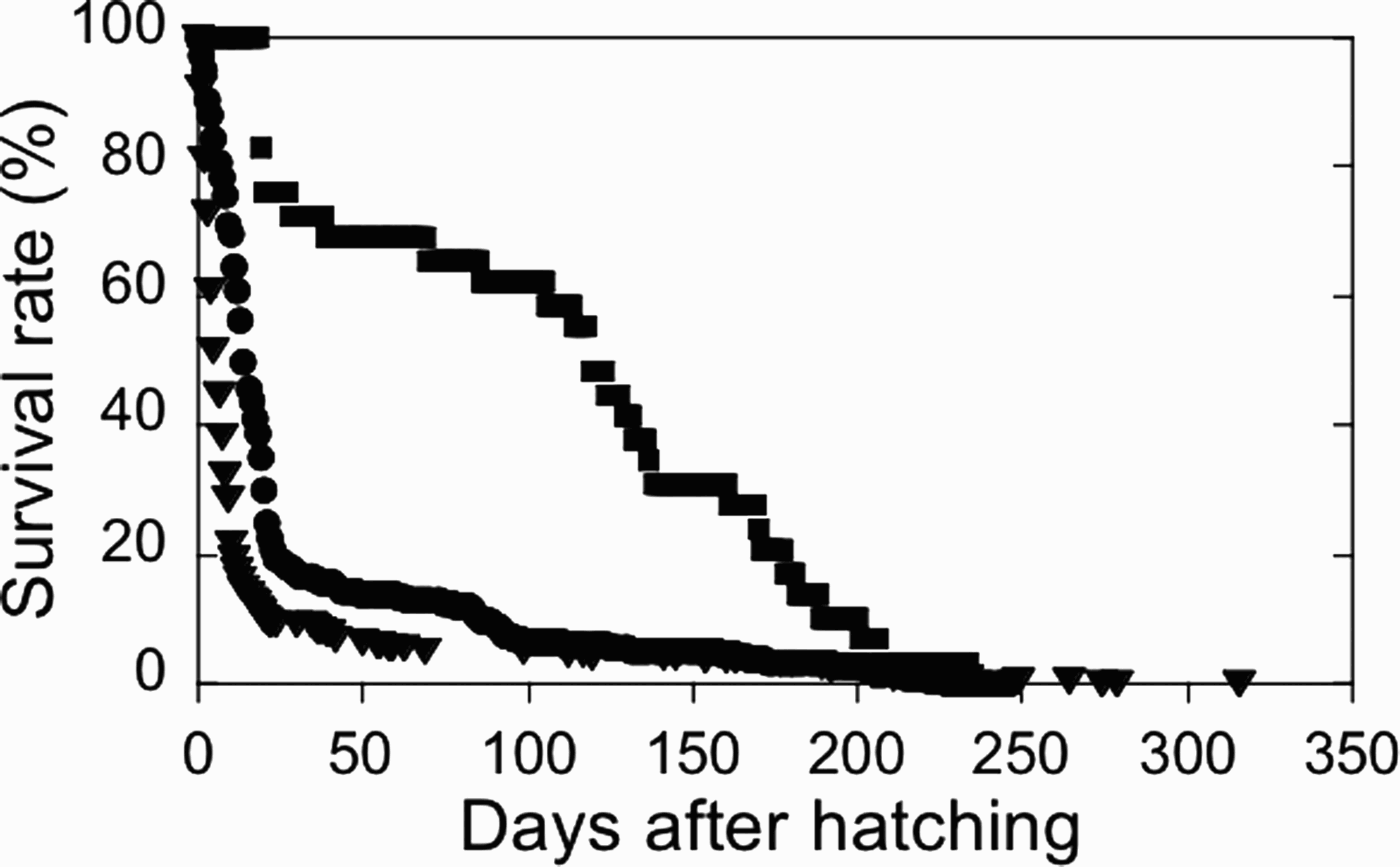
Survivorship can be measured for both G1 and G2. However, the numbers of hatchlings in these two generations were extremely different (G1, N = 833; G2, N = 29). For this reason, survivorship of these two generations should not be directly compared. Therefore, we also show survivorship of TS2002 (hatchlings, N = 449) (Figure 2). A large decrease in survivorship occurred in the first 30 days after hatching (down to 10–20%; Figure 2). In most cases, cannibalism was the main cause of death of young squids. In contrast, survivorship of G2 seemed relatively higher. This may have been due to the low concentration of squids per tank, thus minimizing cannibalism.
Survivorship of cultured Sepioteuthis lessoniana (•, G1; ■, G2; ▾, TS2002).

Maturation and spawning
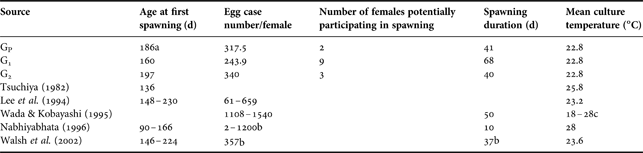
Captive S. lessoniana achieved maturity and produced egg cases in all culturing trials (Table 1).
Measurements relating to spawning for cultured Sepioteuthis lessoniana (GP, parental generation; G1, first generation; G2, second generation) between 2000 and 2002, and previous culturing trials.

The maturation process progressed similarly in all culturing trials. Males reached maturity 140 days after hatching at the latest, and began copulation with females. Numerous spermatophores were attached on the outer lips of the females, with spermatozoa stored in the seminal receptacles of the females (recognizable as a white spot). On one occasion, a mature male GP squid (207 mm ML) was observed with numerous spermatophores on his outer lip, just as in a female. Once copulation began, it continued until the final phase of each culture generation. Captive S. lessoniana reached maturity earlier than wild-caught individuals. In wild-caught male S. lessoniana, mature specimens appeared in April 2001 and were evident until September 2001. These squid shared the same recruitment origin as GP. Therefore, male squid in GP matured 3–8 months earlier than wild-caught squid collected from April through September 2001 (Figure 1). In G1, maturity of males was reached 5–6 months post-hatching (Figure 1). This is at least six months earlier than wild-caught male squid. Female GP squid matured 3–8 months earlier than seen in wild-caught squid collected between May and October 2001, if we assume that GP squid were born on 30 June 2000 (based on a previous survey of wild-caught squid; Ueta, Reference Ueta2000). In both G1 and G2, female S. lessoniana were mature within six months after hatching (Figure 1).
Spawning commenced at 156 days (GP) and 196 days (G1) post-hatching (Table 1). In GP, the same two females spawned on eleven occasions, and a total of 635 egg cases was obtained (Table 1). Some of these occasions were single females spawning more than twice within their life span. After these multiple spawning events, the females died. On at least one occasion in G2, we observed a single female that had spawned twice.
Comparison of reproductive indices between captive and wild-caught squid
There were similarities as well as differences in the progress of reproductive indices between captive and wild-caught S. lessoniana. Both in wild-caught and cultured squid, males matured earlier than females. This was shown by the fact that while male TI values (reflecting the state of spermatogenesis) increased, female GSI values remained low (Figure 1). Male TI values showed wide variation after males reached maturity, both in captive and wild-caught squid (Figure 1). This variation in TI was observed after the squid reached >150 mm ML. In captivity, variation in TI occurred in <150-mm ML squid, which indicates that squid achieved maturity at a smaller size in captivity than in the wild (Figure 1).
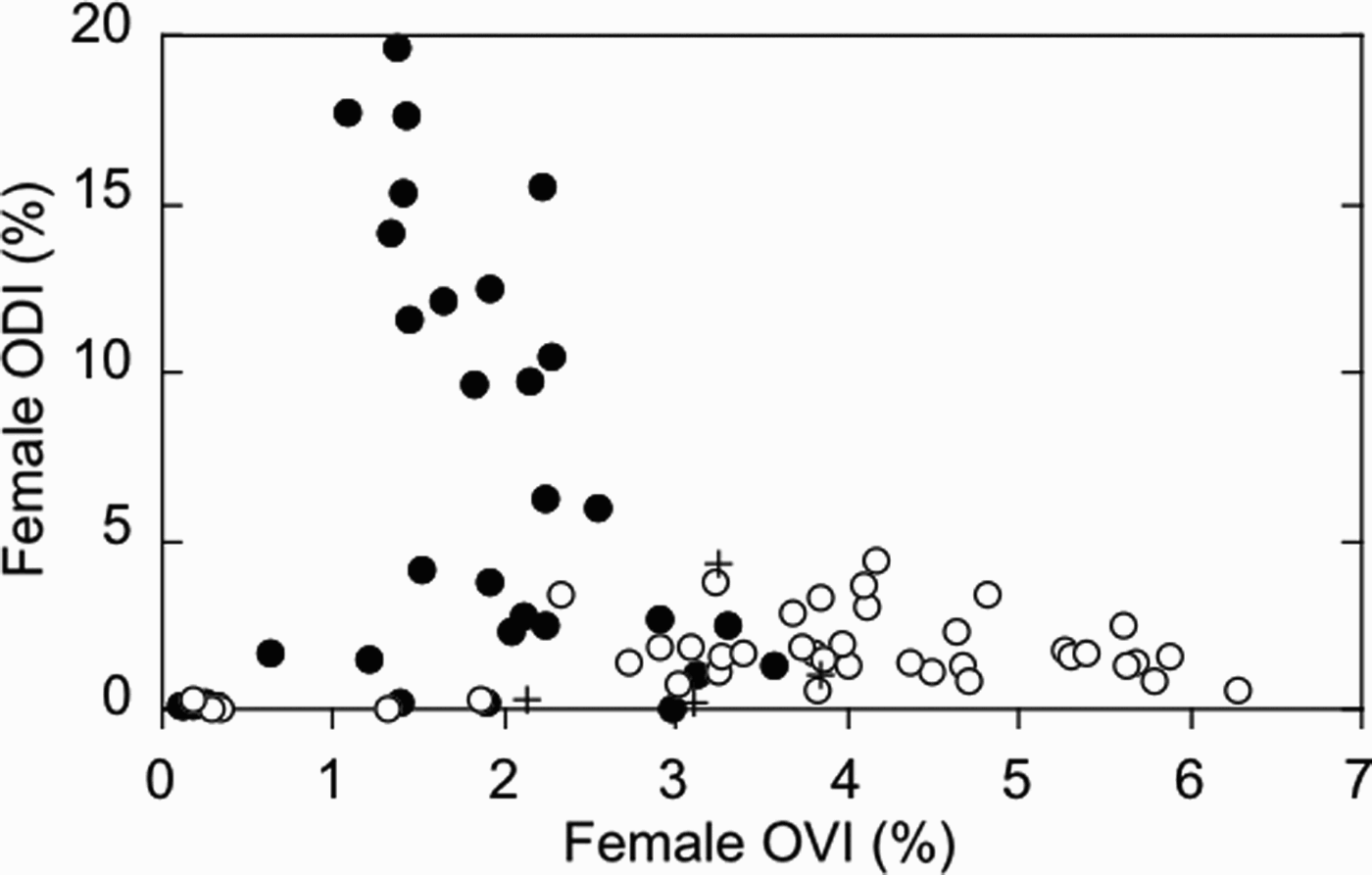
In females, GSI varied widely in individuals with ML >150 mm, the size at which they achieved maturity. Some captive females showed higher GSI values than wild-caught females (Figure 1). This may be a function of captive females accumulating more ova in the oviduct compared to wild-caught females (in nature, 55–303 (N = 7); in captivity, 4–2096 (N = 18)) during the spawning phase. In captivity, spawning females had low ODI values, whereas other females had high ODI values (Figure 3). Wide variation of ODI (0–5%) was observed during the spawning period in both wild-caught females and captive females (Figure 3).
Comparison of female reproductive indices (ovary index (OVI) and oviduct index (ODI)) between cultured (TS2001 and TS2002 included) and wild-caught Sepioteuthis lessoniana. •, cultured squid, ○, wild-caught squid, +, spawned females in captivity.

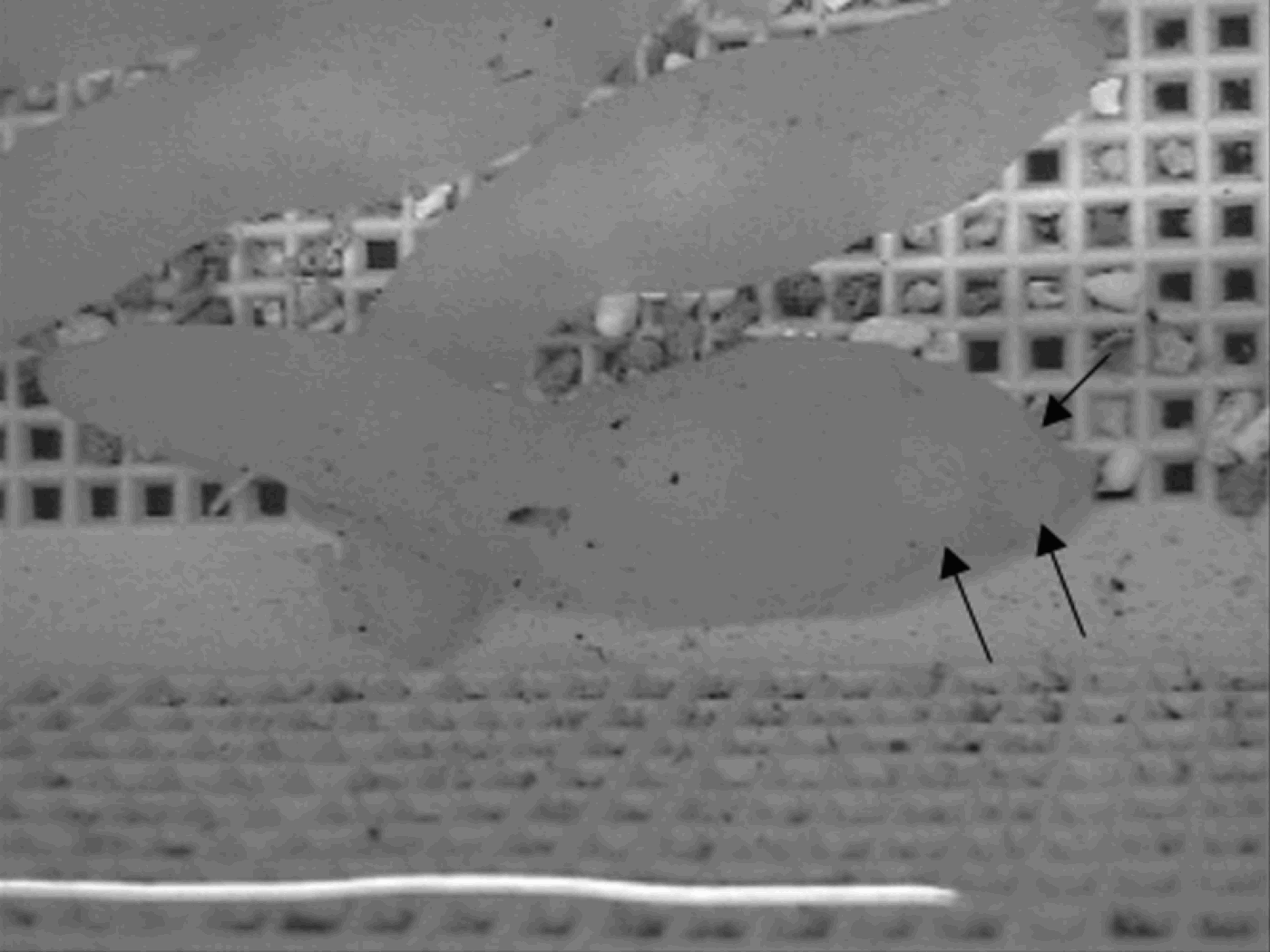
Abnormality in the structure of egg cases was observed for eggs spawned by G1 and G2 females. The outer gelatinous coat (i.e. egg sheath) looked normal but the arrangement of ova in the egg sheath was abnormal. Normally, ova are evenly distributed throughout the egg case, but in the egg cases produced by G1 and G2 females, ova were connected at one end of the egg sheath (Figure 4). The frequency of this abnormal arrangement of ova in the egg cases was relatively high for G2 females (e.g. abnormal arrangement, 47.4%; no ova present, 9.7%; normal arrangement, 37.4%; unknown, 5.4%; data were obtained from 721 egg cases produced by G2 females), and most of the abnormally arranged eggs did not develop.
Egg cases spawned by cultured Sepioteuthis lessoniana, with arrows indicating ova. Note that one end of the egg case is widened due to the abnormal distribution of ova.

Life span and final body size in captivity
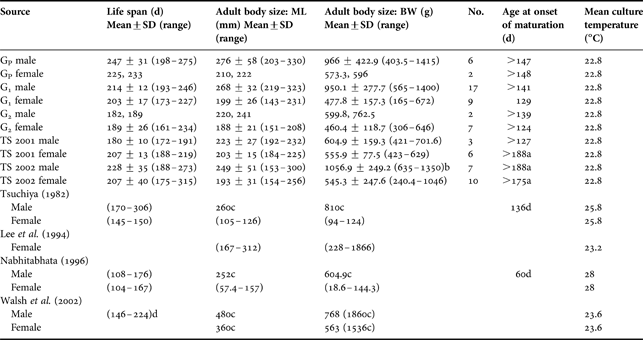
Life span for cultured individuals ranged from 161 days to 315 days (Table 2). Life span did not differ between sexes.
Life span and adult body size expressed by dorsal mantle length (ML) and body weight (BW) of cultured Sepioteuthis lessoniana (GP, parental generation; G1, first generation; G2, second generation, TS2001, TS2002, generation raised from naturally collected eggs), and the previous culturing trials.

The final body size ranges were 153–330 mm ML/403.5–1415 g BW for males, and 151–256 mm ML/165–1046 g BW for females (Figure 1; Table 2).
DISCUSSION
Maturation and life span: captivity versus nature
It is difficult to determine the timing of maturation because we did not periodically sample the captive squid. However, based on the duration of immature individuals and the age of mature individuals that died in captivity, the time to maturity can be estimated (Table 2). These estimates did not differ greatly between culturing trials, and are similar to those seen in other culturing trials (Table 2). In nature, Sepioteuthis lessoniana is estimated to mature at >7 months (~210 days), based on monthly profiles of GSI data (Ueta & Jo, Reference Ueta and Jo1989; Ueta, Reference Ueta2000). Comparing this value with the estimated value in the present study (~140 days), captive squid matured at least two months earlier than wild-caught individuals. Spawning occurred between 160 and 197 days in our study, similar to other culturing trials for S. lessoniana (Table 2). This is at least three months earlier than seen in the wild-caught squid (Ueta & Jo, Reference Ueta and Jo1989; Ueta, Reference Ueta2000). Based on ML frequency analysis, the life span of wild-caught S. lessoniana in temperate waters has been estimated to be one year (Ueta, Reference Ueta2000). The life span of cultured S. lessoniana in the present study (172–275 days for males and 161–315 days for females) is similar to life spans seen in other culturing trials (Table 2).
Precocious maturation is known to occur in captive cephalopods, and changes in various environmental parameters (i.e. light, temperature or food availability) may result in acceleration of gametogenesis in captive animals (Mangold, Reference Mangold and Boyle1987). Van Heukelem (Reference Van Heukelem and Stancyk1979) established the combination of factors (light, temperature and food availability) that lead to early or late spawning in octopuses (and perhaps also in cuttlefish and squid). In the present study, although final body size of cultured individuals did not greatly differ from that of wild-caught individuals, early spawning seemed to occur in all culturing trials. Apart from nutrition, water temperature seemed to be the main difference between cultured and wild squid. In our study, captive S. lessoniana were exposed to a very narrow temperature range (21.1–23.8°C) throughout their life span, while wild-caught S. lessoniana experienced a wide range of temperatures (e.g. 14.0–27.4°C; Figure 1).
Since S. lessoniana is widely distributed in shallow waters throughout the Indo-Pacific (Okutani, Reference Okutani1995), the influence of environmental variables on maturation and life span can be examined. Jackson & Moltschaniwskyj (Reference Jackson and Moltschaniwskyj2002) found that size, maturation and life span differed between S. lessoniana populations inhabiting equatorial and subtropical waters, and concluded that ‘the “hot” strategy produced a short life span and small body size, and the subtropical “cool” strategy produces a longer life span and a much larger body size’. They also reported that even among individuals from the same population, age at maturity differed between seasonal populations of S. lessoniana; individuals born in the winter matured faster than individuals born in the summer (Jackson & Moltschaniwskyj, Reference Jackson and Moltschaniwskyj2002). In our study, the captive temperature range was very narrow and thus simulated tropical or equatorial water, although the actual temperature was slightly cooler than seen in tropical waters in nature.
The fact that higher temperatures induce early maturation has been reported previously for cultured S. lessoniana (Forsythe et al., Reference Forsythe, Walsh, Turk and Lee2001), although in that study the maximum life span was independent of temperature. Forsythe et al. (Reference Forsythe, Walsh, Turk and Lee2001) proposed metabolic compensation as part of their working hypothesis as to why S. lessoniana from temperate waters matured early at warmer temperatures. Wood & O'Dor (Reference Wood and O'Dor2000) showed that the positive correlation between size at maturity and life span seen in coleoid cephalopods is primarily a correlation between size at maturity and the temperatures at which different species live. Since S. lessoniana is distributed over a very wide latitudinal range and thus experiences various temperature regimes, the present study supports the observation that temperature can affect life span in a single species. However, in our study, final body size was not found to differ between cultured squid and wild-caught squid. This was also observed in Forsythe et al.'s (2001) study. Thus higher water temperature might accelerate maturation and lower life span but not determine final body size in S. lessoniana. However, the fact that cultured male S. lessoniana matured at a smaller size (<150 mm ML) than wild-caught males shows that continuous warmer temperature can induce maturity at a smaller size, supporting Jackson & Moltschaniwskyj's (2002) ‘hot’ strategy hypothesis.
Spawning process
Wada & Kobayashi (Reference Wada and Kobayashi1995) first reported multiple spawning by an individual female S. lessoniana in captivity, and this has also been documented in other loliginid squids (e.g. Photololigo sp. (Moltschaniwskyj, Reference Moltschaniwskyj1995) and Doryteuthis pealei (Maxwell et al., Reference Maxwell, Macy, Odate and Hanlon1998)). The wide variation in ODI during the spawning period might show females in the pre- or post-spawning phase (see Figure 3). In the present study, a single female S. lessoniana was calculated to produce 244–340 egg capsules during her series of spawning events (see Table 1). The maximum number of egg capsules produced by a single female in previous culture trials for S. lessoniana is shown in Table 1. The present study's egg capsule number is similar to Lee et al.'s (1994) and Walsh et al.'s (2002) numbers. However, some females in our study may have actually spawned a higher number of egg capsules than estimated because we included all females from a tank during the spawning period, and some of these may never have spawned.
The average number of ova in the oviduct was much larger for cultured S. lessoniana than for wild-caught individuals. This is also true for S. lessoniana caught from another location (e.g. waters adjacent to Townsville, Australia, maximum 298; Pecl, Reference Pecl2001). Wada & Kobayashi (Reference Wada and Kobayashi1995) revealed that the longer the duration between spawning bouts, the larger the number of ova spawned during each bout. In our study, some factors such as strong lighting by three 400-W metal halides may have prevented females from spawning, resulting in a longer duration between spawning bouts and thus producing an extreme number of ova in the oviduct (‘over-ovulation’).
Wada & Kobayashi (Reference Wada and Kobayashi1995) reported that the number of hatchlings of captive S. lessoniana decreased (from 66.7–97.8% to 22.7%, or from 77.1–94.7% to 5.6%) after the removal of male squid from tanks where females were kept. Since the present study provided mature males for females throughout their life span, there must be a different reason for the lower numbers of hatchlings seen in G1 and G2. Clearly, the lower numbers of hatchlings in G1 and G2 was caused by the cessation of embryonic development, probably related to the irregular arrangement of ova seen in many egg cases. Walsh et al. (Reference Walsh, Turk, Forsythe and Lee2002) also reported a decrease in egg viability in their culturing trial (from 34.9% (parental generation) to 5.73% (G1), 13% (G2), 6.24% (G3), 1.58% (G4), 1.71% (G5), 1.56% (G6)), although they did not describe the arrangement of the ova in the egg cases. We could not determine the main cause for the irregular arrangement of ova in the egg cases.
CONCLUSION
By comparison between cultured and wild-caught Sepioteuthis lessoniana throughout the life span, we have demonstrated precocious maturation and a shorter life span in cultured squid. This might relate to the thermal conditions used in our study, and thus our experiments also provide insight into the geographical gradient seen in the maturation process and life span of this species throughout its range.
ACKNOWLEDGEMENTS
We acknowledge S. v. Boletzky and G. Pecl for reading the first draft manuscript. We thank K. Ohkawa, N. Kobayashi, Y. Kayama, K. Ishii and K. Matsui for their cooperation in taking care of squid. This project was financially supported by RIKEN Brain Science Institute and Grant-in-Aid for Young Scientists (B) (No. 14760127), the Ministry of Education, Culture, Sports, Science and Technology to which we are most grateful.