I. INTRODUCTION
Hierarchically porous materials are of great interest for various applications such as catalysis, advanced batteries, and solar cells.Reference Su, Sanchez and Yang1,Reference Li, Fu and Su2 Currently, there are several classes of these materials available, such as metal foams,Reference Banhart3 aerogels, xerogels,Reference Biener, Stadermann, Suss, Worsley, Biener, Rose and Baumann4 and a variety of materials produced by spinodal decomposition.Reference Nakanishi, Bao-Lian, Sanchez and Xiao-Yu5 These materials are produced by direct synthesis from precursors. For many materials for which no direct templating method is available, it is often possible to produce them by nanocasting.Reference Ko and Ryoo6–Reference Ren, Ma and Bruce13 Nanocasting uses a hard template, usually either silica or carbon, as a mold for another material. The mold is then removed leaving a replica. For hierarchically porous materials, it is possible to replicate only the mesoscale structure, giving a negative replica at the mesopore level and positive replica at the macropore level of the original structure.
Typical synthesis methods for hierarchically porous materials yield powders. However, a monolithic form consisting of a macroscopic single piece is advantageous in some applications. In catalysis, a monolithic form allows for easy separations of products from the catalyst,Reference Linares, Hartmann, Galarneau and Barbaro14 and in separations, hierarchically porous stationary phases are significantly faster than traditional packed columns.Reference Cabrera, Lubda, Eggenweiler, Minakuchi and Nakanishi15,Reference Tanaka, Nagayama, Kobayashi, Ikegami, Hosoya, Ishizuka, Minakuchi, Nakanishi, Cabrera and Lubda16 We have demonstrated the use of nanocasting to produce hierarchically porous monoliths of carbon,Reference Taguchi, Smått and Lindén17 metal oxides,Reference Smått, Weidenthaler, Rosenholm and Lindén18 and most recently some metals.Reference Smått, Sayler, Grano and Bakker12
A significant limitation in the field of nanocasting is the ability to remove the silica template after formation of the silica-material composite. Currently, aqueous base or hydrofluoric acid is used to remove the silica. This means that for amphoteric materials, such as zinc oxide, it is difficult to remove the silica template without losing the nanostructure of the replica.Reference Polarz, Orlov, Schüth and Lu19,Reference Waitz, Tiemann, Klar, Sann, Stehr and Meyer20 One method that has been successfully used to produce these materials is the double templating method.Reference Tiemann21 In this method, the silica is first replicated into carbon and then the resulting carbon replica is used as a template in a second nanocasting step to give the desired end product. Although cumbersome, this approach has proven to be effective for some materials but can lead to lower surface areas and destruction of the nanostructure due to the high temperatures required to burn off carbon and the amount of energy that is released from the process. A mild (pH 12) basic etch has been successfully used on zinc oxide nanocast into thin silica films,Reference Lepoutre, Julián-López, Sanchez, Amenitsch, Linden and Grosso22 but the slow rate of etching and limited hydroxide ion concentration mean that this method is unlikely to be suitable for etching of bulk materials such as powders or monoliths. Hydrofluoric acid can be used to etch some metal oxide/silica composites, but it is dangerous to use and is also not compatible with most metals.
In this work, we report a new alcoholic base etch that allows silica to be used as the template for synthesis by nanocasting of hierarchically porous zinc oxide, nickel oxide, and copper monoliths. In addition, we also show that voltage stabilization while etching in aqueous base solution can be used to produce stable copper monoliths. The demonstration in monoliths is generally a much more rigorous test than application to nanocasting of particles, since any short comings of the procedure would result in the fragmentation of a monolith, where such short comings would only decrease the size of nanocast particles.
II. EXPERIMENTAL
A. Chemicals
All chemicals used are commercially available and used as received. Polyethylene glycol 35000 (PEG 35000), tetraethylorthosilicate (TEOS), zinc nitrate hexahydrate [Zn(NO3)2·6H2O], nickel nitrate hexahydrate [Ni(NO3)2·6H2O], copper nitrate trihydrate (Cu(NO3)2·3H2O) and potassium hydroxide (KOH) were all obtained from VWR. Octadecyltrimethylammonium bromide (C18TAB) was obtained from Genscript.
B. Synthesis of silica monolith templates
Silica monolith templates were synthesized using a previously reported method.Reference Smått, Schunk and Lindén23 In a typical synthesis, the PEG is dissolved in dilute nitric acid solution and then TEOS is added. The solution is stirred until no longer cloudy; C18TAB is then added and stirred until dissolved. The resulting sol is poured into molds and undergoes gelation for 24 h, removed, and then treated in 1 M ammonium hydroxide at 90 °C for 12 h. The monoliths are then rinsed and neutralized in HNO3 and acetone, dried for 3 days at 40 °C, and calcined at 550 °C for 5 h with a ramp rate of 1°/min.
C. Synthesis of replicas
A precursor solution of the metal nitrate salt was introduced into the silica template through vacuum infiltration. The solution concentrations used were 4.6 M for nickel (II) nitrate, 6 M for zinc nitrate, and 5.7 M for copper (II) nitrate. All infiltrated templates were heated at 150 °C for 12 h under nitrogen flow. If nickel oxide or zinc oxide were the desired end product, the infiltration and heating steps were performed a total of 3 times, with a final heating at 400 °C, with a ramp rate of 1 °C/min, under nitrogen flow. If the desired end product was copper, the infiltrated monoliths were heated at 150 °C for a total of 12 h under nitrogen flow, followed by heating at 310 °C under nitrogen flow for 1 h to produce copper (II) oxide. This process was performed a total of 4 times and produced a copper oxide-silica composite. Reduction of the copper oxide to copper metal was done under methanol vapor for 1 h at 310 °C. This procedure was used for the samples used in both the methanolic base and voltage-stabilized etch procedures described below.
D. Etching of silica
A 3 M methanolic potassium hydroxide solution (methanol dried by vacuum distillation) was used to chemically dissolve the silica template, releasing nickel oxide, zinc oxide, and copper monoliths. Etching was carried out twice for 24 h at 60 °C, followed by rinsing with methanol until any residual hydroxide was removed. In the case of the copper monolith, a second method was also used; this method will be referred to as a voltage-stabilized etch. For this, the copper–silica composite was attached to a piece of copper tape to provide a point of electrical contact. A potential of negative 3 V versus a platinum basket counter-electrode was applied to the copper–silica composite. The composite, while the potential was applied, was then placed in an aqueous 3 M KOH solution and allowed to sit for 2 h. Subsequent rinsing with water until a neutral pH was reached was also carried out with the potential applied.
E. Characterization
Scanning electron microscope images (SEM) were taken on a JEOL 7000 FE-SEM (Tokyo, Japan). Nitrogen physisorption measurements were taken on a Quantachrome Nova 2200e surface area and pore size analyzer (Boynton Beach, FL). Isotherms were analyzed with Quantachrome’s NovaWin software version 10.01, and the Barrett–Joyner–Halenda (BJH) method was applied to the adsorption branch to determine the pore size distribution. X-ray diffraction (XRD) measurements were performed on a Bruker D8 Discover with GADDS and a Hi-Star area detector. Nickel oxide diffractograms were taken with a cobalt source, and copper and zinc oxide diffractograms were taken with a copper source. Raman spectra of nickel hydroxide compounds were obtained on a Horiba Jobin Yvon HR800 Raman spectrometer (Edison, NJ) with an Olympus BX41 microscope (Center Valley, PA).
III. RESULTS
Upon etching, all replicas produced free-standing monoliths. SEM and XRD measurements were performed on cross-sections taken from the core of the monoliths. Upon visual inspection, the cross-section of all monoliths appeared homogeneous in color and consistency. The SEM images represent the typical morphology observed within the cross-section of the sample. Some variations were observed in the replicas near the outermost edges of the replicas, and this can be attributed to incomplete removal of excess solution before the heating and decomposition steps. This was not a typical behavior for every sample and therefore was not shown.
A. Silica
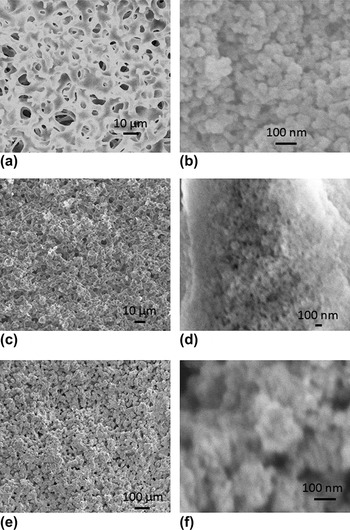
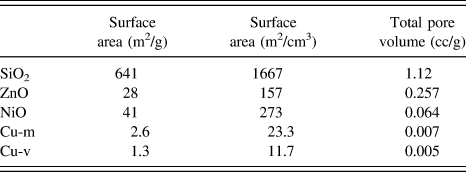
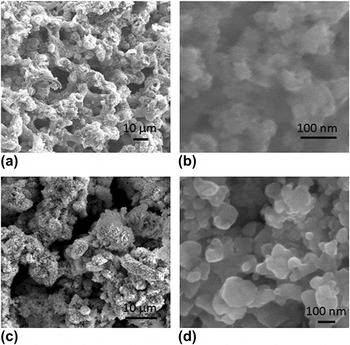
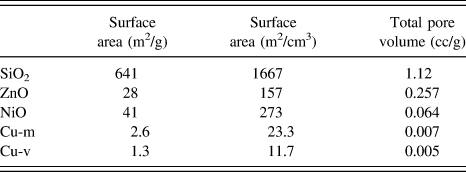
SEM images of the parent silica monolith can be seen in Fig. 1. The silica monolith template consists of a network of macropores. Inside the walls of these macropores are textural mesopores, which line the walls, and surfactant-templated mesopores, which are within the walls. The SEM image shown here is only representative in scale of the macropore size. Variations in the replica macropore size can be due to replication of different batches of the same synthesis of the silica template. The nitrogen adsorption isotherm and pore size distribution can be seen in Fig. S1. The isotherm shows two regions of capillary condensation. The one in the lower pressure range is due to the surfactant-templated mesopores and the one in the higher range is due to the textural mesopores. The resulting surface area of the parent silica is 641 m2/g or 1667 m2/cm3. This is consistent with what has previously been reported for this material.Reference Smått, Schunk and Lindén23 The surface areas and total pore volumes for the silica monoliths and for the metal oxide replicas are summarized in Table I.
SEM images of (a, b) parent silica monolith, (c, d) ZnO replica, and (e, f) NiO replica.

Nitrogen physisorption data from parent silica monolith and replicas.
B. Zinc oxide
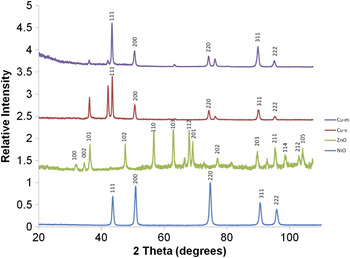
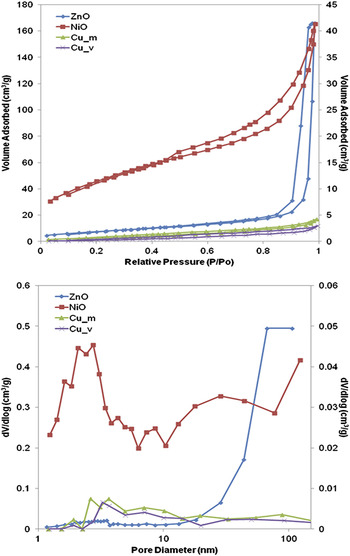
SEM images of the zinc oxide replica can be seen in Fig. 1. The morphology of the macropores is very similar to that of the parent silica monolith. There appears to be fine structure within the walls of the macropores, but higher magnification images are difficult to obtain due to charging of the sample. XRD (Fig. 2) confirms the formation of zinc oxide in the hexagonal wurtzite structure. The nitrogen adsorption isotherm (Fig. 3) shows one region of capillary condensation at higher relative pressures, with a fairly narrow hysteresis loop consistent with an open pore structure. The BJH pore size distribution indicates that the sample has pores in the range of 25–100 nm. This broadness and the location of the peak in the pore size distribution would indicate that mainly the textural mesopores were filled instead of the surfactant-templated mesopores. The resulting surface area is 28 m2/g or 157 m2/cm3.
XRD diffractograms of NiO, ZnO, Cu-m, and Cu-v.

(Top) nitrogen physisorption isotherms and (bottom) BJH pore size distributions of replicas. ZnO and NiO plots correspond to primary axis and Cu-m and Cu-v to secondary axis.

C. Nickel oxide
1. Methanolic base etch
SEM images of the nickel oxide replica can be seen in Fig. 1. The topology of the macropore walls is much coarser than that of the parent silica monolith. XRD, Fig. 2, shows that the resulting monolith is nickel oxide, NiO. The nitrogen sorption isotherm (Fig. 3) shows a small region of capillary condensation at higher relative pressures. This would indicate that most of the porosity detected by the nitrogen sorption corresponds to replication of the textural mesopores or agglomerates on the macropore walls, which agrees with the SEM images. The broad hysteresis loop is consistent with an interconnected pore structure, suggesting some “ink bottle” type pores. The resulting surface area is 41 m2/g or 273 m2/cm3. From the BJH pore size distribution plot, it is evident that the NiO sample has a very broad pore size distribution consistent with some replication of the surfactant-templated silica mesopores, as it shows a small peak in the pore size distribution in the 3–7 nm range. This peak is similar to what has been observed in earlier studies on nanocasting into monoliths but is significantly smaller.Reference Smått, Sayler, Grano and Bakker12,Reference Lu, Smått, Backlund and Lindén24
2. Aqueous base etch
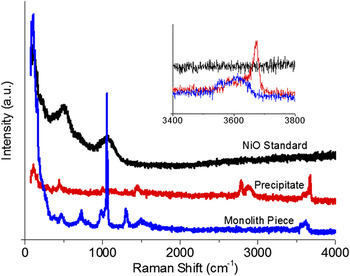
Attempts using 1 M aqueous sodium hydroxide solution to remove the silica template were unsuccessful. This method resulted in the monoliths breaking into smaller pieces (millimeter-sized or larger) accompanied by the formation of a precipitate. Raman spectroscopy (Fig. 4) showed the presence of nickel hydroxide on both the precipitate and pieces. This is evidenced by the peaks between 3550 and 3680 cm−1, which have previously been observed in spectra of nickel hydroxide.Reference Liu and Li25
Raman spectra of nickel oxide standard, precipitate from aqueous etch, and monolith piece from aqueous etch.

D. Copper
1. Methanolic base etch
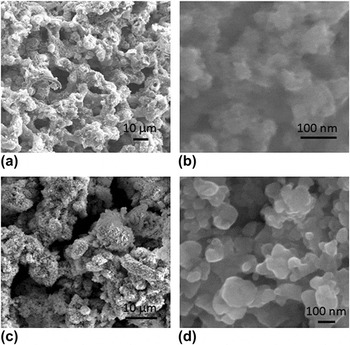
SEM images of the copper replica etched with basic methanol [Cu-m, Fig. 5(c)] show a macropore structure that is much coarser than that present in the parent silica monolith. Within the macropore walls [Fig. 5(d)], there are smaller particles of 100 nm or less in diameter, which seem to be agglomerates of smaller particles. XRD (Fig. 2) and EDS (Fig. S2) confirm that the monolith is copper in a face-centered cubic packing. The nitrogen sorption isotherm shows a small nitrogen uptake over the whole pressure range and gives a surface area of 2.6 m2/g or 23.3 m2/cm3. This is indicative that the copper synthesis method needs to be optimized for future samples but demonstrates that the methanol etch works and can successfully leave a copper monolith.
SEM images of (a, b) Cu-v and (c, d) Cu-m.
2. Voltage stabilized etch
After etching, as outlined in the Sec. II, the voltage was removed and the monolith was removed from the copper tape. The monolith held together very well and was observed to have a metallic copper color. SEM images of the copper replica produced by the voltage stabilized etching method [Cu-v, Fig. 5(a)] show a macropore structure similar to that of the parent silica monolith. Higher magnification SEM images [Fig. 5(b)] show that there are some smaller structures located within the macropores. Both energy dispersive spectroscopy (EDS) (Fig. S2) and XRD (Fig. 2) show that the material produced is copper in a face-centered cubic packing. Nitrogen sorption again indicates a small uptake in the entire pressure range and gives a surface area of 1.3 m2/g or 11.7 m2/cm3.
IV. DISCUSSION
For all four monoliths synthesized, the surface areas are significantly lower than those of the parent silica template. As we have discussed at length elsewhere,Reference Smått, Sayler, Grano and Bakker12 nanocasting involves a series of steps: infiltration, drying, decomposition, reduction (for metals), and template removal. The first two steps are similar to materials already reported and so will not be dealt with in detail here. Decomposition is carried out at elevated temperatures where the zinc oxide, nickel oxide, or copper oxide being formed may become mobile if the temperature exceeds the Tammann or Hüttig temperatures where particles become mobile and can sinter.Reference Smått, Sayler, Grano and Bakker12,Reference Moulijn, van Diepen and Kapteijn26,Reference Cao, Lu and Veser27 These temperatures are respectively one-half and one-third of the melting point of the solid. This would give Hüttig temperatures of 474 °C for zinc oxide, 395 °C for nickel oxide, 260 °C for copper oxide, and 180 °C for copper.Reference Lamoreaux, Hildenbrand and Brewer28,Reference Lide29 The nickel oxide and copper oxide samples were heated above their Hüttig temperatures and so may be mobile, depending upon the strength of the interactions with the silica walls. Another possibility is raised by Yue et al.Reference Yue and Zhou30 who suggest that the growing nanoparticles can disrupt the silica matrix.
A. Zinc oxide
The successful etching of monolithic zinc oxide using the methanolic base etching method presumably reflects the differences in solubility of zinc oxide in methanol compared with that in aqueous base. In general, inorganic salts are less soluble in alcohol than in aqueous media, and our success with removing silica while leaving the complete zinc oxide monoliths indicates that there must be a considerable difference in solubility in basic methanol between silica and zinc oxide. As is discussed below for nickel oxide, it is clear that even a relatively low solubility can be sufficient to cause a monolith to fragment.
B. Nickel oxide
Nanocasting of nickel oxide in particles has been reported by a number of groups.Reference Yue and Zhou30–Reference Yue and Zhou35 However, it has not previously been reported by nanocasting into monolithic silica templates. The prime difficulty has been in the aqueous etch which leads to formation of nickel hydroxide and fragmentation of the monoliths. One explanation for the formation of nickel hydroxide is that the nickel oxide was simply reacting with the hydroxide in solution forming nickel hydroxide on the surface of the monolith. This nickel hydroxide is slightly soluble at room temperature in basic solutionsReference Gayer and Garrett36 and therefore can be inferred to be more soluble at the elevated temperatures at which the hydroxide etch is performed. This conversion to hydroxide during the dissolution process would cause cracking in the monoliths, resulting in their fragmentation.
C. Copper
Copper in the pure form cannot be produced by the nanocasting approach with current etching methods. There are two examples of where nanocast materials containing copper have been successfully removed from a silica template using an aqueous base etch. We have prepared porous monoliths of Sterling silver, an alloy which is 90% silver mixed with 10% copper, by nanocasting into monolithic silica templates.Reference Sayler, Grano, Wiedmer, Smått and Bakker37 The alloy consists of micrometer-sized regions of pure silver and pure copper. We were able to use a standard aqueous base etch to prepare 10 cm long 4 mm monoliths, which did not show any indications of copper hydroxide formation. Similarly, Yen et al.Reference Yen, Seo, Guillet-Nicolas, Kaliaguinec and Kleitz38 reported nanocasting of a mixture of copper and cerium nitrates into mesoporous silica powders to give a mixture of mesoporous copper and cerium oxide. These authors did not report any indications of formation of copper hydroxide. For monoliths in a standard aqueous base etch, any oxidized part of the copper surface would react with hydroxide to form copper hydroxide. This hydroxide would result in weakening of the copper structure due to this conversion. In a methanolic base etch, it is believed that the methanol is acting as a reducing agent to keep the copper from being oxidized to the hydroxide via the oxide.
The alternative etching method explored in this work, voltage stabilized etching, is one that is particularly applicable to metal monoliths. The basis for this method can be seen by referring to the Pourbaix diagram,Reference Pourbaix39 which shows that copper in an aqueous solution with a high pH can be converted to copper (II) oxide or copper hydroxide. From the diagram, it can also be seen that it should be possible to prevent these reactions by holding the copper monolith at a sufficiently negative potential, 3 V, while in the aqueous etch solution. Our observations certainly are in accord with this expectation. This method speaks to the connectivity of the replica. If the replica did not have good connectivity, then pieces that were not electrically connected would have been converted to copper hydroxide and dissolved during the etching process.
Formation of copper monoliths is more difficult because of the need to carry out a number (four) of infiltration cycles. The nitrate salts are used because they have much higher solubility than other copper salts and therefore can build up enough material to make a complete replica in fewer cycles. The decomposition of the copper nitrate salt under methanol vapor does lead to copper formation. However, a second infiltration cycle with copper nitrate solution is observed to give copious evolution of brown gas, which is sufficiently violent to lead to fragmentation of the silica template. It was therefore necessary to decompose the copper nitrate to the copper (II) oxide after each infiltration, with a final reduction to metallic copper.
V. CONCLUSIONS
We have developed new methods for removing the silica template used in nanocasting and successfully demonstrated these methods by synthesizing hierarchically porous monoliths of zinc oxide, nickel oxide (free of nickel hydroxide), and copper metal. The use of methanolic base etch should also be applicable to etching the silica template widely used in nanocasting into mesoporous silica particles. The voltage stabilized etch can also be applicable to other monolithic metal samples.
ACKNOWLEDGMENTS
The use of Central Analytical Facility instruments (SEM, XRD) is greatly acknowledged. This work was partially supported by NSF under Grant No. CHE-0719398 (MGB) and by the Academy of Finland through Grant No. 259310 (JHS). The technical assistance of Ms. Kate Price in the development of the voltage stabilized etch, Mr. Jake Mims for sample preparation, and Mr. Clifton Watkins for running Raman spectroscopy are also much appreciated.