According to the Relación de Michoacán (1977 [1541]:152–155), shortly after the emergence of the Tarascan state, the heirs of its founder, Tariacuri, embarked on a series of military campaigns in the early 1400s to further enrich their lineage (referred to as the uacusecha in Purepecha) and to spread their political influence beyond the limits of the Lake Patzcuaro Basin. The latest of these forays brought the uacusecha into northeastern Michoacan, where they launched raids on settlements along the shoreline of Lake Cuitzeo and would later spread and institutionalize Tarascan rule over the entire lake basin and adjoining upland areas. Before the close of the fifteenth century, northeastern Michoacan and southeastern Guanajuato had become part of a strategic “interpolity frontier zone” (Healan and Hernández Reference Healan and Hernández1997) established along the northeastern and eastern limits of the Tarascan empire (see Pollard Reference Pollard1993:Map 4.4). By a.d. 1520, both the Tarascans and the Aztecs had established a string of defensive garrison sites along their respective sides of the shared border separated by an 80 km wide buffer zone (see Gorenstein Reference Gorenstein1985:Figure 1).
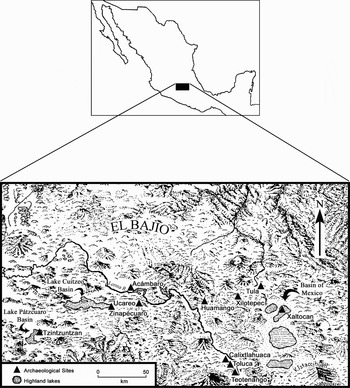
Location of sites in Michoacan and north-central Mexico mentioned in the text (adapted from Raisz Reference Raisz1959).

Early Colonial chroniclers (Carrasco Pizana Reference Carrasco Pizana1979:40–42; Relación de Michoacán 1977 [1541]); Relaciones Geográficas 1958 [1579–1580], 1987 [1579–1580]:248) paint the Tarascan side of the shared frontier as an ethnically diverse, multilingual borderland occupied by Chichimecs, Otomi, Matlatzinca, and Mazahua people among Tarascans and various other local communities assimilated into the Tarascan state culture who likely spoke Purepecha—the lingua franca of the empire (Pollard Reference Pollard1993:101). Small contingents of elite Tarascan families resided in and governed the garrisons on the frontier and the administrative centers in the borderlands among people of diverse ethnic origin charged with defending and mediating the imperial borders as warriors, military suppliers, and cultural brokers (Gorenstein Reference Gorenstein1985, Reference Gorenstein1997). The ruling uacusecha embraced this policy of creating and promoting an ethnically plural periphery that provided, among other things, a ready and easily provisioned military force as well as a physical buffer between Aztec loyalists (or the Spanish by the 1520s) and the Tarascan heartland (Pollard Reference Pollard1993:101–103). It is along the eastern frontier and its adjoining borderlands that we see the existence of ethnic enclaves within settlements, encompassing whole settlements, or even comprising whole regions documented in the ethnohistoric and archaeological records relevant to the Protohistoric period (see Carrasco Pizana Reference Carrasco Pizana1979:276–278; Castañeda López Reference Castañeda López1988; Gorenstein Reference Gorenstein1985; Hernández Rivero Reference Hernández Rivero1994a, Reference Hernández Rivero and Williams1994b; Relación de Michoacán 1977 (1541): 140–141; Relaciones Geográficas 1958 [1579–1580]:57–58, 1987 [1579–1580]:273–278; Silverstein Reference Silverstein2000). By ethnic enclaves, we mean the “spatially bounded isolates within a larger culturally distinct population” (Santley et al. Reference Santley, Yarborough, Hall, Auger, Glass, MacEachern and McCartney1987:86) that can occur either as distinct communities, colonies, or as sub-sections or barrios within a larger settlement.
We believe that the presence of “foreigners” in northeastern Michoacan was not solely a Protohistoric phenomenon. Recent archaeological investigations have revealed the presence of two settlements within the Ucareo-Zinapecuaro obsidian source area (hereafter, Ucareo-Zinapecuaro source area) whose ceramic assemblage connects their inhabitants to sites situated in the Toluca Valley some 90 km to the east (Figure 1). The timing of their arrival and the reason for their presence are questions that will be addressed in this article, as well as the implications for understanding some of the events in this region leading up to and culminating during Protohistoric period Tarascan times.
THE UCAREO-ZINAPECUARO OBSIDIAN SOURCE AREA
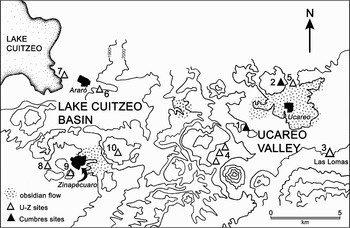
The Ucareo-Zinapecuaro source area is located in northeastern Michoacan, incorporating the modern towns of the same name (Figures 1 and 2). The western portion of the source area is dominated by the Lake Cuitzeo Basin, whose eastern end is bounded by rhyolitic domes, cinder cones, and obsidian flows partially surrounding the modern town of Zinapecuaro. Immediately to the east is a system of volcanic uplands surrounding a high valley, designated the Ucareo Valley, where the modern community of Ucareo is located. Like Zinapecuaro, Ucareo is situated amid a system of rhyolitic domes, cinder cones, and obsidian flows, although it is more than 700 m higher in elevation. Zinapecuaro and Ucareo constitute two geologically and geochemically distinct but related obsidian sources, both of which were exploited in pre-Hispanic times. Obsidian-sourcing studies performed to date indicate that Ucareo and Zinapecuaro obsidians were widely distributed commodities throughout Mesoamerica (see Healan Reference Healan1997:Table 1, Figure 1).
Ucareo-Zinapecuaro obsidian source area, Michoacan (adapted from Healan Reference Healan1997:Figure 2). The 10 major settlements (D) in the source area are the following: (1) Gabriel Durán; (2) El Monte; (3) Las Lomas; (4) Choromuco sites; (5) Las Palmas; (6) Araró; (7) Tierras Blancas; (8) La Bartolilla; (9) El Pedrillo; and (10) Taimeo.

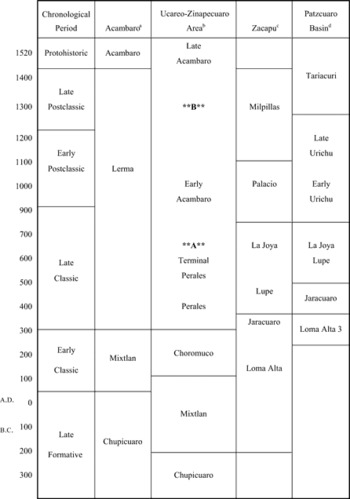
Cultural sequences for the Ucareo-Zinapecuaro obsidian source area and neighboring areas

a Gorenstein (Reference Gorenstein1985)
b Hernández (Reference Hernández2000) (revised)
c Michelet (Reference Michelet1992)
d Pollard (Reference Pollard2000)
During the 1990s, Healan directed a two-phase archaeological investigation of pre-Hispanic settlement and obsidian exploitation in the source area with funding provided by the National Science Foundation, under a concession granted by the Instituto Nacional de Antropología e Historia of Mexico. Phase 1 involved intensive, field-by-field survey of the Ucareo and Zinapecuaro sources, covering an area of approximately 85 km2 and encountering some 1,030 obsidian quarries, 10 major settlements, and numerous smaller sites and artifact scatters (Figure 2). Phase 2 involved exploratory excavation of 30 selected sites encountered in Phase 1. Excavation of habitation sites and artifact scatters was intended to recover in situ artifacts and stratigraphic information to facilitate relative and chronometric dating, while quarry excavations were intended to accomplish these goals plus recover in situ material pertaining to quarry production.
Our work revealed that the Ucareo source was subjected to far more extensive exploitation than was Zinapecuaro, which in fact agrees with existing obsidian-sourcing studies in which an overwhelming majority of obsidian initially identified as Ucareo or Zinapecuaro came specifically from the Ucareo source (see Healan Reference Healan1997:Table 1). This is particularly noteworthy because, until recently, Ucareo was a little-known source, while knowledge of the Zinapecuaro obsidian source goes back to Breton's (Reference Breton and Saville1905) early accounts.
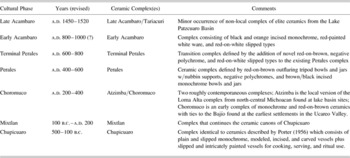
Given the useful but limited prior investigations conducted by Moedano (Reference Moedano and Goytia1990 [1946]) at La Bartolilla (Site 8 in Figure 2) within the source area, a major goal of our investigations was to establish a regional chronology and ceramic sequence for the source area. The resulting chronology (Table 1), based on Hernández's (2000) analysis of approximately 100,000 potsherds recovered from survey and excavation, drew heavily on the sequence of ceramic complexes defined for the neighboring El Chivo site at Acambaro, Guanajuato (Gorenstein Reference Gorenstein1985), with significant modifications to accommodate unique events in the Ucareo-Zinapecuaro source area (Table 2). Particularly noteworthy among the latter was the existence of parallel but often distinct cultural traditions in the eastern Lake Cuitzeo Basin versus the Ucareo Valley, with the former area settled in Late Formative (Chupicuaro) times and incorporating early on traditions rooted in areas farther west and north, while the latter was not settled until Classic times and showed strong ties eastward for much of prehistory.
A sequence of local ceramic complexes in the Ucareo-Zinapecuaro obsidian source area

Evidence of human occupation in the Ucareo-Zinapecuaro source area spans the pre-Hispanic era, beginning in the Preclassic period, with the appearance of settlements along what was likely an earlier shoreline of the southeastern end of Lake Cuitzeo. These settlements show ceramic vessels and figurines characteristic of the Chupicuaro complex (Porter Reference Porter1956) and, in fact, make up some of the first remains of this distinctive funerary complex to be recovered from domestic contexts. Assemblages of the succeeding Mixtlan culture overlay those of Chupicuaro at early lakeshore sites, and they also make up the lowest levels at newly established sites located on higher ground overlooking the lakeshore. Occupation of the neighboring Ucareo Valley appears to begin in earnest at the end of the Mixtlan phase, when a distinct local culture called Choromuco appears at three sites in the southern end of the valley (Table 2). The Choromuco phase also signifies the Early Classic period occupation of lake basin sites represented by a ceramic assemblage called Atzimba that overlay the previous Mixtlan materials. The Atzimba complex shares several decorated and plain wares with contemporary Loma Alta ceramics identified at sites in the Zacapu and southern Lake Patzcuaro Basins located to north and west of the Lake Cuitzeo Basin, respectively (Carot Reference Carot, Lameiras and Weigand1990; Pollard Reference Pollard2001).
Population in the Ucareo-Zinapecuaro source area appears to reach its maximum in the succeeding Classic/Late Classic-period Perales phase with the appearance of Las Lomas (Site 3 in Figure 2), a large (ca. 250 ha) site in the southern end of the Ucareo Valley that appears to have been heavily engaged in the exploitation of the Ucareo obsidian source (Healan Reference Healan2009). Perales-phase contexts are identified by a distinctive type called Cantinas Red-Orange (Snarskis Reference Snarskis and Gorenstein1985:239), in combination with a suite of other red-painted, red-slipped, incised, and negative polychrome ceramics (Hernández Reference Hernández2000:247–250). Perales ceramics overlay earlier Atzimba assemblages at sites in the southeastern Lake Cuitzeo Basin and Choromuco assemblages at sites in the Ucareo Valley (Table 2). Two ceramic types called Campo Red-on-Brown and Encarnación Red Zoned (red-on-white slipped type) appear to replace the earlier Cantinas ceramics in the Perales complex. They overlap stratigraphically with Perales-phase ceramics and those diagnostic of the following ceramic complex called Early Acambaro. We tentatively use the appearance of these two pivotal ceramic types to identify Late Classic-period occupations that define the Terminal Perales phase.
Early Acambaro ceramics occur in the uppermost and surface levels of sites in both the Lake Cuitzeo Basin and in the Ucareo Valley. Our Early Acambaro ceramic complex (Table 2) includes red-painted white ware vessels and incised orange monochrome tripod bowls that Snarskis (Reference Snarskis and Gorenstein1985:245, 247–248) had originally labeled “Acambaro” at the El Chivo site and Gorenstein (Reference Gorenstein1985:Chart 2, 45–46) uses the group to represent the Protohistoric period (see Table 1). We call this ceramic complex and cultural phase “Early” Acambaro because we believe this assemblage predates the Protohistoric period in the region. The “Late” Acambaro designation is reserved for contexts that include fragments of imported elite Tarascan ceramics diagnostic of the Protohistoric-period Tariacuri complex from the Lake Patzcuaro Basin (Table 2). We identified Late Acambaro ceramics in surface-collected units on the outskirts of modern Ucareo, from an obsidian mining site near Ucareo, and in sporadic finds on the surface around Araro on the shore of Lake Cuitzeo.
GABRIEL DURÁN, EL MONTE, AND THE CUMBRES CERAMIC COMPLEX
At some point relatively late in the pre-Hispanic era, two anomalous settlements appeared in the northern end of the Ucareo Valley within 2 km of the modern town of Ucareo (Sites 1 and 2 in Figure 2). Both settlements, designated Gabriel Durán and El Monte, are habitation sites with mound architecture and are located on or directly adjacent to the Ucareo obsidian flow complex and in close proximity to pre-Hispanic quarries.
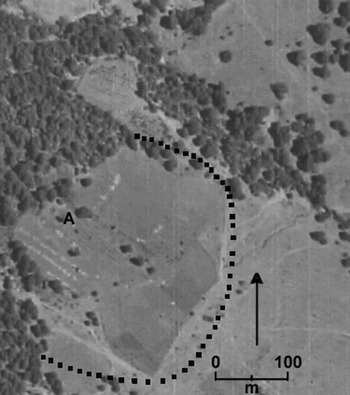
The site of Gabriel Durán is located adjacent to a large ravine, or barranca, that borders an intensive area of pre-Hispanic quarrying on the western periphery of the Ucareo obsidian flow (Figure 3). The site shows moderate to dense ceramic and other surface debris covering an area of approximately 8 ha, and contains a single square platform approximately 1.5 m tall and about 6 m wide built of loose stone and soil faced with large boulders and worked stone. Exploratory excavation within the site encountered extremely shallow deposits, much of which unfortunately lay in the plow zone, although remains of a badly damaged stone-walled structure and an adjacent refuse-filled pit were encountered.
Aerial view of the Gabriel Durán site (Site 1 in Figure 2), with the approximate site limits and the location of a single mound (A) indicated.

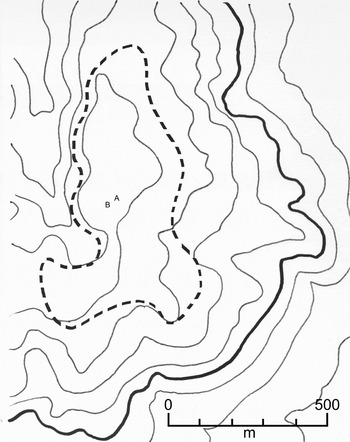
El Monte is situated atop a 100 m high mesa overlooking the mouth of the Ucareo obsidian flow, and obsidian outcrops and pre-Hispanic quarries are located about .5 km to the west. Ceramic and other surface debris extends over much of the mesa top, covering some 26 ha (Figure 4). The site core shows dense surface concentrations of ceramics over an area of 8–10 ha and contains one earthen mound measuring approximately 2 m in height and a lower (approximately .5 m high) mound containing a stone platform. As with Gabriel Durán, exploratory excavations revealed that El Monte contained extremely shallow deposits that had been mostly plowed up, but we were fortunate to encounter a gully or other natural feature about 6 m in diameter that was filled with ceramics, lithics, and other refuse.
Approximate limits of the El Monte site (Site 2 in Figure 2), with the location of two mounds (A and B) indicated.

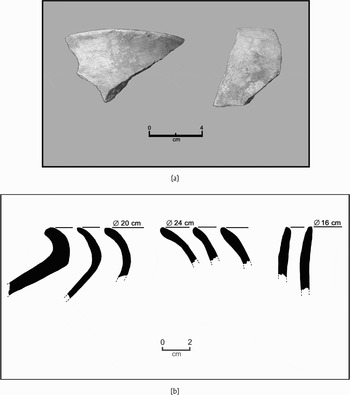
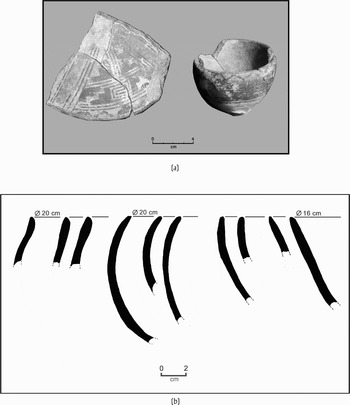
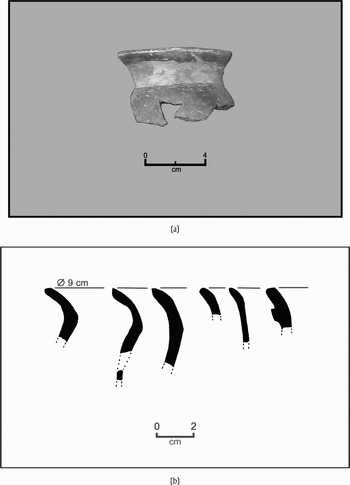
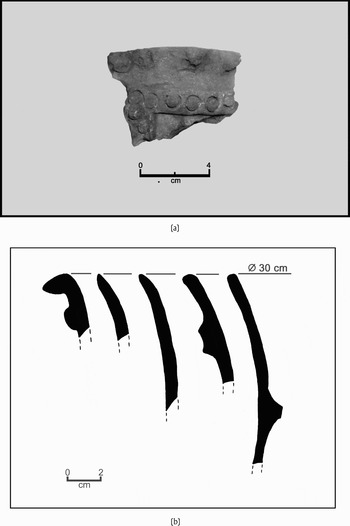
The ceramic material recovered from Durán and El Monte make up a ceramic complex that is wholly unlike any other within the Ucareo-Zinapecuaro obsidian source area and is the most telling evidence at this stage of investigation for the presence of “foreigners” in the Ucareo Valley. Termed Cumbres, the ceramic complex consists of plain utilitarian cooking and storage vessels, painted bichrome and polychrome serving and storage vessels, a sub-complex of pottery vessels associated with ritual activity—hourglass braziers with appliqué spikes or impressed appliqué bands, Tlaloc-effigy censers, ladle censers, and openwork bowl censers, and fragmentary evidence of figurines, pipes, worked potsherds, and whistles (Figures 5–8) (Hernández Reference Hernández2000:1162–1250). The inventory of pottery vessels represented includes hemispherical, open, and out-flaring tripod bowls and plates with tall, solid conical or pointed supports or short annular support, unsupported hemispherical bowls, shouldered jars with vertical round handles, drinking vessels, grinding bowls, and griddles. Cumbres potters painted their designs directly on a semi-lustrous, self-slipped brown vessel surface or over a light-colored slip (Munsell values ranging from 5YR5/4, 6/4, 6/6, 7/4, 7/6, 8/2 to 7.5YR3/1, 5/4, 6/2, 6/3, 7/3, 7/4, 7/6, 8/4). In contrast to the somewhat dull surfaces are very lustrous, crisply painted designs that range from fairly simple combinations of motifs and elements (horizontal bands, parallel wavy lines, and interior slipping) to intricate compositions incorporating solid-colored bands, parallel, wavy, scallop, and zig-zag lines, geometric solids, scrolls, and to a lesser extent circles, dots, and other curvilinear elements painted in red (Munsell values 7.5R/4/6, 10R3/6, 4/6). Polychrome designs often utilized bands painted orange (Munsell values ranging from 5YR7/6, 6/6, 7/8, 6/8 to 7.5YR8/6, 7/6, 6/6, 7/8, 6/8) to frame design space over a vessel surface.
Cumbres Brown Monochrome ceramics: (a) jar and bowl rim sherds; (b) jar, basin, and bowl profiles (adapted from Hernández Reference Hernández2000:119a, 1232; photographs by C. Hernández, 2006).

Cumbres Orange Polychrome and Cumbres Red-on-White slipped ceramics: (a) shallow polychrome tripod bowl with solid conical supports; (b) partial tripod drinking vessel with solid supports; (c) incurving, hemispherical, open, and out-flaring bowl profiles (adapted from Hernández Reference Hernández2000:114a, 1202; photographs by C. Hernández, 2006).

Cumbres painted censers: (a) Cumbres Red-on-White slipped openwork rim sherd; (b) censer rim profiles (adapted from Hernández Reference Hernández2000:Figure 115, 1211; photograph by C. Hernández, 2006.).

Cumbres Monochrome Brown appliqué braziers: (a) Cumbres appliqué brazier rim sherd; (b) brazier rim profiles (adapted from Hernández Reference Hernández2000:Figure 120a, 1238; photograph by C. Hernández, 2006).

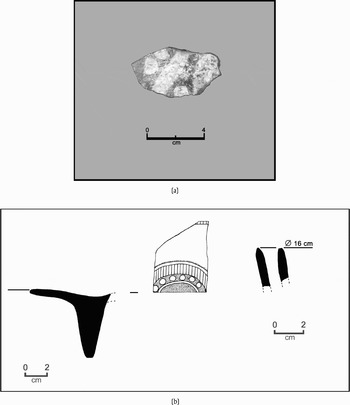
Pottery vessels with negative (or resist) polychrome decoration make up part of the Cumbres complex, as well. Post-fired red-painted bands (Munsell values 7.5 R/ 4/6 and 10R4/6) were added on top of negative designs made on a white slip (Munsell values 7.5YR/7/3, 7/4, 8/3) (Figure 9). The designs on these ceramics tend to be less complex and the motifs are larger in size than those found on the painted bichrome and polychrome vessels.
Cumbres Negative Polychrome vessels: (a) body sherd with exterior decoration; (b) bowl profiles and a plate rim profile with interior decoration (solid black represents post-fired red paint and stippling represents resist over a white slip; adapted from Hernández Reference Hernández2000:Figure 117a, 1222; photograph by C. Hernández, 2006).

The occurrence of the Cumbres complex within the Ucareo-Zinapecuaro source area is limited virtually entirely to the Durán and El Monte sites. Quantities of fewer than five potsherds each of possible Cumbres or Cumbres-related ceramics have been found at other Ucareo-Zinapecuaro source area settlements. Moreover, their presence in neighboring areas of the southern Bajio is limited to minor surface finds. Reported occurrences of bichrome or polychrome ceramics similar to Cumbres types come from two sites in the southern Bajio. A partial red and orange polychrome vessel in association with Tollan-phase ceramics from Tula, Hidalgo, were reported from surface collections at the Santa María del Refugio site located at the confluence of the Laja and Apaseo rivers in Guanajuato (Castañeda López et al. Reference Castañeda López, Crespo, Flores, Crespo and Viramontes1996:172). The description of orange- and red-painted decoration is strongly suggestive of a Cumbres polychrome ceramic vessel. A polychrome potsherd, possibly two, found by Charles Florance (Reference Florance1989, Reference Florance, Foster and Gorenstein2000:Figure 2.8c, 30) at a site (JL-10) in his survey area within the Puroagüita River Basin appears to be a non-local type of polychrome ceramic associated the Cumbres complex and also occurs in very minor quantities at other sites in the Ucareo-Zinapecuaro source area (Hernández Reference Hernández2000:1247–1250). This non-local ceramic, called Pirul Red on Orange, looks very much like a polychrome vessel recovered from a burial at Teotenango (Tommasi de Magrelli Reference Tommasi de Magrelli1978:Plate 29, top). Conversely, no ceramics characteristic of other settlements in the region were recovered from surface or excavated assemblages at either site. Both the consistency of the ceramic assemblage and the shallow nature of the archaeological deposits suggest a single phase of occupation at both sites.
The Cumbres complex is distinctive among the corpus of ceramics identified elsewhere within the Ucareo-Zinapecuaro source area. The most comparable red-on-brown, red-on-white slip, and negative polychrome-decorated ceramics recovered at other source-area settlements are the Classic-period ceramic types Cantinas Red-Orange and Encarnación Red Zoned (Figure 10). Although these two local types share general decorative modes and certain design elements (parallel lines, scrolls, wavy lines, and solid-colored circles) with Cumbres ceramics, their modal vessel forms and design execution are quite different. Vessels of Cantinas Red-Orange include jars and out-flaring bowls often with basal flanges that may be unsupported but more often tripod supported bowls with nubbin, slab-foot, or loop supports (Figure 10a–b) (see Flores Morales and Saint-Charles Zetina Reference Flores Morales, Juan Carlos Saint-Charles, Carrión and Cook2006 for a range of Cantinas Red-Orange whole vessel forms). Vessels of Encarnación include slightly incurving or open bowls and grinding bowls with flat bases and short nubbin or looped supports. Encarnación Red Zoned ceramics are distinctive in having a very thick white slip and large, simple geometric designs incorporating broad bands and circles or semi-circles painted in red and as resist decoration (Figure 10c). The painted motifs on the local ceramics tend to be large in size, smeared by surface polishing, and executed within more open design space, whereas Cumbres ceramics tend to have smaller-scale motifs configured in complex geometric designs and confined to spaces boxed in by solid colored bands (see Figure 6).
Perales-phase ceramics comparable to Cumbres ceramic types: (a) Cantinas Red-Orange tripod bowl; (b) rim sherd of Encarnación Red Zoned bowl (photograph by C. Hernández, 1995).

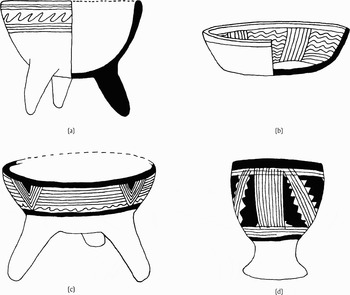
In some respects, Cumbres ceramics are reminiscent of Epiclassic- and Postclassic-period ceramics from regions neighboring the Ucareo-Zinapecuaro source area to the east and northeast (Hernández Reference Hernández2000:278–291). Some of the Cumbres painted geometric and rectilinear designs repeat those found on examples of Coyotlatelco Red on Brown ceramics (Figure 11a), yet more often it is the case that an integral and common element of Cumbres designs are multiple parallel lines as is characteristic of Mazapa Red-on-Brown ceramics (Figure 11b) (Cobean Reference Cobean1990:130–189, 267–282). In particular, Cumbres ceramics are rather similar to Early Matlatzinca ceramics (Figure 11c) in terms of vessel forms (shouldered jars with vertical round handles; plates and shallow bowls; drinking vessels; and tall pointed, tripod supports), painted motifs, and design configurations based on whole vessels recovered from the sites of Teotenango and Calixtlahuaca in the southern Toluca Valley (García Payón Reference García Payón1979; Tommasi de Magrelli Reference Tommasi de Magrelli1978:85–113; Vargas Pacheco Reference Vargas Pacheco and Chan1975). Stylistic ties to the Toluca Basin are also seen in the bichrome and polychrome ceramics of the Copujo ceramic group from the Lake Patzcuaro Basin (see Figure 1), which have been dated to the Late Urichu phase, a.d. 1000/1100–1350 (Table 3) (Pollard Reference Pollard2000, Reference Pollard2001). Copujo ceramics, however, are locally made in the Lake Patzcuaro Basin and they differ from Cumbres decorated ceramics with respect to several formal, decorative, and stylistic modes.
Examples of comparable Epiclassic and Early Postclassic ceramics from neighboring regions east of the Ucareo-Zinapecuaro source area: (a) Coyotlatelco ceramics from the Tula site in Hidalgo; (b) Mazapa Red-on-Brown ceramics from the Tula site in Hidalgo; (c) early Matlatzinca ceramics from Teotenango in the Toluca Valley (redrawn by C. Hernández based on Cobean Reference Cobean1990:Figure 59D, 137, Figure 134D, 271; Tommasi de Magrelli Reference Tommasi de Magrelli1978:Number 15, 154, Number 9, 169).

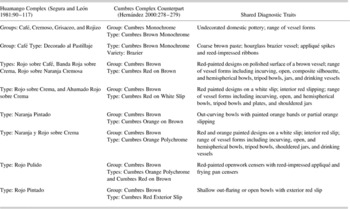
A comparative roster of ceramic groups and types from Huamango in the Acambay region and the Cumbres enclaves in the Ucareo Valley

CUMBRES CERAMICS AND THE ACAMBAY REGION
The Cumbres ceramic, however, complex is virtually indistinguishable from ceramics previously identified at Huamango and other sites in the Acambay region of the northern Toluca Valley (see Figure 1) (Granados Reyes and Guevara Reference Granados Reyes and Guevara1999; Guevara and Granados Reyes Reference Guevara and Reyes2001; Segura and León Reference Segura, León and Chan1981). Huamango is the largest archaeological site in the region, situated atop a long (ca. 2 km × 1 km) mesa (Piña Chan Reference Piña Chan and Chan1981:23–24). The site center consists of three principal mound groups, which proved to be three distinctive clusters of structures that included multiple platforms, plazas, modest pyramids, altars, elite residential structures, and more than 20 burials (Piña Chan Reference Piña Chan and Chan1981:49–51). Segura and León (Reference Segura, León and Chan1981) conducted the analysis of more than 16,500 pieces of pottery recovered from the site center, including burial ceramics, offerings, whole and partial vessels found on the floors of structures and potsherds incorporated into architectural fill. Most of the 20 or so exploratory excavations conducted at the site center encountered shallow deposits with little stratigraphy (Segura and León Reference Segura, León and Chan1981:90).
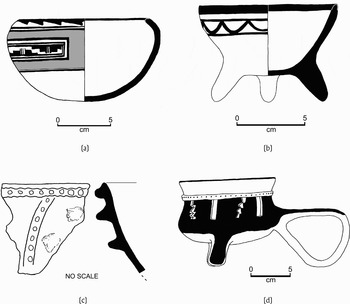
The general description and diversity of plain and painted ceramic groups and types reported by Segura and León (Reference Segura, León and Chan1981:100) for Huamango closely match that described for the Cumbres complex (Table 3; Figure 12). The dual use of red and pale orange painted designs on a white slip is a decorative mode that uniquely ties Huamango to the two Cumbres enclaves in the Ucareo Valley and at the same time differentiates all three from neighboring areas in the Toluca Valley, Michoacan, and the southern Bajio. Another distinguishing characteristic shared by the Cumbres and Huamango ceramic complexes is the absence of a brown monochrome ceramic group with incised or engraved decoration that is counterpart to the painted ceramic types. Such temporal overlap of incised or engraved monochrome ceramics with painted ceramic types characterizes not only the Corral complex at Tula and other Coyotlatelco assemblages in the Basin of Mexico (Cobean Reference Cobean1990:72; Rattray Reference Rattray1966), but also occurs in Classic-period complexes in the Bajio (Saint-Charles Zetina Reference Saint-Charles Zetina1990; Flores Morales and Saint-Charles Zetina 2006) and is true of the Perales complex in the Ucareo-Zinapecuaro source area (Hernández Reference Hernández2000:239–242). So strong are the formal and stylistic ties between the Cumbres and Huamango ceramic complexes that the Durán and El Monte sites appear to be archaeological examples of what Stein (Reference Stein and Stein2005:14–15) terms a foreign colonial enclave which is a “settlement whose architecture, site plan, and material culture assemblage are identical to those of another region but are located as spatially discrete occupations surrounded by settlements of the local culture.”
Decorated ceramics from the site of Huamango: (a) polychrome painted white slipped bowl; (b) red-on-white slipped tripod bowl; (c) censer rim sherd with appliqué spikes and reed-impressed adornments; (d) red-painted openwork censer with appliqué decoration (solid black represents red-painted elements and gray shading represents orange-painted elements; redrawn by C. Hernández based on Segura and León Reference Segura, León and Chan1981:Plate 1, b, 95, Plate 6, 6–8, 103, Plate 8, 3–6, 108).

DATING GABRIEL DURÁN AND EL MONTE
It should be noted that Segura and León (Reference Segura, León and Chan1981:116–117) dated the occupation of Huamango to the Epiclassic to Early Postclassic periods (a.d. 800–1200) based on similarities between Huamango ceramics and Mazapa Red-on-Brown and Early Matlatzinca ceramics. If correct, this dating would mean that the occupation of the two Cumbres enclaves would be contemporary with the Terminal Perales and Early Acambaro phases within the Ucareo-Zinapecuaro source area sequence (“A” in Ucareo-Zinapecuaro area sequence in Table 1). However, four recently obtained radiocarbon dates, two each from the Durán and El Monte sites, call into question the assignment of Cumbres ceramics to the Epiclassic-to-Early Postclassic transition. The first Durán sample (B-164486) came from the bottom of an excavation unit that encountered a refuse pit adjacent to a stone-faced platform mound that likely supported a one-room structure. The second sample (B-153188) came from the top of the platform stairway. The El Monte samples came from the bottom (B-153189) and middle (B-164485) levels of an excavation unit made into a large midden located in the southern end of the site near its two large mounds. These four samples yielded virtually identical dates (Table 4) that fall within the Middle Postclassic period (ca. a.d. 1250–1440), considerably later in the local and regional chronologies than earlier ceramic studies had predicted (“B” in Ucareo-Zinapecuaro area sequence in Table 1). These results have significant implications for understanding the exploitation of the Ucareo obsidian source in later prehistory and its role in the development of the eastern Tarascan-Aztec frontier.
Radiocarbon dates for the Cumbres enclaves in the Ucareo-Zinapecuaro obsidian source area

Note: Radiocarbon dates were run by BetaAnalytic, Inc.
EXPLOITATION AND EXCHANGE OF UCAREO OBSIDIAN DURING THE MIDDLE POSTCLASSIC
We have previously suggested that the two Cumbres enclaves were engaged in the exploitation of Ucareo obsidian, presumably for export to Huamango and/or other sites in the Acambay region (Healan and Hernández Reference Healan and Hernández2000), given their close proximity to obsidian outcrops and to pre-Hispanic obsidian quarries. Obsidian artifacts in the form of flakes, blades, cores, and various tools are common at both sites, although there is no evidence of lithic production at a level above the needs of the sites' occupants. However, there is no reason to presume that facilities that engaged in high-volume production for export would have been located within these settlements rather than at the quarries themselves. Indeed, some of the Ucareo quarries show evidence of intensive production of polyhedral cores like those found at Tula, Hidalgo, and other sites (Healan Reference Healan, Hirth and Andrews2002), although the age of these quarry production sites is not known.
Given the previous dating of Huamango as Epiclassic to Early Postclassic and the substantial presence of Ucareo obsidian at Tula, Hidalgo (Healan Reference Healan, Hirth and Andrews2002), we further suggested that these enclaves were acquiring obsidian to fulfill tribute obligations imposed on the Acambay region by a larger polity, likely neighboring Xilotepec (Healan and Hernández Reference Healan and Hernández2000), which in turn, as Folan (Reference Folan and Chan1981:331) suggested, may have had a tributary relationship with neighboring Tula (see Figure 1). The Acambay region reportedly had very close ties to the neighboring Otomi territories of Xilotepec and the surrounding Tula hinterland in southern Hidalgo since the eve of the Postclassic period (Folan Reference Folan and Chan1981). By the time of the Protohistoric period, their contacts had expanded to include Tarascan-controlled areas to the west and with the Mazahuas farther south in the Toluca Valley (Folan Reference Folan and Chan1981:331). Since the time of its conquest by the Triple Alliance around a.d. 1428, and later by Europeans, the Acambay area has been home to diverse groups of Otomi- and Nahuatl-speakers, with, perhaps, some occasional influxes of people from adjacent areas in the Basin of Mexico and the Bajio (Folan Reference Folan and Chan1981:218–219). However, the above radiocarbon dates place the Cumbres enclaves (and, by extension, Huamango and contemporary sites in the Acambay region) after Tula's apogee and subsequent decline, rendering this hypothesis untenable.
In some respects, a Middle Postclassic period date for the Cumbres enclaves eliminates some troublesome aspects of the Tula-related tributary model—in particular, their contemporaneity with the considerably larger Las Lomas settlement complex that dominated the Ucareo Valley during the Late Classic to Epiclassic periods and was heavily involved in the exploitation of Ucareo obsidian (Healen 2009). However, there are no other settlements or settlement components in the Ucareo Valley that can be securely dated to the Middle Postclassic period on the basis of ceramic or other dating. We (Hernández Reference Hernández2000:298–299, 315) have previously suggested that this lack of evidence may reflect a reorganization of local populations into fewer, more consolidated and defensible settlements in the lake basin, perhaps in response to larger social and environmental changes reportedly taking place across the Bajio and northern Michoacan at this time (see Armillas Reference Armillas1969; Faugère-Kalfon Reference Faugère-Kalfon1996; Michelet et al. Reference Michelet, Ichon, Migeon, Brambila and Crespo1988; Migeon Reference Migeon and Darrás1998; Nalda Reference Nalda, Lombardo and Nalda1996; Saint-Charles Zetina Reference Saint-Charles Zetina1990). If such a reduction and reorganization of settlement did indeed take place in the Ucareo-Zinapecuaro source area around the Middle Postclassic period, the Ucareo Valley would have been more conducive to colonization at that time than in previous periods.
If the obsidian produced by the Cumbres colonial enclaves was not intended as tribute to the Tula state, then perhaps it was destined for another. One possibility is the Otomi state centered at Xaltocan, which beginning in the Middle Postclassic period, enjoyed a brief period of expansion and influence over a sizeable swath of the Basin of Mexico and much of the neighboring Toluca Valley until its conquest in the late fourteenth century by the Tepanecs (Carrasco Pizana Reference Carrasco Pizana1979:258, 266, Figure 25). Alternatively, it is interesting to note that Ucareo obsidian has been identified in the lithic assemblages of Middle Postclassic period sites in the southern end of the Toluca Valley and neighboring Morelos (Smith et al. Reference Smith, Sorensen and Hopke1984; Healan Reference Healan1997:Table 1) and was the principal source of obsidian at the major regional center of Xochicalco in Morelos during the preceding Epiclassic period (Hirth et al. Reference Hirth, Bondar, Glascock, Vonarx, Daubenspeck and Hirth2006:135–136). Perhaps Huamango and/or other sites in the Acambay region seized an opportunity to control still viable obsidian exchange networks or partnerships established during the Epiclassic period that moved Ucareo obsidian through the Toluca Valley to sites to the south and east. Then again, the obsidian produced by the Cumbres enclaves may have been for the Acambay region's own defense and commercial enterprises. During the Middle Postclassic period, the Xilotepec-Chiapan region, which includes the Acambay region, maintained its independence in the post-Toltec world (Folan Reference Folan and Chan1981:331), despite the domination of much of the rest of the Toluca Valley by the Xaltocan and later Tepanec empires (a.d. 1200–1427). One possible scenario is that increasing settlement in the Acambay region on the eve of the Middle Postclassic period led to the establishment of the Cumbres enclaves at Ucareo to satisfy greater demands for obsidian in the homeland. Such an increase could be linked to the displacement of Otomi and Nahuatl speakers into the Basin of Mexico after the decline of Tollan, as chronicled in ethnohistorical sources (Bierhorst Reference Bierhorst1992; Carrasco Pizana Reference Carrasco Pizana1979; Kirchoff et al. Reference Kirchoff, Giiemes and García1989).
ENCLAVES, OBSIDIAN, AND THE PROTOHISTORIC FRONTIER
The incorporation of the Ucareo-Zinapecuaro source area into the expanding Tarascan state some time around a.d. 1450 put a vast supply of high-quality obsidian and a pool of local artisans highly skilled in core-blade production at Tzintzuntzan's disposal. Indeed, there is both ethnohistorical and archaeological evidence of Tarascan exploitation of the Ucareo obsidian source (Feldman Reference Feldman1973; Healen 2009). Ceramic evidence from the Ucareo-Zinapecuaro source area suggests that only a small number of ethnic Tarascans were actually in residence and likely confined to the larger Protohistoric settlements at Ucareo, Zinapecuaro, and Araro (Hernández Reference Hernández2000:315–321). Most of the exploitation and large-scale core-blade production was probably done by local residents, some of whose products were distributed to garrisons along the Tarascan–Aztec frontier, while the rest flowed into the Tarascan capital at Tzintzuntzan as tribute (Healan and Hernández Reference Healan and Hernández1997:8; Pollard and Vogel Reference Pollard, Vogel, Williams and Novella1994).
There may, however, have been other motives for Tarascan incorporation of the Ucareo-Zinapecuaro source area. A Middle Postclassic period dating of the Cumbres enclaves would mean that they were established somewhat more than a century before the uacusecha consolidated their base of power within the Lake Patzcuaro Basin and initiated expansion of their nascent state. The enclaves were likely abandoned by the time the Ucareo Valley was subjugated around a.d. 1450, but the presence of small numbers of Cumbres sherds at other sites in the Ucareo-Zinapecuaro source area and in the extreme southern reaches of the Bajio suggests that these or perhaps similar enclaves were not completely isolated from their neighbors along the Lerma River and to the west. Small amounts of Ucareo and Zinapecuaro obsidian occur in elite contexts at sites in the southeastern Lake Patzcuaro Basin during the Late Urichu phase (a.d. 1000/1100–1350) (Pollard Reference Pollard2000), and the aforementioned similarity of Late Urichu-phase Copujo ceramics may be a consequence of some form of gift exchange or other interaction between the Toluca Valley and adjacent areas of Michoacan. The interaction between the Ucareo Valley and the Toluca Valley embodied by the Cumbres enclaves culminates a long history of cultural and economic interchange between northeastern Michoacan and regions north and west of the Basin of Mexico (Hernández Reference Hernández2000:Chapter 6). The uacusecha may have viewed northeastern Michoacan, a highly strategic region in terms of their territorial and commercial frontier with central Mexico, as problematic in terms of its loyalities, including the Ucareo Valley, which lies at one end of an almost direct overland passage into the core of the Otomi heartland centered at Xilotepec on the northern edge of the Basin of Mexico (Figure 1). In light of the political unrest unfolding in the Basin of Mexico at this time, coupled with the conquest of the Xilotepec-Chiapan region by the Triple Alliance in the early half of the fifteenth century, northeastern Michoacan and its ethnic-linguistic diversity may have seemed particularly vulnerable to invasion. Hence, its incorporation and rapid assimilation by the uacusecha may have been motivated by political as well as economic factors.
FINAL REMARKS
In conclusion, we reiterate that the ethnic diversity that characterized northeastern Michoacan during the Tarascan era extended back in time to include two settlements in the Ucareo-Zinapecuaro source area that appear to have been enclaves of peoples from Huamango or other sites in the Acambay region of the northern Toluca Basin. Although these enclaves were initially thought to be Epiclassic to Early Postclassic period in date, based largely on ceramic cross-dating, recent radiocarbon dating indicates a Middle Postclassic period date instead. We must now discard previous notions about these enclaves as part of a tributary chain linking northeastern Michoacan with the site of Tula, Hidalgo, via the Xilotepec area during the Epiclassic and early Postclassic periods. We must focus instead on what close ties between northeastern Michoacan and the Toluca Valley may have meant in the post-Tula reorganization of populations, exchange networks, and power in central and north-central Mexico and adjacent areas of Michoacan.
Given the substantial presence of Otomi in the Acambay region today and in the past, it is tempting to speculate that the Cumbres enclaves may have been Otomi as well. Indeed, there is considerable ethnohistorical documentation of Otomi enclaves in the region and within the Ucareo-Zinapecuaro source area in particular. The Relación de Acámbaro and Relación de Taimeo (Carrasco Pizana Reference Carrasco Pizana1979:276–278; Relaciones Geográficas 1958 [1579–1580]: 57–58, 1987 [1579–1580]:273–278) tell of factions of Otomi who were persecuted in their homelands under Aztec rule and who were welcomed by Tarascan rulers to establish refugee enclaves within the Tarascan hinterland. Tariacuri allowed an Otomi faction from Xilotepec to settle in the area that is now Morelia, Michoacan. In another case, Otomi from Aztec-controlled Xiquipilco resettled in the uplands around Taimeo within the Ucareo-Zinapecuaro source area (see Figure 1) among Otomi who had emigrated into northeastern Michoacan after the Aztec conquest of the Tepanec Empire in a.d. 1428 (Pollard Reference Pollard1993:90; Warren Reference Warren1977:9).
The revised dating of the Cumbres ceramic complex adds support to the growing realization that general categories of red-on-brown and red-on-white slipped ceramics and, to a lesser extent, ritual ceramics composed of braziers and censers have limited temporal sensitivity in north-central Mexico. We have known since Porter's (1956) description of Preclassic-period Chupicuaro ceramics that red-on-brown and red-on-white slips and intricate geometric designs have very early roots in the ceramic traditions of the area. Our revised dating of the Cumbres sites—and, by extension, of Huamango and contemporaneous sites in the Acambay region—suggests that these decorative modes span the entire cultural sequence in north-central Mexico up to the Protohistoric period and very likely crosscut ethnic and linguistic boundaries. These long-term continuities in ceramics may also indicate long-lasting cultural stability from at least Late Preclassic period times.
Finally, we note again that radiocarbon dating of the Cumbres enclaves puts people from the Toluca Valley living and presumably exploiting obsidian in the Ucareo Valley at the same time that the uacusecha were consolidating their base of power in central Michoacan. The establishment of the Cumbres enclaves marks the culmination of a long history of cultural ties between northeastern Michoacan and north-central Mexico, as revealed by obsidian and ceramic evidence from settlements in the Ucareo-Zinapecuaro source area (Healan Reference Healan1997; Hernández Reference Hernández2000). The Tarascan leaders were almost certainly aware of the multiethnic composition of the region immediately northeast of their newly founded capital as surely as they were aware of the shifting allegiances and increasingly aggressive exploits of individual rulers of city-states in the Basin of Mexico. We suggest that these two factors, as well as their reluctance to have the Ucareo obsidian source fall into the hands of “Mexicans” or their sympathizers on the eve of the fifteenth century, may have been important reasons early on for the uacusecha to take control of northeastern Michoacan and make it part of the string of frontier defenses that held “Mexicans” at bay throughout the Protohistoric period.
RESUMEN
Según las fuentes etnohistóricas, los purepecha incorporaron al noreste de Michoacán en la frontera oriental de su imperio contra los aztecas durante de los primeros años del siglo quince. La región tenía una población multiétnica, con barrios de gente foránea dentro de comunidades tanto como asentamientos enteros de extranjeros. Investigaciones recientes realizadas en la zona de los yacimientos de obsidiana Ucareo-Zinapécuaro descubrieron evidencia de gente extranjera en la forma de dos asentamientos (Gabriel Durán y El Monte) en el valle de Ucareo situados al lado del yacimiento de obsidiana Ucareo. La cerámica de estos dos sitios llamamos Cumbres, y es completamente distinta de la cerámica encontrada en los sitios vecindarios de la zona. De una mano, esta cerámica tiene algunas similitudes a otros tipos de cerámica de los períodos Epiclásico y Posclásico Temprano de sitios al este de Michoacán, incluso Coyotlatelco Red on Brown, Mazapa Red on Brown, y la cerámica temprana de los Matlatzinca en el valle de Toluca. De la otro mano, esta cerámica es indistinguible de la alfarería fechada al período Epiclásico/Posclásico temprano que caracteriza el sitio de Huamango en la región de Acambay a la termina norte del valle de Toluca tanto que interpretamos los dos sitios ser colonias de gente de la región Acambay. Fechas radiocarbonas asignan la ocupación de los sitios Durán y El Monte mucho más reciente que predicaban los estudios alfareros. Se considera la relevancia de estos datos para comprender la explotación de obsidiana Ucareo en la víspera del período Protohistórico y como la figuraba en el desarrollo de la frontera tarasca-azteca.
ACKNOWLEDGMENTS
The investigations of the Ucareo-Zinapecuaro obsidian source area were conducted by Tulane University with funds provided by the National Science Foundation (SBR-8910741), under authorization of the Consejo de Arqueología del Instituto Nacional de Antropología e Historia de Mexico. The National Science Foundation (DBS-9215542) provided the funds for the analysis of the ceramics recovered by the Ucareo-Zinapecuaro Project. We thank Karin Rebnegger and Amy Hirshman for the opportunity to present an initial version of this paper in the session “Social Complexity in Michoacan: Tarascan State Formation” at the 71st Annual Meeting of the Society for American Archaeology in San Juan, Puerto Rico, with special thanks to Kenneth G. Hirth, Susan Evans, and Helen Pollard for their comments on that early version. Thanks also to Michael Spence, Michael Ohnersorgen, and one anonymous reviewer for their insightful and very helpful comments that greatly improved our second draft. We also thank Lizbeth Aguilera Garibay, director of the Centro Regional del Instituto Nacional de Antropología e Historia in Morelia, Michoacan, and Humberto Castro Ramirez, coordinador of the Ex-Convento de Santa María Magdalena de Cuitzeo, Michoacan, for their cooperation and assistance with photographing ceramics conserved by the Instituto Nacional de Antropología e Historia from the Ucareo-Zinapecuaro Project.