Introduction
The neotropical Amazon rainforest covers 757 million hectares in total (Eden, Reference Eden1990). This rainforest is a rich, heterogeneous patchwork of distinct forest types, and its floristic variability is affected by a combination of climatic, edaphic and ecological variables (Gentry, Reference Gentry1988; Pitman et al., Reference Pitman, Terborgh, Silman, Núñez, Neill and Cerón2001; Vormisto, Reference Vormisto2002; ter Steege et al., Reference ter Steege, Pitman, Sabatier, Castellanos, van der Hout and Daly2003; Macía & Svenning, Reference Macía and Svenning2005; Haugaasen & Peres, Reference Haugaasen and Peres2006; Honorio et al., Reference Honorio Coronado, Baker, Phillips, Pitman, Pennington and Vásquez Martínez2009). Long-term monitoring of permanent plots has been fundamental in the study of spatial variability of forest structure, biomass and composition within a region as large as the neotropics (Malhi et al., Reference Malhi, Phillips, Lloyd, Baker, Wright and Almeida2002). The first standardised permanent plot in Amazonia was established by Gentry (Reference Gentry1988); more recently, standardised, rigorous methods have led to a network of such plots, most notably, for our area, RAINFOR, the Amazon Forest Inventory Network (Malhi et al., Reference Malhi, Phillips, Lloyd, Baker, Wright and Almeida2002). Many inventories of the lowland Amazon have been completed, but the area is so vast and the diversity so high that further study is required (Kahn & Mejia, Reference Kahn and Mejia1990, Reference Kahn and Mejia1991; Milliken, Reference Milliken1998; Nebel et al., Reference Nebel, Kvist, Vanclay, Christensen, Freitas and Ruiz2001). In particular, certain forest types, including economically important palm forests, have remained under-represented. However, their investigation is vital for informed decisions to be made about biodiversity conservation and sustainable use (Vormisto, Reference Vormisto2002). Additionally, knowledge of their structural characteristics is useful in the development of more accurate climatic models (Malhi et al., Reference Malhi, Phillips, Lloyd, Baker, Wright and Almeida2002; ter Steege et al., Reference ter Steege, Pitman, Sabatier, Castellanos, van der Hout and Daly2003).
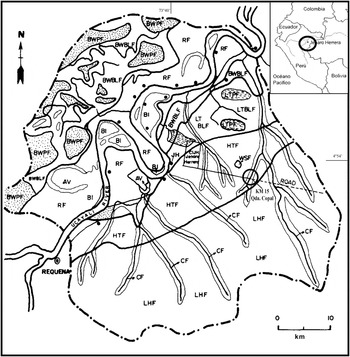
In the light of this gap in our knowledge, this study aimed to investigate the species composition and structure of a palm-dominated creek forest in Jenaro Herrera, Peru (bosque de quebrada, CF in Fig. 1). Such creek forests are located next to streams or their tributaries in high terrain and are subject to flooding during the rainy season (Kahn & Mejia, Reference Kahn and Mejia1990). Terra firme forests of Jenaro Herrera are dominated by Fabaceae, Lecythidaceae and Sapotaceae; while the first family dominates vast areas of Amazonia, the last two families are generally more common in the east (Honorio et al., Reference Honorio Coronado, Baker, Phillips, Pitman, Pennington and Vásquez Martínez2009). There are also a number of regionally less commonly encountered families present in Jenaro Herrera such as Anisophyllaceae, Aquifoliaceae, Opiliaceae, Sabiaceae and Styracaceae. Jenaro Herrera is also noted for its high diversity of palms (Kahn & Mejia, Reference Kahn and Mejia1990, Reference Kahn and Mejia1991). Previous studies on palm forests in the area have focused either on diversity only within the palms (Kahn & Mejia, Reference Kahn and Mejia1990, Reference Kahn and Mejia1991) or on the assemblage of species found in conjunction with palm species (Freitas, Reference Freitas1996a, Reference Freitas1996b). In our study we describe a novel assemblage of species found in the Jenaro Herrera region and, with the establishment of a permanent one-hectare plot, note that monitoring of this forest type has now begun within the RAINFOR network.
Vegetation map of Jenaro Herrera (JH) indicating location of study site (modified from Lopez-Parodi & Freitas, 1990). BI: beach and island vegetation; AV: aquatic vegetation; RF: riverine forest; BWPF: black water palm forest; BWBLF: black water broadleaf forest; LTPF: low terrace palm forest; CF: creek forest; LTBLF: low terrace broadleaf forest; HTF: high terrace forest; LHF: low hill forest; WSF: white sand forest.

Study Area
The bosque de quebrada or creek forest plot (JEN-13) was established in June 2007 at 4°55′S, 73°32′W near Jenaro Herrera, km 16 on the road to Angamos and 1.6 km northeast of the intersection with the Copal River (Fig. 1). The site is located 200 km south of Iquitos on the east margin of the Ucayali River, Peru, and is c.160 m above sea level. According to the records of the National Meteorological and Hydrological Service of Peru (SENAMHI), from 1987 to 2001 Jenaro Herrera had a mean annual temperature of 26°C, mean annual rainfall of 2724 mm and a humidity of 86%. There is a wet season from December to March and a dry season, when it rains less than 180 mm per month, from July to September (Honorio et al., Reference Honorio, Pennington, Freitas, Nebel and Baker2008).
Methods
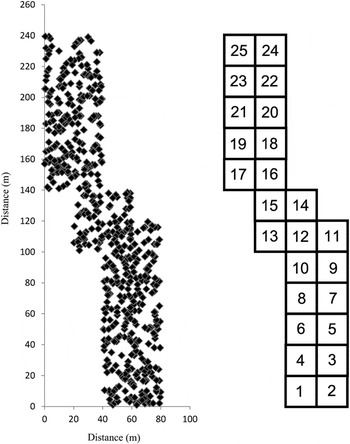
A one-hectare plot was set according to the RAINFOR manual (Phillips & Baker, Reference Phillips and Baker2002). This was composed of 25 subplots along the course of a stream, each measuring 20 × 20 m (Fig. 2). All individuals with ≥ 10 cm diameter at breast height (dbh, 1.3 m) were measured and marked with a numbered aluminium tag. Lianas were measured at three points: 1.3 m along the stem from the ground, 1.3 m vertically from the ground and at the maximum diameter within 2.5 m vertically from the ground. Where large numbers of dead leaf-bases occurred around the base of the palm stems they were cut away until the trunk was uncovered, and the diameter was measured at 1.3 m from the ground. For trees with stilt or buttress roots, the point of measurement was 50 cm above the highest root. Where deformities occurred on the trunk at 1.3 m the measurement was taken 2 cm below the deformity. All trees were mapped within each subplot. To aid relocation, all corners of the subplots were marked with 1 cm-thick PVC pipes, and permanence of the plot was guaranteed by the landowner’s agreement not to disturb it or the surrounding area. Five soil samples were taken from the centre of subplots 1, 5, 10, 15 and 20 at a depth of 0–30 cm. The analyses were performed at the Instituto de Pesquisas da Amazônia (INPA) in Manaus, Brazil using standard lab procedures described in Quesada et al. (Reference Quesada, Lloyd, Schwarz, Patiño, Baker and Czimczik2010).
Map of the plot. Each point represents an individual tree. The plot followed the course of a stream.

The palm species were identified in the field. A voucher specimen was collected for all other species. Identification work was carried out at Herbario Herrerense, the herbarium of the field station in Jenaro Herrera; further identification was carried out in the herbarium of La Molina, Lima. As much of the material collected in this study was sterile, identification to species was sometimes impossible. The abbreviations ‘aff.’ and ‘cf.’ were used where the species were not known but had a clear similarity to a known species. The abbreviation ‘aff.’ was used for a species clearly related to a known species but also likely not to be that species; ‘cf.’ was used when the species may be the same as the species to which it was compared but the identification was uncertain. Specimens are housed in the herbaria of the Instituto de Investigaciones de la Amazonía Peruana in Jenaro Herrera (Herbario Herrerense; HH) and in the Amazonense Herbarium in Iquitos (AMAZ), as well as the Universidad Nacional Agraria, La Molina (MOL) in Peru and the Royal Botanic Garden Edinburgh (E) in Scotland.
Data Analyses
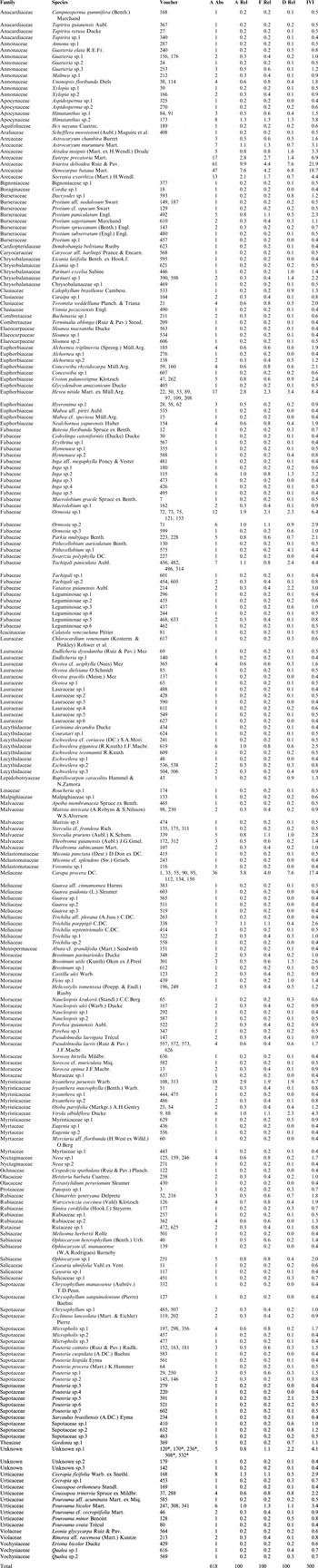
Data were analysed following Mori et al. (Reference Mori, Boom, Carvalho and Santos1983). Relative frequency, relative dominance and relative abundance were calculated for each species and these values were used to determine the importance values for each family and species present.
The relative frequency for species x is equal to the number of subplots where species x occurs divided by the total frequency for all species. The relative abundance is equal to the number of individuals of species x divided by the total number of individuals. The relative dominance is equal to the basal area of species x divided by the total basal area. The relative dominance, frequency and abundance are all expressed as percentages. Family importance values (FIV) were obtained by adding the relative frequency, dominance and abundance for all species within each family.
Results and Discussion
Forest structure
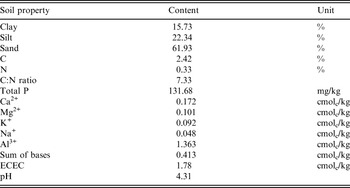
The plot JEN-13 was set along a tributary of the Copal River. This contained 618 trees and 15 lianas with a total basal area of 23.9 m2. Lianas, occurring on a total of eight trees, and four stranglers (Coussapoa trinervia Spruce ex Mildbr., Urticaceae), were recorded in three separate subplots. Lianas were not collected or identified, and for the purposes of this study were disregarded. The mean number of individuals per subplot was 24.7, with a maximum of 35 and a minimum of 12. The trees populated all subplots at a more or less equal density, with the exception of subplot 25, which contained a recent tree fall gap. The soils were classified as gleysols, a soil type often found where there is inundation for part of the year. The soils were sandy, acidic, highly weathered and nutrient poor (Table 1) as in other terra firme forests of Jenaro Herrera (Honorio et al., Reference Honorio, Pennington, Freitas, Nebel and Baker2008). This plot had low concentration of bases (0.4 cmolc/kg) compared to other forests in terra firme of the region where values are over 1 cmolc/kg (Quesada et al., Reference Quesada, Lloyd, Schwarz, Patiño, Baker and Czimczik2010). Low values of the sum of bases are found mainly in terra firme forest of central and eastern Amazonia and on patches of highly leached soils in western Amazonia such as Sucusari and Allpahuayo in Peru and El Zafire in Colombia (Quesada et al., Reference Quesada, Lloyd, Schwarz, Patiño, Baker and Czimczik2010).
Soil properties of plot JEN-13, a palm-dominated creek forest in Jenaro Herrera, Peru

ECEC, effective cation exchange capacity.
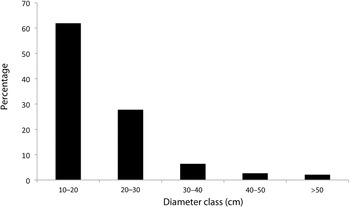
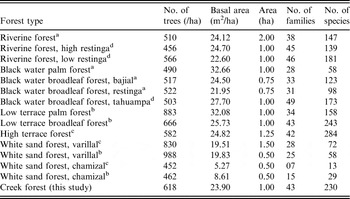
The mean basal area per subplot was 0.95 m2, with a maximum of 1.61 m2 and a minimum of 0.56 m2. The total basal area (23.9 m2) for the plot is significantly lower than those previously reported from terra firme forests in central Amazonia, such as 31 m2 (Milliken, Reference Milliken1998) and 27.6 m2 to 32 m2 (Campbell et al., Reference Campbell, Daly, Prance and Maciel1986), but similar to values of other forests in the area (Table 2). The great majority of trees (90%) were less than 30 cm dbh (Fig. 3). The mean tree diameter was 19.8 cm and the maximum was 110.5 cm. The inverse j-shaped curve is consistent with the pattern found in other Amazon forest plots and is indicative of undisturbed forest (Balslev et al., Reference Balslev, Luteyn, Øllgaard and Holm-Nielsen1987). The family with the largest average dbh was Fabaceae (19.9 cm), followed by Moraceae (19.6 cm), Meliaceae (19.4 cm), Myristicaceae (19.2 cm) and Arecaceae (18.3 cm).
Distribution of trees by diameter class. Ninety per cent of trees were below 30 cm dbh.

Floristic and structural data for different forest types in Jenaro Herrera, Peru

aFreitas et al. (Reference Freitas1996a), bFreitas (Reference Freitas1996b), cFreitas (unpublished data), dNebel et al. (Reference Nebel, Kvist, Vanclay, Christensen, Freitas and Ruiz2001).
This analysis did not distinguish between buttressed and stilt-rooted trees, between them comprising 42% of the individuals surveyed, of which 153 (25%) were palms. Milliken (Reference Milliken1998) found that 28% of trees possessed stilt or buttress roots and Balslev et al. (Reference Balslev, Luteyn, Øllgaard and Holm-Nielsen1987) and Mori et al. (Reference Mori, Boom, Carvalho and Santos1983) found that 17% of trees in unflooded forest had stilt or buttress roots. There are many ecological factors, such as terrain, forest age, species composition and soil conditions (Milliken, Reference Milliken1998), which contribute to the presence of stilt or buttress roots, and the high percentage reported in this study is due to the dominance of stilt root producing palms, such as Iriartea deltoidea Ruiz & Pav. Thirty-eight trees (6%) were leaning, in one case horizontal and alive.
Floristic diversity
The 618 individuals surveyed belonged to a total of 230 species, 106 genera and 43 families. The family concept followed APG II (Angiosperm Phylogeny Group, 2003). Of the 230 presumed species 51% could be named (includes aff. and cf. names), representing 70% of the total number of individuals. Another 38% of taxa were identified only to genus and 10% only to family level. These taxa were recognised by their distinct morphological characters and were labelled accordingly (e.g. Inga sp.2, Bignoniaceae sp.1). There were also three taxa that could not be identified even to family level.
The diversity of species found in this plot of palm-dominated creek forest is high compared to other palm-dominated forests in Jenaro Herrera. In comparison, black water palm forests have 58 species per hectare (Freitas, Reference Freitas1996a) and low terrace palm forests 158 species per hectare (Freitas, Reference Freitas1996b). This high species diversity is more similar to terra firme forests in the area, such as the low terrace broadleaf forest or the high terrace forest (Table 2), indicating the high influence of the surrounding forest. While some streamside species dominate the plot, such as Iriartea deltoidea (Arecaceae) or Carapa procera DC. (Meliaceae), other species are more representative of the Jenaro Herrera terra firme forest, such as those that belong to the families Sapotaceae, Lecythidaceae and Chrysobalanaceae. Terra firme forests in the Amazon are noted for their high species diversity. Gentry (Reference Gentry1988) reported between 180 and 300 species per hectare from Amazonian Peru, Milliken (Reference Milliken1998) found 201 species from one hectare of Brazilian terra firme, while Balslev et al. (Reference Balslev, Luteyn, Øllgaard and Holm-Nielsen1987) estimated 228 species per hectare in Amazonian Ecuador. Lower figures have been reported in southwestern and eastern Amazonia. For example, Campbell et al. (Reference Campbell, Daly, Prance and Maciel1986) reported 118 to 162 species per hectare from the Rio Xingu in Brazil, and Boom (Reference Boom1986) reported 94 species per hectare from terra firme in Amazonian Bolivia. Results presented by Pitman et al. (Reference Pitman, Terborgh, Silman, Núñez, Neill and Cerón2002) from the Manu National Park in southwestern Amazonia showed mean species per hectare of 174 (range 126–217) and from Yasuní, Ecuador in northwestern Amazonia mean species per hectare of 239 (range 188–295).
The most diverse family in this study was Fabaceae with 30 species in 13 genera, followed by Sapotaceae (23 spp., six genera), Moraceae (21 spp., nine genera) and Euphorbiaceae (12 spp., eight genera). The most diverse genera were Pouteria (Sapotaceae) with 11 species, followed by Eschweilera (Lecythidaceae) and Inga (Fabaceae) with six species each, and Pourouma (Urticaceae), Trichilia (Meliaceae) and Guarea (Meliaceae) with five species each.
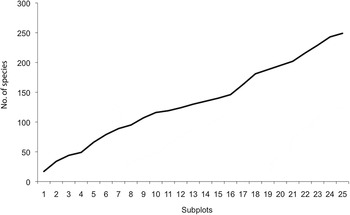
The species–area curve, i.e. the rate at which new species were encountered when moving through the subplots, is shown in Fig. 4. The non-asymptotic nature of the species–area curve may be due to the fact that the 230 species (106 genera, 43 families) reflect only part of the overall diversity of this forest type; in a similar study of terra firme forest Campbell et al. (Reference Campbell, Daly, Prance and Maciel1986) found that the species–area curve levelled off after 1.5 hectares and appeared to be reaching asymptote after 3 hectares.
Species–area curve for one hectare of palm-dominated creek forest (cumulative).

Importance value index (IVI) analysis
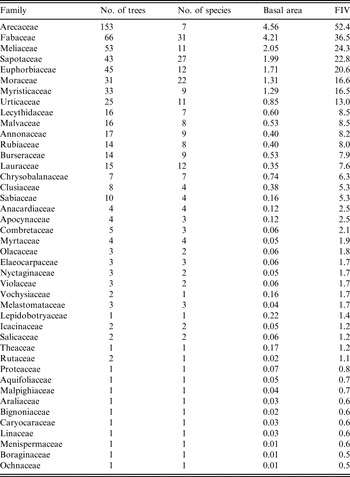
The five most important families in the plot were Arecaceae, Fabaceae, Meliaceae, Euphorbiaceae and Sapotaceae (Table 3). The dominance of Arecaceae in this plot is likely to be due to the periodic flooding that this area undergoes. This family tends to dominate the permanently flooded forests and other poorly drained soils in terra firme of Jenaro Herrera (Kahn & Mejia, Reference Kahn and Mejia1991; Honorio et al., Reference Honorio, Pennington, Freitas, Nebel and Baker2008). Kahn & Mejia (Reference Kahn and Mejia1990) found that large, arborescent palms are frequent in wetland forests on waterlogged or inundated soils, and Wittmann et al. (Reference Wittmann, Schöngart, Montero, Motzer, Junk and Piedade2006) found that Arecaceae was the fifth most important family overall and the most important in high várzea forests. A high importance value for Fabaceae was expected; this family is also important in other vegetation types in Jenaro Herrera (Honorio et al., Reference Honorio, Pennington, Freitas, Nebel and Baker2008) and tends to dominate across Amazon forests, according to ter Steege (2000).
List of families found in the plot ranked by FIV (family importance value), showing tree and species numbers and total basal area for each family

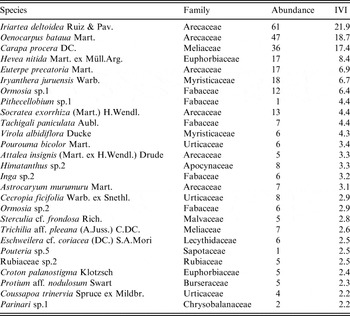
The most important species (Table 4) were Iriartea deltoidea (IVI 21.9), followed by Oenocarpus bataua Mart. (IVI 18.7), Carapa procera (IVI 17.4), Hevea nitida Müll.Arg. (IVI 8.4), Euterpe precatoria Mart. (IVI 6.9) and Iryanthera juruensis Warb. (IVI 6.7). Their cumulative basal area made up 29% of the total basal area of the hectare and approximately 25% of the total IVI. The 27 most important species (Table 4) represent half of the total importance value of the plot, while 76% of all species were represented by only one individual.
The top 27 species of tree from the plot with their IVI values and abundances. A full list of species and their abundance, frequency, dominance and IVI is presented in the Appendix

According to Svenning & Balslev (Reference Svenning and Balslev1999), Iriartea deltoidea prefers poorly drained streamsides in eastern, northern and southern Amazonia but is abundant on well-drained terra firme forest in the rest of its range. The abundance for Iriartea deltoidea found in this study (61 individuals/ha) is higher than those previously reported on terra firme forests from Ecuador, southern Peru (45–49 ind./ha; Pitman et al., Reference Pitman, Terborgh, Silman, Núñez, Neill and Cerón2001), and northern Peru (1–15 ind./ha; Pitman et al., Reference Pitman, Mogollón, Dávila, Ríos, García-Villacorta and Guevara2008). This study represents a new record for northwestern Amazonia where Iriartea deltoidea can be abundant on poorly drained soils, occurring as it does here in an area subject to intermittent flooding.
The next five most important species in this study are all known to be species that do well in areas that are flooded periodically. These included two large arborescent palms, Oenocarpus bataua and Euterpe precatoria. Kahn et al. (Reference Kahn, Mejia and de Castro1988) found that large arborescent palms are generally more common in seasonally inundated forests than in terra firme forests. Oenocarpus bataua is found on a number of soil types from well-drained terra firme areas in Ecuador and on poorly drained soils near Iquitos, Peru (Montufar & Pintaud, Reference Montufar and Pintaud2006), similar to the area in this study. Cintra et al. (Reference Cintra, de Carvalho Ximenes, Gondim and Kropf2005) also suggest that the extensive range of this species indicates that it is tolerant of a wide range of environmental conditions. The topographical variation in this plot allows a species such as this to thrive. Svenning (Reference Svenning1999) found that Oenocarpus bataua and Euterpe precatoria shared a microhabitat preference in his study site in Ecuador, but that E. precatoria was much more abundant on a nearby floodplain forest.
The high importance of Carapa procera in this study correlates well with the findings of Pennington et al. (Reference Pennington, Styles and Taylor1981), who found that C. procera is known to grow on swampy ground, at the edges of mangroves, on river banks and creeks and in low-lying seasonally or permanently flooded forest. Hevea spp. are also known from floodplains and can grow with trunks submerged (Seibert, Reference Seibert1947), suggesting that H. nitida is tolerant of occasional inundation in this forest type. Iryanthera juruensis, the sixth most important species in this study, was found by Boom (Reference Boom1986) to be one of the most frequent species in a hectare of terra firme forest in Amazonian Bolivia. Myristicaceae is one of the most important families in the western Amazon, with Boom’s study ranking it as the second most important after Moraceae.
Haugaasen & Peres (Reference Haugaasen and Peres2006) showed that rich floristic variation in terra firme forest is a result of habitat heterogeneity derived from a combination of edaphic and ecological conditions. Pitman et al. (Reference Pitman, Terborgh, Silman, Núñez, Neill and Cerón2001), Macía & Svenning (Reference Macía and Svenning2005) and Honorio et al. (Reference Honorio Coronado, Baker, Phillips, Pitman, Pennington and Vásquez Martínez2009) linked floristic affinity in the Amazon to local ecological conditions and demonstrated that soil fertility influenced the distribution of species in western Amazonia. Previous work has demonstrated that the most common species in terra firme forests of Jenaro Herrera belong to families such as Fabaceae, Lecythidaceae, Sapotaceae and Chrysobalanaceae that are characteristic of low-fertility soils (Honorio et al., Reference Honorio, Pennington, Freitas, Nebel and Baker2008, Reference Honorio Coronado, Baker, Phillips, Pitman, Pennington and Vásquez Martínez2009). The current research supports the observation that within the western Amazon region proximity is not always correlated with similar floristic composition (Honorio et al., Reference Honorio Coronado, Baker, Phillips, Pitman, Pennington and Vásquez Martínez2009), as the current study demonstrates a very different suite of dominant families to that of a previous study within the area of Jenaro Herrera (Honorio et al., Reference Honorio, Pennington, Freitas, Nebel and Baker2008). Indeed, Honorio et al. (Reference Honorio, Pennington, Freitas, Nebel and Baker2008) postulate that studies based on the family, and even generic level taxonomic scale, are too coarse to allow meaningful environmental correlations. For such conclusions it is necessary to work at the specific level, a fact that has also been pointed out by the RAINFOR group (Phillips & Baker, Reference Phillips and Baker2002).
The dramatic differences observed between forest types reported in this study and that of Honorio et al. (Reference Honorio, Pennington, Freitas, Nebel and Baker2008, Reference Honorio Coronado, Baker, Phillips, Pitman, Pennington and Vásquez Martínez2009) may be explained by periodic flooding of the current study plot resulting in a different floristic composition than that found generally in terra firme in Jenaro Herrera, and support the theory of habitat heterogeneity giving rise to a mosaic of forest types in the Amazon.
Acknowledgements
The authors would like to thank the Royal Geographical Society, Rio Tinto Plc, Royal Scottish Geographical Society, the Davis Expedition Fund, the William Dickson Travel Fund, and the Anglo-Peruvian Society for financial support; the Royal Botanic Garden Edinburgh, Instituto de Investigaciones de la Amazonía Peruana, Centro de Investigaciones Jenaro Herrera and the Universidad Nacional Agraria La Molina for logistical support; and H. Vásquez, J. Irarica and J. Mozambite for assistance in the field. We also thank James Richardson, Jimmy Ratter and Samuel Bridgewater for comments on the text, Nick Gray for help with figures, and Carlos Reynel, Nállarett M. Dávila C., Radolfo Vásquez Martínez, Barry Hammel, Lars W. Chatrou and Charlotte M. Taylor for help with identification.
Species list with absolute abundance (A Abs), relative abundance (A Rel), relative frequency (F Rel), relative dominance (D Rel) and importance value index (IVI). Authorities verified from the Missouri Botanical Garden TROPICOS website. Palms were identified in the field and herbarium specimens (voucher) were collected using Mariano Alvez’s numbers (these numbers are equivalent to those of the tree tags).

* Individuals with no leaves, vouchers not available.