

Human societies are characterised by social relationships, making interdependence and closeness its quintessential feature (Kelley & Thibaut, Reference Kelley and Thibaut1978). Interdependence exists when outcomes of individuals are affected by their own actions and others’ actions (Kelley, Bercheid, Christensen, Harvet, & Huston, Reference Kelley, Bercheid, Christensen, Harvet and Huston1983; Kelley & Thibaut, Reference Kelley and Thibaut1978; Rusbult & Van Lange, Reference Rusbult and Van Lange2003). A strong association has been found between intimate relationships and health outcomes, and the closer the relationship, the higher this association (House, Landis, & Umberson,Reference House, Landis and Umberson1988; Kiecolt-Glaser & Newton, Reference Kiecolt-Glaser and Newton2001; Miller, Hollist, Olsen, & Law, Reference Miller, Hollist, Olsen and Law2013). Given these connections, not surprisingly, there has been a growing interest in understanding the role of contextual influences on health. However, the majority of public health research and programs continue to place emphasis on the individual as the unit of interventions, theories and statistical analysis (Diez-Rouz, Reference Diez-Roux2000; Lewis et al., Reference Lewis, McBride, Pollack, Puleo, Butterfield and Emmons2006). Moreover, often studies examining contextual factors omit looking at mutual partner influences and interdependence across individuals and contexts (Barber, Murphy, Axinn, & Maples, Reference Barber, Murphy, Axinn and Maples2000). Such information is critical as we move beyond determinants to comprehend the processes and mechanisms behind health behaviours and outcomes for more effective interventions.
Despite the vast changes witnessed in marital structures in the last century, intimate relationships continue to be a key social relationship that many individuals establish in adulthood (Cherlin, Reference Cherlin2012). In Western samples, the better health of married adults as compared to their unmarried counterparts across a range of outcomes has been well documented (Proulx, Helms, & Buehler, Reference Proulx, Helms and Buehler2007; Robles, Reference Robles2014; Umberson, Williams, Powers, Liu, & Needham, Reference Umberson, Williams, Powers, Liu and Needham2006). However, these differences in the health status of married versus unmarried individuals have largely been attributed to selection effects (healthier persons being more likely to marry and remain married), and the increased resources that married individuals often tend to have (Robles, Reference Robles2014). Given these limitations of understanding health outcomes by purely examining marital status, couple processes such as marital relationship quality (MRQ) have now become an important area of focus to explore differences in health among couples (Donoho, Crimmins, & Seeman, Reference Donoho, Crimmins and Seeman2013). Marital relationship quality is a multidimensional construct, defined as an evaluation of marriage along several dimensions, including positive and negative aspects, attitudes and behaviours (Fincham & Bradbury, Reference Fincham and Bradbury1987; Spanier & Lewis, Reference Spanier and Lewis1980).
Research has consistently demonstrated the association between MRQ and health, whether assessed subjectively through self-rated health or objectively with biomarkers and/or clinical endpoints. However, current research recognises that marriage is not always beneficial for health but that marriage may be positive only for the happily married (Gallo, Troxel, Matthews, & Kuller, Reference Gallo, Troxel, Matthews and Kuller2003). Moreover, while researchers have hypothesised that the effects of marital functioning on health and physiology might be stronger for women as compared to men because of their interpersonal orientation and/or their subordinate position within marriage, the empirical evidence examining gender differences in MRQ and health outcomes has been inconclusive (Kiecolt-Glaser & Newton, Reference Kiecolt-Glaser and Newton2001; Wanic & Kulic, Reference Wanic and Kulik2011).
In addition, studies have neglected to investigate the role of dyadic interconnectedness or the influence spouses may have on each other's perception of their marriage and health. Broadening understanding of the interpersonal context of marriage is very relevant today given the changes the institution of marriage has witnessed this past century. In modern economies, families are no longer the central units of economic production. Instead, providing emotional sustenance and socialisation appear to be emerging as its primary function (Wilcox & Nock, Reference Wilcox and Nock2006). Moreover, forces such as the growing importance of individualism and the rise in the status of women are also redefining marriage (Wilcox & Nock, Reference Wilcox and Nock2006). Burgess (Reference Burgess1948) described these changes as a transition in marriage from an institution based on traditional patriarchal authority to one based on ‘companionship’, centred on love, friendship and mutual respect, which in turn fosters a more egalitarian relationship, with greater communication and negotiation of mutual desires and goals between spouses (Amato, David, Booth, & Rogers, Reference Amato, David, Booth and Rogers2003; Wilcox & Nock, Reference Wilcox and Nock2006). In such a marital context, one would expect greater mutual spousal influence on each other's health and wellbeing. However, the limited studies of dyadic influences on health and MRQ have largely been in the care-giving literature (Korporaal, Broose van Groenou, & Tilburg, Reference Korporaal, Broese van Groenou and Van Tilburg2013; Rauer, Sabey, & Jensen, 2013).
In sub-Saharan Africa, research in this arena is even more limited. Although challenges brought about by HIV have spawned an interest in marital relationships, this research has mostly investigated the role of gender power relations or the structure of marriage on HIV transmission (Bove & Valeggia, Reference Bove and Valeggia2009; Gupta & Weiss, Reference Gupta and Weiss1993). There still remains a paucity of research that explores the relationship context of couples and the potential impact that might have on health and wellbeing of couples in this setting. There is growing relevance and need for understanding these connections in sub-Saharan Africa. While changes in the structure and function of marriage have been more prominent in the West, these shifts are becoming increasingly visible in the sub-Saharan African context too. For instance, Cherlin (2014) argues that changes currently being witnessed in parts of sub-Saharan Africa in the marital context, such as later entry into marriage because women are increasingly pursuing higher education and careers, and more involvement and say in mate selection, signify profound changes in social relations within the family, marriage, and labour market. As a result of these changes, the power of the husband is declining and marital relationships are becoming more centred on love and companionship. Small-scale studies exploring the nature of marriage in sub-Saharan Africa have also concluded similarly and found a trend towards more egalitarian and romantic marriages, with a preference for open communication and egalitarian decision-making between spouses (Miller & Kannae, Reference Miller and Kannae1999; Steyn, Reference Steyn1996).
Given these gaps in sub-Saharan African research, the ongoing changes in the marital context, and the limited research exploring interdependence and connectedness between spouses, there is a need to systematically understand the relationship between dyadic processes and health. As a step towards this goal, in this study we conducted an in-depth exploration of how spouses influence mutual MRQ and health over time using two waves of couples’ data from peri-urban Ethiopia. We first examined whether spouses influence each other's marital quality over time, adjusting for their baseline health and other covariates (research question 1)Footnote 1 . We then explored the key research question (research question 2)Footnote 2 of interest, the association of baseline marital quality of spouses on each other's self-rated health at the follow-up, adjusting for baseline health and other key covariates. Furthermore, in order to understand the bidirectional relationship between MRQ and health, as well as address issues of reverse causality, we explored the association of baseline self-rated health with the follow-up marital quality scores of spouses.
Study Context and Site
Ethiopia is located in eastern Africa and is the second most populated country in sub-Saharan Africa after Nigeria, and has a population of 87.5 million (World Bank, 2014). Ethiopia is also one of the world's poorest countries, with a per capita income of US$470, which is significantly lower than the regional average of US$1,257 (World Bank, 2014). Ethiopia was ranked in the low human development category in 2012, positioned at 173 out of 187 countries and territories (United Nations Development Programme, 2013). The average life expectancy at birth for an average Ethiopian is 63 years (Population Reference Bureau, 2013).
The median age of first marriage for women in Ethiopia remains low, at 16.5 years (Ethiopia Demographic and Health Survey, EDHS; Central Statistical Agency [Ethiopia] and ICF International, 2011). The age at first marriage (in 2011) is higher for males, at 23.1 years. The majority of Ethiopian marriages are monogamous; only 11% of the females reported living in polygynous unions (Central Statistical Agency [Ethiopia] and ICF International, 2011).
Although there is variation in marriage customs across religious and ethnic groups, in most cases, marriages are traditionally arranged by families with very brief engagement periods (Tilson & Larson, Reference Tilson and Larsen2000). The bride joins the groom's house until the couple establishes their own household (Ezra, Reference Ezra2003). Divorce is prevalent, and as per one estimate, as many as 45% of first marriages end in divorce within the first 30 years (Tilson & Larson, Reference Tilson and Larsen2000). Traditionally, Ethiopian men and women have distinct roles and responsibilities within marriage. Males are viewed as the breadwinners, who work outside the home (Ezra, Reference Ezra2003). Females, on the other hand, primarily have household responsibilities, with childbearing and child rearing culturally seen as their most significant roles (Ezra, Reference Ezra2003).
The current study was conducted in a peri-urban town close to the capital city of Addis Ababa. Studies have noted shifting trends in marital patterns in the urban areas of Ethiopia in general and the Addis Ababa region in particular (Ezra, Reference Ezra2003; Sibanda, Woubalem, Hogan, & Lindstrom, Reference Sibanda, Woubalem, Hogan and Lindstrom2003). In the context of the vastly lower fertility levels in Addis Ababa as compared to the rest of the country and sub-Saharan Africa, Sibanda et al. (Reference Sibanda, Woubalem, Hogan and Lindstrom2003) attribute the decline to later age at marriage and the increasing proportion of women in their late twenties and early thirties who remain single. In another study, Erza (Reference Ezra2003) described education to be the key ‘modernisation variable’ in Ethiopia that has promoted later age at marriage, greater say for the younger generation in mate selection, a reduced risk of being in a polygamous marriage, and more marital happiness, as indicated by reduced marital dissolution.
Methods
Data and Sampling Design
Data for this study were collected as part of a larger ongoing study called Family Health and Wealth Study (FHWS), spanning five sub-Saharan African countries, which aims to examine individual and family-level health and wealth consequences of family size. The study has followed 500–1,000 family cohorts in peri-urban areas in Ethiopia, Ghana, Malawi, Nigeria, and Uganda. Households were eligible for the study if their occupants included a couple formally married or in a stable union. A probability sample of households where the wife was of childbearing age (16–44 years) and the husband aged 20–54 years was selected for the study. The enumeration areas (EAs) were selected probability proportional to size (PPS) and the number of households with eligible couples per EA targeted for each was also determined with PPS. A household census was conducted within each EA, followed by systematic selection of households. Occupants were enumerated and eligible couples identified. Request for consent was sought from both partners of eligible couples; if one or both did not consent to participate in the study, the field team selected another eligible couple from the same household or an adjacent household.
In cases where a family head had multiple wives, only one randomly selected wife was interviewed. Across all EAs, couple participation rates were above 95%, and interview completion rates were uniformly high. The survey questionnaire, administered separately to husbands and wives, covered a range of questions on marital quality and health among other topics. The first round of the Ethiopian FHWS in 2010 consisted of 998 couples; the second round re-interviewed 746 couples (75%) one year later.
Measures
Key dependent and independent variables
Spouses’ MRQ subscale (trust, commitment, and conflict resolution) scores from the baseline and follow-up surveys were the key independent and dependent measures for research question 11. For research question 22, the baseline subscale MRQ scores were the key independent measures, and follow-up self-rated health scores served as the dependent measures.
Marital relationship quality
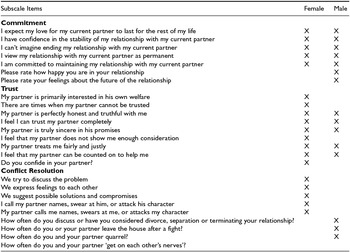
The MRQ measures included in the FHWS consisted of four independent validated Western scales capturing dimensions of trust (Larzelere & Huston, Reference Larzelere and Huston1980), commitment (Harvey et al., Reference Harvey, Beckman, Gerend, Bird, Posner, Huszti and Galavotti2006; Sternberg, Reference Sternberg1997), constructive communication (Christensen & Sullaway, Reference Christensen and Sullaway1984; Heavey, Larson, Zumtobel, & Christensen, Reference Heavey, Larson, Zumtobel and Christensen1996), and satisfaction (Spanier, Reference Spanier1976) in a relationship. Each scale consisted of five to eight statements, to which spouses responded separately. The MRQ scale was initially conceptualised as a four-factor multidimensional scale mirroring the four validated Western scales. In order to assess scale reliability and validity, we first examined Cronbach's alpha and inter-item correlations between scale items to preliminarily determine the reasonableness of assuming a single latent construct underlying the four scales. Following the internal consistency assessment, we conducted a principal components analysis on all scale items to determine the number of factors underlying the scale items. We then examined the structure of the scales and assessed internal validity with exploratory factor analysis on all scale items using the baseline data, which was followed by a confirmatory factor analysis using the follow-up sample. Multiple iterations of the process were performed until a satisfactory solution was attained. The process resulted in a three-factor MRQ scale consisting of three subscales of trust, commitment, and conflict resolution, although the female and male scale items did not mirror each other (see the Appendix for a list of final scale items). The scales were highly reliable with Cronbach's alphas of 0.94 and 0.89 for female and male partners, respectively. Some scale items were reverse scored for ease of interpretability, with a higher score indicating increased trust, conflict resolution, and commitment.
The final scale scores for the baseline and follow-up MRQ measures were derived from the confirmatory factor analysis of baseline and follow-up survey conducted in Stata version 13 to ensure comparability across surveys (Stata Corp, 2013). The scale scores are standardised measures with a mean of zero and standard deviation of 1 (Stata Corp, 2013).
Self-rated health
To assess physical health in the FHWS, the respondents answered a global health question, ‘In general, would you say your own health is: excellent, very good, good, poor or fair?’, rated 4 to 1 respectively — a higher score indicates better health. The use of self-rated global measures of health is common in large studies of marital functioning and physical health (Miller et al., Reference Miller, Hollist, Olsen and Law2013; Umberson et al., Reference Umberson, Williams, Powers, Liu and Needham2006). Previous research has demonstrated that self-reported health is highly correlated with objective measures of health and is a strong predictor of future visits to the doctor, disabilities, and mortality (Ferraro & Farmer, Reference Ferraro and Farmer1999; Lee, Reference Lee2000; Miilunpalo, Vuori, Oja, Pasanen, & Urponen, Reference Miilunpalo, Vuori, Oja, Pasanen and Urponen1997). Moreover, a study assessing validity of self-rated health found that MRQ had similar effects on self-report of physical symptoms, chronic illness, physical disability, and global health (Bookwala, Reference Bookwala2005).
Other key variables
A range of socio-demographic, household-level and couple-level variables known to influence MRQ and self-rated health were included in our analysis, such as respondents’ age, education, parity, household wealth, religion, and spousal age difference. Age and education were measured in years as continuous variables indicating age and schooling in years. Parity, which specifies the number of times a woman has given birth, was assessed using the female partner's response on a series of questions about her childbirth history. Household wealth was constructed through a principal components analysis of household assets and housing characteristics, such as ownership of consumer items and type of dwelling. The index score was then used to divide the households into quintiles that indicate poorest, poor, middle, richer, and richest. Religion was categorised as Christians and other religions. Spousal age difference was measured by subtracting the female partner's age from the male partner's age. Spousal age difference was included in the analysis because prior evidence from sub-Saharan Africa suggests that spousal age difference has a strong effect on couple communication, household decision making, and other variables that influence spousal relationships and health outcomes (e.g., Barbieri, Hertrich, & Grieve, Reference Barbieri, Hertrich and Grieve2005).
In addition, baseline self-rated health scores were added to the model, assessing the association of baseline MRQ on self-rated health at follow-up, to account for any differences in baseline health of spouses.
Statistical Analysis
The analysis was limited to the sample of couples who participated in both survey rounds because of the longitudinal design of the study. We first conducted exploratory data analysis and examined the data spread, frequency distributions, outliers, and patterns of missing values to ascertain the appropriate treatment of the variables. This was followed by univariate analysis to check frequency distributions and summary statistics, such as means and variances for continuous variables and proportions for categorical variables. We estimated polychoric correlations between the MRQ and self-reported health scales of spouses to assess levels of correlation.
In order to determine potential bias due to loss-to-follow-up at the second round of data collection, we checked for significant differences between couples lost-to-follow-up versus couples who were relocated, to identify potential reasons for loss and determine appropriate data management strategies (Kristman, Manno, & Côté, Reference Kristman, Manno and Côté2004). The couples who remained in the study and those lost-to-follow-up did not vary significantly on the key outcomes of MRQ and self-reported health. We thus proceeded with the analysis on the relocated sample without making any adjustments for lost-to-follow up.
We then conducted dyadic level analysis using the Actor Partner Interdependence Model (APIM), which is a commonly used technique to model interdependence in dyadic relationships (Kenny, Kashy, & Cook, Reference Kenny, Kashy and Cook2006). The APIM model suggests that a person's score on an independent variable affects their own dependent variable score (actor effect) as well as the dependent variable score of their partner (partner effect). The partner effect directly models the mutual influence that might be present between individuals in a dyad.
Multilevel modelling was used to operationalise the APIM model. Using multilevel methods to operationalise the APIM model has several advantages over other methods proposed to estimate the APIM. Among its advantages is a greater flexibility in specifying the actor and partner effects, as well as estimation of interactions between different kinds of variables (Campbell & Kashy, Reference Campbell and Kashy2002). However, estimating traditional multilevel models with the common intercept approach has a major disadvantage in the case of dyadic data because it assumes the non-independence in the outcome scores is positive because the non-independence is specified as a variance rather than a correlation (Kenny et al., Reference Kenny, Kashy and Cook2006). Kenny et al. (Reference Kenny, Kashy and Cook2006) therefore recommended an alternate strategy for modelling dyadic non-independence by correlating the error terms, which can be accomplished by treating individual scores as repeated measures in the dyad. The non-independence is then estimated as a covariance. In addition, Kenny et al. (Reference Kenny, Kashy and Cook2006) provide two approaches to modelling APIM for dyads, where the members can be distinguished by some characteristics (e.g., gender). The interaction approach uses interaction terms between the distinguishing variable and the actor and partner predictor variables to factor in the effects of the distinguishing variable.
We estimated multivariate APIM models for the MRQ measures and self-reported health using the interaction approach laid out by Kenny et al. (Reference Kenny, Kashy and Cook2006). Since we were exclusively dealing with female and male dyads, we used gender as the distinguishable variable. We included two interactions of gender with actors’ and partners’ MRQ scores in our APIM models. The interaction terms allowed the estimation of separate actor and partner effects for females and males.
Results
Socio-Demographic Characteristics
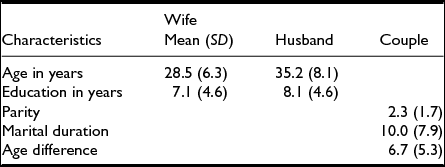
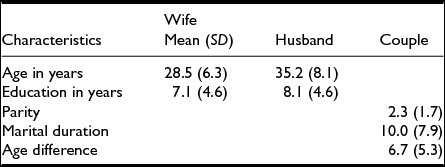
Table 1 provides socio-demographic characteristics of the female and male samples at baseline. Male partners on average were older than their spouses. The mean age of women in the sample was 28.5 (SD = 6.3) years and that of men was 35.2 (SD = 8.1) years at the baseline survey. Mean schooling also varied between spouses; the men (mean: 8.1, SD = 4.6) on average accumulated almost 2 additional years of schooling as compared to the females (mean: 7.1, SD = 4.6). The majority of women (85.0%) and men (84.6%) followed the Christian religion. Mean parity in the group at baseline was 2.3 (SD = 1.7) children.
Baseline Descriptive Summary Statistics of Socio-Demographic Variables by Wife, Husband and Couple (n = 728)
Marital Relationship Quality and Self-rated Health Measures
The distributions of the MRQ and self-rated health measures were skewed towards higher response categories. Since transformation of variables did not improve the data spread, we retained the original variable distributions for the analysis. We collapsed the self-reported health measure to a three-category variable (very good, good and poor) because very few respondents selected the very poor categories.
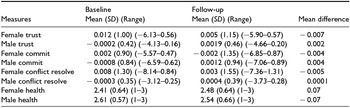
Table 2 shows the baseline and follow-up female and male partners’ MRQ and self-rated health measures. There were small changes in the MRQ and self-reported health scores of spouses between survey rounds. Interestingly, while the female marital quality subscales scores indicated a slight decrease in MRQ over time, the opposite was true for the males. However, as opposed to the trends in MRQ measures, the females reported a slight improvement in their health, while the males reported a slight decline in health.
Descriptive Summary Statistics of Female and Male Marital Quality Subscales and Self-Rated Health Measures at Baseline and Follow-Up (n = 728)

Results of the APIM Models
Marital relationship quality measures
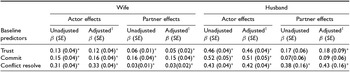
Table 3 provides the actor and partner associations of MRQ measures over time after accounting for baseline health and other covariates. The final APIM analytic sample consisted of 725 dyads. In the multivariate models, MRQ measures of partners were positively associated over time with each other's scores after adjusting for self-rated health and other covariates at baseline. Although all of the female partners’ baseline MRQ subscale scores were positively associated with their partners’ follow-up MRQ measures, the male partners’ trust and conflict resolution subscales scores had a partner effect on the females. In both adjusted and unadjusted models, while the female partners’ commitment score was most strongly associated with the male partners’ commitment score, the male partners’ conflict resolution scores had the strongest partner effect on their female partners. In the multivariate models, a unit change in the female partners’ baseline commitment score was significantly associated with an increase in the male partner's commitment score by 0.15 points (p = .03) at follow-up. On the other hand, a unit increases in the male partners’ conflict score at baseline was associated with a 0.43 points (p = .05) (increase in the female partners’ conflict scores at follow-up after adjusting for covariates.
The Actor-Partner Interdependence Model Demonstrating the Association between Spouses’ Marital Quality Subscale Scores Over Time (n = 1450, dyads: 725)

Note: 1Model adjusted for respondent's baseline self-rated health, age, education, religion, parity, wealth-quintile, and spousal age difference.
*p < .05.
Marital relationship quality and self-rated health
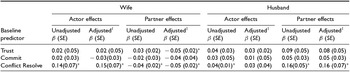
Table 4 shows the actor and partner effects of baseline MRQ subscales measures on self-reported health at follow-up after adjusting for baseline health and other covariates. Both partners’ MRQ scores had partner effects on their spouse, although the direction of these associations and the subscale measures differed for spouses. Surprisingly, after adjusting for baseline health and other covariates, while the female partners’ baseline trust and conflict resolution subscales were negatively associated with their male partners’ self-rated health at follow-up, the male partners’ baseline conflict resolution measure was positively associated with the female partners’ follow-up self-rated health. A unit change in the female partners’ trust and conflict resolution subscale scores was associated with a decrease in the male partners’ self-rated health score by 0.02 (p = .01) and 0.15 (p = .003) units respectively. In contrast, a unit change in the male partners’ conflict resolution subscale score was associated with an increase in the female partners’ self-rated health score by 0.16 (p = .02).
The Actor-Partner Interdependence Model Demonstrating the Association between Spouses’ Marital Quality Subscale Scores with their Self-Reported Health at Follow-Up (n = 1,450, dyads: 725)

Note: 1Model adjusted for respondent's baseline self-reported health, age, education, religion, parity, wealth-quintile, and spousal age difference.
*p < .05.
Moreover, although the results are not presented here, baseline self-rated health of spouses was not significantly associated with the MRQ measures of spouses at follow-up.
Discussion
Our study findings indicate a robust relationship between MRQ and self-rated health measures of spouses, which suggests that relational factors are critical for spousal health and marital outcomes in this peri-urban Ethiopian context. Thus, from a programmatic perspective, our findings suggest that a dyadic approach that places the individual in his/her relational context can bring synergetic health gains to partners, the couple, and the family unit. However, our findings also point to the complexity of this relationship, especially in terms of the gendered pattern of this association. More longitudinal studies in low-resource settings are needed to better understand the mechanisms that generate these gender differences and to ultimately tap into spousal processes that influence health behaviours and outcomes.
Our results indicate that MRQ measures of spouses are associated over time, and more critically, that spousal MRQ measures influence both partners’ self-rated health in the future after accounting for baseline health and other relevant covariates. Moreover, in an attempt to address issues of reverse causality, our analysis also revealed that spousal baseline self-rated health was not associated with the subsequent MRQ measures of partners. However, contrary to our expectation, the female partners’ baseline MRQ measures were negatively associated with male partners’ follow-up self-rated health, while the male partners’ baseline MRQ measures were positively associated with their wives’ follow-up self-rated health.
These partner effects found in our study are potentially reflective of changing marriage patterns in peri-urban Ethiopia and underline the need to broaden understanding of the couple relational context in non-Western settings. In Ethiopia, the available studies indicate a shift away from traditional marriages that were more patriarchal, especially in urban areas, to a preference for more egalitarian marriages (Erza, Reference Ezra2003; Sibanda et al., Reference Sibanda, Woubalem, Hogan and Lindstrom2003). However, our study also indicates that these dyadic influences can be complex. It is unclear why the females’ MRQ scores would have a negative effect on their partners’ self-rated health, whereas the male partners had a positive effect. Prior studies have indicated that, as opposed to cross-sectional results, the longitudinal associations between MRQ and health are complex and that the relationship may not be temporally fixed (Hawkins & Booth, Reference Hawkins and Booth2005; Miller et al., Reference Miller, Hollist, Olsen and Law2013; Umberson et al., Reference Umberson, Williams, Powers, Liu and Needham2006). The results regarding gender differences have also varied in these longitudinal studies (Proulx et al., Reference Proulx, Helms and Buehler2007; Umberson et al., Reference Umberson, Williams, Powers, Liu and Needham2006). However, none of these studies have examined differences in spousal effects.
Another potential explanation for these gender differences may lie in the mediating roles of social support and social control, which are hypothesised as critical mechanisms linking the association between intimate relationship and health (Umberson, Reference Umberson1992; Tucker & Mueller, Reference Tucker and Mueller2000). Although intimate relationships potentially provide the necessary social support for healthy behaviours, they can also be a context for social control, where positive and negative strategies, such as modelling, nagging, or eliciting guilt are deployed by spouses to change their partner's behaviour. This research suggests that women are often the main agents of social control and support that accrues greater health benefits to married men (Markey, Markey, & Grey, Reference Markey, Markey and Gray2007; Umberson, Reference Umberson1992). However, Rauer et al.’s (Reference Rauer, Sabey and Jensen2014) research reports that social support and control may not always have positive effects, especially among the older couples they investigated. They found that compassionate love and self-rated health were negatively associated among older couples and posit that these may be unique to ageing couples, where individuals receiving more care and support due to potentially deteriorating health feel vulnerable and helpless. Similarly, other studies have also shown that social support may elicit a negative reaction if it is seen as a threat to autonomy (Fisher, Nadler, & Whitcher-Alagna, Reference Fisher, Nadler and Whitcher-Alagna1982; Silverstein, Chen, & Heller, Reference Silverstein, Chen and Heller1996).
In our study, drawing on the above-mentioned research findings in Western settings, it is plausible that the female partners who felt emotionally closer to their spouse felt comfortable employing strategies to potentially improve their spouses’ health, but ended up making them feel more vulnerable health-wise, thereby negatively affecting their reported health. For the female partners, on the other hand, having a more loving and emotionally available partner had a positive effect on their overall health and sense of wellbeing. Additional couple studies using longitudinal design are needed in the sub-Saharan African context to investigate gender differences in spousal perceptions of health and wellbeing and the potential mediating effects of mechanisms such as social control and social support on these measures.
Our study has several limitations that warrant discussion. The localised peri-urban nature of this study sample limits the generalisability of the findings only to similar settings. The MRQ measures also may be vulnerable to social desirability bias if the measures are seen as sensitive subjects. Efforts to ensure complete privacy for each partner during the interviews and to protect the confidentiality of participants were followed during data collection. We also investigated the possibility of interviewer effects in the follow-up round's data. Interviewer effects were small and did not warrant adjustments to the analysis. Many Western studies now utilise interviewer ratings of dyadic interactions along with self-reported data to overcome issues of social desirability bias (Lawrence et al., Reference Lawrence, Barry, Brock, Bunde, Langer, Ro and Dzankovic2011), a strategy that may be useful in future research. The use of a subjective measure of health is another limitation. However, previous research has demonstrated that self-reported health is highly correlated with objective measures of health, and is a strong predictor of future visits to the doctor, disabilities, and mortality (Ferraro & Farmer, Reference Ferraro and Farmer1999; Lee, Reference Lee2000; Miilunpalo et al., Reference Miilunpalo, Vuori, Oja, Pasanen and Urponen1997). In addition, we were unable to conduct an in-depth exploration of the role of gender dynamics on our results because of the lack of such measures in the surveys. Nonetheless, we did adjust for spousal age difference in our models, which is often used as a proxy for differences in spousal status in households.
At the same time, this study has several strengths. To the best of our knowledge, our study is a pioneering research study exploring spousal relationships and health in the sub-Saharan African context. Our study is also one of the first research efforts to understand individual spousal influence on MRQ and the linkages between MRQ and self-rated health using the actor-partner interdependence model. Thus, the results fill an important research gap by broadening the understanding of interdependence in spousal relationships and how spousal MRQ affects each partner's reported health status in a very unique and understudied sample. Moreover, our study explored these associations rigorously utilising a longitudinal study design to manage temporal issues of causality, and also investigated the bidirectional relationship between the measures to address reverse causality.
Conclusion
Understanding interdependence in spousal relationships can greatly increase our knowledge of the emotional processes within marriage and ultimately enable further investigation of couple mechanisms that potentially can improve partners’ health behaviors and protect their health status.
Description of Survey Item by Subscales for Female and Male Partners